Every writing teacher who told you "be concise" accidentally murdered your best ideas.
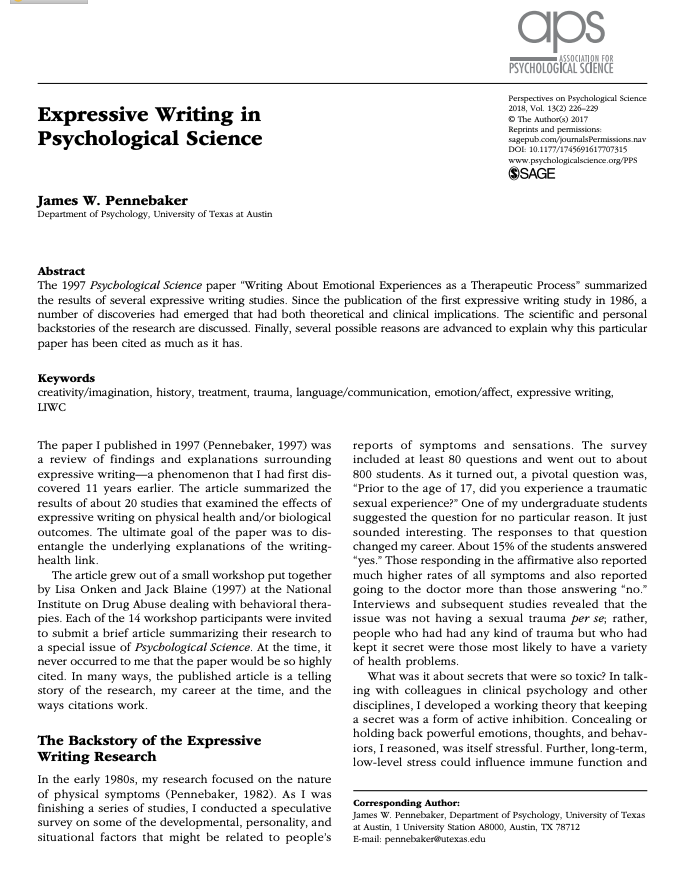
In 1987, psychologist James Pennebaker ran an experiment that broke every assumption about how human creativity works. He divided college students into two groups and gave them the same creative writing prompt. Group A had to write for 15 minutes without stopping, elaborating on every thought that surfaced. Group B had to write concise, polished responses in the same time frame.
The elaborate writers didn't just produce more ideas. They produced fundamentally different types of ideas. Brain scans showed their prefrontal cortex entered a state resembling REM sleep, where distant neural networks suddenly started talking to each other. The concise writers showed patterns identical to focused problem-solving mode, which actively suppresses creative connections.
Six months later, Pennebaker tested both groups again. The elaborate writers had continued generating novel solutions to unrelated problems at twice the rate of the concise group. The act of elaborative writing had permanently rewired their associative thinking patterns.
The advice sounds logical. Cut the fat. Trim the excess. Get to the point faster. What they missed is that ideation and communication are completely different cognitive processes, and optimizing for one destroys the other.
When you write elaborately, your brain enters what cognitive scientists call "divergent thinking mode." Each additional sentence forces your mind to find new angles, make unexpected connections, discover relationships between concepts that would never surface in a stripped-down version. The elaboration itself becomes the thinking tool.
Watch what happens when you try to explain a simple concept in 2000 words instead of 200. Your brain refuses to repeat itself. It starts mining deeper layers, pulling up examples you forgot you knew, connecting dots that seemed unrelated five minutes ago. The constraint of length becomes a creativity multiplier because your mind has to work harder to fill the space meaningfully.
Most people reverse this process. They think first, then write down the conclusions. They treat writing as a documentation tool for thoughts that already exist. This kills the discovery mechanism completely.
Real creative thinking happens during the writing, not before it. The elaborate sentences force your brain to search its entire knowledge network for supporting ideas, contradictory evidence, parallel examples, deeper implications. Every time you expand a thought, you're asking your neural pathways to surface material that stays buried when you think in headlines.
Professional researchers figured this out decades ago. They don't brainstorm in bullet points. They write massive exploratory documents where every paragraph spawns three new questions. They let themselves ramble across pages because they know the rambling is where breakthrough insights hide. The connections emerge in the elaboration, not despite it.
There's another layer most people miss. When you write elaborately about a topic, you're not just exploring what you already know about it. You're discovering what you didn't realize you knew about it. The act of expansion forces you to reach into adjacent knowledge areas, pull connections from unrelated experiences, surface insights that were sitting just below conscious awareness.
Pennebaker's follow-up studies revealed something even stranger. Students who wrote elaborately about completely unrelated topics showed improved creative problem-solving across all domains. The cognitive muscle of elaborative thinking transfers. Train it on one subject, and it enhances your ability to find novel solutions everywhere else.
Your brain was designed to think in stories, not summaries.
Feed it complexity and watch creativity multiply.