
Researcher working on interest-only mortgages, housing, homeownership, social networks, and stock market participation.
Joined August 2011
- Tweets 1,218
- Following 1,952
- Followers 1,451
- Likes 5,368
51 Photos and videos




Pinned Tweet

31 Aug 2022
It's that time of the year where new PhD students have to figure out how to do research. Luckily, the profession has put together a lot of resources to help us all become better researchers, and you can find my collected list of resources here: sites.google.com/view/claesb…
3
84
305
Claes Bäckman retweeted
AI is greatly increasing "equality of opportunity" between econ faculty at top schools vs lower ranked schools.
There's a few reasons for this:
Reason 1: At top schools, faculty have funding for grad student RAs, and these grad student RAs are more likely to make substantive contributions to research. At lower ranked schools, both RA funding and RAs' abilities to make research contributions are less likely.
Now, everyone has the same agentic coding tools and is starting from similar blank slates in terms of knowing how to make best use of them. However - for many of the tasks that RAs used to do - agentic coding tools are far more effective, even with very little knowledge of the tools.
So, for many applied researchers, if you can afford $100/mo (more on that later) for a Codex or Claude Code subscription, with little agentic coding skill you will have a productivity advantage over the economist with many resources not making use of these tools.
Reason 2: You may argue that the economist at the top school can purchase more CC/Codex subscriptions, or get them for all their RAs, and this will nevertheless give them a big edge over economists with fewer resources.
However, this ignores a significant bottleneck in the use of AI for economics research: how to verify LLM output.
In many domains of software engineering, it's possible to functionally verify an LLMs output. This means you can parallelize software development with agents by having other agents themselves verify its output.
This type of verification is possible only for some economics research tasks, and developing verification mechanisms usually requires skill in agentic coding and software design.
So, we can assume economists - poorly skilled at agentic coding and software design - are doing all their verification themselves.
Then, if you have several RAs left to their own devices and producing copious LLM output, it's still incumbent on you as the high-resource economist to verify all their output.
Ostensibly this could still save you time relative to producing and verifying yourself, but in practice, for two reasons, there are often quickly *negative* returns to more RAs.
Reason 2A: Switching costs. It's a lot easier to verify when you are the prompter. This is both because you're mentally in flow in your particular research task and with the coding agent, and because you understand - through your own prompting - the process by which you arrived at some output.
Reason 2B: Wasted time verifying useless AI output. Last weekend, I spoke to one economist who described this failure pattern. He delegated a task to his RA, who then produced after some time output for him to review.
However, the standard errors felt very fishy, and it was difficult to sort through the output to a root cause. The economist, believing the RA had mindlessly use Claude Code, asked the RA to come back with a written explanation in his own words of what he did.
A few days later, he got the explanation, which itself seemed to clearly be written mindlessly with Claude. In the end, the economist gave up and did the task himself.
Of course, you could argue that this is the result of poor RA selection or training. But verification is even problematic with well-intentioned RAs' output, because in many situations, if a substantive mistake is made at one point in a chain of tasks, it can make the successive tasks' output not useful.
Reason 3. One dimension of inequality between top schools and lower ranked schools is access to the cutting edge of research, and access to resources helping you understand the cutting edge of research.
Pre-LLMs, as an economist or PhD student at a top school, you'd get more access to researchers at top schools, funding to attend educational workshops, etc.
Of course this remains an advantage of being at a top school, but LLMs make this much less of an advantage than in the past. The reason for this is that current-gen LLMs are 95th percentile quality teachers on any topic in their training sample.
For me, this has been extremely empowering. I was never was very good at micro theory, but recently I've become much more interested in learning select topics in micro theory.
Pre-AI, I would have probably never acted on this interest. It's hard to figure out what basics I don't understand when trying to work through some paper I'm interested in. I don't want to waste my friends' time who can answer my basic questions, and it's a bit embarrassing if there's something really fundamental which I've forgotten or never learned.
Now, for any given topic in its training data (i.e. basically everything), I can use AI to create a step by step curriculum, give me homework assignments, and evaluate my homework assignments (sign up to my newsletter to learn more about how I do this: aieconomist.io/subscribe ).
Sure, there are nuances that AI sometimes gets wrong. But for a motivated student, especially when considering availability of the teacher, AI is a better teacher on almost every topic than almost every economist (see, for example "Law Professors Prefer AI Over Peer Answers": law.stanford.edu/wp-content/…)
The price of AI: One way in which you might argue these tools increase inequality is through cost. At a top school, researchers can afford $400 /month to have both Claude Code and Codex, whereas $100/mo might be all someone at lower ranked schools can afford.
A few points here:
- Very few economists are making full productive use of the $400/mo of subsidized compute from a Claude Code and Codex subscription. They'd see little to no fall off dropping one subscription.
- Almost everyone can afford $100/mo. If you think you can't pay $100/mo, this is actually a question of your willingness to humble yourself. You can tutor undergrads (maybe at a university across town), drive Uber, sign up to do part time data labelling at one of the firms looking for PhD economists, or just sell some shit you don't need.
Yeah it sucks, and if you were at a top school you wouldn't need to consider this, but your only option almost certainly isn't to pay $0-20/month for an AI subscription.
Addendum: I do trainings on agentic coding for economists and create software products/internal tools for policy organizations. If this interests you - check out this page - aieconomist.io/trainings - or just DM me. I also have a lot of free educational materials here: aieconomist.io/learn
9
32
160
19,332

In #Denmark, higher-income buyers earn higher capital gains on #housing. These different arise due to differences in what low-income buyers can afford, instead of factors like risk aversion or investment skill.
Read: spkl.io/601876gL6
Subscribe: spkl.io/601376gL1
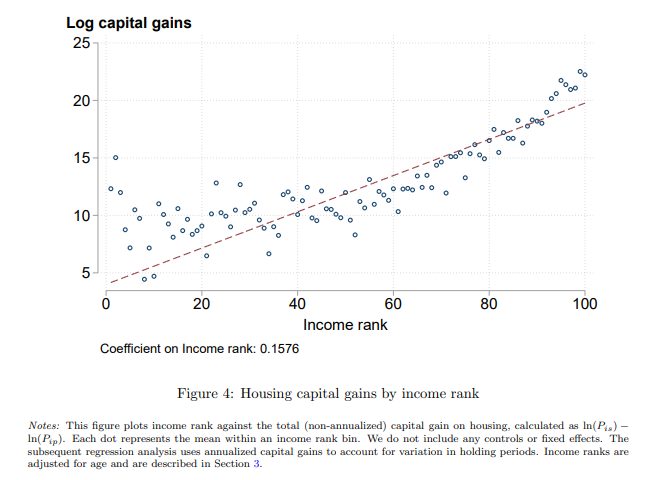
ALT This figure plots income rank against the total (non-annualized) capital gain on housing, calculated as ln(Pis) \u2212 ln(Pip). Each dot represents the mean within an income rank bin. We do not include any controls or fixed effects. The subsequent regression analysis uses annualized capital gains to account for variation in holding periods. Income ranks are adjusted for age and are described in Section 3.
1
2
4
816
Claes Bäckman retweeted

May 27
@EkonomiskDebatt nr 4 finns nu online för gratis läsning! Bl.a. om effekterna av utländska företagsuppköp och om konsekvenserna av de nya amorteringsreglerna. nationalekonomi.se/nummer_ar…
1
1
123
May 23
I posted a brief guide about syncing Overleaf with VS Code, through either Dropbox or Github. This way, you can get the benefit of Claude Code and Codex with the nice collaborative tools offered by Overleaf.
Overleaf guide is here: claesbackman.com/overleaf-vs…
3
17
126
13,676
May 23
If you haven't used Github, it's actually not that scary and it is made much easier by using a tool like Github Desktop. Of course, Claude can also write commit message and use git for you. It's a new world out there.
1
636
May 23
All other guides, including the slides for my AI workshop, are now collected here: claesbackman.com/ai-guides.h…
Enjoy!
1
1
3
355
Claes Bäckman retweeted

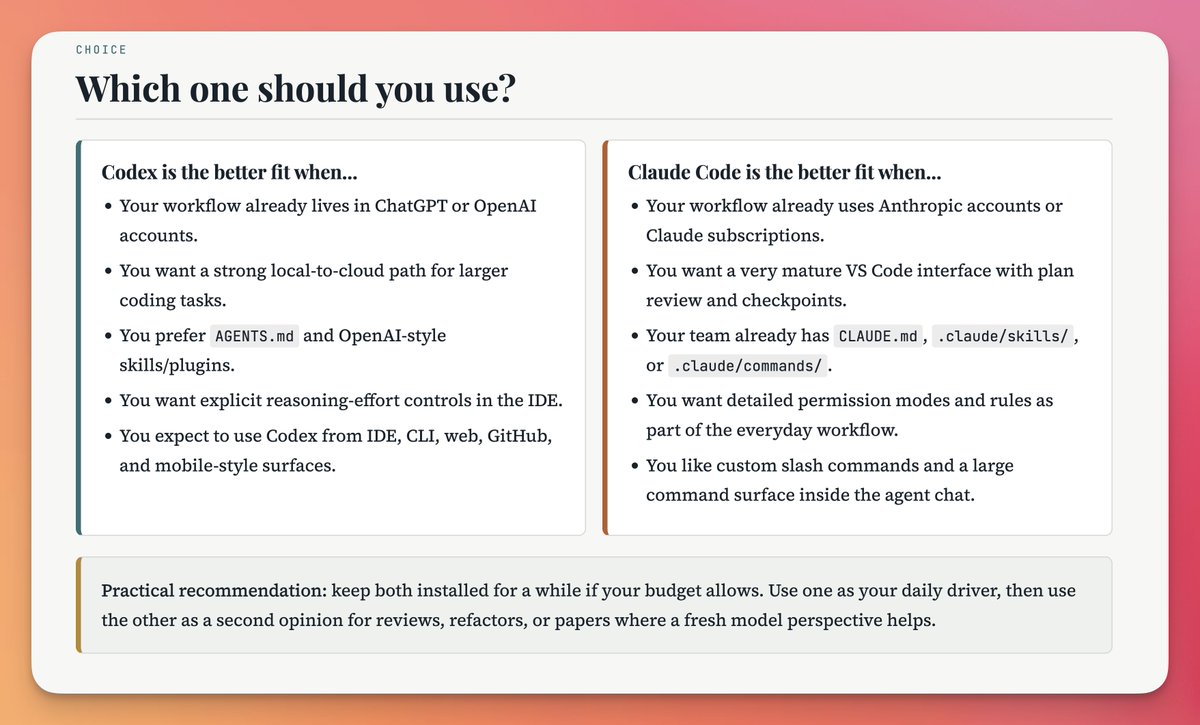
Which is your main: Codex or Claude Code for academic research?
@ClaesBackman shares a practical guide, link in replies.
I have to say, getting enough usage limits and quick responses to things that are broken are two factors that made a huge difference for me. I'm using both.
2
3
32
2,674
Claes Bäckman retweeted

May 17
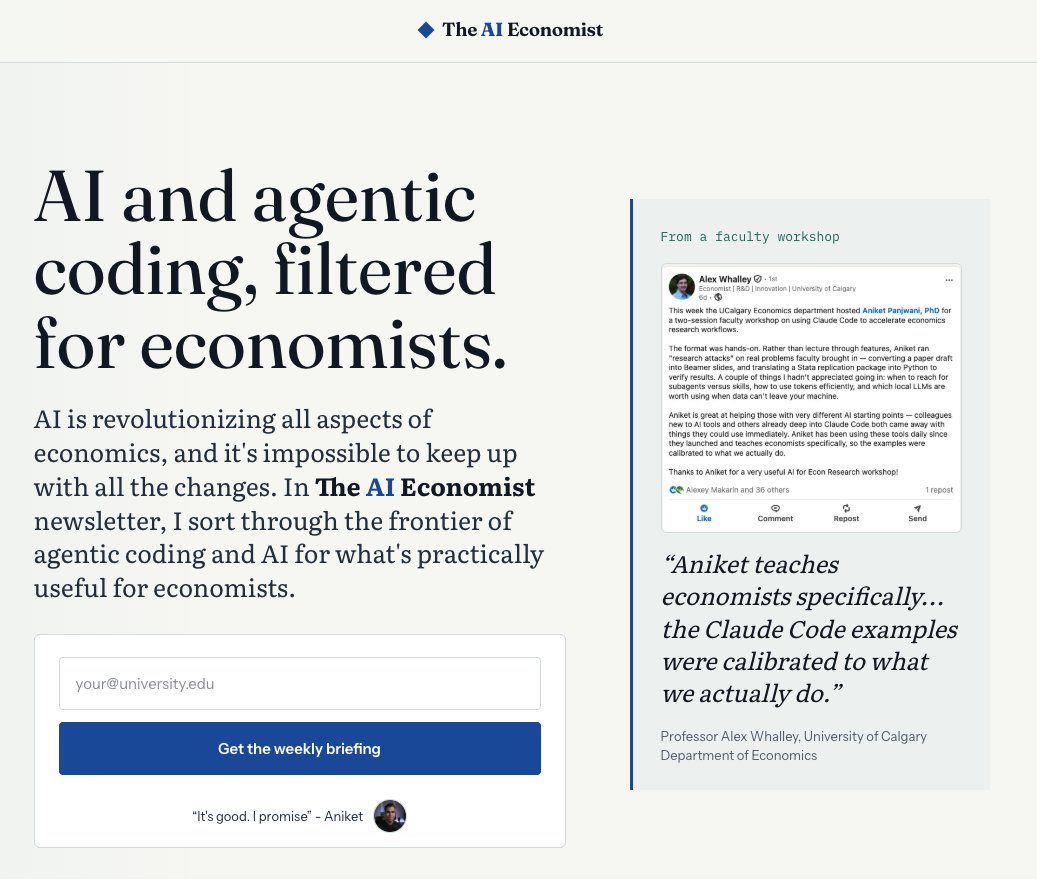
I'm starting a newsletter specifically on AI/agentic coding for economists.
Unlike other excellent newsletters by economists on AI, mine will be primarily focused on what is practically useful for economists.
> model/tool updates which are worth knowing for economists
> new research workflows I'm experimenting with
> lessons I learn from teaching agentic coding to economists (I've taught over 100 economists across individual and group sessions)
> commentary on discussions important to the profession
The first edition will be out Tuesday the 19th. I'll discuss the new /goal feature which has been released in both Codex and Claude Code.
You can subscribe here! : aieconomist.io/subscribe
3
31
236
23,325
Claes Bäckman retweeted

May 11
I was honored to teach a one-day class at @EDHEC_BSchool on using AI in biz/econ research last week — from chatbots to automated research pipelines.
6 demos featuring work from @cblatts, @ben_golub, @pedrohcgs, @alejandroll10 and others.
Slides demos: github.com/velikov-mihail/ed…
1
11
45
10,084
Claes Bäckman retweeted

May 13
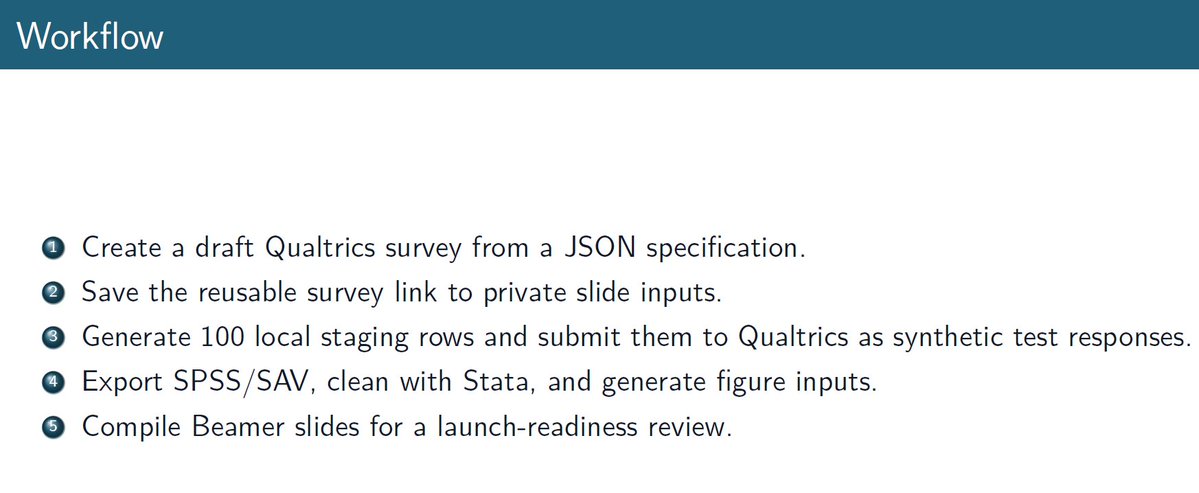
Do you run Qualtrics surveys? Then use my GitHub repo to automate the whole process with Codex! Tell Codex what you want to study, and it will create the survey, push to the survey to Qualtrics and generate synthetic responses, download and clean the data, and produce a set of slides summarizing the process.🧵with complete guided example!
7
41
208
18,778
May 12
And if you prefer to use Codex instead of Claude Code, here is translated version of the practical guide guide: lnkd.in/eaJPR4xZ
I also had Claude and Codex work together to write a comparison between the two: lnkd.in/e4SR9REU
Apr 24

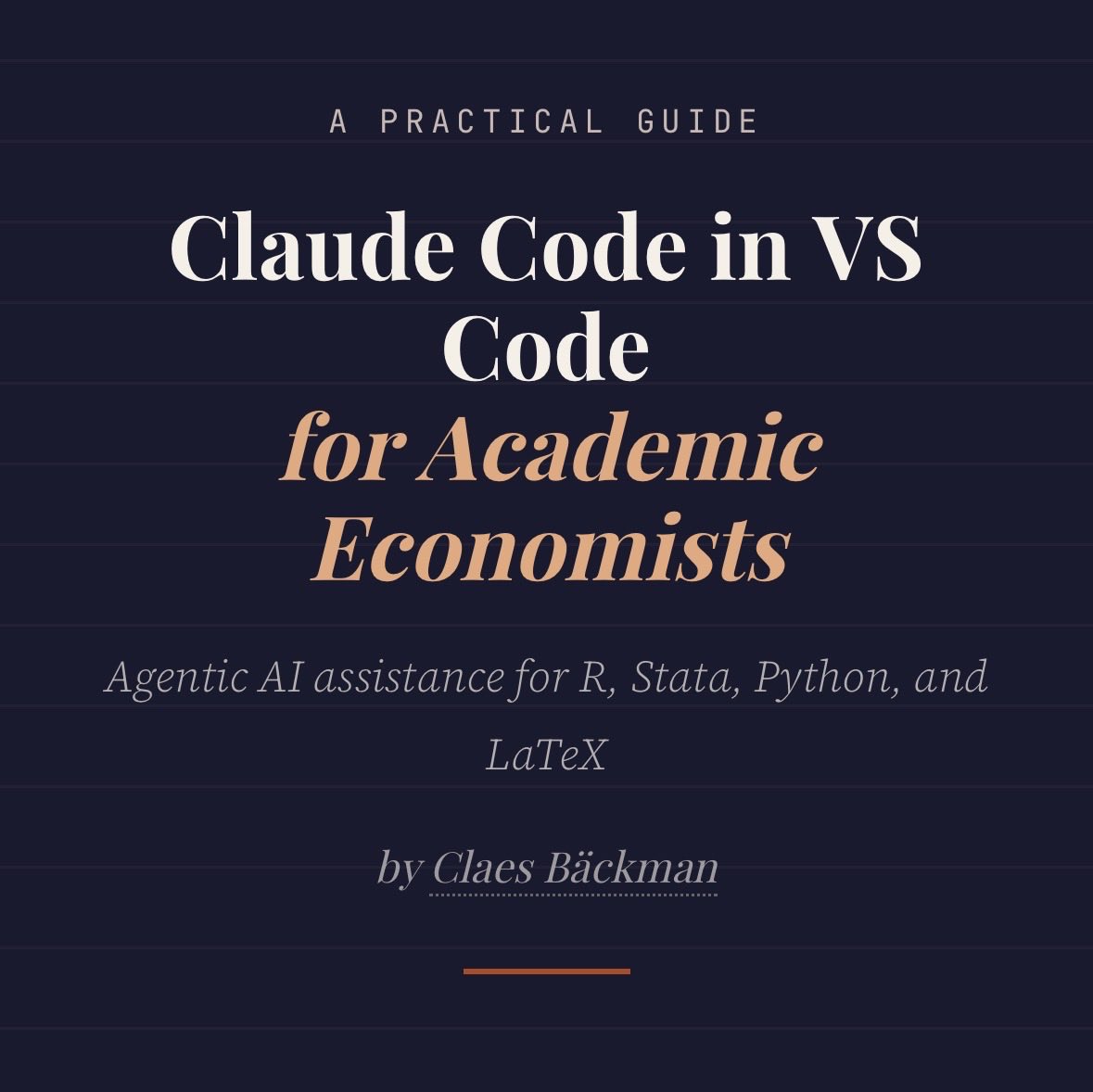
I put together a short practical guide for economists who want to use Claude Code, but who haven't gotten around to trying yet.
The goal is to reduce the start-up costs by using Claude Code within VS Code.
1
31
184
21,332
May 12
Amazing idea by @aniketapanjwani to turn this into a readable transcript. AI is changing the way that we communicate by reducing the cost for e.g. making websites.
May 12

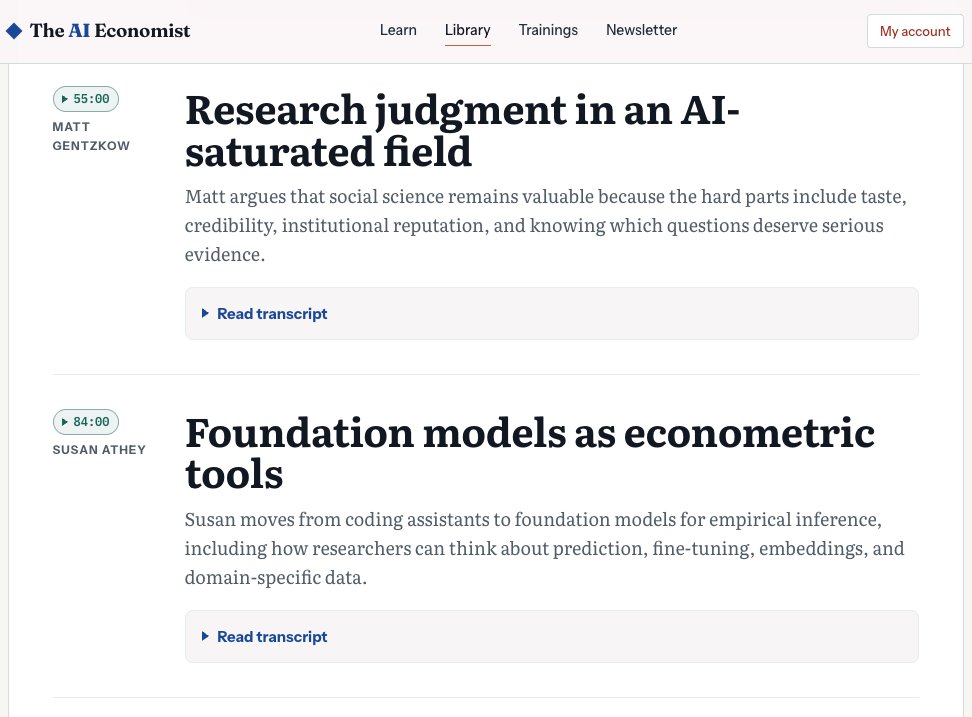
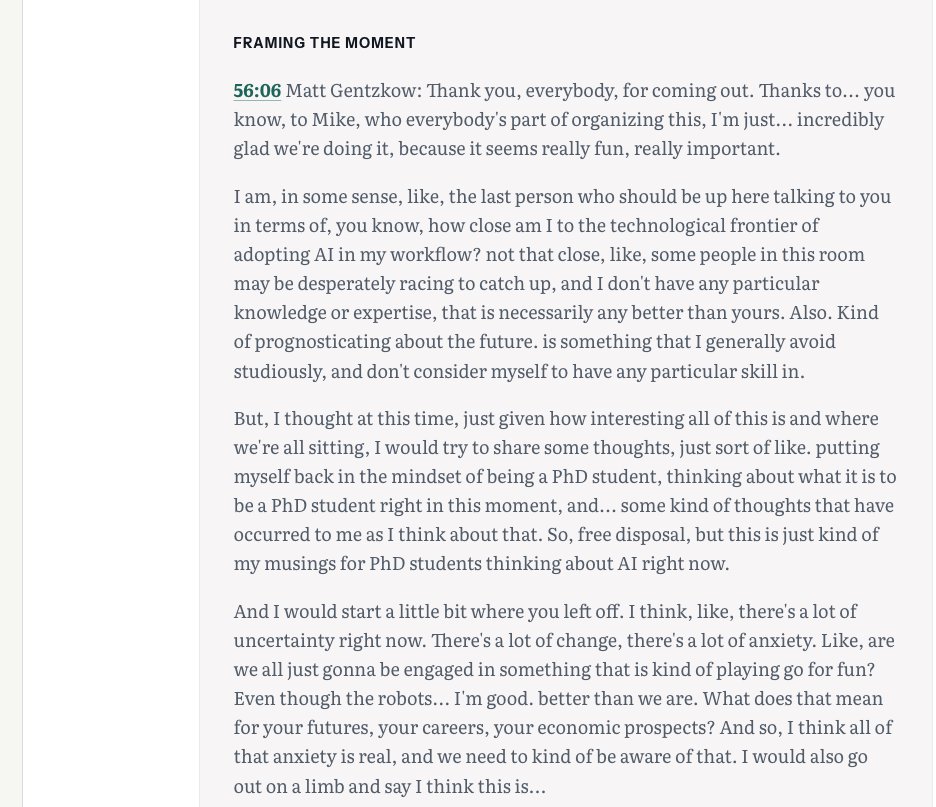
Stanford recently livestreamed a 3.5 hour conference with leading economists (@Susan_Athey , Matt Gentzkow, and @ahall_research , among others) on "Empirical Work in the Age of AI"
I turned the whole thing into a readable transcript, separated by talk.
You can pass the whole thing to your coding agent to extract exactly what is useful for you.
Check it out here!: aieconomist.io/resources/emp…
1
1
11
2,710
May 12
Another plug for my short practical guide to getting started with Claude Code.
I hope it’s useful!
Apr 24
I put together a short practical guide for economists who want to use Claude Code, but who haven't gotten around to trying yet.
The goal is to reduce the start-up costs by using Claude Code within VS Code.
14
106
9,512
Claes Bäckman retweeted
Apr 25
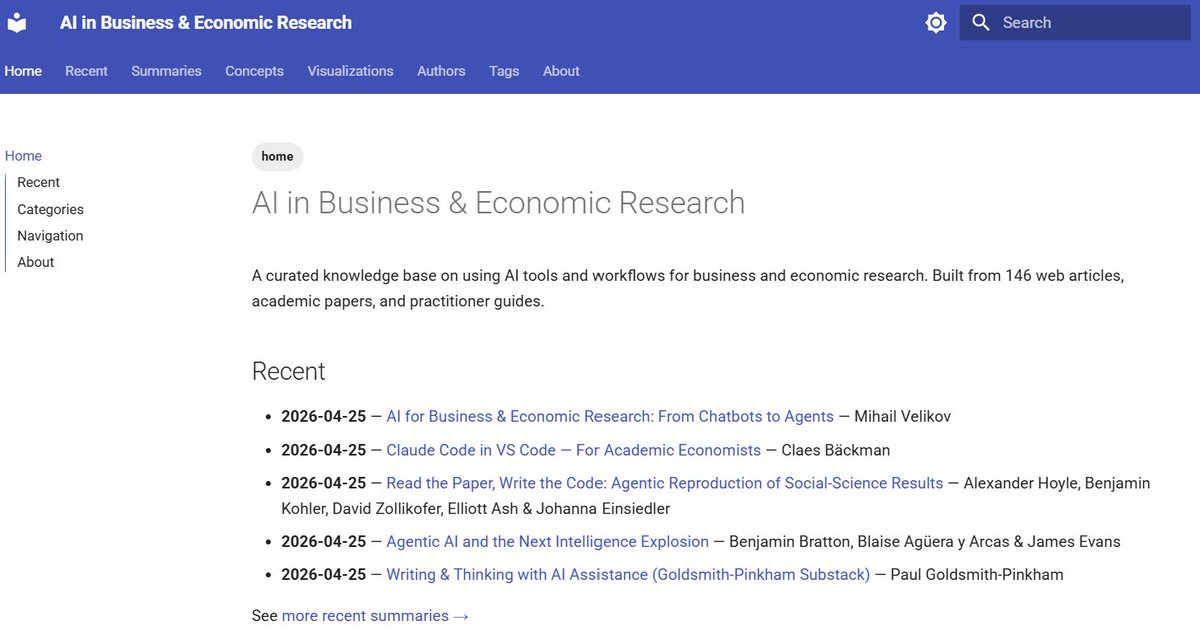
This discussion prompted me to add a "Recent" page to my "guide-of-guides". Up to 146 sources at this point. Chronological order might be the easiest way to keep track.
velikov-mihail.github.io/ai-…
Apr 24

Nice! The guides for economists are growing in number, time to put them all in a place maybe?
1
20
97
9,085
Apr 24
I put together a short practical guide for economists who want to use Claude Code, but who haven't gotten around to trying yet.
The goal is to reduce the start-up costs by using Claude Code within VS Code.
9
178
1,017
99,828
Apr 24
It covers:
• A 5-step install with what you need to get going.
• Which file formats Claude reads and which need a conversion step first
• How to initialize a CLAUDE.md files to give Claude persistent context
• What Skills are, and how to use them
1
1
12
5,264
Apr 24
If you've been curious about agentic AI for empirical work but wary of the setup friction, this should get you from zero to productive in about an hour.
Let me know if anything is missing or unclear!
10
4,548
Claes Bäckman retweeted

Apr 17
Reviewer 2 is now open source. You'll need Gemini and potentially Mathpix API keys, and it costs from ~$1 to $5 per review, depending on length of text and options chosen.
It's better than refine.
github.com/isitcredible/revi…
6
39
295
46,716