
Economist & political scientist @UChicago @HarrisPolicy studying conflict & organized crime. My book is Why We Fight: penguinrandomhouse.com/books…
Joined September 2009
- Tweets 32,143
- Following 4,356
- Followers 106,426
- Likes 12,042
1,106 Photos and videos








0.3% of the water consumed by US golf courses last year

BREAKING: Amazon data centers used 2.5 billion gallons of water in 2025
Community note
Amazon's data centers withdrew 2.5 billion gallons of water in 2025, down 2% from 2024 despite expansion, or less than 0.1% of annual U.S. landscape irrigation. aboutamazon.com/news/sustainab…
432
2,665
42,864
5,968,341
Chris Blattman retweeted

Jun 11
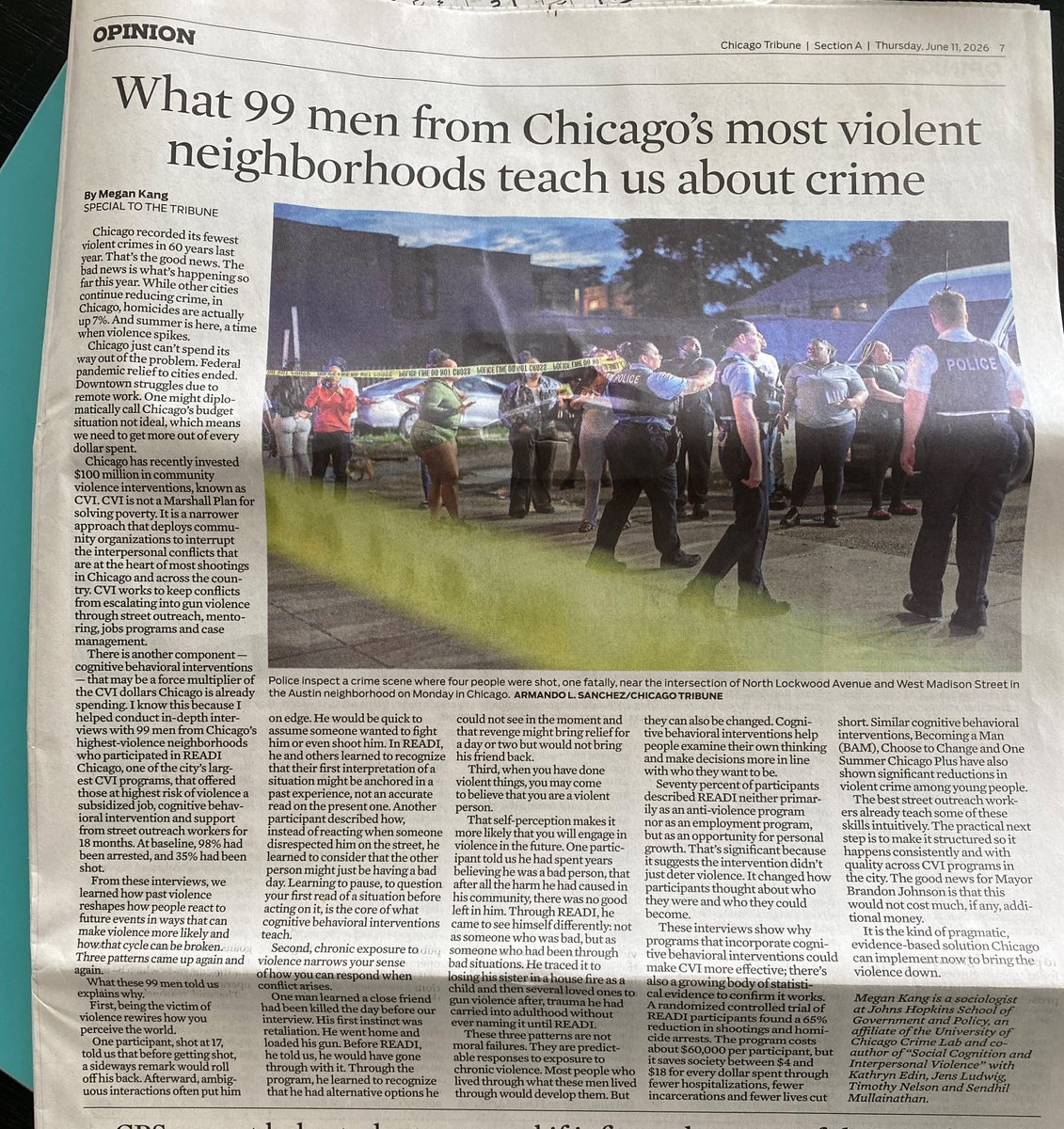
Being a victim of violence rewires how you see and engage with the world. I wrote a piece in the @chicagotribune on how that cycle forms and how cognitive behavioral interventions help break it.
Read here: shorturl.at/M4uPo
9
29
2,557
Chris Blattman retweeted

Jun 10
the ai slop is starting to win me over

162
1,946
42,989
3,321,553
Chris Blattman retweeted

Jun 9
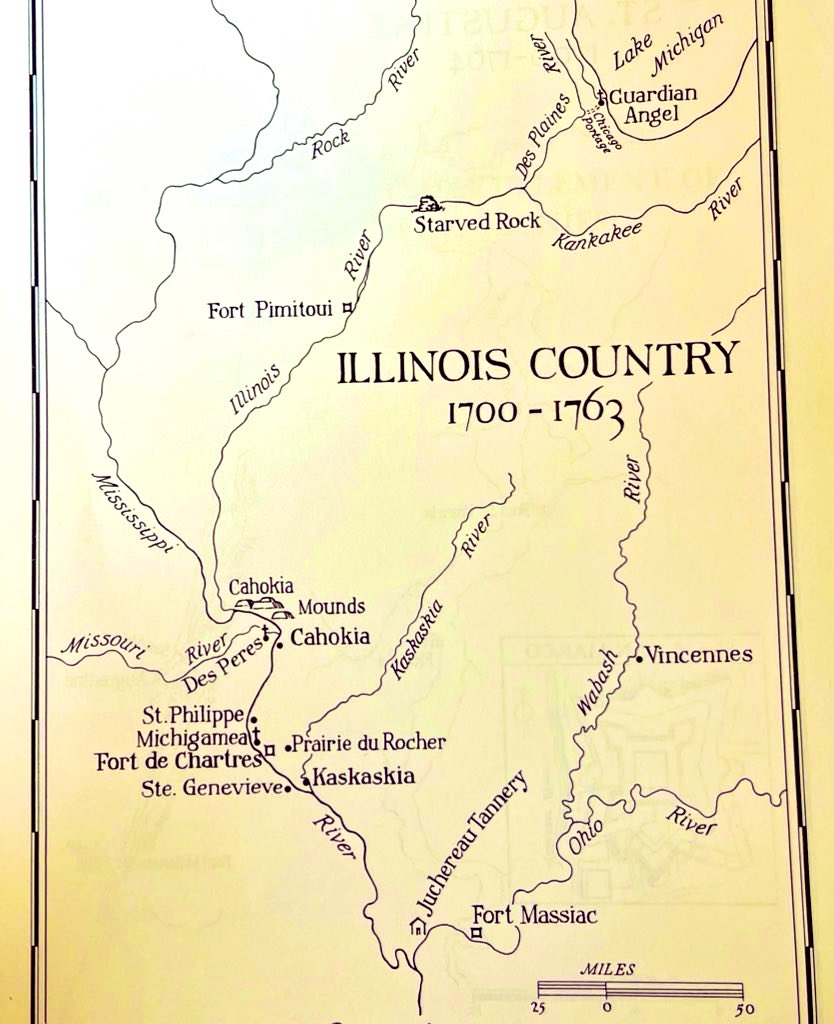
The map most Americans carry around in their heads is wrong.
We think of the Midwest as the middle of the country, tied to highways, Chicago, Washington, and the East Coast.
For a long time, it was part of a different world. The Midwest faced the river. 🧵
13
32
442
30,514
Chris Blattman retweeted

I agree, @tylercowen's talk is beautiful, hopeful, evidence-based, forward looking. A fantastic antidote to the silly hype coming from the labs, very much in the line of our Messy Jobs (which Tyler gracefully blurbs!)- which will come out in Kindle and physical form on the 21st of June.

5
53
381
119,374

Jun 6
Did not have “AI replacing cowboys” on my bingo card
Jun 5

this is just the most ridiculous AI application i've ever seen lol
a Peter Thiel-backed startup that makes AI collars for cows is now worth $2 billion
and the more I read about it the cooler it gets. here's how it works:
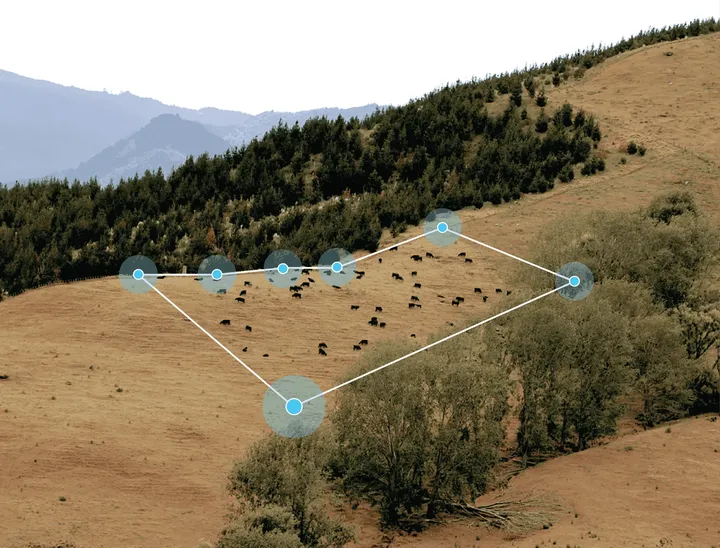
every cow wears a solar-powered collar that talks to a network of radio towers and an app on the farmer's phone
instead of building physical fences, the farmer draws the fence on a map in the app, and the collar keeps each cow inside that invisible line using GPS
when a cow drifts toward the edge, the collar plays a sound to steer her, and a gentle vibration tells her which way to go.
it's like how a car beeps as you back up toward a wall
the cows learn the cues in a few days
so now a rancher can move an entire herd to fresh grass by sliding the fence on a map, without driving out to open a single gate
and that same collar is reading each cow's body the whole time.
it takes five readings per second on every animal, so the AI can catch a cow that's sick, injured, ready to breed, or about to give birth before a person would ever notice walking the field
so it's basically like WHOOP for cows too lol
and they gave the AI behind it the perfect name: the Cowgorithm
it's been trained on more than 7 billion hours of real cow behavior, which is why Halter calls the data its real asset and moat.
they know what a normal cow looks like better than anyone, so they can flag the odd one out instantly
it's already on more than 1M cattle across New Zealand, Australia, and a bunch of US states.
California even used it on public land to graze cattle in patterns that clear dry brush and slow down wildfires
costs about $5 to $8 per cow per month
a job that used to mean barbed wire, gates, and driving the fields all day is now mostly 1 person on their phone

2
3
28
9,965

⏱️ Evidência em 1 minuto | Combate ao Crime
A América Latina e o Caribe têm quase 1/3 dos homicídios, embora concentrem cerca de 8% da população mundial. Como aprender com experiências de outros países sem copiar soluções fora de contexto?

1
2
2
1,841
Chris Blattman retweeted

Jun 1
This is a brilliant idea:
Jun 1

Hello, we are Jonathan and Abigail - unashamed pedants who want to bring this affliction to bear on all things public policy and practice.
We believe that details matter, especially in public administration. This is why today we are founding quibble: a campaign to fix the small stuff.
Think, for example, about the cookie banner that we click on every webpage. Each instance is not a big deal, so we just put up with it. But its cumulative impact adds up - on average we press it 5 times per day. The European Commission estimates that it costs EU citizens 343 million hours per year.
And who is there to represent the impacts of seemingly minor issues like this in a systematic way? We want quibble to be the answer. In the case of the cookie banner, lots of advocacy has rightly focused on privacy, but has this meant that user experience has taken a backseat? We believe there are ways to improve user experience without compromising on privacy. We will share more about this soon.
Consider another example. Did you know that in some government-run car parks you can be fined for a minor keying error, such as accidentally typing a zero instead of an “o”? Again, we will come to the detail of this quibble in the coming weeks, but for now just consider again the question: who? Who is there currently to systematically represent the interests of the parker who is given an unfair ticket?
An inherent feature of consumer interests is that those who have them rarely have enough other things in common to make collective organisation and representation feasible. This is the gap that quibble seeks to fill. Now of course excellent consumer interest groups exist. But understandably quibbles might not be at the top of their lists. Our hope is that quibble will be complementary; picking up the bottom-of-the-list issues faced by various groups - the stuff they are almost too embarrassed to raise because they are too small.
We are not embarrassed about detail. If you’ve ever had a splinter, you know small things can have a big impact. This is what quibble is committed to tackling, and our wider hope is that by doing so we will also incentivise policy makers to be even more careful about detail.
Check out our website here, including our first four campaigns: quibble.org.uk
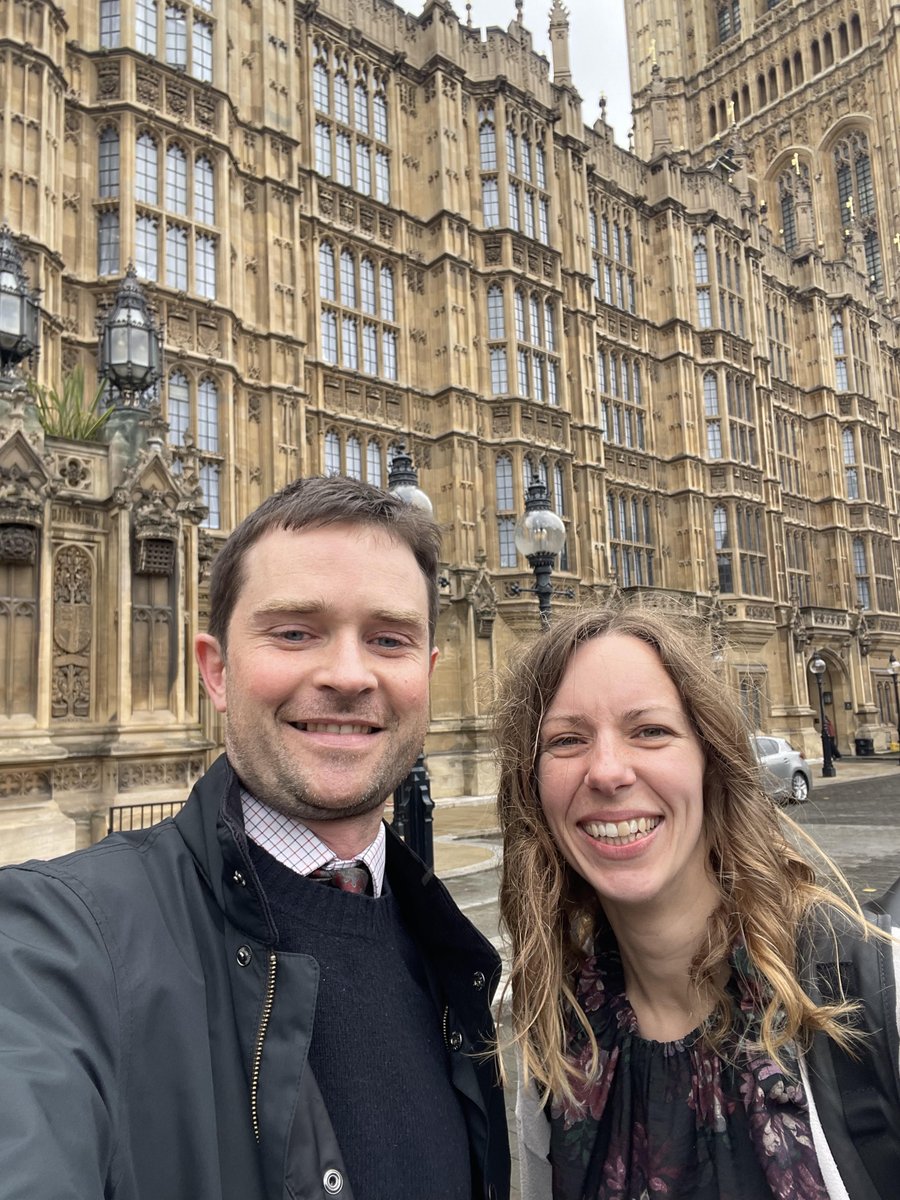
19
92
1,040
454,699
Chris Blattman retweeted

May 31
A few thoughts on the #Colombian election:
1) Colombia will likely follow the steps of other LATAM countries embracing a hard right gvt that has promised to return to conservative values and embrace iron fist security. This is De la Espriella's election to lose.
5
40
208
52,867
May 31
Like most economic models, not a useful simplification or thought experiment, but hard proof of the future
May 30

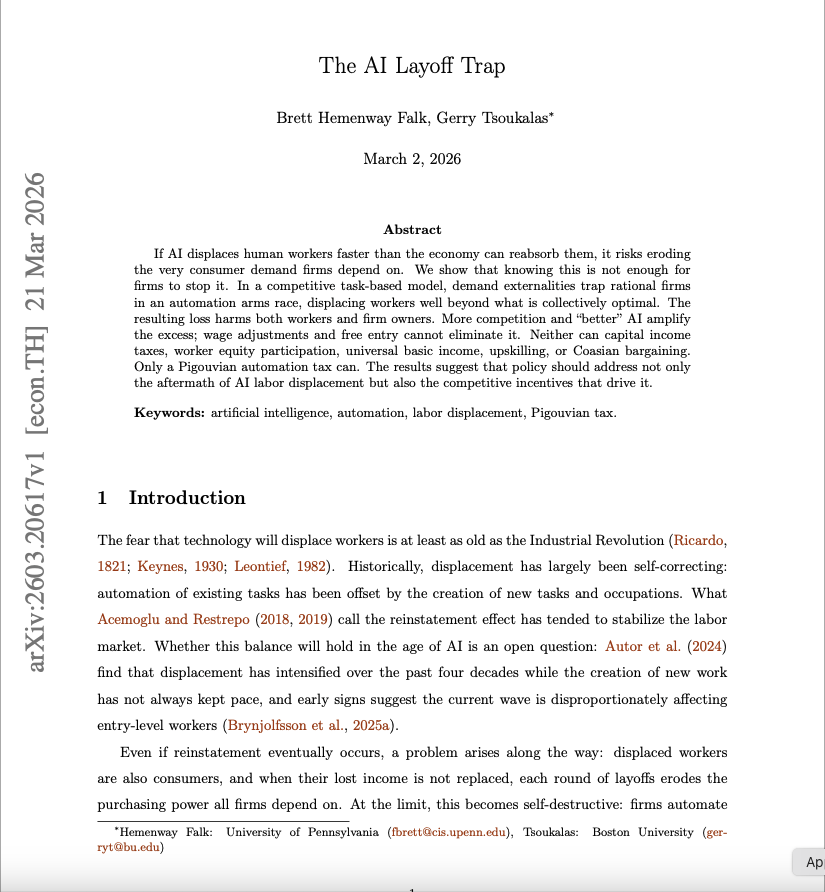
Two economists just published a mathematical proof that AI will destroy the economy.
Not might. Not could. Will — if nothing changes.
The paper is called "The AI Layoff Trap." Published March 2, 2026. Wharton School, University of Pennsylvania. Boston University. Peer reviewed. Mathematically modeled.
The conclusion is one sentence.
"At the limit, firms automate their way to boundless productivity and zero demand."
An economy that produces everything. And sells it to nobody.
Here is how you get there.
A company fires 500 workers and replaces them with AI. A competitor fires 700 to keep up. Another fires 1,000. Every company is behaving rationally. Every company is following the incentives correctly. And every company is building a trap for itself.
Because the workers who were fired were also customers.
When they lose their jobs faster than the economy can absorb them, they stop spending. Consumer demand falls. Companies respond by cutting costs — which means automating more workers — which means less spending — which means more falling demand — which means more automation.
The loop has no natural exit.
The researchers tested every proposed solution. Universal basic income. Capital income taxes. Worker equity participation. Upskilling programs. Corporate coordination agreements.
Every single one failed in the model.
The only intervention that worked: a Pigouvian automation tax — a per-task levy charged every time a company replaces a human with AI, forcing them to price in the demand they are destroying before they pull the trigger.
No government has implemented this. No major economy is seriously discussing it.
Meanwhile the numbers are already tracking the curve. 100,000 tech workers laid off in 2025. 92,000 more in the first months of 2026. Jack Dorsey fired half of Block's workforce and said publicly: "Within the next year, the majority of companies will reach the same conclusion."
Nobody is doing anything wrong. Companies are following their incentives perfectly. That is exactly the problem.
Rational behavior. At scale. Simultaneously. With no mechanism to stop it.
Two economists built the math. The math leads to one place.
Source: Falk & Tsoukalas · Wharton School Boston University ·
8
9
207
45,101
May 31
I loathe most garden cities but I lived here (Stuy Town) from 2006-12 and hands down it was incredible
1
47
15,060
Chris Blattman retweeted

King of Sweden figured this out 500 years ago to price cargo value for import taxes
1. You declare the assessed value of your asset, you pay the tax on your assessed value
2. The king has the right to buy the asset at the declared value
Lindy

Here’s a simple solution. If you don’t like the assessment of your house, you should be allowed to change that assessment to an arbitrarily lower number, provided that you’re required to sell to anyone who offers you say 30% above that number
62
321
8,526
463,566
May 27
N of 75 kids in 10 clusters with two treatment arms is basically noise
May 27

Finnish scientists trucked in real forest dirt and grass and laid it over the gravel at four daycare yards. They let the kids dig around in it for a month. The blood tests came back with changes the researchers hadn’t expected to see so fast or so clear.
The study ran at ten daycares in two Finnish cities with 75 kids aged three to five. Four of the yards got the forest treatment: about a tennis court worth of soil and grass laid over the gravel, plus planters and peat blocks the kids could dig and climb on. Three others stuck with their normal gravel yards. The last three were daycares where the kids were already visiting real forests every day.
After one month, the variety of bacteria living on the kids’ skin shot up, and the kind that helps train the skin’s immune defenses jumped the most. Their gut bacteria started to look like the gut bacteria of the forest-visiting kids. Their blood showed more of the immune cells whose job is to keep the body from freaking out at harmless stuff like pollen and peanuts, and overall inflammation dropped. The kids on the plain gravel yards showed none of this.
Childhood asthma in the US doubled between 1980 and 1995. Food allergies in kids jumped 50 percent between 1997 and 2011, then jumped another 50 percent between 2007 and 2021. And peanut allergies in one-year-olds tripled between 2001 and 2017.
The Finnish researchers think one of the reasons is simple: kids today don’t get dirty enough. 37 percent of American preschoolers now spend an hour or less outside on a normal weekday. Their immune systems are getting trained in environments stripped of the bacteria humans have always lived around.
Aki Sinkkonen, who led the study, put it in plain words: “It would be best if children could play in puddles and everyone could dig organic soil.” The Finnish government is now helping pay for daycares across the country to make the same changes.
2
5
75
25,544
Chris Blattman retweeted

May 24
This is hilarious. This is what AI was made for.
I love it. 100% accurate.
87
449
5,606
440,314
Chris Blattman retweeted

May 25
Why is this corridor in northern India so flat, while the adjacent Himalayas are so rugged?
Where else can we see this?

177
298
4,177
719,290
Chris Blattman retweeted

This is the greatest music video of all time, and it won't be surpassed. It required a specific context that simply can't be replicated, a context that involves Cash's past, and what he had in common with Trent Reznor, plus the exact moment this came along in the former's life.

"Hurt" is not an original by Johnny Cash. The song was written by Trent Reznor (Nine Inch Nails) in 1994 for the album The Downward Spiral. Rick Rubin had to insist several times on Cash recording his version, at first Johnny found the idea completely insane because the original version is industrial and noisy. At 71, already very ill, almost blind and with trembling hands, Cash completely transformed the band.
The iconic video, directed by Mark Romanek, was filmed at the House of Cash (his own museum). June Carter Cash appears looking at him fondly, the video was shot in February 2003, a few months before she died (May) and Johnny himself (September).
Trent Reznor was so moved that he declared, "This song is not mine anymore." It is considered one of the best covers of all time.

56
352
4,842
334,294
Chris Blattman retweeted
17 Mar 2025
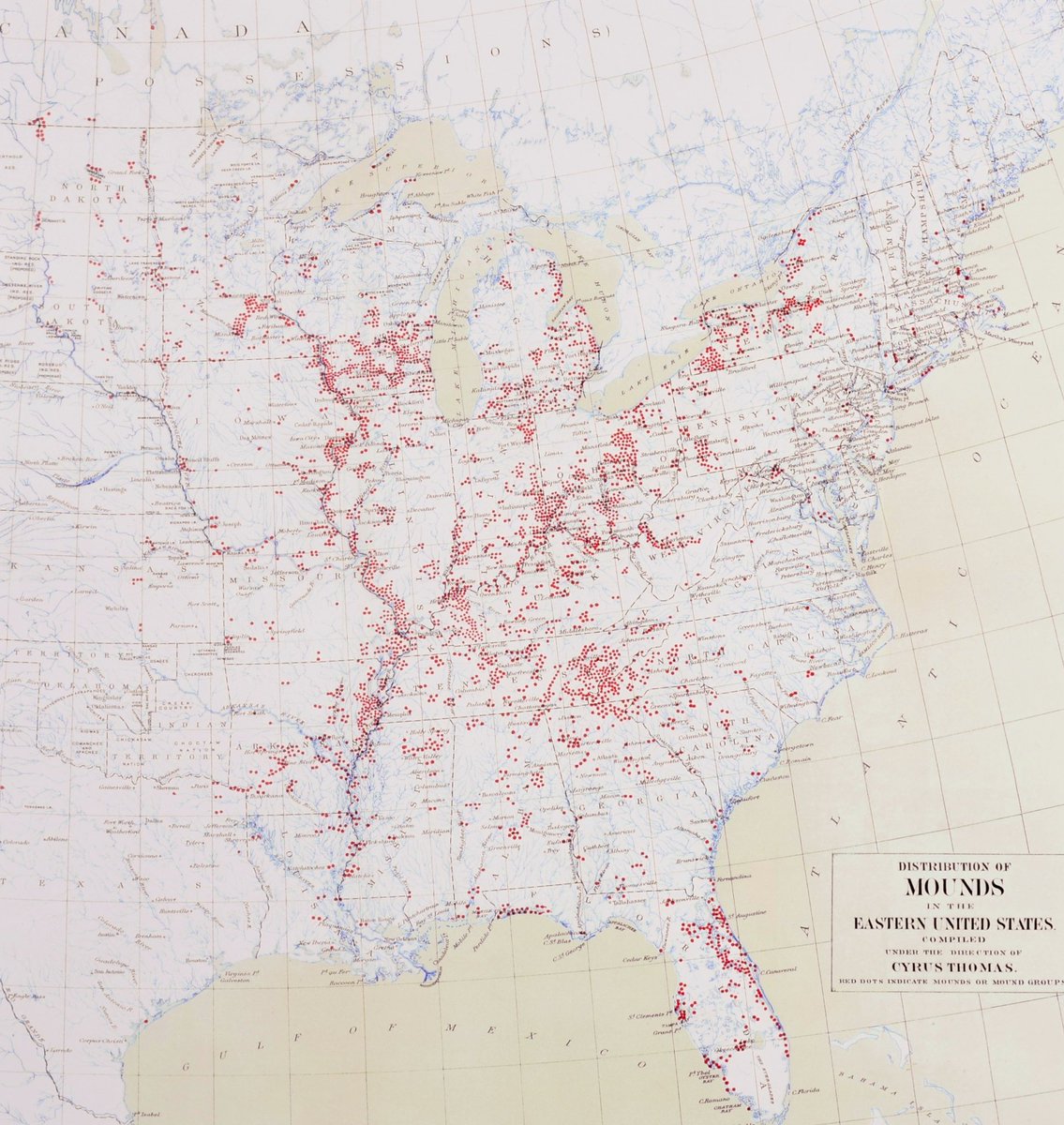
Mound Builders: Who Built What? The Real Story.
The term “Mound Builders” gets thrown around a lot, but not all mounds are the same. Different cultures, different time periods, and vastly different purposes.
Let’s break it down—who built what, when, and why. 🧵👇
50
175
1,173
286,249
May 20
My hypothesis: US university education was a massively successful export industry (foreign students paying tuition housing living expenses is literally classified as exports) and Trump admin collapsed this demand.
May 17

Clemson is $1.5B in debt. Syracuse is closing or pausing 93 programs, UNC-Chapel Hill plans to cut spending by $89M over 3 years. Duke recently let 600 employees go in a $350M budget cut. Indiana public colleges announced a plan to eliminate or merge 580 programs statewide.
219
1,150
8,893
772,054
Chris Blattman retweeted

May 20
If you use fake citations in your paper, you will get one year arrival ban.
If you use fake data in your paper, you will get tenure at Harvard Business School.
11
64
1,167
38,170
May 20
I admit that AI brings new challenges to teaching and learning, and I am happy if some people take this gamble, but I don’t think the best way to prepare the next generation for future thinking/creation/fulfillment/careers is to cut them off from AI for four years.
May 19

The first major university that publicly commits to a total AI ban in its undergrad teaching (no AI in class, in creating syllabi or class prep, creating & completing assignments, or grading) and makes that part of its brand will see a major surge in applications & enrollment.
9
19
151
34,465