
Co-Founder & CEO @ovivatx || Mama || Cell & Molecular Biologist || Science Storyteller || Curious Person
Joined August 2009
- Tweets 1,968
- Following 792
- Followers 2,302
- Likes 4,011
132 Photos and videos



Daisy Robinton, PhD retweeted

11 Jan 2024
A fascinating meeting at the JP Morgan Healthcare confab in SF this week — moonshots in menopause.
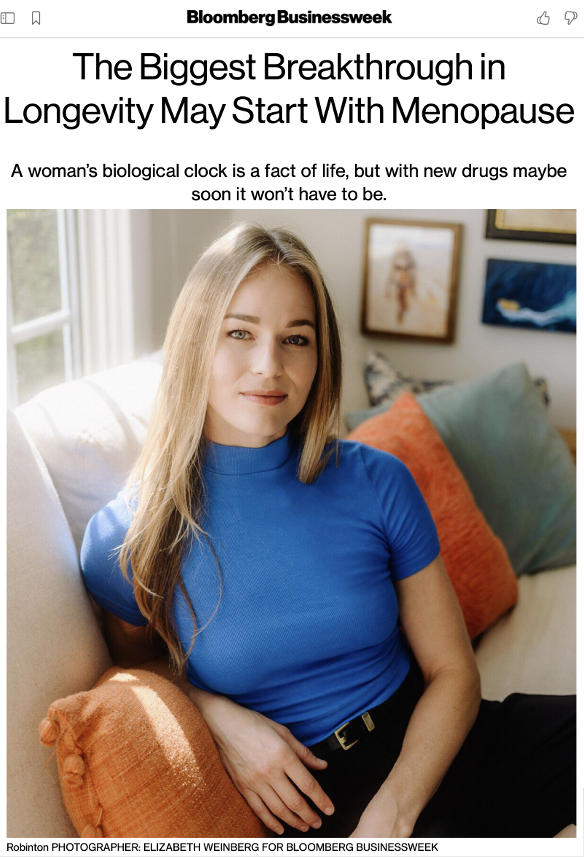
"As scientists finally begin to unravel what makes the reproductive system age so rapidly, they’re also uncovering a tantalizing possibility: There may be ways to slow that aging down. Not only could this extend a woman’s childbearing years, it could dramatically improve women’s health, staving off the ill effects associated with the onset of menopause. Research has shown that women who go through menopause later in life tend to live longer.
The ovary is an ideal model to study aging. Watching the ovaries age is a little like listening to a podcast at double speed, which is why the ovary could even become a proving ground for longevity drugs, a therapeutics market expected to reach more than $44 billion within the next decade. This could have benefits for everyone, since most of the developed world’s biggest killers for men and women—heart disease, stroke, cancer, dementia—are diseases for which age is the main risk factor.
Scientists and startups are racing to turn these revelations into therapies that could one day advance treatment for menopause and infertility and perhaps eventually intervene in the process of aging itself.
A startup called Gameto has used stem cell science to create a less intensive version of IVF and plans to use the same technology to create better menopause therapies.
Two-and-a-half years ago, Pepin, along with Donahoe and Harvard University Ph.D. Daisy Robinton, founded Oviva Therapeutics Inc. with funding from aging-focused drug development company Cambrian BioPharma Inc. Their goal: to turn AMH into treatments that could improve ovarian function and extend life span. Eventually, Oviva hopes to pull off a feat that seems almost unimaginable: giving women a drug that will allow them to choose when—and whether—they go through menopause.
At a time when politicians are eroding women’s hard-won reproductive choices, Oviva’s founders want to give them even more control. “I see it very much akin to how the contraceptive pill really changed the game for women in the ’70s,” Robinton says.
Human females are the odd ones out in terms of the reproductive life cycle. Most mammals are fertile right up to the end of their lives. The only other mammals that go through menopause are a few species of whales and, depending on whom you ask, some great apes. No one is even quite sure why menopause occurs at all.
Prolonging the depletion of a woman’s eggs could delay the march toward menopause, keeping up the body’s production of critical ovarian hormones for a longer period. In older experiments, when researchers transplanted the ovaries of younger mice into older ones, they lived about 40% longer and also appeared to have healthier hearts.
Oviva’s first human therapy (rAMH) will amp up reproductive ability. The purpose is to help women going through IVF and egg freezing who are poor responders to traditional ovarian stimulation. The hope is to get them to produce larger quantities of eggs, which could improve the success rates of egg retrieval procedures that are intensive and expensive.
Such a drug, Robinton says, would show that AMH’s ability to influence the reproductive system can translate from mice and cats into humans in an already proven market. From there, Robinton says, Oviva can eventually tackle the bigger goal: delaying menopause. To achieve that, the complicated AMH protein will need to be altered further, turned into a new drug that is less painful than a jab, and virtually side-effect free, which throws novel challenges into the mix. “When I use the gene therapy, I’m using the natural hormone,” Pepin says. “I’ve modified it, but only a little bit. It’s very safe.”
Robinton envisions a not-too-distant future—maybe before she reaches menopause herself—in which women will have therapeutic interventions that allow their ovaries to keep working for longer, helping maintain the skin and hair and mood and health and maybe even the sex life of their younger years. “For me, the pie in the sky is really choosing when to have the sun set on your ovaries,” she says."
— Excerpts from apple.news/AmibOXxr6Qi-StPH4…
15
27
183
75,522

4 May 2023
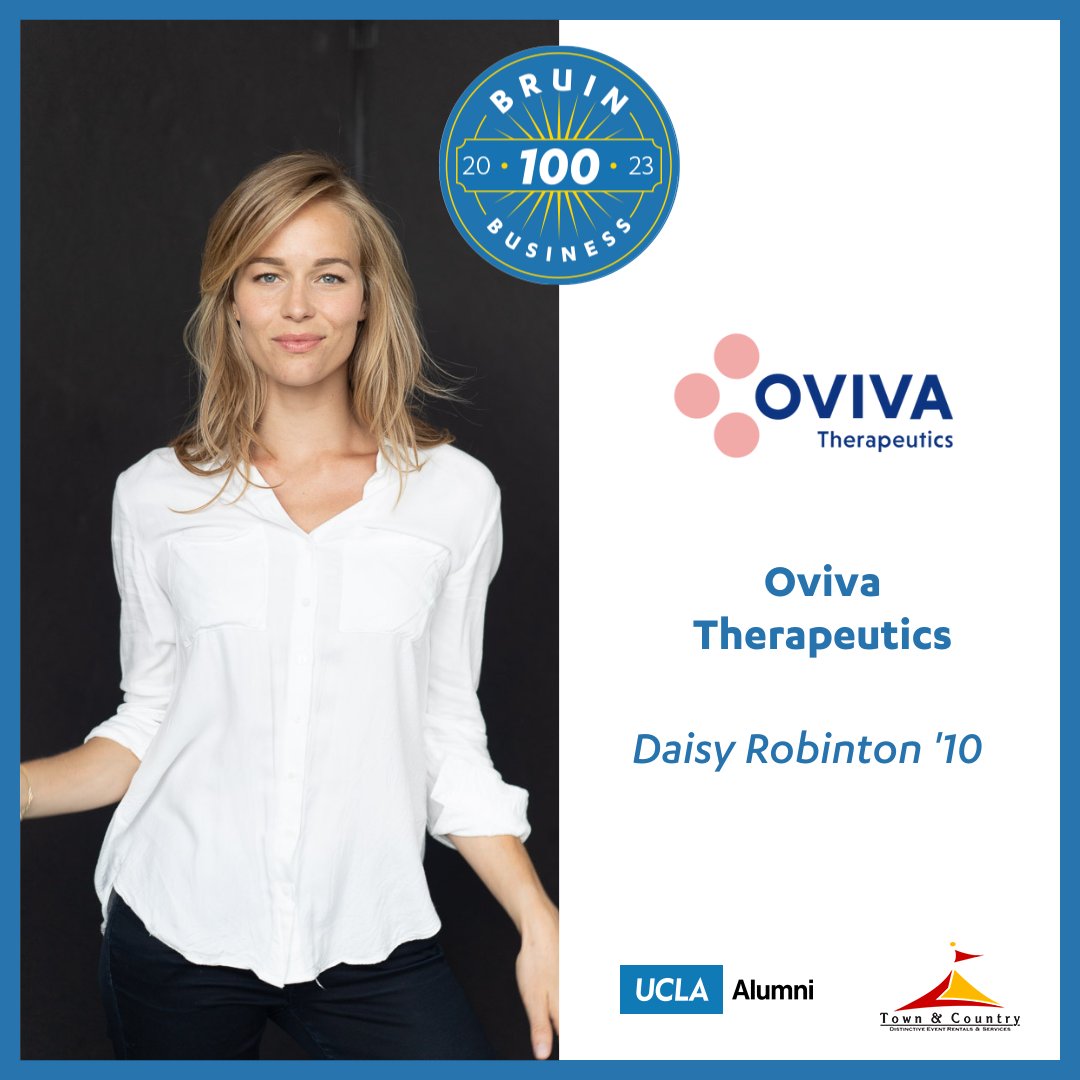
A big thank you to @UCLA_Alumni for the honor of being recognized on the Bruin Business 100 list this year for our work at @OvivaTx. Elevating awareness about the importance of funding and innovation in women's health is half the battle! #BruinBusinesses #womenshealth
1
18
3,394
4 May 2023
It was an honor and a pleasure to speak with the @OprahDaily team about our work at @OvivaTx. Thank you, @Oprah, for putting a spotlight on this important conversation and the innovation driving new options for women to have agency throughout their lives when it comes to health!
5 Apr 2023

Imagine a world in which women get to control when—or even if—they go through menopause. This is the vision @DaisyRobinton set forth when she cofounded @ovivatx. Watch our interview with her here.
oprahdaily.com/life/health/a…
2
2,001
4 May 2023
Loved speaking with Ainsley for this incredible piece on menopause, the $600B market opportunity and science (or lack thereof) behind it. It's a powerful piece and I strongly recommend a read - fastcompany.com/90878726/mee…
1
5
1,643
Daisy Robinton, PhD retweeted

8 Mar 2023
(3/4) By shining a light on important issues, Oviva hopes to promote greater awareness, education, & innovation in this critical area. Every woman deserves access to the best possible healthcare & we are proud to be a part of this journey as we continue to work towards this goal.
1
1
1
1,728
Daisy Robinton, PhD retweeted
8 Mar 2023
(2/4) Their efforts have gone beyond developing #therapeutics that target ovarian function, consequently extending female healthspan, as they have also been actively initiating discussions that elevate the broader conversation around #womenshealth.
1
1
1
1,310
Daisy Robinton, PhD retweeted
8 Mar 2023
(1/4) “Oviva was really born out of the recognition that there is a vast unmet need in women's health." At our PipeCo @OvivaTx , CEO @DaisyRobinton and her team have been dedicated to addressing these gaps in women's health.
1
5
11
2,412
Daisy Robinton, PhD retweeted

8 Mar 2023
Did you know that the ovaries age faster than other organs?
See why research in ovarian health could transform how women experience health, pregnancy and menopause. 🤰🏽
#NaturesBuildingBlocks
#IWD2023
@DaisyRobinton @CambrianBio @PepinLab
#Ad paid and presented by @OvivaTx
1
1
9
38,291
6 Feb 2023
Can't wait to join such an incredible faculty at @NextMedHealth in San Diego next month and to share our vision for a better #future for #women everywhere! @OvivaTx @PepinLab #womenshealth #biotech #innovation
6 Feb 2023

We’re looking forward to having @DaisyRobinton on our faculty for NextMed.Health this March 13-16th in San Diego and exploring the future of #WomensHealth
NextMed.Health/faculty
5
6
3,193
6 Feb 2023
VERY excited for the debut of this series, and especially for the world to see the episode on @OvivaTx! Thank you @BBCStoryWorks @BBC for giving us the chance to share our story in such a beautiful way, to broaden the reach of our vision, mission and impact! #womenshealth #future
6 Feb 2023

🕸️ From fashion inspired by spider silk to the AI helping cure cancers, biotechnology is doing remarkable things.
On Feb 21, immerse yourself in #NaturesBuildingBlocks and see the world as you’ve never seen it before. 🌏
#Advertisement feature presented by @IAmBiotech

2
1,201
Daisy Robinton, PhD retweeted

16 Dec 2022
It’s fitting that @dictionarycom selected “woman” as its word of the year for 2022. It’s one of the oldest words in the English language and the most fundamental when it comes to the work @OvivaTx is doing to empower #women by addressing ovarian aging. tinyurl.com/mrxaarp7
1
2
8
1,653
Daisy Robinton, PhD retweeted

12 Dec 2022
“We don’t have any good treatments for menopause once it’s happened, and we are doing nothing to prevent it, and all of those things combined make it a fantastic opportunity."
@DaisyRobinton wants to slow women’s aging by extending ovulation.
buff.ly/3EwlpZW
1
2
7
Daisy Robinton, PhD retweeted
12 Jun 2022
“We don’t have any good treatments for menopause once it’s happened, and we are doing nothing to prevent it, and all of those things combined make it a fantastic opportunity."
#menopause #womenshealth @JamesPeyer @DaisyRobinton @OvivaTx
buff.ly/3EwlpZW
2
5
17
Daisy Robinton, PhD retweeted

22 Jun 2022
Oviva – giving women added years of agency and resilient living.
Dr @DaisyRobinton talks #womens #health, ovarian function and clinical translation.
#ovarian #aging @OvivaTx
longevity.technology/archive…
1
6
1 Jul 2022
Helpful thread summarizing the data on COVID and COVID Vaccination for the 6m-5y age group. On my way to the pediatrician now 💉 Thanks to @AzzaGadir for the h/t!
19 Jun 2022

1/In recent days, the @US_FDA has authorized and the @CDCgov (via @CDCDirector) has recommended the @pfizer and @moderna_tx #COVID19 vaccines for
children 6m .
Though the safety and effectiveness of the vaccines are quite impressive, I've seen a more fundamental question.
1
24 Jun 2022
I want a whole lot more for my daughter than the America we have today.
I wanted more for her than what we had yesterday, but somehow – today – we’ve slipped even further. I have failed her. We have failed all our daughters.
What our mothers before us fought for, we have lost.
2
1
17
24 Jun 2022
I feel sad, devastated, especially for the women & girls living in states where laws dictate that their bodies can be regulated by a small number of people, largely men who cannot possibly relate and who will never face the same consequences that we do with this legislation.
1
3
24 Jun 2022
I feel angry. Furious. Passionate. Enraged.
This dark day will not put that fire out. Let the fire rage on, and I will keep fighting and we will keep fighting until we get the rights that we deserve.
Until our bodies, at least, are our own.
1
4