
#DeFi Enthusiasts | Content lover | Art lover🌸 | UI/UX-er
Joined December 2017
- Tweets 31,240
- Following 1,772
- Followers 31,286
- Likes 58,908
822 Photos and videos




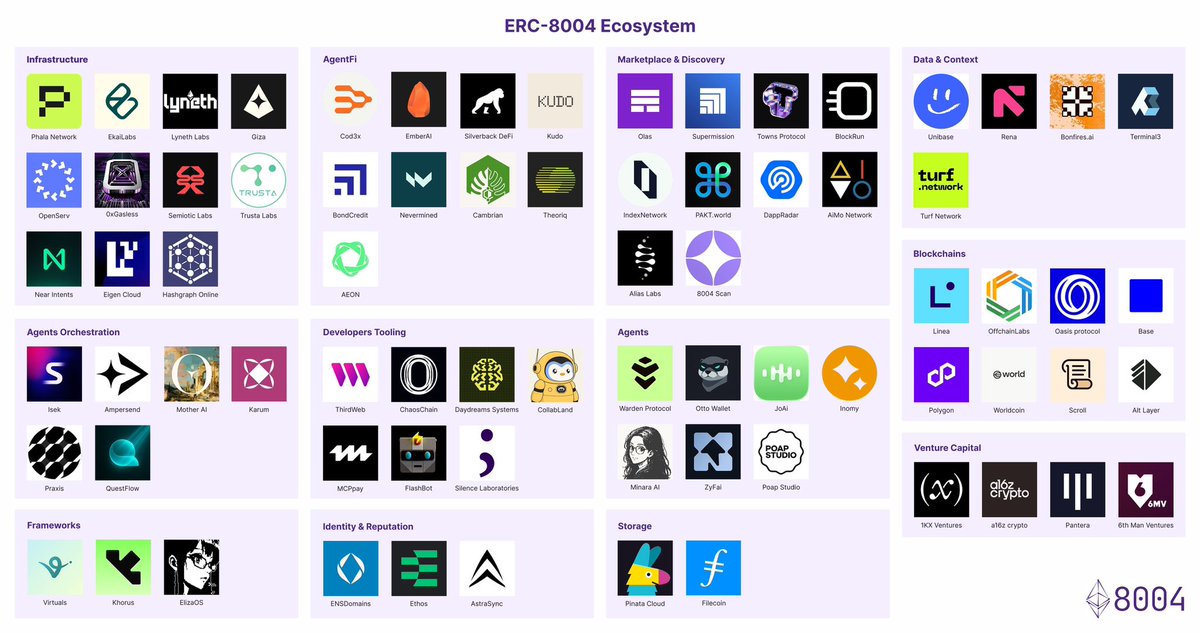
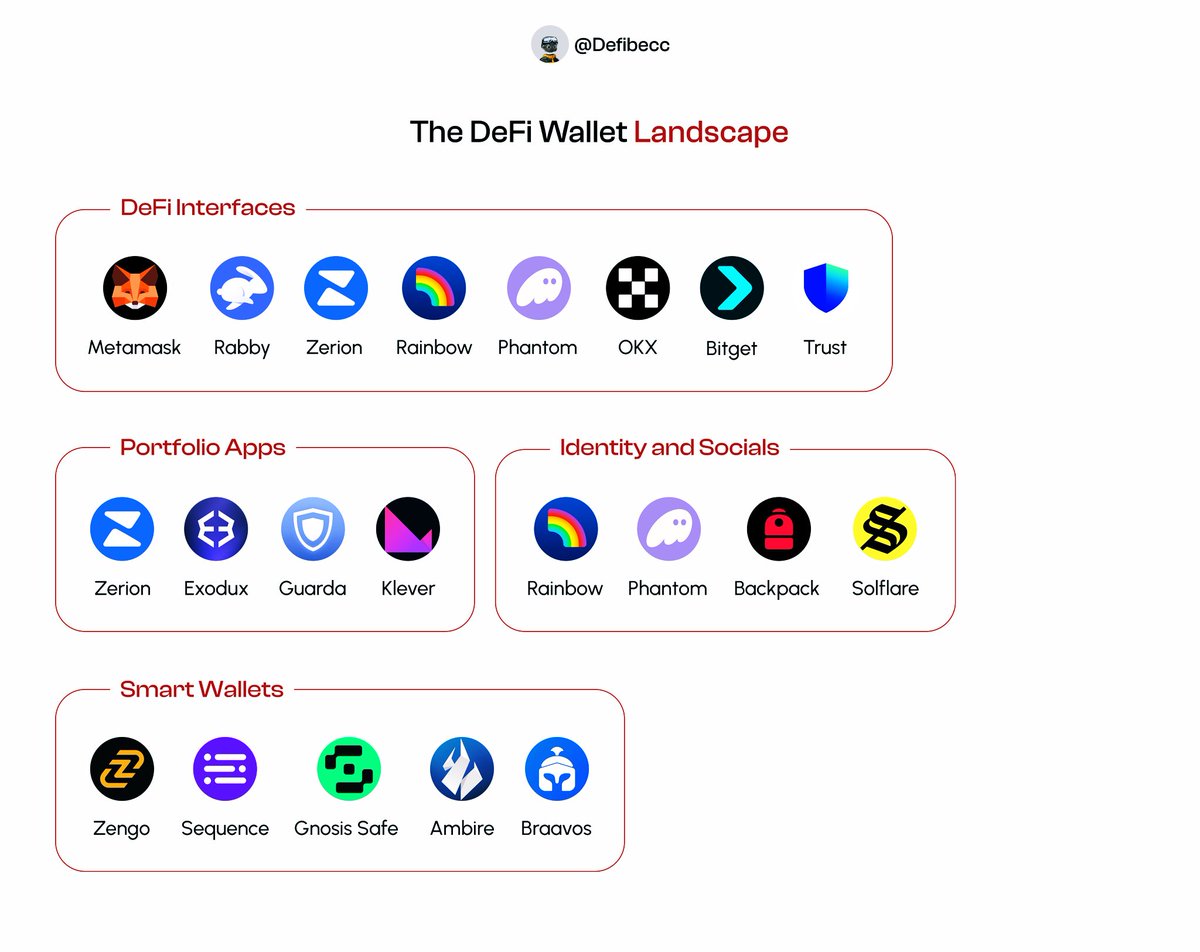
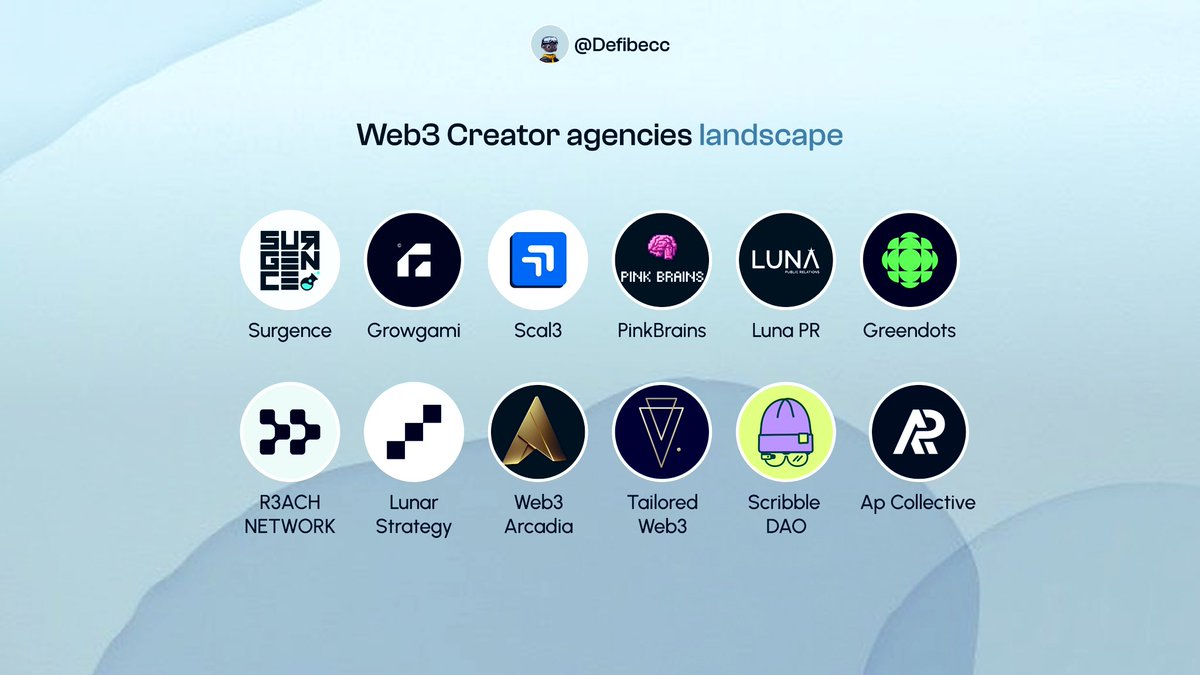

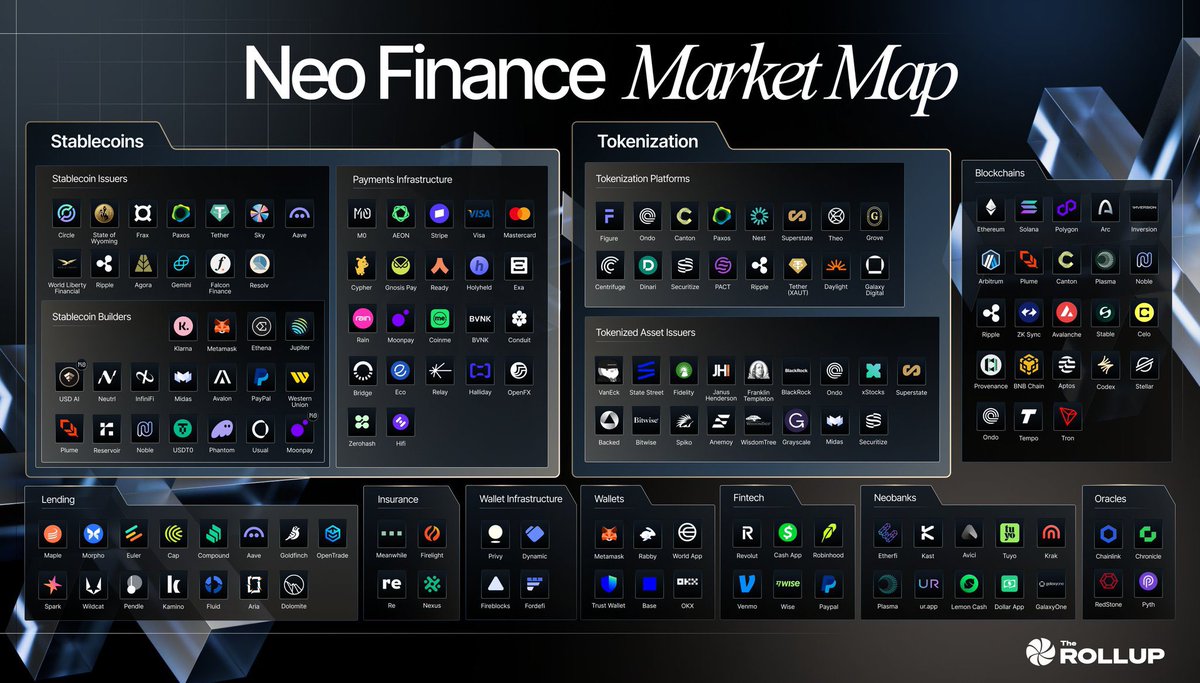



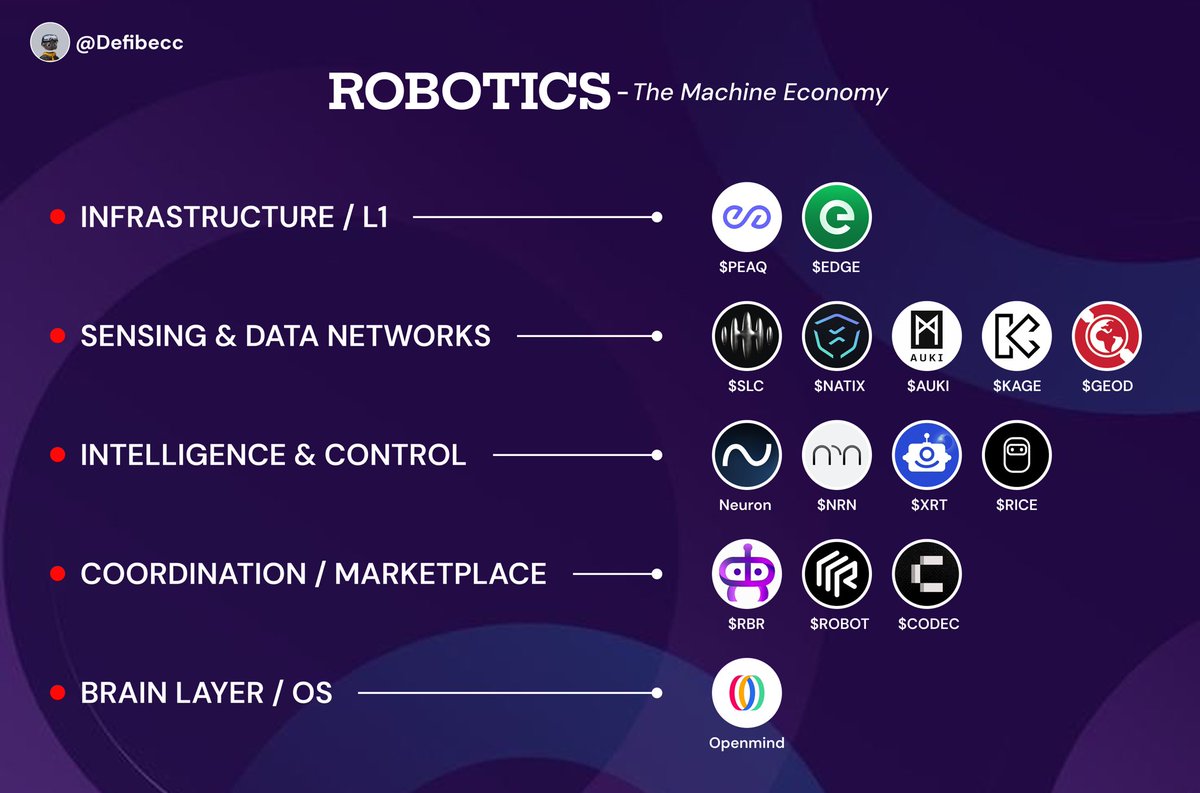
The Robotics narrative is heating up,
• Projected to hit $370B by 2034
• $5T humanoid market by 2050
• Hardware costs are collapsing
• AI models more capable than ever
Crypto’s robotics sector? Just $440M mcap. We are early, anon.
Here’s a list of builders worth watching🧵
73
9
75
35,281

Bec🩵 retweeted

May 2
Last month should have been a wake up call for anyone still underestimating crypto risk.
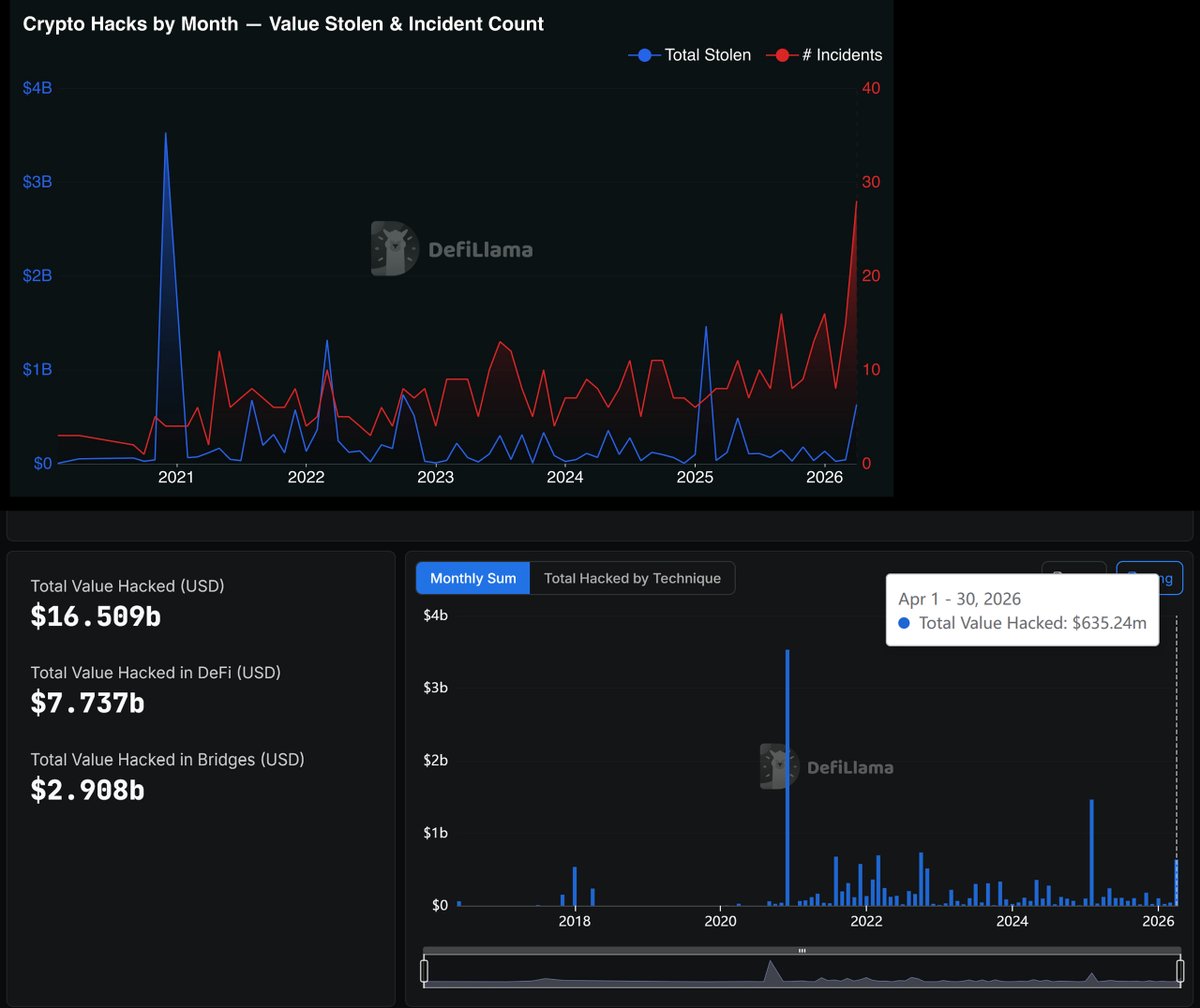
The various hacks that occurred proved that security is not keeping up. In April 2026 alone, DeFi exploits crossed over $630M in losses across 26 different hacks (according to CoinMarketCap - x.com/coinmarketcap/status/2…).
Let's break it down 👇
Most people will focus on the bigger numbers like;
➸ @KelpDAO ($290M drained)
➸ @DriftProtocol ($280M exploited)
That is just two incidents and over half a billion dollars gone.
But it was not just two hacks. The entire ecosystem seemed to be under pressure at the same time;
➸ @purrlend ($1.5M exploited)
➸ @wasabi_protocol ($4.5M lost)
➸ @volo_sui ($3.5M drained)
Along with dozens of other attacks most people will not even hear about.
So in a single month, we’ve had;
➸ Massive protocol breaking exploits
➸ Smaller, constant drains happening in the background
➸ Retail users getting hit through indirect exposure
It goes to show just how fragile the security culture really is.
With the rise in AI assisted exploits, these attacks are getting smarter. It points to faster vulnerability discovery, more scalable attack strategies and more convincing social engineering with fake identities posing as trusted insiders.
And this is where crypto has a real problem. From the outside looking in, people see;
➸ Platforms losing hundreds of millions overnight
➸ Users with no protection or recovery options
➸ A system where one mistake equals total loss
You cannot build the future of finance on systems that fail this often.
Security in crypto is still treated like a feature instead of infrastructure. At the moment, to a lot of protocols, throughput means more to them than safety.
People tend to only focus on security after something breaks, while hype gets way more attention than actually building strong, reliable systems. When that is the pattern, you can already guess how things will turn out.
If crypto wants to be taken seriously, three things need to happen:
✦ Prioritize security during development
✦ Better user protection layers such as insurance and other recovery mechanisms
✦ Accountability when protocols fail
Until then, every major hack will reinforce the narrative that says, “This space is not ready”. The technology and opportunities matter less if people do not feel safe. And right now, they don't.
May 1

📰 Narrative of the Week: DeFi Exploits Surge
📌 Purrlend exploited for $1.52M across MegaETH and HyperEVM.
📌 Wasabi Protocol loses over $4.5M across multiple EVM assets.
📌 Sui-based Volo exploited for $3.5M from Volo Vaults.
📌 April records 26 known hacks with losses exceeding $630M.
The rapid rise in AI-assisted attack sophistication is exposing major weaknesses across DeFi infrastructure.
3/6
17
4
54
5,571
Bec🩵 retweeted

Apr 30
I applied for this.
mint date is 13th may

9
3
52
9,327

If you think CT or crypto are irreversibly dead, you might be looking in the wrong place, or following the wrong people.
In fact, so many things happened last week.
Check out our best articles and posts of the week here ⤵

6
4
18
2,746
Bec🩵 retweeted
Mar 14
One of the biggest shifts happening in software development right now is the rise of AI coding agents.
Tools like Claude Code, Codex, and other CLI-based agents are changing how devs work.
Instead of writing every line manually, they can now delegate tasks like debugging, refactoring, or even implementing features to AI.
But this introduces a new challenge.
If you want to get the most out of these agents, you often need to run multiple agents in parallel. One fixing bugs, another writing tests, another building a feature.
Managing that workflow quickly becomes messy.
Different terminals, conflicting environments, and agents stepping on each other’s changes.
This is where a new category of tooling is starting to emerge, which is orchestration layers for coding agents.
Instead of treating each AI agent as a separate process managed manually, these tools help coordinate multiple agents, track their work, and keep environments isolated.
I did a deep dive into projects building in this direction, then I stumbled upon @superset_sh.
Superset is essentially a terminal designed for running many coding agents at the same time.
It lets devs spin up parallel workspaces where agents can work on different tasks simultaneously without interfering with each other.
Under the hood, it uses isolated Git worktrees so each agent has its own environment and changes can be reviewed or merged independently.
As AI agents become a bigger part of the development workflow, tools that help devs manage and orchestrate them efficiently will likely become an important layer of the modern dev stack, and Superset is one of the projects experimenting with that model.
It’s still early for this category, but the direction is quite interesting. Eyes peeled.
22
1
49
5,420

Bec🩵 retweeted
Mar 9
Another week in crypto and the market is still in limbo, with $BTC going back below $70K.
Projects are wary of TGEs, and those that have launched are struggling to keep head above water.
While the calendar for the week isn’t so packed, there’s quite a number of solid updates to pay attention to.
We’re kicking off with some big shifts, fresh launches, and the usual mix of hype, macro noise that keeps us all glued to our screens, and that ever-present token unlock pressure. Here’s everything worth watching this week.
🎯 General Updates
◈ 9th
✦ @edeldotfinance plans to drop an announcement
✦ @MagicEden sunsets its EVM and BTC marketplaces
◈ 10th
✦ @DungeonCross777 officially launches
✦ @SuccinctLabs plans to drop a major update
✦ @trdEverything Phase 1 starts, featuring public token sale, points, and release of their new app
◈ 11th
✦ Xertraverse, @XertraPlatform’s NFT marketplace, goes live
✦ @MultiversX’s Battle of Nodes begins
✦ @_Qubic_’s Network Guardians open beta starts
✦ @ether_fi’s Analyst Call featuring 2026 roadmap
◈ 12th
✦ @Polkadot’s scheduled economic upgrade start
✦ @illuviumio’s Beyond Wave 5 launches
✦ @build_on_bob’s next mainnet upgrade (Jovian Hardfork)
🎯 TGE and ICO Updates
◈ 9th
✦ @NexiraDAEP ($NEXI) TGE
◈ 10th
✦ @trdEverything ($E) public sale
🎯 Macro Economic Events
✦ US CPI data
✦ Fed Bowman’s speech
🎯 Token Unlocks
◈ 12th
✦ @Aptos - 11.31M $APT ($10.52M)
◈ 13th
✦ @WhiteBit - 81.5M $WBT ($4.37B)
◈ 15th
✦ @ConnexSocial - 1.32M $CONX ($15.13M)
And that’s the lineup for the next few days, ft catalysts that could spark moves in either direction.
Between Magic Eden’s full retreat to Solana, some intriguing TGEs and app drops, major protocol upgrades, and those hefty unlocks looming ($WBT especially), it’s shaping up to be an eventful week.
Keep an eye on the macro-economic events too. That’s always a wildcard for the broader market mood.

23
3
42
6,048
Bec🩵 retweeted

Mar 2
I recently broke down how RWAs split into two distinct categories: permissionless and permissioned and why both models matter.
Now let’s zoom in
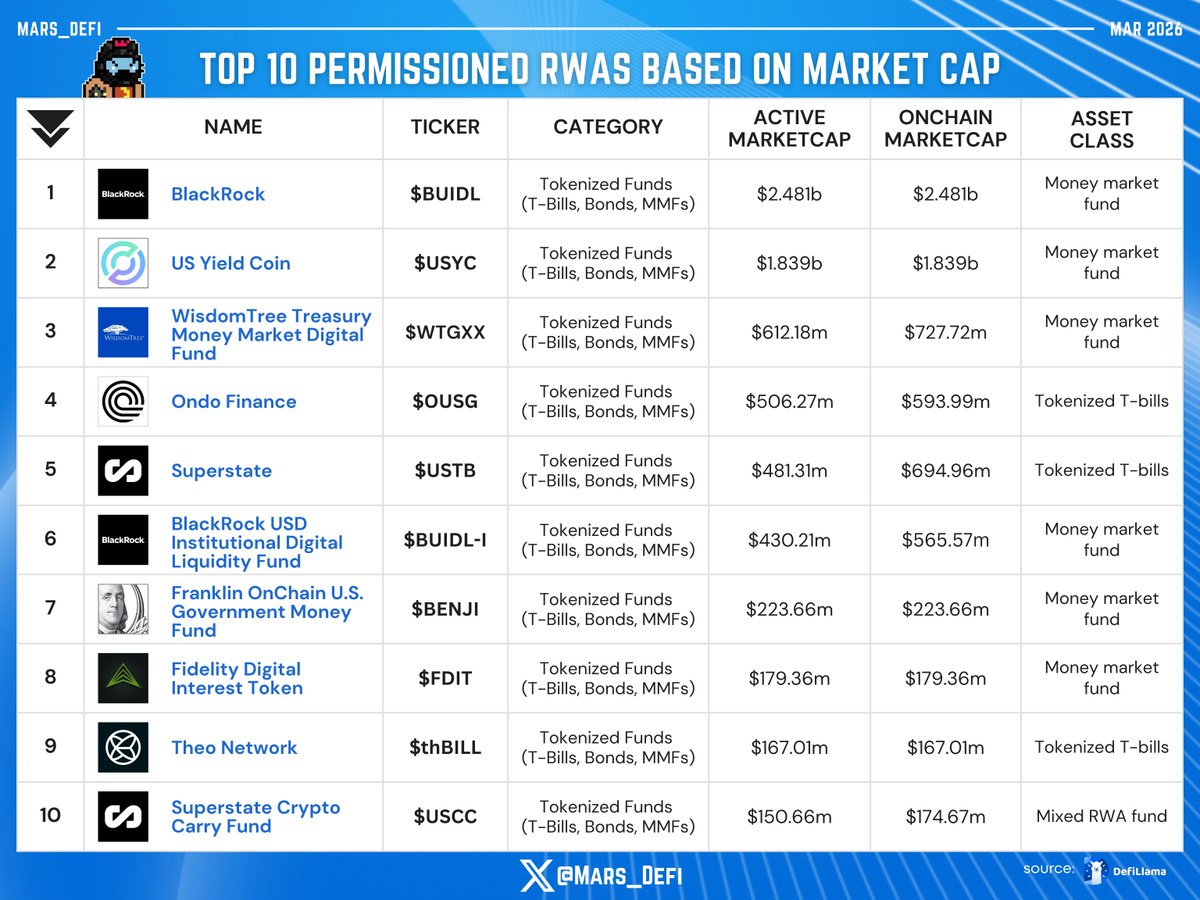
Here are the Top 10 Permissioned RWAs ranked by active market cap.
• @BlackRock BUIDL ( $BUIDL ) - $2.481B
• @circle US Yield Coin ( $USYC ) - $1.893B
• @WisdomTreeFunds Treasury Money Market Digital Fund( $WTGXX ) - $612.18M
• @OndoFinance OUSG ( $OUSG ) - $506.27M
• @SuperstateInc USTB ( $USTB ) - $481.31M
• @BlackRock USD Institutional Digital Liquidity Fund ( $BUIDL-I ) - $430.21M
• @FTI_US Franklin Onchain U.S Government Money Fund ( $BENJI ) - $223.66M
• @DigitalAssets Fidelity Digital Interest Token ( $FDIT ) - $179.36M
• @Theo_Network thBill ( $thBILL ) - $167.01M
• @SuperstateInc Crypto Carry Fund ( $USCC) - $150.66M
h/t : @DefiLlama
Feb 25

Here’s the uncomfortable truth about RWAs some people don't want you to know.
Institutions are building permissioned RWAs but retail is adopting permissionless RWAs and the market cap data already shows it.
—
First of all, what’s the real difference?
● Permissioned RWAs
This is Tradfi onchain.
• Access is gated: you usually need KYC/AML, accreditation checks, or whitelisting.
• Transfers can be restricted: only approved wallets can hold/receive.
• Issuer has tighter compliance control (often required for regulated funds / MMFs / T-bills).
● Permissionless RWAs
This is DeFi-style distribution.
• Anyone can buy/hold/transfer (no whitelist wall for basic usage).
• More composable: easier to plug into DeFi apps, pools, collateral, etc.
• Often includes gold tokens and tokenized-stock wrappers.
—
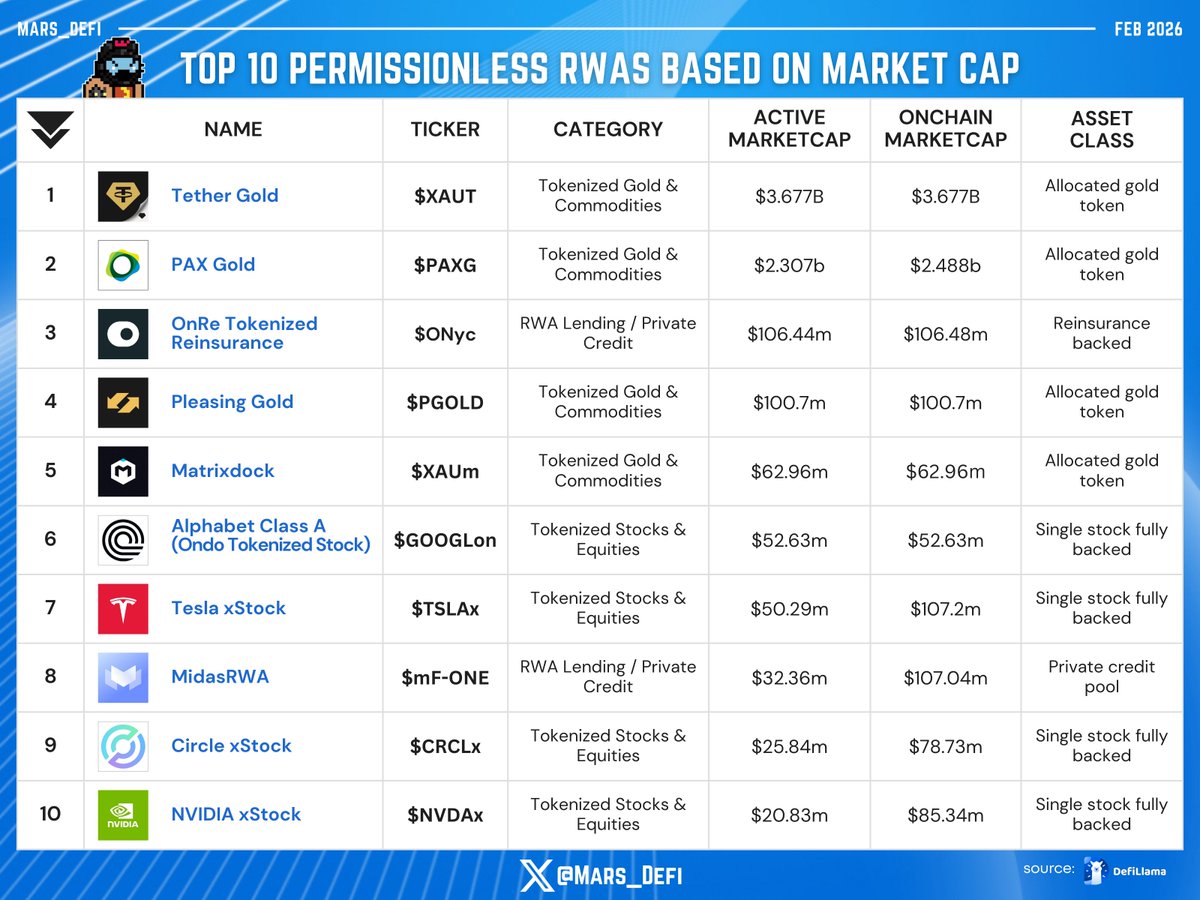
These are the top 10 Permissionless RWAs based on market cap.
• @tether Gold ( $XAUT) - $3.677B
• @Paxos Gold ( $PAXG) - $2.307B
• @onrefinance Tokenized Reinsurance ( $ONYC) - $106.44M
• @PleasingGolden ( $PGOLD) - $100.7M
• @matrixdock Gold ( $XAUm) - $62.96M
• Alphabet Class A ( @OndoFinance ) tokenized stock - $52.63M
• @Tesla xStock ( $TSLAx) - $50.29M
• @MidasRWA mF-ONE - $32.36M
• @circle xStock ( $CRCLx) - $25.84M
• @nvidia xStock ( $NVDAx) - $20.83M
—
Even though most institutional funds are permissioned, the permissionless RWA winners by 30-day active market cap are dominated by:
• Gold rails ( $XAUT, $PAXG, $XAUm, $PGOLD)
• Tokenized equities wrappers (xStocks)
• Newer, niche credit/risk products ( $ONYC, mf-ONE)
—
The next RWA breakout won’t come from compliance decks.
It will come from:
• Composability
• Liquidity
• Simple narratives
• Permissionless access
Clearly distribution must be greater than regulation for growth of this sector.
Permissioned RWAs will hold the big money while permissionless RWAs will win attention, users, and liquidity.
In the longterm, there will be a flipping and broader adoption.
h/t : @DefiLlama
11
7
40
3,370
Been watching the RWA space for a long time, and this might interest you…
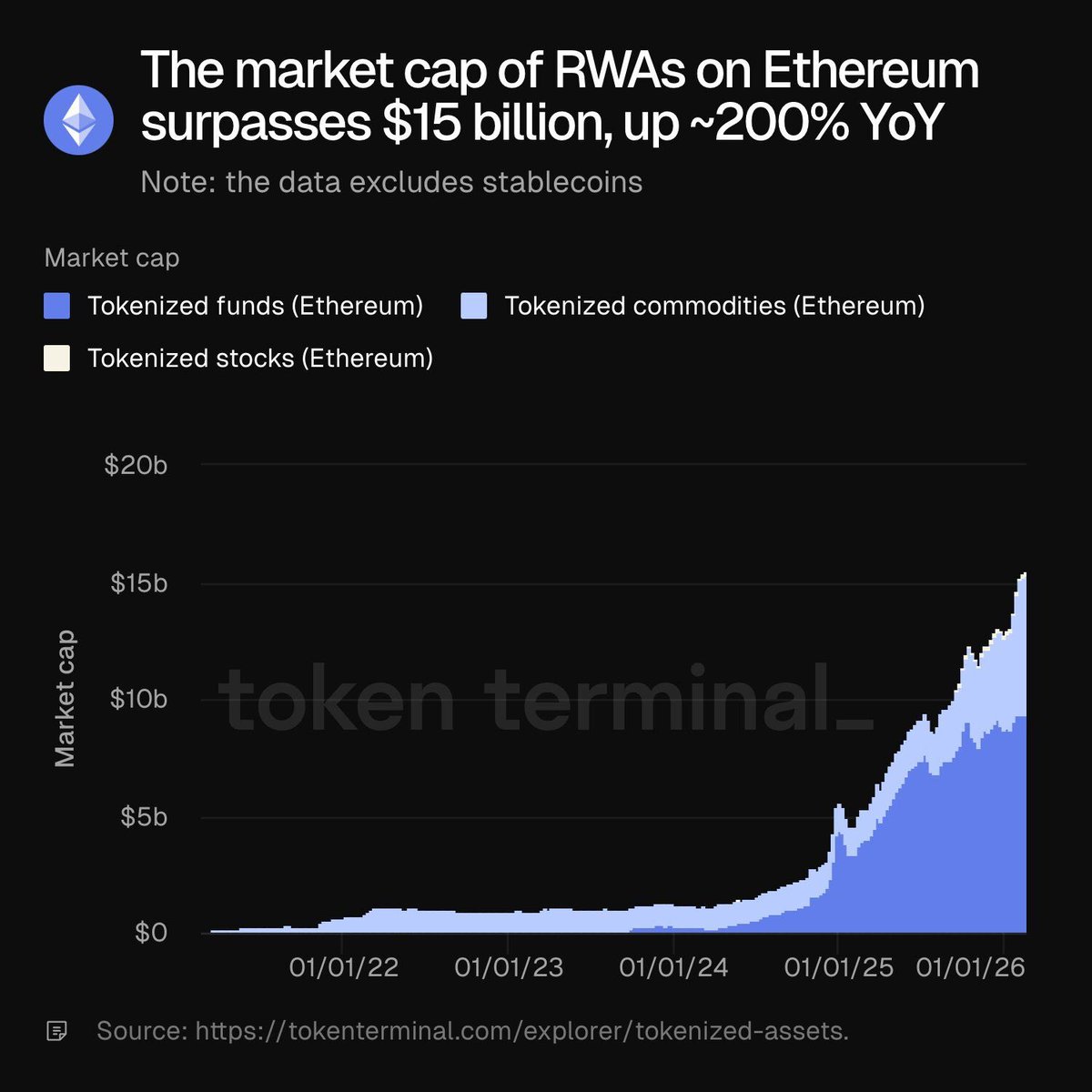
RWAs on Ethereum just crossed $15B.
That’s roughly a 200% increase YoY.
And no, this isn’t some random narrative pump. This is tokenized treasuries, money market funds, private credit, actual traditional financial products moving on-chain.
A year ago we were sitting around $4–5B. Now it’s $15B .
That kind of growth doesn’t happen from retail degen activity alone. That’s institutional capital testing infrastructure and getting comfortable.
We’ve got players like BlackRock putting tokenized funds on-chain. JPMorgan experimenting. Big names slowly stepping into public blockchain infrastructure instead of just talking about it.
What’s interesting isn’t just the number, It’s what it signals.
Ethereum isn’t just hosting DeFi apps anymore, it’s becoming settlement infrastructure for real capital markets.
Stablecoins proved blockchain could handle digital dollars.
RWAs are proving it can handle traditional finance.
$15B might still look small compared to global markets, but the growth rate? That’s the part people should be paying attention to.
15
1
39
11,040
Dear founders, exposure gets people in the door. Product quality makes them buy.
Marketing won’t save a weak product.
Feb 21

Dear founders,
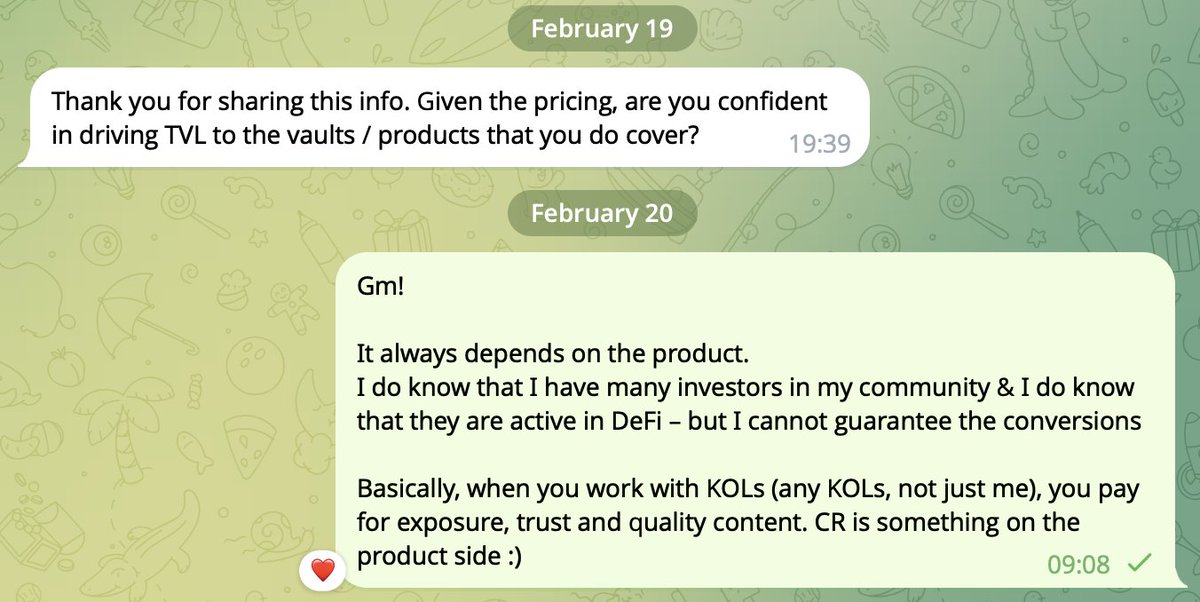
No KOL in the world will guarantee you conversions.
If they do, they just want your money.
KOLs give teams exposure to a specific community of people who are loyal to the KOL.
But if your product’s value proposition is weak, no KOL – and no other marketing channel – will save you.
I’m so tired of explaining this, to be honest...
5
3
26
4,230
Bec🩵 retweeted

Feb 19
We don't need more chains.
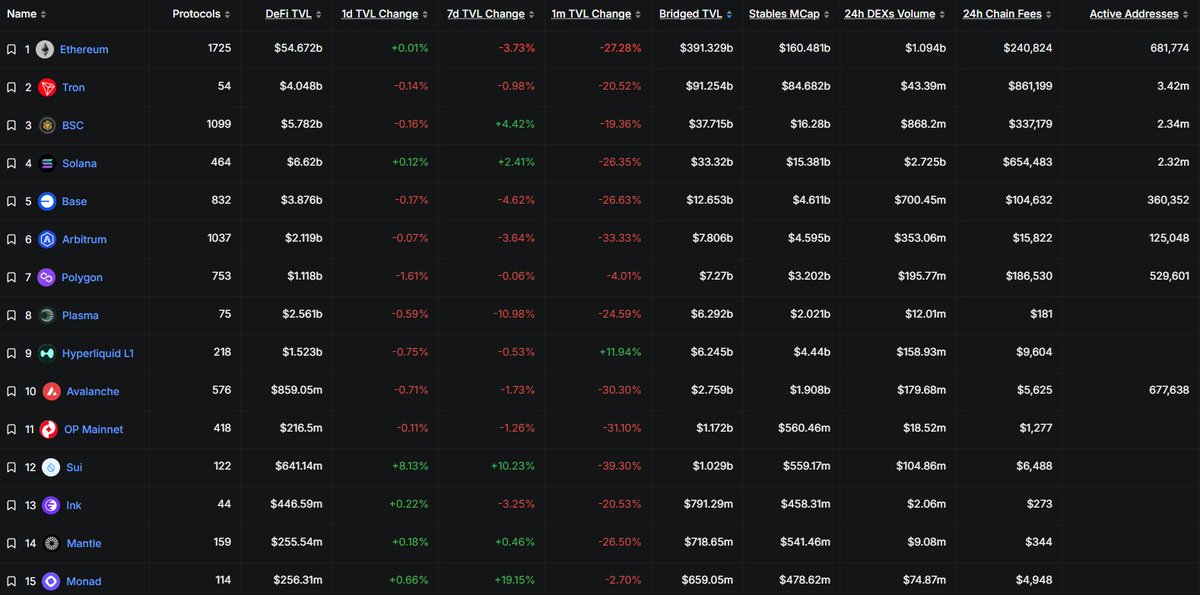
95% of all TVL is on these 15 networks ↓
1. Ethereum
2. Tron
3. BSC
4. Solana
5. Base
6. Arbitrum
7. Polygon
8. Plasma
9. Hyperliquid L1
10. Avalanche
11. OP Mainnet
12. Sui
13. Ink
14. Mantle
15. Monad
No more new general-purpose chains.
We need better apps where liquidity already lives.
55
12
114
12,220
Been following the games since the first round (was a tough one😅)
Killed the second round of course, team midnight black for the win!
Now waiting on the next reveal because maximum points i want, maximum points i must get 🌚🔥
Feb 19

Team @brave chose 18 and 24 lockers to open - Tada!
#Bravegames
@AttentionToken @MythicalGames @MidnightNtwrk

7
2
21
4,187
Bec🩵 retweeted
Feb 18
Slow month for crypto, but if you’re looking beyond charts, here’s where to check.
While timelines argued over price, builders shipped and a few quiet updates flew under the radar.
If you blinked, you probably missed it. So here’s a rundown of recent updates and what’s scheduled for the next 2 weeks.
—
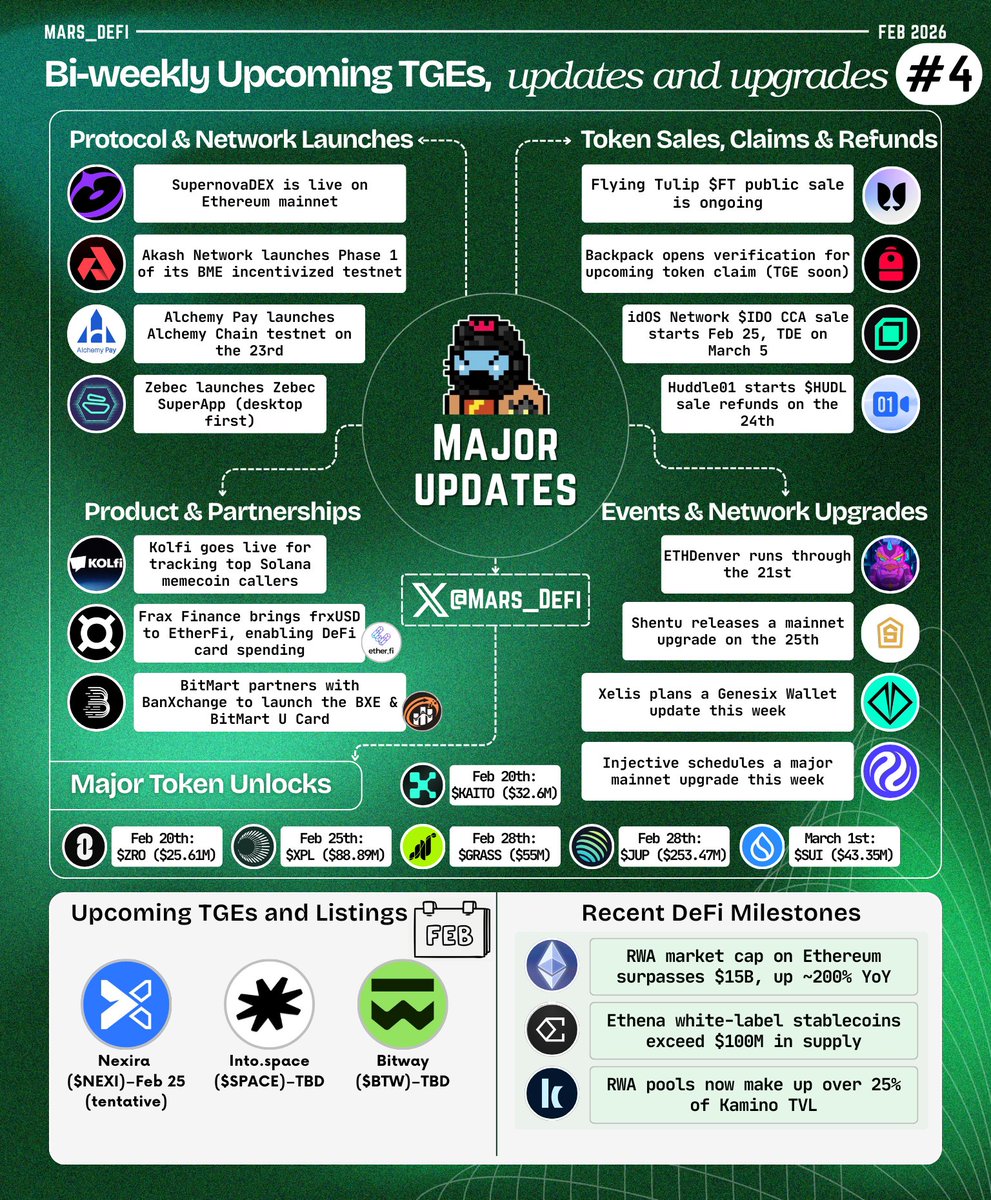
● Major Updates
• @SupernovaDEX is now live on Ethereum mainnet
x.com/supernovadex/status/20…
• @fraxfinance’s frxUSD is now on @EtherFi, letting users spend frxUSD via a DeFi-native card
x.com/fraxfinance/status/202…
• @flyingtulip’s $FT public sale is currently ongoing
x.com/flyingtulip_/status/20…
• @akashnet just launched Phase 1 of its Burn-Mint Equilibrium (BME) incentivized testnet
x.com/akashnet/status/202345…
• @kolfiapp is live, an app that lets users track and discover top solana memecoin callers
x.com/kolfiapp/status/202351…
• @Backpack has started verification for its upcoming token claim eligibility. TGE soon
x.com/backpack/status/202349…
• ETHDenver, the largest annual Web3 BUIDLathon and innovation festival, holds from today till 21st
x.com/ethereumdenver/status/…
• @BitMartExchange is partnering with @BanXchange to launch the BXE&BitMart U Card on the 21st
x.com/bitmartexchange/status…
• @AlchemyPay is launching testnet for its Alchemy Chain on the 23rd
x.com/alchemypay/status/2023…
• @huddle01com starts refunds to $HUDL sale participants on the 24th
x.com/huddle01com/status/202…
• @Zebec_HQ launches the Zebec SuperApp on the 25th, starting with the desktop version. Mobile soon
x.com/zebec_hq/status/202232…
• @idOS_network’s $IDO CCA sale starts on Feb 25th. Token distribution event (TDE) is on March 5th
x.com/idos_network/status/20…
• @ShentuChain is releasing a mainnet upgrade on the 25th
x.com/shentuchain/status/202…
• @xelis_project plans to release an update for Genesix Wallet this week
x.com/xeliscurrency/status/2…
• @injective has scheduled a major mainnet upgrade for this week
x.com/injective/status/20234…
—
● Upcoming TGEs and Listings
• @NexiraDAEP ($NEXI) - 25th (tentatively)
x.com/nexiradaep/status/2015…
• @intodotspace ($SPACE) - TBD
x.com/intodotspace/status/20…
• @BitwayOfficial ($BTW) - TBD
x.com/bitwayofficial/status/…
—
● Major Token Unlocks
• @KaitoAI (32.6M $KAITO) - 20th
• @LayerZero_Core (25.61M $ZRO) - 20th
• @Plasma (88.89M $XPL) - 25th
• @grass (55M $GRASS) - 28th
• @JupiterExchange (253.47M $JUP) - 28th
• @SuiNetwork (43.35M $SUI) - March 1st
—
● Recent Milestones Across Top Protocols/Networks
• RWA market cap on @ethereum surpasses $15B, a YoY increase of about 200%
x.com/tokenterminal/status/2…
• @ethena's white label stablecoins crossed $100M in circulating supply, driven by suiUSDe’s recent inclusion
x.com/kairos_res/status/2021…
• RWA pools now account for over 25% of @kamino's TVL
x.com/kamino_liq/status/2023…
—
If you care about updates beyond price movements, this is your two-minute edge. Stay tuned for more in 2 weeks.
Feb 16

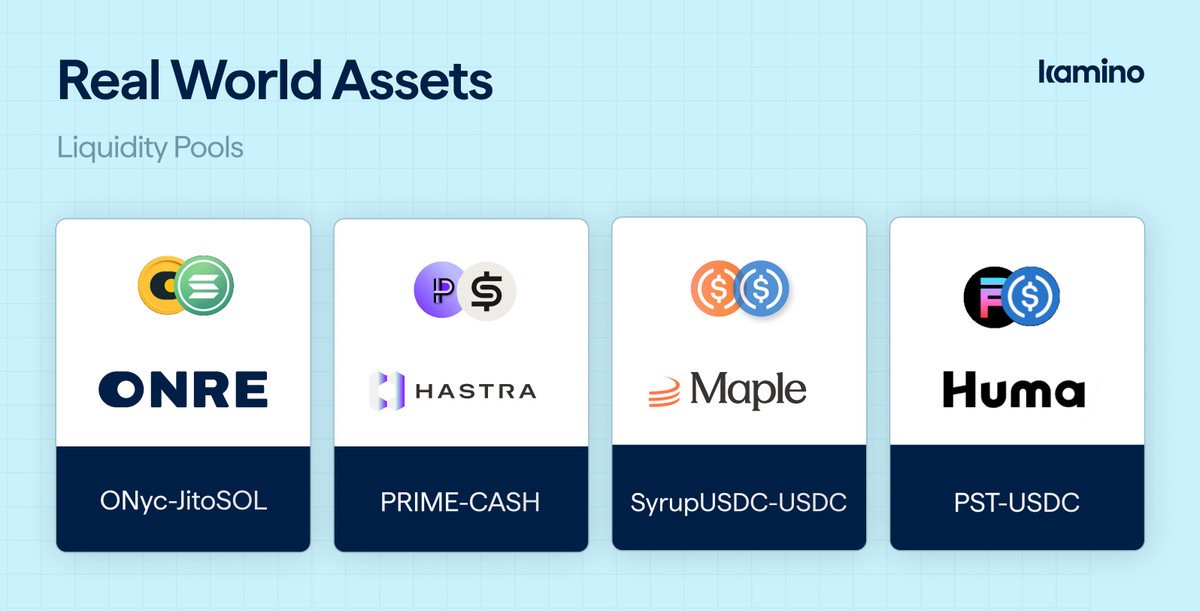
Over 25% of Kamino Liquidity's TVL is now in RWA pools:
- $PRIME: HELOC origination
- $ONYC: Reinsurance premiums
- $PST: Payment financing
- $SyrupUSDC: Institutional lending
At over $60M TVL, Kamino's LPs provide the deep liquidity that powers RWA trading on Solana ⤵️
19
4
39
2,663
Robinhood Chain Launches Public Testnet
If you’ve followed @RobinhoodApp over the years, you’ll know it started out as an app that made stocks, ETFs, options, and eventually crypto accessible to everyone, all commission free.
Now, they’re building their own blockchain, the Robinhood Chain.
Robinhood launched the public testnet for its blockchain built as an Ethereum L2 on @arbitrum, open for devs to test, build, and experiment.
Being built as an ETH L2 network means it gets Ethereum’s security and ecosystem while adding speed, scalability, and the ability to handle financial-grade apps.
▪️What Robinhood Chain Can Do
Robinhood Chain has big ambitions:
• Tokenized RWAs: Stocks, ETFs, and other financial instruments could become programmable on-chain.
• 24/7 trading with instant settlement: No market hours, no middlemen slowing things down.
• DeFi-style liquidity and self-custody: Users could hold and move assets without centralized control.
▪️Why This Matters
• Developers now have access to network entry points and detailed documentation.
• Robinhood Chain is compatible with standard Ethereum development tools, meaning if you’ve built on Ethereum or Arbitrum before, you can jump right in.
• Big players like @Alchemy, @chainlink, @LayerZero_Fndn, @trmlabs, and @AlliumLabs are already testing integrations and more will join as the testnet grows.
• The goal is to find bugs, stabilize the system, and prepare for the mainnet.
▪️How to get involved
Robinhood is putting $1 million USD toward the 2026 Arbitrum Open House program to support developers on the testnet and future mainnet.
They’re hosting global online Buildathons in New York City, Dubai, London, and Singapore, plus in-person Founder Houses in New York City and London.
Devs and institutions can get started, find docs, and access testnet resources at docs.robinhood.com/chain/
So yes, @RobinhoodApp launching a public testnet isn’t the full blockchain you trade stocks on today, but it’s the first real step toward that future.
Robinhood is trying to bring traditional finance to on-chain channels, where assets move faster, cheaper, and with more freedom.
18
1
54
9,089
For years, blockchains have tried to scale without breaking their core principles.
But most of them still share the same architectural limitation.
@LayerZero_Core ’s new system, called Zero, is their attempt to rethink that limitation.
Today, every validator repeats the same work. Every transaction gets downloaded and executed across thousands of machines. That redundancy keeps networks secure, but it also creates a hard ceiling on performance.
Zero proposes a different model.
Instead of forcing every validator to replay every transaction, Zero uses ZK-proofs to separate execution from verification. One group, called Block Producers, executes transactions and generates proofs. Another group, Block Validators, simply verifies those proofs.
Validators no longer have to redo all the work. They just check that the work was done correctly.
This shift allows Zero to move away from the traditional “single-core” design most blockchains rely on.
Instead of everything competing for the same resources, Zero can run multiple “Atomicity Zones” in parallel, similar to how a modern multi-core computer runs different processes at once.
To make this possible, the team focused on four major areas:
• Storage (QMDB)
• Parallel execution (FAFO)
• Real-time ZK proving (Jolt Pro)
• High-throughput networking (SVID)
Their target is 2M transactions per second per Zone.
For context, Ethereum processes around ~15 transactions per second on L1, and Solana in the thousands.
The scale of what Zero is aiming for is several orders of magnitude higher.
But the bigger argument isn’t just about speed. It’s about structure.
Zero claims decentralization doesn’t scale by making validators more powerful. It scales by reducing how much work each validator has to do.
If it works as described, this isn’t just another high-performance chain. It’s an attempt to rethink blockchain design from the ground up.
Interested to see how this plays out in practice.

13
3
45
10,419
Bec🩵 retweeted

Feb 10
119
201
1,110
110,794
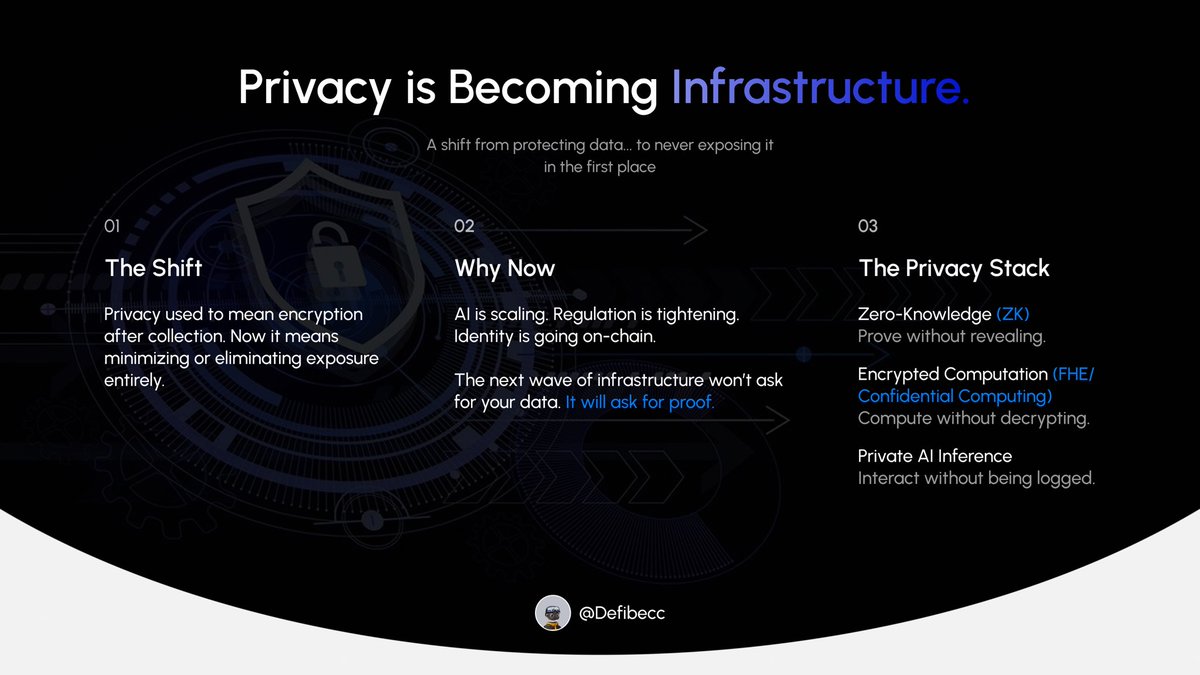
Privacy is one of narratives that’s been building quietly in the background and is now becoming unavoidable across tech, AI, and Web3.
For a long time, privacy mostly meant encrypted messaging, VPNs, or private transactions. But that view is changing fast.
The focus now is less about protecting data after it is collected and more about designing systems where data is either minimized or never exposed in the first place.
A lot of this shift is driven by Zero-Knowledge (ZK) technology.
ZK allows users or apps to prove something is true without revealing the underlying data. It sounds technical, but it unlocks very real use cases:
• Private transactions
• Identity verification without exposing personal info
• Confidential smart contracts
• Privacy-preserving KYC
ZK is becoming one of the most important infra layers being built across chains and identity systems.
Another area gaining momentum is encrypted computation, technologies like Confidential Computing and Fully Homomorphic Encryption (FHE) allow data to remain encrypted even while it is being processed.
This is especially important as AI adoption grows. There’s increasing demand for systems where users can interact with AI models without their prompts, data, or inputs being stored, logged, or used for training.
▪️ Notable Projects
We’re already seeing several projects push this privacy-first design forward.
• @aztecnetwork - Building privacy infra on ETH through programmable private transactions and ZK rollups, setting itself as a key player in private DeFi and on-chain apps.
• @nym - Hides metadata to keep communications truly private, even when messages are encrypted.
• @zama - Building fhEVM, letting smart contracts compute on encrypted data without ever exposing it.
• @RAILGUN_Project - Privacy layer for ETH and DeFi, shielding transactions while letting users interact with protocols.
• @nillion - Infra for private computation, letting data be processed without ever exposing raw information.
• @anoma - Blockchain where users express “intents” instead of public transactions, keeping details private by design.
• @UmbraPrivacy - Private ETH wallet and payment system that hides transaction details and recipient info.
• @fhenix - Builds FHE-powered ETH rollups for fully private smart contracts and applications.
Privacy is also becoming a big part of AI..
It’s no longer just about who built the model. People are starting to question what happens to the data behind it.
Concerns around exposed training data, stored prompts, and AI misuse are pushing more focus toward encrypted processing and private AI inference.
Platforms like @ProtonPrivacy and other confidential AI frameworks are already exploring this.
At its core, it’s about building trust in how AI handles data, on the regulatory side, things are getting more complicated, not easier.
Governments are rolling out stricter rules around digital identity, AI compliance, and verification.
Pushing more interest toward privacy tools that let people prove things about themselves without revealing everything, like selective disclosure and ZK verification.
Privacy isn’t something you add on later anymore. It’s becoming the backbone of everything… AI, Web3, identity.
The real question now isn’t if it matters. It’s who’s going to build it right from the start.
15
4
65
13,176