
🐙 postdoc in the levin lab at tufts studying cell learning, aging
Joined May 2021
- Tweets 100
- Following 404
- Followers 117
- Likes 2,113
2 Photos and videos
Patrick Erickson retweeted

Jun 8
Came out!! This work is my first publication from my postdoc at the multicellgenome.com in @IBE_Barcelona. Together with Iñaki Ruiz-Trillo @multicellgenome & Elena Casacuberta to try and ask ourselves what we actually mean by single-cell learning? What mechanisms 1/n

By modeling individual organisms as learners that are capable of building, refining, and testing internal models of environmental states, this study offers a new paradigm for understanding biological adaptation beyond passive selection.
Check it out: go.aps.org/4vAU56R
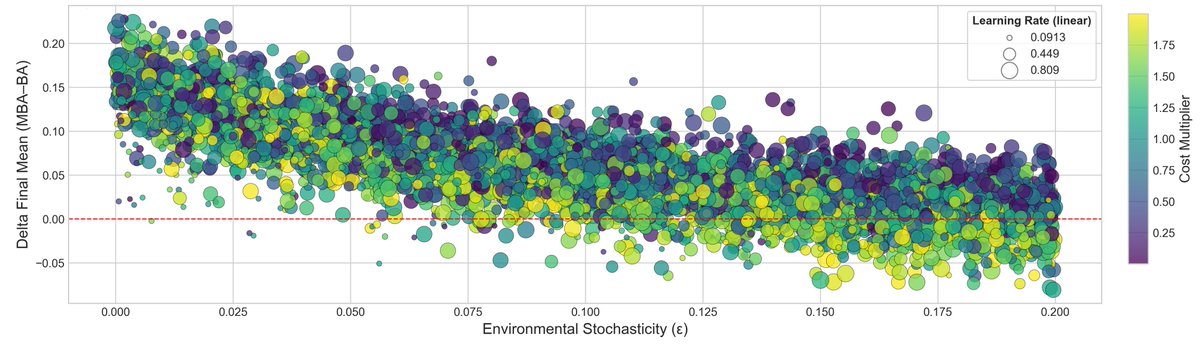
ALT A graph showing the performance landscape of the learning agent across environmental stochasticity, ε, on the x axis and delta final mean, MBA-BA, on the y axis. On the right is a color scale bar labeled cost multiplier, with lower values in blue, medium in green, and high in yellow. The size of the marker indicates the learning rate, with smaller rates as smaller circles and larger rates as larger circles. A red dashed line marks ∆ = 0, the point where fixed strategies outperform.
2
4
17
4,531
Patrick Erickson retweeted

May 16
More #preprints:
Giving Simulated Cells a Voice: Evolving Prompt-to-Intervention Models for Cellular Control
arxiv.org/abs/2505.02766
@namlehai @DrPatrickE @YanboZhang3 @DoctorJosh
ZapGPT: Free-form Language Prompting for Simulated Cellular Control
arxiv.org/abs/2509.10660
@namlehai @DrPatrickE @YanboZhang3 @DoctorJosh
Advancing the Scientific Method with Large Language Models: From Hypothesis to Discovery
arxiv.org/abs/2505.16477
@YanboZhang3 @hectorzenil and many others!
13
44
212
11,329
Patrick Erickson retweeted

Mar 20
It has been a great privilege to work with @drmichaellevin and an amazing team of scientists at @wyssinstitute and @TuftsUniversity to learn how neurons grow and form connections within completely novel bodies! @LaurieONeill99 @mmsperry @LPiolopez @DrPatrickE & Tiffany Lin
Mar 20

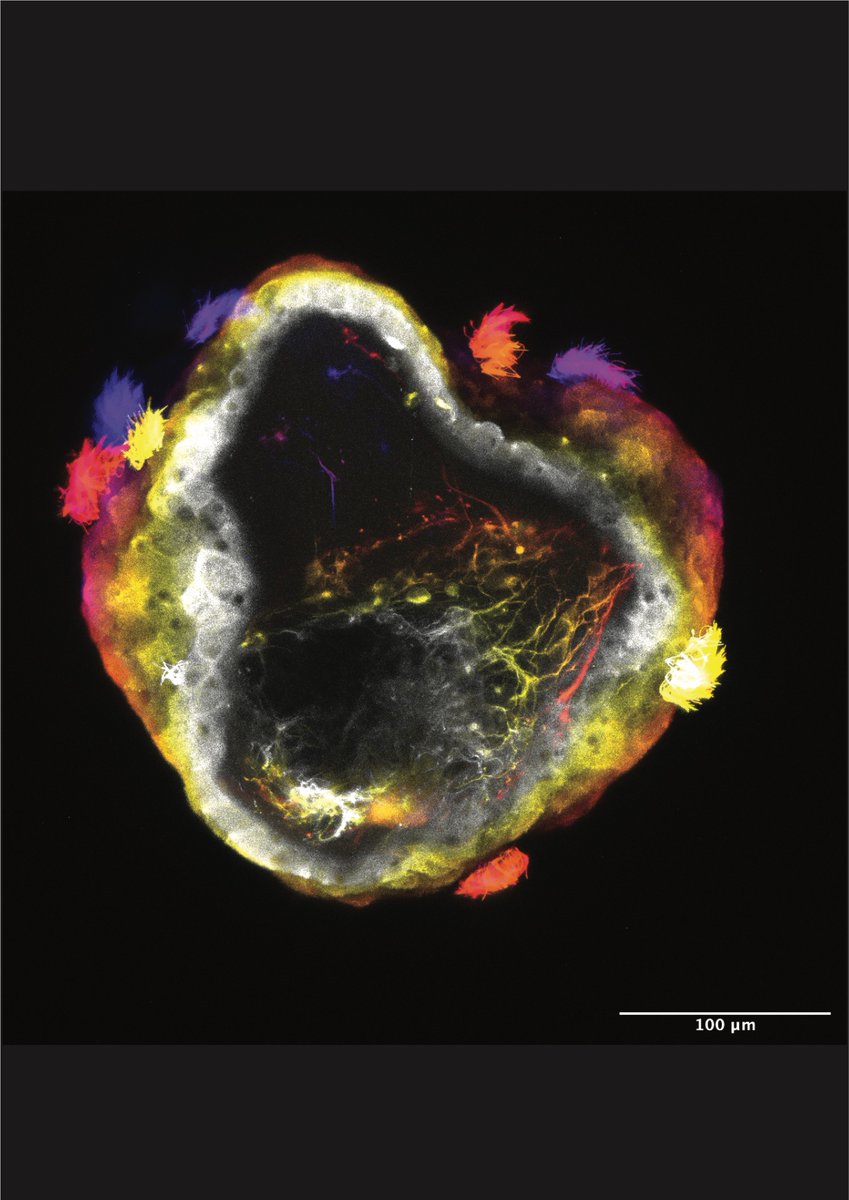
Ever wonder what a nervous system would look like if it self-assembled inside a novel being that hadn't faced a history of selection for its organism-level form and function? Or, perhaps you wondered how #Xenobots would look and act, or what their transcriptome would be like, if they had nervous systems?
Well, here's the first step: advanced.onlinelibrary.wiley…
"Engineered Living Systems With Self-Organizing NeuralNetworks: From Anatomy to Behavior and Gene Expression"
Our awesome team: led by @halehf: @LaurieONeill99, @mmsperry, @LPiolopez, @DrPatrickE, and Tiffany Lin.
The @TuftsUniversity and @wyssinstitute press releases are here, for summaries:
now.tufts.edu/2026/03/16/sci…
wyss.harvard.edu/news/toward…
1
3
42
1,911
Patrick Erickson retweeted
Mar 20
Ever wonder what a nervous system would look like if it self-assembled inside a novel being that hadn't faced a history of selection for its organism-level form and function? Or, perhaps you wondered how #Xenobots would look and act, or what their transcriptome would be like, if they had nervous systems?
Well, here's the first step: advanced.onlinelibrary.wiley…
"Engineered Living Systems With Self-Organizing NeuralNetworks: From Anatomy to Behavior and Gene Expression"
Our awesome team: led by @halehf: @LaurieONeill99, @mmsperry, @LPiolopez, @DrPatrickE, and Tiffany Lin.
The @TuftsUniversity and @wyssinstitute press releases are here, for summaries:
now.tufts.edu/2026/03/16/sci…
wyss.harvard.edu/news/toward…
62
271
1,527
213,780
Patrick Erickson retweeted

Mar 16
Call for papers for 'Artificial Life for Science and Engineering'
We seek work applying ALife concepts and tools to model real-world systems and engineer solutions—and assist scientific discovery through open-ended and curiosity-driven search.
Call info: alifeforscience.github.io
7
30
188
14,039

Patrick Erickson retweeted

9 Jul 2025
What is the bioelectric pattern of immortality and mortality in hydra? Happy to share our latest work with Angelina Pimkina, @DrPTMcMillen, @parandetayyebi, @DrPatrickE, @drmichaellevin in the journal Bioelectricity! liebertpub.com/doi/10.1089/b…
@TuftsUniversity @wyssinstitute
2
17
49
4,894
Patrick Erickson retweeted
24 Apr 2025
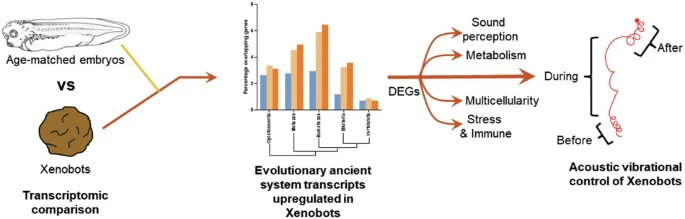
What if you analyzed the transcriptome of a living construct, made of wild-type (genetically-unmodified) cells but that had self-assembled with novel form and function - what genes might such a thing turn on and off, with what relationship to these genes' phylogenetic history, and what modes of control/communication with this form of life would the analysis of novel transcripts enable? I present the hard work of @pai_vaibhav , @LPiolopez, @mmsperry, @DrPatrickE, @parandetayyebi
nature.com/articles/s42003-0…
Abstract: "Would transcriptomes change if cell collectives acquired a novel morphogenetic and behavioral phenotype in the absence of genomic editing, transgenes, heterologous materials, or drugs? We investigate the effects of morphology and nascent emergent life history on gene expression in the basal (no engineering, no sculpting) form of Xenobots —autonomously motile constructs derived from Xenopus embryo ectodermal cell explants. To investigate gene expression differences between cells in the context of an embryo with those that have been freed from instructive signals and acquired novel lived experiences, we compare transcriptomes of these basal Xenobots with age-matched Xenopus embryos. Basal Xenobots show significantly larger inter-individual gene variability than age-matched embryos, suggesting increased exploration of the transcriptional space. We identify at least 537 (non-epidermal) transcripts uniquely upregulated in these Xenobots. Phylostratigraphy shows a majority of transcriptomic shifts in the basal Xenobots towards evolutionarily ancient transcripts. Pathway analyses indicate transcriptomic shifts in the categories of motility machinery, multicellularity, stress and immune response, metabolism, thanatotranscriptome, and sensory perception of sound and mechanical stimuli. We experimentally confirm that basal Xenobots respond to acoustic stimuli via changes in behavior. Together, these data may have implications for evolution, biomedicine, and synthetic morphoengineering."
14
51
238
19,972
Patrick Erickson retweeted
20 Apr 2025
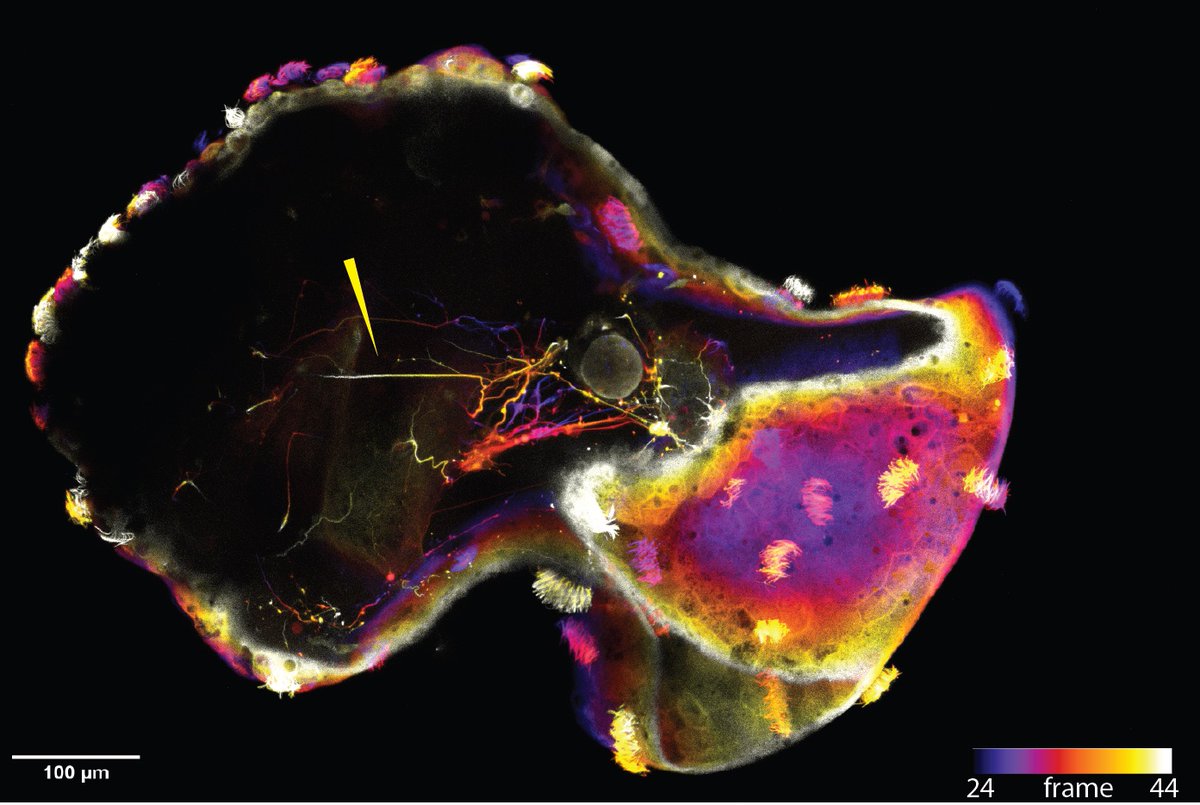
Ever wonder what the architecture of a neural network would look like, in a novel organism that had not been through selection for specific structure and function of an embodied nervous system? Here's our #preprint with morphological, behavioral, electrophysiological, and transcriptomic analysis of a new kind of Xenobot with a nervous system:
biorxiv.org/content/10.1101/… - the hard work of @halehf @LaurieONeill99 @mmsperry and @LPiolopez
Abstract: "A great deal is known about the formation and architecture of biological neural networks in animal models, which have arrived at their current structure-function relationship through evolution by natural selection. Little is known about the development of such structure-function relationships in a scenario where neurons are allowed to grow within evolutionarily-novel, motile bodies. Previous work showed that when a piece of ectodermal tissue is excised from Xenopus embryos and allowed to develop ex vivo, it will develop into a three-dimensional (3D) mucociliary organoid, and exhibits behaviors different from those observed in tadpoles of the same age. These 'biological robots' or 'biobots' are autonomous, self-powered, and able to move through aqueous environments. Here we report a novel type of biobot that is composed of ciliated epidermis and additionally incorporates neural tissue (neurobots). We show that neural precursor cells implanted within the Xenopus skin constructs develop into mature neurons and extend processes towards the outer surface of the bot as well as among each other. These self-organized neurobots show distinct external morphology, generate more complex patterns of spontaneous movements, and are differentially affected by neuroactive drugs compared to their non-neuronal counterparts. Calcium imaging experiments show that neurons within neurobots are indeed active. Transcriptomics analysis of the neurobots reveals increased variability of transcript profiles, expression of a plethora of genes relating to nervous system development and function, a shift toward more ancient genes, and up-regulation of neuronal genes implicated in visual perception."
41
182
891
71,916