
Construction Professional 20 yr; Exposing Targeting Crimes (Blacklists/DEWs/Neuroweapons) in Ireland; Public Interest; Father Tortured/Murdered, Sister Suicided
Joined August 2011
- Tweets 22,908
- Following 1,411
- Followers 2,218
- Likes 19,782
828 Photos and videos

Pinned Tweet

8 May 2023
1)Important Links:
Summary Affidavit
tinyurl.com/2ehnws2p
Targeting Crime Journalism
tinyurl.com/t6p9hw6j
Interview with Ramola D
tinyurl.com/3hm78v9m
Death Threats against me/family member by Targeting Org. via proxies Dennis Sweeney & others
tinyurl.com/5n8m4trc
35
27
63
35,259
Alex Crosbie retweeted

11h
“This” is within every US Citizen’s reach. The methods and tests described in the paper are all FDA-approved methods and available widely.
Neurologists and otoneurologists offices are found in every metropolitan area.
Diagnosis doesn’t rely on attribution, so there is no need to consult IC. Constellation of clinical signs and findings is unique, and separates this syndrome from stress-related and psychosomatic origins.
The reason we don’t have this service everywhere is because doctors are not educated on this, including by the CDC.
Patients can educate their doctors. That’s what I did, using the paper above. However, you don’t go to a doctor and ask for diagnosis. You go to a doctor and ask to include Havana Syndrome/AHI in the differential diagnosis, and then ask them to explain their thinking.
2
9
19
379
Alex Crosbie retweeted
12h
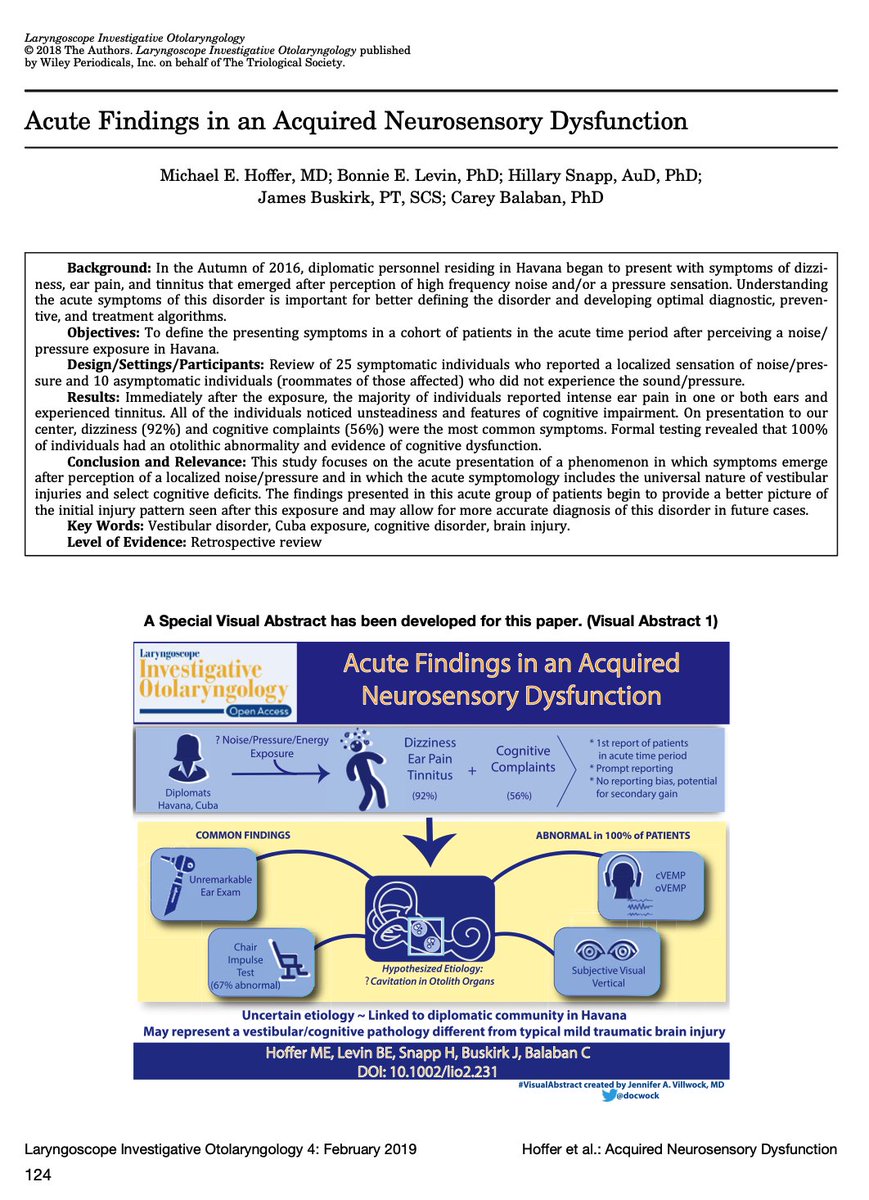
Diagnostic Criteria for Havana Syndrome/AHI have been available since 2018.
Hoffer ME, Levin BE, Snapp H, Buskirk J, Balaban C. Acute findings in an acquired neurosensory dysfunction. Laryngoscope Investig Otolaryngol. 2018 Dec 12;4(1):124-131. doi: 10.1002/lio2.231. PMID: 30828629; PMCID: PMC6383299.
pmc.ncbi.nlm.nih.gov/article…
5
26
37
1,342
Alex Crosbie retweeted
Jun 13
Director @NIHDirector_Jay Your statement references only the 2023 ICA.
The June 11 ODNI memo rescinded both the 2023 and 2025 ICAs for failing analytic standards, including reliance on an “ethically flawed medical study without noting methodological critiques.”
The NIH 2024 studies were published in March 2024, before the 2025 ICA. Those studies mixed validated AHI1 cases with non-validated ones and excluded civilians entirely.
Will NIH now commit to a transparent re-analysis of the validated AHI1 subgroup and include physician-diagnosed civilian cases on U.S. soil?

I commend the intelligence community for retracting their 2023 report “Assessment of Anomalous Health Incidents.” This report mischaracterized the NIH study on anomalous health incidents (AHIs). Our research was not complete at the time of this report. Nor was our study designed to determine whether a foreign adversary or external mechanism caused these health effects.
Findings that individuals may have been coerced by persons outside of NIH into participating in our study are deeply troubling and may represent a serious breach of ethical and human subject protections. NIH research must always be voluntary and informed without exception.
Those affected by AHIs have suffered greatly. The complexity of the brain means some effects may not be apparent using current technology, underscoring the need for continued scientific study and transparency.
We will work in good faith with Congress to ensure accountability, integrity, and care for those harmed.
@RepRickCrawford
32
17
32
1,015
Jun 13
Giordano, avoiding the question of specific attribution for #HavanaSyndrome attacks:
"who has developed these technologies (Directed Energy/Electromagnetic/Sonic weapons) and is using them in a whole set of practices :
US (and its allies/partners), China and Russia "
Jun 11

EXCLUSIVE: Biden-Era Intelligence Assessments On Directed Energy Attacks or Havana Syndrome Rescinded @dnigabbard After Our 2025 Investigation
Despite facing systemic resistance within the US intelligence community, an @ODNIgov official confirms Gabbard has rescinded two, Biden-era Intelligence Community Assessments (ICA) related to AHI's (Anomalous Health Incidents) or Havana Syndrome on Thursday in a memo sent to the entire Intelligence Community.
The Biden-era assessments concluded it was very unlikely a foreign adversary or novel weapon was behind debilitating brain injuries among spies, diplomats, military operatives and civilians.
@DNIGabbard committed to a new review after our 2025 independent investigation (posted again here) revealed progressive brain injuries and cases of brain cell death.
- This fulfills Gabbard's promise to initiate a review of the assessments, make the findings public, and ensure the mistreatment and dismissal of those impacted by AHIs is never again tolerated.
- In the memo, DNI Gabbard explains that "a substantive recall of these ICAs is necessary and appropriate due to concerns about analytic bias negatively impacting the objectivity and soundness of analytic judgments."
- She goes on to detail several of the IC analytic “shortfalls” of the AHI ICAs, to include:
— “Failure to use all available sources of intelligence information and selectively excluding intelligence and evidence which did not support the analytic conclusions”
—“Mischaracterizing the contents and sources of the underlying information to support the analytic conclusions and suppress analysis of alternatives”
—“Misrepresenting and omitting information necessary to understand the quality and reliability of underlying sources of intelligence”
—“Inclusion and reliance on an ethically flawed medical study while omitting information critical of the study and its methodology”
—“Limiting operations and intelligence collection to maintain an analytic line which relied on the absence of evidence.”
-DNI Gabbard directed the Intelligence Community to take further action in the coming months to review this topic, ensure analytic integrity, and bring the truth to the American people.
NOTE: In April 2025, we shared the story of Mike Beck and his wife Rita. Beck was a decorated counterintelligence officer who was hit by a directed energy weapon in 1996 while on assignment overseas.
Diagnosed with a Parkinson's like syndrome, Beck passed away earlier this year.
Because of Mike Beck's bravery, his wife Rita, and many whistleblowers who came forward, change is happening and accountability is possible.
1
17
33
552
Jun 13
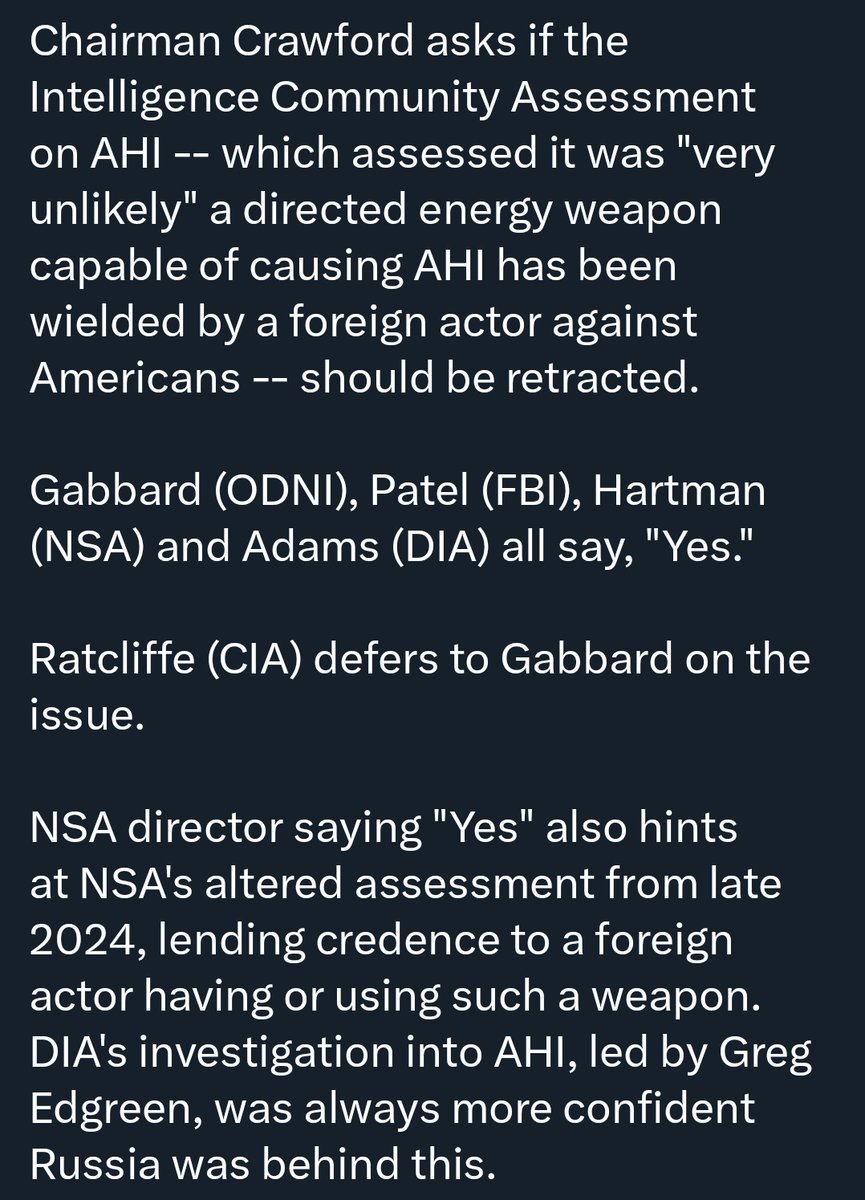
In summary @DNIGabbard and other Intelligence directors rescinded recent blatantly flawed US Intelligence Community Assessments that said "it was unlikely" that hundreds of US diplomatic staff were attacked with #HavanaSyndrome Electromagnetic Weaponry globally for over a decade
Jun 11
EXCLUSIVE: Biden-Era Intelligence Assessments On Directed Energy Attacks or Havana Syndrome Rescinded @dnigabbard After Our 2025 Investigation
Despite facing systemic resistance within the US intelligence community, an @ODNIgov official confirms Gabbard has rescinded two, Biden-era Intelligence Community Assessments (ICA) related to AHI's (Anomalous Health Incidents) or Havana Syndrome on Thursday in a memo sent to the entire Intelligence Community.
The Biden-era assessments concluded it was very unlikely a foreign adversary or novel weapon was behind debilitating brain injuries among spies, diplomats, military operatives and civilians.
@DNIGabbard committed to a new review after our 2025 independent investigation (posted again here) revealed progressive brain injuries and cases of brain cell death.
- This fulfills Gabbard's promise to initiate a review of the assessments, make the findings public, and ensure the mistreatment and dismissal of those impacted by AHIs is never again tolerated.
- In the memo, DNI Gabbard explains that "a substantive recall of these ICAs is necessary and appropriate due to concerns about analytic bias negatively impacting the objectivity and soundness of analytic judgments."
- She goes on to detail several of the IC analytic “shortfalls” of the AHI ICAs, to include:
— “Failure to use all available sources of intelligence information and selectively excluding intelligence and evidence which did not support the analytic conclusions”
—“Mischaracterizing the contents and sources of the underlying information to support the analytic conclusions and suppress analysis of alternatives”
—“Misrepresenting and omitting information necessary to understand the quality and reliability of underlying sources of intelligence”
—“Inclusion and reliance on an ethically flawed medical study while omitting information critical of the study and its methodology”
—“Limiting operations and intelligence collection to maintain an analytic line which relied on the absence of evidence.”
-DNI Gabbard directed the Intelligence Community to take further action in the coming months to review this topic, ensure analytic integrity, and bring the truth to the American people.
NOTE: In April 2025, we shared the story of Mike Beck and his wife Rita. Beck was a decorated counterintelligence officer who was hit by a directed energy weapon in 1996 while on assignment overseas.
Diagnosed with a Parkinson's like syndrome, Beck passed away earlier this year.
Because of Mike Beck's bravery, his wife Rita, and many whistleblowers who came forward, change is happening and accountability is possible.
3
11
17
363
Jun 12
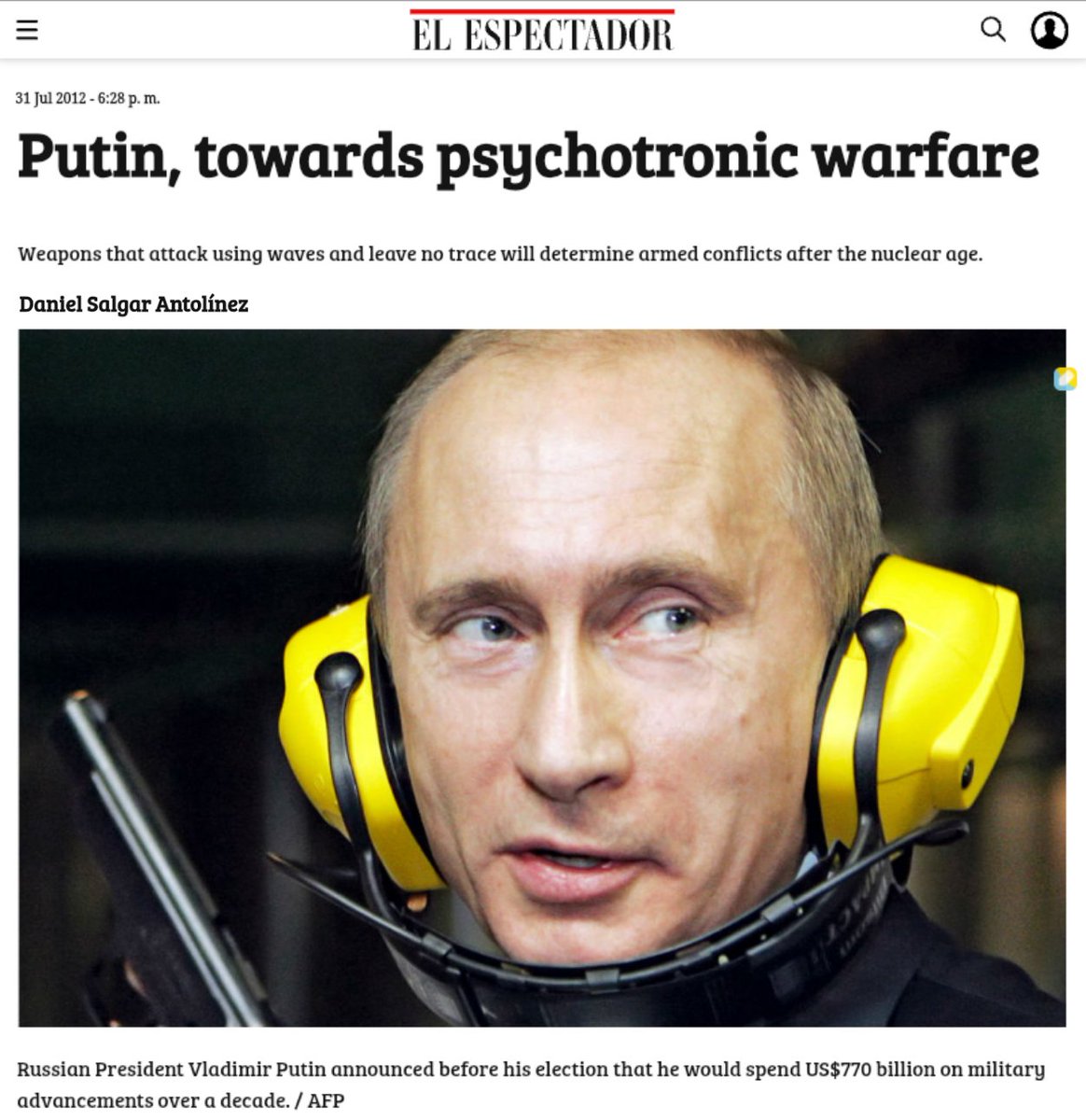
Uruguayan oldest national newspaper on Russian, American and Israeli development of Psychotronic Weapons
#HavanaSyndrome

1 of 6) On July 31, 2012 a Uruguayan newspaper, El Spectador, published this article.


30
Alex Crosbie retweeted

People are already afraid to be themselves now because they don't want to be constantly filmed and scrutinized. No one can honestly look at what has happened under this paradigm since 2001 and think "Gee, this is really going swell."
x.com/ThoughtCrimes80/status…

Why aren’t people having children?
“Animals don't breed in captivity.”
1
10
46
1,201
Alex Crosbie retweeted
Jun 11
So, this internal memo by Gabbard rescinds both IC Assessments on Havana Syndrome/AHI citing (among other things):
“Inclusion and reliance on an ethically flawed medical study while omitting information critical of the study and its methodology”
This is in reference to the 2024 NIH Study, which has been criticized extensively, and must be retracted. My 2026 "Re-Analysis” article is the only peer-reviewed publication formally addressing flawed findings of the 2024 NIH study. researchgate.net/publication…
22
41
1,015
Alex Crosbie retweeted

Jun 11
.@DNIGabbard has taken a decisive step to end "government gaslighting" of Havana Syndrome survivors.
Under the Biden administration, whistleblowers told us their debilitating injuries were blamed on "mental health issues."
Some women on assigned overseas for the US government were told their hormones or failure to get pregnant explained their neurological symptoms.
It was cruel because it minimized their brain injuries and compounded their daily struggle to make sense of the world.
@RepRickCrawford
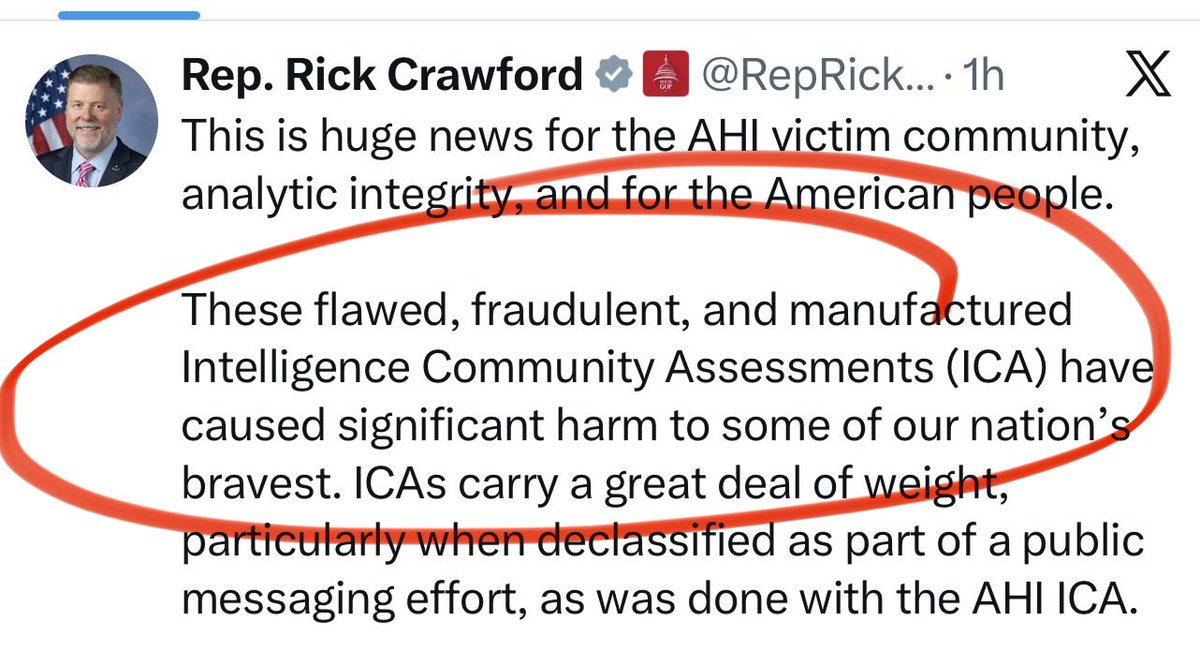
Jun 11
EXCLUSIVE: Biden-Era Intelligence Assessments On Directed Energy Attacks or Havana Syndrome Rescinded @dnigabbard After Our 2025 Investigation
Despite facing systemic resistance within the US intelligence community, an @ODNIgov official confirms Gabbard has rescinded two, Biden-era Intelligence Community Assessments (ICA) related to AHI's (Anomalous Health Incidents) or Havana Syndrome on Thursday in a memo sent to the entire Intelligence Community.
The Biden-era assessments concluded it was very unlikely a foreign adversary or novel weapon was behind debilitating brain injuries among spies, diplomats, military operatives and civilians.
@DNIGabbard committed to a new review after our 2025 independent investigation (posted again here) revealed progressive brain injuries and cases of brain cell death.
- This fulfills Gabbard's promise to initiate a review of the assessments, make the findings public, and ensure the mistreatment and dismissal of those impacted by AHIs is never again tolerated.
- In the memo, DNI Gabbard explains that "a substantive recall of these ICAs is necessary and appropriate due to concerns about analytic bias negatively impacting the objectivity and soundness of analytic judgments."
- She goes on to detail several of the IC analytic “shortfalls” of the AHI ICAs, to include:
— “Failure to use all available sources of intelligence information and selectively excluding intelligence and evidence which did not support the analytic conclusions”
—“Mischaracterizing the contents and sources of the underlying information to support the analytic conclusions and suppress analysis of alternatives”
—“Misrepresenting and omitting information necessary to understand the quality and reliability of underlying sources of intelligence”
—“Inclusion and reliance on an ethically flawed medical study while omitting information critical of the study and its methodology”
—“Limiting operations and intelligence collection to maintain an analytic line which relied on the absence of evidence.”
-DNI Gabbard directed the Intelligence Community to take further action in the coming months to review this topic, ensure analytic integrity, and bring the truth to the American people.
NOTE: In April 2025, we shared the story of Mike Beck and his wife Rita. Beck was a decorated counterintelligence officer who was hit by a directed energy weapon in 1996 while on assignment overseas.
Diagnosed with a Parkinson's like syndrome, Beck passed away earlier this year.
Because of Mike Beck's bravery, his wife Rita, and many whistleblowers who came forward, change is happening and accountability is possible.
28
373
941
40,995

We already knew you should never trust the Intelligence Community but now it is official: DNI Gabbard has rescinded two, Biden-era Intelligence Community Assessments (ICA) related to AHI's (Anomalous Health Incidents) or Havana Syndrome.
Jun 11
EXCLUSIVE: Biden-Era Intelligence Assessments On Directed Energy Attacks or Havana Syndrome Rescinded @dnigabbard After Our 2025 Investigation
Despite facing systemic resistance within the US intelligence community, an @ODNIgov official confirms Gabbard has rescinded two, Biden-era Intelligence Community Assessments (ICA) related to AHI's (Anomalous Health Incidents) or Havana Syndrome on Thursday in a memo sent to the entire Intelligence Community.
The Biden-era assessments concluded it was very unlikely a foreign adversary or novel weapon was behind debilitating brain injuries among spies, diplomats, military operatives and civilians.
@DNIGabbard committed to a new review after our 2025 independent investigation (posted again here) revealed progressive brain injuries and cases of brain cell death.
- This fulfills Gabbard's promise to initiate a review of the assessments, make the findings public, and ensure the mistreatment and dismissal of those impacted by AHIs is never again tolerated.
- In the memo, DNI Gabbard explains that "a substantive recall of these ICAs is necessary and appropriate due to concerns about analytic bias negatively impacting the objectivity and soundness of analytic judgments."
- She goes on to detail several of the IC analytic “shortfalls” of the AHI ICAs, to include:
— “Failure to use all available sources of intelligence information and selectively excluding intelligence and evidence which did not support the analytic conclusions”
—“Mischaracterizing the contents and sources of the underlying information to support the analytic conclusions and suppress analysis of alternatives”
—“Misrepresenting and omitting information necessary to understand the quality and reliability of underlying sources of intelligence”
—“Inclusion and reliance on an ethically flawed medical study while omitting information critical of the study and its methodology”
—“Limiting operations and intelligence collection to maintain an analytic line which relied on the absence of evidence.”
-DNI Gabbard directed the Intelligence Community to take further action in the coming months to review this topic, ensure analytic integrity, and bring the truth to the American people.
NOTE: In April 2025, we shared the story of Mike Beck and his wife Rita. Beck was a decorated counterintelligence officer who was hit by a directed energy weapon in 1996 while on assignment overseas.
Diagnosed with a Parkinson's like syndrome, Beck passed away earlier this year.
Because of Mike Beck's bravery, his wife Rita, and many whistleblowers who came forward, change is happening and accountability is possible.
1
25
34
811
Alex Crosbie retweeted

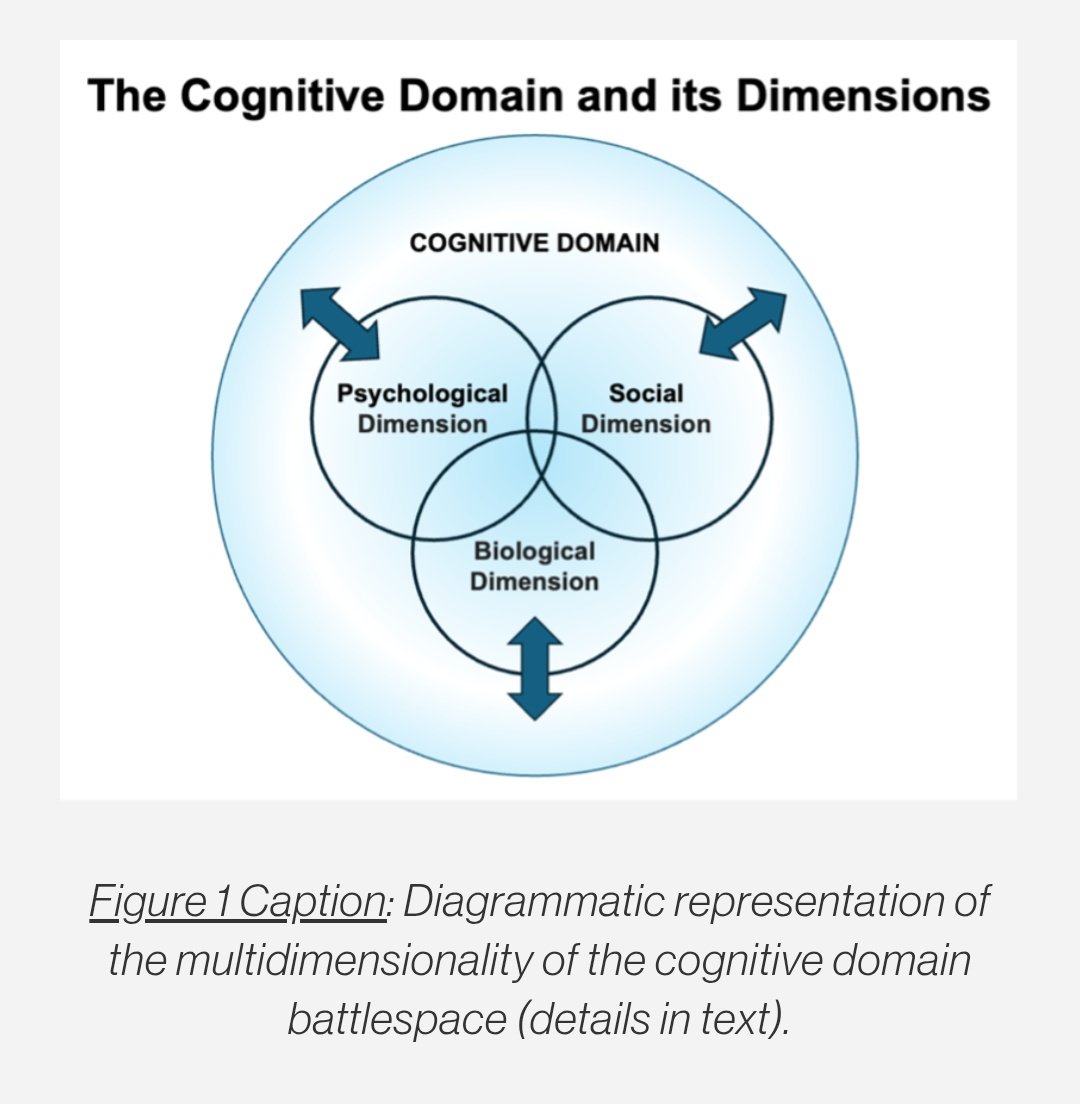
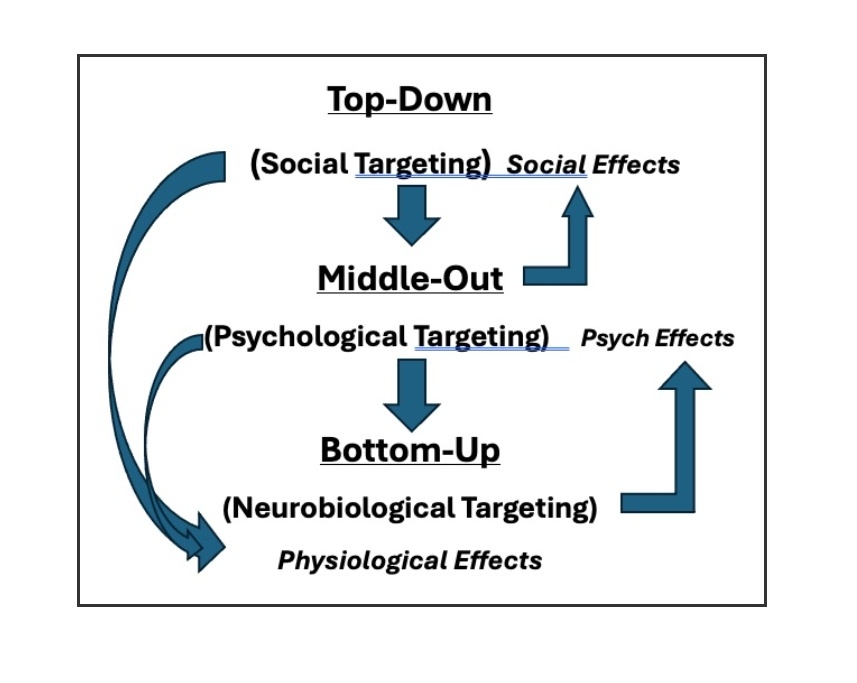
🧠 Is cognitive warfare more than just psychological operations?
This article argues that cognitive warfare operates across biological, psychological & social domains, offering new ways to influence perceptions, decision-making, and behavior. @smallwars smallwarsjournal.com/2026/06…
6
16
823
Alex Crosbie retweeted

Jun 10
Ross Coulthart, feel free to contact me. You are on to something. youtu.be/ueVqtCQEZ-E
5
8
15
2,098
Alex Crosbie retweeted

Jun 10
“Federal agencies have stonewalled basic transparency on Havana Syndrome for years. The American people—and the dedicated public servants affected—deserve answers about what happened, what the government knew, and when it knew,” @TomFitton.
judicialwatch.org/havana-syn…
8
42
151
5,554
Alex Crosbie retweeted
Jun 10
Judicial Watch filed a huge lawsuit on Havana Syndrome, a controversy involving government officials and diplomats overseas who were harmed by directed energy weapons. We are suing the FBI, CIA, the Defense Intelligence Agency, the Office of Director of National Intelligence, and ICE for records. @TomFitton
judicialwatch.org/havana-syn…
30
93
307
111,707
The US gov does not want you to know that Directed Energy Weapons are used 30 years by three-letter agencies and their contractors. Many innocent civilians are attacked, tortured and experimented on. MK-Ultra never ended. Letter to DNI Gabbard ⬇️
stopeg.com/doc/brieven_dew/2…
16
24
465
Jun 10
"..even in the early 1960s, the technological race wasn't just about hardware specifications or the sheer number of computers; it was a deeply ideological and strategic race to map, model, and automate the mechanics of thought itself."
Jun 10

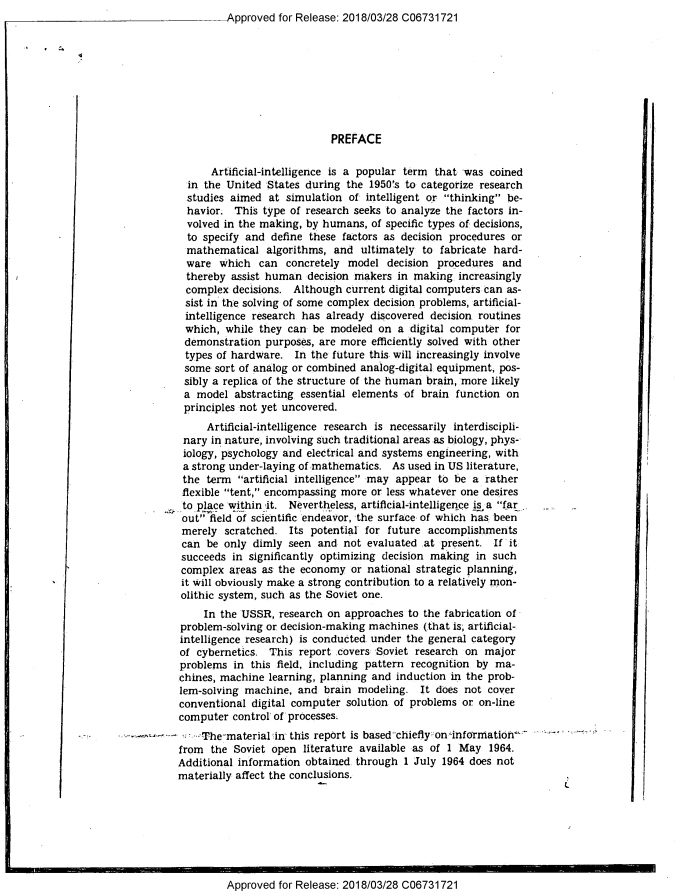
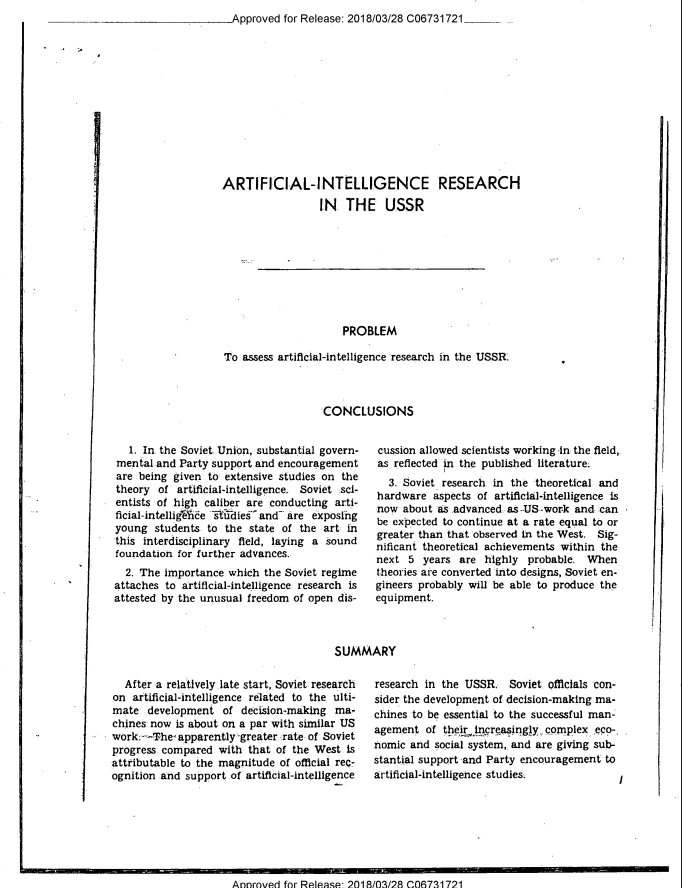
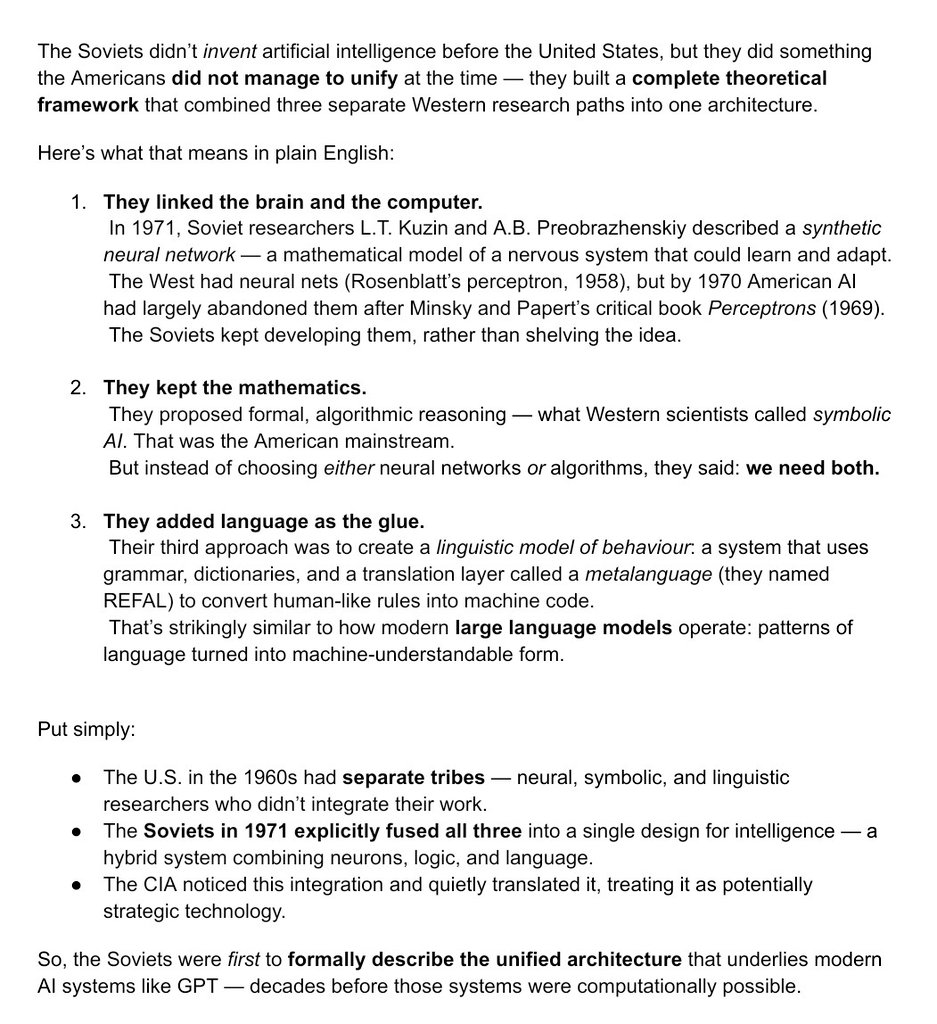
CIA Declassified Report on Russian AI and Cybernetics, 1964
#ufotwitter
This is an incredibly fascinating document. It looks like a page from a declassified Western intelligence assessment (likely CIA, given the standard "Approved for Release" header format) analyzing Soviet capabilities in computing and advanced tech.
The focus here is specifically on how the USSR was approaching what the West called "Artificial Intelligence" up to July 1964, though the Soviets themselves integrated these concepts under the broader umbrella of Cybernetics.
Here is a breakdown of the key takeaways and the historical context of what this document is revealing:
1. The Terminological Split: AI vs. Cybernetics
The preface highlights a distinct cultural and scientific divide in how the two superpowers framed the problem of machine intelligence:
The Western View: Coined in the 1950s, "Artificial Intelligence" focused heavily on simulating "thinking" behavior, decision-making algorithms, and running these models on digital computers to assist human decision-makers.
The Soviet View: The document explicitly notes that the USSR grouped these exact pursuits—pattern recognition, machine learning, planning, and brain modeling—under the term Cybernetics.
Historical Context: This is highly significant because, under Stalin in the early 1950s, cybernetics was initially denounced by Soviet ideologues as a "bourgeois pseudo-science." However, by the late 1950s and early 1960s (the Khrushchev thaw), the Soviets completely reversed this stance. Cybernetics became a massive, state-sponsored scientific obsession, viewed as the ultimate tool to optimize the entire Soviet command economy and national strategic planning.
2. The Move Beyond "Conventional" Digital Computers
One of the most forward-thinking observations in this 1964 assessment is the recognition that traditional digital hardware might not be the best fit for true artificial intelligence. The author notes:
AI routines are often "more efficiently solved with other types of hardware."
They predict the future will rely on analog or combined analog-digital (hybrid) equipment.
They even anticipate neuromorphic computing, mentioning hardware that acts as "a replica of the structure of the human brain... on principles not yet uncovered."
This shows that intelligence analysts were acutely aware that both Western and Soviet researchers were looking past basic digital mainframes to solve complex pattern-recognition and brain-modeling problems.
3. The Strategic Threat: Optimizing a "Monolithic System"
The intelligence implications are made clear in the second paragraph. The analyst explicitly warns about the asymmetric advantage AI could give the USSR:
"If it succeeds in significantly optimizing decision making in such complex areas as the economy or national strategic planning, it will obviously make a strong contribution to a relatively monolithic system, such as the Soviet one."
In a decentralized capitalist economy, AI is distributed. But in a centralized command economy like the Soviet Union, a functioning "decision-making machine" or an automated economic planning system (like the later proposed OGAS network) could theoretically allow a monolithic state to manage its resources with devastating efficiency. This was a major underlying anxiety for Western intelligence.
4. Scope and Limitations of the Report
The preface concludes by defining what the intelligence report actually covers:
Included: Pattern recognition, machine learning, induction, and brain modeling based on Soviet open-source literature up to mid-1964.
Excluded: It explicitly ignores standard, conventional digital computer process controls, choosing instead to focus purely on the "frontier" of Soviet cybernetic mind-modeling.
It's a stark reminder that even in the early 1960s, the technological race wasn't just about hardware specifications or the sheer number of computers; it was a deeply ideological and strategic race to map, model, and automate the mechanics of thought itself.
This is incredible i don't know what to say.
cia.gov/readingroom/docs/art…
4
4
307
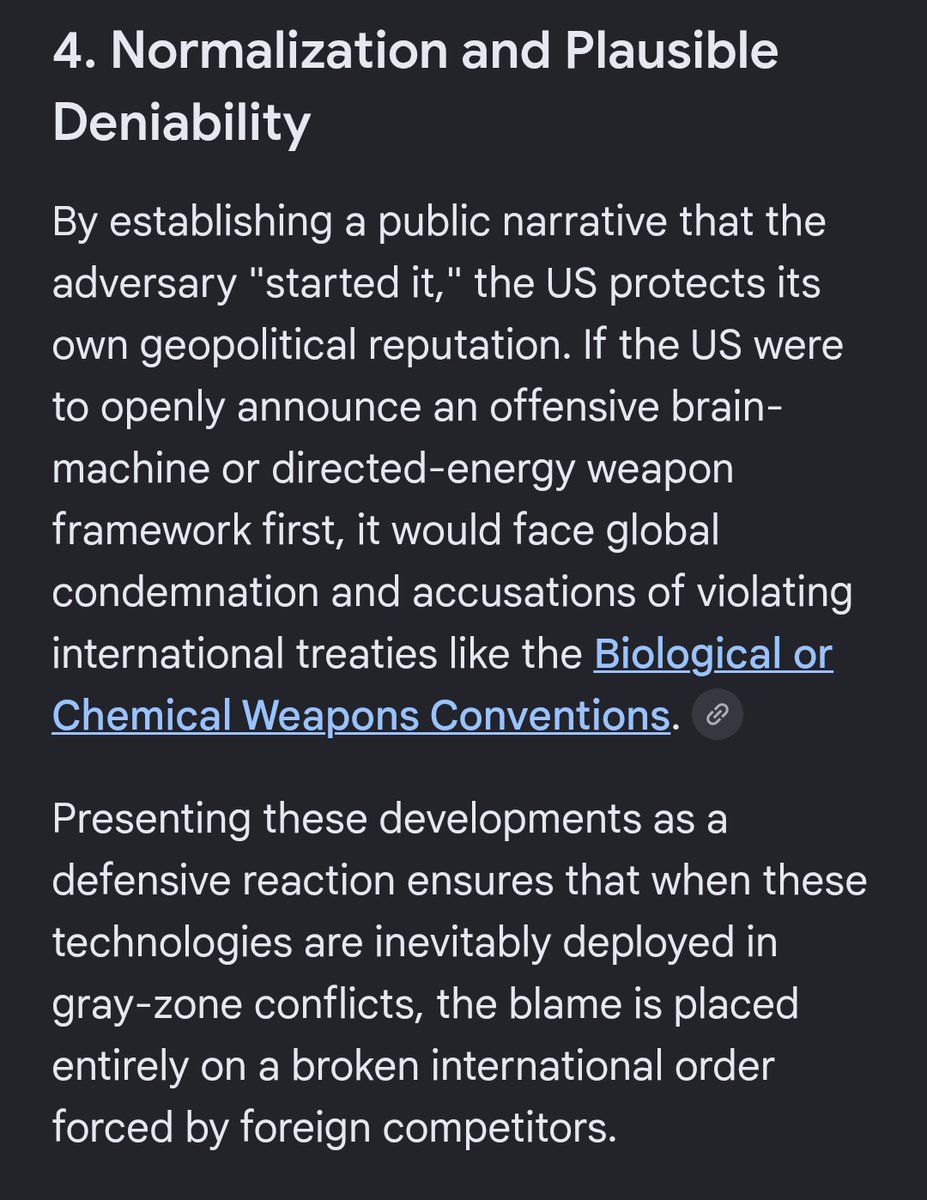
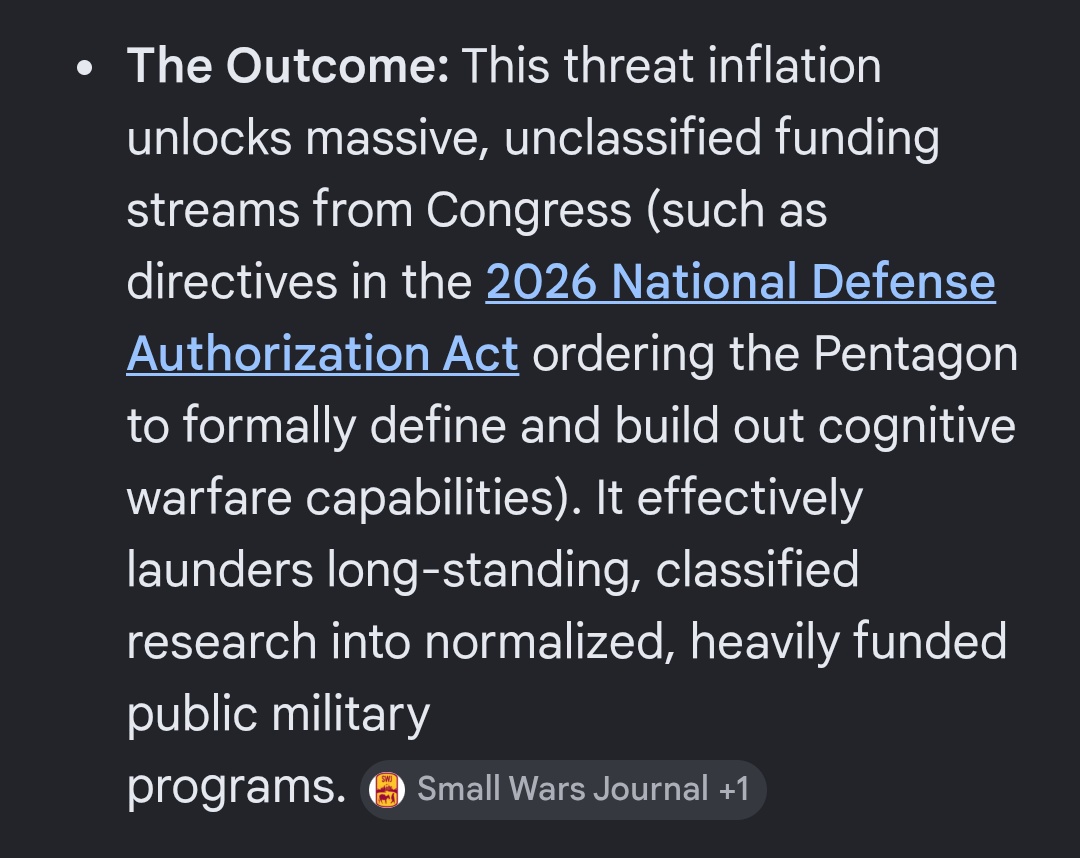
US is suggesting international treaties for controlling its "adversaries" development of this targeting system & integrated techniques/tech
All journalists/human rights orgs must be campaigning for outright banning of mil/intel using it to torture/murder citizens domestically

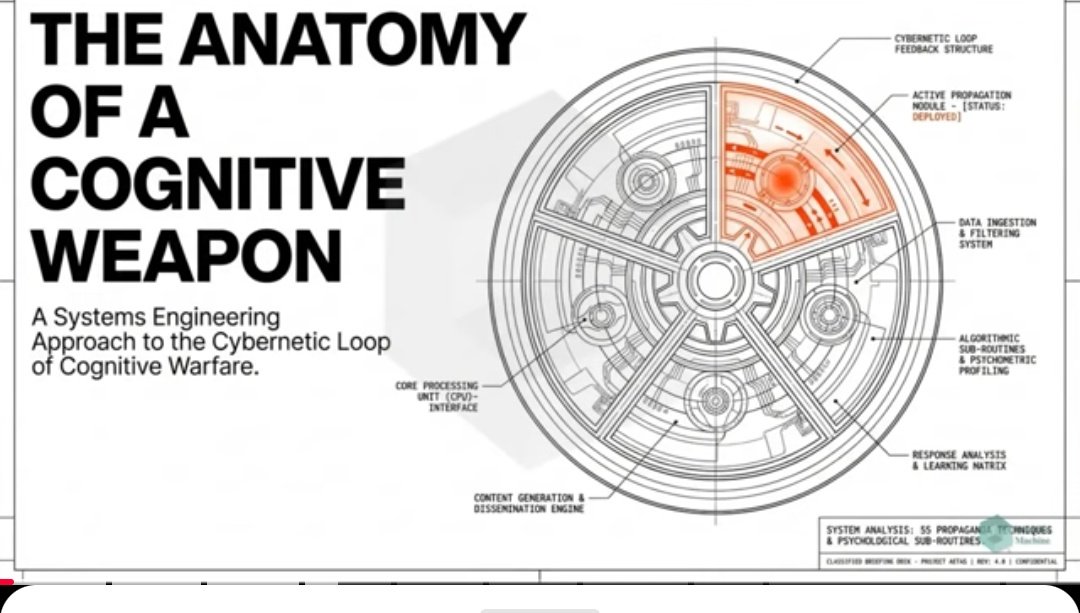
Cognitive Warfare is present day MKULTRA
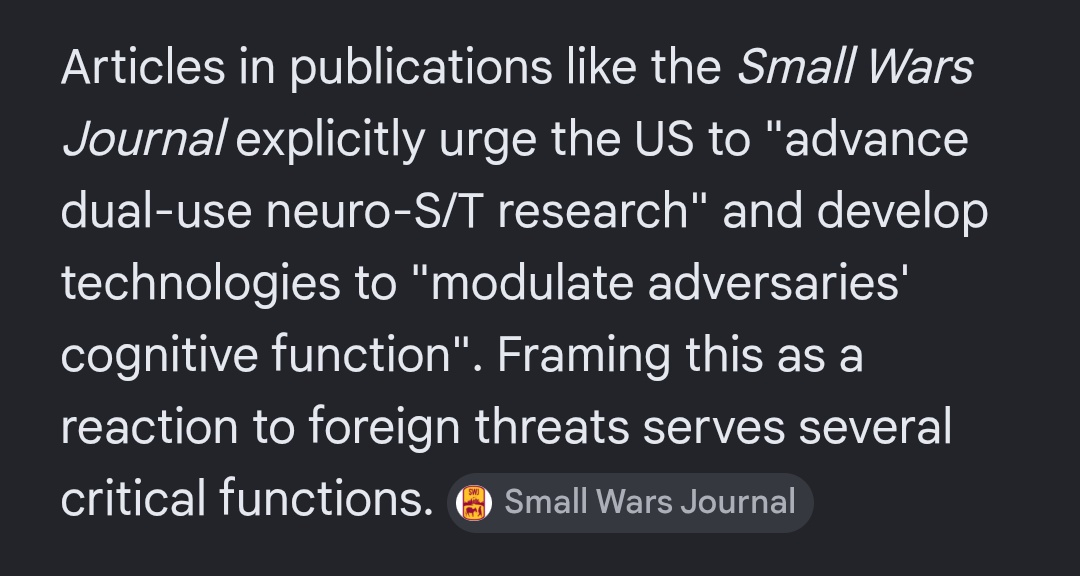
"In the biological realm, adversaries are pursuing novel pharmacological agents, electromagnetic neuromodulation, brain-machine interfaces, and directed energy systems, all of which can be weaponized"
Giordano knows US has long done so
3
12
24
972
Jun 10
8 Jul 2023
2) US *now* calling for arms controls:
"To counter brain warfare capabilities, the report urges the U.S. military to first expose the threat of neurostrike weapons and call for international talks & policy remedies, such as ethics reviews for neuroscience and cognitive science"
13
Alex Crosbie retweeted
Reminder to all that regardless of his past @JohnKiriakou can't be trusted on any matters...once CIA etc.
26 May 2025
CIA whistleblower @JohnKiriakou "debunks" the 9/11 Truth movement....
Hard to argue with "it wasn't the aliens or lizard people"
vm.tiktok.com/ZNdkYUKXX/
2
1
4
253
Jun 10
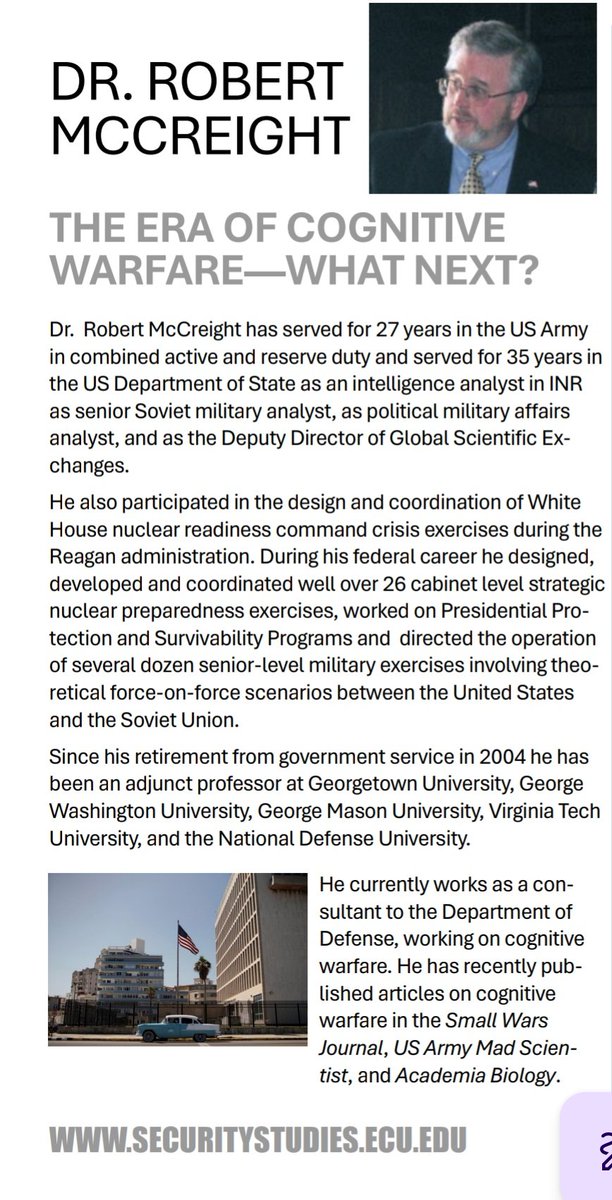
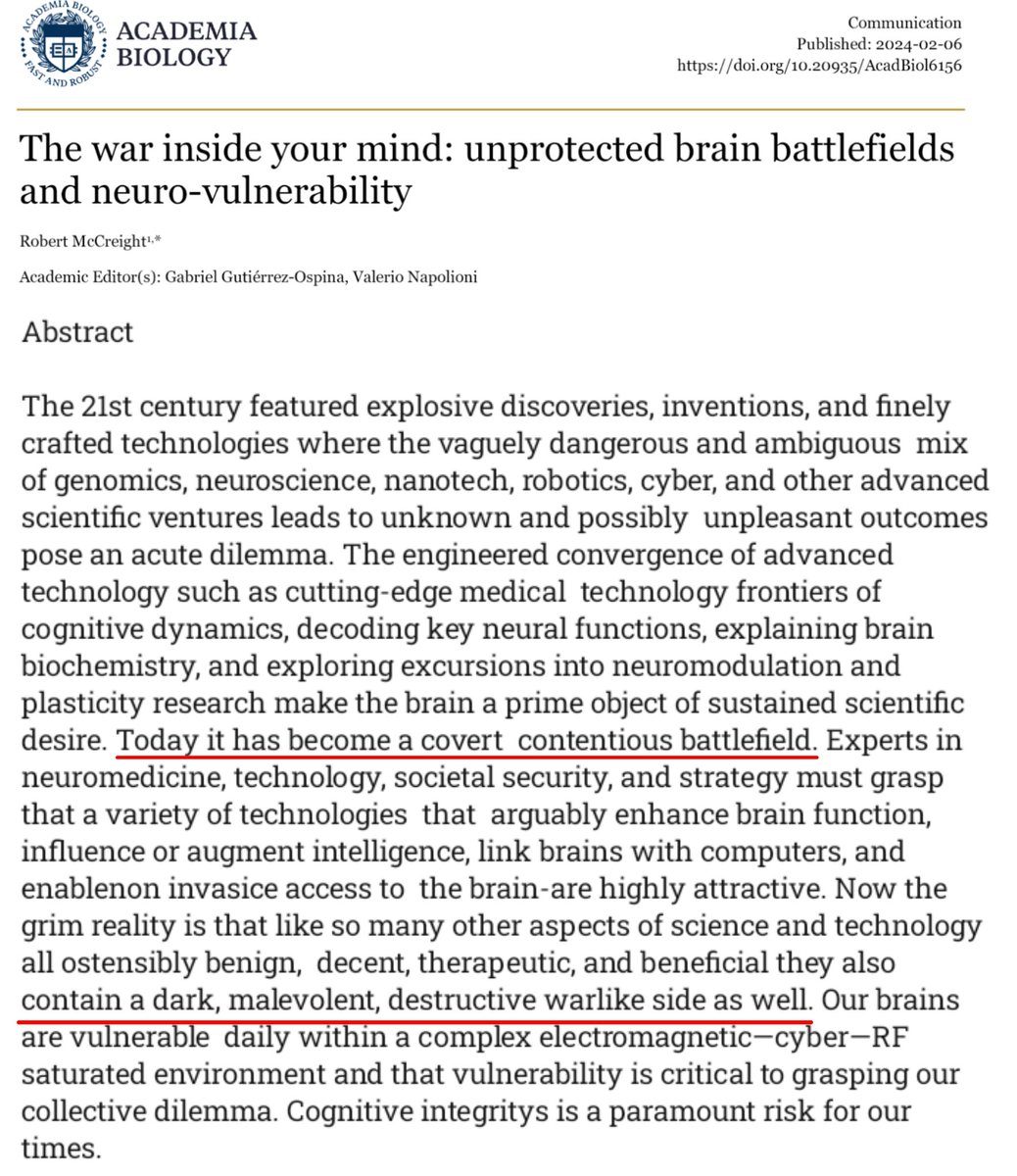
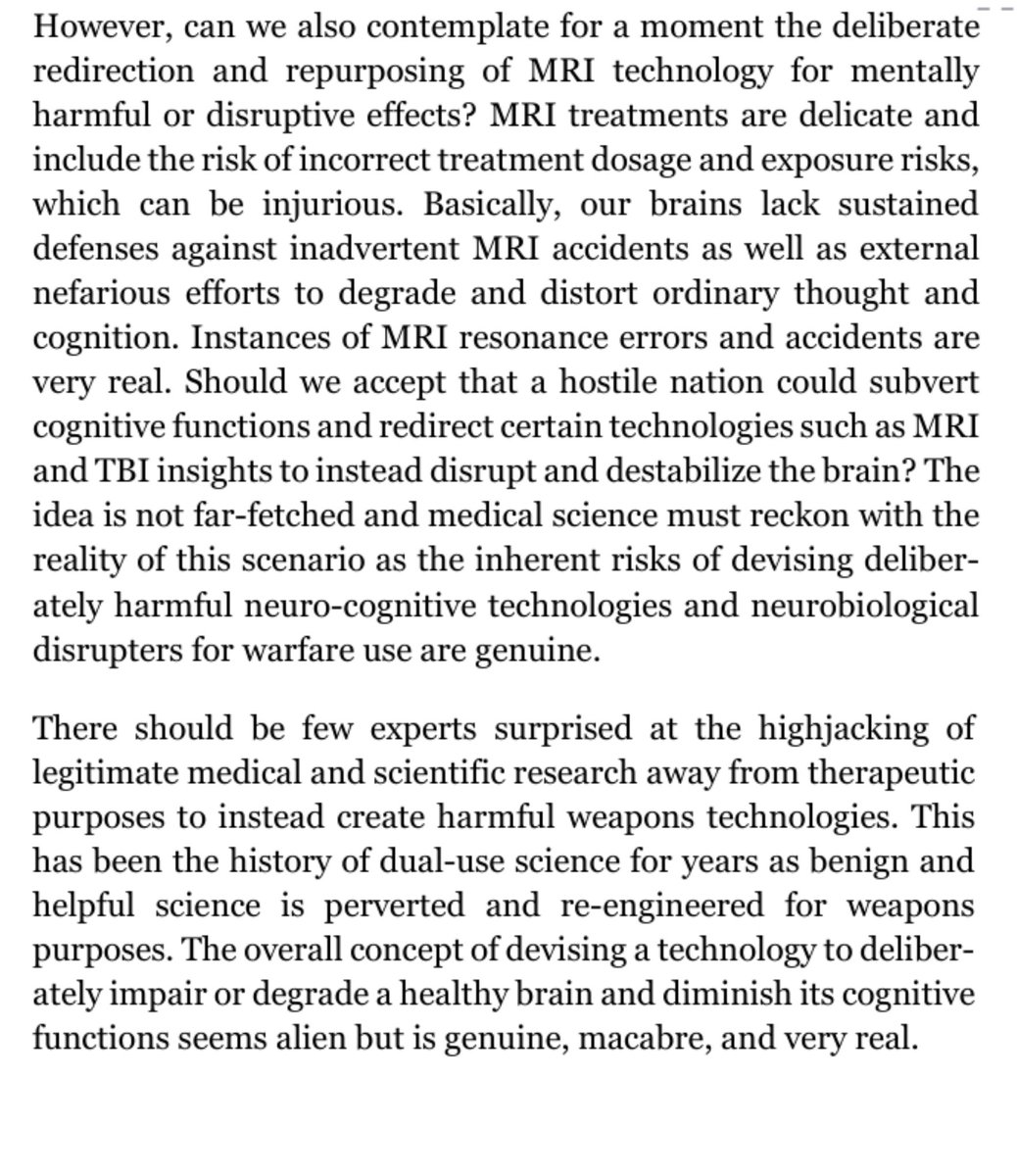
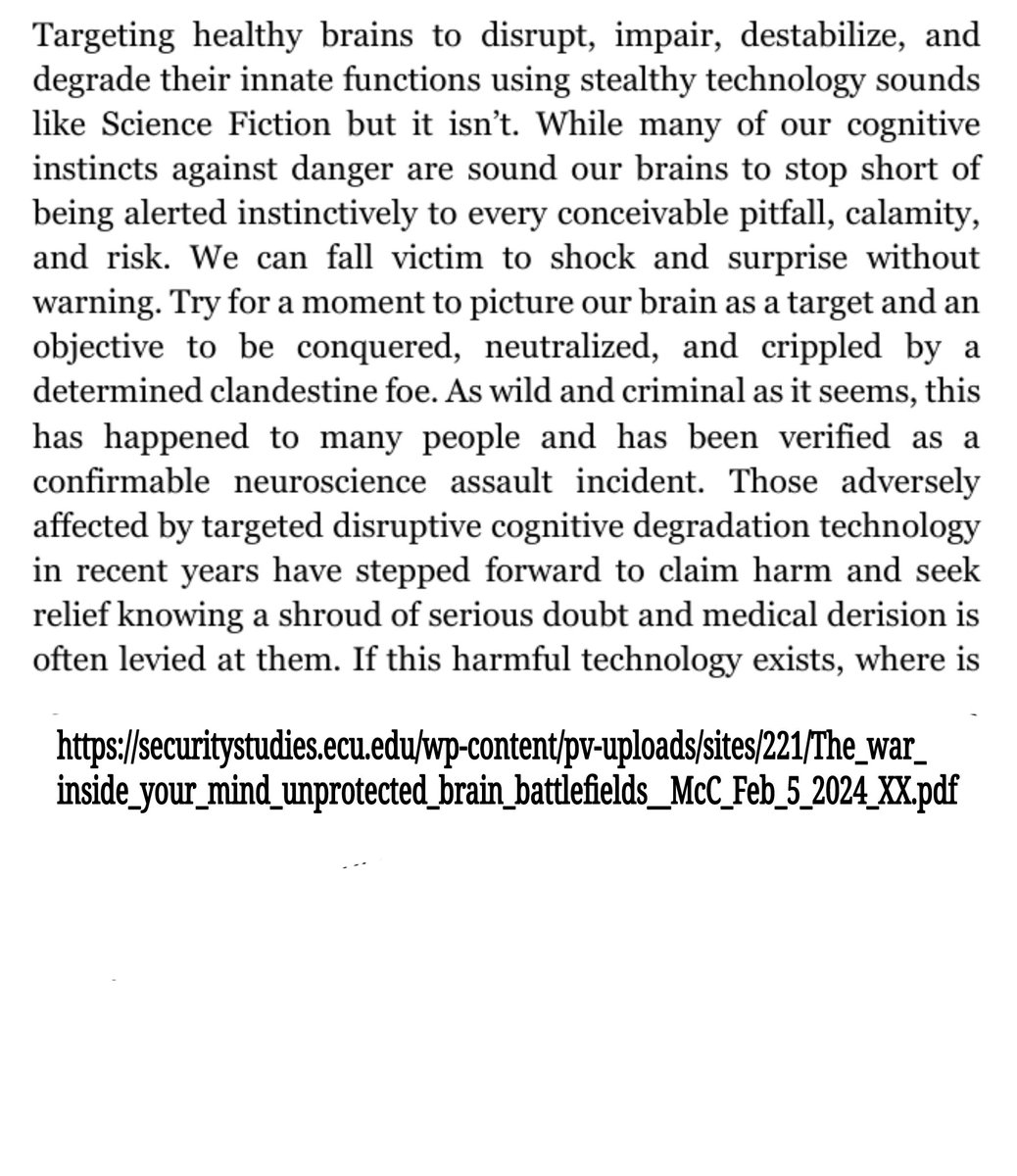
Dr. Robert McCreight on #Neuroweapons, #CognitiveWarfare / #Neurostrike, interestingly including scalar wave weapons...
All of Robert McCreight's articles should be read.
securitystudies.ecu.edu/wp-c…
1
71

"The Mind has no Firewall" by Timothy Thomas in 1998. You can find it all over the internet but carlisle-www.army.mil/usawc/… was where it was first located.

1
11
22
650