
Learner and leader curious about tech x edu, future of work, and education. Director of Technology and Co-Founder @Ed3dao | Founder of Peck Education LLC
Joined February 2013
- Tweets 7,832
- Following 1,560
- Followers 2,306
- Likes 12,379
722 Photos and videos







Pinned Tweet

31 Dec 2021
So excited to begin exploring the new frontier of web3 and its pending impacts on education, the future of work, and technology. Join me via wordpress or mirror.xyz. edtechmpeck.wordpress.com/20…
6
13
69
Mike Peck, Ed. D.🛡️ retweeted

Jun 14
⚡️Satya is describing the new balance sheet of the firm.
The old firm owned people, processes, software, customer relationships, brand, data, and IP.
The new firm will own a compounding cognition loop.
Every workflow becomes a training surface. Every decision becomes a trace. Every expert judgment becomes reusable signal. Every internal correction becomes model improvement. Every model run becomes a chance to turn human judgment into institutional intelligence.
That is what “token capital” really means.
It is accumulated machine-operable cognition. A company’s expertise becomes executable, queryable, evaluable, improvable, and portable across models.
That is a massive shift.
The most important line is the one about switching out the generalist model without losing the company veteran expertise. That is the entire enterprise AI war. Model providers want the firm’s knowledge to flow into the model layer.
Enterprises need that knowledge to stay inside their own loop.
Whoever owns the loop owns the future economic rent.
Satya is laying out Microsoft’s answer to the frontier-model monopoly problem.
If all company knowledge flows upward into a few foundation models, the foundation model labs become landlords of the entire economy. They absorb everyone’s expertise, commoditize every workflow, and capture the value created by every firm’s learning process. That equilibrium will trigger political backlash, customer resistance, regulatory pressure, and corporate revolt.
So Microsoft’s doctrine is: every company should build its own AI learning system on top of frontier models, while Microsoft owns the infrastructure where that happens.
That is elegant and self-serving.
Microsoft does not need to own the single best frontier model forever. It needs to own the enterprise control plane: identity, security, permissions, data, workflow, evals, agents, memory, developer tools, cloud, compliance, and model routing. If the model becomes swappable, the platform underneath the firm’s learning loop becomes the durable asset.
Satya is quietly saying the frontier model alone is unstable. A world of a few models eating every company’s expertise breaks the political economy. A world where every company builds firm-specific AI capital on top of models is more stable, more defensible, and much better for Microsoft.
The “human capital gets more valuable” line is partly true and partly corporate diplomacy.
High-agency humans become more valuable. People with taste, judgment, relationships, domain intuition, ambition, and the ability to direct agentic systems become much more valuable.
Routine cognitive labor loses bargaining power.
The future firm does not need every human equally. It needs humans who can generate high-quality signal for the loop. The human becomes a trainer, judge, strategist, relationship node, taste layer, and goal-setter. The work that cannot feed the loop or direct the loop gets compressed.
This also connects directly to the Anthropic crisis.
If frontier model access can be restricted, pulled, nationality-gated, or subordinated to state power, then enterprises cannot allow their intelligence layer to live entirely inside one external model. They need portability. They need private evals. They need internal memory. They need their own traces. They need model-agnostic learning systems.
The model can change.
The firm’s cognition loop has to survive.
That is the new sovereignty test.
A company that only buys AI access is a renter.
A company that turns its workflows, judgments, corrections, and outcomes into a private learning loop is building capital.
The deeper implication: the future economy splits between firms that compound cognition and firms that leak cognition.
Firms that compound cognition will get stronger every time they operate.

63
147
1,157
336,869
Models are getting smaller and faster in a way that is hard to comprehend. The implications we're only beginning to understand, though a safe bet is we're moving towards a world of ambient AI.
Jun 3

📍 Local AI Worker, Not Local Authority
I tested Gemma 4 12B on one M2 Pro Mac mini.
11.9B Q4_K_M
100% GPU
~14.4 tok/sec
8.1 GB resident
It works.
But the real takeaway is not “local AI replaces cloud AI.”
It is this:
local models are now fast enough to become private workers behind a governed backend relay.
They should annotate artifacts, pre-process memory candidates, and QA visual specs.
They should not touch credentials, MCP secrets, or backend-only tools.
The model does the local perception.
The relay keeps the authority.
1
2
112
Check out the latest article in my newsletter: What If the Best Preparation for AI Isn't More Technology? linkedin.com/pulse/what-best… via @LinkedIn
1
24
Mike Peck, Ed. D.🛡️ retweeted

The thing nobody tells you about exponential change is that it feels like nothing is happening right up until the moment everything happens at once.
676
2,190
12,170
16,309,430
May 21
My first piece just published with District Administration
Most AI conversations in schools assume everyone is solving the same problem.
Principals and superintendents need fundamentally different frames for AI. One is operational. One is systemic.
Until you name the gap, implementation stalls.
Check out the full article here: districtadministration.com/o…
2
30
May 12
A lot of nuance in the future of work that is being missed in the proclamations from the hyperscalers

3
55
Apr 18
Situational awareness

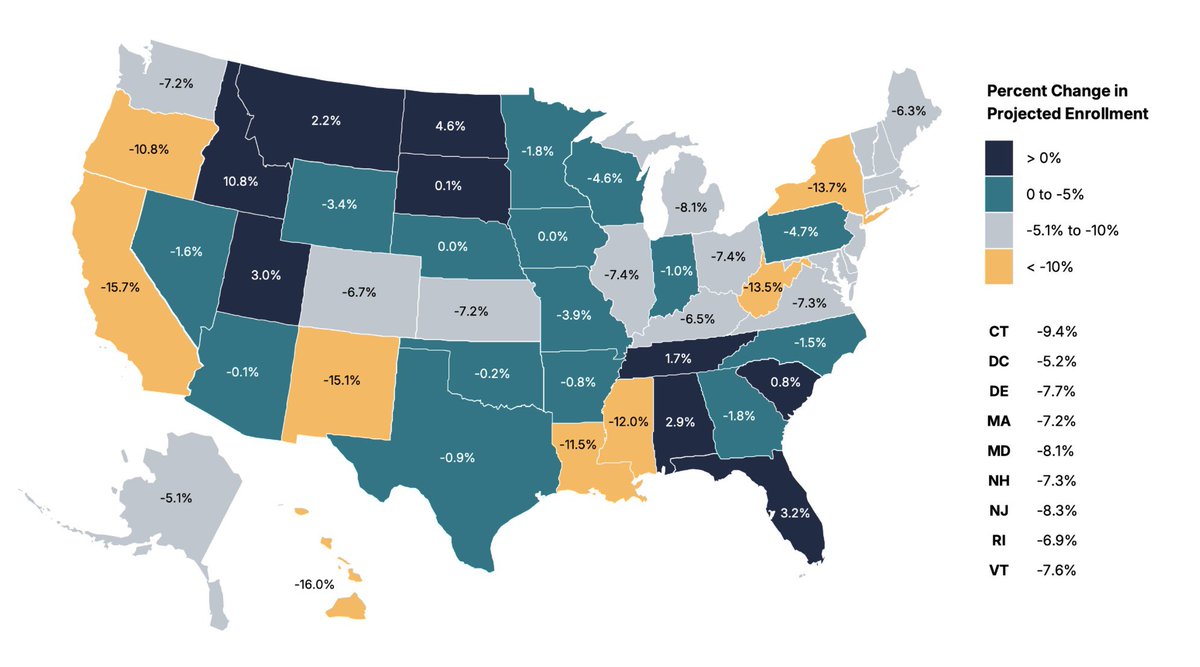
I don’t think people have fully absorbed just how big the declines in student enrollment are going to be.
Eight states are projected to experience DOUBLE DIGIT declines by 2031.
1
35
Mike Peck, Ed. D.🛡️ retweeted

Apr 14
The more enterprises I talk to about AI agent transformation, the more it’s clear that there is going to be a new type of role in most enterprises going forward. The job is to be the agent deployer and manager in teams. Here’s the rough JD:
This person will need to figure out what are the highest leverage set of workflows on a team are (either existing or new ones) where agents can actually drive significantly more value for the team and company.
In general, it’s going to be in areas where if you threw compute (in the form of agents) at a task you could either execute it 100X faster or do it 100X more times than before. Examples would be processing orders of magnitude more leads to hand them off to reps with extra customer signal, automating a contracting review and intake process, streamlining a client onboarding process to reduce as many straps as possible, setting up knowledge bases than the whole company taps into, and so on.
This person’s job is to figure out what the future state workflow needs to look like to drive this new form of automation, and how to connect up the various existing or new systems in such a way that this can be fulfilled. The gnarly part of the work is mapping structured and unstructured data flows, figuring out the ideal workflow, getting the agent the context it needs to do the work properly, figuring out where the human interfaces with the agent and at what steps, manages evals and reviews after any major model or data change, and runs and manages the agents on an ongoing basis tracking KPIs, and so on.
The person must be good at mapping the process and understanding where the value could be unlocked and be relatively technical, and has full autonomy to connect up business systems and drive automation. This means they’re comfortable with skills, MCP, CLIs, and so on, and the company believes it’s safe for them to do so. But also great operationally and at business.
It may be an existing person repositioned, or a totally net new person in the company. There will likely need to be one or more of these people on every team, so it’s not a centralized role per se. It may rile up into IT or an AI team, or live in the function and just have checkpoints with a central function.
This would also be a fantastic job for next gen hires who are leaning into AI, and are technical, to be able to go into. And for anyone concerned about engineers in the future, this will be an obvious area for these skills as well.
277
398
3,808
1,040,648
Mike Peck, Ed. D.🛡️ retweeted

Apr 5
There are no words.

7,773
85,753
646,685
39,023,637
Mar 24
>be AI twitter
> post the biggest thing ever in AI
> world is upending
> insert dicaprio inception meme
> you can save yourself by reading my newsletter
38
Mar 17
Teachers are using AI to plan lessons faster.
Students are using AI to finish assignments faster.
Via @EdWeekEdTech
61% of teachers now use AI in their work.
52% of teens say AI on assignments should be encouraged.
Let that tension sink in
2
40
Mar 17
I've gotten more done in 30 minutes with Hermes via @NousResearch than I did in 3 weeks with @openclaw. Borrowing from @Zeneca but it just works. Looking forward to building a Chief of Staff.
1
3
58
Mar 16
When I started teaching in 2008, the realization that the internet meant that a student could come in to class and know more than me on any given topic was jarring. BUT was critical to help me rethink the value of what and how I taught.
AI has allowed millions of people to gain access to, in effect, a personal tutor.
We are now at the stage of building interactive classrooms complete with adaptive content and agent-powered classmates, with AI.
Each event comes with challenges and opportunities. We're at a critical moment where we need to again revist the question of what are we teaching and how are we doing it.
Mar 15

(1/2) Glad to announce our OpenMAIC! 🎉
Open-sourcing MAIC (Multi-Agent Interactive Classroom) from Tsinghua University — LLM-driven multi-agent classroom for scalable & adaptive online education.
🏗️ Core Architecture:
✅ MAIC-Craft: Read (multimodal extraction) → Plan (course components agent generation)
✅ Adaptive Engine: Cognitive student modeling Token-level personalization (RAG Bloom's/ZPD/UDL)
✅ Multi-Agent Classroom: 1 Student N Agents (Teacher, Assistant, 4 Peer Archetypes)
✅ Manager Agent: Class state receptor for turn-taking orchestration
🔗 Give it a try 👉🏻 GitHub: github.com/THU-MAIC/OpenMAIC
#AI #EdTech #MultiAgent #LLM #Research #OpenSource #Tsinghua
4
205
You can almost feel the accceleration

1
1
40
Check out the latest article in my newsletter: I Built an AI Agent Lab. Here’s What It Taught Me. linkedin.com/pulse/i-built-a… via @LinkedIn
2
26
Mike Peck, Ed. D.🛡️ retweeted

Feb 28
Everybody I know using AI is working more hours not less.
Feb 28

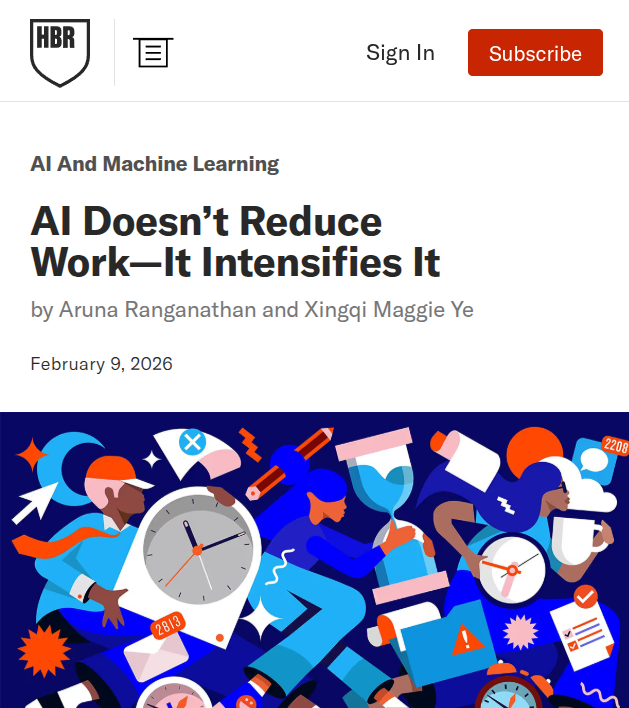
Powerful new Harvard Business Review study.
"AI does not reduce work. It intensifies it. "
A 8-month field study at a US tech company with about 200 employees found that AI use did not shrink work, it intensified it, and made employees busier.
Task expansion happened because AI filled in gaps in knowledge, so people started doing work that used to belong to other roles or would have been outsourced or deferred.
That shift created extra coordination and review work for specialists, including fixing AI-assisted drafts and coaching colleagues whose work was only partly correct or complete.
Boundaries blurred because starting became as easy as writing a prompt, so work slipped into lunch, meetings, and the minutes right before stepping away.
Multitasking rose because people ran multiple AI threads at once and kept checking outputs, which increased attention switching and mental load.
Over time, this faster rhythm raised expectations for speed through what became visible and normal, even without explicit pressure from managers.
297
619
6,393
760,429
Feb 27
Feelin this right about now

I have AIDHD.
The models are so good that I’m working on 5 different projects a day.
At first it felt like distraction, but I’ve shipped more features and apps in the last 3 months than ever before.
AI made building fun again. It’s a better programmer than me, so I can focus on creativity instead.
I’m grateful to be alive at this moment. Decades from now, people will look back at this era as the best time to be a maker.
Huge respect to the people building the models so idiots like me can just make stuff.
49
Feb 23
Having experimented with a bunch of AI tools, there seems to be an outsized advantage to having strong documentation and organization for your digital work. It seems likely the AI agents will be a significant driver for the future and being digitally organized for the future puts you ahead.
1
1
25
The future is here just not evenly distributed. Follow the signal.
47

This is worth a read and is an answer to one of the most common questions we get at The Exponentialst - "How do I prepare my children for the world of AI?"

94
150
1,439
448,961