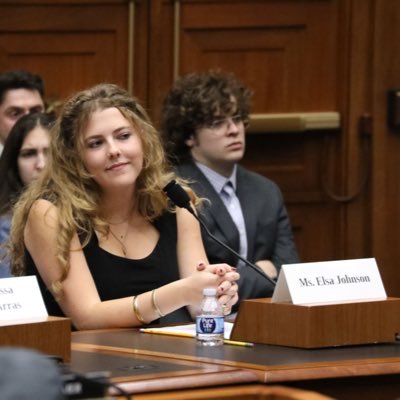
editor-in-chief @stanfordreview
Joined January 2009
- Tweets 167
- Following 1,033
- Followers 837
- Likes 99,544
4 Photos and videos


Elsa retweeted

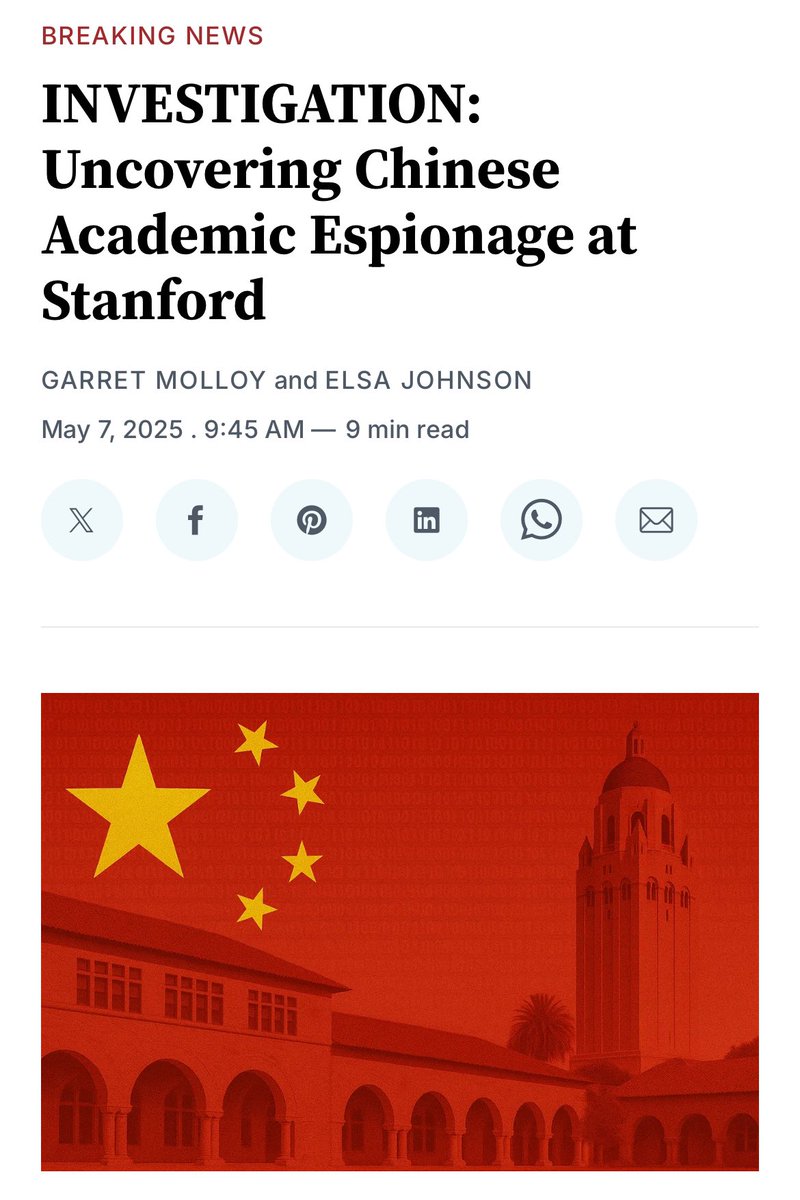
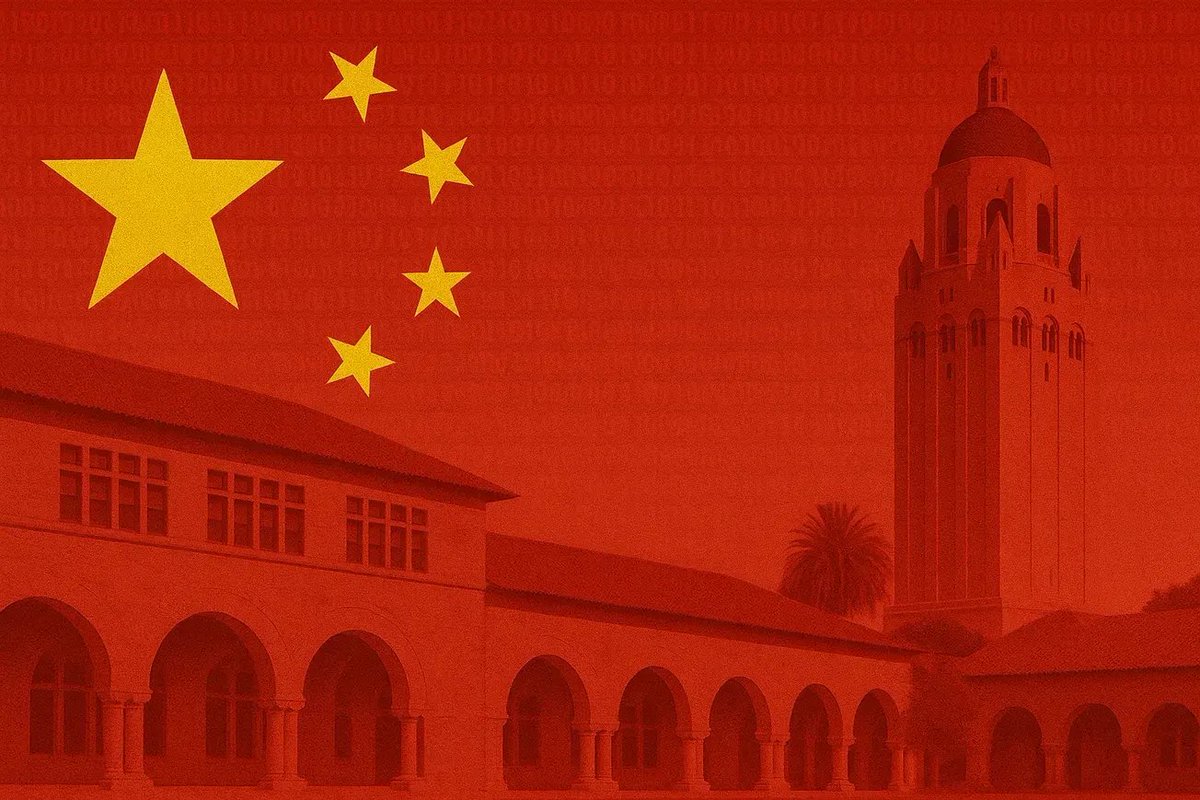
INVESTIGATION: A whistleblower has leaked Stanford's private foreign-funding records to the Review, revealing millions in funding from Chinese state-linked entities and CCP donors.
177
1,658
3,559
454,080
Elsa retweeted

New @ChinaSelect Report | Research Security for America’s Future in Space: NASA’s Enforcement of the Wolf Amendment
According to our latest report released today, federally funded @NASA research, intended to advance American innovation, has been repeatedly linked to collaborations with institutions embedded in China’s defense and military ecosystem.
In one case alone, researchers produced more than 200 co-authored publications between 2020 and 2025 with Chinese defense-affiliated institutions, while still receiving U.S. federal funding. @ChinaSelect also found multiple active grants, some running through 2026 and 2027, supporting research conducted alongside entities linked to China’s military-industrial base, including those on U.S. restricted lists.
These findings reveal systemic failures in oversight, disclosure, and enforcement of the Wolf Amendment, allowing taxpayer-funded research to flow into China’s military-civil fusion strategy and raising urgent national security concerns that demand immediate action.
chinaselectcommittee.house.g…
6
42
85
6,352
Elsa retweeted

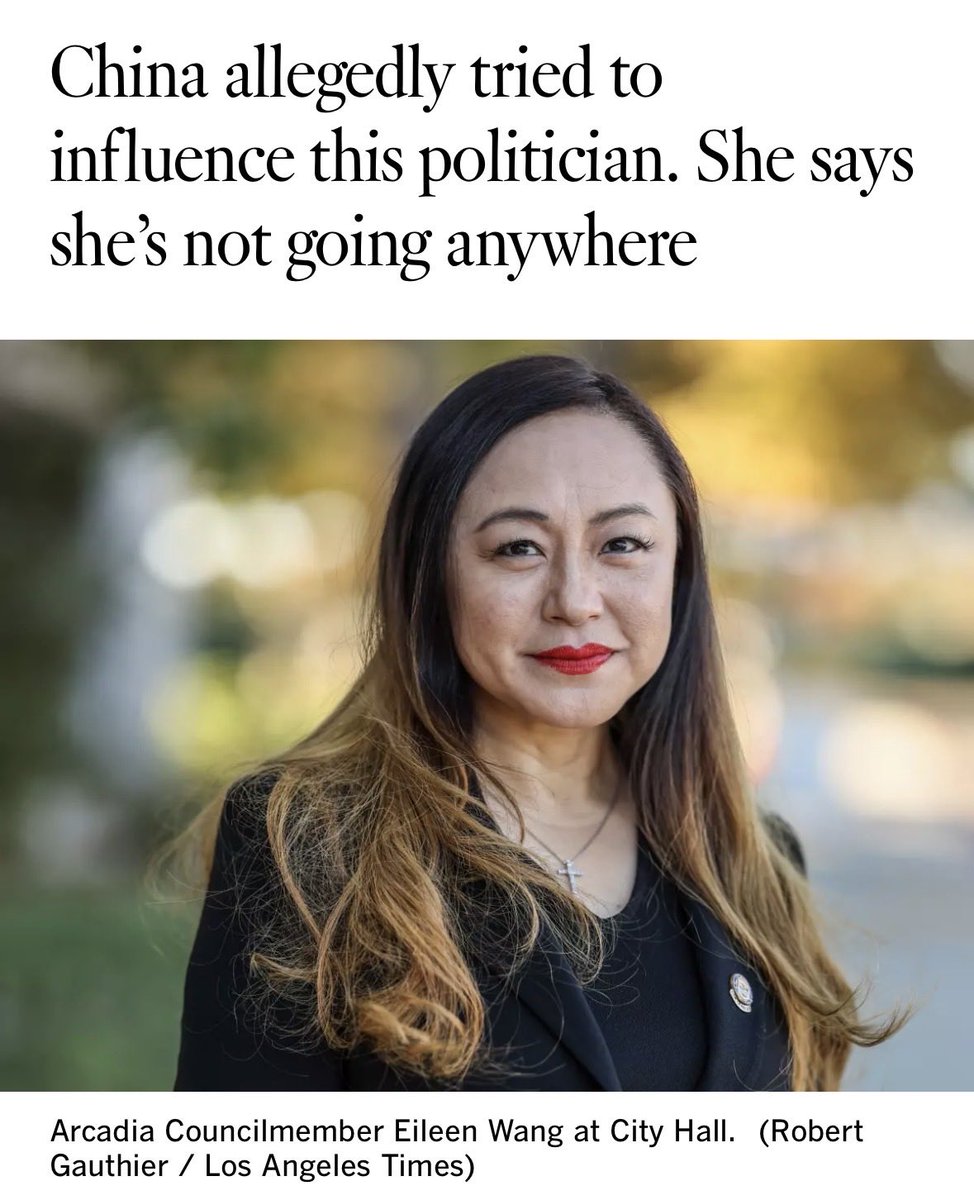
Arcadia Mayor Eileen Wang has been charged with violating 18 USC 951, acting in the United States as an illegal agent of the People’s Republic of China.
Wang appeared in federal court this afternoon for her arraignment. She agreed to plead guilty and resign from public office.
Wang admitted to acting as a foreign agent from at least 2020 through 2022. At the direction of the PRC government, she coordinated with individuals to promote PRC interests by spreading pro-PRC propaganda in the United States.
Wang faces a statutory maximum sentence of 10 years in federal prison.
710
2,672
8,254
689,367
Elsa retweeted
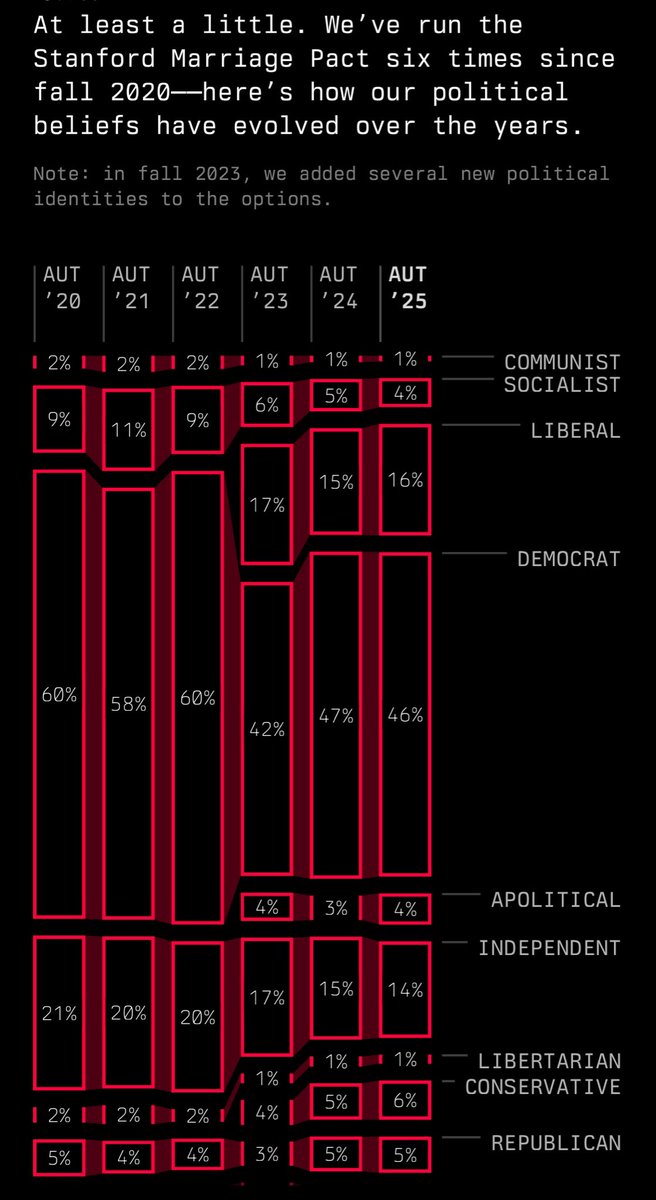
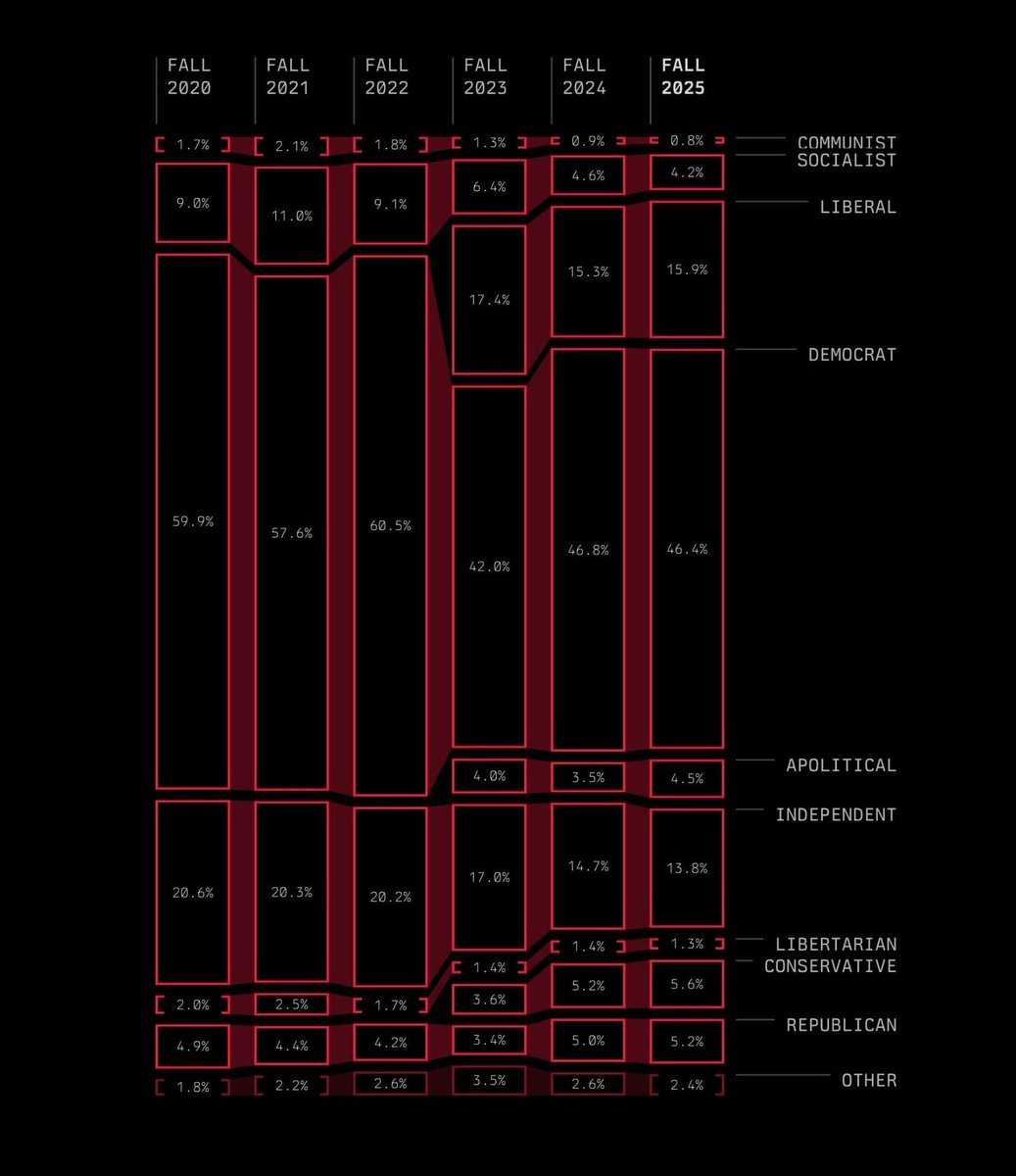
Number of Right-Wing Students at Stanford Nearly Doubles
15
16
319
11,877

May 3
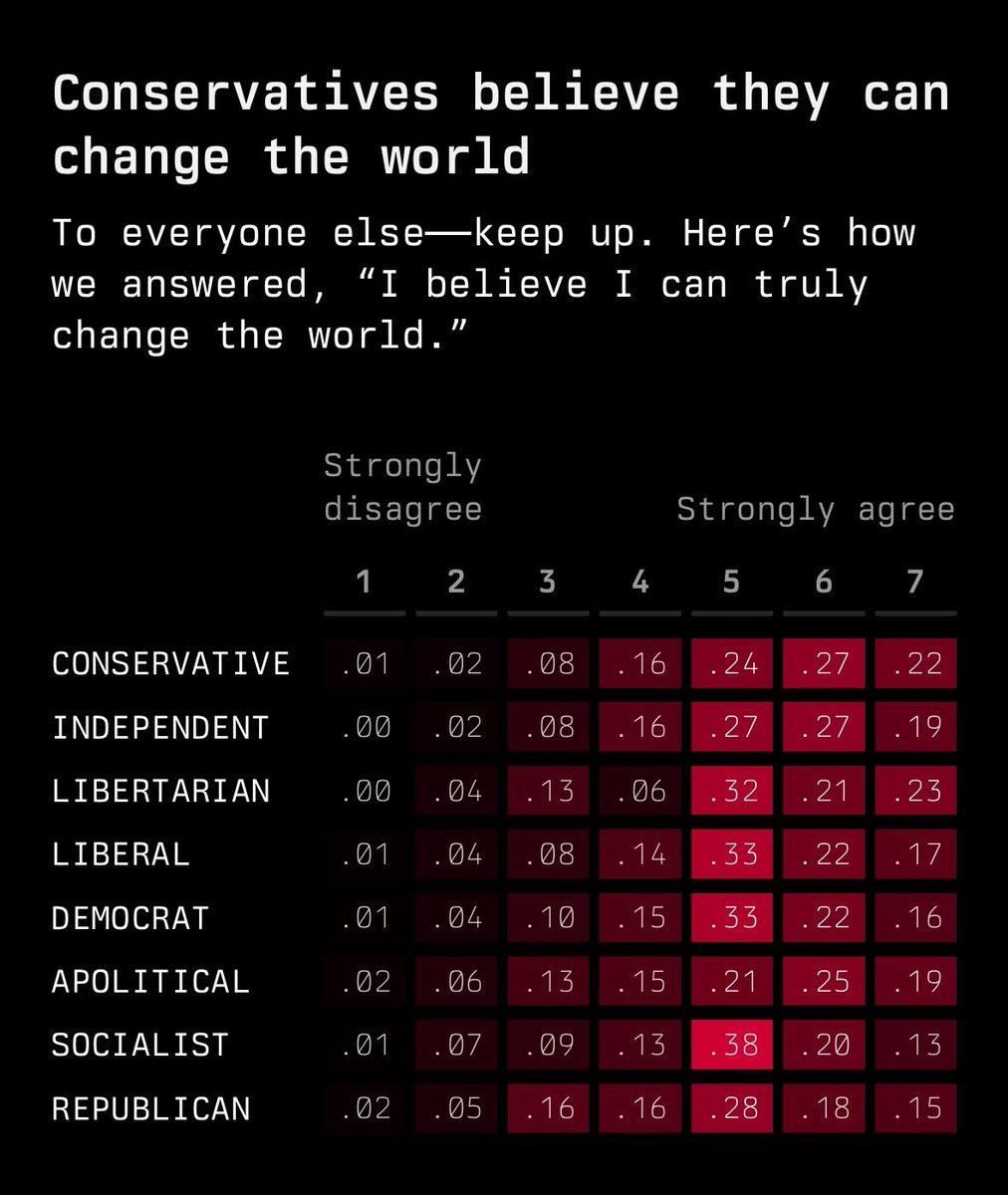
Socialists and Communists are down from 11% to 5% of the Stanford student body, Conservatives are up from 2% to 6%, and the group most confident they can change the world is now the right. Per the Stanford Marriage Pact student survey, 4,177 submissions.
The tide is turning at Stanford.
16
723
Elsa retweeted

Apr 7
thetimes.com/us/news-today/a…
Many parallels between Elsa Johnson's harassment by China's spies and my own experience at Stanford U.
"If a university does not defend academic freedom and provide a safe space for the academics who embody it, what good is it?"
6
25
62
4,787
Apr 1
RT @CUyghurs: Elsa Johnson, a student at Stanford University, has been stalked and harassed by the CCP for years after coming to Stanford t…
28
Apr 1
my congressional testimony on being harassed by the CCP at Stanford in @thetimes
read below:
1
14
736
Apr 1
12
395
Elsa retweeted

Mar 31
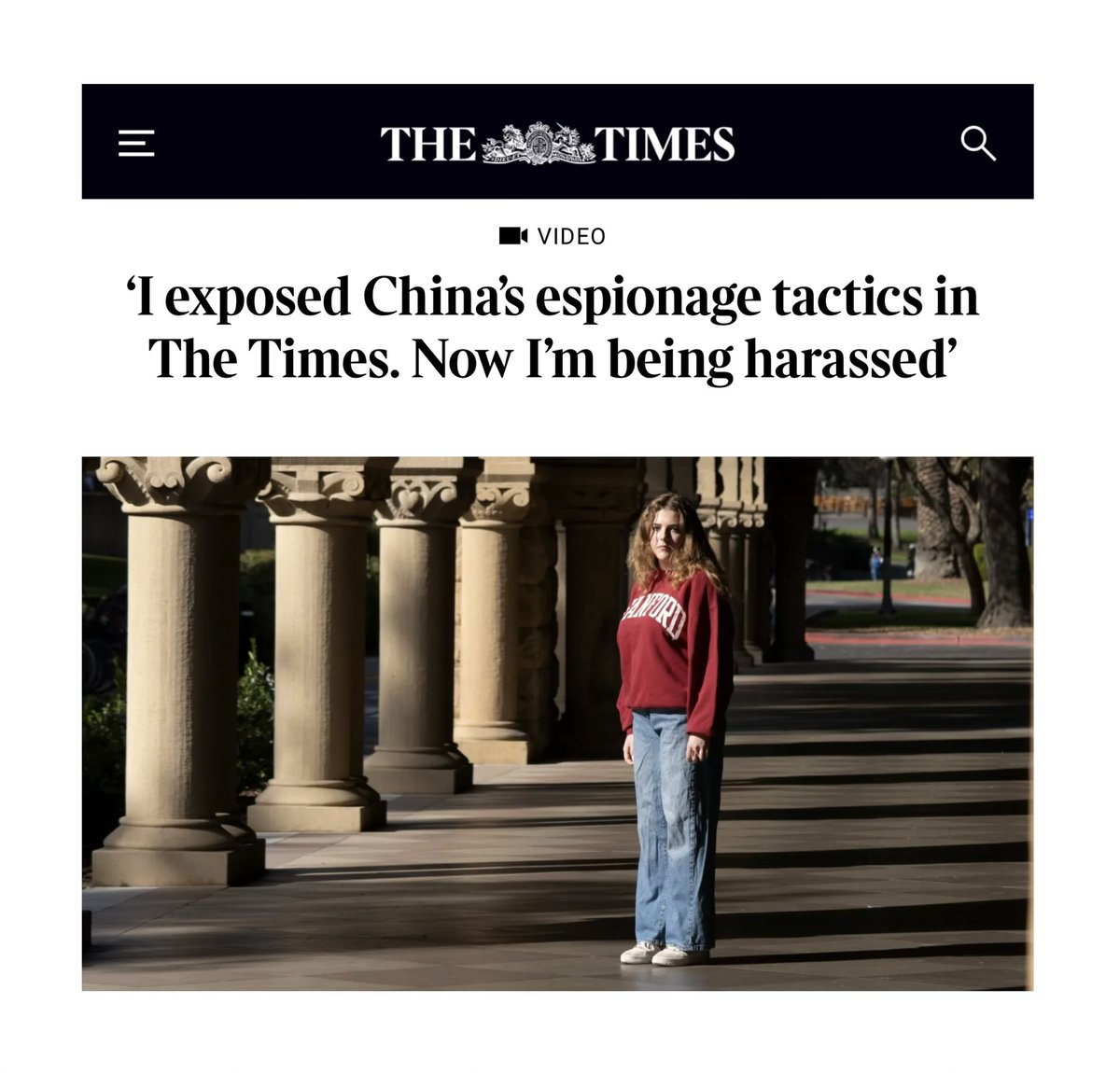
In Aug 2025, Elsa Johnson, a Stanford student, wrote a piece for The Times about how members of the CCP tried to recruit her as a spy. Since then, the junior, who is majoring in East Asian Studies, has faced a wave of harassment from Mandarin speakers who have called her and threatened her and her family. The FBI also informed Johnson that the CCP is physically monitoring her whereabouts on campus — making her fear for her own safety. On Mar 26 she testified before the House Committee on Education and the Workforce, urging Congress to do something to protect America’s students who “face transnational repression”, given that Stanford “has chosen not to address this problem at all”. Here is an abridged and lightly edited version of her testimony.
=======
After I wrote a first-person account of my experience in The Times of London, the repression only worsened.
Last summer, while conducting research on China in Washington, DC, I began receiving regular phone calls from unknown US numbers. When I answered the calls in English, the callers would switch to Mandarin. In one case, the caller referenced my mother. These bizarre calls were intimidation attempts, designed to remind me that neither my family, nor I, is safe from transnational repression by the CCP.
Then, this past fall, the FBI informed me that I am being physically monitored on Stanford’s campus by agents of the Chinese Communist Party. They told me that my family is also at risk and is being monitored. As a 21-year-old who grew up loving the Chinese language and culture, I never imagined that studying it would put me in a position where a foreign intelligence service is tracking my movements on my own campus and monitoring my family. I fear for my safety and for my family’s safety.
The intimidation calls have not stopped. Just this week, I received another call from a US number. After exchanging hellos, the caller switched to Mandarin and asked whether I had finished dinner. That cannot be a coincidence. It is happening to me on American soil because I reported on the activities of a foreign government at an American university.
My experience is disturbing, but it reflects a much larger pattern playing out on campuses across the country. According to Freedom House, the Chinese government is the greatest perpetrator of transnational repression targeting students and scholars in the United States. Their 2024 report found that international students and faculty face surveillance and coercion by foreign governments. More than 1.3 million international students study at American colleges and universities, yet many are unable to exercise the freedoms that are supposed to define an American education.
There is also infrastructure already embedded on American campuses that facilitates this system. Chinese Students and Scholars Associations (CSSAs) exist at roughly 150 American colleges and universities, including Stanford.
The US State Department has stated plainly that the CCP created the CSSA to monitor Chinese students and mobilize them against views that dissent from the Party’s stance. The US-China Economic and Security Review Commission found in 2018 that CSSAs receive guidance from the CCP through Chinese embassies and consulates, and that they are active in carrying out work consistent with Beijing’s United Front strategy. In some cases, the local Chinese consulate must approve CSSA presidential candidates. Documents obtained by Foreign Policy showed that at Georgetown, the CSSA accepted embassy funding amounting to roughly half its total annual budget.
The Association of Chinese Students and Scholars at Stanford, or ACSSS, is a recognized student organisation that receives university support and funding.
The CCP’s United Front uses these organisations as vehicles for surveillance and influence.
American universities are supposed to be places where people can think and speak freely. Right now, for too many students, they are not.
thetimes.com/us/news-today/a…
29 Aug 2025

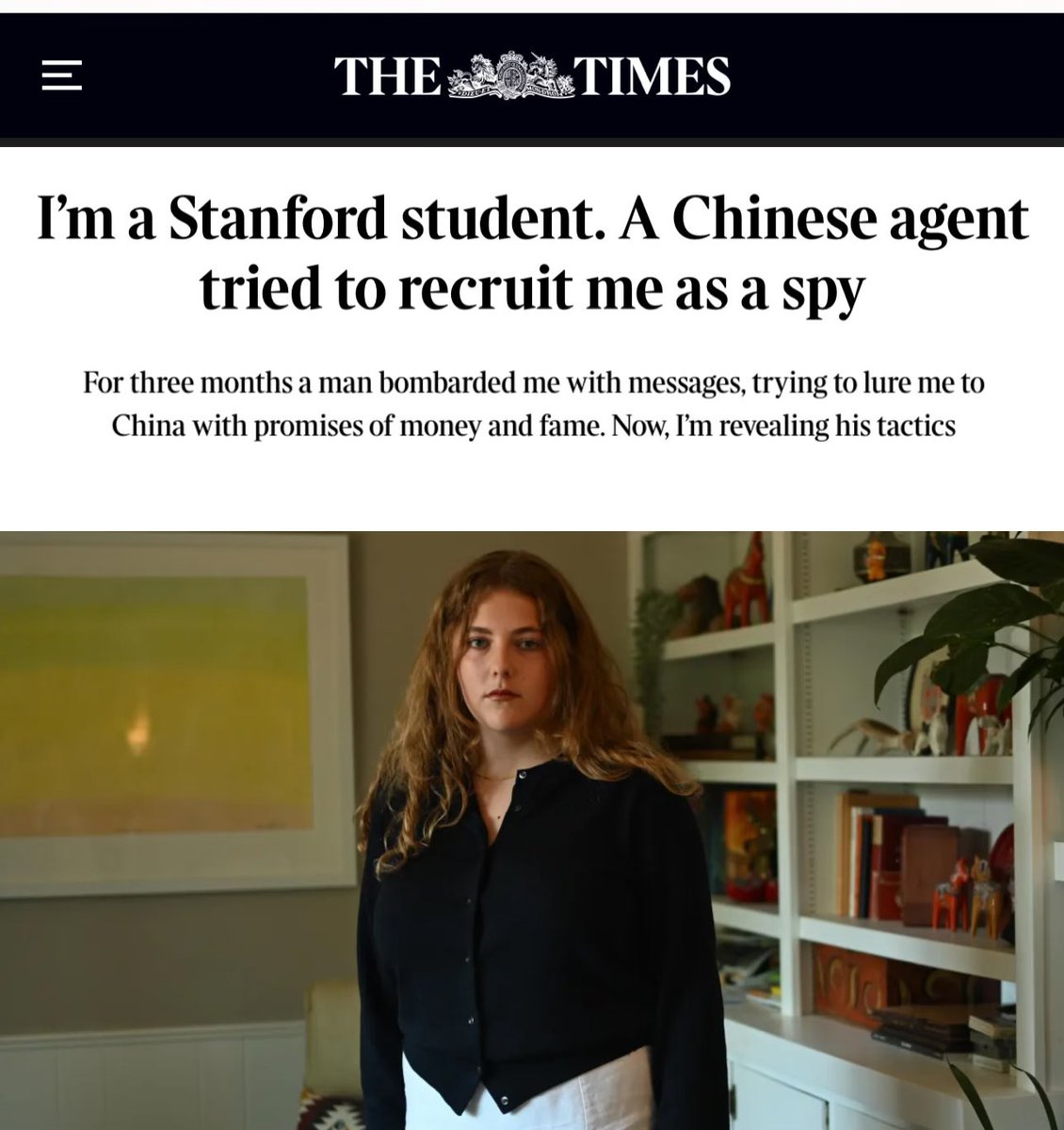
Stanford student Elsa Johnson is presumably “Anna” in the investigative article “Uncovering Chinese Academic Espionage at Stanford” published in The Stanford Review in May. Now Elsa speaks out in person.
It all started with a message sent to Elsa on Instagram by a stranger, a man calling himself Charles Chen and claiming he’s an international student at Stanford, on June 10, 2024.
“Have we met on campus?”
It’s the same playbook: someone claiming to be a 🇨🇳 student “slips into your DMs”. They start out friendly with inquiries about your home life and ask whether or not you have mutual friends. Sometimes they point out shared interests and invite you to hang out.
Then the hard sell begins, with offers of an all-expenses-paid trip to China. They might flatter you with compliments and claim you can make money in the country as a social media star. If the conversation progresses, they may ask about your research, academic achievements over the years or the software you might use in class.
This is exactly what Charles did. He shared videos of another woman he claimed was a Stanford student. “She was on a TV show in China and is famous now!” The implication: Elsa, too, could become prosperous and popular in China.
On June 27, Charles pressed the point. “You really should travel to China soon … A bunch of people at Stanford have been to China this summer. If someone pays for you, would you come?”
He sent her a flight itinerary from LA to Shanghai that cost $912 with China Eastern Airlines. “I can take care of your accommodation and transportation here.” He showed her a bank wire worth $5,485 that he received in May to prove he could afford it.
Elsa told him it’s too expensive but he persisted. “It’s not worth it for a quick trip,” she replied.
Elsa alerted two trusted Chinese experts at Stanford to tell them she’s worried she’s being targeted. They put her in touch with an FBI contact who worked with the college on cases of CCP-related espionage. She met them in Sep, handing over the screenshots and the names of other people that Charles said he had been in touch with.
Charles was found to have no affiliation with Stanford. He had probably posed for years as a student with fake Instagram and LinkedIn profiles that he used to target people researching China-related topics.
Elsa identified as many as 10 other female students who had been targeted by this individual since 2020.
Charles was likely to be associated with 🇨🇳 ministry of state security, and he’s probably conducting an elaborate entrapment operation targeting young female students.
The FBI confirmed that several of the 1,129 🇨🇳 students at Stanford were reporting to the CCP.
The fact that he targeted young, white American women is significant. The CCP apparently sees people like Elsa as valuable assets in their propaganda war, who can give the impression that there’s nothing to fear from China.
These spies want to learn how leading universities such as Stanford are developing key technologies that are giving the US an edge over China. They target young, sometimes naive, students working in these fields with the aim of befriending them and grooming them to share their knowledge. Some students have even been approached by strangers about working for Chinese tech companies such as Baidu and Huawei.
Most students see thru this espionage. But inevitably, some don’t, and accidentally disclose sensitive info. Others may even be sympathetic to the CCP’s cause and knowingly cooperate. Perhaps Charles assumed Elsa could be persuaded to spy on other Stanford students.
At first Elsa was extremely frightened to talk about what happened to her out of fear of being further targeted. She loves Chinese culture and wants to be able to visit China, but speaking out could lead to retaliation by 🇨🇳 authorities.
But now she realizes that her experience is emblematic of Beijing’s larger efforts to infiltrate US institutions and she has to do something.
thetimes.com/us/news-today/a…
5
149
354
24,185
Elsa retweeted

Mar 30
What happened to @ElsaJohnson is wrong and speaks to the Chinese Communist Party’s brazen attempts to silence criticism around the world, including in American universities. Freedom House’s research has highlighted the negative impacts of surveillance and harassment by foreign governments at universities across the country: freedomhouse.org/report/tran…
Mar 26

Meet @ElsaJohnson, an American undergraduate junior at Stanford University who faced transnational repression (as well as her family!) from the Chinese Communist Party including online and physical surveillance on campus.
Our universities have become soft targets for foreign espionage and gateways for our adversaries, and they need a serious wake-up call to address these significant national security threats.
1
14
33
4,260
Elsa retweeted

The CCP is infiltrating our universities to steal research, undermine American values, and silence free speech. At our hearing this week, student-journalist @elsajohnson told her story: she was tailed, monitored, and harassed by the CCP. Her story is horrifying, but it isn't unique—this is happening at schools across the nation.

CCP Stalked Stanford Coed for Years: FBI Confirms Campus Surveillance
redstate.com/wardclark/2026/…
1
11
18
1,622
Elsa retweeted
Mar 27
One of the reasons that Chinese agents are stalking and harassing Elsa Johnson is that, in May 2024, she published in the Stanford Review how China bullied Stanford into terminating me.
"Announcing 'Stanford's Censorship'" (May 3, 2024) and the follow-up "Stanford's Censorship: A History of Academic Freedom" (May 6, 2024) describe how, in the early 1980s, Stanford expelled PhD student Steven Mosher from its anthropology doctoral program after he conducted field research in rural Guangdong province, China. Mosher documented forced abortions, sterilizations, and poverty under China's one-child policy. His reporting angered the Chinese Communist Party (CCP), which pressured Stanford and other U.S. institutions.
Those who are harassing her should be immediately deported.

41
506
1,978
67,961

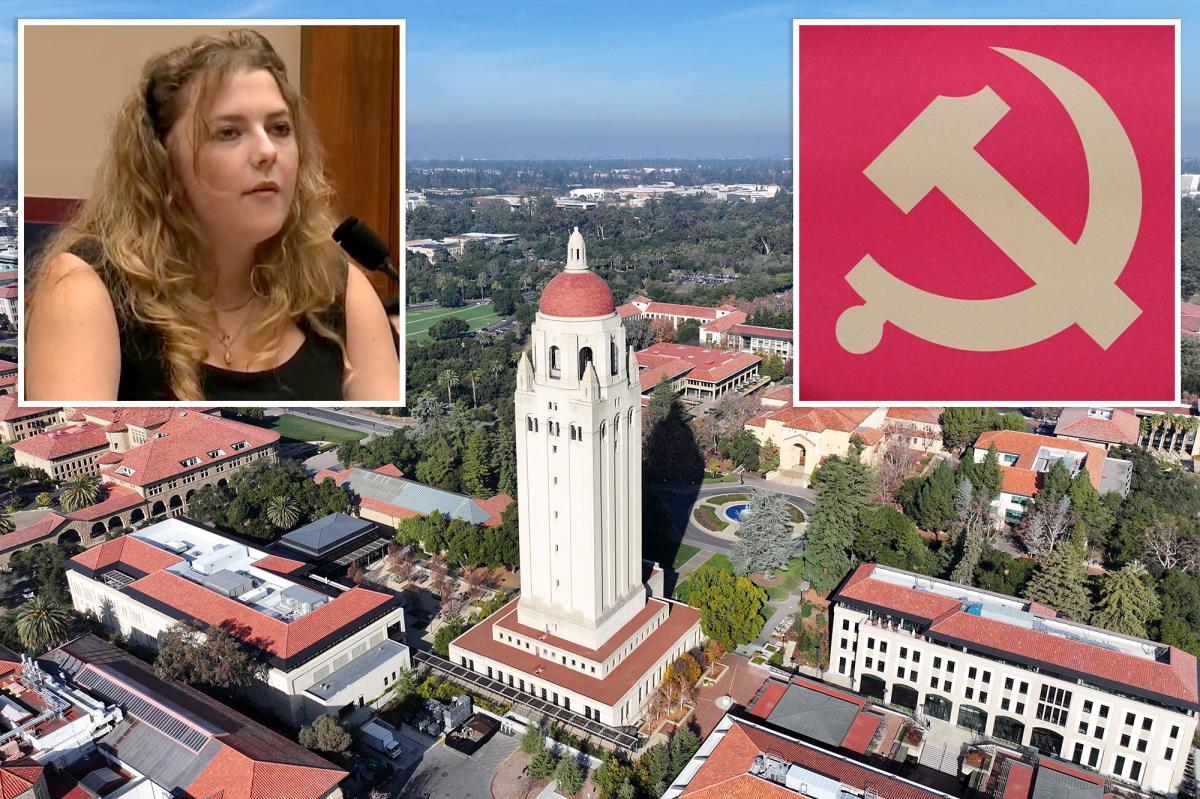
A Stanford student testified that she was targeted by a Chinese spy — and the FBI confirmed to her that she and her family were being surveilled by China.
Elsa Johnson said a man who called himself Charles Chen reached out to her on Instagram during her Freshman year. The FBI later told her he had no affiliation with Stanford and was likely working on behalf of China’s ministry of state security. And she was not the only student targeted.
302
952
2,940
437,914
Elsa retweeted

Mar 27
The Chinese government believes it can terrorize people in the US. Agents working for the CCP stalked and threatened a student at Stanford who was doing research on China's military. This is happening in other democracies as well and we must put a stop to it.
29
387
1,461
38,633
Elsa retweeted
The Stanford Review's Editor-in-Chief @Elsajohnson testified in front of the House Committee on Education & Workforce this morning, discussing the Review’s investigation into Chinese academic espionage.
Watch her testimony below:
Mar 26
Meet @ElsaJohnson, an American undergraduate junior at Stanford University who faced transnational repression (as well as her family!) from the Chinese Communist Party including online and physical surveillance on campus.
Our universities have become soft targets for foreign espionage and gateways for our adversaries, and they need a serious wake-up call to address these significant national security threats.
4
21
66
6,864
Elsa retweeted

Mar 26
For fellow America First higher education reform warriors & China hawks, this is a very long tweet (almost as long as @BillAckman) but it is BOMBSHELL must read.
I just participated in the House Education hearing "U.S. Universities Under Siege: Foreign Espionage, Stolen Innovation, and the National Security Threat."
I was absolutely STUNNED by the testimony of American @Stanford undergraduate @elsajohnson about facing criminal transnational repression from the Chinese Communist Party. She is an American!
Our universities seriously need to get their act together on these significant foreign threats. Thank goodness for @HooverInst 's leadership where the greater university failed to step up.
cc @CondoleezzaRice
READ THIS 👇👇👇🚨🚨🚨
"My name is Elsa Johnson. I am a junior at Stanford University studying East Asian Studies with a focus on China, and I serve as Editor-in-Chief of The Stanford Review. I am here because I was personally targeted by a suspected agent of the Chinese Communist Party while conducting research at Stanford. The consequences of that targeting have followed me ever since.
I grew up in Minneapolis, Minnesota. There, I attended a Chinese language immersion school from Kindergarten through eighth grade. By the time I arrived on Stanford’s campus, I had already been studying China, its language, and culture for over a decade. I chose Stanford specifically to deepen my understanding of the country whose culture and language have fundamentally influenced my upbringing and my aspirations for the future.
When I arrived at Stanford, I began working as a research assistant at the Hoover Institution, where I focused on Chinese industry and military tactics. I was surrounded by some of the country’s foremost China scholars. I felt like I was exactly where I was supposed to be.
However, that sense of belonging was upended during the summer following my freshman year. In June 2024, a few days after I spoke with one of my supervisors at Hoover about Chinese recruitment tactics targeting American academics, a man calling himself “Charles Chen” reached out to me on Instagram. He had over 100 mutual followers with me and had photos of Stanford on his profile. I had no reason to believe he was anything other than a fellow student. Over the following weeks, Chen’s messages grew more concerning. He told me he was from China and asked detailed questions about my research and background in Chinese. He offered to pay for a trip to China, sent me a flight itinerary from Los Angeles to Shanghai, and sent screenshots of a bank wire to prove he could afford my accommodations once I got there. He also sent me a document outlining a policy that would allow me to travel to China without a visa. He sent me videos of Americans who had gotten rich and famous in China and insisted that I, too, could find wealth and fame in the PRC.
Later on, he began incessantly pressuring me to move our conversation to WeChat, a Chinese government-monitored messaging app. When I didn’t respond to Charles Chen fast enough, he would delete and resend his messages. He even referenced the whereabouts of Stanford students who were in China at the time of our correspondence.
Then, in July, he publicly commented on one of my Instagram posts in Mandarin, asking me to delete the screenshots I had taken of our private conversation. I had not told anyone I had taken screenshots, and I do not know how he knew. The only explanation I could come up with was that my phone or my account had been compromised somehow. I contacted two China experts at Stanford whom I trusted, and they connected me with an FBI contact who handled CCP-related espionage cases at the university. I met with the FBI in September and handed over everything I had. The FBI confirmed that Charles Chen had no real affiliation with Stanford.
He had likely posed as a student for years and used multiple fabricated social media profiles to target students researching China-related topics. I was told he was likely operating on behalf of China’s Ministry of State Security. I later found out that I was one of at least ten other female students targeted by “Charles Chen” since 2020.
My experience with Charles Chen was only the beginning of what I have gone on to experience from the CCP. After my co-author, Garret Molloy, and I published our investigation in The Stanford Review in May 2025. After I wrote a first-person account of my experience in The Times of London, the repression only worsened.
Last summer, while conducting research on China in Washington, D.C., I began receiving regular phone calls from unknown U.S. numbers. When I answered the calls in English, the callers would switch to Mandarin. In one case, the caller referenced my mother. These bizarre calls were intimidation attempts, designed to remind me that neither my family nor I is safe from transnational repression by the CCP.
Then, this past fall, the FBI informed me that I am being physically monitored on Stanford’s campus by agents of the Chinese Communist Party. They told me that my family is also at risk and is being monitored. As a 21-year-old who grew up loving the Chinese language and culture, I never imagined that studying it would put me in a position where a foreign intelligence service is tracking my movements on my own campus and monitoring my family. I fear for my safety and for my family’s safety. The intimidation calls have not stopped.
Just this week, I received another call from a U.S. number. After exchanging hellos, the caller switched to Mandarin and asked whether I had finished dinner. That cannot be a coincidence. It is happening to me on American soil because I reported on the activities of a foreign government at an American university. My experience is disturbing, but it reflects a much larger pattern playing out on campuses across the country. According to Freedom House, the Chinese government is the greatest perpetrator of transnational repression targeting students and scholars in the United States. Their 2024 report found that international students and faculty face surveillance and coercion by foreign governments. More than 1.3 million international students study at American colleges and universities, yet many are unable to exercise the freedoms that are supposed to define an American education.
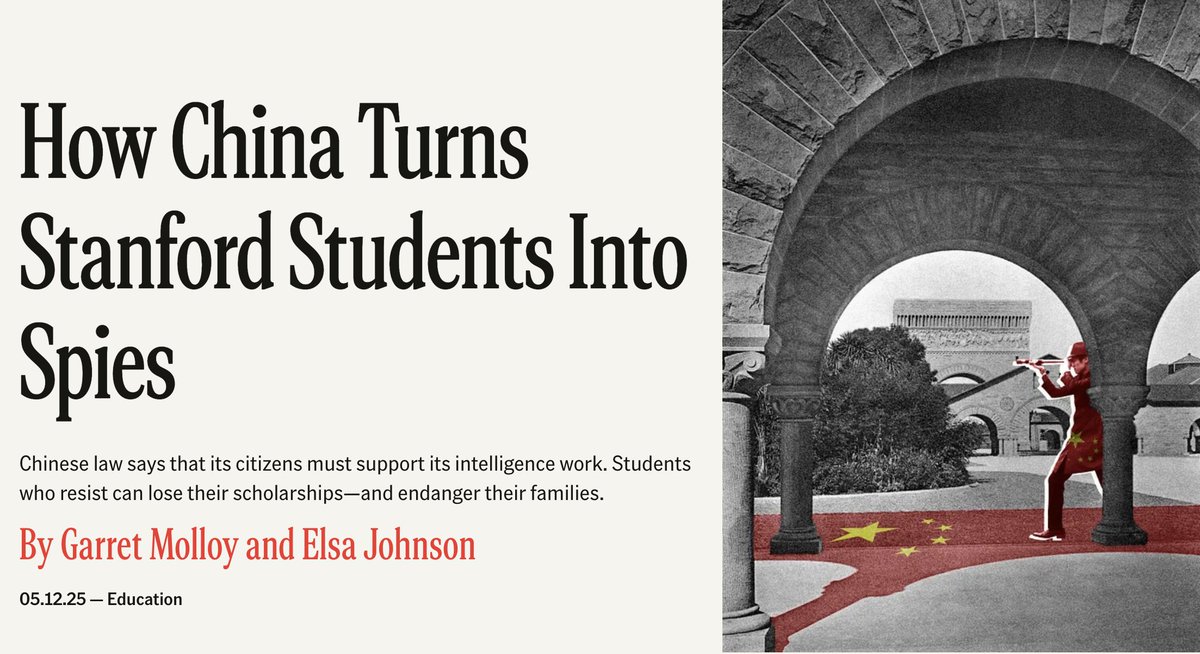
Our investigation at The Stanford Review confirmed this. Under China’s 2017 National Intelligence Law, all Chinese citizens are legally required to cooperate with state intelligence work regardless of their location. The Chinese Scholarship Council, which funds approximately 15 percent of Chinese students studying in the United States, allegedly requires recipients to submit regular reports about their research to Chinese diplomatic missions. Students who refuse to cooperate face consequences. In some cases, their families are brought into police stations in China.
There is also infrastructure already embedded on American campuses that facilitates this system. Chinese Students and Scholars Associations (CSSAs) exist at roughly 150 American colleges and universities, including Stanford. The U.S. State Department has stated plainly that the CCP created the CSSA to monitor Chinese students and mobilize them against views that dissent from the Party’s stance. The U.S.-China Economic and Security Review Commission found in 2018 that CSSAs receive guidance from the CCP through Chinese embassies and consulates, and that they are active in carrying out work consistent with Beijing’s United Front strategy. In some cases, the local Chinese consulate must approve CSSA presidential candidates. Documents obtained by Foreign Policy showed that at Georgetown, the CSSA accepted embassy funding amounting to roughly half its total annual budget.
At Stanford, the Association of Chinese Students and Scholars at Stanford, or ACSSS, is a recognized student organization that receives university support and funding. It operates as a social and cultural group, and I want to be clear that many of its members almost certainly have no knowledge of the broader structure I am describing. That is what makes it so effective.
The CCP’s United Front uses these organizations as vehicles for surveillance and influence without the consent or awareness of most participants. I thank Chairman Walberg for co-signing the March letter to Secretary Rubio, requesting that CSSAs be evaluated for designation as foreign missions under the Foreign Missions Act. This is a very important step in the right direction. Universities should not fund or officially recognize organizations that function as extensions of a foreign intelligence apparatus, and students within those organizations deserve to know the truth about the institutional ties that govern them.
At Stanford alone, there are over 1,100 Chinese international students. Despite coming to the United States to pursue their education in an environment of liberty, many of these students find that such freedom is out of reach. Even within a free society, they remain under the persistent influence of a foreign power, which prevents them from exercising their right to speak and study without constraint.
After Garret Molloy and my investigations were published, Stanford issued a statement saying it was looking into the reports and had reached out to federal law enforcement. That was over a year ago. Nothing meaningful has changed. The university has not established a reporting mechanism for transnational repression. It has not provided resources for students targeted by foreign governments.
Stanford sits in Silicon Valley, at the frontier of artificial intelligence and emerging technology. By any measure, it is one of the most strategically significant universities in the world for a foreign adversary seeking to acquire sensitive research and technology. And the university has decided to treat this as not requiring a response. That silence creates an environment that stifles innovation and academic freedom. When students and researchers know they are being watched but have nowhere to turn, they self-censor and stop collaborating openly. The very qualities that make American universities engines of innovation are being undermined by a threat that the universities themselves refuse to acknowledge. I was fortunate enough to be working at the Hoover Institution when I was targeted, and the scholars there knew exactly what was happening and connected me with the FBI. If I had not been at Hoover, I do not know how I would have gotten help. There was no university resource to call and no tip line to contact. I was a freshman and had to navigate a foreign intelligence operation targeting me with no institutional support from the university I attend.
Stanford should establish an anonymous tip line for students facing transnational repression. Right now, no such infrastructure exists. A student who is being surveilled or coerced by a foreign government has nowhere to go within the university. The institution that collects their tuition has no system in place to protect them. The University of Wisconsin-Madison has already created an information guide and reporting structure that directs targeted students to relevant offices and connects them with law enforcement. Stanford should adopt this model immediately. It does not require an act of Congress. Stanford should build a dedicated office to handle cases of transnational repression, rather than treating each incident as an isolated event to be quietly managed. The response to our investigation was a single public statement, followed by silence. There is no designated office and no institutional memory for these cases. Students who come forward should be met with a clear and secure process. This is an administrative decision that the university can make tomorrow. Stanford should stop treating transnational repression as a secret. Information about transnational repression should be incorporated into the onboarding process for incoming students and faculty. Students arrive on campus with no understanding of the threat they face and no knowledge of where to turn if they are targeted. I was fortunate enough to be working at the Hoover Institution when I was targeted, and the scholars there connected me with the FBI. Most students do not have that access. Stanford has the resources to build these systems. The question is whether the university has the will.
I came to Stanford wanting to study China after growing up learning Mandarin, and I expected to feel safe pursuing that interest at one of the world’s best universities. Instead, I have spent the past two years being targeted by a foreign intelligence service and getting physically surveilled on my own campus. No student should be in such a position, especially at an American institution. I am testifying before you today because if this can happen to me, it is happening to students across this country who do not have a platform and who do not have a path to the FBI. American universities are supposed to be places where people can think and speak freely. Right now, for too many students, they are not."
42
193
625
58,568
Elsa retweeted

Mar 26
Meet @ElsaJohnson, an American undergraduate junior at Stanford University who faced transnational repression (as well as her family!) from the Chinese Communist Party including online and physical surveillance on campus.
Our universities have become soft targets for foreign espionage and gateways for our adversaries, and they need a serious wake-up call to address these significant national security threats.
79
616
1,692
137,975
Mar 20
great chat with @NatHalberstadt
listen below!
Mar 20

NEW EPISODE: What's happening at Stanford? with Elsa Johnson, Editor-in-Chief, Stanford Review | #80
Today, @NatHalberstadt sits down with @elsajohnson to talk about the situation across tech, politics, culture, and more - especially on Stanford campus and at the Stanford Review.
Elsa Johnson is the current editor-in-chief at the @StanfordReview, the leading (and quite storied) conservative magazine on campus.
Timestamps:
0:00 – Intro
3:20 – Is AI Destroying Entry-Level Tech Jobs?
5:20 – Gender Dynamics and Dating at Stanford
8:10 – Post-Grad Paths: YC, FAANG, etc.
13:10 – National Security & Stanford’s AI Labs
25:40 – Campus Religious Life
29:00 – Latest work from The Stanford Review
36:23 – Foreign Students and Cultural Erosion
43:06 – Minneapolis
49:50 – Apathy and the Future for Stanford Student
3
26
3,537