
I follow Tesla/EVs/space X and tech trends closely and share useful updates/opportunities in this space.
Joined March 2009
- Tweets 56,781
- Following 14,490
- Followers 25,830
- Likes 35,728
4,789 Photos and videos







Pinned Tweet
Today, I’m introducing the SpaceX Share Project an opportunity to be part of the future we’re building.
The details are coming soon, but once you see what’s behind it, you’ll understand why so many people are paying attention.
Stay tuned. The future is closer than you think.
1
2
6
261
Steve Howell retweeted

May 29
Bring your full vision to life, just like you imagined it
Create continuous videos with smooth transitions with Extend in Grok Imagine
289
130
819
1,152,829


Grok Imagine Video 1.5 Preview has achieved the #1 spot on @Designarena
Jun 8

Grok Imagine Video 1.5 Preview by @xAI reclaims 1st in Image to Video with an Elo of 1357 on Design Arena.
With this model, @xAI establishes new Pareto frontiers in both Speed and Price, with an average generation time of 41.2 seconds and $0.01/img and $0.08/sec for the 480p quality.
Grok Imagine Video 1.5 Preview now leads Image to Video with a 49 point Elo gap, ahead of Seedance 2.0 and Seedance 2.0 Fast by @BytePlusGlobal.
Congratulations to the @xAI team on this release!

221
98
550
1,229,850
Steve Howell retweeted
Jun 10
Iterate quickly and stay consistent. Try Agent Mode in Grok Imagine.
🎥 @BenKaluza
132
72
531
611,373
The @MongoDB plugin is live in the Grok Build Plugin Marketplace.
Explore data, optimize database performance, and build high performance vector search systems with a single prompt.

The Grok Build Plugin Marketplace is now in beta.
Build with MongoDB, Vercel, Sentry, Cloudflare, and Chrome DevTools plugins from your terminal.
Read more x.ai/news/grok-plugin-market…
56
64
612
251,115
Use the @vercel plugin to deploy to production, spin up sandboxes, or build apps with Shadcn.
The Grok Build Plugin Marketplace is now in beta.
Build with MongoDB, Vercel, Sentry, Cloudflare, and Chrome DevTools plugins from your terminal.
Read more x.ai/news/grok-plugin-market…
241
1,069
2,592
1,218,295
Install the @sentry plugin and ask your agent to find and fix errors, analyze stack traces, and triage alerts
The Grok Build Plugin Marketplace is now in beta.
Build with MongoDB, Vercel, Sentry, Cloudflare, and Chrome DevTools plugins from your terminal.
Read more x.ai/news/grok-plugin-market…
161
218
1,854
11,649,115
In order to understand the universe, you must explore the universe → x.ai/careers
1,085
1,279
6,568
1,559,257
Steve Howell retweeted

Jun 7
😻 Latest list of supporting organisations for the International Anti-War conference!
So many new international supporters. Get your name on the graphic!

1
46
80
3,852
Steve Howell retweeted

Saving Lives Is Not Terrorism.
A UK judge may be about to sentence four young people as “terrorists” for dismantling these drones at an Elbit weapons factory on UK soil. They were not convicted of terrorism.
Join us on June 12th to oppose this injustice: defendourjuries.net/savingli…

Leaked documents show Israeli drones made by Elbit – which has factories in the UK – took a leading a role in the mass slaughter in Gaza, with onboard AI systems selecting targets autonomously, based on algorithms. The drones are integrated into a "Server in the Sky".
Palestine Action was declared a terrorist organisation by the UK government for trying to destroy this drone production.
Israel announced last week its annual defence exports had surged by 30% on the back of showcasing what Israeli tech can do in Gaza, to $20 billion.
archive.ph/lJtqr

179
226
4,206
Steve Howell retweeted

Jun 7
The wonderful Miriam Margolyes, Michael Rosen and Alexei Sayle sat down with @DoubleDownNews to talk about what being Jewish means to them.
Enjoy - and plse share.
youtube.com/watch?v=URpIy_pW…
80
1,235
2,334
160,674
Steve Howell retweeted

Jun 6
Claudia Sheinbaum has approval ratings of between 70 and 80%, thanks to her progressive policies which have lifted over 8 million people out of poverty.
So of course the @NYTimes finds some reason to attack her.
They hate her because she shows what can be done.

2,280
5,740
30,078
1,084,927
Steve Howell retweeted

May 24
Cold War Puerto Rico exposes how the US has used threats, repression and covert action to keep the island a colony.
It's on sale via most retailers. In the UK and Ireland only, you can buy it via my website for £20 inc P&P using PayPal/credit card, see: steve-howell.com/cold-war-pu…


14
27
2,647
This fixation with rejoining the EU is completely out of touch with economic reality.
The EU's share of global GDP has declined from 30% in 2008 to 17% in 2025 (and Britain leaving was only 3% of that). Germany has had virtually zero growth since 2019, compared to 6% for the UK.
1
8
20
852
Steve Howell retweeted

"In short Pax Silica is not a wall against China, it's really a cage to keep America's 'partners' in - dependent on American tech, and unable to build their own."

Here is a quick hypothetical question for you.
A friend calls you: "So there's this guy in my neighborhood. He keeps insulting me in public, slapped me around a few times, and told everyone he might take my garage. Last month he tried to annex my neighbor's yard. He now wants me to join his "club" where I can only buy groceries from his store, even if the shop across the street sells the same thing for half the price. He named the club "The I Want to Dominate This Block Association." I hate this guy and desperately want to get away from him... Should I join the club?"
Well, your friend pretty much described the EU joining America's "Pax Silica" - which they apparently just committed to (x.com/BertuzLuca/status/2062…)
Starting with the name. Typically, when great powers set up an initiative that is imperialistic in nature, they pick a name that says the opposite: “alliance for progress,” “partnership for peace,” etc.
This time, evidently in no mood for euphemism, the US straight up called their initiative the most imperialistic name conceivable, directly inspired by the Roman Empire (Pax Romana). Literally the equivalent of naming your neighborhood club "The I Want to Dominate This Block Association."
And it's exactly what it, quite explicitly, sets out to do. It's written right on the tin (state.gov/pax-silica): countries sign up, align their supply chains with Washington, shut out Chinese products - however good or cheap - and buy American. The neighborhood bully grocery store clause, basically, except it's for the most strategic technology of the century: the entire AI stack.
Worse still, as I explain in my article, not only is the EU voluntarily locking itself into even further dependency on the very power it keeps saying it needs to break free from, but it's doing so in a way that will make it all the more difficult for them to compete in the layer of AI that will matter most - the application layer, where the actual value of AI will get built.
That’s the fundamental con behind “Pax Silica”: on the one hand the declaration they wrote (state.gov/pax-silica) affirms that “the 21st century will run on compute” just like “the 20th century ran on oil and steel,” yet on the other hand they’re building a system that makes that very resource scarcer and more expensive for every member of the club - everyone, that is, except for themselves who get to sell it.
On top of ensuring, if we keep using their "oil and steel" analogy, that members of the club don’t drill their own oil wells or build their own steel mills.
In short Pax Silica is not a wall against China, it's really a cage to keep America's "partners" in - dependent on American tech, and unable to build their own.
To understand the full argument and how Europe is making - yet again - another massive strategic mistake that will set it back immensely for the most consequential technology of the future, it's all in my latest article titled "The Pax Silica Con": open.substack.com/pub/arnaud…

2
27
97
11,754
Steve Howell retweeted

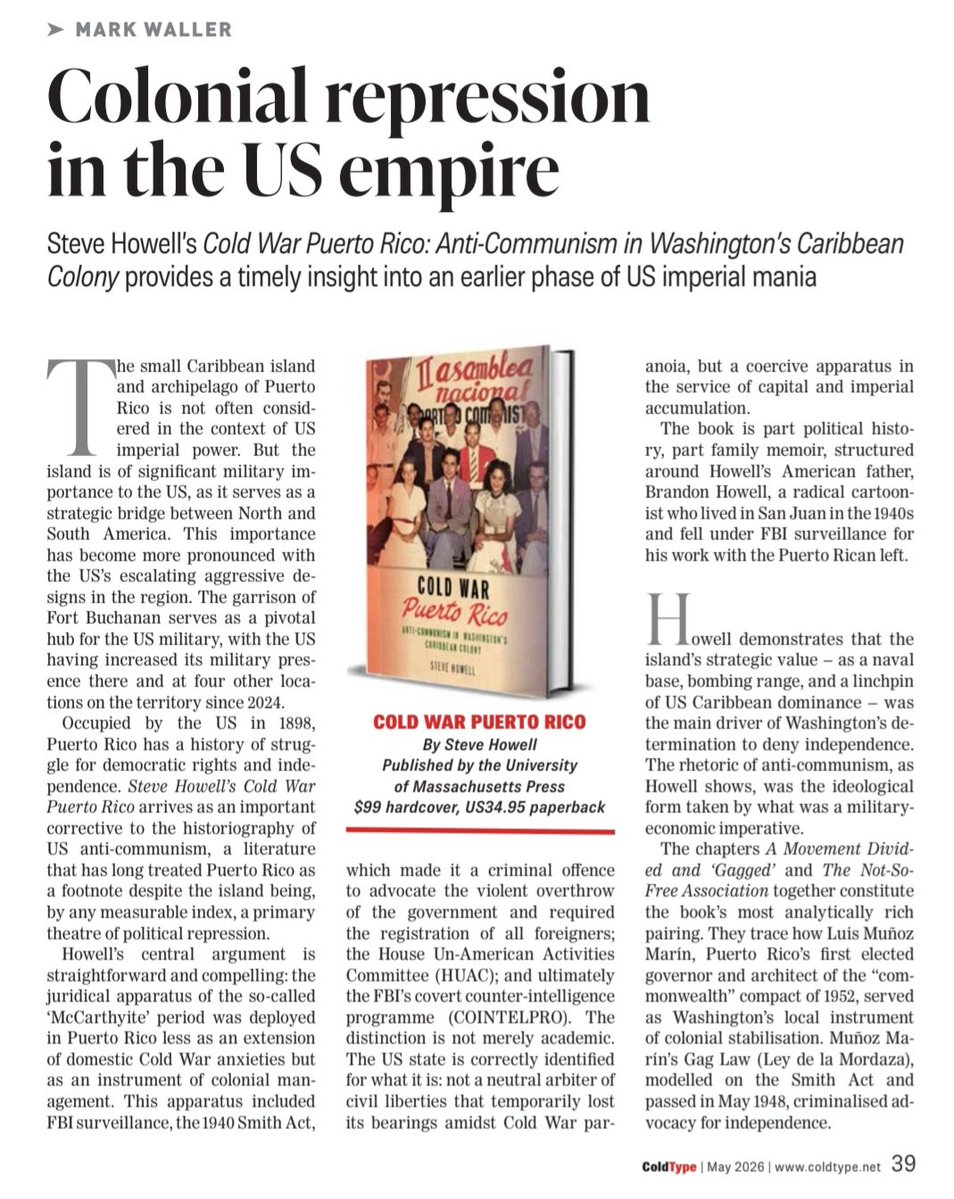
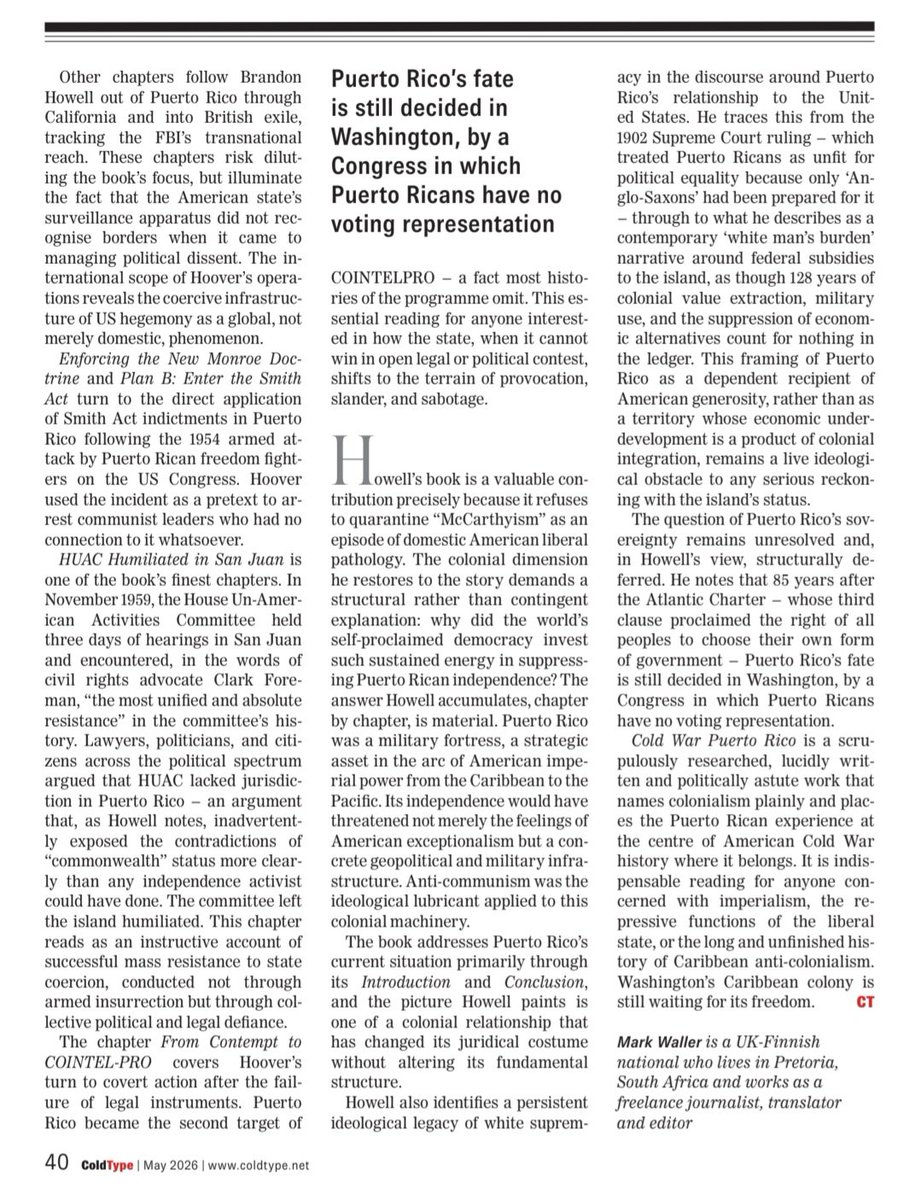
«Une lecture incontournable pour quiconque s'intéresse à l'impérialisme, aux fonctions répressives de l'État libéral ou à l'histoire longue et inachevée de l'anticolonialisme caribéen.»
Plus de détails sur steve-howell.com/cold-war-pu…

"Indispensable reading for anyone concerned with imperialism, the repressive functions of the liberal state, or the long and unfinished history of Caribbean anti-colonialism."
Check out Cold Type's review of Cold War Puerto Rico below.
Book details here: steve-howell.com/cold-war-pu…
3
3
219
Steve Howell retweeted
Jun 3
Really good to have the support of @DefendOurJuries for the International Anti-War conference on 20 June
Their campaigning work around the assault by government on democratic rights and freedoms are core to the building of an international movement for peace

1
21
38
2,690