
Joined October 2021
- Tweets 5,657
- Following 3,624
- Followers 537
- Likes 11,645
267 Photos and videos




Pinned Tweet

*Open Letter to the Leadership of India, the Rising Youth Movement, and Citizens of the World*
Subject : Beyond the Indian Spring: Why the Future of India May Depend on Reimagining Governance at Planetary Scale
From: Chandra Vikash
Convenor, United Earth Federation Organisation (UEFO)
Interim President, Earth Federation
Date: 8 June 2026
To:
The leadership of the National Democratic Alliance (NDA), including the Bharatiya Janata Party (BJP)
The leadership of the INDIA Alliance, including the Indian National Congress
Leaders of regional and other political parties across India
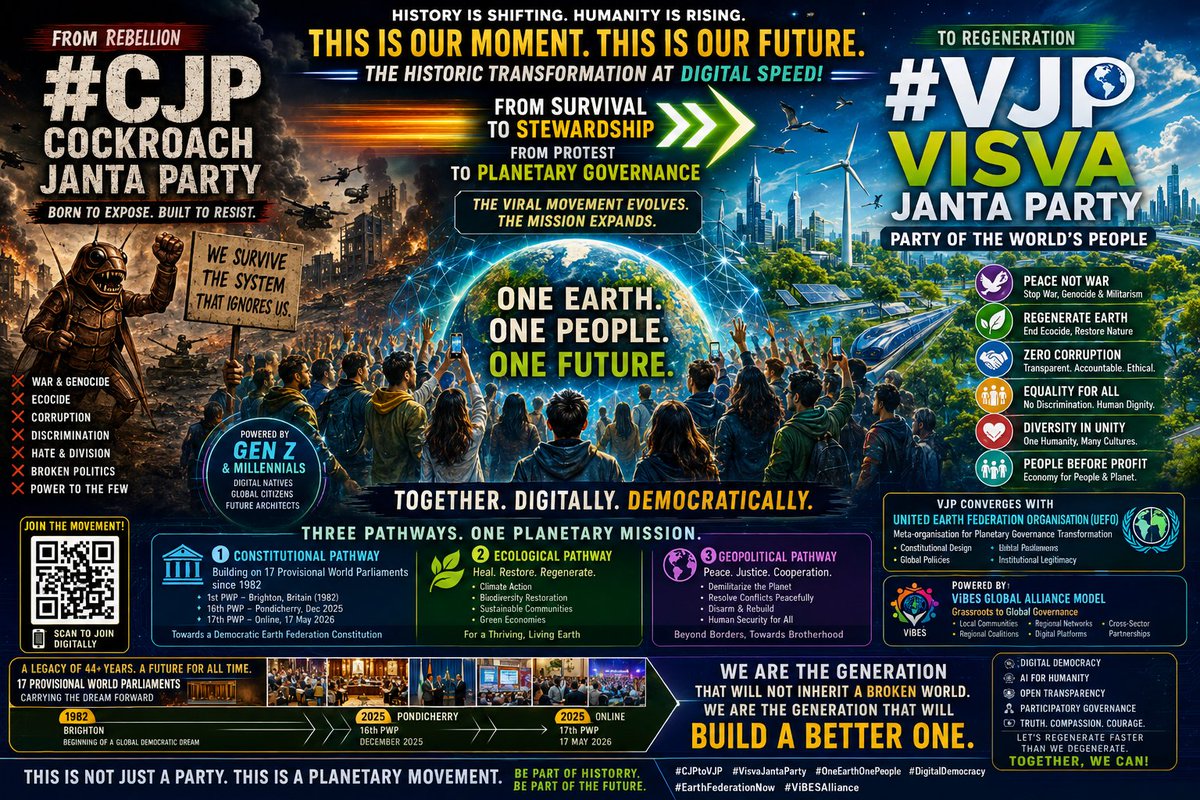
Members and supporters of the emerging Cockroach Janta Party (CJP) movement
Civil society organisations, student groups, labour unions, farmers' movements, and concerned citizens
The people of India
Global citizens, scholars, policymakers, diplomats, and geopolitical observers
Dear Fellow Citizens of India and the World,
India stands at a historic crossroads.
The developments unfolding across our nation today are not merely political events. They are symptoms of deeper structural stresses that are simultaneously economic, demographic, ecological, institutional, and civilisational in nature.
Across cities, towns, villages, universities, workplaces, and digital platforms, a growing number of young Indians are expressing frustration, alienation, and despair. Rising costs of living, declining economic opportunities, widening inequalities, environmental degradation, social fragmentation, and a pervasive sense that political institutions are failing to address fundamental challenges have created conditions that no responsible leadership can afford to ignore.
The rapid emergence of the Cockroach Janta Party (CJP) as a vehicle of satire, protest, and rebellion should not be dismissed as a passing internet phenomenon. Rather, it should be understood as a warning signal emerging from a generation that increasingly feels unheard, unseen, and excluded from meaningful participation in shaping its future.
History teaches us that when legitimate grievances are ignored for too long, public frustration can eventually overflow in unpredictable and sometimes destructive ways.
No nation should wish to witness a descent into chaos, violence, or social breakdown.
No responsible political party should gamble with such risks.
And no patriotic citizen should mistake silence for stability.
The ruling establishment may take comfort in the fragmentation of opposition forces. Equally, opposition parties may hope that public dissatisfaction alone will generate political change. Both assumptions would be dangerous.
India's challenges have grown larger than any single party.
Larger than any election cycle.
Larger even than the nation-state framework within which they are conventionally understood.
The crises confronting India's youth are increasingly tied to forces operating at the planetary level:
Climate change and ecological destabilisation.
Global financial volatility and debt structures.
Energy insecurity.
Technological disruption and automation.
Demographic transitions.
Supply chain vulnerabilities.
Resource competition.
Geopolitical fragmentation.
The erosion of international governance mechanisms.
These are not problems that India alone created, nor problems that India alone can solve.
This is why I urge political leaders across the spectrum to begin thinking beyond the narrow confines of partisan competition and beyond the inherited limitations of the Westphalian nation-state system.
India possesses a unique historical opportunity to lead humanity toward a new paradigm of governance.
As the world's largest democracy, one of its oldest civilisations, and a leading voice of the Global South, India can champion a transition toward an Earth Federation framework founded upon democratic accountability, cultural pluralism, civilisational dialogue, ecological stewardship, and shared human destiny.
In this vision, India does not surrender sovereignty.
India elevates leadership.
India becomes a bridge between nations, cultures, and civilisations.
India helps pioneer institutions capable of addressing challenges that transcend borders.
India demonstrates that patriotism and planetary responsibility are not contradictions but complementary duties.
The BRICS framework, particularly during India's current leadership role, offers an unprecedented opportunity to initiate discussions about new forms of global cooperation capable of addressing twenty-first-century realities.
The question before us is not whether humanity requires stronger planetary governance mechanisms.
The question is whether such mechanisms will emerge through democratic cooperation and foresight—or through crisis, conflict, and collapse.
Today, as leaders of opposition parties and allied groups gather in support of the INDIA bloc on 8 June 2026, I respectfully appeal to all participants to rise above narrow party interests and political calculations.
This moment demands statesmanship rather than partisanship.
The national interest must come before electoral interest.
The future of India's youth must come before factional advantage.
And the long-term interests of humanity must come before the short-term ambitions of individuals and parties.
Likewise, I appeal to the leadership of the BJP and the broader NDA.
Governments are ultimately judged not by slogans, spectacles, or narratives, but by their ability to improve the lived realities of ordinary people.
The concerns being expressed by millions of Indians, particularly young people, deserve engagement rather than dismissal.
Constructive dialogue is always wiser than confrontation.
Reform is always less costly than upheaval.
Listening is always stronger than denial.
To the youth of India, I offer a message of hope and responsibility.
Your frustration is understandable.
Your desire for change is legitimate.
But the future must not be built through hatred or destruction.
The task before your generation is not merely to replace one political formation with another.
It is to help pioneer a new model of governance adequate to the challenges of an interconnected world.
The goal is not simply regime change.
The goal is systemic transformation.
The goal is not victory over fellow citizens.
The goal is a future in which all citizens can flourish.
The accompanying article, "Beyond the Indian Spring: Why the Future of India's Youth May Depend on Reimagining Governance at Planetary Scale," explores these themes in greater depth and argues that many of India's current challenges cannot be sustainably resolved without simultaneously addressing the structural deficiencies of global governance itself.
I invite all political leaders, scholars, activists, policymakers, journalists, diplomats, and concerned citizens to engage with these ideas in a spirit of openness and dialogue.
The stakes are too high for complacency.
The opportunities are too great for cynicism.
And the future is too important to be left to the inertia of institutions designed for a different era.
India can either become a theatre of escalating crisis.
Or it can become the birthplace of a new planetary renaissance.
The choice remains ours.
With hope, determination, and faith in humanity's collective future,
Chandra Vikash
Convenor, United Earth Federation Organisation (UEFO)
Interim President, Earth Federation
Peace, Harmony, Stability and Sustainability Advocate
chandravikash.wordpress.com/…
@jawharsircar @Jairam_Ramesh @AmitShah @NitinNabin @derekobrienmp @HemantSorenJMM @MamataOfficial @DKShivakumar @revanth_anumula @vijaythottathil @BhagwantMann @RahulGandhi @Glenn_Diesen @jaffrelotc @mfa_russia @MFA_China @AshutoshRanka @abhijeet_dipke @SauravDassss @Wangchuk66 @Oyemisty @sanket @MnshaP @TheRedMike @sidhant_sarthak @sampitroda @ShashiTharoor
182
*Google's fall from 'Don't be Evil' and Carbon Neutrality planks into the Wrong Side of History*
*'Donald Trump, the Last Faustian Figurehead is not Alone. He has Bad Company*
*Has Sundar Pichai @sundarpichai lost his Moral Compass?*
Rene Mayrhofer @rene_mobile Director of Android Platform Security quits, citing Google’s Pentagon AI contract as violating CEO Sundar Pichai’s 2018 AI principles and his own pacifist values. He described the decision as “incredibly hard” yet unavoidable, criticizing management for losing its moral compass and ignoring employee petitions.
(NB: As his former classmate who has known him since 1990 I reckon he never had one and is too weak and spineless to stand by his earlier commitments. We studied together in the same class at IIT Kharagpur, he didn't have a moral compass to begin with. With common friends and in young formative years, i would share my doubts over the educational system that turned IITs into 'Schol Vending Machines' - *Schol is short for the 'Student Scholarships that America offers on top of Free Education as a nice cover up for its 'Loot, Plunder and Mass Murder' War Machine*. I said this at my farewell speech in 1993 to the stunning silence of everyone. Some took me as a young idealist, Many felt that I was either impractical or just insane. Not easy to deal with at a young age. Only latter do I realise - What a blessing in disguise it was!)
Rene Mayrhofer, writes in his farewell letter last week:
"The AI principles published by Sundar Pichai in 2018 stated very clearly that “AI applications we will not pursue: … 2. Weapons or other technologies whose principal purpose or implementation is to cause or directly facilitate injury to people. 3. Technologies that gather or use information for surveillance violating internationally accepted norms. 4. Technologies whose purpose contravenes widely accepted principles of international law and human rights.” "
"Google management has quietly abandoned its goals to become carbon-neutral because of the AI model energy usage. Worse, Google management is now signing deals with the US Ministry of War—where “any lawful purpose” by the current US government has already been repeatedly demonstrated to be in violation of international laws. None of this is being debated or communicated within the company. It is just decided by top-level management (I was part of the management chain before, and I hadn’t heard of any of these changes through internal channels). With my moral and ethical principles, I cannot—explicitly or implicitly, directly or transitively—support the current and ongoing actions of the “Maximum lethality, not tepid legality” US Ministry of War. Given Google’s top-level management direction and recent doubling-down, this unfortunately leaves me with the only choice to resign." @RobynScott @S_Ramadorai @gaillkent @PrasadJaladi @sanket @MnshaP
financialexpress.com/world-n…
88
*Why Millions of Young Indians Are Opting Out of the Success Trap and Imagining a Different Future*
Gen Z and Millennials Are Calling Out the “Toxic Sh*t” We Were Told to Accept
by Chandra Vikash | Convenor | United Earth Federation Organisation
12 June 2026 | Delhi, India
The Grind Is Broken : Is Gen Z Writing a New Script for Success?
For decades, young people were told that success required sacrifice.
Work harder. Study harder. Stay later. Complain less. Develop a “thick skin.”
Accept pressure as professionalism. Accept humiliation as leadership. Accept burnout as ambition. Accept exploitation as commitment. Accept anxiety as the price of success.
What previous generations often regarded as unfortunate but unavoidable realities of modern life, many Millennials and Gen Z are increasingly identifying as something else altogether:
toxic systems disguised as normality.
A recent viral discussion triggered by a Bengaluru startup founder captured this shift in a few powerful words. Calling out what she described as “toxic sh*t that is normalised in Indian workplaces,” she highlighted behaviours ranging from public humiliation and late-night calls to weekend meetings, disregard for personal boundaries and last-minute crises manufactured by poor leadership. Her central message was simple:
“They are the problem, not you.”
The overwhelming public response suggests that this conversation extends far beyond workplace etiquette.
It points toward a deeper generational awakening.
Across India and much of the world, younger generations are increasingly questioning assumptions that shaped twentieth-century industrial civilisation.
The old script promised:
Study hard. Get a degree. Secure a good job. Climb the corporate ladder. Buy a home. Achieve financial security. Live happily ever after.
For a growing number of young people, reality looks different.
Study harder. Accumulate more credentials. Take on more debt. Compete against more candidates. Work longer hours. Accept greater uncertainty. Receive lower returns.
The gap between promise and reality is becoming increasingly difficult to ignore.
This is why concepts such as neijuan (involution) emerging in China have resonated globally. They describe a condition in which individuals expend ever-greater effort while experiencing diminishing returns. The treadmill accelerates, but the destination remains unchanged.
India increasingly exhibits similar symptoms.
contd.
chandravikash.wordpress.com/…
41
new blog post
*Boomers to Zoomers : Is the clock turning a full circle ?*
Gen Z and the Innate Quest of a Regenerative Civilisation Rooted in Indigenous Wisdom, Appropriate Technology and Non-Violent Prosperity
by Chandra Vikash | Convenor | United Earth Federation Organisation
11 June 2026 | Delhi, India
Snapshots:
The Boomers Built the Machine. GenX turbo-charges it, Gen Z now Wants to Regenerate the Planet
Wi-Fi, Food Forests & AI: The Unexpected Rise of Gen Z’s Regenerative Future
From Side Hustles to Soil Health: Why Gen Z Is Reimagining Prosperity Without Calling It That
The Future Is Already Here: Gen Z’s Quiet Shift Beyond Consumerism and Fossil Fuels
Many economists, echoing the Boomers sentiment and steeped in the Development tradition that has been cultivated in last couple of centuries since the extractive and exploitative cradle-to-grave Modern Industrial Revolution, implicitly assume a historical path:
Agriculture employs fewer people over time.
Manufacturing expands.
Services expand.
Living standards rise.
Within that framework, an increase in agricultural employment is often treated as evidence of economic distress rather than success. Economist Santosh Mehrotra is one among them, who has repeatedly argued that growth in farm employment should not be celebrated as job creation.
He shares this and lots more in a conversation that examines one of the most important questions facing India today: if the economy is growing, why are employment concerns continuing to dominate public debate?
Drawing from his book India Out of Work, Dr Mehrotra challenges several widely accepted assumptions about growth, jobs, formalisation and economic development. The discussion explores why India’s demographic opportunity may be narrowing faster than many realise, and what that could mean for the country’s future.
Nearly 121 million young Indians are estimated to be neither employed, in education, nor in training.
India’s demographic dividend window is projected to narrow around 2040, creating urgency around job creation.
The economy may need to generate 10–12 million non-farm jobs every year to absorb new entrants into the workforce.
Between 2020 and 2024, roughly 80 million workers returned to agriculture, reversing a long-term structural trend.
Unemployment among graduates and degree holders remains a major concern despite rising educational attainment.
In a televised conversation on India’s Jobs Crisis Explained: 121 Million Youth, 80 Million Back to Farming & the Growth Paradox, he also examines the future of manufacturing, the role of MSMEs, formalisation, inequality, and whether India can create enough opportunities to fully realise its economic ambitions.
Even as Dr Mehrotra’s concern for greater employment and economic opportunities for all is highly creditworthy, his incessant focus on this employment and opportunities coming from even more fossil fuel guzzling, polluting, wasteful and inefficient industrialisation needs a careful deliberation.
Interestingly, this also exhibits an inter-generational divide that defies global trends especially among the younger generation. Younger people are waking up to the follies and blunders of the past and fosters a new culture of ecologically responsive and community oriented agriculture.
Consider this:
Agriculture is not merely an employment category; it is a food system, ecological system, and way of life.
Small farmers provide social and environmental benefits not captured by GDP statistics.
Measuring success only by movement out of farming reflects an industrial-era bias.
Rural self-employment may sometimes be preferable to precarious urban informal work.
So the disagreement is often about values and assumptions, not merely data.
contd.
chandravikash.wordpress.com/…
45
United Earth Federation Organisation (#UEFO) retweeted

From global collaboration to resilient infrastructure and sustainable urban futures — the countdown to the 13th BRICS Urbanisation Forum begins. 🌏
📍 11–12 June 2026 | New Delhi, India
#BRICSUrbanisationForum
1
12
19
1,359
*INDIA’s Case for Right to Self-Determination and the coming Earth Federation : Why It is an Idea Whose Time has Come*
Beyond Partisan Remedies — Why India Must Consider Systemic Transformation
by Chandra Vikash | Convenor | United Earth Federation Organisation
08 June 2026 | Delhi, India
On 8 June 2026, leaders of the opposition INDIA alliance in India met at the Constitution Club in New Delhi and announced a five-point program intended to address growing concerns regarding governance, electoral integrity, economic distress, unemployment, rising prices, farmers’ grievances, and institutional accountability in India.
The decisions announced included:
A joint letter to the Chief Justice of India regarding allegations of electoral irregularities and concerns over the integrity of the electoral process.
A unanimous demand for the resignation of the Union Education Minister.
A call upon the Union Government to convene an all-party meeting to discuss the economic situation, unemployment, inflation, farmers’ concerns, atrocities, and other people-centric issues.
A decision for opposition parties to meet every two months, with the next meeting scheduled in Hyderabad.
Continued parliamentary coordination during the Monsoon Session through daily meetings led by the Leader of the Opposition.
These much-awaited announcements offer a measure of hope that at least some sections of India’s political leadership recognise the gravity of the challenges confronting the country. In a democracy, dialogue, accountability, institutional oversight, and sustained political engagement are essential and welcome developments.
The organisers however spared no time for any interaction. The public announcement for the start of the meeting was 12 noon. As journalists and political observers were asked to assemble in another room, it was also announced that the Press Conference will begin at 2:30pm.
It actually began at 3pm after the leaders of the constituent regional parties were seated as per the elaborate arrangement made on the dias. The press meet however ended abruptly and immediately after the announcement first in English and then in Hindi by Mallikarjun Kharge, Chairperson and convenor of the Indian National Developmental Inclusive Alliance (INDIA). The journalists who had been waiting for over 3 hours had no opportunity to ask even a single question.
There was a ruckus created by a few journalists who interjected that the action points and measures announced were not adequate but all the opposition leaders got up and walked out as if the ghost of Narendra Modi had entered each one of them.
Many discerning political observers would agree that the quality of national politics in India has hit a new low that is only getting worse by every election cycle. It is mired in brazen incompetence, apathy, pettiness and short-sightedness besides the infectious culture of greed, corruption, deceit and lack of accountability that it spawns.
Coming back to the five-point announcement, even if every one of these demands were fully implemented, a deeper question remains.
Would these measures be sufficient to address the structural roots of India’s governance crisis?
The argument presented in this essay is that they would not. India must think out of the box to meaningfully solve its deepening multi-faceted crises.
India’s challenges today are not merely the result of one government, one political party, one alliance, or one election cycle. Nor can they be reduced to a contest between the ruling NDA and the opposition INDIA bloc. The crisis has become systemic.
The symptoms are visible everywhere:
Deepening political polarisation.
Declining trust in institutions.
Persistent unemployment and economic insecurity.
Ecological degradation and environmental collapse.
Air and water pollution on a massive scale.
Agricultural distress.
Educational failures and examination irregularities.
Administrative inefficiencies.
Growing centralisation of power.
Weak global governance in an increasingly interconnected world.
These problems have accumulated over decades under multiple governments and political formations. While parties differ in ideology and priorities, all remain constrained by institutional frameworks designed for a different era.
The central thesis of this article is therefore not that one party should replace another, but that humanity has entered a historical period in which the inherited structures of governance themselves require serious reconsideration.
contd.
chandravikash.wordpress.com/…
96
A good start. Way to go.

1. It was agreed to send a letter to the Chief Justice of India regarding vote chori and the stealing of elections. The letter will be delivered very soon.
2. It was unanimously agreed to demand the immediate resignation of the Education Minister.
3. The Union Government should immediately call an all-party meeting to discuss the current precarious economic situation, unemployment, price rise, farmers' issues, atrocities, and other people-centric issues.
4. It was agreed that all of us should meet every two months. The next meeting will be held in Hyderabad.
5. Parliamentary coordination will continue during the Monsoon Session, with daily morning meetings in the office of the Hon'ble Leader of the Opposition.
: Congress President Shri @kharge
9
United Earth Federation Organisation (#UEFO) retweeted

ये युवा एक बहुत बड़ी कंपनी में काम करते हैं और कल अपनी जिंदगी में पहली बार प्रोटेस्ट करने आए
युवाओं में इतनी ज़्यादा निराशा है इस सरकार से! कुछ भी ठीक से चल नहीं रहा। पेपर लीक होते है, डेटा हैक होता है, और फिर भी धर्मेंद्र प्रधान इस्तीफ़ा नहीं दे रहे।
और नहीं सहेंगे
184
2,160
7,113
77,474
United Earth Federation Organisation (#UEFO) retweeted

Jun 7
Briefly addressed an important point whilst talking with @Smita_Sharma yesterday about our right to protest, because the way we enforce it is quietly broken.
Right now, India runs on a permission regime. You have to ask the state for permission, an NOC, before you can hold a peaceful protest. Think about what that means. The very government you want to criticise gets to decide whether you are allowed to criticise it. The power to grant permission is also the power to refuse it, and to refuse it selectively. A right that needs the state's signature is not a right anymore. It is a privilege they can withhold.
There is a better system, and it is not chaos. It is called a notification regime. You simply inform the authorities when, where, and (roughly) how many. They cannot say no. They only prepare, manage traffic, arrange safety, protect you from counter mobs. Notification facilitates protest. Permission controls it. This is the international standard, backed by the UN and the OSCE Venice Commission. The US needs no permit for ordinary protest. The UK and Germany run on notification. Even our own Supreme Court warned back in 1973, in Himmat Lal, that giving officials unchecked power to permit or refuse a protest is bad in law.
So this is my appeal to every citizen, not as an activist but as a lawyer. Ask for this change. Demand with every protest that India moves from a permission regime to a notification regime. This is bigger than any single protest. It is about whether the people remain sovereign or slowly forget that they are.
And this is exactly why thousands of young protestors were out with @CJP_2029. 70 paper leaks at different levels over the last decade. NEET-UG 2026 cancelled outright. Lakhs of futures wrecked. And at the top, denial, then a quiet reshuffle of a few bureaucrats while the minister stays. That is the apathy of a leadership that believes it answers to no one. We are here to remind them that they answer to us.
7
37
111
7,454
*Eyewitness Account: #CJP-led Youth Protest at Jantar Mantar — Beyond the Half-Truths and Mischaracterisations*
Saturday, 6 June 2026 | Jantar Mantar, New Delhi
By Chandra Vikash
Interim President for Earth President
Convenor, United Earth Federation Organisation (UEFO)
Eyewitness Presence: 12 PM – 4 PM IST
Date of Account: 7 June 2026
Preamble
This account is offered in response to a widely circulated Facebook post shared by Mr. Natraj Krishnan on 7 June 2026, reproducing the observations of an individual claiming to have attended the youth protest at Jantar Mantar and subsequently describing it as a “flop show.”
Every eyewitness is entitled to an opinion. However, no eyewitness account can claim credibility if it selectively reports facts while omitting critical context and drawing conclusions unsupported by evidence.
Having personally attended the protest between 12 noon and 4 PM, I believe it is important to place on record a fuller, fairer, and more humane account of what actually transpired.
1. The RealFeel effective temperature with all the overcrowding inside a heavily barricaded area of less than 300 sq. metres (<15m x 20m) in that time span was in excess of 45 deg Celsius.
2. There could not be more than 1500-2000 people inside, as the account rightly mentions. A good few thousand was dispersed in surrounding areas in the shade and despite all the emotive and well-spirited support and solidarity couldn’t be inside all the time.
3. The fact that there were no big banners and no proper stage and audio system actually points towards the fact that there was no big sponsor involved. I spoke to some of the organisers who are the well-meaning, idealist Delhi citizenry who supported the youth movement against the massive scandal in the board and entrance examination system in India. Many of them might have also supported AAP in the past or even BJP or Congress. But these are Indians and Delhi folks first. Don’t err in sticking a political party identity on them just because that is your jaundiced-eye lens.
contd.
@MnshaP @sanket @Cockroachisback @CJP_for_India @abhijeet_dipke @SauravDassss @AshutoshRanka @VijetaDahiya @Wangchuk66 @ravish_journo @sardesairajdeep @KaranThapar_TTP @RahulTavar_ @RahulGandhi @ANI @NitinNabin
chandravikash.wordpress.com/…
48

"विश्वगुरु हैं हम, एक पेपर ढंग से करा नहीं सकते, पर विश्वगुरु हैं हम": आलोक शर्मा, कांग्रेस प्रवक्ता
#ATVideo #NeetPaperLeak #हल्ला_बोल | @anjanaomkashyap @Aloksharmaaicc
302
1,602
7,328
154,431
*From Cockroach Janta Party to a Generational Reckoning: Why India’s Youth Revolt Could Become Something Much Bigger*
by Chandra Vikash | Convenor | United Earth Federation Organisation
06 June 2026 | Delhi, India
A New Generation Steps Onto the Political Stage
On 6 June 2026, a protest movement that began as satire, memes, and digital dissent entered a new phase as supporters of the Cockroach Janta Party (CJP) gathered around Delhi’s Jantar Mantar alongside the return of its founder, Abhijeet Dipke, to India. Originally centered on grievances over examination scandals, educational governance, and youth unemployment, the movement has rapidly evolved into a broader expression of frustration among Generation Z. The youth protest has focused on demands for accountability in the education system and criticism of perceived institutional failures affecting students and young job seekers.
Whether the movement ultimately succeeds or fades remains uncertain. What is already clear, however, is that it reflects a deeper generational crisis that extends far beyond any single ministry, examination system, political party, or government.
The real question is not whether a protest succeeds on one day at Jantar Mantar.
The real question is whether India is witnessing the emergence of a new political generation that no longer believes the existing political order is capable of solving its problems.
Why Gen Z Is Angry
India possesses one of the youngest populations in the world. Yet many young Indians increasingly find themselves trapped between educational credentialism, rising competition, uncertain employment prospects, housing affordability challenges, and declining faith in public institutions.
Generation Z has grown up in a hyper-connected world. They compare opportunities not only with their neighbors but with peers across Asia, Europe, North America, and beyond. They experience globalisation directly through social media, remote work, artificial intelligence, and digital communities.
As a result, their expectations are fundamentally different from those of previous generations.
They do not merely demand jobs.
They demand competence.
They do not merely demand growth.
They demand fairness.
They do not merely demand representation.
They demand accountability.
When these expectations collide with bureaucratic dysfunction, examination controversies, and political polarization, frustration accumulates rapidly.
Why Suppression May Strengthen the Movement
Contd.
chandravikash.wordpress.com/…
162
United Earth Federation Organisation (#UEFO) retweeted

VIDEO | Delhi: "Reported leak of JEE (Advanced) 2026 candidate data shows how 'incompetent' is Dharmendra Pradhan... We appeal PM Modi to sack Education Minister immediately," said CJP spokesperson Ashutosh Ranka.
(Full video available on PTI Videos - ptivideos.com)
#Delhi
41
610
2,391
88,374
United Earth Federation Organisation (#UEFO) retweeted

In this deadly heat, students have come out in one of the largest protests seen in the last 12 years following the paper leak scandal led By @IYC , @INCIndia
They are demanding accountability, transparency, and justice. We must support them in whatever way we can ,,, by raising awareness, amplifying their voices, and standing in solidarity with their cause
44
1,578
4,419
38,796
United Earth Federation Organisation (#UEFO) retweeted

Jun 2
IF NOT US, WHO?
IF NOT NOW, WHEN !
I will be joining the CJP members in Delhi on 6th June if nothing changes by 5th June. Any self respecting Minister should resign if things go so wrong... Not to mention the effect on millions of young lives and in fact the future of India.
#CockroachJantaParty #CJP #SonamWangchuk
Please share; No copyright
1,948
9,824
37,083
1,274,352
new blog post
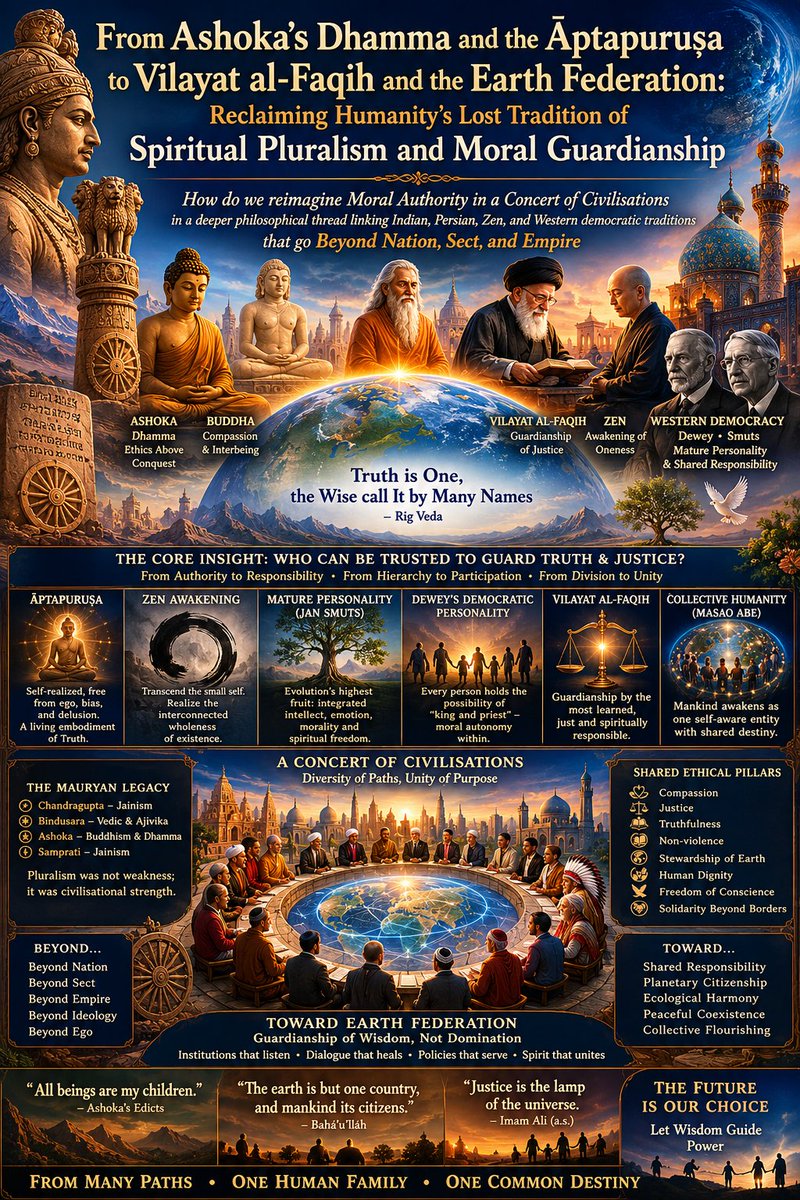
**From Ashoka’s Dhamma and the Āptapuruṣa to Vilayat al-Faqih and the Earth Federation: Reclaiming Humanity’s Lost Tradition of Spiritual Pluralism and Moral Guardianship toward a New Planetary Ethic**
How do we reimagine moral authority in a deeper philosophical thread linking diverse global traditions as a Concert of Civilisations that go Beyond Nation, Sect, and Empire
by Chandra Vikash | Convenor | United Earth Federation Organisation
02 June 2026 | Delhi, India
Few dynasties in world history illustrate the principle of spiritual freedom as vividly as the Mauryan Empire. Within just four generations, the ruling family embraced and supported four distinct streams of Indian civilisation.
Emperor Ashoka, the global catalyst for Buddhism initially followed the prevailing mix of Vedic traditions and folk worship. However, he went on to become the single most influential royal patron of Buddhism in world history.
Chandragupta Maurya, his grandfather and the founder of the empire, was initially guided by Chanakya and the traditions of Vedic statecraft. Yet toward the end of his life he embraced Jainism and is remembered in Jain tradition as having renounced worldly power in pursuit of spiritual discipline.
His son Bindusara preserved the empire’s pluralistic foundations. Ancient accounts portray him as a patron of Brahmanical institutions while also maintaining a deep affinity for the Ajivika movement. Ajivika philosophers and astrologers occupied important positions within his court. Rather than treating different traditions as enemies, Bindusara viewed them as legitimate pathways within a larger civilisational landscape.
The next generation witnessed one of history’s most dramatic spiritual transformations. Following the immense suffering caused by the Kalinga War, Ashoka embraced the teachings of the Buddha. Disturbed by the human cost of conquest, he sought a new basis for political legitimacy rooted in ethics, compassion, and self-restraint. (Can we imagine a @realDonaldTrump Donald Trump today doing the same after the carnage in the Gaza genocide and scores of such calamities by America in almost every decade since the Second World War?)
Yet Ashoka did not establish a Buddhist theocracy.
..
What was the ancient world like before religious orthodoxy?
..
This pluralism did not end with the Mauryas.
chandravikash.wordpress.com/…
11
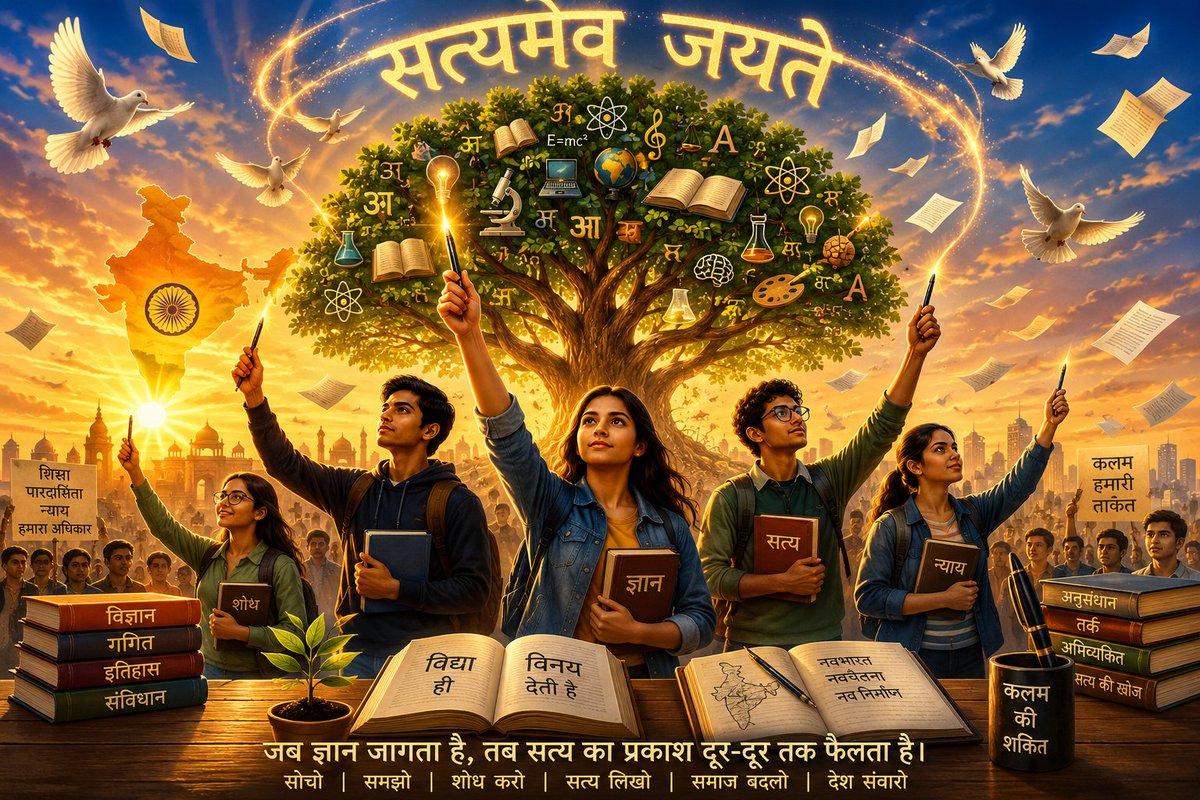
**युवा चेतना का विजयपर्व**
GenZ ने कर दिया कमाल
'सार्थक' 'निसर्ग' और 'वेदांत' -
भारत के होनहार नये कर्णधारों ने
पाप के युग का कर दिया अंत।
CBSE NEET और CUET जैसे
परीक्षा घोटालों का किया खुलासा
करोड़ों बच्चों और परिजनों को
दिलाया उचित न्याय का भरोसा।
'धर्मेंद्र प्रधान' और 'नरेंद्र मोदी' को
जनता के सामने खड़ा कर दिया
'सम्राट के कपड़े' पहने हुए थे
इस सच को उजागर कर दिया।
इन ठगों के शर्मनाक कारोबार को
कर दिया इस तरह तार तार
अपने सूझबूझ और गहरे शोध से
साबित हुए असली और सच्चे पत्रकार।
'गोदी मीडिया' मुँह ताकता रह गया
चुल्लू भर पानी के लिए तरस गया
अंध समर्थक अब पछता रहे हैं
उनमें से कई अफीम की नींद से जाग रहे हैं।
Gen Z ने शांतिपूर्वक कर दी 'विद्या क्रांति'
साबित कर दिया समाज ही है 'विश्वगुरु भारत'
दंगा फसाद मारकाट और आगजनी से नहीं
दिखा दिया फिर से कलम की असली ताकत।
युवा ही देश के कर्णधार होते हैं
यही सनातन सत्य दोहरा रहा है
भारत की पावन धरा पर
'सत्यमेव जयते' का पताका फिर से फहरा रहा है।
नवभारत की यह नई कहानी,
जन-जन को संदेश सुना रही है—
जब जाग उठती है युवा चेतना,
तो व्यवस्था भी दिशा बदलती है।
#अबकीबारGenZसरकार
- Gen X की कलम से
चंद्र विकाश
1 जून 2026
मुख्य बिंदु:
विद्या क्रांति का शंखनाद
सत्यमेव जयते: Gen Z का उदय
कलम की ताकत, युवा की जीत
जब युवाओं ने सच को आवाज़ दी
परीक्षा घोटालों से न्याय तक
नवयुग के कर्णधार
ज्ञान, शोध और जनजागरण
सत्य की मशाल: Gen Z
पाप के युग का अंत
#cuet
#neet
#cbse
#cjp
facebook.com/share/p/1CGji7q…
22
United Earth Federation Organisation (#UEFO) retweeted

May 30
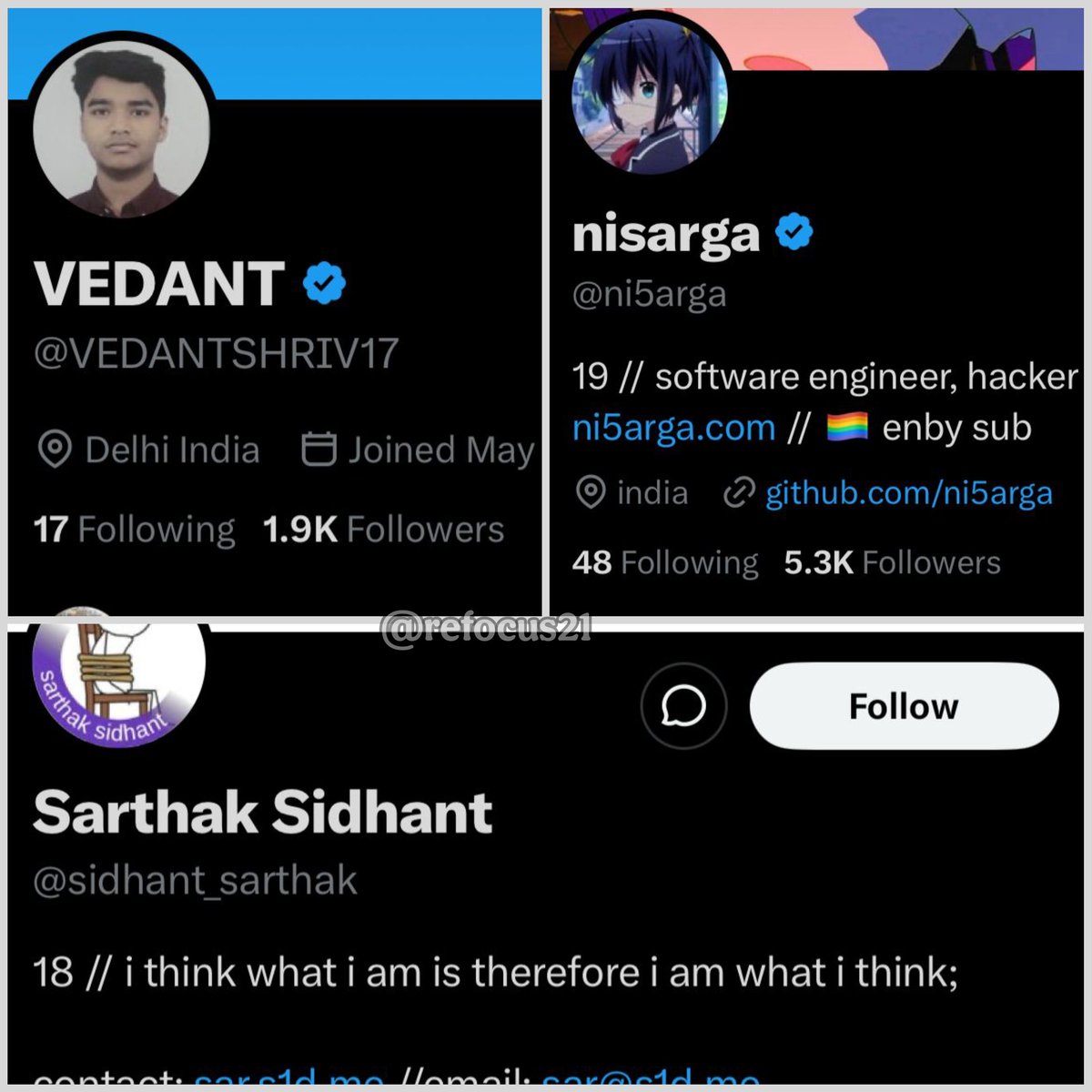
Meet Vedant Shrivastava, Nisarga Adhikary, and Sarthak Sidhant ,they exposed CBSE in every possible way :
17 years old Vedant Shrivastava :
> Applied for the CBSE re-evaluation process
> Got a different Physics answer sheet
> Posted it on X
> Got labelled "Pakistani" by the BJP IT cell
> Brought CBSE to its knees and proved them wrong
19 years old Nisarga Adhikary :
> Bro hacked the CBSE website
> Reported the vulnerability to them
> But they didn't take any action
> Then bro posted it on X
> Showed everyone that it could be hacked
18 years old Sarthak Sidhant :
> Bro exposed a CBSE tender
> Took it to X
> Wrote a detailed thread
> Explained how the CBSE OSM tender conditions allegedly favoured COEMPT
> And today came on the media
> Exposed them with facts
These three boys are doing what whole media failed to do, all of them took x to expose CBSE .
108
2,581
11,353
311,804