
Director at @LISER_LM. Passionate about labor economics, migration and yoga. Fellow @CEPR, @iza_bonn, @CESifoNetwork, @ZEW and @CReAM_Research.
Joined January 2022
- Tweets 251
- Following 240
- Followers 441
- Likes 85
15 Photos and videos









Christina Gathmann retweeted

Apr 14
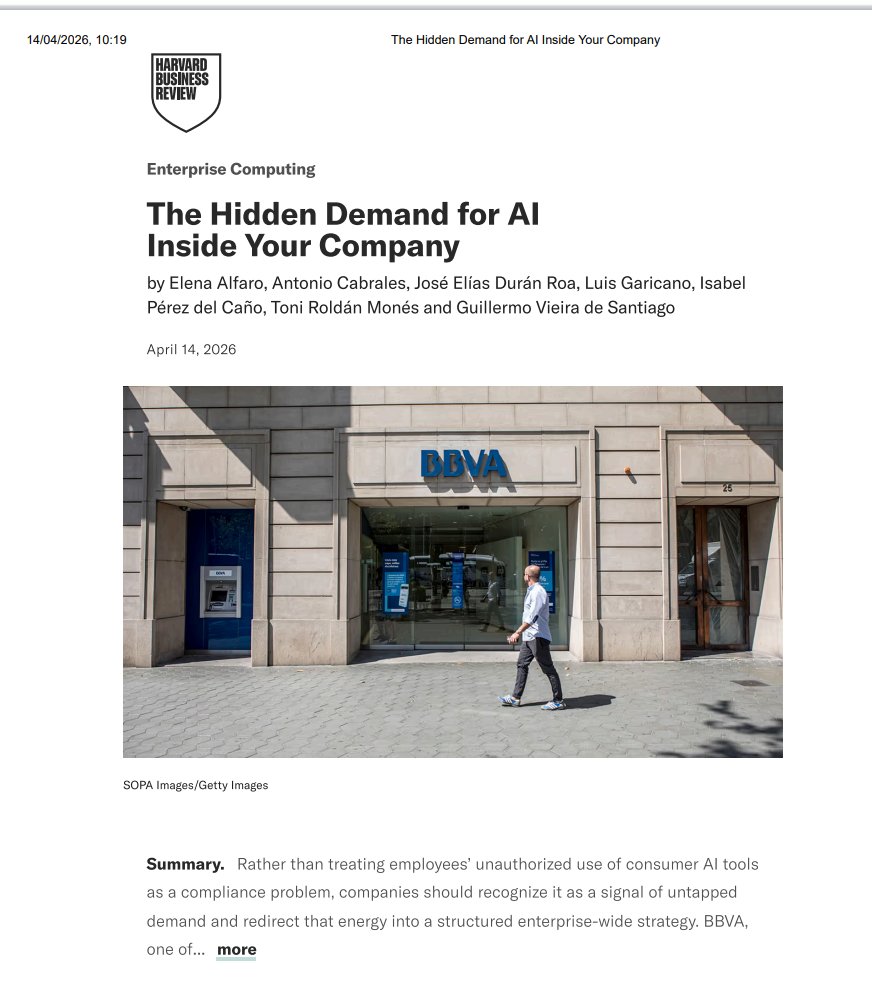
I have a new piece out today on AI Adoption in @HarvardBiz with Antonio Cabrales, José Durán @toniroldanm, and colleagues from @BBVA on why most enterprise AI programs fail and what BBVA did differently.
Most large companies have a shadow AI economy. As of Summer 2025, only 40% of firms had bought official LLM subscriptions, but employees at 90% used consumer AI for work on the side. The standard corporate response is to restrict and monitor. The "core IT" department takes over and sees its task as reducing usage. This is the wrong reaction. Shadow AI is not a threat. It is a demand signal telling you that productivity gains exist.
BBVA deployed ChatGPT Enterprise company-wide in a secure cloud, compressing risk assessment, legal review, and GDPR compliance into two months. Their bet was that unmanaged hidden usage is more dangerous than rapid managed deployment.
The rollout leveraged "FOMO" (fear of missing out): only 3,000 initial licenses, allocated competitively with a "use it or lose it" policy. This turned enterprise AI from a mandate into a privilege. Then they built an Adoption Network: Champions, Co-Champions, and 200 Wizards (power users) who provided peer-to-peer support. The Community of Practice became the most active internal forum in BBVA's history.
Within a year, active users grew from 3,000 to 11,000. 83% use it weekly. Employees built 4,800 custom GPTs. In audit, 99% of 600 auditors worldwide became active users, saving 3-4 hours per week. In Mexico, an insurance-advisory GPT cut query response time by 92% for 4,400 branch managers. These tools were built by frontline employees, not by IT. A human always owns the output. No direct writes to core systems.
If you want enterprise AI to work, stop building centralized plans. Trust the people who already figured out where AI helps. Give them a secure environment, clear rules, and a network to share what they learn.
hbr.org/2026/04/the-hidden-d…
11
71
240
49,403
Could not agree more!
Feb 10

I think this is a bit hysterical. Academic publishing has at least two pragmatic functions. Much of the difficulty derives from trying to perform both of those functions with the same venue/process. Decouple them, and things can work just fine.
Academic publishing does two things: it allocates *credentials*, and it attempts to allocate *attention*.
The credentialing function of academic publishing is actually really important. Universities are our largest and most enduring organisations for fundamental research in the public interest. For that research to make genuine progress towards knowledge, we have to apply standards of rigour. To know who to hire into tenure-track positions, we need to be able to assess the quality of their work, and see how it is judged by their peers. And to decide who gets the ultimate liberty of being able to follow their intellectual interests wherever they lead (ie tenure), we need the same thing. Peer review has all sorts of flaws, it's broken in many different ways, but we need to have *some* mechanisms for this kind of quality control in order for the whole endeavour of the collective pursuit of wisdom in the public interest to advance.
But the problem is, peer review takes *time*. And by the time it's complete, it's generally too late to contribute in a meaningful and effective way to the public conversation on a topic as fast-moving as AI progress. In addition, while the people running journals (etc) are often good judges of methodological rigour and other epistemic criteria, they are very *fallible* judges of what work is actually the most important, or otherwise in the broader interest of society (this is especially true for humanities fields like mine).
But this just means that while academic publishing is the right vehicle for quality control and credentialing, it's the wrong one for the allocation of public attention. The solution seems pretty clear—especially since this is how things are basically already done in CS. Decouple the two things. Preprints, substacks, the other changing forms of public communication for the allocation of attention; journals and peer-reviewed conferences for the quality control/credentialing function.
Obviously this exposes us to epistemic risk: if you don't wait for peer-review, then some of the work that attracts a tonne of public attention will prove to be bogus. But that's a self-correcting problem, since if it attracts a lot of attention then the errors are likely to be found out.
And obviously peer review faces MANY challenges right now. But that's something that *can* be salvaged (and an area where AI is likely to help).
136
Christina Gathmann retweeted

Feb 6
New NBER Economics of Artificial Intelligence conference — this year Sept 23-24 in Toronto. Focus on AI in China. Submit here. conference.nber.org/confsubm…
2
17
64
12,723

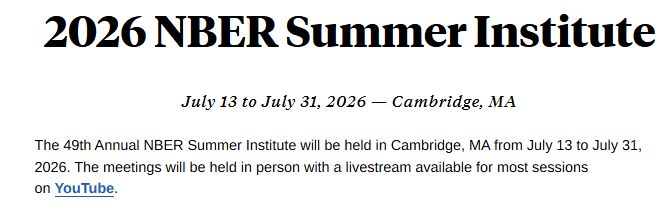
Open call for papers, 2026 NBER Summer Institute. Conferences to be held in Cambridge, MA from July 13 to July 31, 2026. Submit papers by 11:59pm EDT on March 26, 2026. More information: nber.org/calls-papers-and-pr…
44
149
29,764
Christina Gathmann retweeted
Join us for the Labor Economics Summer School in Barcelona! Applications open📊 🏖
Jan 20

Barcelona Labor Summer School 2026!
Applications already open: ow.ly/Tkxr50XW0Bl
Migration, Wages, Gender, Employer-Employee Data
Amazing teachers:
@LibertadGonLu
@JoanLlull_econ
@DNealEconUofC
@farre_lidia
@emanresa82
@bse_barcelona
2
37
4,638

12 Dec 2025
Worthwhile threat on policy advising
11 Dec 2025

Recently, I have been thinking about the political economy of policy advice. Below are my thoughts; I'd be curious to hear what "practitioners" think about these. Let's start by thinking about the demand for and supply in the market for policy advice.
5
1,027
Christina Gathmann retweeted

Mortality of displaced worker and his partner increases after male job loss, but not after female job loss. Just Accepted new paper by Christina Gathmann, Kristiina Huttunen @KristiinaHuttu2 Laura Jernström, Lauri Sääksvuori, and Robin Stitzing zurl.co/VoYxu
13
38
3,506
Christina Gathmann retweeted

22 Nov 2025
EALE 2026 in Barcelona! Deadline February 1, submit here: ub.edu/eale2026/
31
125
16,083
21 Nov 2025
Thanks Ludger and David for putting this great workshop together - it was great fun to present our (almost) latest work on AI! @TerryAGregory, @MargueritDavid @LISER_LM
20 Nov 2025

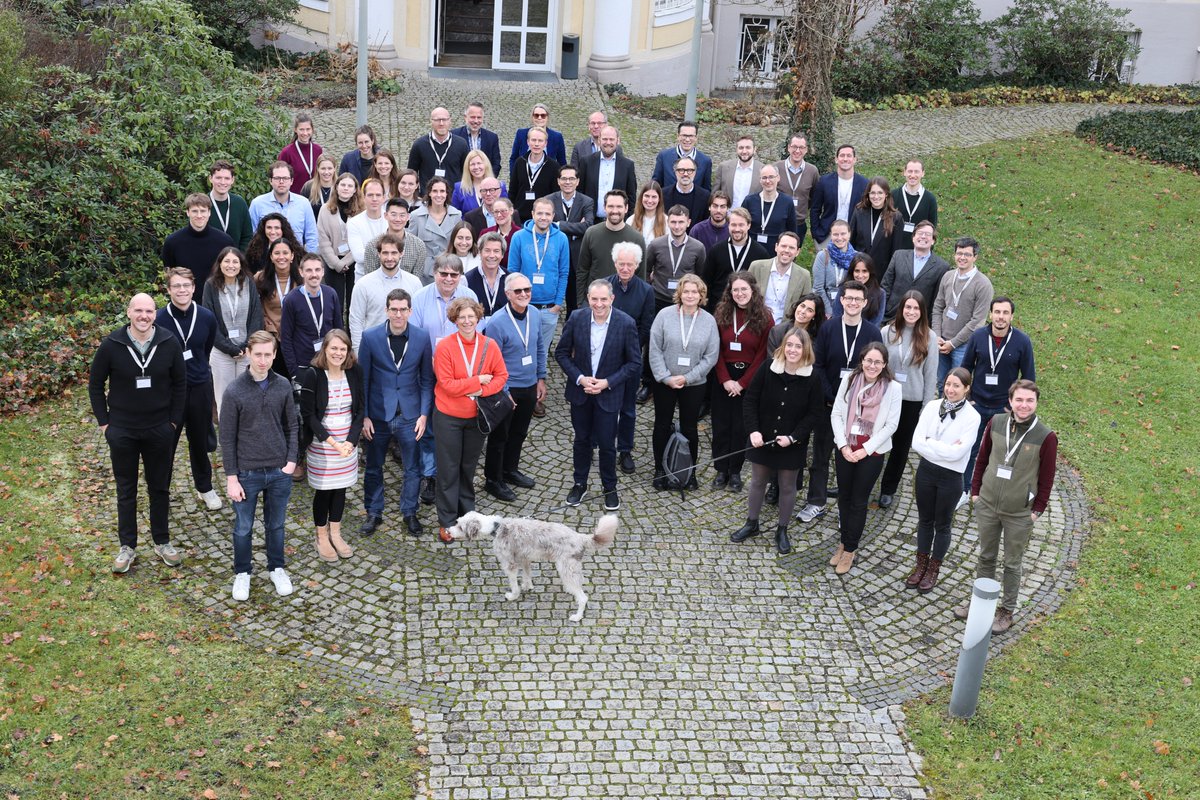
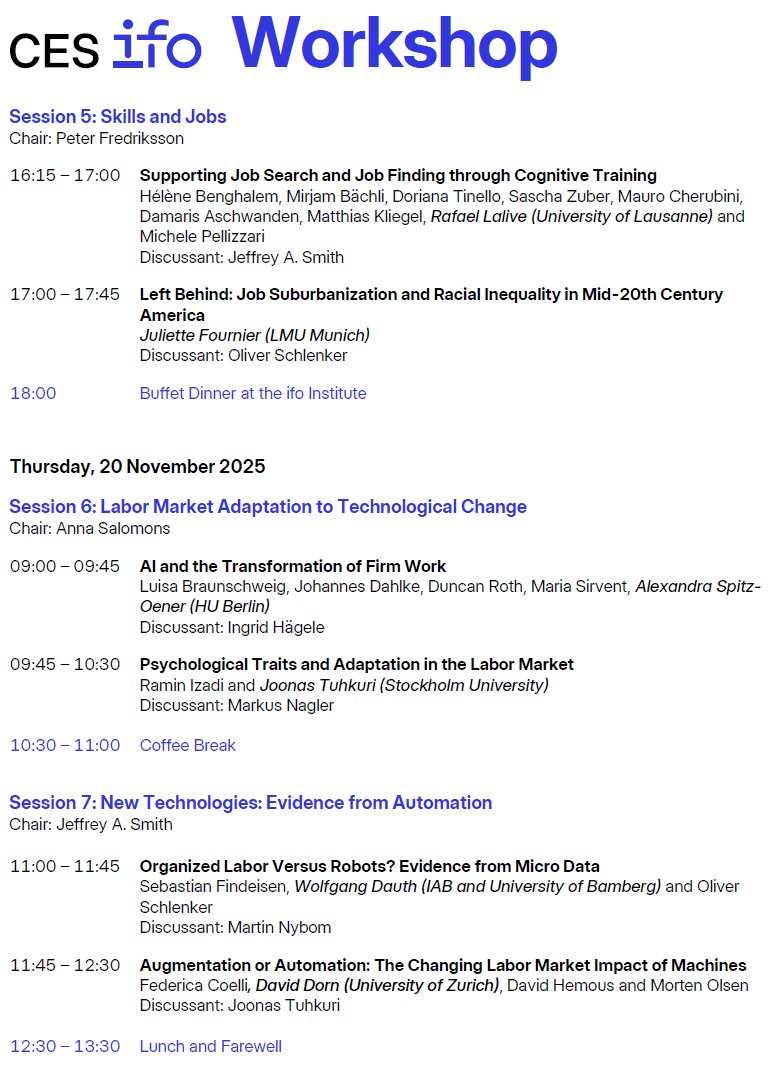
Our fantastic workshop with @davidautor on
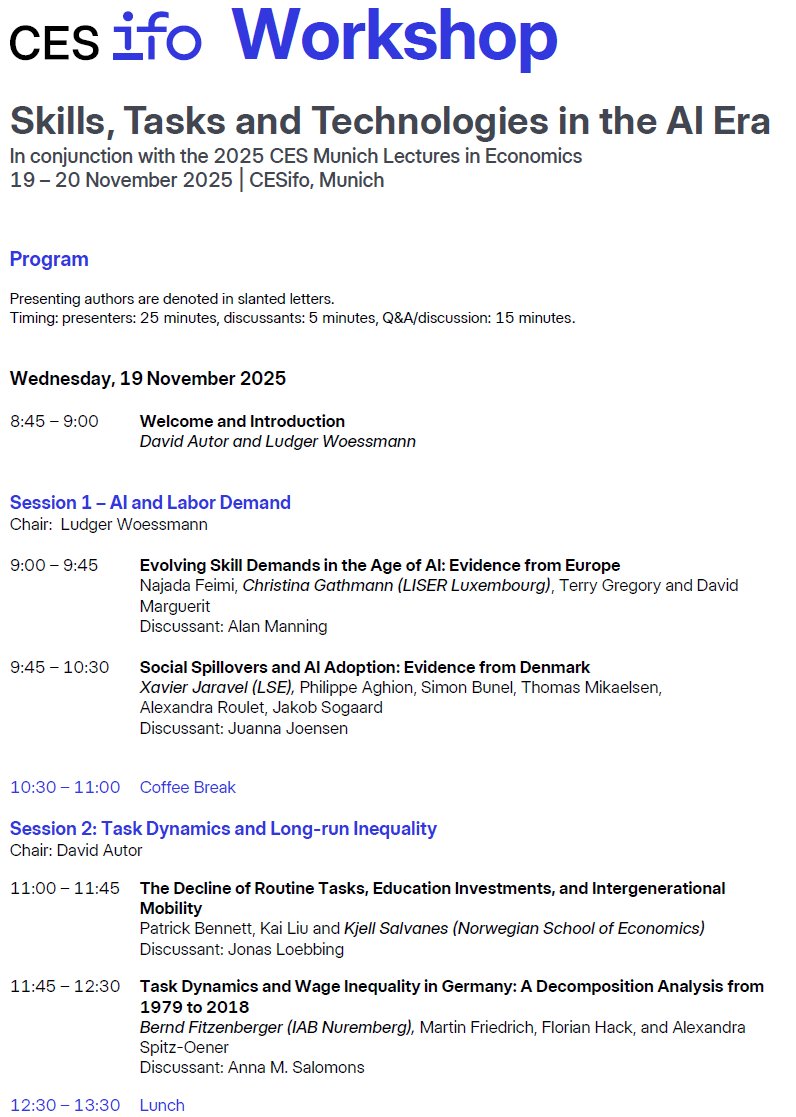
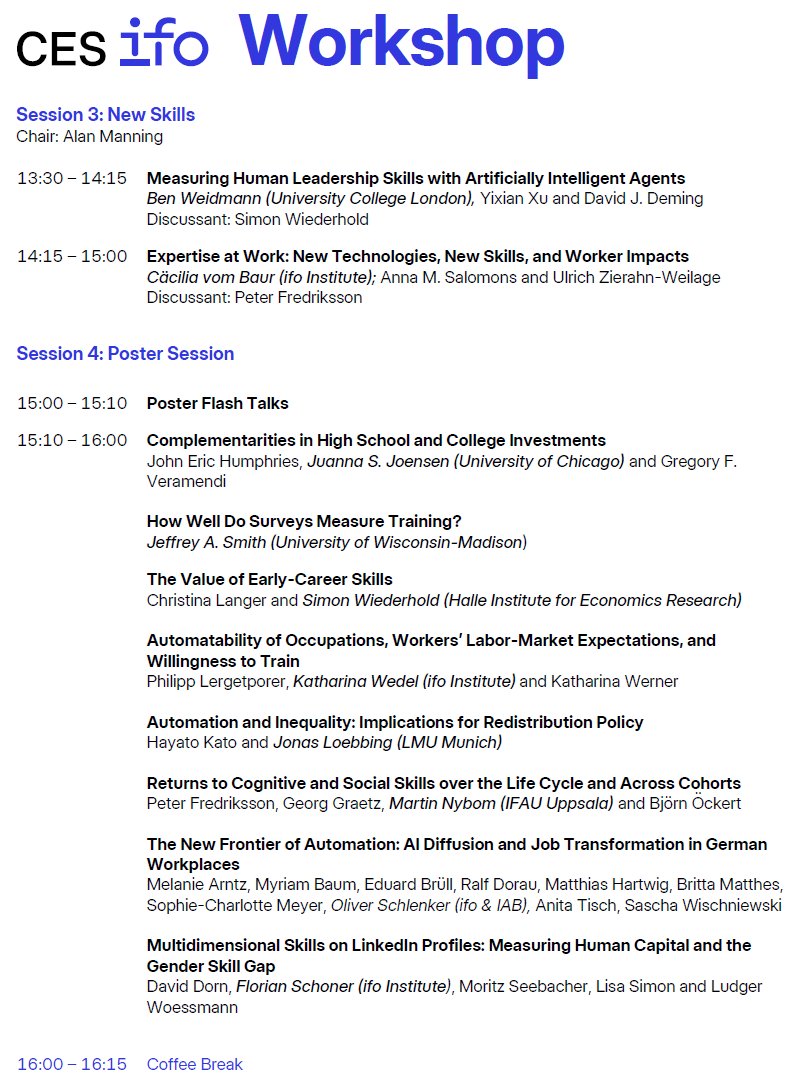
Skills, Tasks and Technologies in the AI Era
has come to a close. What a blast of outstanding research, new insights & lively discussion! Tremendouns thanks to all contributors!
Check out the exciting program:
ifo.de/en/cesifo/event/2025-…
1
2
199
10 Nov 2025
I will organize a session on AI and labor markets - hope to see you there!

Call for Papers – 38th EALE Annual Conference, Barcelona, Spain, 31 August - 2 September 2026.
We invite all labour economists to submit papers for presentation at the conference.
Link to CfP and submission portal: ub.edu/eale2026/
Deadline: 1-02-2026
101
Christina Gathmann retweeted

5 Nov 2025
The research behind yesterday's Opinion Piece: 'Extreme Temperatures, Health and Retirement' - IZA DIscussion Paper No. 18161 by Andrea Albanese @LISERinLUX, @O_Deschenes @UCSB, @GathmannCh @LISERinLUX and Adrian Nieto Castro at Lund University.
docs.iza.org/dp18161.pdf

2
3
522
Christina Gathmann retweeted

14 Oct 2025
IF:
you're interested in understanding what we know, what we don't know, and what we need to do next when it comes to AI and labor,
THEN:
This piece by @econ_b, a postdoc at the @DigEconLab is a must-read.
Link in next post:
5
16
61
11,085
Christina Gathmann retweeted

14 Jan 2025
📢 Call for Papers: TASKS VII Conference: The Economic Impacts of AI on Work & Labor Markets
🗓️ Sept. 11-12, 2025 at LISER #Luxembourg
🗣️ W/ Keynotes from @davidautor, @LindseyRRaymond & Thijs Bol
⏳ Submit by March 1, 2025
🔗 liser.lu/Call-for-Papers-TAS…

11
21
1,961
Christina Gathmann retweeted
28 Apr 2025
Back online (still no light here). Lessons from Spain after a really weird day (no electricity, no 4G, no WiFi) for the world
1. Go out and buy a pocket battery-power radio. It was really disconcerting to have no way to know what is going on.
2. Buy a battery powered torche . There were none left in shops.
3. Keep cash. I had none.
4. Keep spare batteries.
877
2,008
13,003
1,077,954

🧪Today CEPR shines a light on cutting-edge research on #patents, #intellectualproperty, and #innovation for #WorldIPDay. We would also like to thank @WIPO for their support as a CEPR Member organisation.

1
1,411
15 Apr 2025
The parallels are clearly there but even more shocking is that we do not seem to learn from history.
15 Apr 2025

Like many, I've long wondered how a leading nation's whole society fell silent and offered little resistance as it lost its freedoms in just a few months in 1933. Today, I'm less surprised.
1
171
Christina Gathmann retweeted

1 Apr 2025
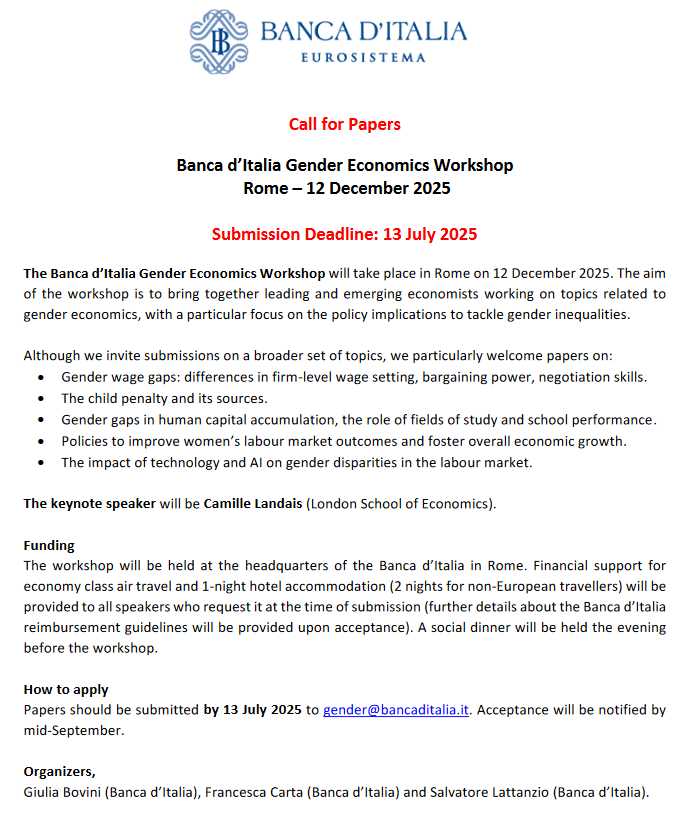
📢The call for papers for the 2025 Banca d’Italia Gender Economics Workshop is now open!
The workshop will take place on 12 December at the Banca d’Italia headquarters in Rome.
Submit your paper by 13 July!
@bancaditalia #econtwitter
bancaditalia.it/media/notizi…
47
116
17,069
Christina Gathmann retweeted

3 Apr 2025
Even better. Eu should remove all trade barriers and become the center of the new global free trade zone. Let the us stagnate for 10 years while Eu roars past us, until we wake up
24
135
757
123,087
25 Mar 2025
Looking forward to yet another exciting event on AI and its implications for the labor market, firms and workers
ecb.europa.eu/press/conferen…
1
3
238