
Student of AI, plus a political activist with the Liberal Democrats & Social Liberal Forum. Try to see all sides. Into Chess, folk music and Japanese Cooking.
Joined September 2008
- Tweets 34,871
- Following 4,794
- Followers 931
- Likes 15,667
1,053 Photos and videos

Geoff_Hackney retweeted

Jun 13
Chemtrails don't exist
Turbo cancer doesn't exist
Covid does exist
Covid vaccines worked
Ivermectin doesn't work for Covid
Ivermectin doesn't work for cancer
Vaccines eradicated smallpox
Vaccines don't cause autism
Thanks and have a wonderful day
848
1,265
6,585
85,605
Geoff_Hackney retweeted

May 29
More Democrats would do well to adopt Sarah McBrideism
May 29

Dems haven't moved on policy but they've clearly adopted Sarah McBride-ism - ie, you don't win rights by telling people they're terrible bigots for not using the right language RIGHT NOW.
3
26
251
36,460

May 26
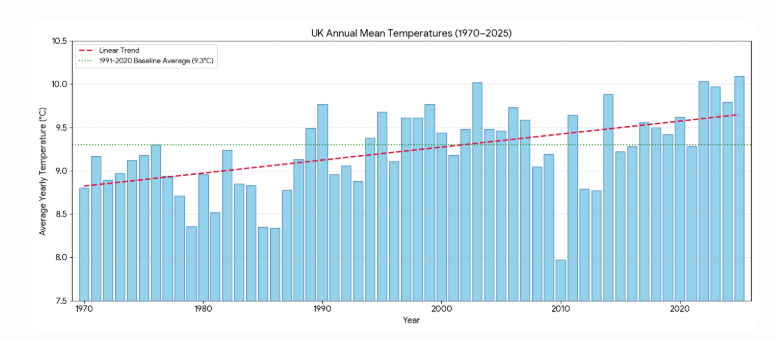
If you want to consider climate rather than weather, then we should not cherry pick outlier data, we should consider average tempteratures over a year. And from that we see a clear upward trend, with 8 out of the last 10 years above the 1976 average. Data from the Met office.
1
26
Geoff_Hackney retweeted

May 26
Anyone who says "summers have always been like this" is lying.
Night time averages are up.
Day time averages are up.
Highest temperatures are up.
Lowest temperatures are up.
Heatwaves are higher and cover more area.
The deniers are liars.
165
424
2,016
18,072
Geoff_Hackney retweeted

May 20
Ahmadinejad, SERIOUSLY? The Holocaust denier? The wipe Israel off the map guy? The Green Revolution death and torture guy who stole the 2009 elections? The nuclear program accelerator guy? The Islamic fundamentalist end-days guy?
May 19

BIG SCOOP: US-Israel goal was to install former President Ahmadinejad as Iran's leader (aka Delcy)
An Israeli strike designed to free him from house arrest was part of an effort to bring about regime change and put him in power. w/ @MarkMazzettiNYT @julianbarnes @ronenbergman
nytimes.com/2026/05/19/us/po…
479
1,093
4,364
916,787
Geoff_Hackney retweeted

May 20
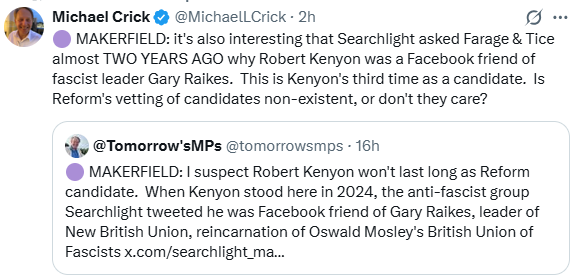
🟣 MAKERFIELD: it's also interesting that Searchlight asked Farage & Tice almost TWO YEARS AGO why Robert Kenyon was a Facebook friend of fascist leader Gary Raikes. This is Kenyon's third time as a candidate. Is Reform's vetting of candidates non-existent, or don't they care?
May 19

🟣 MAKERFIELD: I suspect Robert Kenyon won't last long as Reform candidate. When Kenyon stood here in 2024, the anti-fascist group Searchlight tweeted he was Facebook friend of Gary Raikes, leader of New British Union, reincarnation of Oswald Mosley's British Union of Fascists
229
485
1,097
123,132
May 19
Rather shocked to find out that when the war with Iran is won next week that prices won't be going down 500%...

Q: Where do you expect the prices to go over the summer? What is your assessment given supply and demand over the summer? Will they go higher?
Energy Secretary Chris Wright: I don't make projections—particularly about the future
44

Geoff_Hackney retweeted

May 14
תסתכלו על הגילאים בסרטון הזה ועל הבעות הפנים המלאות בשנאה.
באמת שלא מבינה את זה. יום ירושלים אמור להיות יום חג איך זה הפך להיות יום של שנאה? ילדים שרים שישרף לכם הכפר, פוגעים בחנויות של ערבים סתם ככה. על מה ולמה? מי חינך אותם? נראה שהם באים רק בשביל זה.
863
2,091
5,279
308,300
Geoff_Hackney retweeted

May 14
Could Reform beat Labour in Makerfield?
💯.
686
265
3,726
118,515
Geoff_Hackney retweeted

“You think you’ll be able to catch me out? I’ve run rings around protestors and judges, mate.
“You’d never be able to catch me out”
@lewis_goodall gets barred from cafe after an interview with controversial Birmingham campaigner, Akhmed Yakoob, descends into chaos.
340
172
1,202
426,015
Geoff_Hackney retweeted

Let's assume the 'marches' are banned. Where would this leave anyone wanting to protest about what's going on in Gaza, the West Bank, Lebanon and Syria?
517
450
1,744
106,574
Geoff_Hackney retweeted

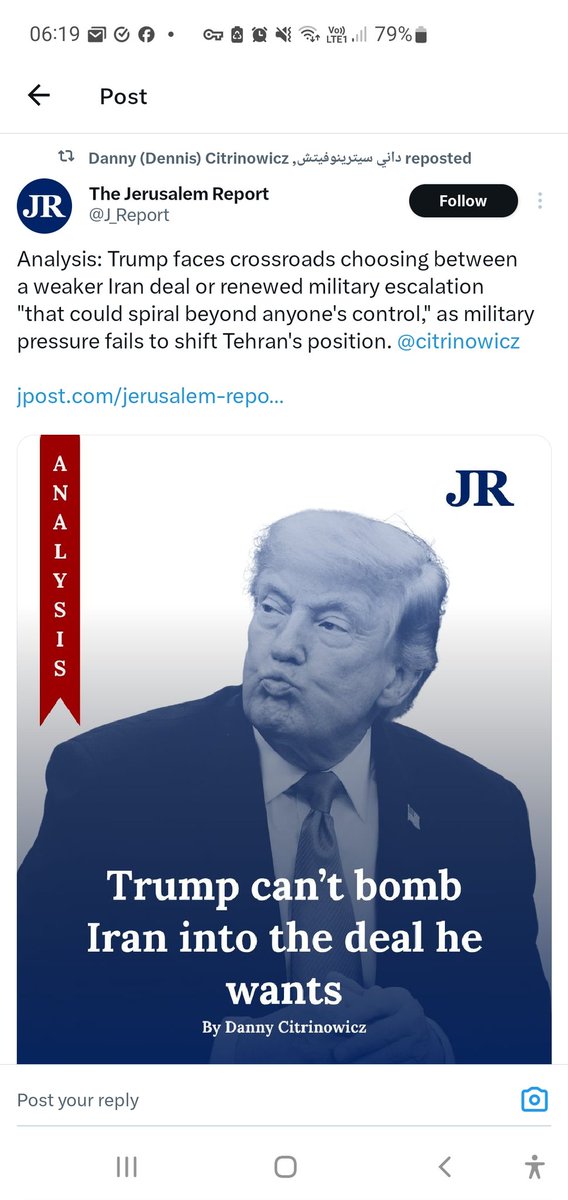
The Myth of the “Imminent Iranian Bomb”
The most persistent justification for the current campaign against Iran is also the most misleading: the claim that Iran was on the verge of acquiring a nuclear weapon and had to be stopped.
This narrative collapses under scrutiny.
For years, U.S. and allied intelligence assessments have been consistent on one key point: Iran’s nuclear program, while advanced, is not equivalent to an active decision to build a bomb. The critical threshold has always been political, not technical. Tehran would first have to make a deliberate choice to weaponize, a decision that, by all credible accounts, had not been made prior to the conflict.
Yet this distinction has been blurred, if not erased, in public discourse. The hypothetical, “Iran could have built a bomb”, has been repackaged as an imminent threat. It is a subtle but consequential shift, one that transforms uncertainty into urgency and speculation into justification.
More troubling is what this framing obscures.
The nuclear issue was never the sole, or even primary, driver of the campaign. It functioned as a convenient rationale for a broader strategic objective: reshaping the Iranian regime itself. By centering the narrative on nuclear urgency, policymakers have sidestepped a more honest debate about aims, risks, and long-term consequences.
And those consequences are already coming into view.
If the goal was to eliminate Iran’s nuclear potential, the evidence so far suggests the opposite outcome. This war has underscored a hard truth: there is no clean military solution to the Iranian nuclear challenge. Airstrikes and coercion can delay, disrupt, and degrade — but they cannot erase knowledge, dismantle intent, or resolve the underlying strategic calculus.
In fact, they may accelerate it.
By raising the perceived threat to the regime, the conflict increases the incentive for Tehran to reconsider its nuclear posture. What was once a conditional and deferred decision meaning “if we choose to”, may become a more urgent strategic imperative. In trying to prevent a nuclear Iran through force, we may be creating the conditions that make it more likely.
This is the paradox at the heart of the current approach: the nuclear threat has been inflated to justify the war, and the war itself may ensure that the threat becomes real.
Absent a credible diplomatic framework, this cycle will only deepen. The question is no longer whether Iran could pursue a bomb. It is whether our own actions are pushing it closer to deciding that it should.
#iran
May 5

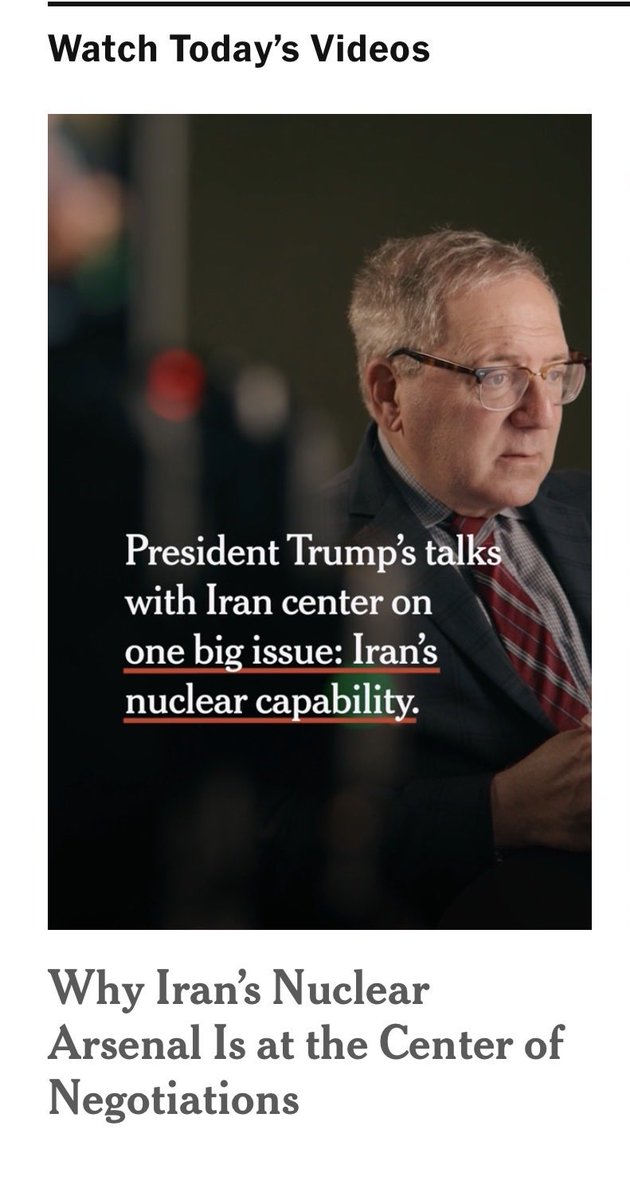
What “nuclear arsenal”? Come on, @nytimes this is a misleading headline to say the least.
Iran has no “nuclear arsenal.” According to U.S. intelligence, Iran wasn’t weaponizing and was at least 9-12 months away from getting a bomb.
20
95
244
52,125
Geoff_Hackney retweeted

We spoke to Jews on the Palestine march in London
Not all Jews support Genocide, to say otherwise is textbook antisemitism:
365
4,599
9,503
211,807
Geoff_Hackney retweeted
The story is actually quite simple.The fundamental problem began with the U.S. withdrawal from the Iran nuclear deal (JCPOA) without a coherent alternative strategy. That decision reinforced Supreme Leader Khamenei’s long-standing suspicions about the agreement and about negotiating with the United States more broadly.
Once President Trump chose to exit the deal, the chances of returning to it became extremely slim. Trump himself encountered this reality when efforts to reopen diplomacy, such as the attempt to engage Foreign Minister Javad Zarif at the White House, failed to gain traction.
The consequences are clear and measurable. Iran’s large stockpile of enriched uranium, its deployment of advanced centrifuges, the technical knowledge it has accumulated, and its increasing proximity to nuclear threshold status are all direct outcomes of the U.S. withdrawal. That decision effectively eliminated the possibility of returning to a diplomatic track on terms more favorable than those achieved under the original agreement.
Everything else is secondary.
#iran
Apr 30

The second point is irrelevant to this debate, and the first has some pretty serious logical flaws. Simply put, there are better explanations for why Iran expanded enrichment when it did.
1. Why didn’t Iran expand enrichment more quickly after Trump withdrew from the deal? Were they “scared” of what Trump might do? Evidence suggests other factors were more important. First among them, Iran (and the other JCPOA participants) wanted desperately to keep the deal alive. Tehran’s play was to drive a wedge between the U.S. and Europe, and try to maximize alternative arrangements for sanctions relief (remember good old INSTEX?). Moving rapidly to expand enrichment would not serve that strategy. Toward the end of Trump’s first term, Iran ditched this (failed) approach. Hence why we started to see the build up.
2. Is that continued accelerated build up under Biden due to US “weakness?” Again, evidence suggests more important factors. Iran wanted to strengthen its negotiating hand. It concluded that prior restraint had not served it well. The 60% in particular was in response to the Israeli sabotage against the above ground centrifuge manufacturing plant. Also no doubt that some in Iran saw 60% as creating a more viable pathway to the bomb. Again, all of this was made doable by the U.S. withdrawal from the deal.
3. I have my qualms with the Biden administration’s approach to talks, but it should also be recognized that whatever loose “understanding” was later achieved led Iran to dilute some of that 60%, and U.S. willingness to hold off on BoG resolutions led Iran to refrain from adding more centrifuges or turning existing ones on. One can criticize that approach, but it’s at odds with the claim that “weakness” (as some critics labels it) only leads to Iranian enrichment expansion.
4. Perhaps most importantly, the “Iran was scared of Trump” narrative is also contradicted by the fact that in Trump’s second term, Iran significantly increased its 60% production. If they were deterred, one would expect the opposite result.
There also may be other factors that drove these Iranian decisions (eg, technical) that are less visible to those of us on the outside, adding another layer of complexity.
Bottom line: The argument that Biden’s “failure to deter” caused Iranian expansion, and conversely that Trump’s “pressure and deterrence” did, does not hold up to scrutiny.
26
89
304
80,560
Geoff_Hackney retweeted

Apr 27
Ellie Chowns here showing a bit of spine in dissenting from Polanski’s ill-conceived comments on Trump vs Putin.
1
4
14
1,490
Geoff_Hackney retweeted

Apr 26
In the UK which of the following groupings would you feel most comfortable voting for?
7%
Labour
80%
Tory/Reform/Restore
9%
Green/Your Party
5%
Lib Dem/SNP/PC/Other
314 votes • Final results
110
198
146
9,477
Geoff_Hackney retweeted

Apr 27
What is a bigger problem
🔴 Right wing violence - 34%
🔵 Left wing violence - 32%
YouGov - A - 4/26
282
78
1,095
149,977
Geoff_Hackney retweeted
Apr 26
Who would you rather have as UK Prime Minister?
46%
Keir Starmer
18%
Ed Davey
14%
Zack Polanski
22%
Jeremy Corbyn
584 votes • Final results
4,035
658
581
167,515
Geoff_Hackney retweeted

Apr 22
I’m detecting more and more unease in the US and Europe about Pres Trump’s bewildering conduct in the war with Iran. ‘He doesn’t seem to have any idea how to get out of the trap Iran has set for him,’ says one US ex-diplomat.
605
1,725
8,186
380,865