
Joined July 2024
- Tweets 186
- Following 545
- Followers 68
- Likes 111
8 Photos and videos


Jun 11
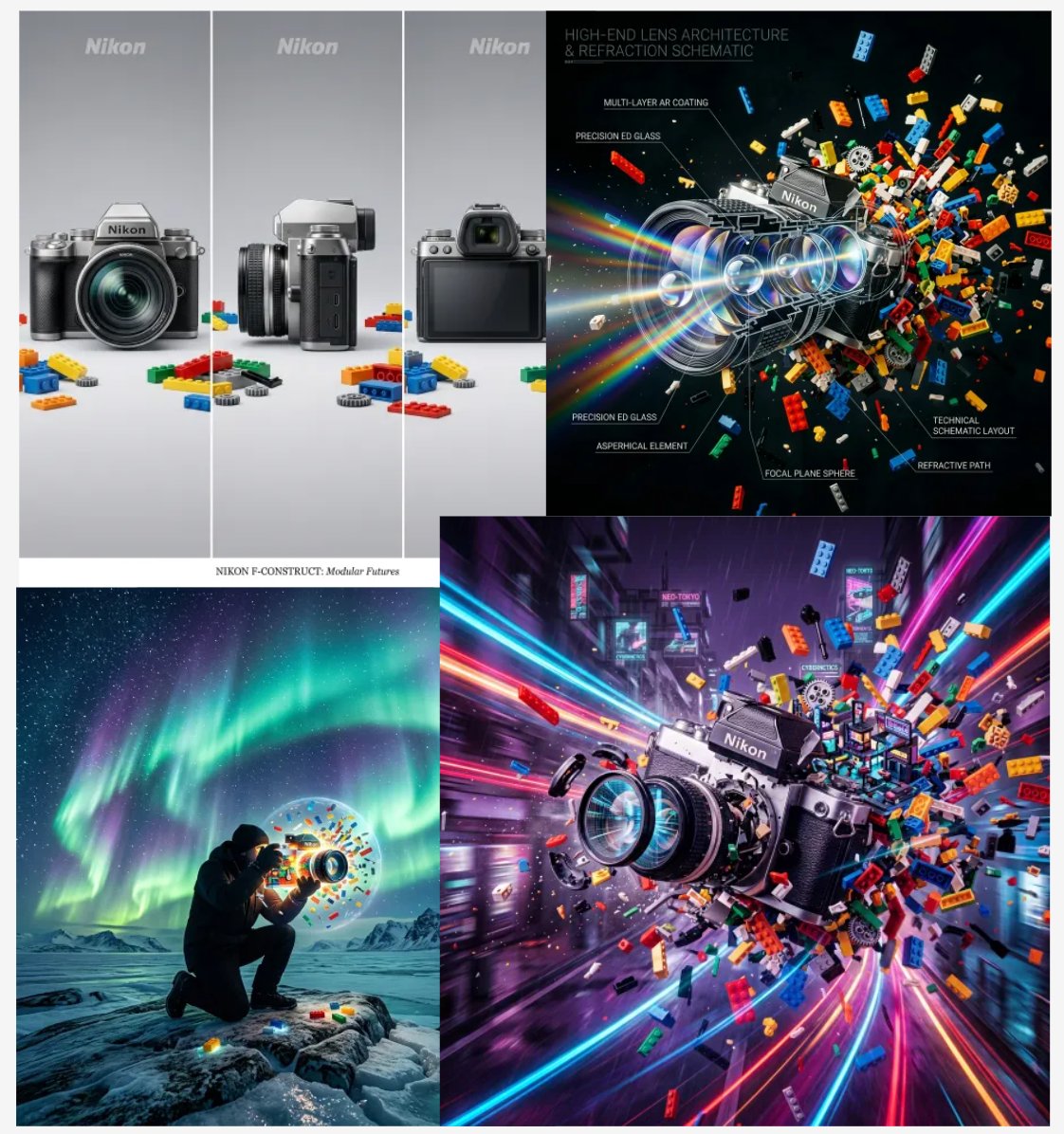
Products don't have to win the same game. Even within the same category, they're often optimizing for different user needs.
If a product serves its audience exceptionally well and creates a great experience, that's already a win.
Jun 10

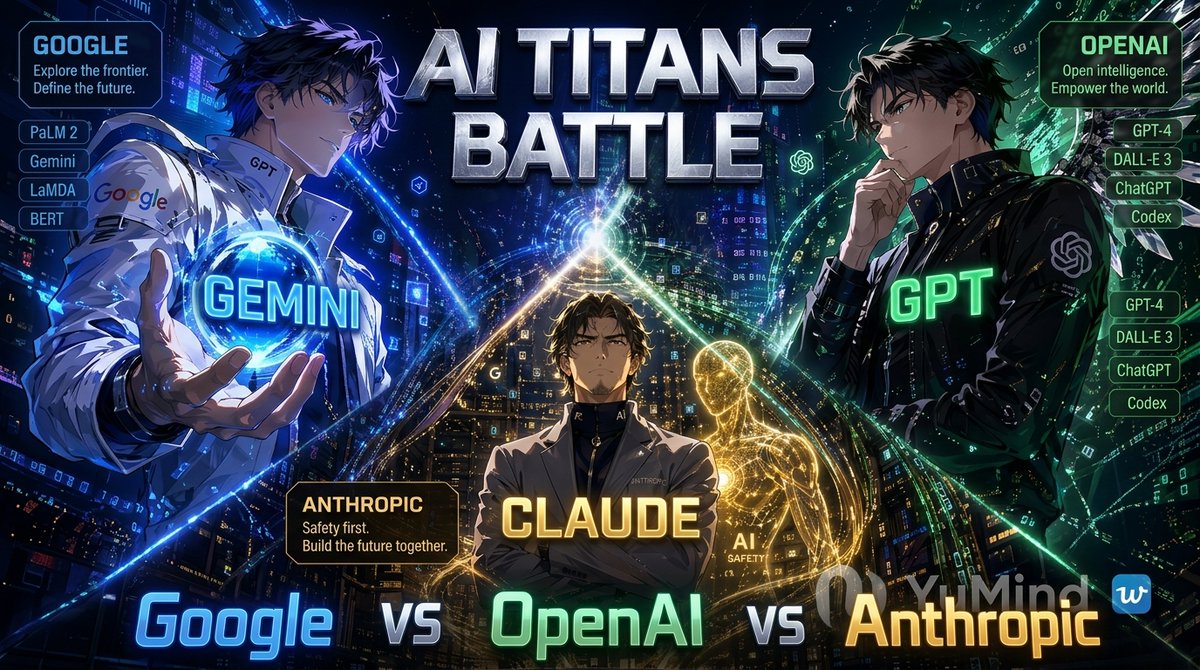
Who gonna win the AI race?
- Anthropic
- OpenAI
- Gemini
- Deepseek
- Manus
1
37

Jun 8
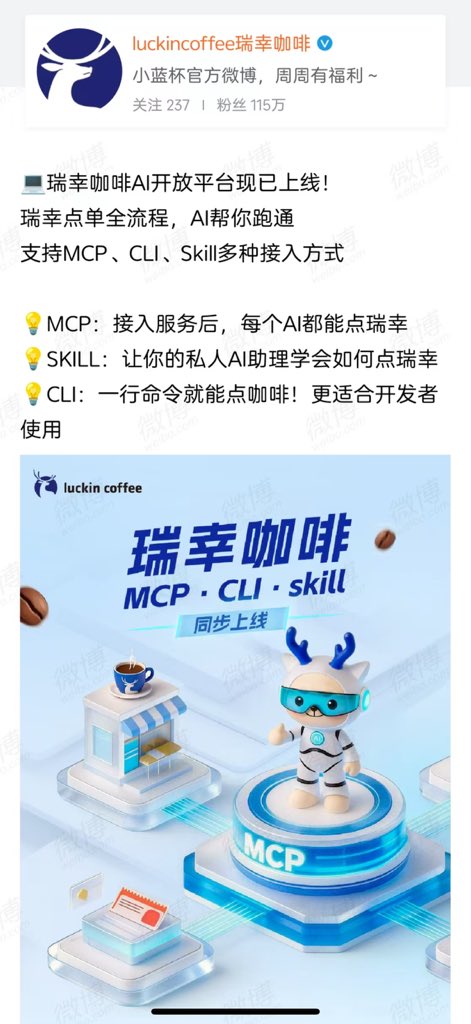
感谢@MangoLabs_ 作为一个初创公司增长团队的一员,这篇文章真的让我在深感共鸣的同时学到了很多
我们最近也一直在想一个问题:如果我们希望和 KOL/KOC Agency合作,或者做一场以打开声量为目标的 Campaign,我们到底是在买什么?
以前我可能会很自然地把曝光量、互动率、讨论量当成很核心的指标。甚至在看不同合作方案的时候,也会觉得“保量”的合作听起来更安全,因为它至少给了一个看得见的结果。
但这篇文章让我意识到,问题可能恰恰在这里。曝光当然重要,尤其是对一个从 0 到 1 的 AI 产品来说。如果产品刚开始进入市场,没有第一波声量,就很难被看见,也很难拿到第一批反馈。
但曝光不应该是终点。更重要的是,曝光之后到底发生了什么。谁真的看到了我们?他们是不是我们的目标用户?他们有没有产生真实兴趣?有没有人愿意试用产品、留下反馈,甚至和我们做一次 1v1 深度沟通?
如果这些问题回答不了,那一份再漂亮的结案报告,可能也只是证明了一场短期的热闹。
所以我现在会更倾向于把 Campaign 理解成一个起点,而不是终点。它不只是帮我们“铺量”,更重要的是帮我们发现:哪些用户真的在意这个问题,哪些叙事真的能触发他们的情绪,哪些互动值得继续追踪,哪些人可能成为真正的 early users。
这也会反过来影响我之后选择 Agency 的标准。我可能不会只问:你们能带来多少曝光?
我会更想问:这些曝光有没有进入我们真正想触达的圈层?你们怎么判断哪些互动是高质量的?怎么区分看热闹的人和真正有需求的人?Campaign 结束后,除了数据截图,你们还能留下什么能指导下一轮增长决策的东西?
早期 GTM 不是单纯购买注意力,Attention is just attention, 而是在购买一次对目标市场的高密度探测机会。
接下来在从 0 到 1 的增长过程中,我也想经常提醒自己:我到底想从一次 Campaign 中得到什么?至少“长期可以复用的信任资产”这个答案一定是正确的方向

1
126
Servio Hub retweeted

Jun 7
Tony Fadell's resume:
Co-created the iPhone → $2.3 trillion in sales
Created the iPod → saved Apple from bankruptcy
Founded Nest → AI in your home 11 years before ChatGPT
I asked him about everything he's learned:
🔸 Why opinion-based decisions are essential for v1 products
🔸 Why marketing matters as much as the product itself
🔸 Why taste is the biggest moat in AI
🔸 His prediction for the next breakthrough consumer device
🔸 Why "cognitive surrender" to AI is the biggest risk for builders
Listen now 👇
youtu.be/RJjl1TwyfWM
35
22
195
241,711
Jun 2
I agree that expression is where knowledge starts creating value.
But publishing isn’t the finish line. Real value is created when knowledge reaches more minds and becomes useful to others.
That’s why we believe at Servio: your knowledge shouldn’t stop at you.
Jun 2

The season finale of the CODE Challenge is out
Every note Carolina, Edvardo, and Ethan have captured, organized, and distilled exists for what happens this week
Express is the step where a Second Brain has to produce something the rest of the world can see, use, or buy
95
Jun 2
Many people are talking about “everything becomes code.”
But the more important question isn’t can we build it , it’s what should we build.
That’s where the real value of design and creativity lies in the AI era.

79
Jun 2
Agree. Distribution is becoming less about reach and more about trust. One authentic advocate is often worth more than a massive audience with weak conviction.

.@ElegantSnowWhit "Distribution density compounds" — 100%.
We learned this the hard way. Paid a single KOL, got zero registrations. Then shifted to seeding 30 smaller voices who genuinely used the product.
Result? 80% of our open source growth came from organic word-of-mouth, not any single big influencer.
The old playbook of "find ONE big influencer" is 2022 thinking. In 2026 it's about building a network of genuine advocates.
47
Jun 2
Absolutely. The most valuable use of AI shouldn’t just be making workflows faster, but making long-overlooked, deeply consequential problems finally visible.
May 31

AI doomerism exists, in part, because solutions to our most important problems still remain unsolved while examples of superficial process automation abound.
We’ve lost the script.
If AI wants to be celebrated, it should put solutions to some of society’s greatest problems at the front of the line.
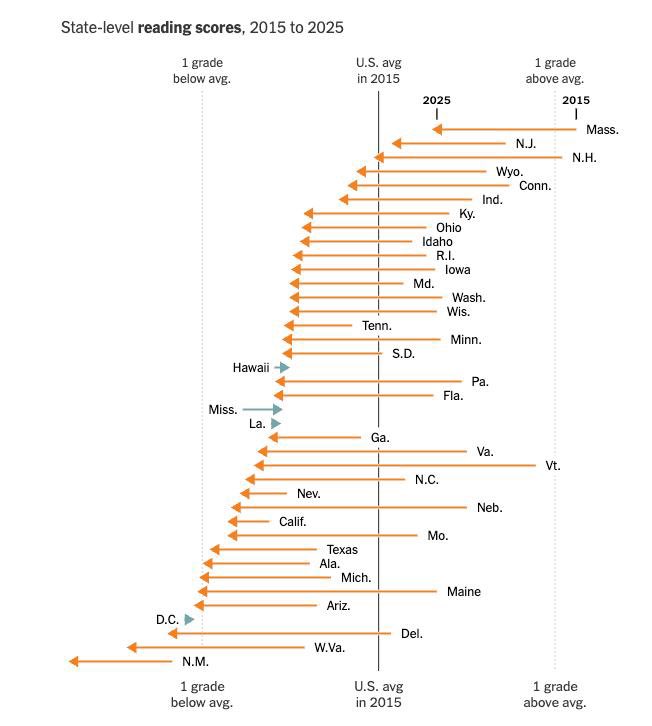
Case in point…why hasn’t anyone focused on an AI for fixing the growing illiteracy of our children?
1
1
51
Jun 1
I’m changing my X strategy after reading this long post. Here are the 3 biggest things I want to share
1. Text-only posts are dead. The algorithm loves videos and photos. You need to stop just "writing" and start "showing."
2. Reactions > Truth. X doesn't care if a post is true; it only cares if people react. To get reach, you have to trigger emotions while keeping your style.
3. You Only Get One Shot. A user will only see your post once. If your first sentence (the hook) doesn't grab them immediately, you’ve already lost.
Highly recommend reading this full breakdown from the author below. It’s a must-read for 2026.

2
84
Jun 1
Rest isn't a reward for productivity; it's a requirement for excellence.
I’ve found that stepping away for a walk right before a final delivery is my best quality-control tool.
Returning with fresh eyes often reveals insights that were invisible while I was 'in the weeds.'
May 31

The fallacy of this is that more creates more. More hours, more hiring, more something.
And it is true in a sense. If you put in more work, more work will happen. But I think for most startups, the leverage is really in how differently you approach the problem, how well you cultivate your team, and the strategy.
Any large company can outspend you on hours. They have thousands or tens of thousands more people, spending more hours. If hours worked were the metric, every large company and government organization would always win and do the best work. More hours, better output.
This thinking is often representative of younger founders, where the startup becomes their identity and life. They have a hard time doing anything else, and cannot understand that your work is not the person that is you. But activities outside of work can grow you as a person too and make you do better work.
I’ve never worked this way. As a designer, I always saw the need to take a step back, to take a break. At times, I might work 12 hours or 16 hours, or whatever amount was needed, but it wasn’t the norm. You just can't grind design, you need inspiration. But taking that step away from the work, would give me more perspective, inspiration and I could approach the problem differently or I could just see the solution.
Grinding is never good for any creative problem, and startups or creating new products are often mostly about creative problem solving. Grinding works ok for email jobs, or where you just executing on very clear playbook.
With Linear, we’ve never worked this way. We work reasonable hours, 5 days a week. All of us founders have families. Many of our employees have families. I personally stop every evening, spend time with the family, cook dinner for the family, eat dinner together, and focus on things outside of work. Sometimes I work in the late evenings or weekends, but to me the pride is that I don’t need to. Company should be succesful without it.
My goal is to build a company that is sustainable in the long term, and doesn’t require heroics or personal sacrifices every single day.
There are times when our team is heroic. Launches, incidents, some other work that just needs to be done. They will work late into the night because they know it is the right thing. But we don’t require that every day or every week, and the more this happens, the more I think it is a failure of our company and leadership. The team and the leaders should always keep a reserve to use when something is needed.
Our thinking was also that quality, which we value, doesn’t emerge from working more or stressing people more. It emerges when you create the conditions for it to emerge. Often it is the appreciation, space, time, and how the person feels. A person who is rested will do better work.
I wouldn’t attribute much of our success to working a lot. The success came from having clear thinking, ideas, and focus to do the right things.
I sometimes wish we could move the culture more toward a Zen master.
Real mastery is not exerting the most effort. It is achieving the outcome with the least necessary effort.
1
46
Jun 1
Benedict’s comparison of AI to the "1997 internet moment" is the perfect reality check. We often mistake the automation of a task for the replacement of a job.
The real value shift isn't just in building the models, but in how we redefine workflows when software becomes a commodity.
As distribution becomes the ultimate moat, the question for builders isn't "what can AI do," but "what complex organizational problems still require human judgment?
May 31

A rational conversation on where AI is actually going with @benedictevans
For 20 years, Benedict has been one of the clearest, most reliable thinkers on where technology is heading, and how it'll impact our lives. He was @a16z's resident "thinker" for 5 years, and has spent the last six as an independent analyst tracking the most important tech trends. As you’d expect, he’s spending all of his time on AI. In his words, "AI is eating the world."
We discuss:
🔸 Where value will actually accrue in the AI stack
🔸 Why AI labs are suddenly buying consulting firms
🔸 The rise in anti-AI sentiment, and where it leads
🔸 Why distribution is becoming the ultimate moat
🔸 Why the right question about your job isn’t “What percent can AI do?” but “Is this a task or a job?”
🔸 Why things will probably be okay
Listen now 👇
youtu.be/BD3vLtWhT5A
1
47
May 29
Taste and judgment become more important, not less, because infinite execution without a clear sense of what humans want just produces faster noise.
May 29

Thought experiment: if every company suddenly had infinite free compute, what new products would emerge?
My take: with very few exceptions, not much would change. The bottleneck is figuring out what people want, and it’s not so easy to apply compute to solve that.
1
2
74
May 21
A one-time report is just an output. The real value comes from the loop: read, think, question — then read again, think deeper, and question again. That’s how useful insight is actually built.
Interactive tools are the real way forward.

IMO deep research has been ~dead since o3 and interactivity was always more impt for active learning and eliciting intention
thoughtless prompt -> long ass report nobody reads
is inferior to
read -> think -> ask -> read -> think -> ask
4
73
May 10
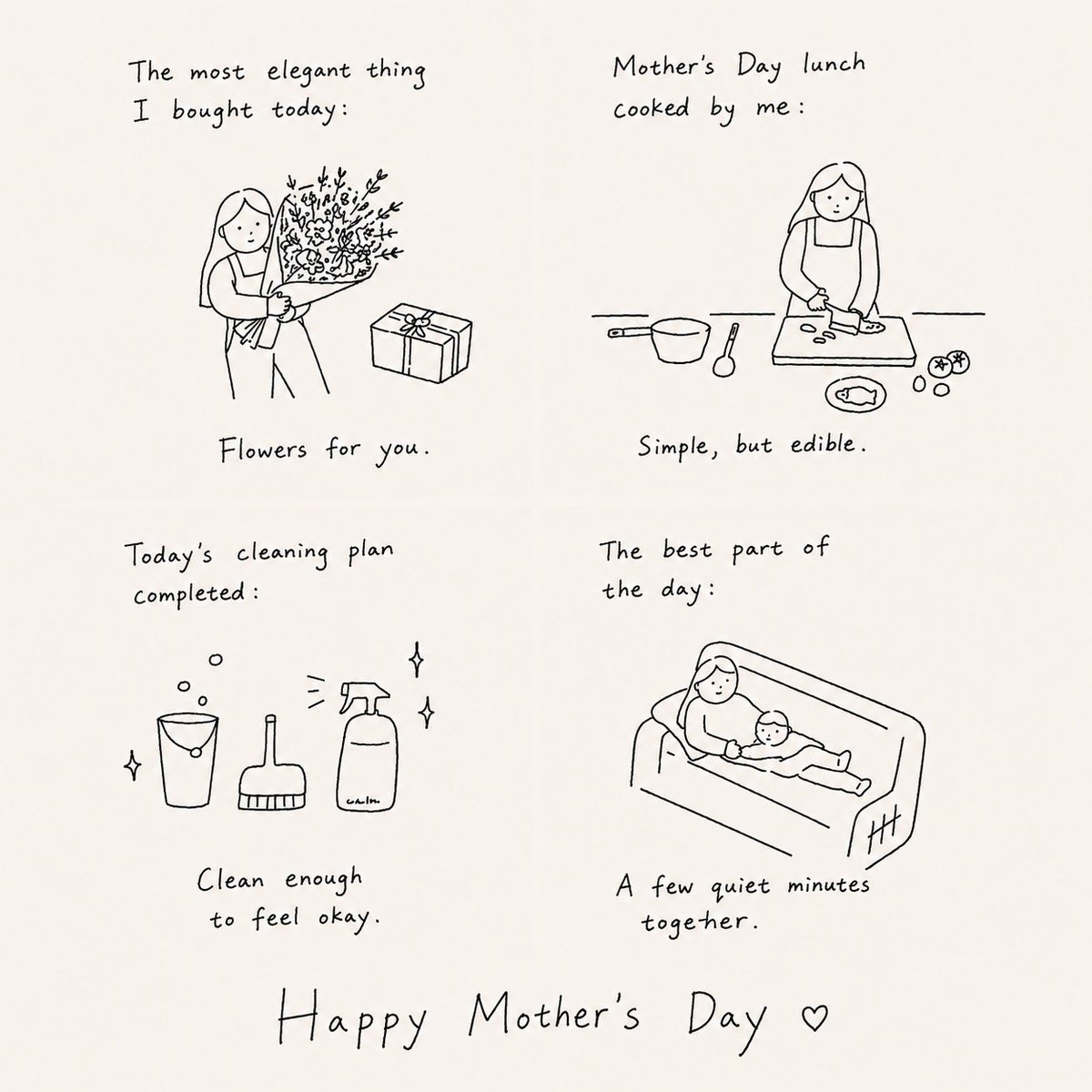
Happy Mother’s Day to all mothers,and to all the girls
who may become mothers someday. ♡
Try This Prompt:
Minimalist four-panel Mother’s Day comic card illustration in a quiet indie zine style. Black ink line drawing on a warm off-white or light beige paper background. Extremely simple hand-drawn doodle aesthetic with thin uneven pen lines, awkward proportions, and large empty space. No shading, no textures, no realistic rendering.
The layout contains four evenly spaced square panels arranged in a clean 2x2 grid. Each panel shows a small everyday moment related to motherhood in a calm, observational, slightly absurd way. The drawings should feel emotionally restrained, unintentionally funny, and handmade rather than polished.
Character style:
naive hand-drawn anatomy
tiny dot eyes
small straight-line mouth
simplified body shapes
stiff or awkward poses
minimal facial expressions
uneven imperfect linework
simple objects drawn with casual notebook-sketch energy
Panel ideas:
Mother holding an oversized bouquet and a small gift box.
Mother quietly cooking lunch at a table with very simple kitchen objects.
Cleaning supplies arranged seriously like important objects.
Mother and child sitting silently together on a couch.
Each panel includes small handwritten English captions in uneven casual handwriting. The text should feel dry, emotionally neutral, slightly awkward, and quietly warm — like documenting tiny domestic moments too seriously.
Example caption style:
“The most elegant thing I bought today:”
“Simple, but edible.”
“Clean enough to feel okay.”
“A few quiet minutes together.”
At the bottom center of the page, add large uneven handwritten text:
“Happy Mother’s Day ♡”
Visual restrictions:
no shadows
no gradients
no texture overlays
no realistic anatomy
no polished illustration
no anime style
no bright colors
no decorative floral aesthetic
no detailed background scenery
no dramatic emotion
no glossy digital painting
Style references:
minimalist observational comics, handmade greeting cards, indie art zines, casual notebook doodles, deadpan humor, emotionally restrained illustration, imperfect black ink sketches, quiet absurdism, Muji-style visual simplicity
3
156
Apr 28
What Levie is describing is something I see constantly — people underestimate complexity in work they don't do themselves.
A doctor sees all the nuance in medicine. A lawyer sees it in law. But both might look at the other's field and think "AI can handle that."
The last mile isn't a technical problem. It's an expertise problem. That distinction matters a lot for where AI actually creates value vs. where it just creates noise.
Apr 27

Noticing an interesting version of gell-man amnesia where people use AI for their job and see all the various things they have to do in the “last mile”, but then look at someone else’s job and think that AI will eliminate it immediately.
We all have a much deeper appreciation for the nuances and complexities of the work that we do every day. We run into issues about accessing data, we know how much context is needed to get AI models to work the way we need, we have to review the output of the AI to make sure it’s accurate, and then we have to incorporate that work into some broader business process. We see all those steps deeply for the work that we do.
Then, a moment later, we see AI do something in a foreign space and think that it can go automate that entire function. We tend to dramatically underestimate the work that goes into making the AI work just as effectively in those jobs.
This is reason to be skeptical about many of the theories of job loss. It’s coming from the lens of being able to automate individual tasks with AI, without understanding all the work that goes into doing the job fully.
2
65
Apr 23
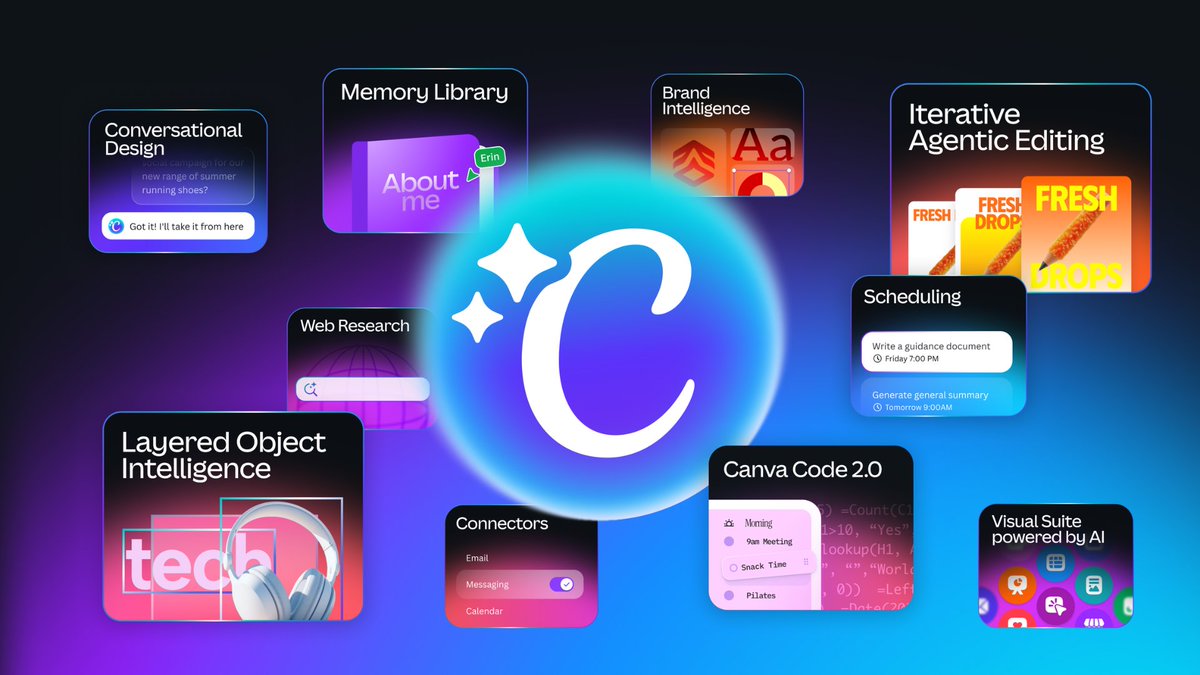
Canva AI 2.0 looks incredible! 🚀
Transforming from a design tool to a conversational agentic platform is exactly the workflow upgrade I needed. Can't wait to dive in and see how it streamlines my daily projects.
Huge congrats to the @canva team!

🚀 Introducing Canva AI 2.0: our biggest product launch to date, and the most significant shift for design in a decade. For the first time, imagination is the starting point. Read more: bit.ly/4cm5Zuy
2
202
Apr 23
Can’t wait to see how this transforms daily clinical work and unlocks for care
Apr 22

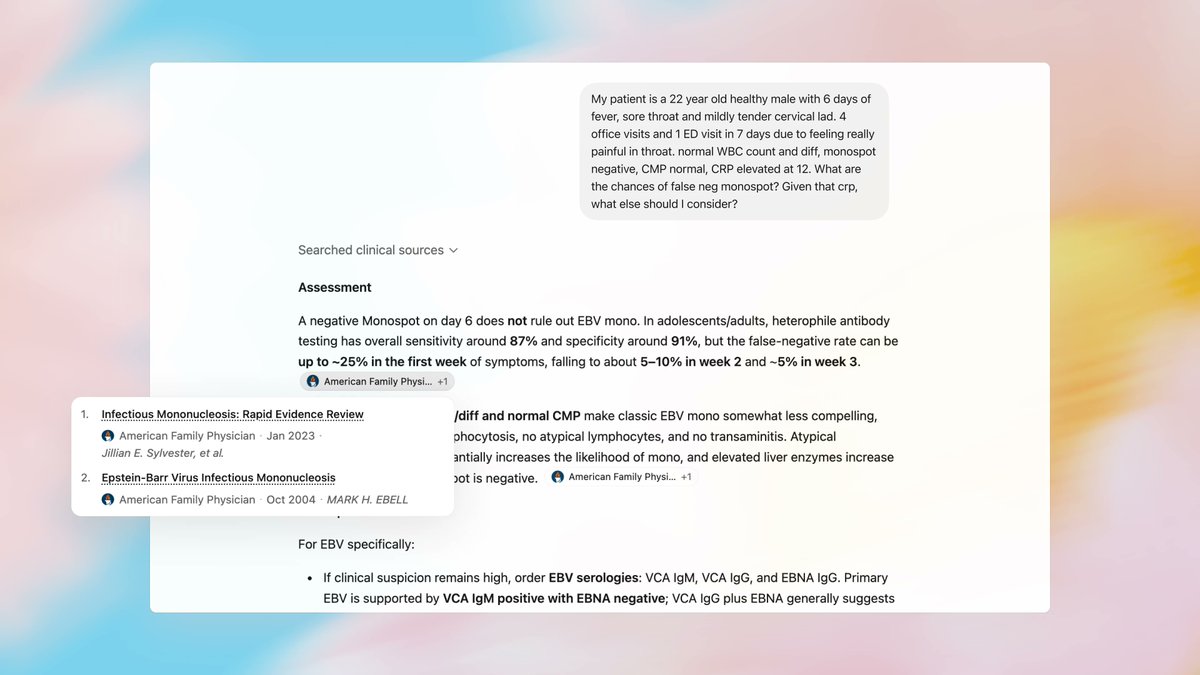
Today we’re introducing two big steps for health at OpenAI:
- ChatGPT for Clinicians, a free version of ChatGPT designed for clinical work
- HealthBench Professional, a new benchmark to evaluate real clinician chat tasks
We’re excited about what this can unlock for care. ❤️
1
64
Apr 23
Truly inspiring!Stop measuring how much AI can replace you and start noticing how much your unique perspective can enrich yourwork.

54