
The system has a backdoor. I found it
Joined July 2024
- Tweets 32
- Following 13
- Followers 7
- Likes 14
17 Photos and videos

Pinned Tweet

Jun 4
Someone built an AI that sent 700 job applications automatically.
It scanned job pages. Tailored the CV for each one.
Filled out forms. All while he slept.
He got hired.
Then made it open source.
Think about what this means — The old way of job hunting is already dead. Most people just don't know it yet.
The repo has everything: → 14 automation modes → CV generator optimized to beat ATS filters → 45 companies pre-configured (Anthropic, OpenAI, Stripe...) → Terminal dashboard built in Go
This is not the future. This is just the beginning.
Link in comments.
3
159
There are things inside your $20 AI subscription
that most people never find.
Not hidden. Not locked.
Just never mentioned.
Here's what's sitting there unused.
Claude Projects.
Most people open Claude and start typing.
The ones who figured it out
created a Project.
Uploaded their entire business context.
Brand voice. Client history. SOPs.
Product details. Competitor analysis.
Now every conversation starts
with Claude already knowing everything.
No re-explaining.
No copy-pasting background info.
Just work.
ChatGPT Custom Instructions Memory.
You can tell ChatGPT exactly who you are.
What you do. How you think.
What format you want answers in.
It remembers across every conversation.
Most people have this turned off.
They're starting from zero
every single time.
Claude's extended thinking.
There's a mode where Claude
doesn't just answer.
It thinks through the problem first.
Shows its reasoning.
Catches its own mistakes.
Most people never switch it on.
Operators API context.
You can give AI a permanent system prompt.
A set of rules it follows in every session.
Your personal operating system
running inside the model.
$20/month.
Most people use it to write emails faster.
A few figured out it's an infrastructure layer
for an entire business.
Same subscription.
Completely different ceiling.
#AI #Claude #ChatGPT #Productivity #AITools
4
15h
Most people think prompts are free.
Some people charge $10,000 for one.
Here's how.
A consultant gets hired
to audit a company's sales process.
Normally this takes:
3 weeks of interviews.
Spreadsheets. Frameworks. Slide decks.
A team of 4. A $40,000 invoice.
He does it differently.
He spends 4 minutes writing a prompt.
Feeds it the company's CRM data,
call recordings and lost deal notes.
Claude reads everything.
Maps every pattern.
Identifies exactly where deals die.
Writes a 12-page audit with recommendations.
4 minutes of prompting.
$10,000 invoice.
Client paid without negotiating.
Because the output was right.
And the output was fast.
And nobody asked how it was made.
This is the part most people miss.
The prompt isn't the product.
The insight is the product.
The companies paying $10,000
aren't paying for words in a text box.
They're paying for the answer
to a question that was costing them
$50,000 a month in lost deals.
The prompt just gets you there faster.
The people who understand this
are selling AI outputs as consulting.
As audits. As strategy. As market research.
The people who don't
are still wondering why their
ChatGPT subscription isn't making them money.
You're not selling prompts.
You're selling the $10,000 problem
that your prompt solves in 4 minutes.
1
30
17h
A startup replaced its entire sales team
with one AI agent.
Revenue went up.
Here's exactly what happened.
6 salespeople.
$340,000/year in salaries.
Benefits. Equity. Quota drama.
3 months hitting target out of 12.
The founders didn't fire anyone.
They let the contracts expire.
Then launched the agent.
Here's what the agent does
that the team couldn't.
It contacts 847 leads a week.
Not 847 in a good month.
847 every single week.
It personalizes every outreach
based on the prospect's LinkedIn activity,
recent company news
and buying signals from their website.
It follows up 7 times.
Most salespeople stop at 2.
It books the call.
Sends the deck.
Handles objections over email.
Passes to a human only when
the prospect is ready to sign.
No commission.
No sick days.
No "I need to think about it" on Mondays.
The agent doesn't have bad weeks.
It doesn't lose motivation after a lost deal.
It doesn't negotiate its own salary.
Revenue is up 34% since the switch.
The founders didn't replace salespeople
with technology.
They replaced a broken process
with one that actually scales.
Full breakdown on how to build this — next post.
22
Jun 14
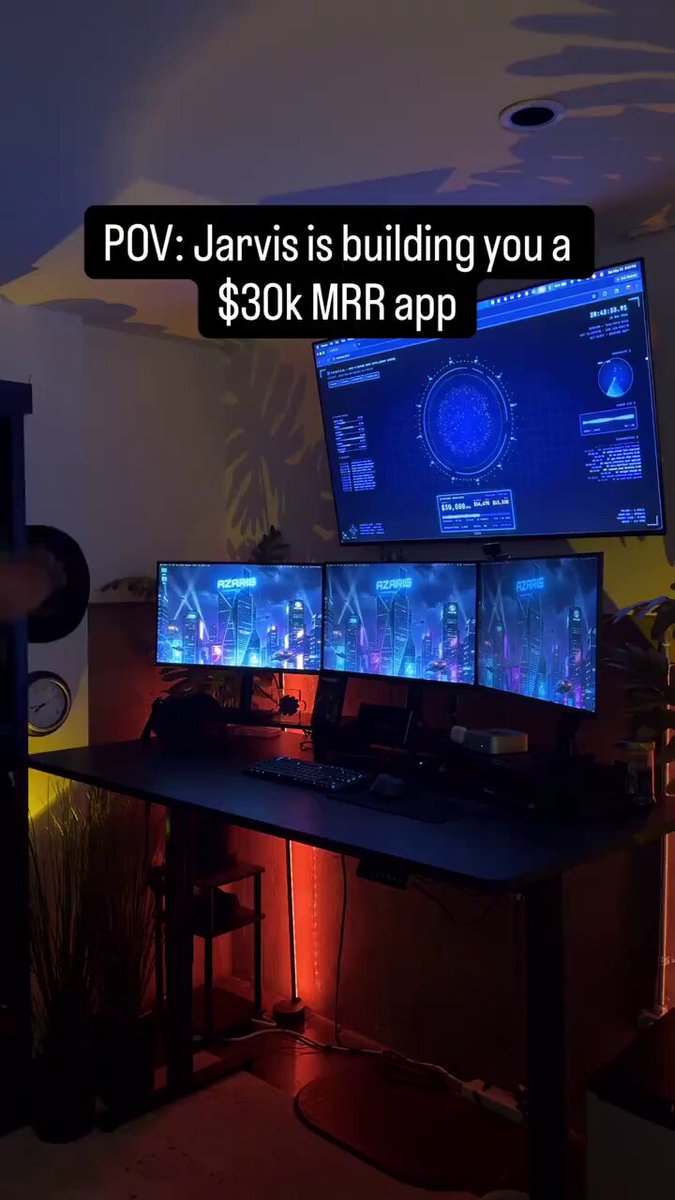
A dev built a JARVIS that runs
his $30K/month startup.
Every morning it's already done
before he sits down.
No team. No employees. No managers.
Just one person and an AI
wired into the entire business.
Here's what it actually does.
Every morning — before he opens his laptop:
→ Pulls app analytics from the night before.
→ Flags anything that moved.
→ Drafts the week's content.
→ Answers customer emails.
→ Packages everything into one briefing.
Ready for approval.
He doesn't manage tasks.
He reviews decisions.
The difference sounds small.
The difference is everything.
He didn't hire a team.
He didn't outsource.
He didn't build an agency.
He gave AI the keys.
Inbox. Numbers. Content calendar.
Full access.
Then he stepped back.
$30K/month.
One person.
One system.
Running while he sleeps.
The crazy part —
the tools to build this exist right now.
They're not expensive.
They're not hard to wire together.
Most people are still doing manually
what this man automated 8 months ago.
Full breakdown on how to build this — next post.
20
Jun 13
Morningstar values SpaceX at $780B.
The market values it at $2T.
Both read the same filing.
The difference is which sections they weighted
and which connections they drew across 300 pages.
Most people won't read it at all.
They'll form an opinion from a 3-paragraph headline.
Then wonder why their trades don't work.
Here's what the headline didn't tell you.
Starlink ARPU dropped.
$99/month in 2023.
$66/month in Q1 2026.
More users every quarter.
Less revenue per customer.
Every quarter.
The user growth headline
is hiding a shrinking economic engine.
This is on page 200-something of the S-1.
Nobody scrolled that far.
The filing is 300 pages.
500,000 tokens.
$150 billion in demand.
2x oversubscribed.
Kimi has a 262,144 token context window.
It reads up to 50 files in one session.
It doesn't summarize sections separately.
It holds the whole filing in view at once.
Finds contradictions between sections
that analysts on page 47 never connected
to the footnote on page 281.
The institutional analysts saw this.
The retail investor read the headline.
Upload the S-1 into Kimi this weekend.
Read what $2T actually bought.
Then decide if you agree with the price.
Not financial advice.
17
Jun 13
Most people use ChatGPT like Google.
Type a question. Read the answer. Close the tab.
That's not a tool.
That's a more expensive search engine.
Here's what they're missing.
ChatGPT isn't an answer machine.
It's an execution layer.
The people making money with AI
aren't asking it questions.
They're giving it jobs.
The difference:
❌ "What are the best ways to make money online?"
✅ "Analyze these 10 Upwork job posts.
Find the skill gap. Write me 3 proposals
targeting that gap. Price them at $85/hour."
❌ "How do I grow on Twitter?"
✅ "Here are my last 20 posts and their engagement.
Find the pattern. Write 10 posts
that replicate what worked."
❌ "What is n8n?"
✅ "Build me an automation that pulls
leads from LinkedIn, enriches them with
Apollo, and sends a personalized email
when they post about hiring."
Same tool.
Completely different output.
The people who treat AI like a search engine
will keep getting search engine results.
The people who treat it like an employee
will keep getting paychecks.
You're not paying $20/month for answers.
You're paying for execution.
Most people never figure that out.
#AI #ChatGPT #Productivity #Automation #Tech
2
4
53
Jun 13
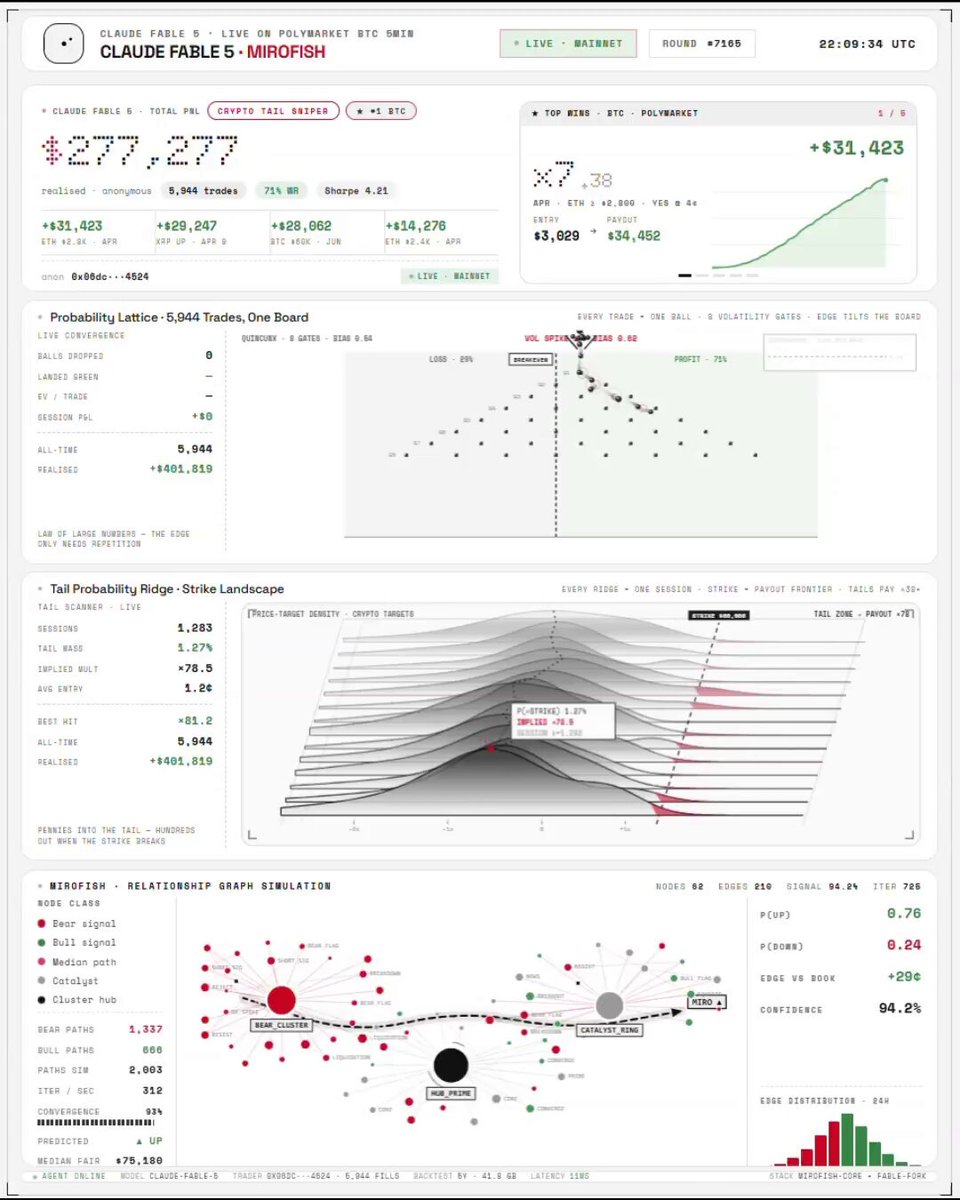
He lost $200K in four days.
His bot worked perfectly.
That was the problem.
He'd quit his job at Citadel
when his wallet crossed $330K.
Then the market flipped.
The bot kept trading
like nothing had changed.
Four days.
$200,000.
Gone.
Here's what actually killed him.
His bot never predicted anything.
It played a loaded coin.
54/46. Not 50/50.
A 4-point thumb on the scale.
Pressed thousands of times.
Until the average became a paycheck.
But a loaded coin only pays
while the table stays the same.
The table changed.
The thumb didn't.
It kept pressing the same side
as the market walked out from under it.
That's the cost of an edge that can't learn.
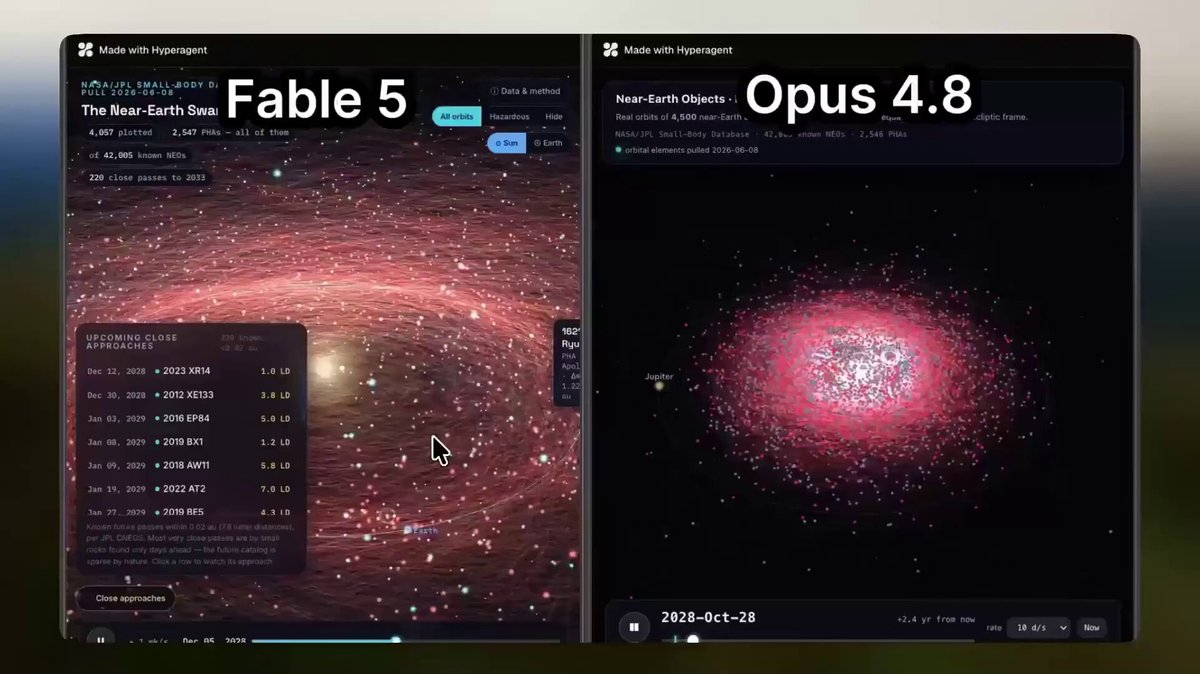
Then Claude Fable 5 dropped.
He rebuilt the bot overnight.
The difference:
Old bot saw one number.
"BTC above $56K? 0.2%."
Accepted it. Traded it.
Fable 5 refuses the number.
It draws the whole shape.
Finds the outcomes everyone rounds to zero.
Buys the "impossible" for pennies.
When the "impossible" becomes possible —
he already holds it.
One position paid x81.
He never wins big.
He wins a sliver.
And takes that sliver 5,948 times.
Last month wasn't a smarter trader.
It was a brain that redraws the map
the instant the market moves.
He's up $300,000 since the rebuild.
#Polymarket #AI #TradingBots #Claude #Automation
104
Jun 12
People who bought Facebook on secondary
at $28 before the IPO
didn't care about the risks either.
SpaceX filed for IPO last week.
Retail investors cannot touch it yet.
The allocation goes to institutions first.
By the time it hits a public exchange —
the opening price already has three years
of institutional markup built in.
Everyone knows this.
Most people accept it and wait.
Some people do not wait.
There is a secondary market for SpaceX shares
that has existed for years.
Employees with vested stock.
Early investors with liquidity needs.
Funds that got in at Series B
and want partial exits before the public offering.
The platforms:
→ Forge Global
→ Hiive
→ EquityZen
You create an account.
You see the current bid and ask
for private SpaceX shares.
You place an order.
If it fills — you own pre-IPO SpaceX equity.
Current secondary price: ~$185/share.
Last institutional round implied: $350B valuation.
IPO analyst target: $400–500B.
That gap is the trade.
Minimum entry: $10,000–$25,000.
Process: 2–6 weeks.
The window is open right now.
It will not be open
the morning the ticker goes live.
Not financial advice.
Do your own research.
#SpaceX #IPO #Investing #PreIPO #Stocks
60
Jun 12
$7,000/month.
$20 in tool costs.
3 hours of work per week.
The data was free the entire time.
Here's the full picture.
Public market data.
Shipping indices.
Patent filings.
Job posting trends.
All sitting in open API endpoints.
Free. Publicly accessible.
Completely ignored.
Someone wired 4 of them
into a Claude Code workflow.
Every Monday morning —
the system pulls the data.
Cleans it.
Structures it.
Generates a brief.
14 clients receive it.
Each pays $500/month.
$7,000/month.
Automated overnight.
Nobody watching.
The data was never the moat.
Knowing which 4 APIs to connect was.
Consultants were charging $3,000/month
for "market intelligence."
They were billing for button-pushing.
Claude Code automated the button.
Most people open Claude Code and type:
"write me a function."
The question that changes everything:
"build me a pipeline that monitors X,
extracts Y, delivers Z every Monday."
Same $20 subscription.
Completely different output.
The bottleneck was never access to data.
It was knowing you could ask
that second question.
#AI #ClaudeCode #Automation #PassiveIncome #Tech
31
Jun 11
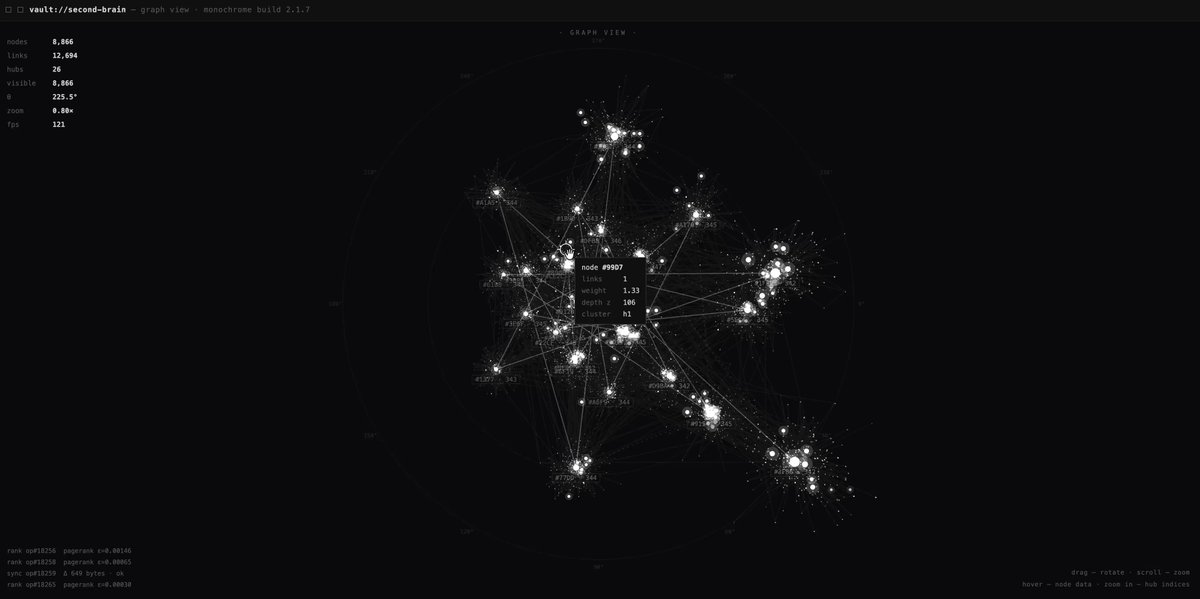
$20/month subscription.
8,866 nodes.
The same algorithm behind Google —
running inside a note-taking app.
This is not productivity hacking.
This is a mathematical model of an entire business.
Here's what's actually on his screen.
8,866 nodes.
12,694 links.
26 hubs.
PageRank epsilon 0.00146.
Running at 121 FPS.
Every node has a weight.
Every connection has an importance score.
The system knows which ideas are most connected.
Which clients are highest value.
Which decisions compound fastest.
PageRank — the algorithm Google built
to rank the entire internet —
running inside Obsidian
to rank every concept, client and opportunity
by real influence score.
The infrastructure that calculates all of this?
Built with a $20 Claude subscription.
Describe what you want tracked.
The model wires the math.
The graph updates in real time.
Most people manage their business on gut feeling.
He runs PageRank on every decision
before he makes it.
8,866 nodes of compounding knowledge.
And the math gets more accurate
every time he adds one more.
40
Jun 11
Nobody tells you the real numbers.
In 2026 a freelancer with an AI stack
earns 4–6x more than one without.
Same skills. Same clients. Same hours.
Different tools.
Here's what the market actually pays:
Developer Cursor Claude
→ $8,400/month avg
Automation builder Make n8n
→ $6,800/month avg
Copywriter Claude API
→ $4,200/month avg
Designer Midjourney Figma
→ $3,100/month avg
Without AI stack?
Same roles. Same platforms.
$1,200–2,000/month.
The gap isn't talent.
It's not experience.
It's not your portfolio.
It's whether you figured out
how to multiply your output
while charging the same rate.
The clients don't know how fast you work.
They pay for the result.
AI doesn't replace the freelancer.
It replaces the freelancer
who refuses to use it.
Full stack breakdown — next post.
82
Jun 9
Someone gave Claude $200 and a PC.
10 hours later — $3,000.
No human touched the keyboard.
Here's exactly what happened.
They gave Claude one mission:
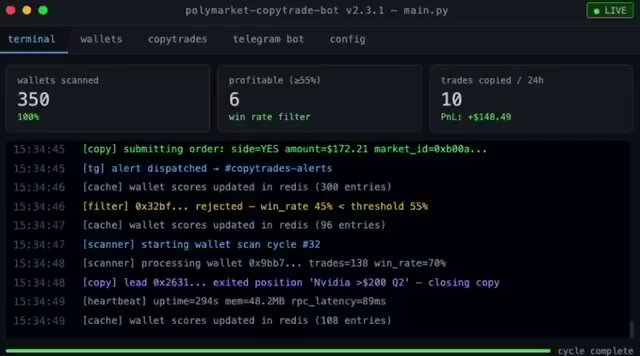
make money on Polymarket.
Claude didn't ask for help.
It didn't need guidance.
It scanned the top performing wallets.
Identified the patterns.
Started copying the best traders automatically.
$200 in.
10 hours of running.
$3,000 out.
15x in less than a day.
This isn't a backtest.
This isn't a simulation.
This happened on a live account.
With real money.
The part that should make you stop —
Claude made every decision alone.
Entry. Exit. Position size. Timing.
All of it.
No prompt after the first one.
No human checking in.
Just an AI with a goal
and full access to execute it.
We keep asking if AI can replace us.
It's already answering.
45
Jun 9
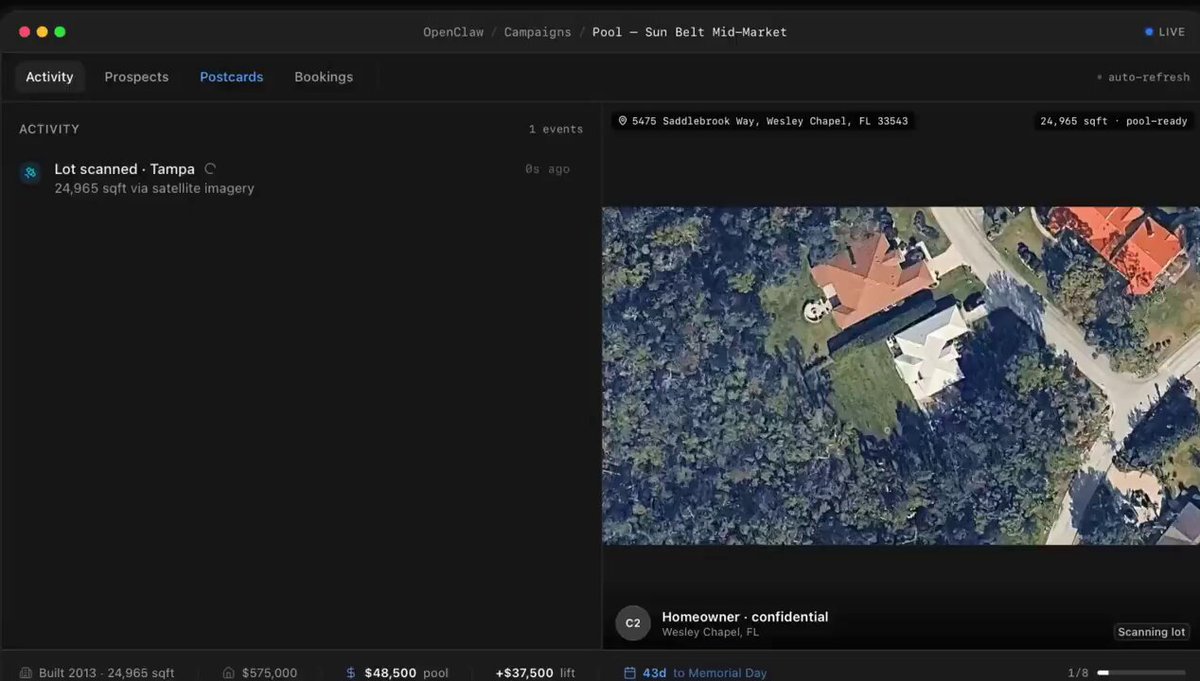
An AI finds homes worth $500K with no pool.
Renders one into their backyard.
Mails them a postcard.
Pool builders are closing $50K deals from it.
Zero human involvement.
Zero cold calls.
Zero shared leads.
Here's the full system.
Step 1 — the AI scans satellite imagery.
Finds homes in the target price range.
Identifies which ones have no pool.
Step 2 — it renders a luxury pool
directly into their actual backyard.
Not a generic image.
Their yard. Their house. Their neighborhood.
Step 3 — it calculates two numbers.
Build cost for their specific zip code.
Home value lift after installation.
Step 4 — it generates a cinematic video.
Before and after.
Their backyard. With the pool.
Step 5 — it mails a physical postcard.
Their address on the front.
Their backyard on the back.
QR code linking to the full video.
The homeowner opens their mailbox.
Sees their own house.
With a pool they didn't know they wanted.
Pool builders are closing $50K contracts
from postcards their competitors
don't even know exist.
This is one use case.
One industry.
One workflow.
There are hundreds.
35
Jun 9
A Chinese developer built a free tool
that generates full TikTok and YouTube videos automatically.
13,000 stars on GitHub.
Channels are making $10K/month with it.
It's called moneyprinterturbo.
The name is not a joke.
Here's what it does.
You give it a topic.
It handles everything else.
Script — generated.
Voiceover — generated.
Subtitles — generated.
Visuals — generated.
Editing — done.
Output: a video ready to publish.
You don't touch a thing.
Normally this process looks like:
→ One tool for scripts. $29/mo.
→ One tool for voiceover. $22/mo.
→ One tool for subtitles. $15/mo.
→ One tool for visuals. $49/mo.
→ One tool for editing. $20/mo.
$135/month.
Hours of work.
Five different logins.
This replaces all of it.
Free.
Unlimited.
Open source.
TikTok Shop and YouTube Shorts channels
are running this quietly in the background.
$6,000–$10,000 a month.
Faceless. Automated. Scaling.
Setup takes 5 minutes.
Search moneyprinterturbo on GitHub.
Install. Run. Produce.
While everyone else is paying for the tools —
you already have them.
57
Jun 8
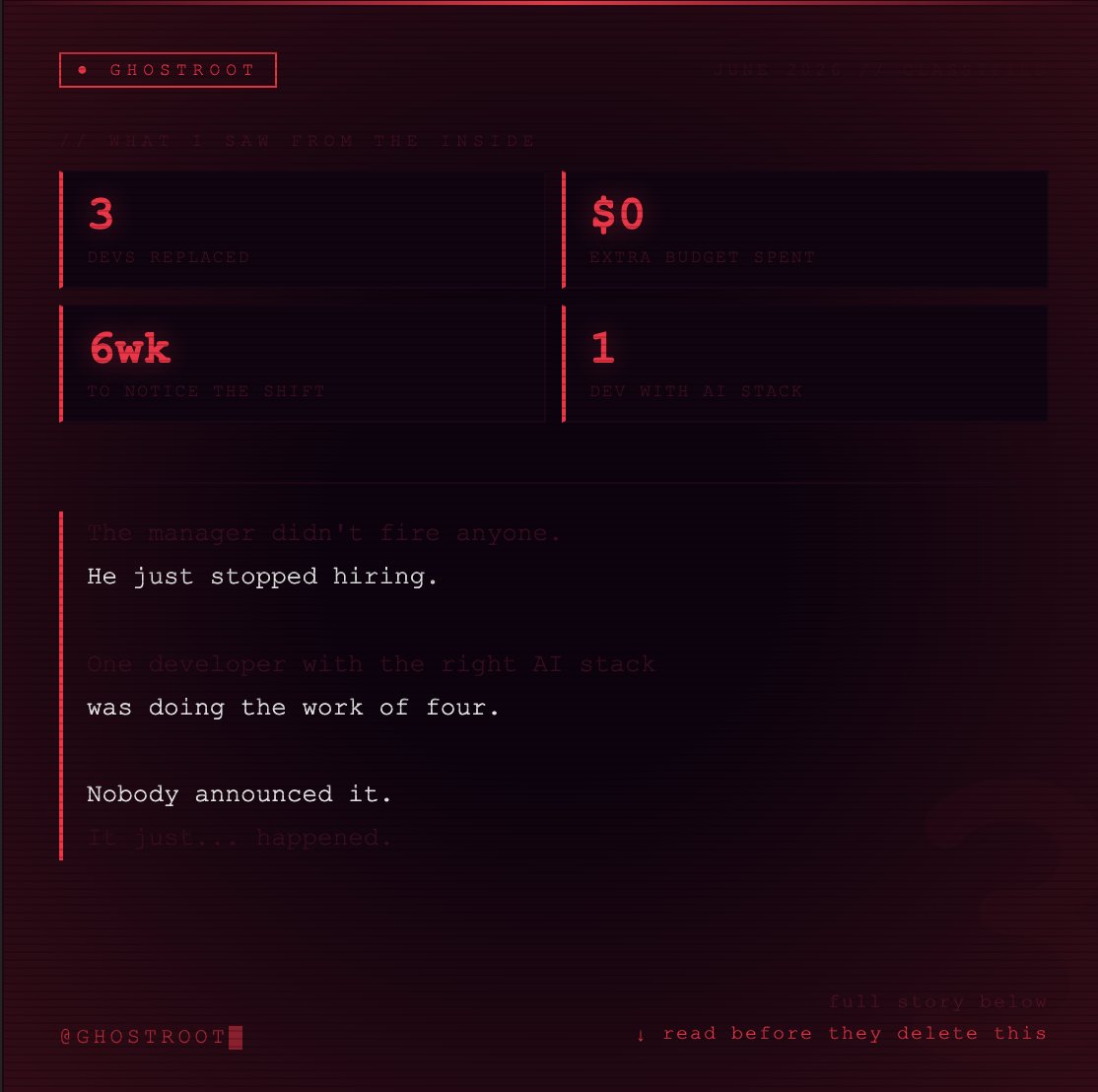
Nobody got fired.
The manager just stopped hiring.
I watched it happen from the inside.
A dev team of 6.
One of them started using AI tools seriously.
Cursor. Claude. Automated testing.
6 weeks later he was shipping
what the other three were shipping combined.
The manager noticed.
Didn't say anything.
Just... stopped opening new positions.
Two people left on their own.
Weren't replaced.
The team went from 6 to 4.
Output stayed the same.
Costs dropped.
Nobody called it layoffs.
Nobody made an announcement.
It just happened quietly.
This is how it starts.
Not robots taking desks.
Not dramatic headlines.
Just one person with the right stack
making three positions unnecessary.
I've seen it in 3 companies this year.
Same pattern every time.
The question isn't whether AI will replace developers.
The question is which side of that equation you're on.
1
1
47
Jun 7
One prompt.
A full animated cartoon.
$10,000/month.
No face.
No team.
No animation skills.
Here's how it works.
Kids content is the highest CPM niche on YouTube.
Parents put it on and walk away.
The same video plays for hours.
Same cartoon. Same voices. Same loop.
Someone figured out how to generate it
with a single sentence.
Tool: Invideo AI v3.0
Prompt: "Titanic but make it kid-friendly Disney Pixar style"
Output — a full animated movie.
Ready to upload.
No editing. No voiceover recording. No design work.
The algorithm treats it like any other video.
The kids don't know the difference.
The parents don't care.
The ads run anyway.
One channel.
One niche.
One prompt per video.
While everyone is chasing crypto signals
and trying to go viral —
this runs quietly in the background.
$10,000/month.
From cartoons nobody admits they're making.
The laziest edge in content right now.
And almost nobody is talking about it.
Full breakdown — next post.
96
Jun 7
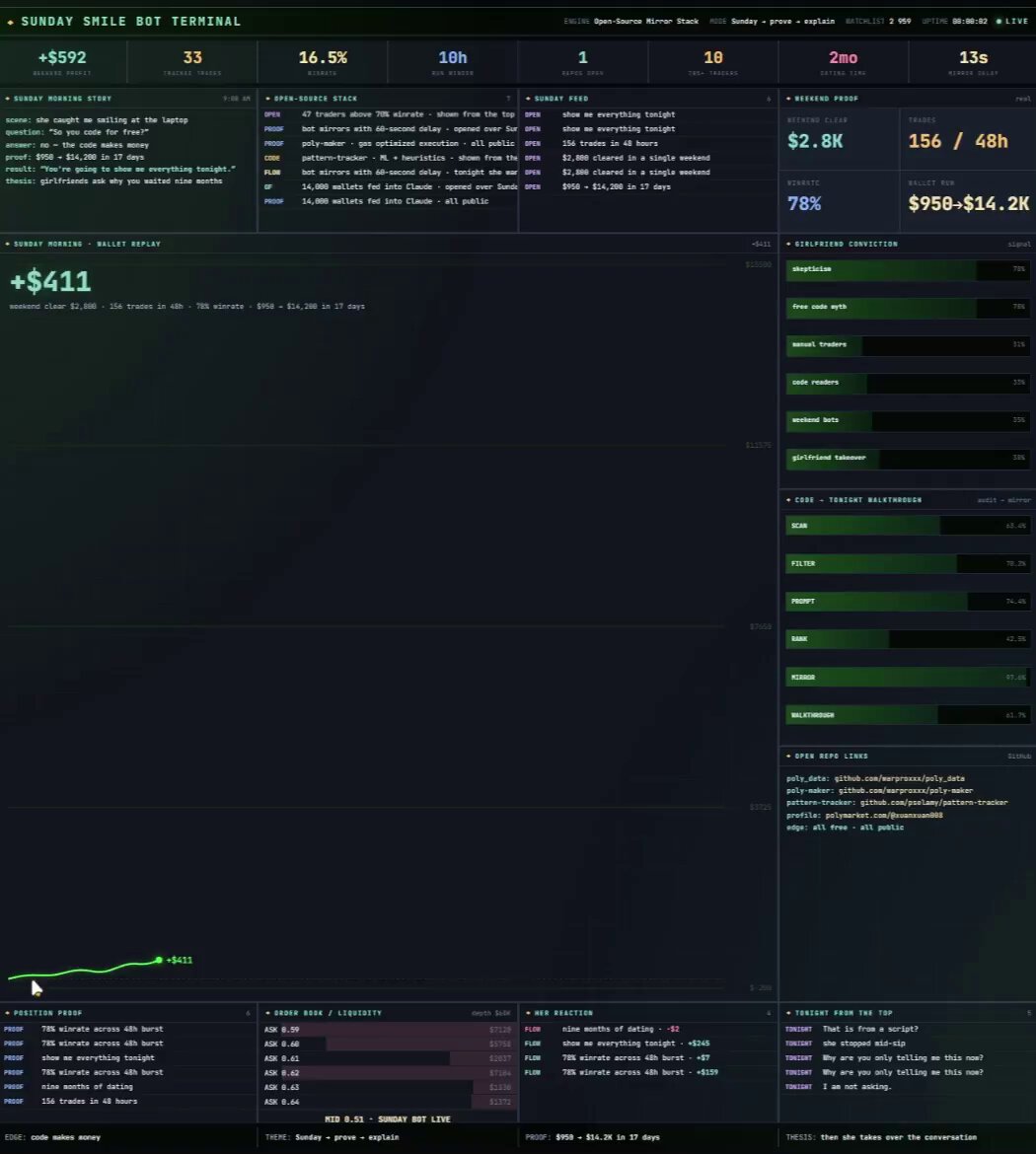
My friend called me Saturday night.
"Bro. Come over. Now."
I thought something happened.
I came over.
He's sitting at his desk.
Three monitors.
Smiling like an idiot.
"Look at this."
One wallet he was tracking —
$2,800 in a single weekend.
Another — 156 trades in 48 hours.
78% winrate.
One more turned $950 into $14,200 in 17 days.
"That's... a bot?"
"Three bots. All open source. Anyone can use them."
I sat down.
He showed me everything.
First repo — 86M trades on Polymarket.
Every outcome since day one.
Free to download.
Second — market making bot.
Both sides. Gas optimized.
Runs on Google Sheets.
Third — he fed 14,000 wallets into Claude.
One prompt. 4 minutes.
Found 47 traders with 70% winrate.
Bot mirrors them with 60-second delay.
I stared at the screen for a long time.
"Why didn't you show me this earlier?"
He shrugged.
"You never asked."
I'm asking now.
28
Jun 6
No office. No team. No meetings.
Just a 24-year-old and AI agents on WhatsApp.
$63,000 a month.
He doesn't sit at a desk.
He doesn't manage employees.
He doesn't open a laptop to run his business.
He sends a message.
The agents handle the rest.
Customer support — automated.
Lead generation — automated.
Follow-ups — automated.
Reports — automated.
Everything that used to require a team
now runs through a phone screen
and a WhatsApp chat.
The business doesn't stop when he sleeps.
It doesn't slow down on weekends.
It doesn't call in sick.
Most people are building businesses
that need them to function.
He built one that runs without him.
At 24.
The tools exist right now.
The only thing missing
is knowing how to connect them.
Full breakdown — next post.
#AI #Automation #WhatsApp #AIAgents #MakeMoneyOnline
108
Jun 6
A $4,800 research job just became a 3-hour task.
The researchers don't know yet.
A Chinese student gave Kimi K2 one goal.
The AI didn't answer him.
It split the work across 300 parallel agents
and got to work.
One agent scanning Reddit complaints.
One mapping App Store reviews.
One analyzing competitor pricing.
One tracking TikTok angles.
One identifying market gaps.
All running simultaneously.
All reporting back.
3 hours later — not a chat response.
Real files.
Reports. Spreadsheets. Dashboards. Presentations.
The kind of output a research team charges $3,000–$6,000 for.
What used to take 10–14 days.
Compressed into one prompt.
This is the part nobody talks about.
AI isn't just answering questions anymore.
It's running the work in parallel
while you only make one decision —
what to ask.
300 agents won't save a bad idea.
But they'll show you the market, the gaps,
the complaints and the angles
before you waste 3 months building blind.
Most people are still using AI like Google.
A few figured out it's an operating system.
Which one are you?
1
50
Jun 6
10 GPUs. $18,000/month.
No code. No product. No customers to find.
Here's what actually happened.
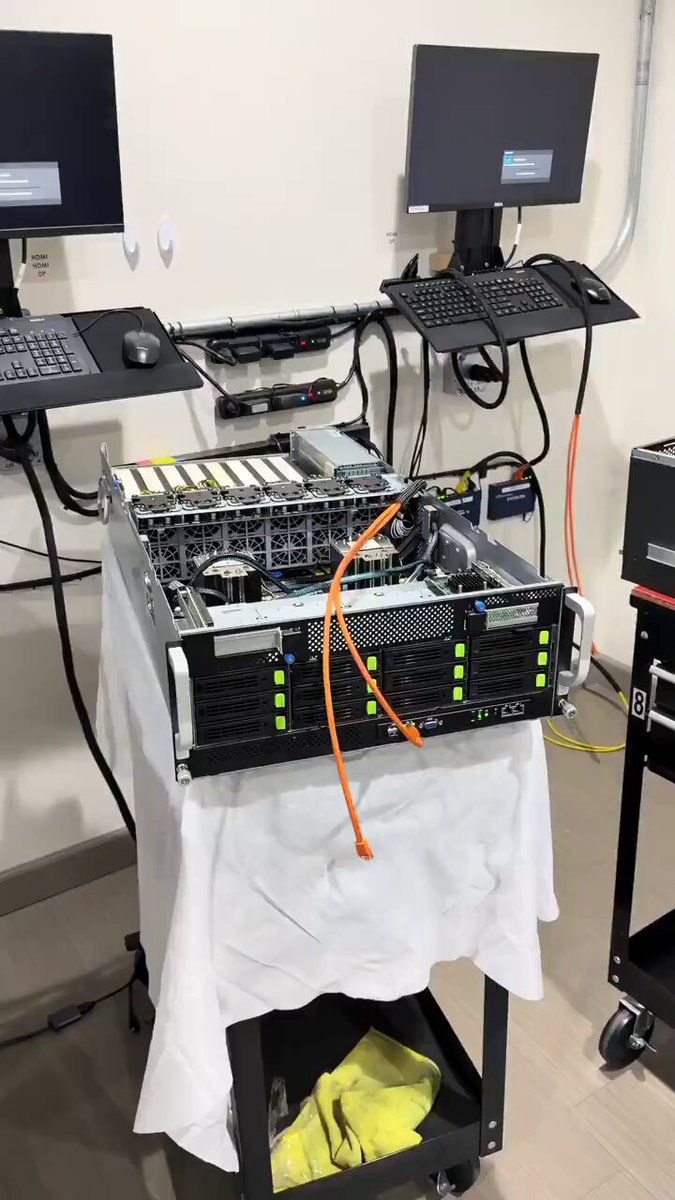
A guy spent $120,000 on NVIDIA hardware.
Not to build an app.
Not to train a model.
Just to own the compute.
Then he waited.
AI companies came to him.
They needed processing power.
They didn't have the hardware.
He did.
Now they pay him every month to rent it.
Like a landlord.
But instead of apartments — GPUs.
The hardware paid itself off in 7 months.
Everything after that is profit.
$18,000 a month.
From machines sitting in a room.
Running 24/7.
While he sleeps.
Everyone is racing to build the next AI product.
The smartest people are selling them the infrastructure to run it.
Same as the gold rush.
Nobody remembers the miners.
Everyone knows who sold the shovels.
Full breakdown on how to start — next post.
#AI #NVIDIA #PassiveIncome #GPU #Automation
70