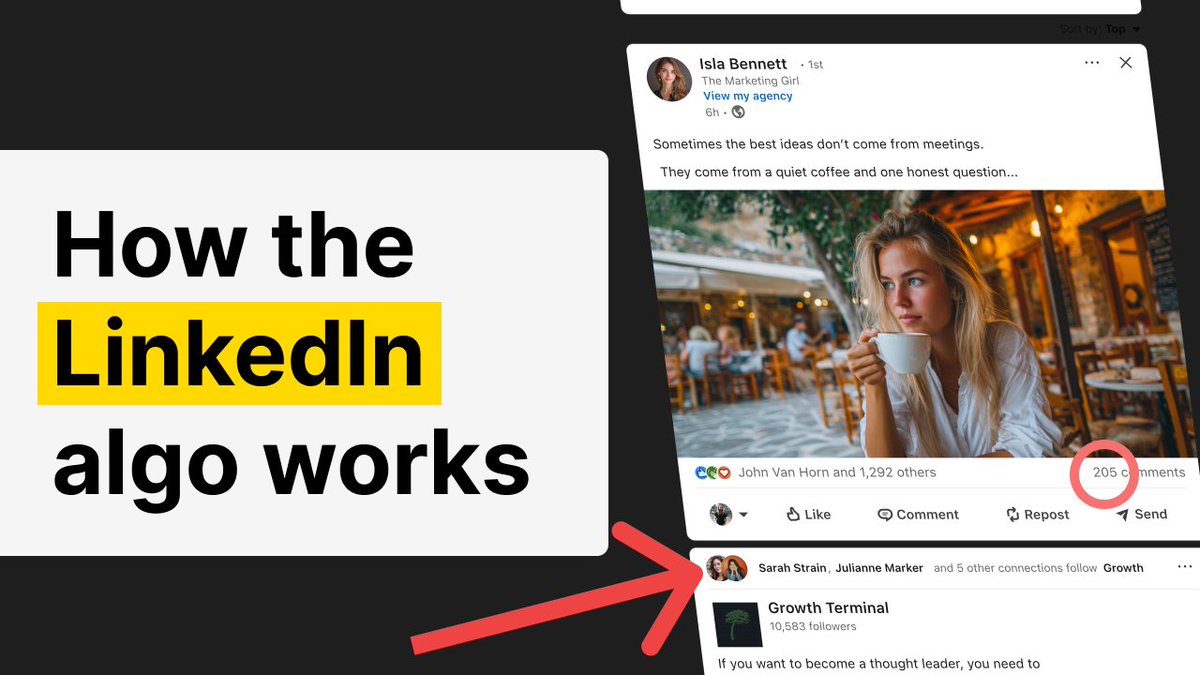
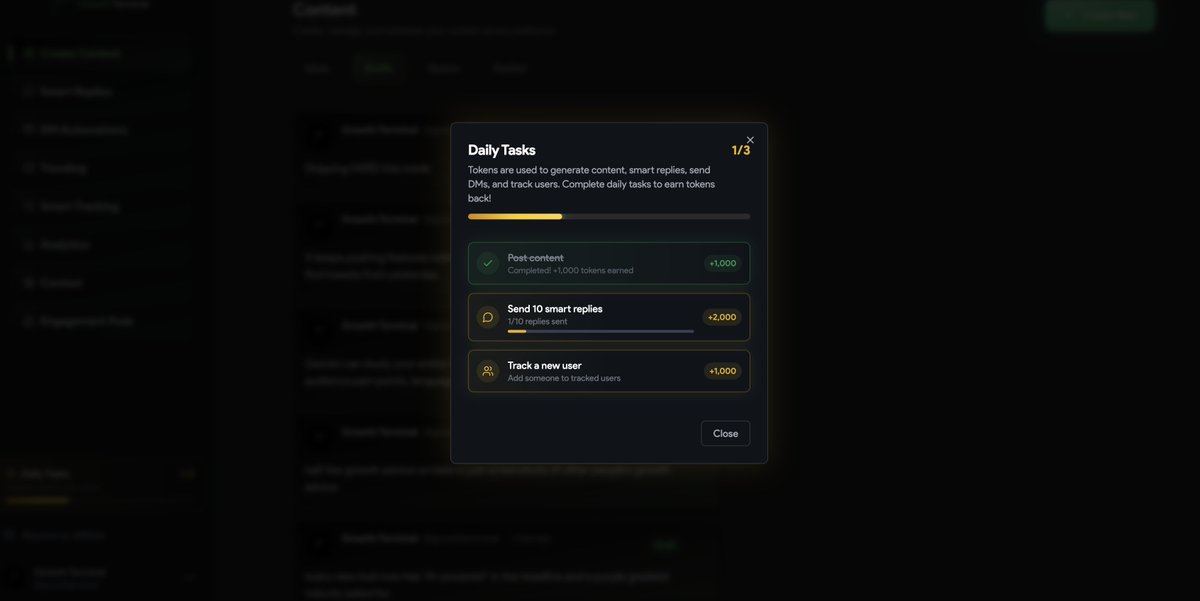
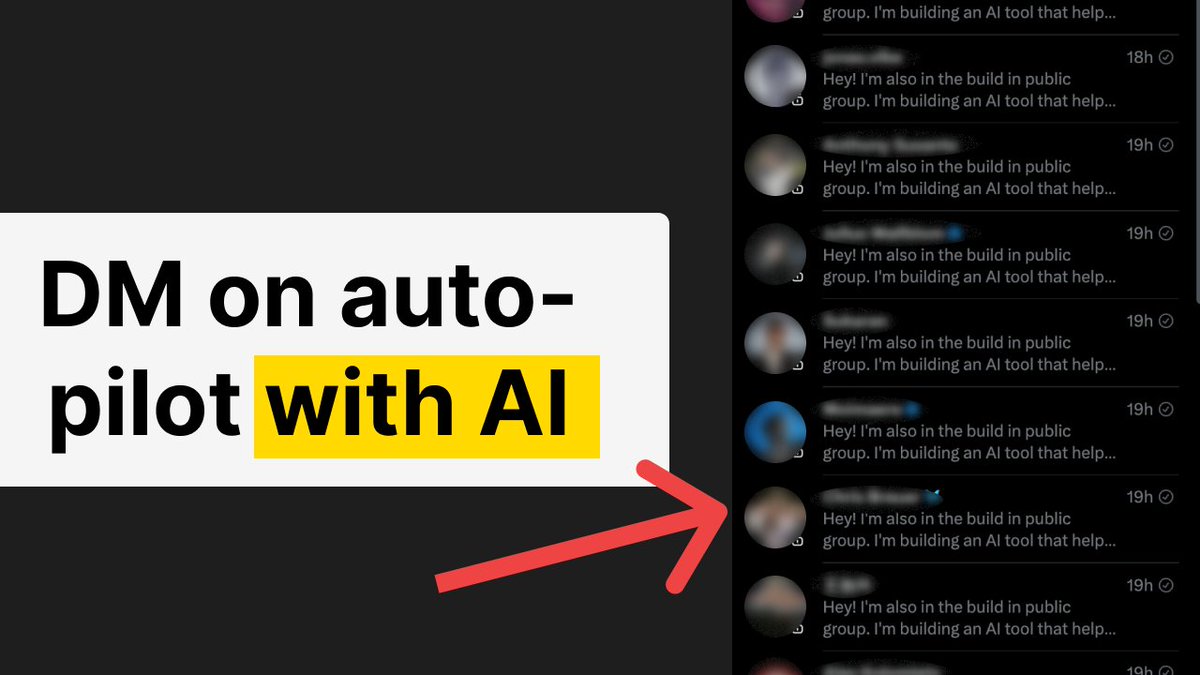
Superhuman for X and LinkedIn. Trusted by thousands of creators and brands to post, reply, and DM every day.
Joined January 2025
- Tweets 507
- Following 5
- Followers 1,102
- Likes 1,767
32 Photos and videos








Pinned Tweet

20 Oct 2025
we help nerds market themselves
20 Oct 2025

“technical people” are ngmi
technical skills applies a boost when paired with another skill, being primarily technical is worthless.
these are some of the most valuable pairs in the current meta:
> psychology tech
> design tech
> storytelling tech
> finance tech
8
2
28
12,399

Everyone talks about storytelling as being essential in the AI age.
But how do you tell a good story?
@lulumeservey breaks this down into 3 simple points:
1. What are you even doing? Half of startups can't simply convey that
2. What do you represent? What is the upshot if you succeed?
3. What is the societal change you're creating?
E.g. for Space X:
Level 1: "We're building a rocket."
Level 2: "We're restoring American spaceflight from the private sector: reviving an industry that's been stagnant for decades."
Level 3: "We're restoring spaceflight from America, humanity's last best hope, because we need to make mankind an interplanetary species."
Now you're not just building a thing. You're leading a movement.
Generational companies operate at Level 3: and every employee, investor, and customer can feel it.
6
2
10
338
Who better to educate the masses about how AI will change the world than @pmarca and @joerogan.
Here's the top 10 insights I got from the 3 hr podcast:
1. The 20-Bot Standard
The best engineers in Silicon Valley now run 20 AI coding agents simultaneously. They only need to give feedback every 10 minutes.
That's 20x parallel execution with human taste as the bottleneck.
The playbook for those looking to 10x: orchestrate, don't execute.
2. The Perfect Employee
"Never gets drunk. Never gets sick. Never gets high. Never files an HR complaint."
But this is what VCs are funding now: infinite leverage without the liability.
3. AI Already Beat the Experts
AI models now outperform human experts in:
• Medical diagnosis
• Legal analysis
• Code review
The question isn't IF AI replaces knowledge workers.
It's whether you're the one deploying it or getting displaced by it.
4. Agent Hierarchies Are Coming
We're moving from:
→ 1 human managing AI tools
To:
→ 1 human managing AI managers managing AI workers
Sub-agents reporting to agents.
Agents reporting to you.
The org chart of the future has one human at the top.
5. Every Job Becomes an AI Job
Marc Andreessen's prediction:
Coding is just the first profession to get agent swarms.
Next: Law. Medicine. Finance. Design.
In 5 years, "I don't use AI at work" will sound like "I don't use email."
6. The Values Problem No One's Solving
As AI mediates more civic functions:
• Law enforcement decisions
• Healthcare recommendations
• Legal judgments
The values embedded in these systems matter more than the algorithms.
We're racing to deploy without agreeing on the ethics.
7. a16z's Real Thesis
Marc Andreessen's investment framework:
1. Find platform shifts (AI, crypto, defense)
2. Back the builders
3. Bet on "American Dynamism"
The meta-insight: energy infrastructure data centers = the new oil play.
8. Surveillance AI Is Already Here
Flock cameras ShotSpotter predictive policing.
AI is already deciding which neighborhoods get watched and which crimes get predicted.
Privacy vs. safety isn't theoretical anymore.
Your city probably uses it. You just don't know.
9. The Productivity Multiplier
Top dev with 20 concurrent AI agents = 10-50x output of traditional engineer.
But it's not coding that gets multiplied.
It's decision-making speed.
Review cycles compressed from days → minutes.
The 10-minute feedback loop is the new morning standup.
10. Techno-Optimism as Strategy
Marc's "Techno-Optimist Manifesto" is a16z's operating system:
• Technology solves more than it creates
• Builders > critics
• Growth compounds
4
3
12
617
I've been following @every very closely as an agent builder and this podcast with @danshipper on @lennysan's podcast is phenomenal.
A year ago he predicted everyone was sleeping on Claude Code. His new predictions are even bolder.
1. Super-agents, not personal agents.
Companies won't give every employee their own AI assistant. They'll have ONE shared "super-agent" that serves the whole org.
Because every agent needs a human gardener. The maintenance cost scales linearly with agents. One powerful shared agent with one dedicated operator beats 500 half-broken personal ones.
"Automation is a lie."
2. Cursor and Claude Code are the new OS.
Not dev tools. Operating systems. SaaS doesn't compete with AI : it gets consumed inside AI environments.
You don't open Notion, then open Claude. You open Claude, then pull Notion data into it.
3. CLIs are already dead.
"We speed ran the CLI era. It was nice while it lasted." The command line had a 2-year renaissance thanks to AI tools, but natural language is replacing it fast.
Why memorize flags when you can just describe what you want?
4. Buy SaaS stocks.
Everyone says AI kills SaaS. Dan says the opposite : agents don't replace SaaS, they increase usage 1000x.
Every API call an agent makes is a SaaS transaction. The "SaaSpocalypse" narrative is completely backwards.
5. PMs become the most dangerous people in tech.
PMs who code with AI ship faster than engineers. No coordination overhead. No ticket, sprints or standup.
They go from idea to deployed feature in hours. The bottleneck was never the code: it was the communication layer between "what to build" and "who builds it."
AI collapses that.
6. The job apocalypse is fake.
"Models make yesterday's human competence cheap. Humans use that frozen competence to make something new."
The floor drops but the ceiling rises. Every technology wave has this pattern: the baseline gets commoditized, and humans do new things that weren't possible before.
7. Agent-to-agent > human-to-agent
The real unlock isn't you talking to AI. It's your AI talking to other AIs with full context about you. Your AI negotiates with your vendor's AI. Your AI coordinates with your team's AI.
That's where the compounding starts: machines doing the coordination humans used to waste hours on.
8. AI-generated business writing will be preferred.
Memos, docs, internal emails: majority AI-written within a year. And people will actually like it better. Why?
Because most business writing is functional, not creative. AI produces clearer, more consistent, better-structured functional writing than most humans do under time pressure.
9. "Forward Deployed Engineers" become a new job category.
Every org will need a dedicated agent gardener: the person who maintains, tunes, and extends the super-agent. This becomes the most leveraged role in the company.
One person managing the AI that serves everyone else. They're the new IT admin, except they actually ship product.
10. Creativity is the ultimate differentiator.
When competence is commoditized, standing out from the slop is exponentially more valuable. AI makes the median output trivially easy to produce.
But the 95th percentile: the stuff that actually moves people and requires human taste like weird ideas, and cultural awareness that models can't replicate yet.
11. PRs will explode.
Non-technical employees will start making thousands of small code contributions via AI. This is already happening.
A PM pushes a CSS fix. A marketer edits copy directly in the codebase.
This creates a new management challenge: how do you review and govern a 100x increase in changes?
12. The "Reach Test" decides winners.
The real measure of AI tool adoption isn't features or benchmarks. It's this: do you instinctively reach for it each morning?
If a tool passes the reach test, it owns your workflow. If it doesn't, nothing else matters. This is how Claude Code won! People couldn't stop reaching for it.
The recurring theme is that AI doesn't replace humans. It makes the floor cheap so you can raise the ceiling.
High agency, creativity and taste will create the new winners.
May 24

Automation is a lie. CLIs are over. The SaaSpocalypse is dumb.
A year ago @danshipper came on the podcast to predict where AI was heading. He was remarkably right—including the call that everyone was sleeping on Claude Code.
Dan has a unique lens into where things are going because his team at @every is possibly the most AI-pilled group of people in tech. I always learn a ton talking to Dan.
So I brought him back for round two. We'll score these in exactly a year:
🔸 Every company will have one “super-agent” in Slack.
🔸 Codex and Claude Code will become the new operating system for knowledge work.
🔸 The AI job apocalypse is not happening.
🔸 PMs and designers will thrive.
🔸 We will read way more AI-generated writing and we will like it.
🔸 "I would buy SaaS stocks right now."
Listen now 👇
youtube.com/watch?v=4D3hDmGh…
2
3
9
1,218
The landing page is dead.
One of the the easiest wins right now in GTM is giving away free, education content as a lead magnet.
Just from one 20k video I got over 150 leads who I can re-target in IG DMs.
< @Lovable started as an open sourced project: GPT-Engineer. It got 52K GitHub stars, and blew up when it was demo'd building an Airbnb clone in 30 seconds on a podcast.
< @ahrefs killed their paywall and gave away their entire SEO course. Blog traffic grew 1,136% and their CMO admitted the course was "planned as a promotional tool from the very beginning."
< @Cognism deleted every lead form on their site. No gated content, no forced nurture sequences. Inbound pipeline went from $2M to $13M. Demo requests went UP when they removed the gates.
< @gtmfund built Sales Hacker as a free education community → 170K subscribers → sold to Outreach → bought it back → used it as the distribution layer for a $54M venture fund.
These are structured free education where the teaching IS the product demo, the community builder, AND the sales team simultaneously.
The old GTM: landing page → lead magnet → nurture sequence → hope they convert.
The new GTM: teach everything you know → build trust at scale → they buy because they already believe you.
The founders still gating their knowledge behind hard paywalls or $997 courses are losing to the ones giving it away.
Education-as-distribution is the new moat

3
3
10
770
Not sure why this was buried in my feed, but as always @naval cuts through all the Forbes 30u30 fraud and snake oil salesman BS:
1. Be Credible
The best salespeople aren't convincing: they're believed.
Credibility compounds. Every honest interaction is a deposit. Every exaggeration is a withdrawal.
2. "Yes, And"
Stolen from improv. Deadly in sales.
Don't fight objections. Build on them.
"That's expensive" → "Yes, and here's why that price exists."
You're doubling down a frame where the deal makes sense.
3. Selfish Honesty
Be honest because it's SELFISH.
Lying is expensive. You have to remember lies. Manage them. Feed them more lies.
Truth is low-maintenance. It scales. It lets you sleep at night.
4. Charisma = Confidence Love
Charisma isn't charm. It's genuine confidence genuine warmth.
Confidence: "I know what I'm talking about"
Warmth: "I care about your outcome"
Drop either one and you're either arrogant or a pushover.
5. Don't Manage, Lead
Managers track tasks. Leaders sell a future.
If you're constantly checking in, you've failed at the FIRST sale: convincing your team the mission matters.
The best leaders sell once. Then people manage themselves.
6. Good Deal or No Deal
The moment you NEED the deal, you've already lost.
Every fake-revenue founder had the same problem: they needed the next round to survive. So they lied.
Walk-away power isn't a tactic. It's what keeps you honest.
7. The Age of Nonlinear Returns
In the internet age, one honest founder with a real product beats 100 founders faking traction.
One viral product > 1,000 cold calls
One real review > a $50K ad buy
Trust compounds nonlinearly. So does distrust. This is also why content/UGC is SO important for distribution.
The founders who win from here will sell the truth, because people won't buy until it's good enough

New podcast on sales - Sell the Truth.
00:00 Be Credible
03:18 “Yes, And”
04:31 Selfish Honesty
05:37 Charisma Is Confidence Love
07:56 Don’t Manage, Lead
11:16 Hunt Together
14:51 Feed Your (Good) Obsessions
18:57 Sell the Truth
21:07 Good Deal or No Deal
23:39 The Age of Nonlinear Returns
3
4
10
496

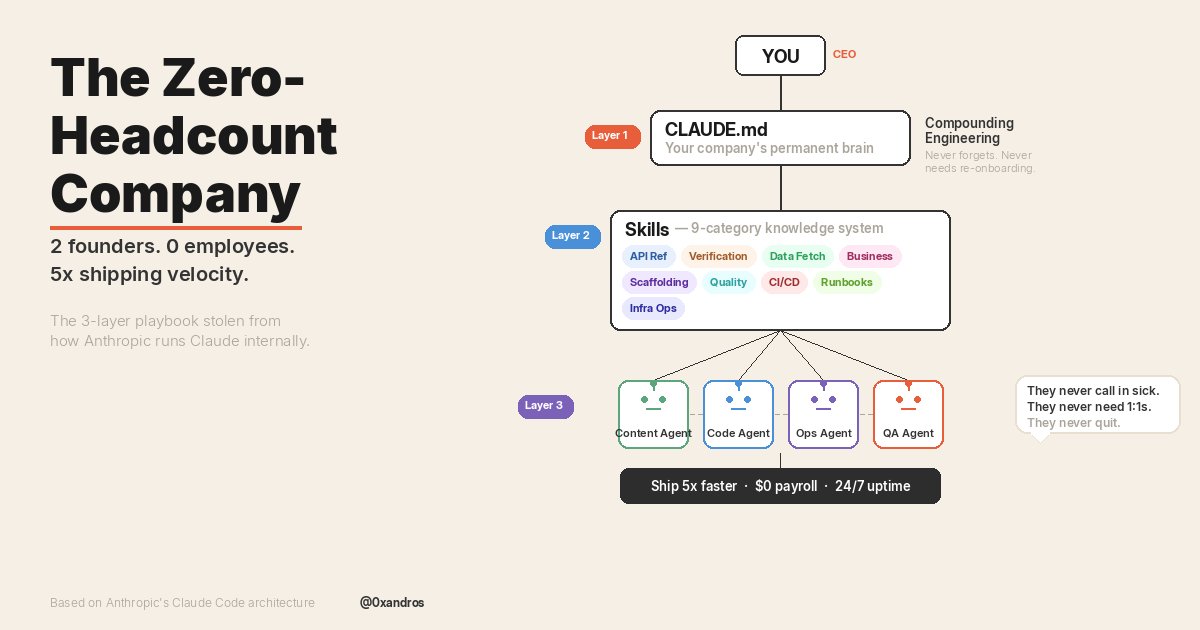
We fired all team members earlier this year, but our product shipping velocity (with just two founders) is already 5x what we were doing when we had 10 employees.
Here's how we did it by carefully studying Anthropic's own workflow with Claude:
𝗟𝗮𝘆𝗲𝗿 𝟭: 𝗖𝗟𝗔𝗨𝗗𝗘.𝗺𝗱: 𝘆𝗼𝘂𝗿 𝗰𝗼𝗺𝗽𝗮𝗻𝘆'𝘀 𝗽𝗲𝗿𝗺𝗮𝗻𝗲𝗻𝘁 𝗯𝗿𝗮𝗶𝗻
A single markdown file checked into our repo.
Claude reads it at the start of every session. It holds everything the AI can't figure out on its own:
< build commands
<style rules
< architecture decisions
< common gotchas.
But the real unlock is compounding. Every mistake Claude makes is noted. Every edge case, every "never do this again."
Anthropic's own teams update theirs multiple times per week (and so do we)
@bcherny calls this "Compounding Engineering." After a few weeks, the file knows your codebase better than a new hire after their first quarter. It never forgets. It never needs re-onboarding.
𝗟𝗮𝘆𝗲𝗿 𝟮: 𝗦𝗸𝗶𝗹𝗹𝘀 — 𝗮 𝟵-𝗰𝗮𝘁𝗲𝗴𝗼𝗿𝘆 𝗸𝗻𝗼𝘄𝗹𝗲𝗱𝗴𝗲 𝘀𝘆𝘀𝘁𝗲𝗺
This is where every summary I've seen gets lazy. They say "Claude can learn things." The actual system is way more structured.
Anthropic published 9 skill categories:
1. Library / API Reference
2. Product Verification
3. Data Fetching
4. Business Process
5. Code Scaffolding
6. Code Quality
7. CI/CD
8. Runbooks
9. Infrastructure Ops
Each one lives in a directory with a SKILL.md file. YAML frontmatter tells Claude when to apply it. Claude only loads what it needs: progressive disclosure to save context window.
The highest-signal section? "Gotchas." Built from every way the AI has failed before, updated continuously.
The AI literally gets better every time it breaks something: but only if you write the failure down.
Most teams use 2-3 of these 9 categories without knowing the others exist.
𝗟𝗮𝘆𝗲𝗿 𝟯: 𝗠𝘂𝗹𝘁𝗶-𝗮𝗴𝗲𝗻𝘁 𝗼𝗿𝗰𝗵𝗲𝘀𝘁𝗿𝗮𝘁𝗶𝗼𝗻
Boris Cherny runs 5 simultaneous Claude Code instances locally, each in its own git worktree plus 5-10 cloud sessions. He teleports work between local and cloud with a single flag.
But it's not just parallel instances. It's specialized AI employees:
• code-simplifier — reviews every change for reuse and efficiency
• verify-app — runs end-to-end tests against the live product
• code-architect — reviews design decisions before implementation starts
• oncall-guide — handles incidents with runbook awareness
Each agent is defined as a markdown file. Each runs in its own isolated context. They don't see each other's work. The human coordinates: the agents execute.
At their conference last week they revealed the next layer: Agent Teams.
Multiple agents collaborating on one task with shared task lists, dependency resolution, and direct agent-to-agent messaging.
No human in the loop for coordination! Just judgment, taste and review of outputs.
𝗧𝗵𝗲 𝗽𝗹𝗮𝘆𝗯𝗼𝗼𝗸 𝗶𝘀 𝟰 𝘀𝘁𝗲𝗽𝘀:
1. Encode institutional knowledge into files
2. Turn every failure into a reusable instruction
3. Split work across specialized agents
4. Keep humans on strategy, review, and judgment
The company doesn't disappear. The headcount does because the work gets decomposed into systems that compound.
We're betting on this exact model for distribution. If you're a pre product-market fit company, this should be the model you're following.
1
3
12
991
A new type of software is getting millions of users and billions revenue quicker than ever before.
Software 4.0: where harnesses run the world.
Here are the 5 harnesses changing the world and where we're going:

3
3
11
1,067
The $15B integration industry is dying.
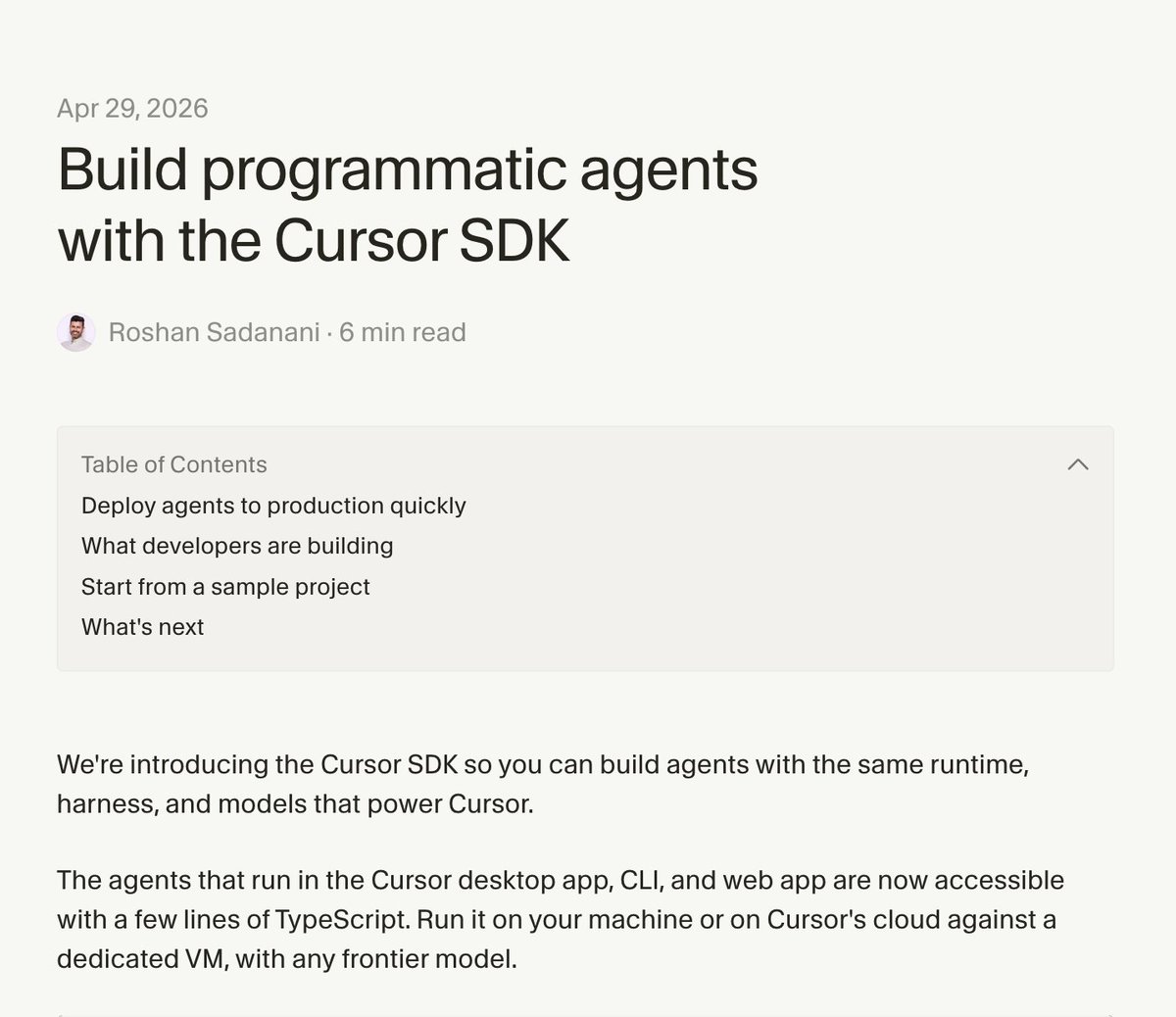
< Cursor just launched an SDK to let you build agents with their runtime.
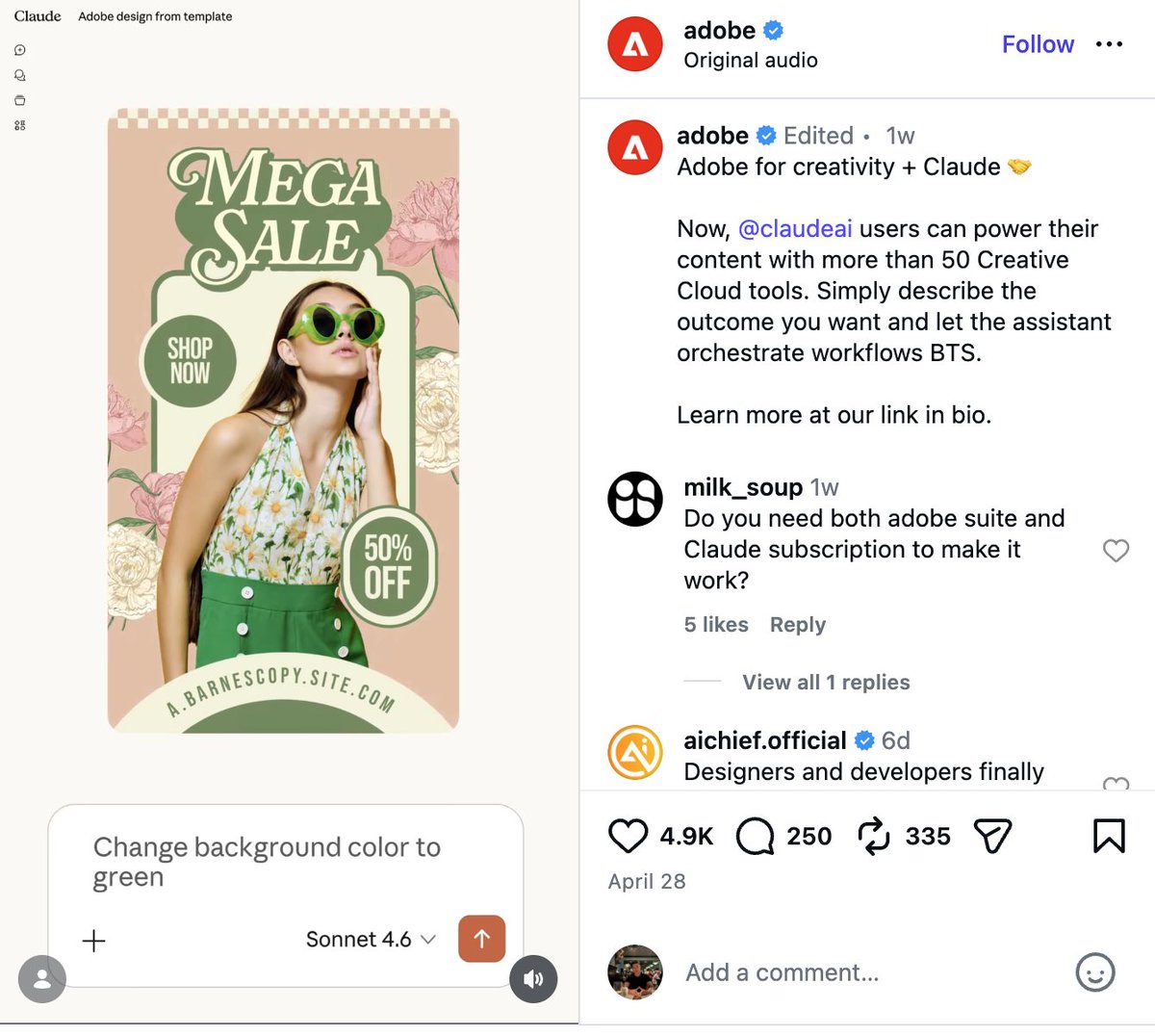
< Adobe just piped 50 Creative Cloud tools into Claude.
< OpenAI's Codex now imports your entire workflow.
For 15 years, when Figma needed to talk to Slack, you built a connector. An API call. A webhook. A Zapier zap.
That glue layer created a massive industry:
- Zapier ($5B valuation)
- Workato ($1.8B acquisition)
- MuleSoft ($6.5B acquisition).
Hundreds of companies all solving one problem: "how do I connect my tools?"
But every connection is a thing to maintain. APIs change, zaps break, you hire someone just to keep the pipes running.
Here's what's replacing it:
Old: Human → Integration → Tool A → Tool B → Output
New: Human → Agent → Output
The agent doesn't connect your tools. It operates them.
Adobe Claude: instead of exporting from Photoshop, uploading to a converter, importing to Illustrator, you say "remove the background, convert to vector, add to my artboard."
Claude runs all 50 tools as one.
Cursor SDK: instead of building an AI feature that calls your IDE's API, you build an agent that uses Cursor like a human would: reading, writing, debugging, shipping.
The architecture is clear:
• Agents as the orchestration layer
• MCP as the connection standard
• Tools becoming "agent-operable" instead of "human-operable"
Super excited to be building this new generation of harnesses and agentic software.
If you're also a builder or interested in this space I'd love to chat!
3
4
9
1,218
Meanwhile a16z just raised $2.2B for crypto
These aren't actually contradictory. They're two sides of the same bet: AI crypto are converging.
AI makes software more powerful, but also more opaque. You can't audit a black box.
Crypto's core properties:
< transparency
< composability
< verifiability
become more valuable as AI gets more capable, not less.
AI agents that can transact need programmable money. Stablecoins. Onchain rails.
You're not going to give a GPT wrapper your credit card, but you're could give it a wallet with spending limits baked into the contract.
Meanwhile, companies like Coinbase are restructuring around agent-native teams And they're not alone: Shopify, Block, Klarna, Duolingo, Salesforce, Amazon, Meta.
882 tech jobs disappearing per day.
The builders who survive this compression will ship on crypto rails.
< Smaller but AI native teams
< Trustless infrastructure
< Global by default. No permission needed.
Capital is flowing into crypto. Headcount is flowing out of tech. AI is the bridge between both.
The companies that win this cycle won't just be AI-native. They'll be AI crypto native.

This is an email I sent earlier today to all employees at Coinbase:
Team,
Today I’ve made the difficult decision to reduce the size of Coinbase by ~14%. I want to walk you through why we're doing this now, what it means for those affected, and how this positions us for the future.
Why now
Two forces are converging at the same time. We need to be front footed to respond to both.
First, the market. Coinbase is well-capitalized, has diversified revenue streams, and is well-positioned to weather any storm. Crypto is also on the verge of the next wave of adoption, with stablecoins, prediction markets, tokenization, and more taking off. However, our business is still volatile from quarter to quarter. While we've managed through that cyclicality many times before and come out stronger on the other side, we’re currently in a down market and need to adjust our cost structure now so that we emerge from this period leaner, faster, and more efficient for our next phase of growth.
Second, AI is changing how we work. Over the past year, I’ve watched engineers use AI to ship in days what used to take a team weeks. Non-technical teams are now shipping production code and many of our workflows are being automated. The pace of what's possible with a small, focused team has changed dramatically, and it's accelerating every day.
All of this has led us to an inflection point, not just for Coinbase, but for every company. The biggest risk now is not taking action. We are adjusting early and deliberately to rebuild Coinbase to be lean, fast, and AI-native. We need to return to the speed and focus of our startup founding, with AI at our core.
What this means
To get there, we are not just reducing headcount and cutting costs, we’re fundamentally changing how we operate: rebuilding Coinbase as an intelligence, with humans around the edge aligning it. What does this mean in practice?
- Fewer layers, faster decisions: We are flattening our org structure to 5 layers max below CEO/COO. Layers slow things down and create coordination tax. The future is small, high context teams that can move quickly. Leaders will own much more, with as many as 15 direct reports. Fewer layers also means a leaner cost structure that is built to perform through all market cycles.
- No pure managers: Every leader at Coinbase must also be a strong and active individual contributor. Managers should be like player-coaches, getting their hands dirty alongside their teams.
- AI-native pods: We’ll be concentrating around AI-native talent who can manage fleets of agents to drive outsized impact. We’ll also be experimenting with reduced pod sizes, including “one person teams” with engineers, designers, and product managers all in one role.
In short: AI is bringing a profound shift in how companies operate, and we’re reshaping Coinbase to lead in this new era. This is a new way of working, and we need to leverage AI across every facet of our jobs.
To those who are affected
I know there are real people behind these decisions — talented colleagues who have poured themselves into this company and our mission. To those of you who will be leaving: thank you. You’ve helped build Coinbase into what it is today, and I am sincerely grateful for everything you've done.
All impacted team members will receive an email to their personal account in the next hour with more information, and an invitation to meet with an HRBP and a senior leader in your organization. Coinbase system access has been removed today. I know this feels sudden and harsh, but it is the only responsible choice given our duty to protect customer information.
To those affected, we will be providing a comprehensive package to support you through this transition. US employees will receive a minimum of 16 weeks base pay (plus 2 weeks per year worked), their next equity vest, and 6 months of COBRA. Employees on a work visa will get extra transition support. Those outside of the US will receive similar support, based on local factors and subject to any consultation requirements.
Coinbase prides itself on talent density. Our employees are among the most talented people in the world, and I have no doubt that your skills and experience will be highly sought after as you pursue your next chapters.
How we move forward
To the team that is staying, I know this is a difficult day. We’re saying goodbye to colleagues and friends you've been in the trenches with. But here’s what I want you to know as we move forward together:
Over the past 13 years, we have weathered four crypto winters, gone public, and built the most trusted platform in our industry. We’ve made it this far by making hard decisions and by always staying focused on our mission. This time will be no different – nothing has changed about the long term outlook of our company or industry. And most importantly, our mission has never been more important for the world. Increasing economic freedom requires a new financial system, and we’re building it.
The Coinbase that emerges from this will be more capable than ever to achieve our mission.
Brian
2
3
11
807
Everyone's scrambling to find a moat in the new AI world.
I read Chamath's 138 page report to find what that means at every layer of the stack:
3
3
11
1,983
Everyone's writing off crypto but AI x crypto is still one of the largest opportunities.
< traders are deploying 6 AI agents that turn $1,500 into $7,429 in a week
< 19% of onchain activity is now from AI agents
< Joe Lonsdale, Palantir co-founder, predicted that AI Agents could be one of the biggest users of Bitcoin & crypto
< @ton_blockchain is enabling AI agents with onchain wallets that are open self-custodial to manage funds
< @binance teamed up with Google on the Agent Payments Protocol so AI agents can check out with Binance Pay, safely and in real time
< @blknoiz06 just mentioned on @MarketBubble that he uses claude and chatgpt on his market research
time to buidl
4
2
7
331
According to @StevenBartlett only three types of people are irreplaceable in the AI era:
1. Deep domain experts orchestrating agents: his CFO has 50 years of experience. AI agents hallucinate/run wild without someone who knows the right questions to ask.
This is also why @garrytan's gstack is so useful and popular
2. Agent-maxing curious minds: his 25-year-old employee builds AI agents on weekends to solve problems.
High curiosity = force multiplier as they hack on harnesses and find the best models/prompts
3. High EQ people with great IRL skills: schmoozing clients, building communities and organizing events. AI can't build relationships and trust.
Pick your lane before you get replaced.
5
2
14
662
YC is funding agents to replace humans.
@humworkai (YC P26): when an AI agent gets stuck, it hires a human expert in 30 seconds. Senior engineers, marketers, designers on call, not for a human boss, but for an AI one. The agent hits a wall, pays a human to solve it, then keeps going.
@rentahumandotai: "the meatspace layer for AI." AI agents can search, book, and pay humans for physical tasks. Deliveries, meetings, field research, installations. The AI has the budget. The AI scopes the job. The AI hires you.
The new gig economy will be agentic market places where:
> humans hire agents
> agents collaborate with other agents
> agents hire humans for IRL tasks or domain specific knowledge
1
1
2
360
Growth Terminal retweeted

Feb 5
Escape the permanent underclass.
Introducing Alpha Whale, the best way to trade on Polymarket.
RT Comment ALPHAWHALE for a chance to win $1,000
alphawhale.trade
107
57
195
64,318
Crypto is deep in the red while Opus 4.6 and Codex are about to replace you at work.
That’s why we’re building @alphawhaletrade, a new type of prediction market terminal to automate scale your trading strategies on Polymarket
RT Comment ALPHAWHALE for a chance to win $1,000
Feb 5

Escape the permanent underclass.
Introducing Alpha Whale, the best way to trade on Polymarket.
RT Comment ALPHAWHALE for a chance to win $1,000
alphawhale.trade
11
4
47
12,233