
Creating money out-of-thin-air is a secret superpower. It belongs to We, The People - not to the bankers. Used wisely, it will provide abundance. Unvaxxed.
Joined September 2023
- Tweets 2,180
- Following 206
- Followers 132
- Likes 5,551
3 Photos and videos

@Hard Fiat retweeted

🦔KPMG published a report in October about how businesses are adopting AI and filled it with case studies of major organizations. UBS, the NHS, Swiss Federal Railways, and Transport for London all appeared in the report. Every one of them said the claims about their AI use were wrong. GPTZero found the errors and identified them as hallucinations. KPMG pulled the report. A month earlier, EY retracted a separate AI study over fabricated footnotes.
My Take
A Big Four consulting firm used AI to write a report about how well AI works, and the AI invented the evidence. The companies named in the report went public to say none of it was true. A month earlier, EY published a study with fake footnotes and had to retract that too. Two of the most expensive advisory firms on earth published AI-generated work this year without verifying whether any of it was accurate.
These are the firms Fortune 500 companies hire to tell them how to adopt AI. The firms that advise everyone else on AI adoption can't verify the output of their own AI tools.
Hedgie🤗

20
105
326
14,214
@Hard Fiat retweeted

Jun 12
🚨 The government made their own devices 100% invisible, so they can force yours to be 100% transparent. Did you know this? 🚨
They dodge the laws they force on you.
On us. The people!
Do not take this lightly.
Every MP is exempt.
Every Lord is exempt.
Every elite civil servant is exempt.
EVERY PARASITE IS EXEMPT!
They force the laws on us.
They legally shield themselves.
Total public surveillance.
Total state secrecy.
Absolute parasite immunity.
The well-funded, ‘professional’ campaigns wrap this up in polite, Ofcom-palatable jargon… we need to stop playing nice and call this brutal hypocrisy exactly what it is: a legal coup against our privacy.
If you complain about the length of this post or a 8-minute video, you are part of the problem. No filters and no apologies. Wake up or get out of the way.
🚨 RULES FOR THEE, PRIVACY FOR ME: What you NEED to know!
The UK has engineered a digital dictatorship. They demand total transparency from you, while securing absolute secrecy for themselves. This is not a theory. It is written directly into hard law.
Here is the brutal, stripped-down truth of how the political parasites legally insulated themselves from the surveillance panopticon they are forcing onto the public.
1. The Divine Right of MPs
The Law: Section 26, Investigatory Powers Act 2016
The Privilege: Intelligence agencies cannot touch an MP’s data without a personal, written veto from the Prime Minister.
The Tyranny: Your life is subjected to automated bulk surveillance. Theirs is legally untouchable.
2. The Private Internet Loophole
The Law: Schedule 1, Online Safety Act 2023
The Privilege: Official networks used by Ministers, Lords, and civil servants are explicitly exempt from client-side phone scanning.
The Tyranny: Your personal WhatsApp must be stripped of privacy and screened. Their government-shielded apps are completely walled off.
3. The Unchecked Dictator Veto
The Law: The "Henry VIII" Clauses in the Online Safety Act
The Privilege: Ministers hold secondary legislative powers to alter and expand exemptions via Statutory Instruments.
The Tyranny: If parasite official ever faces a surveillance clause, they can simply rewrite the law behind closed doors without a democratic vote.
4. The Weaponised Wilson Doctrine
The Law: Codified Parliamentary Surveillance Protections
The Privilege: The police and security services are completely banned from tracking, tapping, or snooping on politicians.
The Tyranny: The very individuals voting to turn your smartphone into an informant are constitutionally protected from ever experiencing the consequences of their own votes.
💥 THE VERDICT
This is the textbook definition of tyranny. A free society requires a transparent state and private citizens. The UK has completely inverted it. Your private thoughts, messages, and photos are treated as state property, while the parasites have declared their own devices sacred, unmonitored, and completely opaque.
They know exactly how dangerous this technology is - which is precisely why they wrote themselves out of it.
📱 Step 1: The Secret Tunnel (The State VPN)
When an MP, Minister, or elite civil servant works from home, they do not use standard family Wi-Fi. Their government laptops and phones are hard-coded to connect to a secure Government VPN (Virtual Private Network).
🔒 Step 2: The Legal Loophole Activates
The second that VPN clicks on, every single text, photo, and WhatsApp message they send is sucked out of their house and routed through private servers owned by Parliament. Because their data is now flowing through a "public body network," it triggers Schedule 1 of the Online Safety Act.
🕵️♂️ Step 3: Complete Invisibility
By law, this private state network is 100% exempt from the screening and scanning algorithms forced onto the public. Their devices instantly become legally invisible and untouchable to the state dragnet.
💥 The Naked Truth
Your Home: Your personal Wi-Fi pushes your private messages into a public commercial pipeline where the government demands it be scanned and screened.
Their Home: Their Wi-Fi instantly flips into a secure, state-shielded fortress.
Location does not matter. The ruling class built a private internet for themselves, using a legal and technical bypass to completely dodge the digital panopticon they are forcing onto you.
FYI: From 2020, when Civil Servants and MP’s worked from home, the Parliamentary Digital Service (PDS) mass-distributed pre-configured laptops, secure mobile devices, and hardware to the home addresses of every MP, Peer, and civil servant. They did not need to install private physical servers in individual houses because the devices themselves act as portable endpoints for the state's centralised servers… then, Government IT teams rapidly re-engineered their servers to handle the strain, massive scaling their corporate VPN capability. This allowed every single person in the state machine to plug their official laptop into their home Wi-Fi, click a button, and completely tunnel their traffic back into secure, centralized government servers.
So, what shall we do folks!?
New MNC (link in bio) campaign to begin VERY soon! But ideas welcome.
424
4,349
8,195
195,009

May 31
Interesting.
May 30

Voltaire passed away today in 1778.
There are two quotes of his I always come back to:
"I disapprove of what you say, but I will defend to the death your right to say it."
and
“Those who can make you believe absurdities can make you commit atrocities.”

Community note
The first quote is not by Voltaire. It was created by Evelyn Beatrice Hall in 1906 to summarize his philosophy. The second quote is a variation of Voltaire's 1765 words which referred to committing injustices rather than atrocities.
quoteinvestigator.com/2015/06/01/def… quoteinvestigator.com/2021/11/08/abs…
206
@Hard Fiat retweeted

May 25
I just finished watching *Off Campus*, and it sparked a deep, uncomfortable realization in me about what we’ve been blindly consuming for the last decade. If you pay close attention, right around 2013, a switch flipped in Hollywood's writing rooms. There has been a deliberate, systematic agenda to completely emasculate the modern male lead while aggressively romanticizing female toxicity, and we have all just sat back and watched it happen.
Let’s talk about the most glaring double standard of all: infidelity.
If a male character cheats in a modern movie or show, the narrative immediately crushes him. He is the ultimate villain, a manipulative narcissist, and his entire life is rightfully dismantled by the end of the script. But when a female lead cheats? The tone completely changes. Cue the indie pop music. Suddenly, her infidelity is framed as a "messy era," a "cute mistake," or a brave journey of self-discovery.
Even worse, the writers actively gaslight the audience into blaming the man she cheated on. The script will bend over backwards to justify her disloyalty by portraying the boyfriend as "emotionally unavailable," "too focused on his job," or simply "too boring." They literally train women to believe that if a man isn't perfectly catering to her every emotional whim 24/7, stepping outside the relationship is a perfectly valid, empowered response.
And look at how they write "strong" women now. Hollywood has completely forgotten how to write a genuinely resilient, intelligent, and elegant female lead. Instead, their idea of a "boss" is a woman who is incredibly rude, emotionally dysregulated, and highly combative. She speaks to the men in her life with absolute venom, never takes accountability, and acts like a literal child when she is told 'no.' Yet, the script demands we applaud her for her "confidence."
Meanwhile, what happens to the men in these shows? They have been entirely stripped of their backbone.
They are no longer written as protectors, leaders, or men with actual boundaries. They are written as hyper-apologetic doormats. If the female lead disrespects him publicly, embarrasses him in front of his friends, or destroys his property, the modern male character doesn't walk away. Instead, he shows up at her apartment in the rain the next morning to apologize for "triggering" her. He is a glorified simp whose only purpose in the story is to absorb her terrible behavior and validate her chaos.
The most dangerous part about this is the real-world translation. Art imitates life, but life also imitates art. We have an entire generation of young men and women who grew up internalizing this garbage.
We now have a demographic of women who genuinely believe that taking zero accountability is a personality trait, and that any man who demands basic respect is "controlling." On the flip side, we have men who are absolutely terrified to set a boundary in their relationships because a decade of media conditioning taught them that standing up for their own dignity makes them "toxic."
They aren't writing romance anymore. They are writing thinly veiled revenge fantasies that normalize absolute disrespect. Until we stop calling female toxicity "empowerment" and male weakness "romantic," the dating pool is going to stay exactly as broken as the movies designed it to be.


52
200
1,495
765,265
@Hard Fiat retweeted

May 21
A Wharton economist ran a randomized controlled trial on almost a thousand high school students in Turkey.
The result was so brutal for the AI-in-education narrative that it had to be peer-reviewed by PNAS before people would believe it.
Her name is Hamsa Bastani. She teaches operations and information at the Wharton School at the University of Pennsylvania, and the study she published in 2025 alongside her co-authors is one of the cleanest experiments anyone has run on what AI actually does to learning when you remove it from the equation and check what is left.
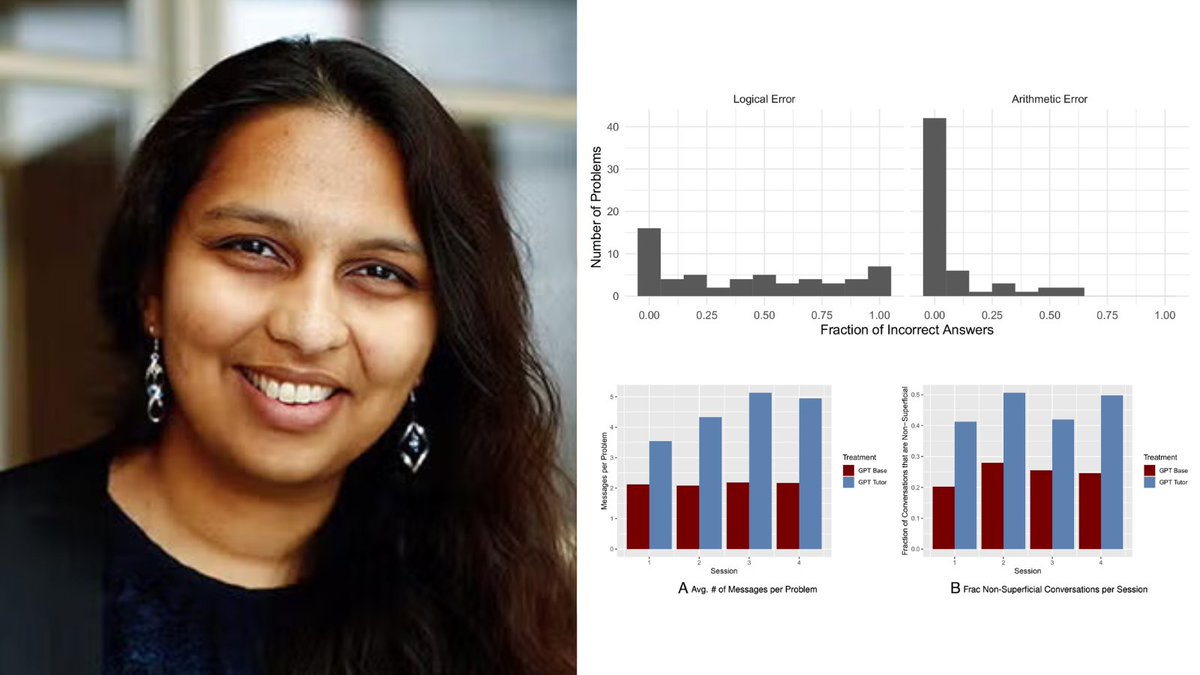
The setup was a randomized controlled trial, the same methodology used in clinical drug trials. Nearly a thousand high school math students in Turkey were split into three groups and put through four sessions of ninety minutes each. One group practiced with GPT Base, a standard ChatGPT-4 interface that could answer any question directly. One group practiced with GPT Tutor, a version of the same model that had been prompted to guide students with hints rather than hand them the answer. One group practiced with nothing but their textbook and their own head.
During the practice sessions, the AI groups looked like a miracle. The GPT Base group solved 48% more problems than the students working alone. The GPT Tutor group solved 127% more. Every administrator looking at those numbers would have written a press release about the transformative power of AI in education and moved on.
Then the actual exam came, and AI was not allowed.
The students who had practiced with GPT Base scored 17% worse than the students who had practiced alone. Seventeen percent worse, despite having solved nearly half again as many problems in the sessions leading up to it. The students who had struggled the most, who had sat with the confusion and worked through it without a tool to rescue them, were now the only ones who could actually do the math when it counted.
Bastani's team read through the chat logs to understand what had actually been happening during the practice sessions, and the answer was exactly what the exam results had already implied. The GPT Base group had not been learning. They had been extracting answers and moving on, and every moment that felt like understanding was actually the model doing the cognitive work while the student's brain waited for the next problem to arrive. The paper describes it precisely: without guardrails, students attempt to use GPT-4 as a crutch during practice, and subsequently perform worse on their own.
The detail that should follow every conversation about AI in education is the one buried in the post-test survey results. The students who had relied on AI the most during practice were also the most confident they had understood the material. The tool had not just failed to teach them. It had convinced them they had learned something they had not, which is a different kind of failure entirely and a much harder one to correct because the student has no idea it is happening.
The crutch had made them confident and weak at the same time.
143
1,164
2,537
341,293
May 6
This is really bad. But when the backlash comes it will hit like a tidal wave.
May 5

A new silent generation: Why America’s students are choosing self-censorship | Daniel McCarthy, New York Post
American teenagers may be doing to themselves what the Chinese Communist state does to its citizens.
An Ivy League professor — an old-fashioned liberal who actually cares about free speech — recently warned me about what’s happening in classrooms like his.
He encourages class discussion of the great books he teaches in class — but students are reluctant to speak.
Not because they’re afraid of the professor, but because they fear each other.
Communist regimes have tried to stamp out dissent for more than a century; tyrants and totalitarians have always tried to sow suspicion among their subjects, turning friends, neighbors and even family members into informers against anyone who won’t conform to the party line.
That’s the scenario in George Orwell’s dystopian classic “Nineteen Eighty-Four,” and it’s the intention behind China’s insidious “social credit” system today.
What Orwell never imagined, though, was that young men and women in a free society would one day willingly impose “political correctness” on their peers — and use the 21st century’s decentralized social media to do it.
Students, the professor told me, are afraid to be recorded on their classmates’ cellphones talking about politics and political philosophy — the subjects he teaches — and don’t want to disagree with their fellow students about anything because the person they’re arguing with might belong to a “disadvantaged” group.
It’s not only what you say that’s dangerous, but who you say it to.
A young man getting into an argument with a young woman, or a white student with a black student, is not a good look on social media, and a classroom conversation runs the risk of sparking an online inquisition.
Conservative students, who often have to face ostracism for their dissenting views, might be less intimidated than liberals and progressives, who aren’t used to not fitting in.
But all too many liberals have been conditioned from a young age, both at home and in school, to believe that good-faith argument about serious subjects is inherently offensive — you might hurt the feelings of the person you’re arguing with.
Better to remain silent, even if the professor urges you to speak up.
Communists in the 20th century used very heavy-handed tactics to punish dissidents.
But the more groups like the independent, Catholic-inspired labor unions of Poland’s Solidarity movement were harassed, the more they resisted.
What’s terrifying about the new self-imposed social control in America is that it’s more effective using less coercive and more decentralized techniques.
And the effect is a kind of brainwashing, no less than what Orwell’s protagonist Winston Smith suffers in Room 101 of the Ministry of Love.
Once young men and women get used to censoring themselves and their defensive crouch becomes permanent, they don’t need to be punished anymore: Their thoughtcrimes will have been stopped before they can begin.
This American-style social credit system is what happens of when pervasive technology combines with an ideology that claims to be about compassion and tolerance — but that really uses those noble-sounding principles as a pretext for enforcing submission.
That part Orwell did anticipate: There’s a reason Big Brother’s inquisition is called the Ministry of Love.
Anecdotes aren’t data — maybe my professor friend has just had an unusually passive set of students for the past 10 or 15 years.
Yet plenty of other indications support what he tells me.
A study published in Science last month by researchers at Stanford University, for example, found one-third of American teens prefer turning to AI for “serious conversations” rather than engaging with another human being.
This was a study of artificial intelligence’s people-pleasing bias — it tells users what they want to hear.
It doesn’t argue, contradict or hurt anyone’s feelings, “even when users engaged in unethical, illegal or harmful behaviors,” the study noted.
“The very feature that causes harm also drives engagement,” the report’s abstract concluded.
That might be said about today’s liberalism as an ideology, too — it may sound agreeable and nice, but adopting it leads to harm, including the psychological damage that politically left-wing people report experiencing at much higher levels than conservatives.
Fragility, bitterness, timidity — these are the fruits of the orthodoxy America’s elite has embraced, and which its children enforce against outliers with vigilante zeal.
The victim mentality has become an excuse for bullying.
And rather than confront it, many young people find it easier to make friends with an AI chatbot than with one another.
Social isolation is socialism’s greatest ally, while the kinds of community the Communists could never stamp out, not with all the power of Soviet tyranny, are the secret to freedom’s survival.
Something as simple as a robust debate in class strikes a blow against Big Brother — and against Little Brother’s snooping cellphone.
nypost.com/2026/05/04/opinio…

139
Apr 13
Excellent post @RollingHedge
UK wasting billions on "projects" that don't go anywhere. Incompetence is staggering. But other European countries can pull it off.
IMO, the rot starts in the contempt for domain expertise (engineering, finance etc), in favour of "liberal arts".

Excellent thread, this. Something I’ve spent a lot of time thinking about…
The British state is run by people who have never been fired, never missed a number, never had a client scream at them, never stayed up until 3am working on a deal, or repricing a book because Tokyo opened badly.
They have never experienced CONSEQUENCE. Ever.
THAT is the single most important fact in British public life.
The pipeline is so uniform and mediocre it scarcely needs describing:
- School
- PPE or adjacent
- Civil Service fast stream or a Think Tank research role
- Spell as local councillor to appear “grounded,”
- Then a safe seat and a red box before 40
At no point has the market ever called them a moron.
At no point has a P&L told them their idea was shit.
The feedback loop that every private sector professional takes for granted simply does not exist in their world.
This matters because policy is NOT an essay. It IS a trade. Every regulation has a cost, every tax has a behavioural response, every intervention has second and third order consequences.
In markets, if you misread convexity you get carried out. In government, you get reshuffled to a different department.
The incentive structure could not be more perfectly designed to retain the incompetent and repel the capable.
Anyone with genuine commercial talent is earning multiples of a ministerial salary by their early thirties. So the applicant pool self selects for people for whom the title is the reward because they could never command that status where performance is measured.
The think tank ecosystem makes it worse.
IPPR, the Resolution Foundation, JRF and the rest function as ideological finishing schools and revolving doors. They produce people fluent in the language of policy who have never implemented anything. They can model a distributional impact assessment in their sleep but could not run a corner shop at profit.
This is NOT intelligence. It is pattern matching within a closed system that never tests its own assumptions because everyone in it shares the same priors.
The civil service compounds it further. The fast stream rewards generalism, rotating you through departments every 18 to 24 months to develop “breadth,” which in practice means you never develop depth.
A Treasury official who helped design a tax policy in 2019 is working on transport by the time it starts distorting behaviour in 2022. Nobody owns the outcome.
The private sector has one thing the state fundamentally lacks: a kill switch.
Bad companies go bust.
Bad traders get sacked.
The state just absorbs failure, reclassifies it as “lessons learned,” and promotes the people responsible.
The compound effect of thirty years of this is a permanent class institutionally incapable of delivering growth or even understanding why the private sector they depend on for revenue keeps shrinking under their stewardship. This is what we have, right now.
You cannot fix this with better people inside the same system. The system selects against competence, insulates against feedback, and rewards survival over performance.
Every parliament is just a fresh rotation of the same profile through the same machine expressing the same surprise when nothing improves.
We need parallel institutions to be built by the guy or gal staying up til 3am repricing the book. The risk taker. The entrepreneur.
Then we gradually phase the existing sclerotic failed structures out.
That’s how we win.
Make Britain Great Again 🇬🇧 💪
1
3
229
Apr 13
RT @HealthRanger: GLOBAL IMPACTS OF TRUMP'S WAR ON IRAN AND NEW BLOCKADE:
Here's what Trump is setting into motion for America, while his r…
192
Apr 12
AI will also create new jobs, but my guess is that in the short term, it will be less than 10% of the jobs destroyed.
Apr 11

🚨RESEARCHERS JUST MATHEMATICALLY PROVED THAT AI LAYOFFS WILL DESTROY THE ECONOMY.. AND EVERY CEO ALREADY KNOWS IT.. BUT NONE OF THEM CAN STOP..
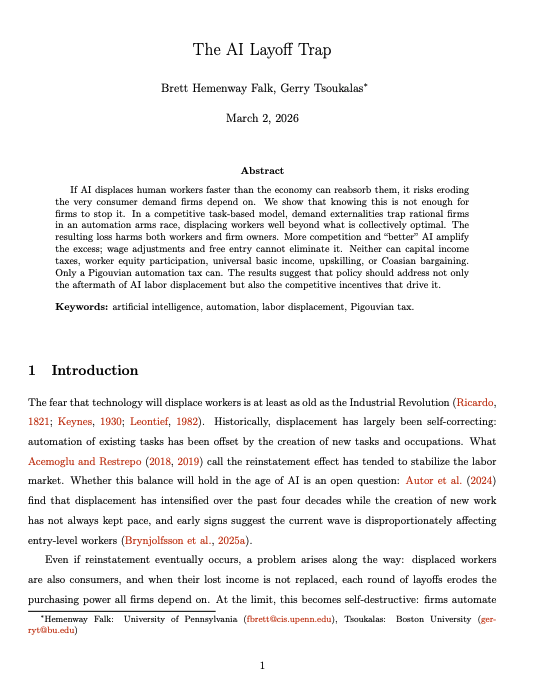
Two researchers from UPenn and Boston University just published a paper called "The AI Layoff Trap"..
They proved something terrifying..
Every company replacing workers with AI is also firing its own customers.. Every laid-off employee is someone who used to spend money.. When enough people lose their jobs.. Nobody can afford to buy anything.. And the companies that fired everyone go bankrupt selling products to an economy with no purchasing power..
Every CEO can see this coming.. The math is obvious.. Fire workers.. Lose customers.. Lose revenue.. Collapse..
But here's the trap..
No company can afford to stop..
If you don't automate.. Your competitor will.. They cut costs.. Undercut your prices.. Steal your market share.. And you die anyway..
So every company automates.. Knowing it's collectively suicidal.. Because the alternative is dying alone while everyone else survives..
It's a Prisoner's Dilemma.. And the researchers proved it mathematically..
The numbers are already stacking up..
Block cut nearly half its 10,000 employees this year.. CEO Jack Dorsey said AI made those roles unnecessary and that "within the next year, the majority of companies will reach the same conclusion"..
Salesforce replaced 4,000 customer support agents with AI..
Goldman Sachs deployed an AI coder that lets one senior engineer do the work of a five-person team..
Over 100,000 tech workers were laid off in 2025 alone.. AI was cited as the primary driver in more than half the cases..
80% of US workers hold jobs with tasks susceptible to AI automation..
And here's what should scare policymakers..
The researchers tested every proposed solution..
Universal Basic Income.. Doesn't fix it.. It raises living standards but doesn't change a single company's incentive to automate..
Capital income taxes.. Don't fix it.. They change profit levels but not the per-task decision to replace a human..
Worker equity and profit sharing.. Narrows the gap but can't close it..
Collective bargaining.. Can't fix it.. Because automating is a dominant strategy.. No voluntary agreement between companies is self-enforcing..
Only one thing works.. A Pigouvian automation tax.. A per-task charge that forces every company to pay for the demand it destroys when it fires a worker..
The researchers call it a "Red Queen effect".. Better AI doesn't solve the problem.. It makes it worse.. Because every company sees a bigger market share gain from automating faster than rivals.. But at the end.. Everyone automates equally.. The gains cancel out.. And the only thing left is more destroyed demand..
The paper's conclusion is devastating..
This isn't a transfer from workers to company owners.. Both sides lose.. Workers lose their income.. Companies lose their customers.. It's a deadweight loss that harms everyone..
And no market force can break the cycle..
The AI layoff trap isn't a prediction.. It's already happening.. And the math says it won't stop on its own.
1
71
@Hard Fiat retweeted

Mar 29
22
113
282
105,430
@Hard Fiat retweeted

Mar 23
Japan is leading the way in protecting children's health by targeting a complete elimination of processed foods and artificial additives from school cafeterias.
The country is spearheading a global movement toward superior nutrition by removing all processed and ultra-processed items from school menus. In their place, students now enjoy fresh, traditional, seasonal Japanese dishes prepared daily from scratch—emphasizing whole, natural ingredients over convenience foods.
This is far more than just a dietary change; it's a comprehensive national strategy to educate the next generation about the true value of balanced, wholesome nutrition. By prioritizing quality over quick fixes, Japan is cultivating lifelong healthy eating habits that start right in the school cafeteria.
Japan's dedication to food purity extends well beyond schools. The nation enforces some of the world's strictest regulations on food additives, preservatives, and chemical colorings—many of which are common in Western processed snacks and beverages. International brands must reformulate products like cereals, candies, and soft drinks to comply with these rigorous standards.
Additionally, Japan maintains tight controls on food imports, including strict bans or high certification requirements for meat products and a strong emphasis on the JAS organic label. These measures protect against diseases, industrial contaminants, and unsafe practices, reinforcing Japan's global reputation for having among the highest food safety and quality standards worldwide.
[Ministry of Education, Culture, Sports, Science and Technology. School Lunch Program and Nutrition Education in Japan. Government of Japan Publication]

187
2,011
5,865
160,576
@Hard Fiat retweeted

Mar 8
Richard Werner, formerly on the ECB's "Shadow Council":
"[With] total digital control... it's not just transactions, it's also assets... They want to add everything—natural assets, the air we breathe, the water we drink, the oceans, everything... [and they want to] put monetary terms [on] nature, calculating, where possible, monetary value to the benefits produced by natural assets. And this will support, they say, prioritization. In other words, some people will get access, others not. And the criteria, well, they can be made up."
This clip of Werner (@scientificecon), who holds a First Class Honors BSc. in Economics from the London School of Economics and a doctorate in Economics from the University of Oxford, is taken from a Make Europe Healthy Again (MEHA) initiative event held at the EU Parliament in Brussels posted to the Children's Health Defense (@ChildrensHD) Rumble channel on March 4, 2026.
----------------Partial transcription of clip---------------
"What is this? This is actually the fallback plan B route to impose digital ID and total digital control of all our transactions in case things don't work out so well with plan A.
"So we have to be aware that plan A is central bank digital currency that are programmable. The power to create and allocate new money which would give this to the central bank and therefore also transfer fiscal powers. The only sort of remaining power in the hands of parliaments, which is one of the definitions of democracy, for parliaments to decide over budgets.
"Obviously, you know, we're not in the parliament here because that's not, you know, that's not the democratic parliament when you don't have those powers. But they want to take them away from those parliaments in Europe that have those powers. The central planners want to take that job.
"So it's the transactions. And here, of course, what is the programmability? Well, there's the infrastructure being created. It could be anything. It could be climate change, carbon footprint, that could be the principle, but it can be other principles. Do you support the war? Are you on the right side with your opinion on whatever currently is, countries we're making war on? It, could be anything. Could be you're stepping outside a 15-minute city and so your money perhaps shouldn't work.
"But it's not just transactions, it's also assets. And this gets pretty scary here, I think. The Bank for International Settlements, the central banks' central bank, originally created, like most central banks, is a privately owned institution. But extraterritorial created the precedent for extraterritorial organization that is above countries, outside countries. So, it's sort of in Switzerland, but it's not actually in Switzerland, in Basel.
"[It] has suggested that, well, we need to tokenize everything, all assets and bank deposit, bank money, central bank money, as well as other assets. And there needs to be seamless integration of all this and programmability in one platform, we are told.
"So what are these other assets? It turns out we already have national organizations that are currently compiling asset registers. And you think, okay, that's financial assets, perhaps add land, well, you can add quite a lot. They want to add everything. Natural assets, the air we breathe, the water we drink, the oceans, everything.
"Now why is this? Tolstoy wrote a good, piece on this, when he criticized economists for only having land, labor, capital, and the production function. Why is the air not in there, the energy, the sun? Well, because they haven't figured out how to control access and charge for it.
"[But] that's what's happening with digital ID. They now are able to do this, and now they want to do it. As we hear from World Economic Forum agenda contributor Lindsay Hooper at Sustainability Institute in Cambridge, we need to bring nature onto the balance sheet, allocate a value to it and bring it into the accounting and financial mechanism.
"Well, and of course, there's various agencies in the US, in the UK, in Europe, in many countries already doing this for nature, and they're digitalizing it now. A natural capital register, the value, the quantity, and the quality of natural resources in one place.
"Now this agency in the UK says, well, there's some critics that suggest we're trying to put a price tag on nature. It's important to understand that this is not the intention of natural capital accounts. Of course not, because the intention is to control access to nature and charge for it.
"And they themselves go on. Well, actually, what we're going to do is put monetary terms to nature, calculating, where possible, monetary value to the benefits produced by natural assets. And this will support, they say, prioritization. In other words, some people will get access, others not. And the criteria, well, they can be made up."
30
440
723
18,423
@Hard Fiat retweeted

Mar 3
When I was in “Women’s and Gender Studies” in college, we spent a lot of time talking about “systems,” “the patriarchy” and all these hidden structures supposedly shaping women’s lives in the West
I entertained a lot of those ideas back then and I was trying my best to understand the frameworks they were teaching
But the one place I never gave them an inch on was women in the Middle East
Every time someone would say “that’s just their culture” something in me short-circuited. No matter how hard I tried, I just couldn’t reconcile it
We were told American women were oppressed because of wage gaps or subtle social expectations, but when the conversation turned to women who could be punished by the state for showing their hair, suddenly we were supposed to become culturally sensitive (some of these lunatics even romanticized it!)
My professors used to get irritated with me when that topic came up bc they knew I wasn’t going to play along and my pushback would cause a rift in their narrative
They didn't like it when I pointed out the hypocrisy of calling Western women oppressed while treating literal legal restrictions on women’s bodies as a cultural difference
One of my professors even had a running joke she'd use to preface discussions on Islam—she'd do this smug smirk and say something to the effect of “we all know Stepfanie's take on Islam” as if I was the ridiculous one
Looking back, I wish I had the language and wit to verbally obliterate her but I was 22 and simply did not have the intellectual capacity yet. I didn't know the first thing about geopolitics, I just knew in my bones how fucking stupid it sounded to be bitching about making 20 cents less than men when women in the Middle East were being stoned to death for showing their hair
Even back then, before my politics changed, that contradiction never sat right with me. And it's one of the many reasons I despise so-called feminists so much today
445
1,826
15,643
433,201
Mar 4
Who is surprised. Meta!
Mar 4

🦔 Meta contractors in Kenya told Swedish newspapers they're being asked to review intimate footage from Ray-Ban AI glasses, including people undressing, using the bathroom, watching porn, and filming sex. One contractor said users often don't realize they're still recording when they set the glasses down. Meta sold 7 million pairs in 2025, up from 2 million in 2023-2024 combined.
Users can't use the AI features without agreeing to share data with Meta's servers, and the terms of service bury the fact that humans may manually review your footage. One annotator said "if they knew about the extent of the data collection, no one would dare to use the glasses."
My Take
This is the Google Home story again but worse. At least with cameras in your house, you know where they are. These are glasses you wear on your face that keep recording when you take them off and set them on your nightstand. And the footage goes to contractors overseas who are paid to watch and label it for AI training. One worker described seeing a man leave the room, then his wife come in and change clothes. People forget the camera is still on.
Meta buries all of this in terms of service nobody reads. The product is marketed as a cool way to capture your life and interact with AI. The reality is strangers in Kenya watching you undress so they can annotate the footage to make Zuckerberg's AI better. Seven million people bought these last year. I'd bet almost none of them understood what they were actually agreeing to.
Hedgie🤗

35
@Hard Fiat retweeted

Feb 13
I'm sometimes asked to spell out my research agenda in "Scientific Economics".
OK, here goes:
Economic performance, institutions and credit power (EPIC)
Modern economics predominantly follows the deductive methodology of posing axioms and adding assumptions, which was originally introduced by City of London financier David Ricardo in the 19th century and advanced by him by financing other economists, such as John Stewart Mill. Other bankers funded later followers. The approach impresses with consistent logic – mathematics being pure logic. However, the track record of deductive economics has been disappointing: While other disciplines, including in the social sciences, have made great strides, economists now admit that modern deductive economics has essentially made no progress (Nakamura and Steinsson, 2018, JEP, 32 (3): 59). It is recognised in this EPIC research agenda that this is due to the restrictive environment of the deductive methodology: Logic can only indicate theoretical possibilities. Reality must be discovered by observing data, which is what the inductive methodology does, dominant in the natural sciences.
By contrast, the EPIC research program maintains that there is no good reason why the inductive methodology, dominant and highly successful in the natural sciences (and also known as the ‘scientific methodology’), can not also be applied to economics. Inductive or 'scientific economics', adopted by EPIC researchers, means that models, theorems and theories all need to be based on empirical evidence. Consequently, a different economics emerges that recognises pervasive disequilbrium and quantity-rationing in all markets, which re-introduces the power dimenstion to economics (resulting in a revival of the discipline of political economy: in rationed markets the short-side principle applies, and the short side has the power to pick and choose with who to trade).
Another central aspect of EPIC economics are institutions, often established by historical quirks. Applied to financial markets, this approach recognises banks as key power centres, due to their empirically established (while theoretically denied) role as creators of credit in a supply-rationed market for purchasing power.
The EPIC research agenda is all-encompassing and applicable to any economic phenomenon, although there is an initial emphasis on macroeconomic aspects and, on the microeconomic level, the intentional design of incentive structures to shape outcomes, including in corporate HRM systems. Applications include the recognition of the central pillars of the successful East Asian High Growth System, revisiting economic history during virtually any era and discovering new insights, as well as practical policy advice for governments, central banks and law-makers to improve economic performance and deliver prosperity for all, in a much more equitable manner than resulting from the failed deductive economics.
18
42
163
6,809
@Hard Fiat retweeted
Feb 13
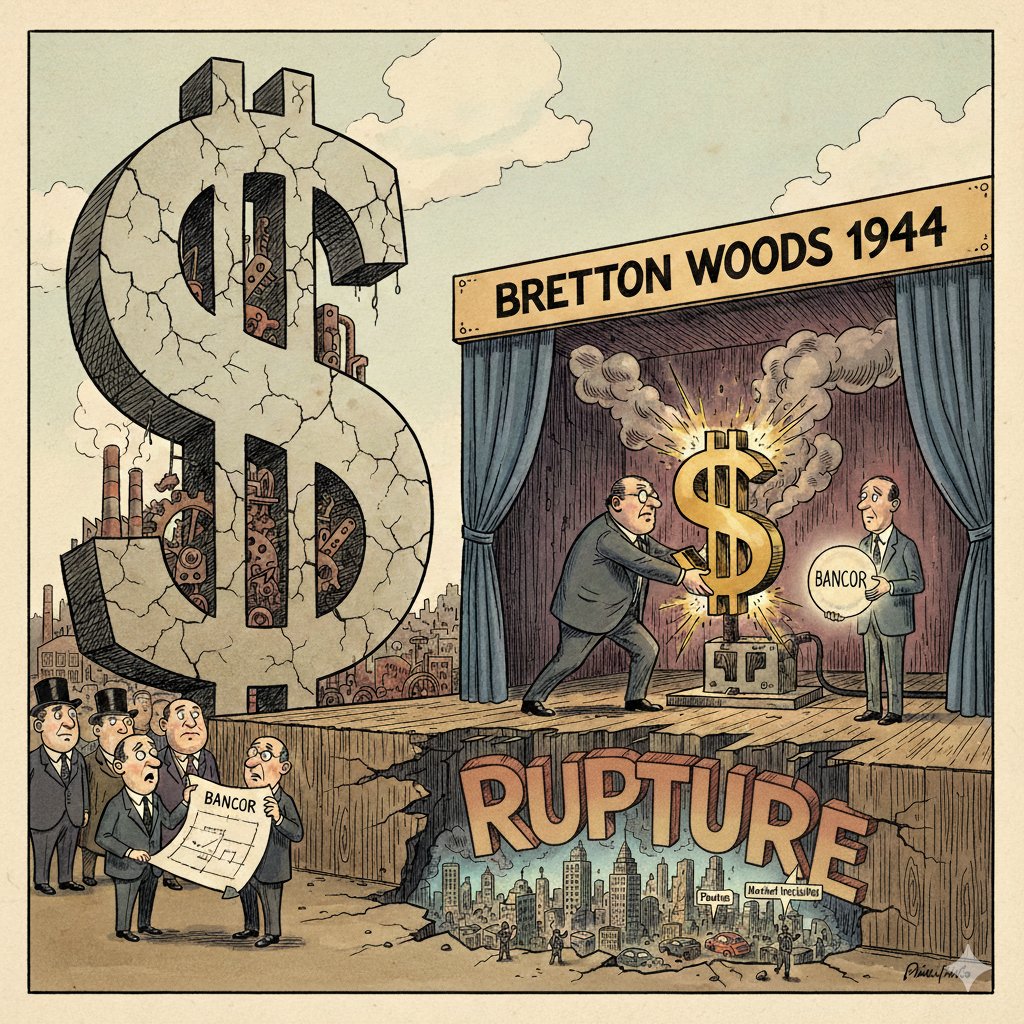
We are not in a transition. We are in a rupture.
Those were the words of Mark Carney, and for once, a central banker is telling the unvarnished truth. The "rules-based international order" was always a convenient fiction, designed to serve the strongest until it didn't.
But while everyone is panicking about Donald Trump's return or the chaos in the markets, almost no one is looking at the root cause.
It isn't about tariffs. It isn't about left vs. right.
It is about a decision made decades ago at Bretton Woods.
Harry Dexter White, an American bureaucrat (and likely Soviet spy), pushed through a system that made the US Dollar the global reserve currency. He thought it was a victory for American exceptionalism.
In reality, it was a poison pill.
By forcing the world to use the dollar, the US doomed its own manufacturing sector to be uncompetitive. It is the "curse of capitalist empires." You rely on your currency for power, your industry hollows out, and eventually, a rival nation with a strong manufacturing base rises up to take your place.
Keynes tried to warn us. He proposed a neutral unit of account—the Bancor—that would have forced trade balance and prevented these massive global imbalances.
We ignored him then. We are paying the price now.
I've just released a deep dive into how this history is dictating our dangerous present and how a new system based on a neutral currency like the "Terra" could save us from a total collapse.
P.S. If we don't fix the monetary plumbing, the political chaos will only get worse.
Watch my solution in the first comment
#Economy #History #Money #Politics
20
67
202
8,173
@Hard Fiat retweeted

Jan 28
The banks are PISSING THEMSELVES.
They’ve just realized that some autistic crypto startup in a WeWork with $20 million in T‑Bills and a React front-end is about to nuke the entire $17 trillion U.S. deposit base…
…by offering 4.9% yield on a stablecoin while JPMorgan gives you 0.01% and a debit card that expires in two years.
“BUT THAT’S NOT FAIR” – every bank lobbyist ever
Now the banking system, this Godzilla made of soy, duct tape, and 11,000 physical branches, is whining to Congress like:
“This isn’t fair! If people can earn yield on dollars outside the bank… they might leave the bank!”
No shit. That’s the point. You locked everyone into a zero‑yield Ponzi for a decade while printing $7 trillion, and now you’re shocked people want out?
What’s next, are you gonna sue water for being wet?
This is a regulatory street fight between code and bureaucracy, between global liquidity that settles in five seconds and the rotting husk of Bretton Woods wearing a suit made of FDIC pamphlets.
And guess what?
The White House is hosting peace talks.
Yes.
Trump’s team just invited Circle and Coinbase to sit down with Jamie Dimon and tell him that the future of dollars may not involve Jamie Dimon.
Can you imagine the mood in that meeting?
“Hi Jamie, meet Brian from Circle. He tokenizes T-Bills with six engineers and a Discord server. He’s taking 3% of your deposits and none of your regulatory costs. Thoughts?”
The reality is that every time one of these banks says “we’re concerned about financial stability,” what they mean is:
“Please don’t let these crypto goblins disrupt our ability to harvest yield off the lower-middle class with 18% credit cards and 0% checking accounts.”
They want protection rackets codified into law.
Like “you can’t offer yield on stablecoins unless you’re a licensed bank,”
aka:
“We missed the boat, so let’s blow up the dock.”
Banks can’t compete.
Let’s model it:
A bank: 11,000 branches, 75,000 tellers, legacy core systems from 1982, and a CFO who thinks Solana is a fish.
Circle: 25 people, 100% T-Bill backing, 24/7 redemptions, yield streamed on-chain like Netflix.
Now let me make this brutally simple... Who wins?
The guys with marble lobbies or the protocol that turns dollars into yield-bearing bearer assets?
The banks are playing defense against stablecoin yield... but what happens when it clicks that stablecoins are just a transition vector to full monetary exit?
What happens when people use stablecoins to bootstrap into Bitcoin treasuries with self-custody?
You go from “5% yield off Circle’s T-Bill stack” to “30% CAGR in purchasing power in a bearer asset that can’t be diluted and lives outside the IMF death loop.”
That’s endgame stuff.
The banks are scared of USDC USDT.
Wait until every mom in Omaha is yield farming STRC dividends from their Roth IRAs using a Lightning app.
We’re replacing the entire fiat architecture with a monetary black hole.
reuters.com/sustainability/b…
472
1,440
7,094
578,364
@Hard Fiat retweeted

Jan 24
India’s digital ID disaster is a warning to the world‼️
Over a billion people were forced into a biometric system linking food, pensions, and healthcare to a single digital ID. The result? A humanitarian crisis‼️
Criminals hacked and cloned identities, leaving families starving, elderly without pensions, and the sick turned away from hospitals‼️
In one state alone, two dozen people starved to death after being denied rations due to system failures. Millions of fake accounts siphoned funds meant for the poor, creating a black market for stolen identities‼️
Sold as “secure,” it became a tool for control and exploitation. When survival depends on a single ID, a glitch—or a hacker—can erase your access to life itself‼️
This isn’t progress. It’s a blueprint for dystopia‼️🙏👇
373
5,759
8,033
187,576
@Hard Fiat retweeted
8 Dec 2025
The crash everyone's talking about will be worse than 2008. And mainstream economists still can't see it coming.
I predicted the 2008 financial crisis by watching one chart that neoclassical economists refuse to acknowledge even exists. The correlation between private debt and unemployment hits -0.93. That's not a typo.
When I showed Ben Bernanke's own writing claiming private credit has no macroeconomic effects, I knew we were in trouble. Turn to page 24 of his essays on the Great Depression. He literally dismisses the mechanism that caused the crisis.
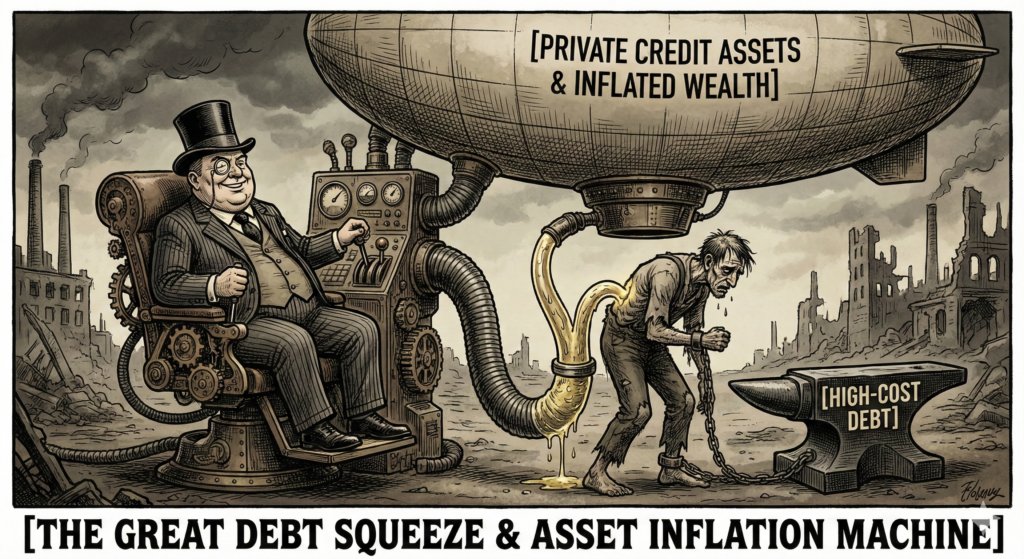
American household debt has surpassed 18 trillion dollars. Private debt peaked at 170% of GDP before 2008. And the mainstream still thinks it's government debt we should worry about.
Banks don't just intermediate. They create money. And when neoclassical economists mistake the level of debt for the change in debt, you know we're being guided by people who don't understand the system they're supposed to manage.
Watch the full breakdown - youtube.com/watch?v=8VwhvSux…
#Economics #FinancialCrisis #PrivateDebt #DebtDeflation #EconomicTheory
124
491
1,731
141,584
@Hard Fiat retweeted
6 Dec 2025
The much-repeated claim that lower interest rates lead to high growth and higher rates lead to lower growth is simply not true. Proclaimed by economists of most schools of thought for 200 years, no empirical evidence exists. In fact, the opposite is true. sciencedirect.com/science/ar…
6 Dec 2025

High bond market returns mean lower economic growth (because bond prices go up when interest rates go down).
So this is Trump's idiotic Treasury Department bragging about hurting the economy with tariffs.
They really are that stupid.
33
84
429
43,098