
Joined November 2010
- Tweets 8,863
- Following 2,039
- Followers 882
- Likes 40,418
1,578 Photos and videos



Ivan Yaholnitsky retweeted

Jun 14
In 2007, a Citibank executive laughed at BYD's CEO asking 'You said you'll be the world No.1 by 2025. Are you just bragging? Hahaha."
The result is self-evident now. BYD has made it the king of electric cars. Never underestimate China.
45
595
2,984
90,667
Ivan Yaholnitsky retweeted

Jun 10
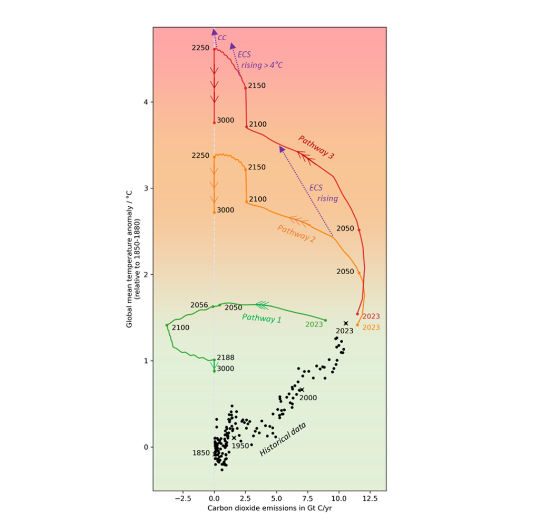
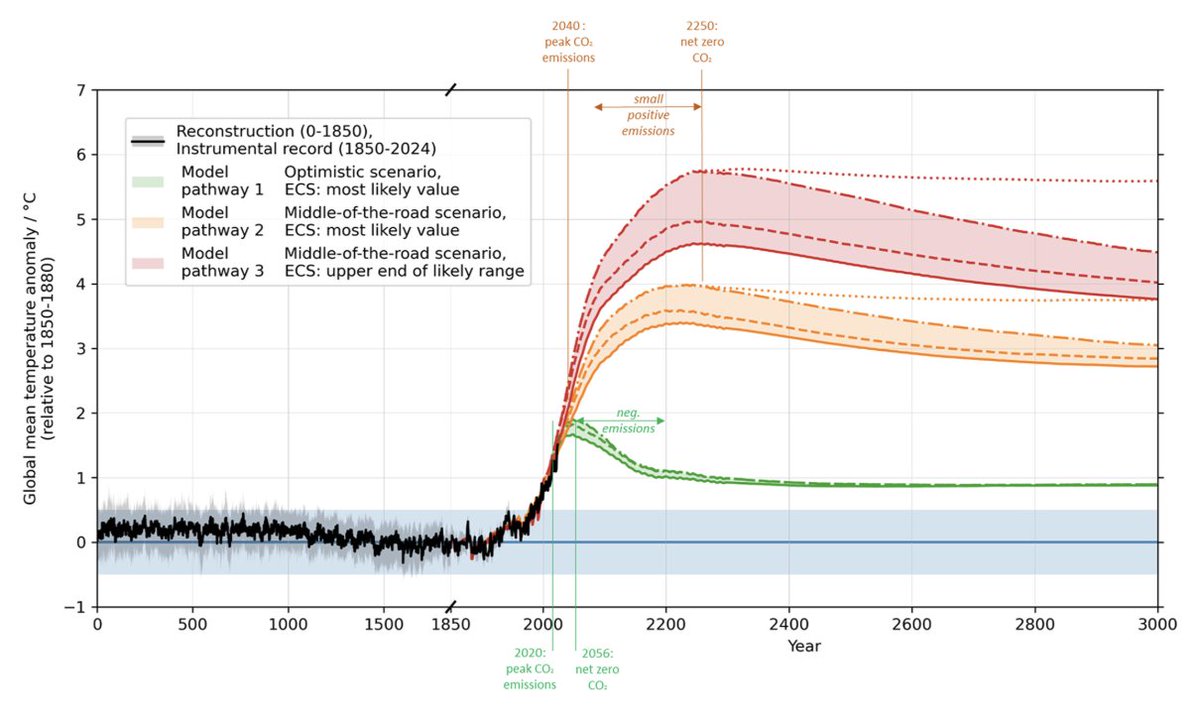
The best remaining option—the only remaining option to have a chance of staying on a trajectory in which the physical and biogeochemical conditions in the Anthropocene at least vaguely resemble that of the Holocene inter-glacial, as we will show in more detail in the next section—is a trans-formation toward
sustainable stewardship (pathway 1).
Such a transformation would entail a drastic reduction of human pressures, on all scales and in all domains (e.g., 7.5% annual greenhouse gas emission reduction (United Nations Environment Programme, 2024). Over time, it would bring the Earth system back from its current transgression of seven ofnine Planetary Boundaries to the safe operating space (Richardsonet al., 2023; Sakschewski et al., 2025) (albeit with an effectively permanent loss of biosphere integrity—both in terms of loss of species and loss of ecological functions). A major problem we are facing, however, is the long residence time of carbon dioxide (Archer & Brovkin, 2008) in the atmosphere: only part of our emissions is taken up by the ocean and the terrestrialbiosphere on a timescale of decades to centuries, while much of it remains for tens of thousands of years until gradually removed by sedimentation inthe deep sea (Cartapanis et al., 2018; DeVries, 2022). Our current actions will affect humanity's living conditions for thousands of years to come. Soeven the best outcome, pathway 1, cannot be considered “good”– it is merely “manageable” in the sense that the Earth system would continue to operate in a Holocene‐like way and that there is hope that established ways of living overall could be preserved. But our environment would still deviate far away from what it was during the Holocene, and we would be burdened with committed change to both the physical/chemical and the living world for millennia to come.
Jun 10

New Anthropocene paper. Earth still operates in "Holocene logic", buffering heat imbalance. Anthropocene = Pressure. But, BAU, reaching 3°C in 2100 & we get "stuck" in a Hothouse trajectory for 1000 years. Anthropocene risks turning into a state. No Good.
agupubs.onlinelibrary.wiley.…
1
30
49
1,662
Ivan Yaholnitsky retweeted

Jun 8
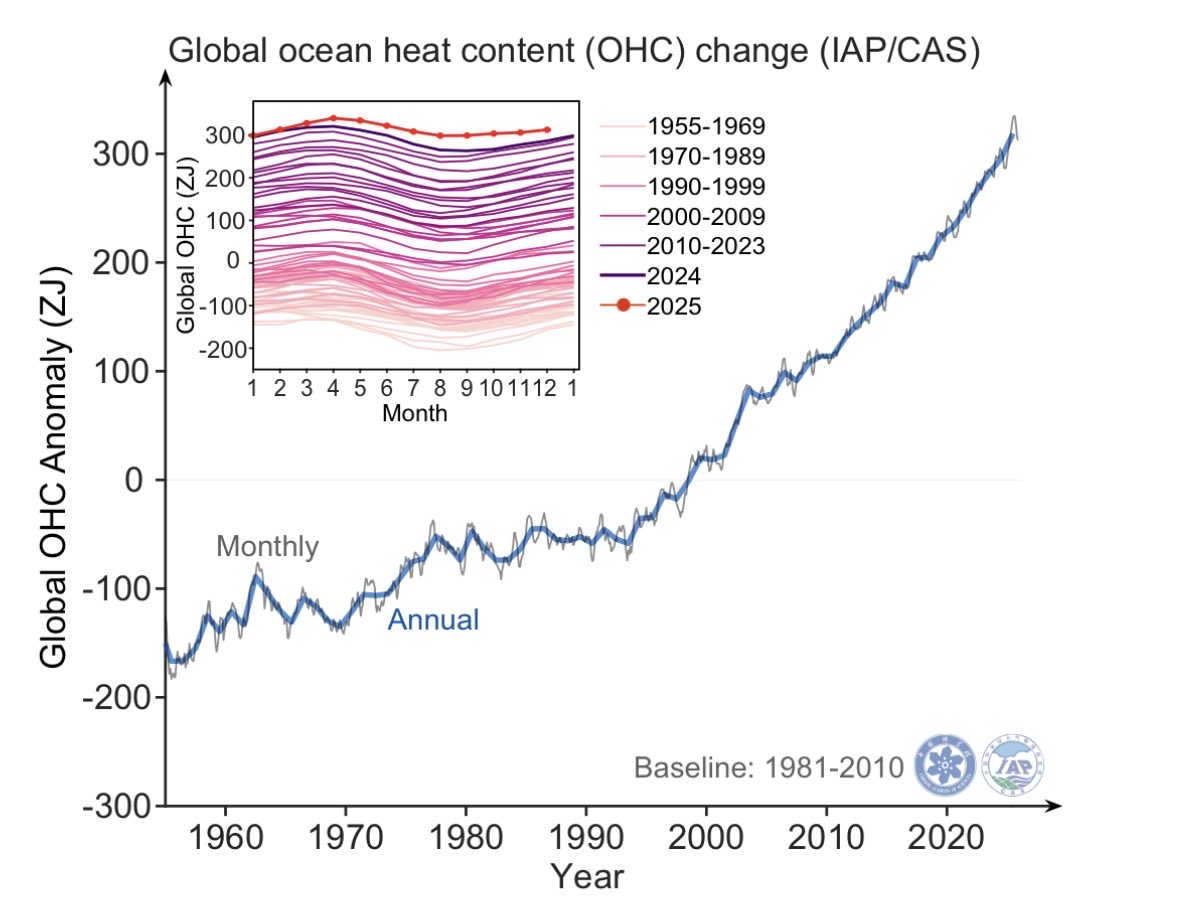
Today is World Ocean Day and our oceans are being bombarded by all kinds of threats like pollution, over-fishing, acidification, etc…
But as a meteorologist, I’ll discuss the rapid warming!
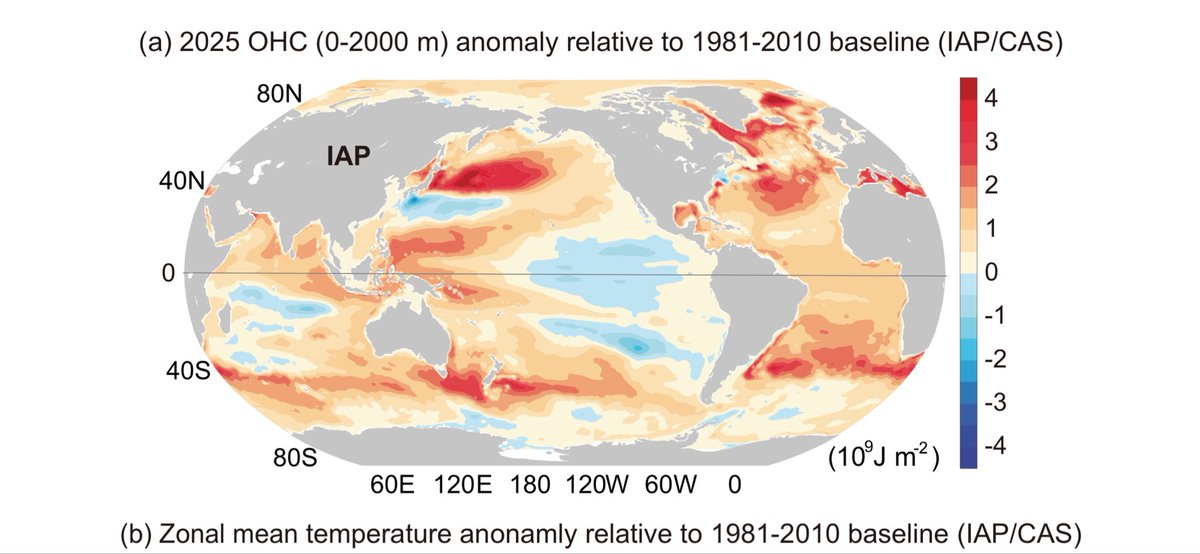
We often focus on air temperatures. But the real story is in the oceans.
More than 90% of the excess heat trapped by greenhouse gases is retained in the ocean.
Each year a new assessment is released, and in 2025 the world’s oceans gained an astounding 23 zettajoules (ZJ) of heat.
In relatable terms that’s equivalent to:
🌊 37 years of humanity’s current annual energy consumption
🌊 About 380 million Hiroshima-sized atomic bombs worth of energy
🌊 More than 200 times the world’s annual electricity generation
And that’s just one year!
Why does this matter?
Warmer oceans can fuel marine heatwaves, coral bleaching and death, sea level rise through thermal expansion, contribute to bigger land heatwaves, and provide more energy for heavy rainfall and tropical cyclones. Ocean warming also stresses marine ecosystems that support fisheries, biodiversity, and coastal economies around the world.
The ocean has shielded us from much greater atmospheric warming by absorbing the vast majority of Earth’s excess heat. But that protection comes with growing consequences for ocean health.
On this World Ocean Day, it’s worth remembering that the ocean is not just responding to climate change, it’s bearing the brunt! We must protect our oceans.
#WorldOceanDay #Ocean #Climate #OceanHeat #ClimateChange
Paper link in 🧵
32
200
393
17,145
Ivan Yaholnitsky retweeted

Jun 7
Technology is the primary driver. Exponential technologies create abundance. Constraints that appear permanent usually disappear faster than linear models anticipate. Growth and decarbonisation can occur together.
Thought experiment:
In 1900, ask experts to design a "sustainable" world for 2000.
They would not predict the internet, smartphones, solar, lithium batteries, AI, GPS, gene sequencing or modern automation.
That's the problem with degrowth thinking. It tries to ration the future using today's imagination.
We don't know what we don't know. History suggests innovation is usually underestimated, not overestimated.
1
3
60
Ivan Yaholnitsky retweeted

Jun 3
✨🇨🇳China is turning deserts into fertile farmland.
To date, 12 million mu of reclaimed desert land has produced bumper harvests of wheat, rice, corn and other crops.
8
38
139
2,415

Ivan Yaholnitsky retweeted

May 30
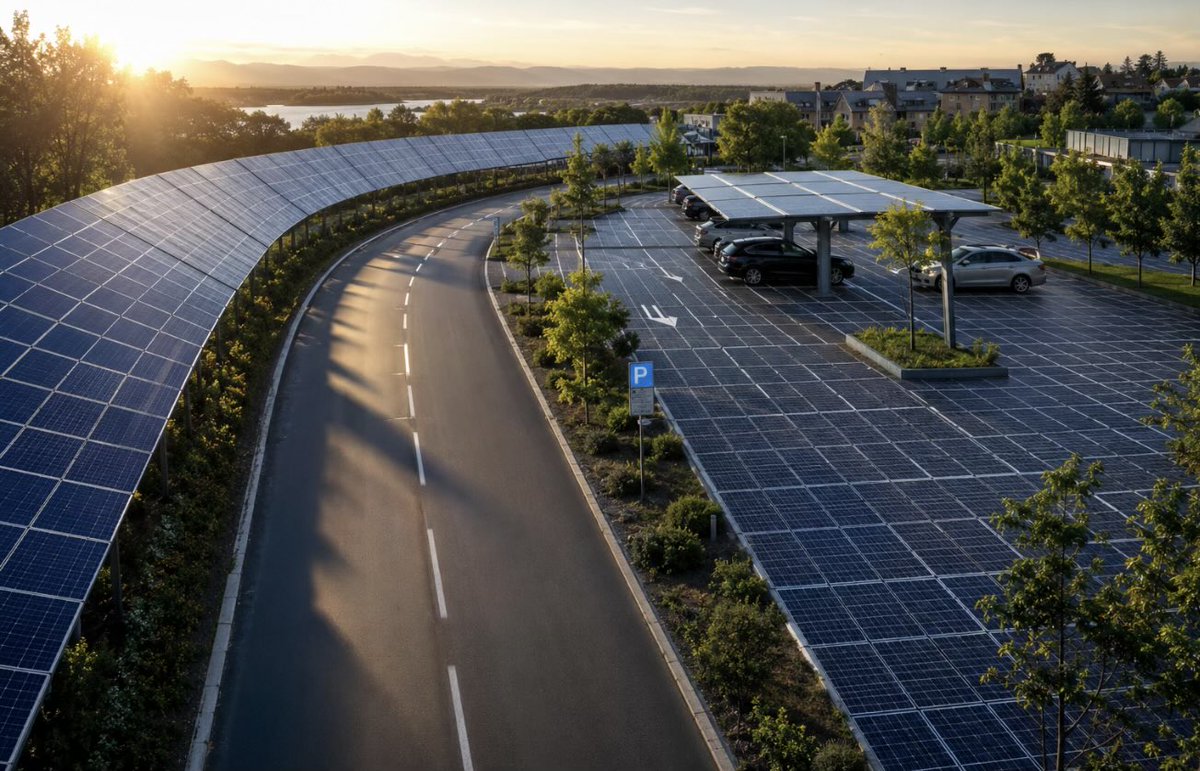
The EU saved $60 billion in fossil fuel costs in 2025, according to the IEA. Solar led the charge, generating over 340 TWh and reaching 12.5% of the bloc’s electricity mix. Clean energy investments helped Europe avoid €51.4 billion in fossil fuel imports, while global savings across five major importing regions reached $260 billion.
European industry trade on input costs. For thirty years, European manufacturers competed with one hand tied behind their back because gas and electricity prices here ran consistently higher than in the United States, Russia, or the Gulf. That cost gap drove investment decisions, plant closures, and relocations. It shaped entire supply chains.
Solar is beginning to close that gap structurally. The distinction is critical. A temporary dip in gas prices does not change investment calculus. A decade of declining renewable generation costs, combined with massive domestic capacity, does. When a factory in the Ruhr or northern Italy can increasingly price its electricity from domestic solar rather than from Qatari LNG or Norwegian gas, its cost base becomes more predictable and, over time, more competitive.
The 2025 savings also served as a direct buffer against the energy price spikes driven by the ongoing Middle East conflict. That is the geopolitical hedge in action.
Certain American politicians who appear to believe Europe is permanently overcast, argue that solar cannot be a reliable baseload source because clouds exist. This reflects a misunderstanding of how modern grids work. No serious grid planner expects a single source to carry the entire load. Solar operates as part of a diversified generation mix alongside wind, hydro, gas peakers, nuclear, and increasingly grid-scale storage. Germany manages this. Spain manages this. Denmark manages this. The grid does not stop when a cloud passes over Bavaria any more than it stops when a gas turbine goes offline for maintenance.
By the late 2020s, if capacity expansion continues at current pace, European heavy industry could hold a genuine structural cost advantage over competitors still dependent on volatile fossil fuel imports. That would represent a quiet but decisive reversal of a narrative that defined European industrial decline for a generation.
The $60 billion figure is the receipt. The competitive advantage is still being built.
Gandalv / @Microinteracti1
25
183
583
19,826
Ivan Yaholnitsky retweeted
May 29
Could the AMOC really collapse!? A brand new study shows what science has long surmised - decreased poleward heat transport in the Atlantic - a slow down of Earth’s most vital circulation the AMOC - is indeed the cause of the very odd cold blob (warming hole) in the N. Atlantic. This video provides a simple and brief summary of why the AMOC is so vital, how manmade climate change is putting it in jeopardy, and what the latest science says about the probability of collapse. #AMOC #climate
12
58
191
8,792
Ivan Yaholnitsky retweeted

May 25
Novelist Elif Shafak shared with me two things all of us should do consistently whether we are writers or not:
1) Be good readers
"Our reading lists should be eclectic. Let's read anything and everything that speaks to us. Let's read the classics. But if there's a particular book that speaks to us in that moment in time, let's not ask if it's highbrow or lowbrow literature. Who makes those distinctions?
Graphic novels are amazing. They open up our imagination. Cookbooks are amazing. They tell us so much about cultures. Equally, let's read political philosophy. Let's read neuroscience, water science. Let's have interdisciplinary conversations. Let's keep the curiosity of the mind alive.
I've always believed in being intellectual nomads. We shouldn't have comfort zones. The mind is always more nourished when we dare to leave our comfort zones."
2) Be good listeners
"Not everything is found in written culture. There's so much knowledge in this world that is transferred through oral storytelling: ballads, folktales, legends, riddles. We should not belittle that world.
When I listen to people, I try to listen to two things: what they're telling me, of course, but how they're saying what they're saying — the choice of words, the pauses, the silences.
You can't only be interested in stories. You also need to start paying attention to silences. Being a novelist is a bit like a linguistic cultural archaeologist. You have to dig deep through layers of memory and amnesia, stories and silences."
2
23
101
11,897
Ivan Yaholnitsky retweeted

May 25
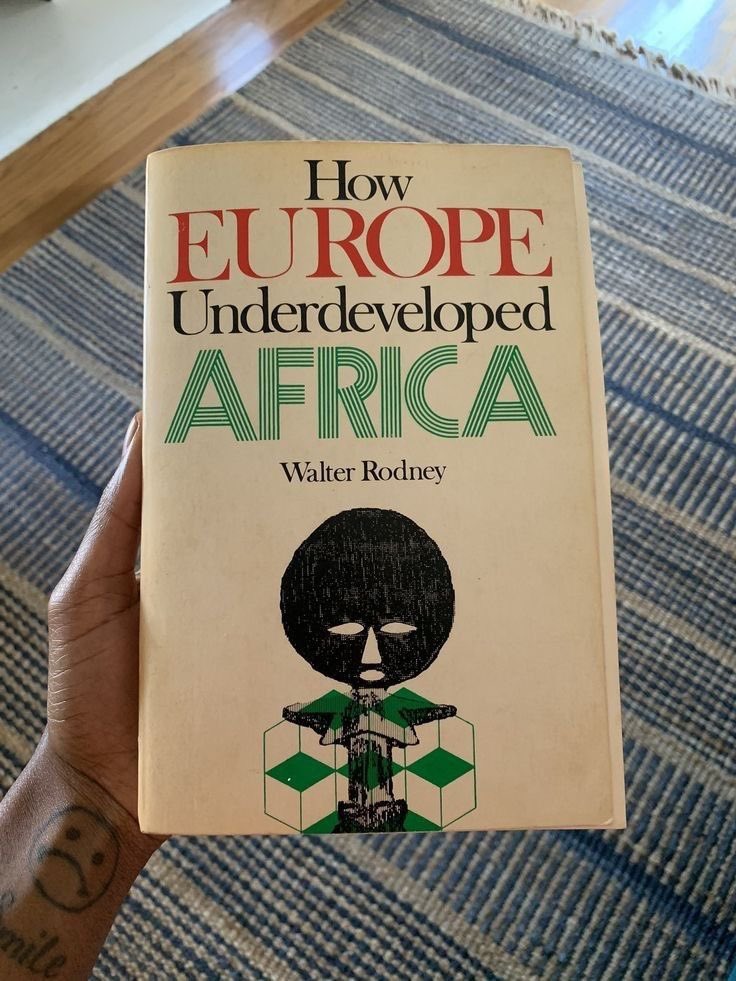
Walter Rodney was wrong.
Africans are poor because too many African countries make it hard to start businesses, get permits, access reliable electricity, trade freely, protect property, enforce contracts, attract investment, and keep the rewards of hard work.
Singapore is richer than Britain, its former colonizer.
Switzerland, which never built a colonial empire, is richer than Spain and Portugal, two of the greatest imperial powers in history.

695
1,274
7,978
920,247
Ivan Yaholnitsky retweeted
May 21
I believe in criticizing by creating.
Anyone can point out what's wrong; that takes zero courage.
Building something that actually works - a factory, a product, a company that employs your people - that takes everything.
Entrepreneurship is agency in its purest form.
You stop asking for help and start making it happen yourself.
9
45
288
4,463
Ivan Yaholnitsky retweeted

May 17
EVs are actually better than gasoline cars for extreme rural areas for a very specific reason: you can generate electricity anywhere, but you have to have fuel shipped in.
Putting solar out in the yard is far, far, FAR easier than driving hours to the nearest fuel station.
95
115
1,595
22,453
Ivan Yaholnitsky retweeted
May 16
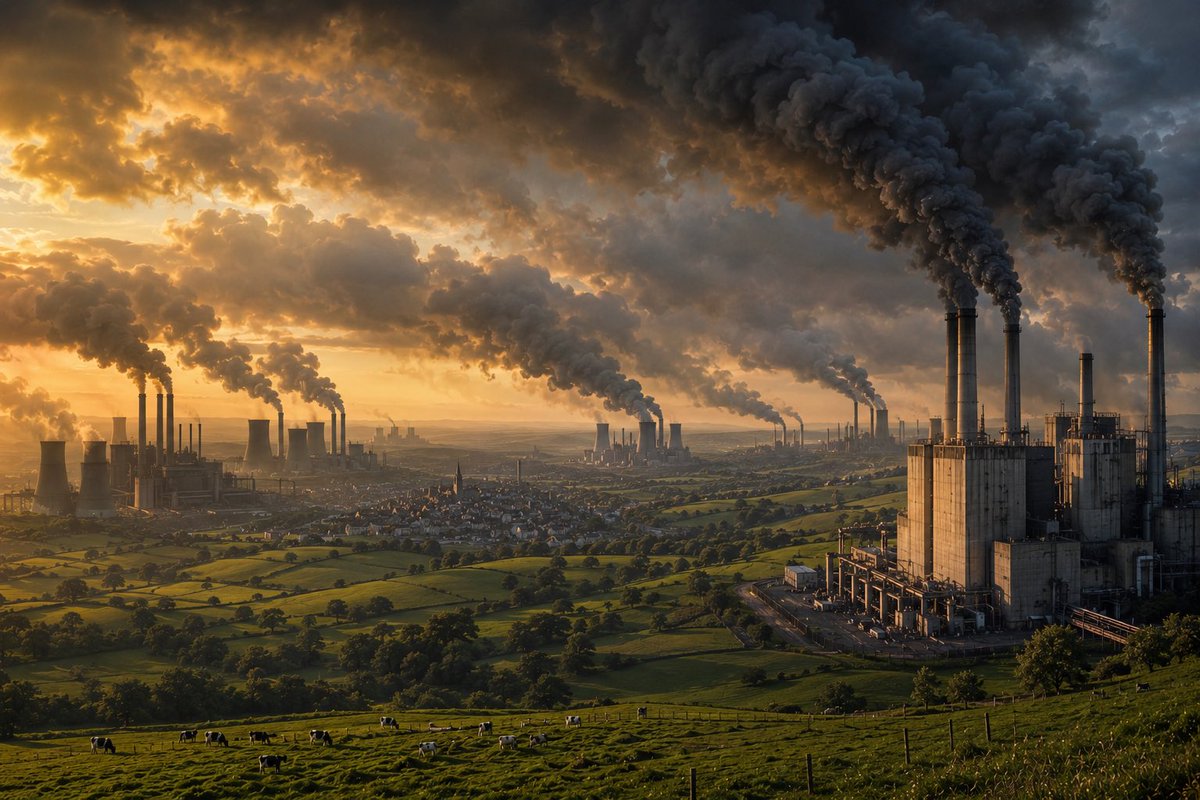
Donald Trump hates wind turbines. He has been very clear about this. They are ugly, he says. They ruin the landscape. Nobody wants to look at them. And because he is a man of the people, a president who listens, a leader who genuinely understands what ordinary Americans want outside their kitchen window, he has a better idea.
So I drew it for him.
There it is. The rolling green hills of rural America, the cows, the little town in the valley, and stretching from one end of the horizon to the other, the glorious coal-fired future that the people have been waiting for. Dozens of plants. Hundreds of smokestacks. A sky the colour of a lung X-ray.
This is the aesthetic vision of a man who found wind turbines too distracting.
The beauty of it, really, is how in touch with regular Americans this all is.
Nobody wants a wind turbine near their home. What they want, clearly, is this. The smell. The soot. The permanent twilight. The sense that something enormous and grey is breathing on you from every direction at once.
That is what the heartland has been asking for, and by God, the man is delivering.
The cows seem fine with it. They always do.
30
134
546
12,912
Ivan Yaholnitsky retweeted

May 16
Ethiopia 🇪🇹 is leading the way:
youtube.com/shorts/M4LNbnvoO…
3
3
104
Ivan Yaholnitsky retweeted

May 14
Pretty soon we're going to have a design genre called sprawl-to-trails, similar to rails-to-trails. Repurposing infrastructure that isn't necessary.
21
28
379
29,340
Ivan Yaholnitsky retweeted
May 8
Zambia 🇿🇲 to make the procurement of Electric Vehicles mandatory from now on for all National, Provincial, and other Govt dependents so reduce the Govt's fuel bill.
May 7

KANGWA Backs Electric Vehicles in Public Service
(ZANIS) Secretary to the Cabinet PATRICK KANGWA says Government is promoting the use of electric vehicles in public institutions as part of measures aimed at cutting costs and reducing fuel expenditure.
Here is a report….
1
6
11
1,025
Ivan Yaholnitsky retweeted

Apr 28
This is a single human cell. The white tubes are microtubules. The colored beads are ribosomes. You have 37 trillion of these.
Every cell in your body is a manufacturing plant running 24/7 without supervision.
Each ribosome (the colored beads) is assembling a protein right now. A single ribosome chains together about 20 amino acids per second. A typical mammalian cell contains millions of ribosomes. Every cell in your body is forming hundreds of millions of peptide bonds per second. Continuously.
The white worm-like tubes are microtubules, the cell's internal highway system. Motor proteins called kinesin walk along them on two protein legs, carrying cargo from one end of the cell to the other at around 800 nanometers per second. Each cell has thousands of these tracks with thousands of motor proteins walking on them simultaneously.
The blue mesh on the outside is the actin cortex. It holds the cell shape against pressure. It's also being torn down and rebuilt constantly. Every cell rewrites its own structural skeleton every few minutes.
Now scale that.
37 trillion cells. Each running millions of ribosomes. Each running hundreds of mitochondria producing ATP at roughly 100 million molecules per second. Your total daily ATP turnover is around your full body weight. You synthesize and consume your bodyweight in ATP every 24 hours.
The DNA in a single cell stretches 2 meters uncoiled. End to end across all 37 trillion cells, that's enough to reach the sun and back 250 times.
None of this is voluntary. None of it stops. It started when you were one cell and hasn't paused since.
88
517
2,017
122,431
Ivan Yaholnitsky retweeted

Apr 28
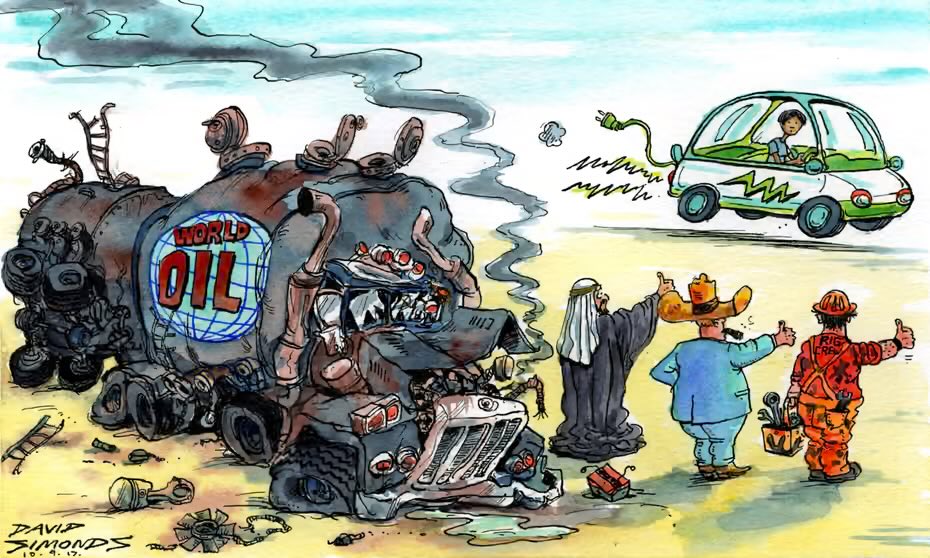
EV share of new car sales in Singapore:
2021: 3.8%
2022: 11.7%
2023: 18.1%
2024: 34%
2025: 45%
2026 (1st 3 months): 60%
Game over: 150 years of petrol dominance wiped out in 6 years
31
274
949
53,729
