
I write/research about technology & society, past, present & future. Latest book: The New Goliaths. Technology & automation in the past, Learning by Doing.
Joined April 2013
- Tweets 4,519
- Following 582
- Followers 5,595
- Likes 1,778
193 Photos and videos



Pinned Tweet

Apr 7
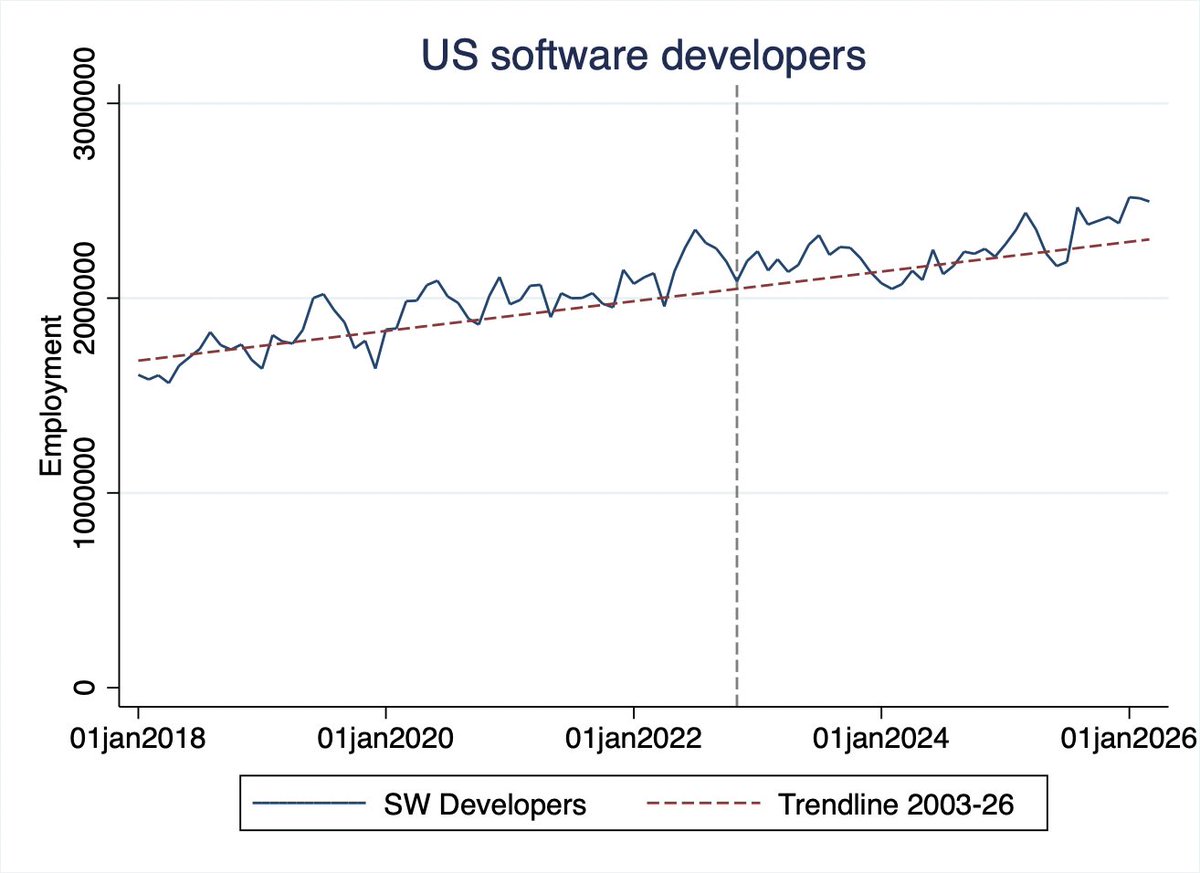
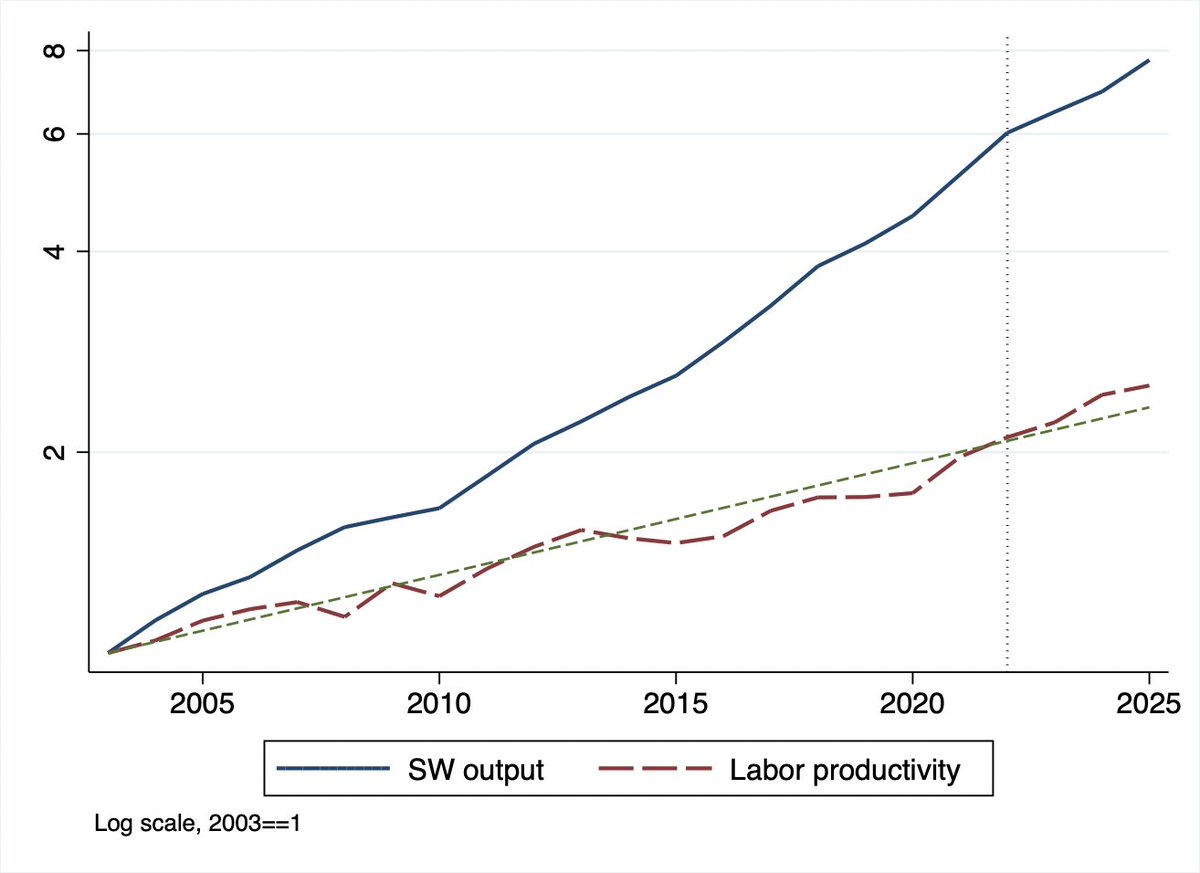
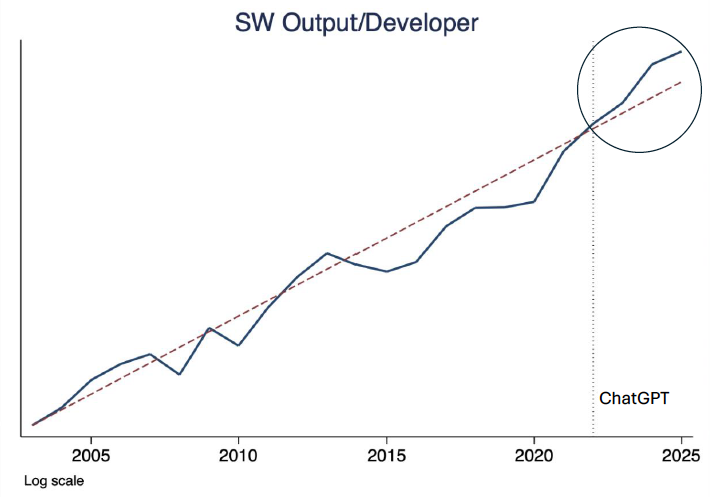
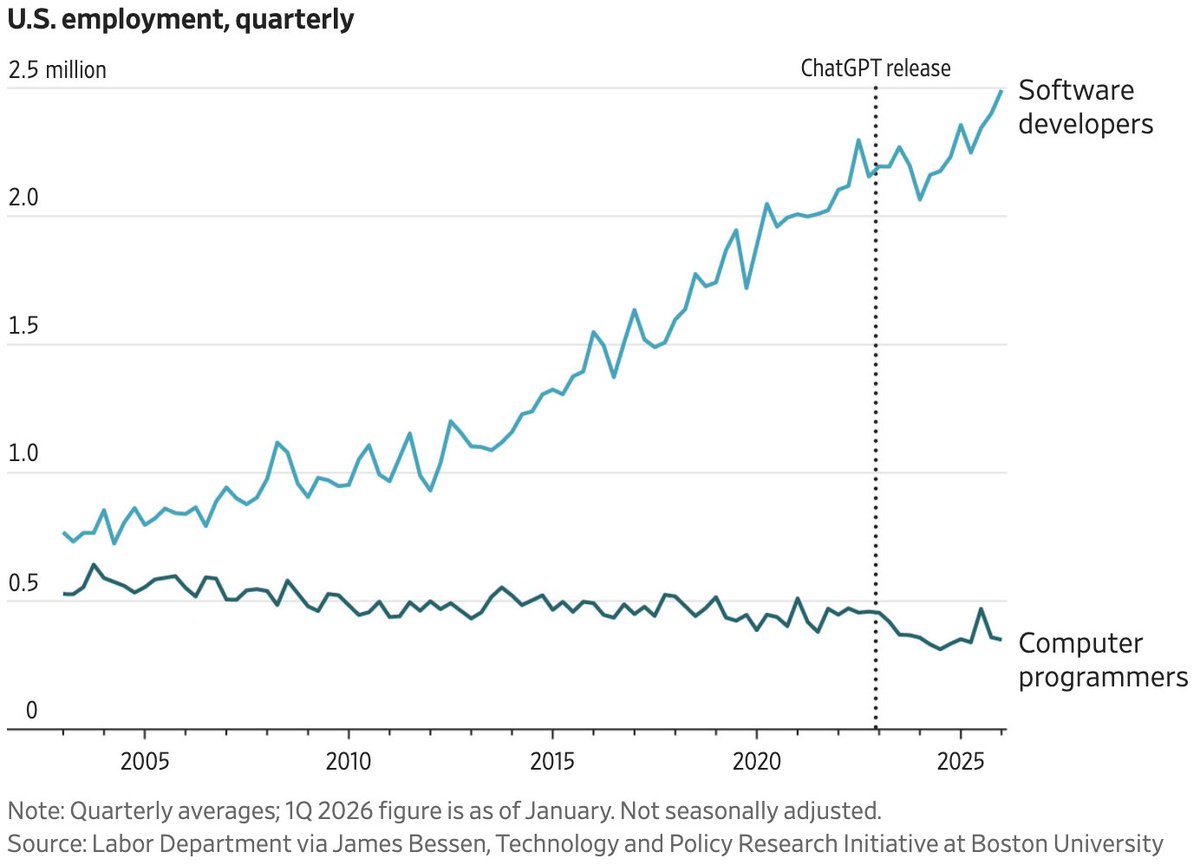
AI is NOT killing the software developer. AI is taking over tasks that software developers perform, but that does not translate into lost jobs. A new report shows why: AI is creating new and improved software products that raise demand. sites.bu.edu/tpri/files/2026…
1/9
20
102
646
279,900
James Bessen retweeted

Jun 4
Running uncorroborated claims on Platner from an ex-girlfriend who is a professional Republican operative is outrageous from the New York Times. It's consistent with their biased treatment of candidates skeptical of Israel.
442
881
5,905
295,838
James Bessen retweeted

May 19
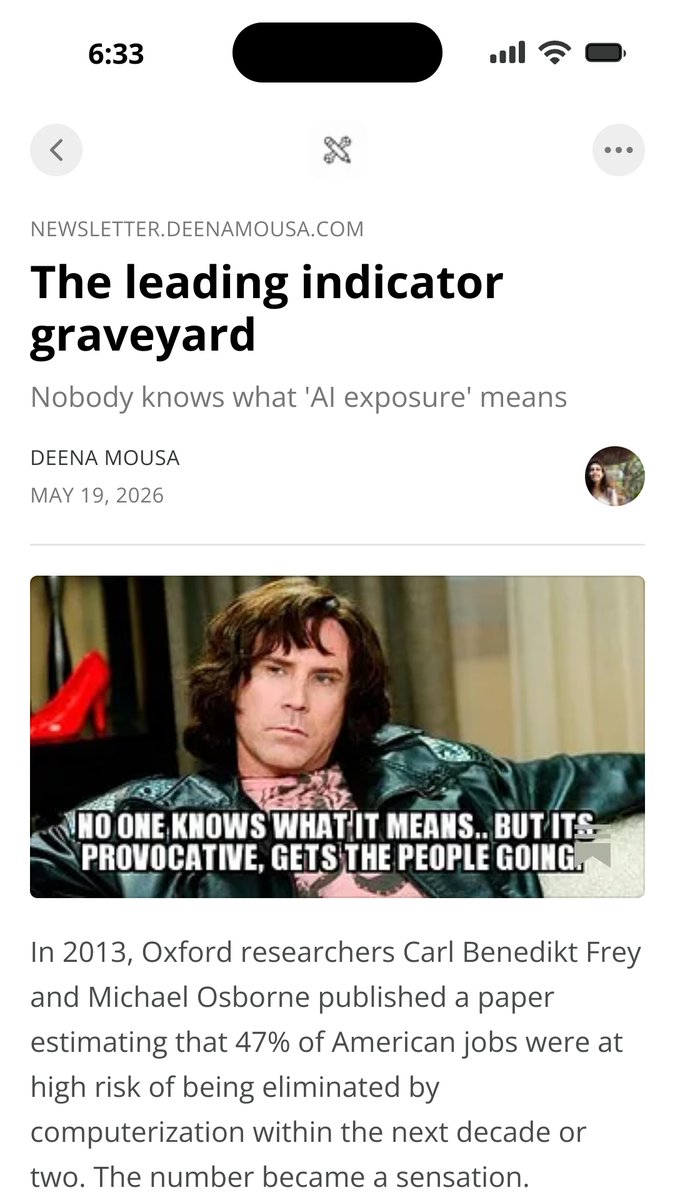
Very nice piece on the limitations of the AI exposure measures. Important we don't get out over our skis when using them.
The point at the end about occupation-specific analyses is a good one, "One thing missing in the focus on aggregate indicators is a less satisfying but more useful approach: careful, occupation-specific work."
I would add industry specific studies as well, like @JamesBessen on textiles, steel, and autos.
Even so, there are lots of things we can do within the federal statistical system to improve AI measurement. I'll have more on that coming soon.

New post: Unfortunately, nobody knows what AI exposure means.
1
7
1,122

James Bessen retweeted

May 8
Some news: This week I am starting at @GoogleDeepMind as Director of AGI Economics on @shanelegg’s team. I will be joining the other amazing cross-disciplinary scientists researching AGI there.
My team will study how frontier AI could reshape the economy: what happens to work and labor, how wealth and power are distributed, how institutions adapt, how AI agents shape markets, and what kinds of models can help us reason clearly about futures that may look very different from the past. I’m incredibly excited to help build this research agenda.
If AGI changes how society operates, economics is going to be critical for shaping our shared future. Many more announcements soon.

479
196
4,503
571,944
James Bessen retweeted

A lot of analysis (including some from BL!) has used the exposure metrics to look at tracking possible labor market impacts from AI. But one* issue with the exposure metrics (as Zanna Iscenko and Fabien Curto Millet have discussed) is that exposed occupations !=unexposed. SO 1/

The introduction and adoption of powerful new AI tools has many wondering if the labor market has already - or will soon - be affected in a big way. Prior Budget Lab analysis a regularly updated tracker haven't yet found such effects. But these are early days and it's important to explore new methods for monitoring the labor market.
Today the @The_Budget_Lab has a new analysis of AI effects on the labor market that does exactly this. Read full report here: budgetlab.yale.edu/research/…
1
4
10
7,232
James Bessen retweeted

Apr 29
was talking to some folks a couple of weeks about the costs of the AI build out, but realized i hadn't run the numbers in a bit. so i did that.
redmonk.com/sogrady/2026/04/…
4
2
519
James Bessen retweeted

Apr 30
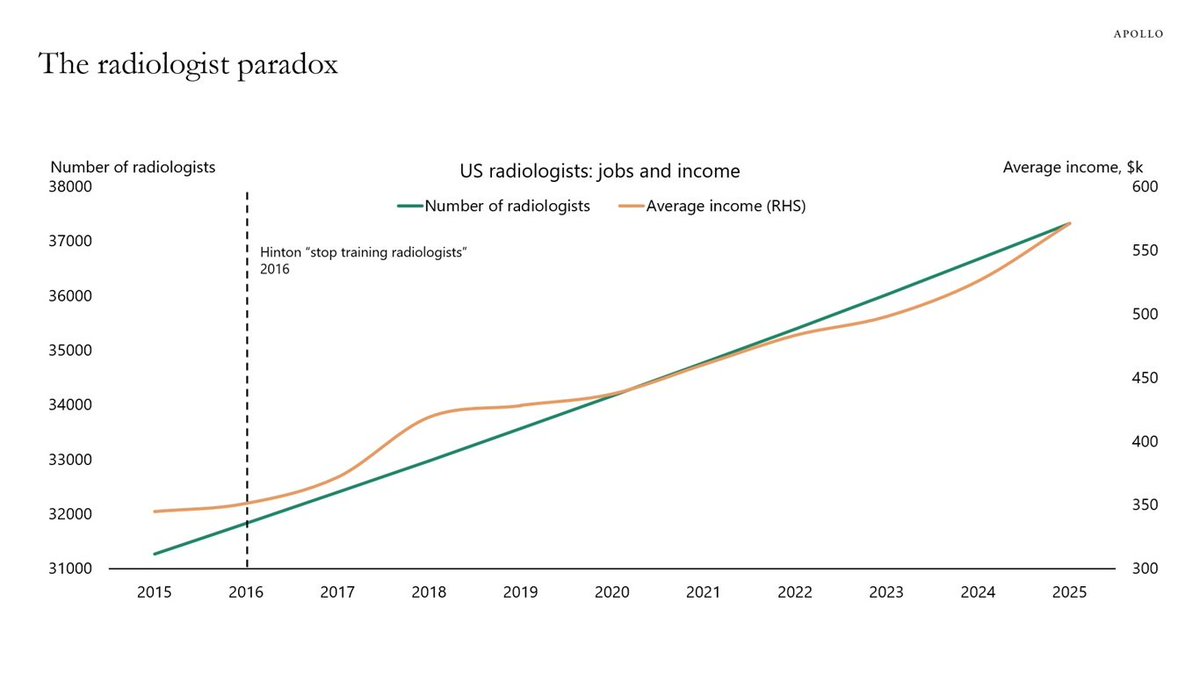
AI automates tasks, not jobs, and when a task gets cheaper, demand for the job grows.
AI cannot automate jobs end-to-end because it lacks autonomy and cannot operate without supervision. There is still zero job from 2022 that can be performed end-to-end by AI, not even translator or customer support associate.

"A decade ago, AI was supposed to replace radiologists. Today, radiologists make more than $500,000 per year, and their employment continues to grow, see chart below. Reading scans is a task, not a job, and when the task gets cheaper, demand for the job grows."
139
230
1,475
142,397
Apr 25
Nice account with good examples: What the AI ‘jobpocalypse’ narrative misses ft.com/content/f55c4eba-6e10… via @ft
1
440
James Bessen retweeted

Apr 23
@JamesBessen is right. Whether labour saving tech creates or destroys jobs in the sector depends on the elasticity of demand for the output of that sector
Apr 22

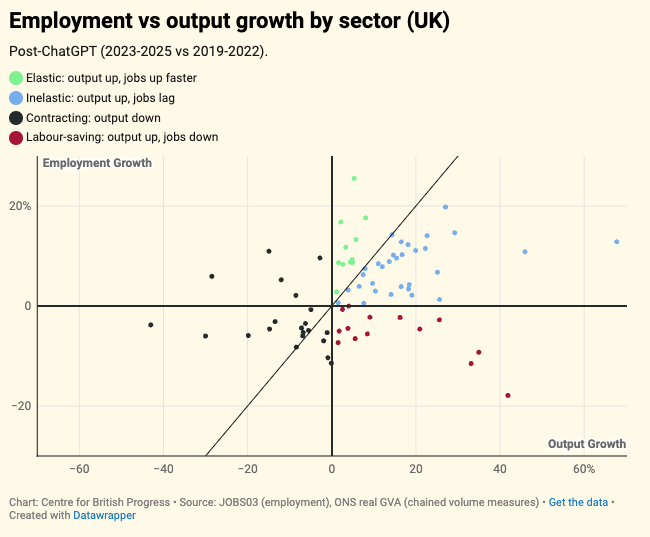
@JamesBessen's work argues that whether automation destroys jobs depends on the elasticity of demand for what the sector produces.
ATMs cut the cost of running a bank branch, but banks opened more branches. Teller employment kept rising for two decades following that technological shock.
Where a sector's output responds strongly to cheaper production, automation grows the market faster than it shrinks the labour needed per unit.
Where demand is rigid, productivity gains come out of headcount.
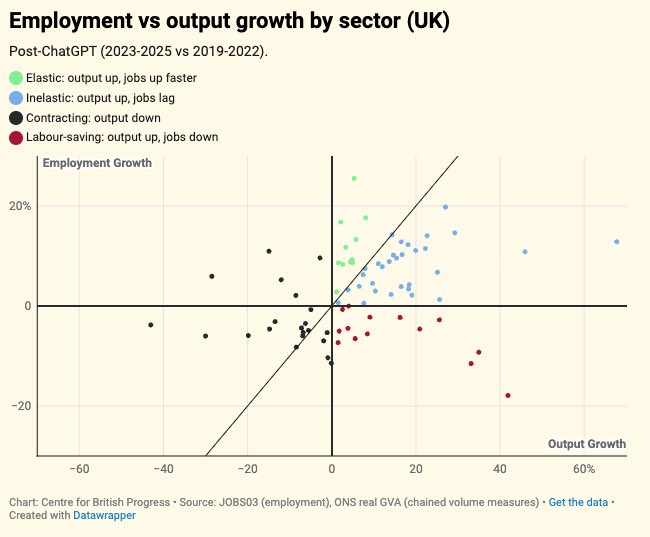
Across UK sectors, employment and real output growth tend to go hand in hand: most of the economy displays elastic demand for output.
But many sectors sit below that line, where output has grown faster than employment and productivity per worker is rising.
Computer programming is one of them, which makes software one of the sectors to watch.
1
4
1,038
James Bessen retweeted

Apr 22
🤖 ¿Realmente la IA está eliminando empleos? Te dejo una reflexión importante para México 🇲🇽
A tres años del lanzamiento de ChatGPT, los datos del Reino Unido arrojan conclusiones inesperadas que desafían el alarmismo tradicional.
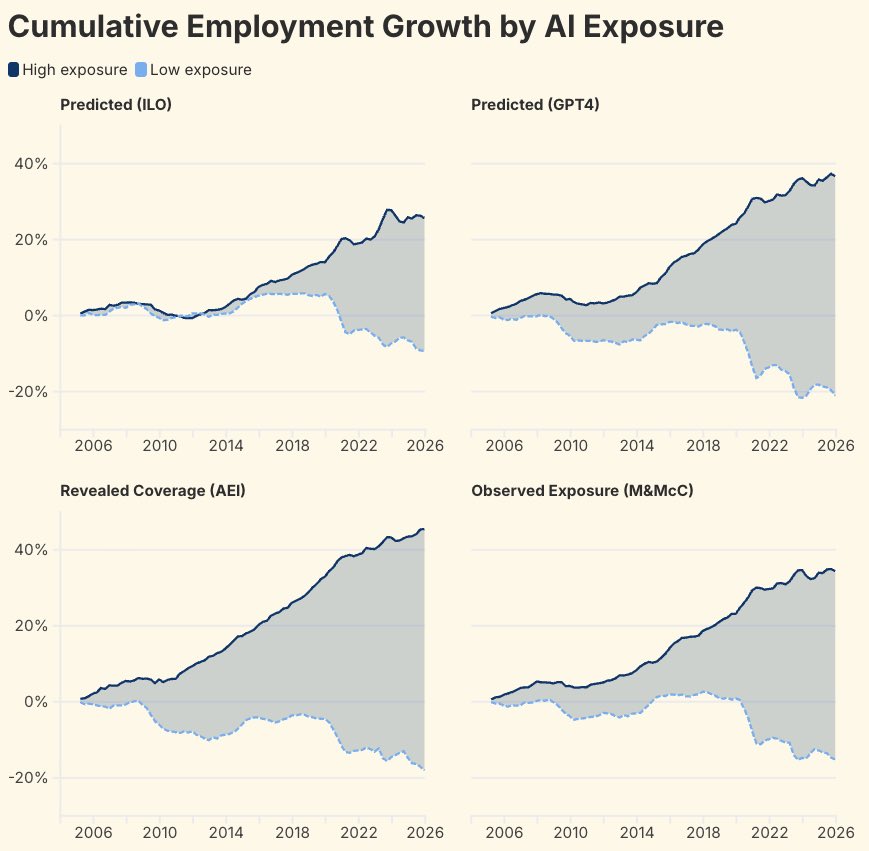
No solo no hay evidencia de un impacto negativo masivo en el empleo total, sino que las ocupaciones más expuestas a la IA están creciendo más rápido que las menos expuestas.
📊 Los hallazgos clave:
•Aumento vs. Sustitución. El impacto depende de la naturaleza del rol. Mientras que los analistas de TI ( 38%) y programadores ( 18%) crecen porque la IA los hace más productivos, los roles de call centers (-19%) caen porque sus tareas son procesos fijos fácilmente automatizables.
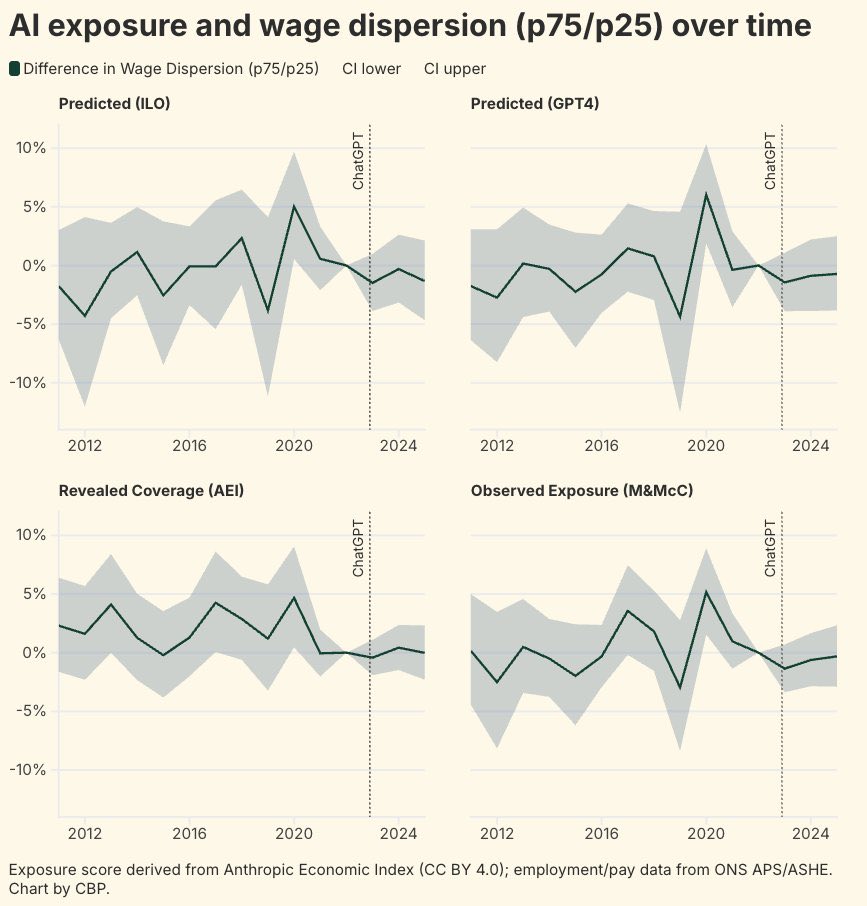
•Salarios y Horas. Aunque los salarios en sectores de IA se han estancado, esta tendencia comenzó años antes de la IA generativa. Curiosamente, las horas trabajadas en roles expuestos han subido, lo que sugiere que las empresas quieren más tiempo de sus trabajadores ahora que son más productivos.
•El factor de Elasticidad.
Siguiendo la lógica de @JamesBessen , si la IA abarata un servicio (como el software) y la demanda por ese servicio es elástica, el mercado crecerá tanto que terminará contratando a más personas (como pasó con los cajeros automáticos y las sucursales bancarias).
🔍 La brecha de adopción:
A pesar del ruido mediático, la adopción real es estrecha. Según el Anthropic Economic Index, el uso de herramientas como Claude en el Reino Unido solo abarca el 2% de las tareas totales posibles. Estamos en una etapa de despliegue muy temprana.
2
7
14
1,541
James Bessen retweeted

Apr 22
Software is where any early AI signal should first appear in UK data.
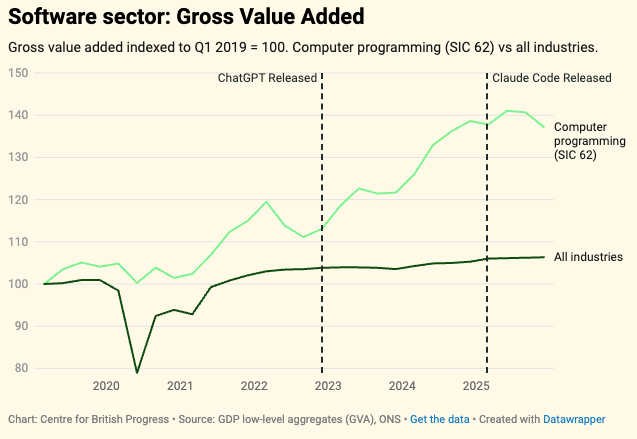
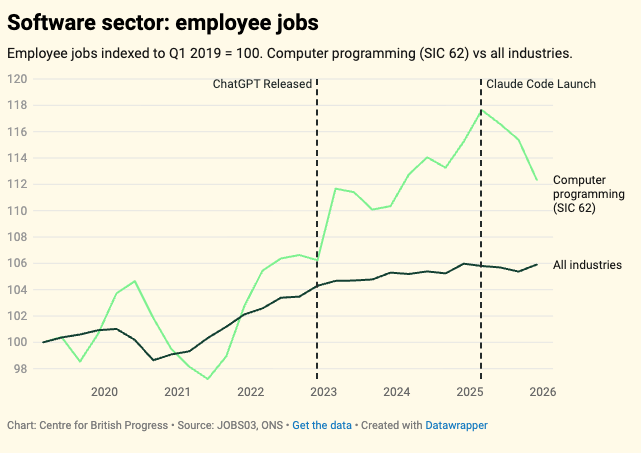
ONS data shows computer programming employment grew 18% between 2019 and 2025, three times the economy-wide rate.
Real GVA [of software?] grew 35% in the same period. GVA per worker rose 16%, against about 0.4% across the whole economy.
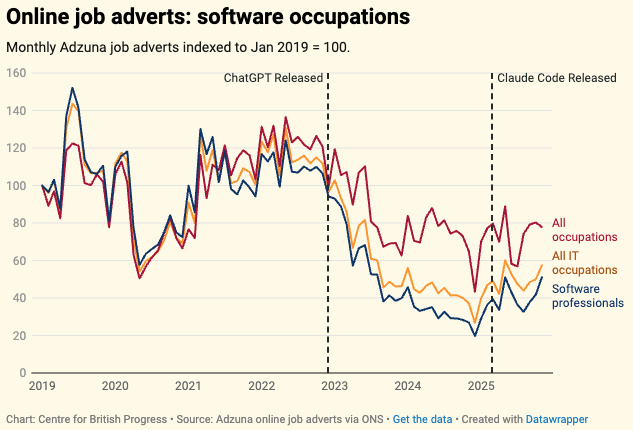
But both employment and output in software fell in the second half of 2025, coinciding with the wider release of AI coding tools.
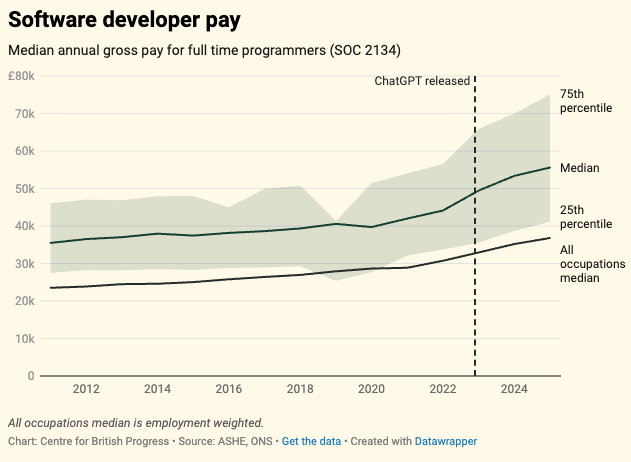
It’s too early to tell what is causing what here, but we know software was already growing before ChatGPT.
Since then, productivity in software has accelerated to roughly 3.8% a year, close to five times the pre-ChatGPT pace, and well ahead of the rest of the economy.
Within software, the composition has also shifted: cybersecurity and business analyst roles have outpaced programmers since 2023, consistent with AI pushing work toward design, analysis, and security rather than direct coding.
Crane and Soto, two economists at the Federal Reserve Board, find that US coder employment is three percentage points per year below trend since the release of ChatGPT.
It would be the cleanest formal evidence of AI displacing jobs in a specific occupation.
We cannot replicate this finding for the UK.
The pre-ChatGPT window is too short, because the UK occupational classification changed in 2021, and the same deceleration shows up in occupations with no AI exposure at all.
In other words, it looks like the main driver here is pandemic recovery, rather than AI displacement.
2
7
32
4,393
James Bessen retweeted
Apr 22
@JamesBessen's work argues that whether automation destroys jobs depends on the elasticity of demand for what the sector produces.
ATMs cut the cost of running a bank branch, but banks opened more branches. Teller employment kept rising for two decades following that technological shock.
Where a sector's output responds strongly to cheaper production, automation grows the market faster than it shrinks the labour needed per unit.
Where demand is rigid, productivity gains come out of headcount.
Across UK sectors, employment and real output growth tend to go hand in hand: most of the economy displays elastic demand for output.
But many sectors sit below that line, where output has grown faster than employment and productivity per worker is rising.
Computer programming is one of them, which makes software one of the sectors to watch.
1
6
35
6,039
Apr 17
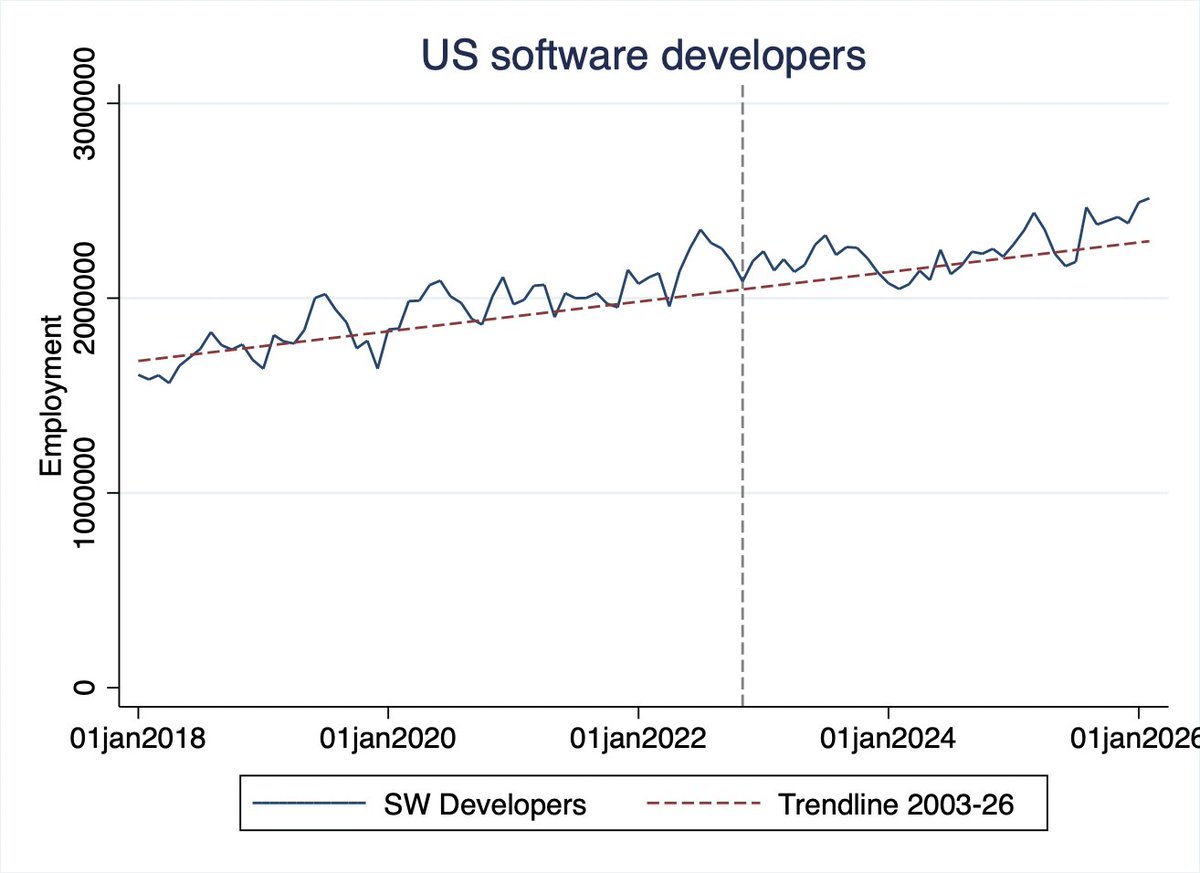
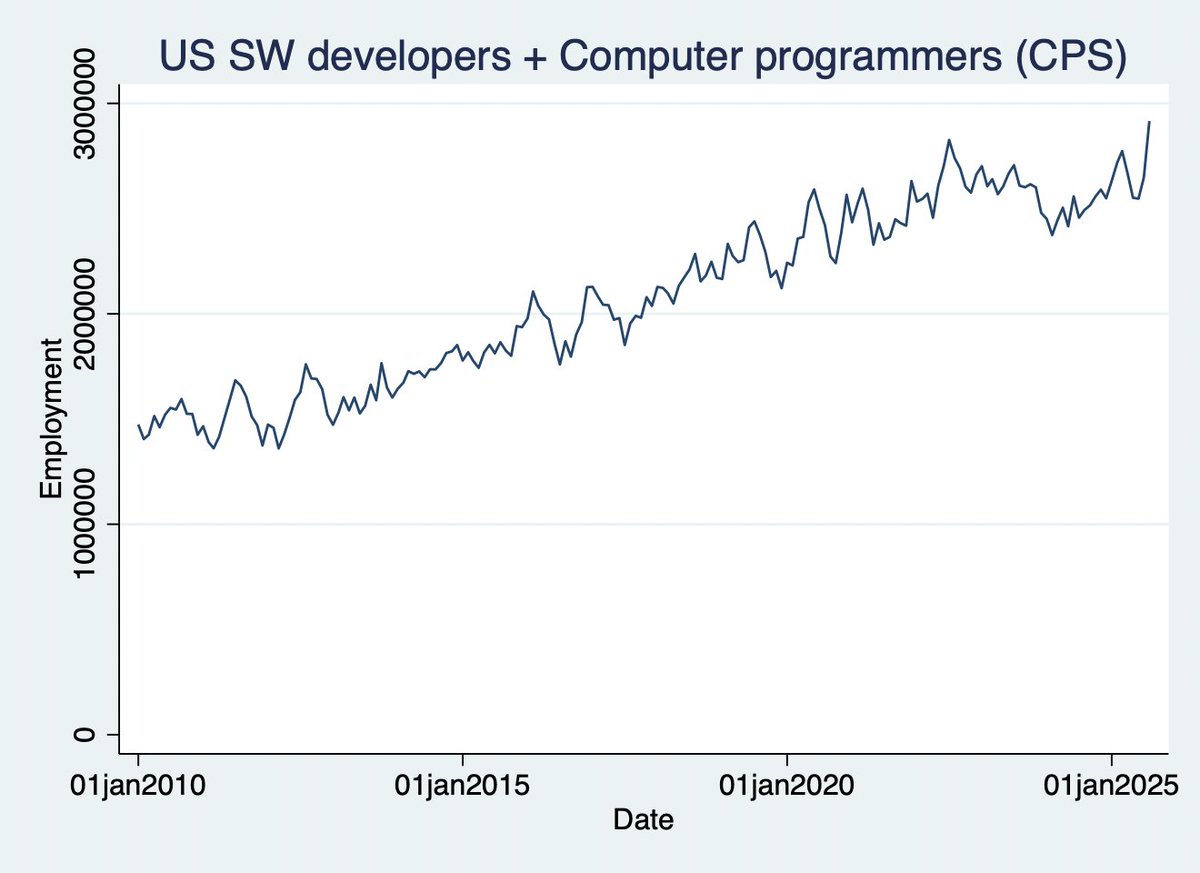
Employment of software developers still at near-record levels in March (CPS)
1
7
576
Apr 17
Job postings for software engineers are up. Important analysis by @citsecurities citadelsecurities.com/news-a…
1
1
2
343
James Bessen retweeted
Apr 13
I’ve now seen this paper posted by several “BREAKING” accounts (and we hopefully know what that means by now).
But:
1) there is no mathematical “proof” and 2) the assumptions you need for this prediction don’t hold in practice.
I wrote out the economic conditions you need for such demand collapse here: open.substack.com/pub/alexim…
There is a formal model linked in the post. TLDR: you need preferences to fully satiate (ie a person doesn’t want literally anything else) for demand collapse to happen, and even if that’s the case, there are many very simple policies can prevent it.
Apr 12

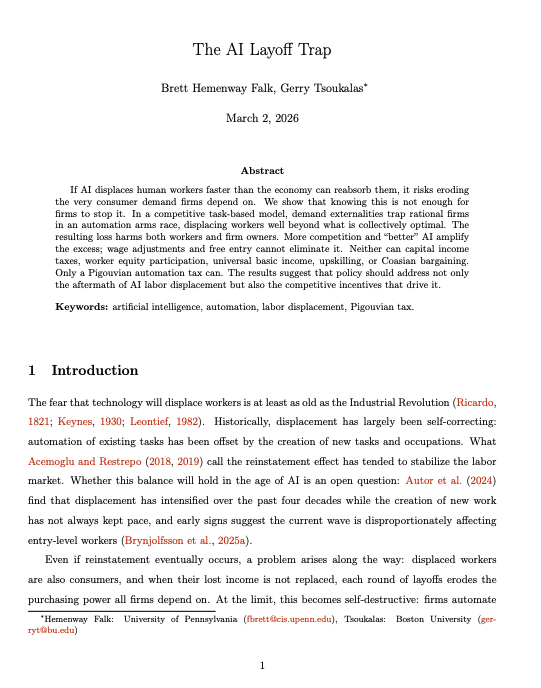
🤯BREAKING: Researchers just mathematically proved that AI layoffs will collapse the economy: and every CEO already knows it.
The AI Layoff Trap. A game theory paper from UPenn Boston University is glaringly important!
100K tech layoffs in 2025. 80% of US workers exposed. And no market force can stop it.
→ Every company fires workers to cut costs
→ Every fired worker stops buying products
→ Revenue collapses across every sector
→ The companies that fired everyone go bankrupt
It's a Prisoner's Dilemma with math behind it. Automate and you survive short-term. Don't automate and your competitor kills you. But everyone automating destroys the demand that makes all companies viable.
UBI (universal basic income) won't fix it.
Profit taxes won't fix it.
The researchers found only one solution: a Pigouvian automation tax "robot tax"
The AI trap on the economy is here!
16
52
298
80,030
James Bessen retweeted

This is the nuance people miss. AI isn't eliminating dev roles — it's reshaping what companies need. Platforms like Mercor are already matching devs with AI-augmented roles where the demand is growing fast. The shift rewards adapters, not resisters.
1
1
157
Apr 8
This happened in the past, too. See @ccatalini forbes.com/sites/christianca…

Agree with a commenter on using Dec 2025 as a start date. We’re seeing massive productivity gains creating new choke points. Creating new demand for resources i.e. so much new code, not enough QA. Imagine this will happen across orgs spiking the resource demands until AI tooling solves the old bottlenecks and creates new ones….
1
4
936
James Bessen retweeted

Apr 7
Important thread by the always insightful @JamesBessen
Cc @zakkohane
Apr 7

AI is NOT killing the software developer. AI is taking over tasks that software developers perform, but that does not translate into lost jobs. A new report shows why: AI is creating new and improved software products that raise demand. sites.bu.edu/tpri/files/2026…
1/9
1
3
1,562
Apr 7
AI is NOT killing the software developer. AI is taking over tasks that software developers perform, but that does not translate into lost jobs. A new report shows why: AI is creating new and improved software products that raise demand. sites.bu.edu/tpri/files/2026…
1/9
20
102
646
279,900
Apr 7
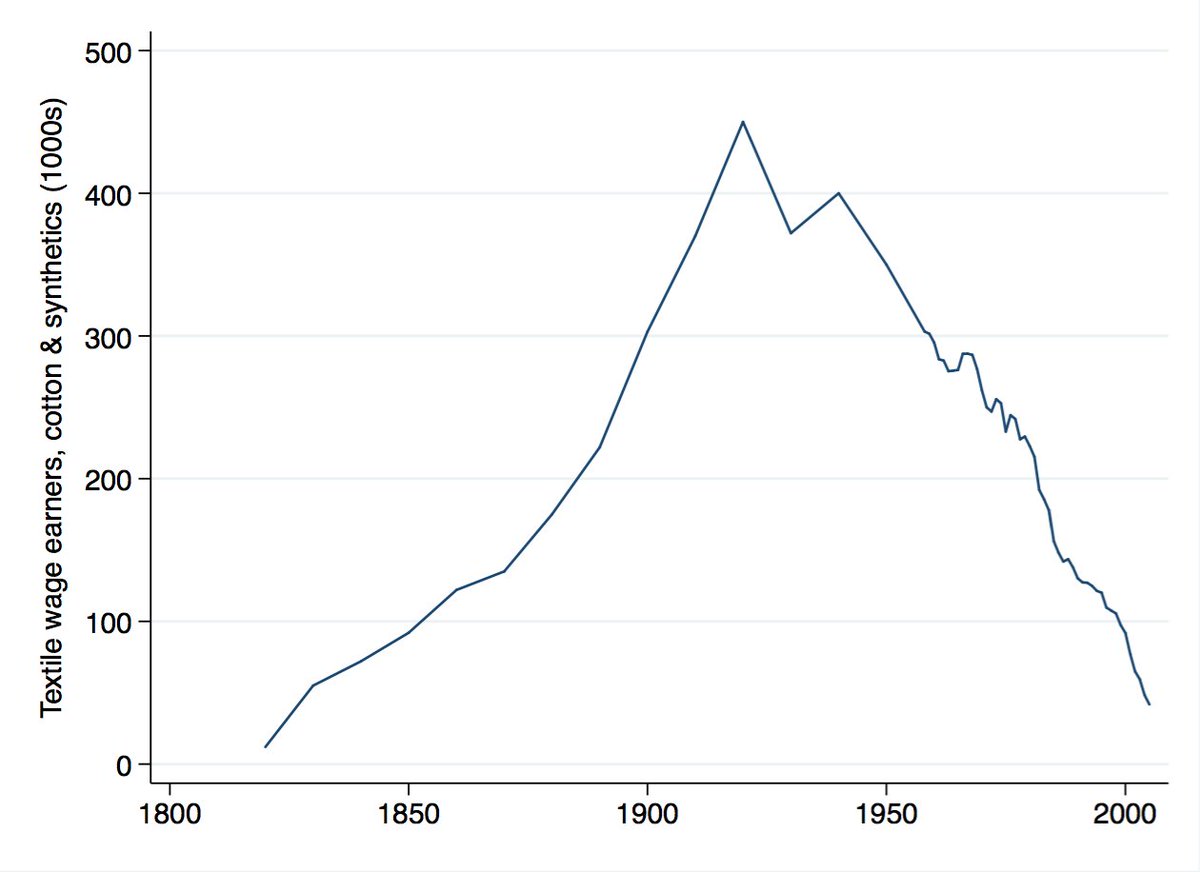
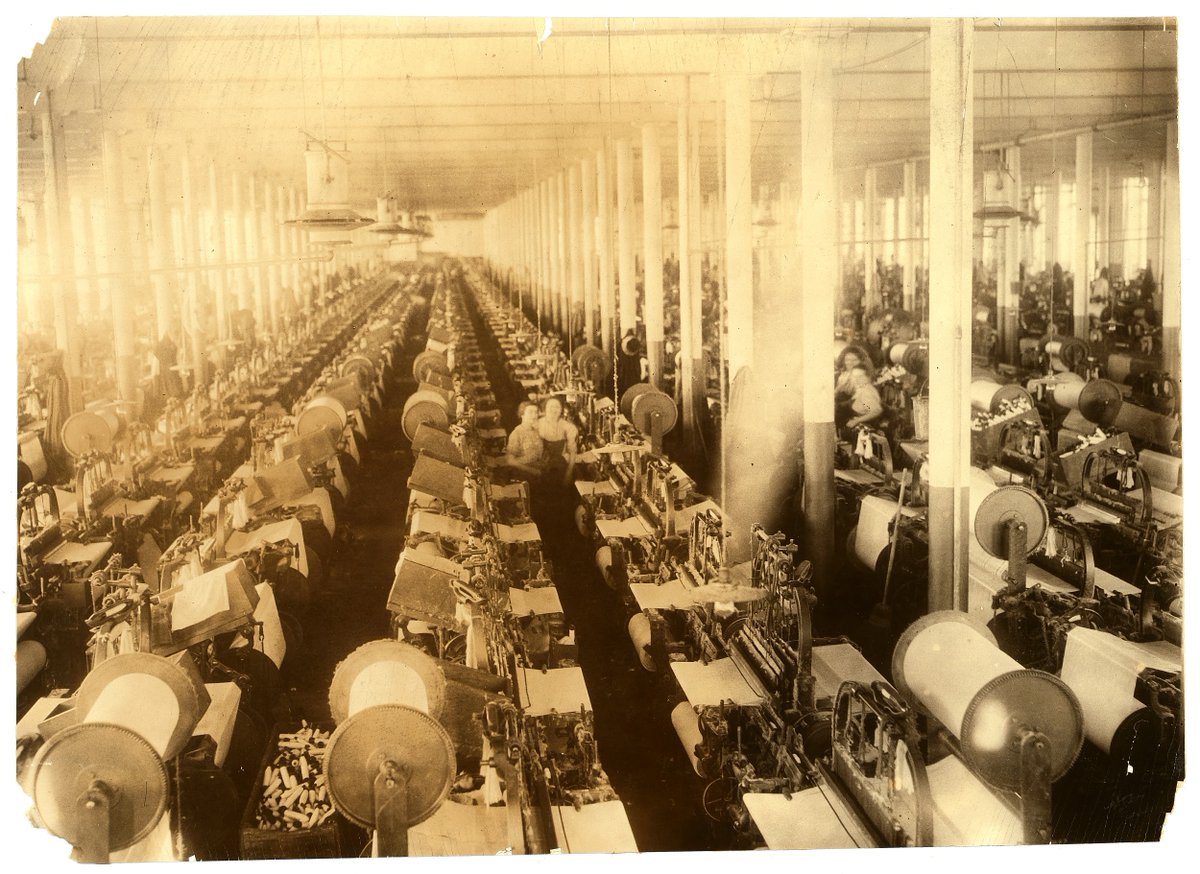
In textiles, steel, and autos, employment grew for decades as automation sharply raised productivity and also raised output. Until it didn’t. In textiles, after a century, demand satiated and productivity growth exceeded output growth, leading to fewer jobs.
8/9
1
5
40
3,770
Apr 7
So this: software developer jobs will continue to grow as long as technology helps them create new and better products, raising output. AI leads to mass layoffs of SW developers only if AI is a very limited technology. Or if AI can do every single developer task (not soon).
9/9
6
4
44
3,782