
tech @CarnegieEndow / podcast The World Unpacked
Joined February 2019
- Tweets 2,500
- Following 2,235
- Followers 4,546
- Likes 13,434
169 Photos and videos




Pinned Tweet

May 1
🎙️The Orb vs. AI Bots
AI bots and slop are suffocating the Internet. Is there a way to prove who's human without losing our privacy?
I talked to @nickpickles at @tfh_technology about the crisis of trust & whether @sama's eyeball-reading Orb can save us.
youtube.com/watch?v=xCMvIT1A…
4
474
Jon Bateman retweeted
The Fable decision is fundamentally a domestic US policy mess, and it seems likely to resolve itself, albeit chaotically. For middle powers, it's a tempting starting point for ill-conceived 'sovereign' AI takes, but I think the right move is to let it blow over and buy more time.
The decision itself seems counterintuitively domestic in scope. USG got worried about the prospect of a jailbreak, didn't feel like it had a particularly precise and effective way to tackle that risk, and defaulted to limiting access in an obvious and available way. The easy way to do this was also a way to make Anthropic uncomfortable and annoy allies, but these seem like secondary considerations at best.
That's still relevant information for middle powers--it goes to show that there is no immediately effective and legible reason for USG or American developers to consider their interests in making access decisions. As for middle powers' posture in reacting to this: I think nothing good comes from wading into a politically charged AI policy environment, solidarising with Anthropic and drawing the continued ire of the Trump administration. Right now, middle powers are collateral damage, and acting hastily risks making them parties to the conflict.
What would have helped in this case? It's not clear that even a European model would really have. Imagine you had the absolute best case European sovereignty in place, up and running since 2024. would it have a Fable-class model by now? or would it 'only' be at the level of Opus 4.8 - a near-frontier model in its own right that remains available today? you'd have to be quite confident that the European champion would not just be 2 months behind the curve, but at the absolute bleeding edge of frontier development, to make a difference to this particular scenario. Not even the most bullish views of the domestic project makes that kind of outcome particularly likely, so this really is not a particularly incisive wake-up call on European frontier models specifically.
But even if you disagree, what would it actually *mean* for this to be a wake-up call for European sovereignty? Are you going to build your own model now? What are you going to do in the--generously--three years between announcing this project and reaping the frontier models it would build: are you willing to give up frontier access in the meantime? Because the resources required for building this frontier model directly trade off against the resources you could invest into guaranteeing access instead (most notably through compute); and the political fallout from announcing an attempt to build the very kind of model capability the US is attempting to restrict would also make future access negotiations harder.
Let's say you're willing to bear that delay: do you think a Trump administration that just refused to give you access to Fable is going to let you buy enough frontier chips to train an unrestricted Fable clone yourself? Are you willing to go the mat on semiconductor chokepoints, even if it comes with sky-high costs in Ukraine and trade policy? I don't actually think so. Look into the details of what would be required for a big European push right now, and you'll see the leverage for 'waking up' and divorcing from the US ecosystem simply is not feasible in the current technological or geopolitical environment. I regret that this is the case, but that doesn't make it the case any less!
What, then, is the alternative?
First, I think it's worth noting that this is fundamentally a very good version of a very bad thing. In a fortuitous turn of events, the Trump administration has picked the most ill-conceived version of access restrictions you could possibly come up with. It's legally fraught, so domestically impactful that it will lead to massive internal pushback, and likely extremely economically harmful. As a result, it will likely go down in flames eventually. The U.S. is not yet in the spot to actually go through with long-term cut off: international markets are still too important, the security situation is not yet sufficiently dire, and so on. So the first live fire exercise of cutting off the rest of the world is going to fail, which means labs and the admin are going to be much more wary of subsequent attempts to do the same, even if they end up more sophisticated.
Second, I think the access recipe is fundamentally the same as it was yesterday: build leverage on the margins that makes cut-offs like these even less attractive, for instance through access-for-compute deals and by creating deep economic integrations that are economically central to US labs and strategically central to the US supply chain--create a lobby to push back harder against attempts like this in the future. In the future, we can use the resources and capacities that gives us to sprint toward our own frontier project if we must, but right now we neither have the political will nor the relative power to get even close to trying that.
Third, and somewhat trivially, we should start thinking about what we want to do the next time this happens. I suspect any analyses that assess whether you can use ASML or any semiconductor chokepoint to avert this will come up short, but there's still value in analysing and then credibly precommitting to threats. Right now, USG did this operating under the assumption there would be absolutely no reaction from middle powers at all. Any plan in the drawer that suggests there is a non-negliblie cost for the US to act like this in the future would be helpful. There's little use in deploying it reactively now; there's lots of value in precommitting to it for the next iteration. That's different than actually going to the mat; the goal here is to play chicken a bit, increase uncertainty and latent risk for the administration in making these decisions to tilt the calculus toward integration, not to go all out on a highly costly tradewar.
Fourth, I think this clarifies the specific concerns that could motivate access restrictions. Security concerns, both on misuse as well as distillation and model theft, fundamentally make the US more likely to restrict model access; this time around, it was concerns around reducing surface area for unmonitored jailbreak attempts. That is, in principle, fixable--middle power governments can and should engage with labs to create security conditions that create permission structure for exports and model sharing. Make your infrastructure as secure as they want it to be, and you reduce the risk they consider exporting to you a security vulnerability. Again, I understand if this sounds submissive and uncomfortable to you---but again, all this is necessary even if you go for the maximal sovereignty playbook at the same time, because you will need frontier access in the meantime.
Instead of these reasonable responses, I worry that the low-resolution view on this whole affair is to think this should shake middle powers into the wrong kind of action. Realising how important and contingent frontier AI access is quickly leads down the path of wanting to build your own; realising how capricious the American ecosystem is makes you want to divorce from it faster.
But for better or for worse, the central implication of this episode is the opposite: as evidenced by this episode being possible at all, middle powers currently do not have the leverage to do much about any of this, and building up this leverage is almost impossible to do in an openly adversarial relationship to the US. In that sense, waking up is not a matter of loud yelling, decisive action or pivotal decisions. For all the internal urgency with which I think we should precommit to some leverage and shore up our security concerns, I still think the optimal strategy is one of public restraint and progress on the margins of the current playbook. I'm just not sure there's that much to wake up from - this is just what life is like for now.
Jun 13

The US government, citing national security authorities, has issued an export control directive to suspend all access to Fable 5 and Mythos 5 by any foreign national, whether inside or outside the United States, including foreign national Anthropic employees.
The net effect of this order is that we must abruptly disable Fable 5 and Mythos 5 for all our customers to ensure compliance.
Access to all other Claude models is not affected.
We apologize for this disruption to our customers. We believe this is a misunderstanding and are working to restore access as soon as possible.
Read our full statement: anthropic.com/news/fable-myt…
38
49
378
110,436
Jon Bateman retweeted

Jun 11
i'm very excited about this new report on compute in the free world. these days, I think this is the most immediately important issue in middle power AI policy: compute policy is the one clear way to turn strategic awareness into actual AI policy. there are four ways to do that:
the first is making compute deals for frontier access. frontier labs need a lot of reliable compute very fast. as the report points out, US capacity to provide that is straining as political pushback increases and sites and turbines run out. If a middle power can get datacenters up and running fast enough, that makes for a great negotiating position - in exchange, they could ask for access to the same models as the American market, and for preferential access to the capacity provided by its local compute.
the second is controlling compute capacity as an anchor for regulatory and fiscal participation. with past technological trends driven by the US, middle powers had an easier time getting their policy views in and skimming off some tax revenue because America needed their markets. but insofar as AI supply remains constrained, that will be much harder. so it's very helpful for a middle powers to retain another lever to keep firms sufficiently involved to enable taxation and some regulation.
third is developing on-shore compute capacity to create optionality for future catching-up. once the compute is in your country, there are in principle ultimae rationes you can take: turn off the power, nationalise, expropriate, and so on. if the race to advanced AI actually does turn existential, middle powers that control some compute at least have a tangible desparation play available. and if that's true for enough middle powers, they could even band together and catch up to some relevant level of capability.
fourth and most ambitious is building out compute capacity as a broadly leveragable access - not unlike natural resources like oil. a country that controls a sizable portion of global compute supply can spin that into actual influence. for instance, if you control 5-10% of global compute, you can throttle compute supply in a financialised market and cause price shocks not unlike OPEC rationing. to make that work, you don't only need datacenters today - you have to be and remain prohibitively good at building them so the world continues to send you their chips. but at the limit, for some countries with large funds and abundant power (Norway?), this is the maximally effective compute play.
but all of this starts with actually being an effective and attractive buyer of compute and host of datacenters. that, in turn, comes down to a range of factors this report explores in great depth. one of the most encouraging takeaways is: hard, near-immutable factors like energy prices are surmountable. tractable and policy-sensitive factors, especially time to power, matter most. as long as the compute scramble continues, there's still time and room for middle powers to act ambitiously on compute!
Jun 11

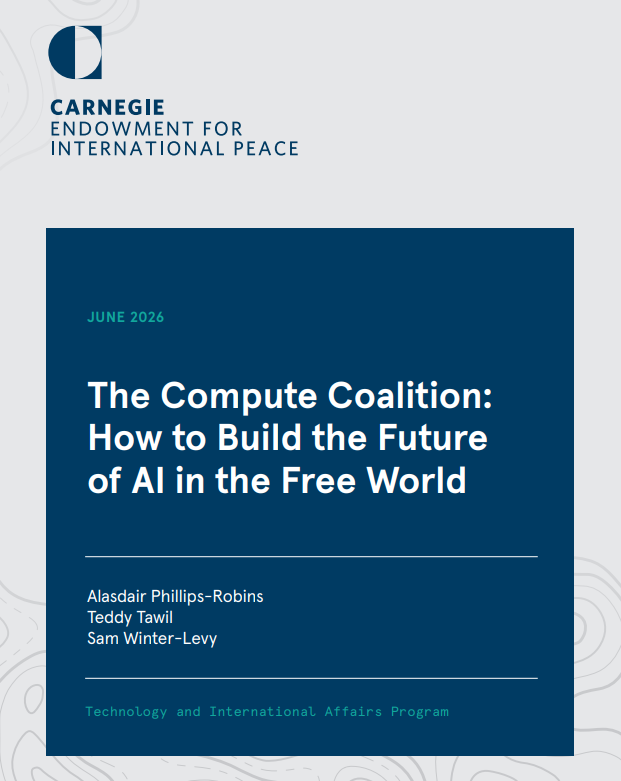
🧵I spent 9 months building a detailed new global model of AI data center finances along with @alasdairpr and @SamWinterLevy.
It shows which factors are driving $10 billion investment decisions, who will control a key strategic asset of this century, and what policymakers can do to steer results while minimizing harms to the public.
It’s part of a new @CarnegieEndow & @CEIPTechProgram report. Here are five key findings:
3
16
74
11,145
Jon Bateman retweeted

Jun 10
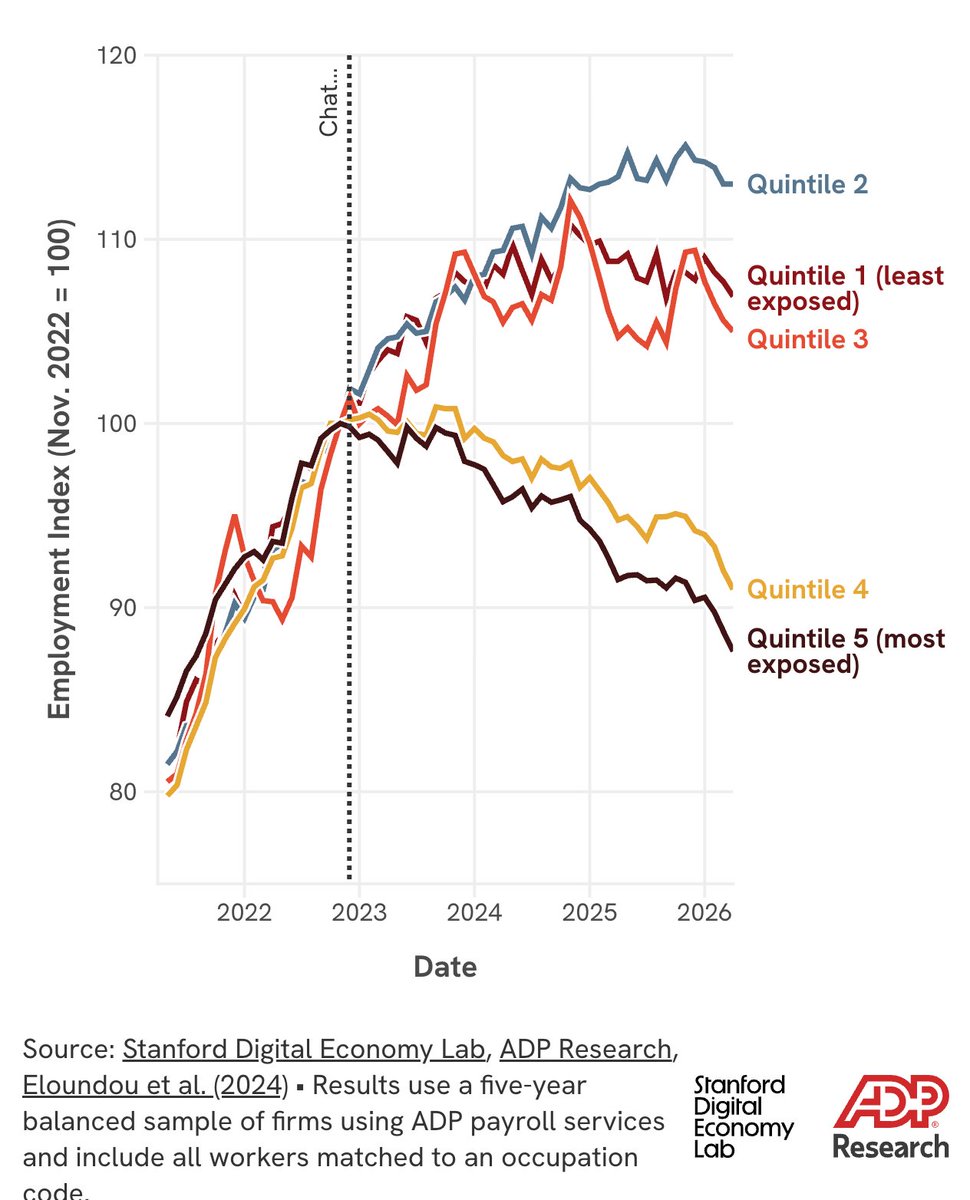
Today, the Stanford @DigEconLab launches the AI Economic Indicators, a new platform for tracking how AI is reshaping work, productivity, adoption, and the economy.
1/6
35
305
1,003
241,097
Jon Bateman retweeted

Jun 11
🧵I spent 9 months building a detailed new global model of AI data center finances along with @alasdairpr and @SamWinterLevy.
It shows which factors are driving $10 billion investment decisions, who will control a key strategic asset of this century, and what policymakers can do to steer results while minimizing harms to the public.
It’s part of a new @CarnegieEndow & @CEIPTechProgram report. Here are five key findings:
5
17
66
14,801
Jon Bateman retweeted

Jun 9
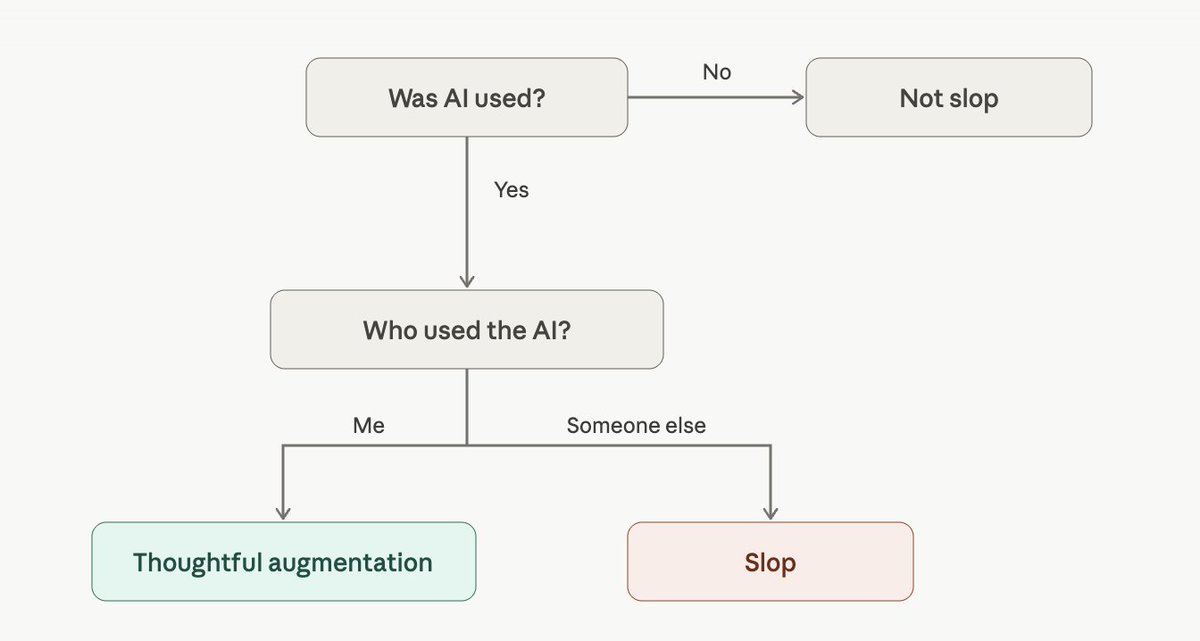
I just open sourced my "Is this slop?" simple test
115
1,044
19,164
449,574
Jon Bateman retweeted

Jun 6
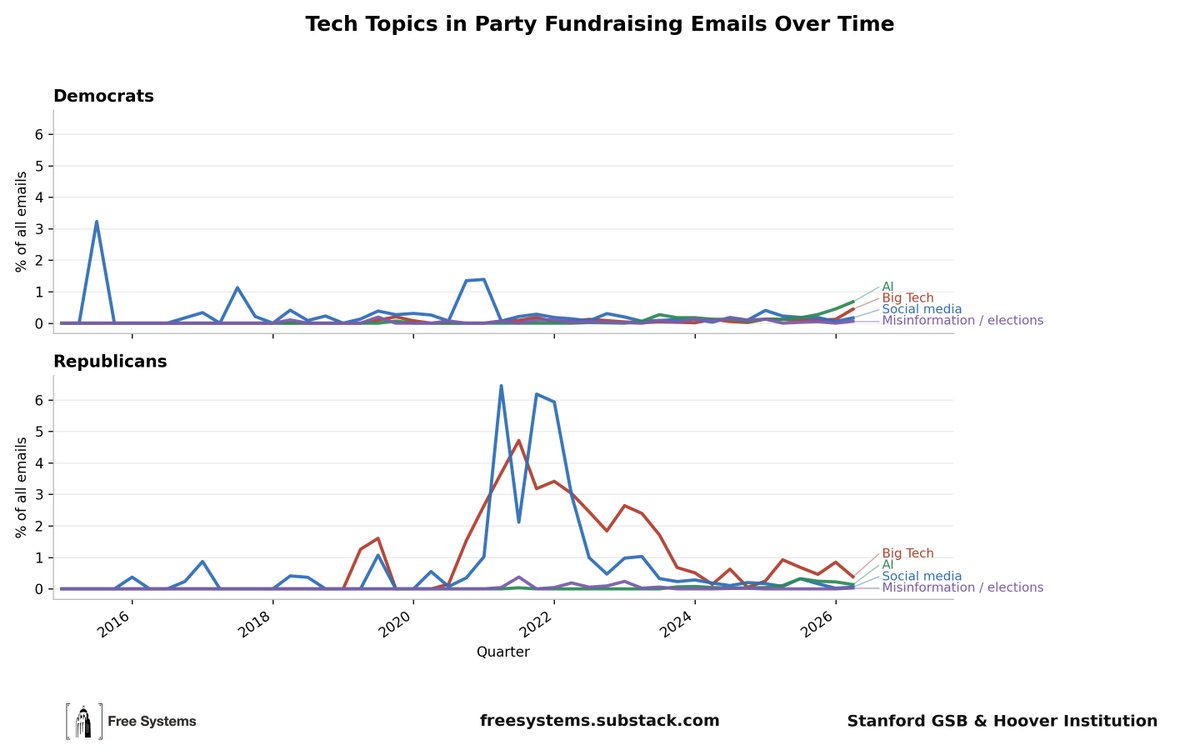
For all the attention AI gets, data shows that the parties are still not adopting it as a major issue.
I've been playing with @derekwillis 's awesome data on party fundraising emails. As my plot here shows, AI is just starting to tick up as a Democratic talking point, but it's still very, very modest.
The Republicans' 2020-era freakout about social media remains much, much larger than the current AI freakout in terms of email focus...and that never amounted to much in terms of policy.
At the same time, policy proposals around AI are getting bolder, like Sanders and Trump floating national ownership---yet surprisingly, the party rank and file are actually moving pretty slowly to adopt AI as an issue, maybe because it's not very salient with the American public.
Will be very curious how this changes in the coming months. Seems likely Democrats may start messaging around it more...but maybe not, if we don't start to see meaningful employment effects.
Jun 6

Present Trump on Air Force One taking to the press:
Reporter: 'Sir, on AI companies, potentially taking these equity stakes, have you Spoken to Sam Altman or any of the-'
President Trump: 'No, there's a concept out there, there's so much money, and it's so big, that there are concepts where pieces could be given to the American public. Where the American public essentially becomes a partner with the companies and, I will tell you, yeah, I have, I have spoken with all of them. There's something very interesting about it where it almost becomes a partnership with the American public. And we'll look into that. I actually have a meeting scheduled in the very short, in the very near future with, did you know that? With all of the companies, and, we're talking about it. Where the American people can benefit from the success of AI. And by doing that they're going to like it better. Because we're leading China. We're leading everybody in the world with AI. And we want to keep it that way. It's probably the biggest industry maybe that we've ever seen.'
Reporter: 'Which companies-
President Trump: 'All of them.'
Reporter: ' Anthropic, SpaceX-'
President Trump: 'All the big ones yeah, all of them. They're all coming to the White House. Probably next week.'
Reporter: 'Is the idea that there would be dividends for the American-'
President Trump: 'I don't know. We're going to see. I mean, we're going to see. Sort of, it's like, you make them a partnership in this revolution. It would be a beautiful thing. It would make them rich.'
1
4
21
7,128
Jon Bateman retweeted
The Middle East faces Gaza’s destruction, Iran’s defiance, Israel’s militarization, and the Gulf’s insecurity (and the projected halving of oil revenues by 2050). What’s the best path forward?
@MarwanMuasher & @JonKBateman discuss on The World Unpacked: youtu.be/MkSBuKmERr0
4
2
4
976
Jon Bateman retweeted

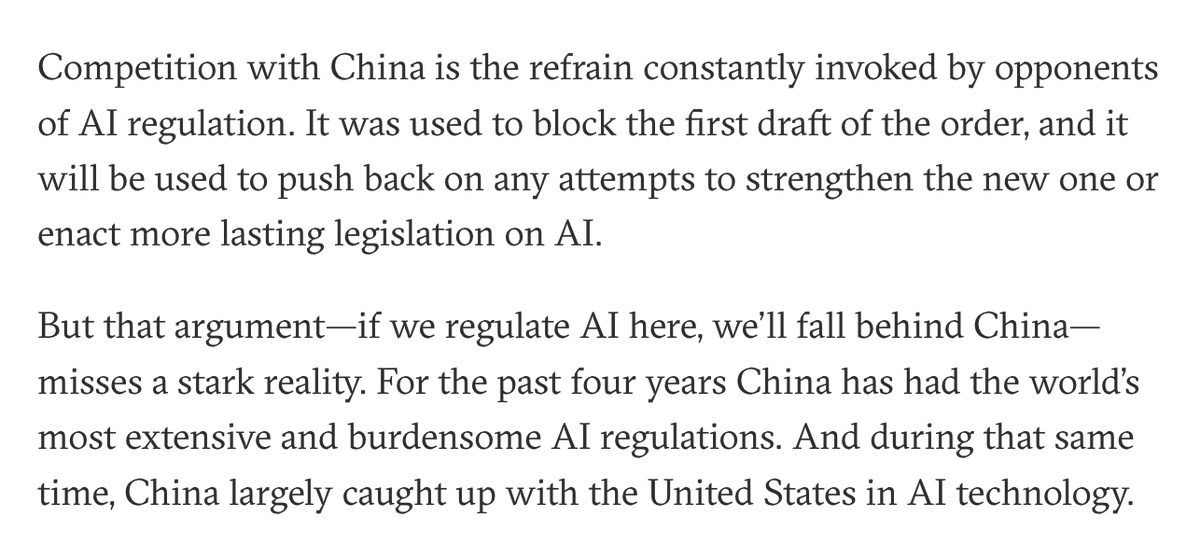
New piece from me in the wake of new White House EO on AI. It looks at a seeming paradox:
- For the past 4 years, 🇨🇳 has had the world's most extensive and burdensome AI regulations.
- During that same period, Chinese AI companies largely caught up w/ their 🇺🇸 peers.
Link below
5
14
46
7,625
May 29
What is the name for this type of half-hearted corporate “humor” you see everywhere nowadays?
2
206
May 28
Very clear and useful.
Still funny that AI ppl keep reinventing other fields' 101 ideas from 1st principles
"in the real world, power is more the product of having the authority and trust to get lots of people to collaborate with you"
May 17

# The mistake of conflating intelligence and power
I had an interesting discussion recently. Someone asked me, what is intelligence? I said, the ability to achieve your goals across a wide range of domains. Okay, he says, then by that definition isn’t Donald Trump the intelligent person in the world, followed in quick succession by Xi Jinping and Vladimir Putin?
To be clear, these people are obviously very competent and clever. But when you think of ASI, you don’t think of Trump, but more so.
The person who kept pressing this question was correctly pointing out that I basically defined intelligence as power. And by this definition, Stalin was the most intelligent person who ever lived.
Now, of course, you could change the definition of intelligence to something more like, manipulate abstract concepts and rotate shapes.
But notice that the most powerful people in the world do not max out this quantity. The correlation between extreme power and this kind of intelligence might be even weaker than the correlation between extreme power and height. The physicists are not running the world.
We tend to conflate power-seeking AI and superintelligent (in science and tech) AI. I’m not denying that AI can be power-seeking. Whatever skills and drives Donald Trump has could be embodied in a digital mind. I’m simply pointing out that the way AI systems are currently becoming smarter (by getting trained to be to be really good at specific economically valuable tasks like coding) is not that strongly correlated with power.
We often talk about power in this way that misunderstands how it is actually derived in our world. Our intuitions are primed by games like Diplomacy or Go, which are designed to isolate and reward a g loaded kind of strategic reasoning.
But in the real world, power is more the product of having the authority and trust to get lots of people to collaborate with you, rather than some galaxy brain scheming capability. Trump is not powerful because his brain, considered in isolation, is the most effective optimization engine on Earth. He is powerful because the government which hundreds of millions of people consider legitimate gives him a lot of authority.
A group versus individual level analysis is useful here. As @GarettJones has written a lot about, individual IQ is only modestly correlated with individual income, but national IQ is strongly correlated with national outcomes. This is because intelligence has a lot of spillover effects - smarter societies cooperate more, save more, and can coordinate to build things like space shuttles and semiconductors.
Richard Trevithick, who invented the high-pressure steam engine, died in poverty, buried in an unmarked pauper’s grave. But the fact that 18th and 19th century Britain had lots and lots of people like Trevithick contributed to Britain being able to set up a global empire and outcompete lots of backwards principalities around the world.
It seems to me that the right mental model is that automated firms will outcompete everyone else in normal capitalist ways, rather than a single AI outthinking everyone else.
201
Jon Bateman retweeted

May 22
The “Stanford within Stanford” links top students with some of the world’s most powerful Silicon Valley investors. Is this good for students – and the world?
@tab_delete joins @JonKBateman on this week’s World Unpacked to discuss: m.youtube.com/watch?v=Kayg-5…
5
9
3,011
Jon Bateman retweeted
May 18
Vladimir Putin's regime is stoking fear for those in Russia, even among the elite. @amenka joined @JonKBateman on Friday's World Unpacked to discuss.
Watch their full conversation here: youtube.com/watch?v=2OQhWMn4…
2
8
1,424
Jon Bateman retweeted

May 15
In your podcast of the week @JonKBateman and I dig into what's behind Russia's surprising recent internet shutdown — which did more than disrupt daily life: it also crippled the regime's own communications and propaganda. One of a series of strange events — from a diminished Victory Day parade to crackdowns on businesspeople and celebrities — that suggest growing disorder and confusion within the Russian state. And what it all signals about where Russia is heading
youtube.com/watch?v=2OQhWMn4…
2
22
44
14,039
Jon Bateman retweeted

May 13
What is going on with this website, why does Anton not have 20k followers. Tell you what tho, bet you the 2k following him are among the most interesting people on here. This is another banger of a piece. I hereby remind people that Anton has a PhD in Philosophy.
May 13

AI strategies everywhere hinge on widely available American frontier AI. Post-Mythos, amid compute crunches, security concerns and distillation crackdowns, that paradigm is under threat.
Today, I argue the era of widespread access to frontier AI is almost over.
14
12
279
83,134
Jon Bateman retweeted

May 13
Anton is on point here, as always.
Policymakers and other strategists tend to implicitly assume a level of frontier AI abundance that I do not expect to materialize over the next few years. Scarce frontier AI profoundly changes the political economy of AI.
May 13
AI strategies everywhere hinge on widely available American frontier AI. Post-Mythos, amid compute crunches, security concerns and distillation crackdowns, that paradigm is under threat.
Today, I argue the era of widespread access to frontier AI is almost over.
11
28
244
33,015
Jon Bateman retweeted
After Venezuela and Iran, the Trump administration seems to be setting its sights on Cuba. @jcorrales2011 sat down with @JonKBateman on today's World Unpacked to break down what to know before things come to a head.
Watch their full conversation here: youtube.com/watch?v=8p5xiQKQ…
3
1
5
1,239
Jon Bateman retweeted

May 4
Pleasure to join @JonKBateman to discuss AI, bots, geopolitics and a future where we know who is human!

In an online world where slop and bots seem to rule, should we just give up on trying to determine who's human? Maybe not quite.
@JonKBateman sat down with @nickpickles on today's World Unpacked to discuss a promising new tool: youtube.com/watch?v=xCMvIT1A…
1
1
4
856
Jon Bateman retweeted

May 1
Excelllent thread on various views of how AI will affect work, from catastrophic to highly optimistic, and the best arguments for each.
May 1
Experts have three views on the future of work, each credible but sharply opposed.
Who’s right? In a new paper for @CarnegieEndow & @CEIPTechProgram, I lay out the best arguments made by the alarmed, patient, and excited groups.
🧵On the most important points and what policymakers can do today
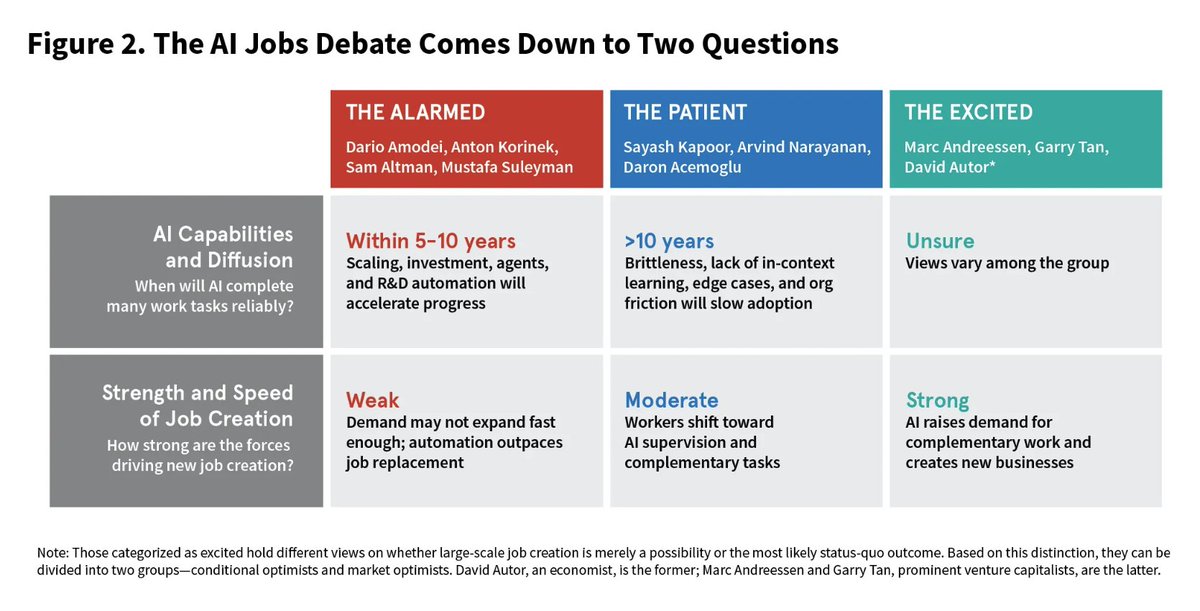
2
3
9
2,668
Jon Bateman retweeted

May 1
Having been working on actually deploying AI w white collar workers (not just SWEs!), my bet is somewhere b/w 2/3. Many new things can be done now bc of AI that couldn’t be before = more work. And while lots of work content will be destroyed, 100% automation is 100x harder than 80%
May 1
Experts have three views on the future of work, each credible but sharply opposed.
Who’s right? In a new paper for @CarnegieEndow & @CEIPTechProgram, I lay out the best arguments made by the alarmed, patient, and excited groups.
🧵On the most important points and what policymakers can do today
1
24
131
4,618
Jon Bateman retweeted

May 1
"Claude, vaguepost for me. make no mistakes."
4
5
1,608
73,905