
Energy maximalist. e/acc
Joined May 2011
- Tweets 4,824
- Following 1,556
- Followers 2,751
- Likes 4,895
840 Photos and videos







Josh Metnic𐤊 🏗️ 🇺🇸 retweeted

Mar 25
It’s time for Proof Of Human.
Mar 25

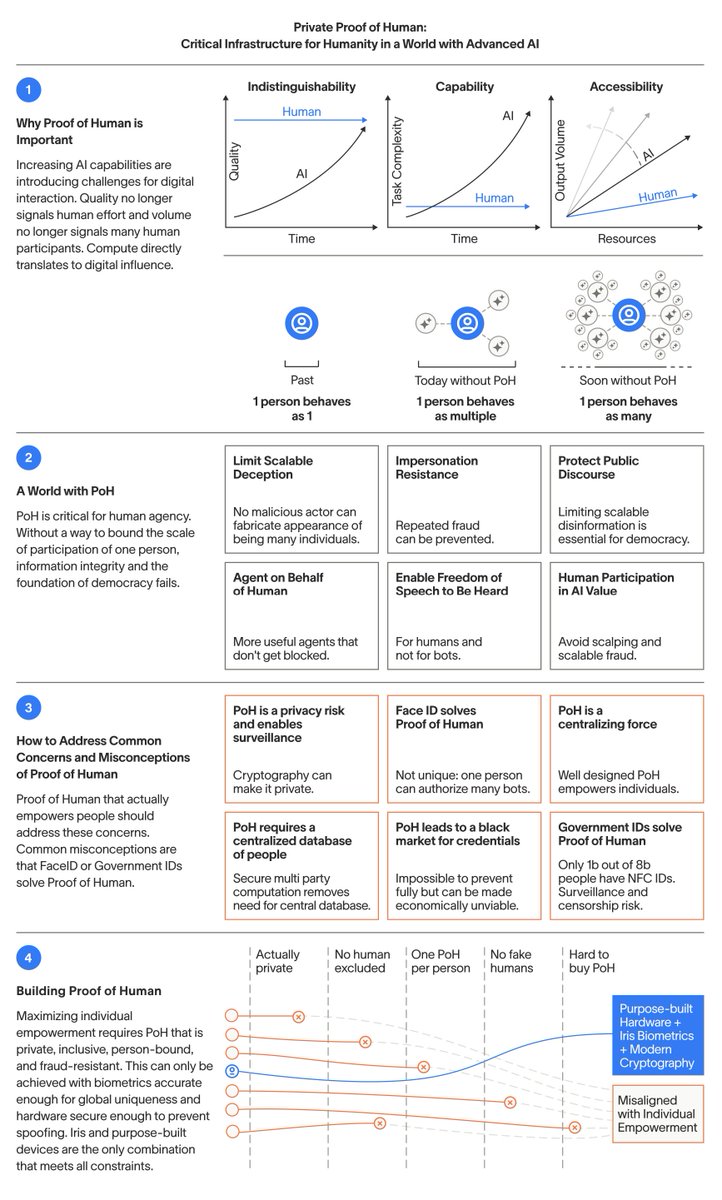
Agentic capability is improving fast. We believe Proof of Human is becoming critical for the internet and many of the platforms we use (like X).
This paper explains why FaceID, face biometrics & government IDs won’t solve the problem, and what properties are most important.
394
328
2,361
527,946
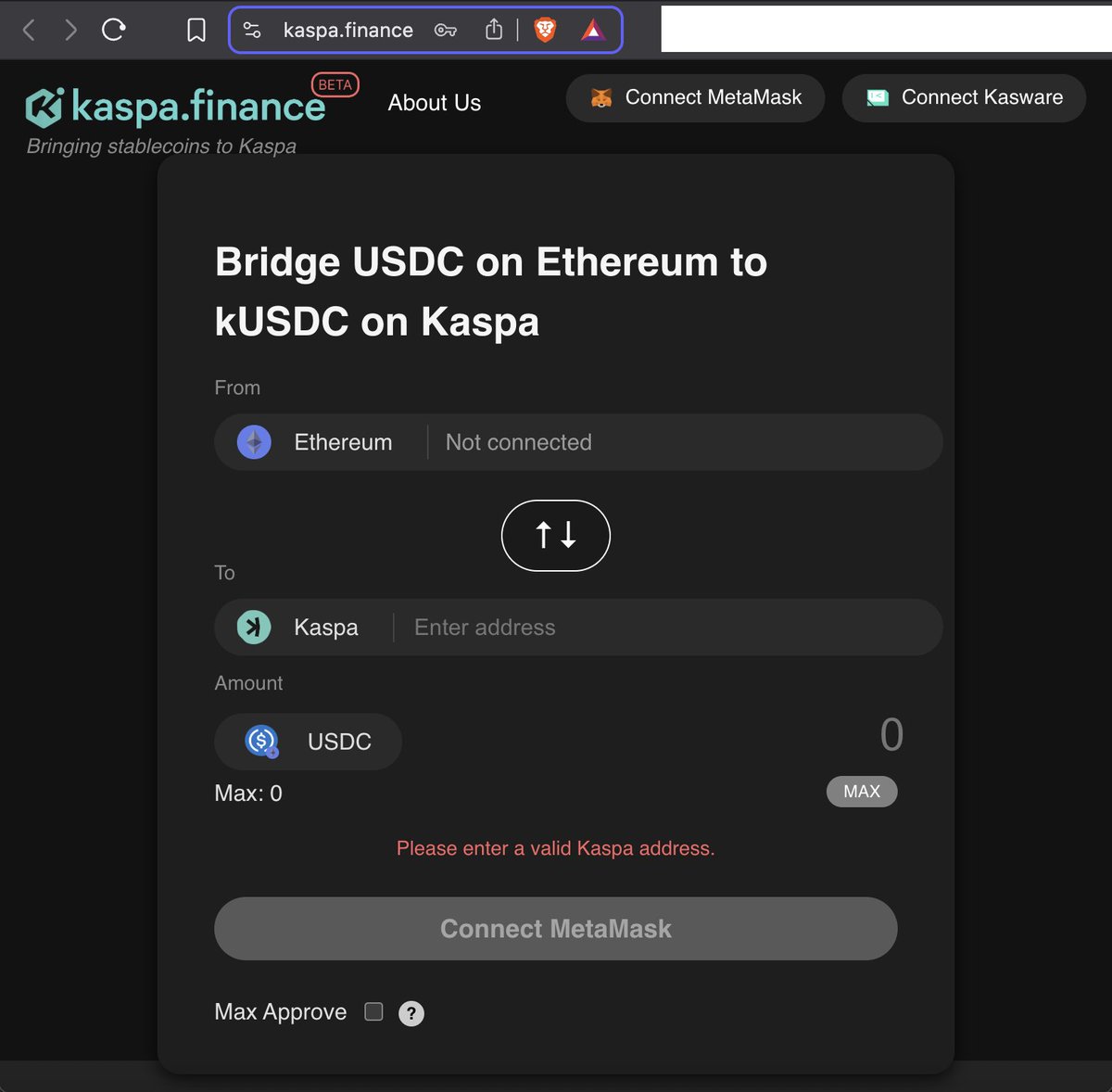
PROTOTYPE #KASPA $1 STABLECOIN on $KAS
1/6/26 test launch - feedback appreciated.
PoC live (beta) here: kaspa.finance
Deposit $USDC and receive $kUSDC 1:1 minus fees (& the reverse, convert $kUSDC back to $USDC on @ethereum. Max tx size $5 as we test the system.
DM me for the site password if interested.
@Kaspa_HypeMan @KasWare_Wallet @oneforonehaha @kaspaunchained @KaspaEVM @KaspaCentral @notontweetter @DailyKaspa @EYakoby @Igra_Labs @USDC @circle @hashdag @VitalikButerin @CoinDesk @DefiantNews @swicktalk @plzsats @Chris_Hutch7 @KaspaBuilders @Kaspa_Commons @Kaspa_KEF @Yestronaut
10
76
273
16,607
Josh Metnic𐤊 🏗️ 🇺🇸 retweeted

4 Dec 2025
So much to unpack in @hashdag's recent lecture!
I used @NotebookLM to generate an explainer video that is a bit easier to digest.
What are projects that will be built on $KAS that can't be built elsewhere?

In his recent talk, @hashdag articulated a comprehensive vision for Kaspa that goes beyond throughput metrics. He moved past technical specifications to define a core thesis: How Kaspa becomes true "Internet Money."
Currently, most blockchains operate as isolated mathematical silos, decoupled from off-chain reality. Here is a technical breakdown of the talk's key points.
1/ Breaking the Isolation: Internal Validity vs. External Reality
Current blockchains optimize strictly for internal cryptographic correctness but lack awareness of external context. Yonatan argues that to function as genuine Internet Money, the protocol must interact trustlessly with real-world events. For instance, upon significant market news (e.g., equity index changes), the chain must be capable of ingesting and reacting to that data immediately.
2/ The Latency Constraint of Nakamoto Consensus
Consider a high-velocity financial event (e.g., MicroStrategy’s inclusion in an index) that impacts asset valuation instantly. On Bitcoin, achieving probabilistic finality for a reactive transaction takes ~60 minutes. In the context of high-frequency internet finance, this latency is prohibitive. Kaspa aims to compress consensus and state reaction times to the moment the event occurs—effectively, a single Internet Round Trip Time (RTT).
3/ 100 BPS as a Statistical Security Parameter
High block rates are not merely for throughput; they provide statistical certainty.
Think of it as majority sampling:
• 10 samples (blocks) per second leaves a non-negligible margin for minority variance or manipulation.
• 100 samples (blocks) per second drives the probability of sampling the honest majority to ~100%.
High BPS enables rapid convergence, making the system resistant to tampering through granular, high-frequency sampling.
4/ High-Definition PoW: The Technical Moat
While PoS is often touted as the modern standard, Yonatan asserts that only Proof-of-Work (PoW) allows for the unforgeable, granular sampling of the honest majority in real-time without susceptibility to manipulation. This capability—High-Definition PoW—is a unique technical moat of the DAG structure that other consensus mechanisms cannot natively replicate.
5/ Future Utility: Native L1 Atomicity & Logic Execution
This architecture transforms miners into decentralized attestors of external state. It enables conditional transaction execution ("If Event A, then Action B") with zero-latency atomicity directly on Layer 1. This eliminates reliance on centralized exchanges or asynchronous bridges, allowing for instantaneous, trustless financial reactions.
6/ MEV Auctions for Execution Safety
To prevent miners from front-running transactions based on privileged knowledge of external events, the system proposes embedding MEV auctions. This mechanism ensures fair transaction sequencing via open bidding, protecting user intent and delegated strategies from exploitation by the consensus layer.
7/ Conclusion: The Nervous System of Value
Kaspa is not merely architecting a "faster Bitcoin." It is designing a reactive settlement layer—a nervous system—capable of synchronizing with physical reality and executing financial logic instantly. This defines the thesis of "Real-Time Decentralization" (RTD), the prerequisite for a true Internet of Value.
$KAS #Kaspa #Layer1 #PoW #DeFi #BlockchainArchitecture #MEV
27
120
360
49,722
Josh Metnic𐤊 🏗️ 🇺🇸 retweeted

21 Nov 2025
Not all compute can carry the future of AI.
As models grow larger and inference costs surge, what truly matters is no longer peak performance — but sustained usability, verifiability, and intelligent efficiency.
@PsyProtocol joins forces with @CodeStreamAI to redefine what scalable compute means ↓
4
15
342
5,411
Josh Metnic𐤊 🏗️ 🇺🇸 retweeted

2 Oct 2025
The case for the uniqueness of fast pow
tl;dr
Finality has two moving parts: (i) fast inclusion (= high bps, how quickly a tx gets into a block), and (ii) fast confirmations (= how quickly that tx becomes irreversible). Any system with rapid block production can achieve the first. The second is where the tension shows: in pos, fast confirmations press directly against decentralization. In fast pow, the two properties are decoupled.
prologue
A few weeks ago I came across Solana’s founder claiming: “Solana is the fastest monetary system in the world”. Since Kaspa already runs at a faster block rate, I was curious to check Solana’s finality times. That curiosity quickly pointed me to a deeper issue: not raw speed, but how speed interacts with decentralization.
——————
The tension is structural. In pos, finality means accumulating staked votes, and the more decentralized the stake distribution, the more time is required to reach finality. Here I’m not talking about hardware requirements or validator specs. The axis I’m discussing is centralization around the security mechanism itself: stake in pos vs. hardware in pow. To be secure, a block must be confirmed by a supermajority--typically >66.7% of the total economic stake. In a truly decentralized network, where n stakers with uniform share grows without bound, the time to coordinate this supermajority becomes a real bottleneck.
Pow works differently. It samples the hardware space without requiring the protocol to explicitly collect evidence from a majority of miners. Each block is itself a statistical proof that the finder out-competed the full network’s hash power. This process--and its timing--remains independent of how many individual miners participate.
Ethereum’s researchers understood this when moving to pos. Unlike Solana, which tolerates concentration to reach ~13-second finality, Ethereum’s designers could not accept that trade-off. Their solution was to introduce rotating committees. A rotating committee is a smaller subset of validators, randomly chosen from the full set, that votes on behalf of everyone else.
But this comes with a different security model, known in the literature as exposure to a BFT adaptive attacker. The committee is selected first and then votes. That “select-then-work” sequence is theoretically exposed to adaptive attackers, since members are known in advance. Pow, by contrast, is “work-then-select”: the winner is only revealed after the work is done. Think of it this way: in pos, you know who the referees are before the game starts, which gives an attacker time to pressure them. In pow, you only learn who won after the work is already done, which removes that attack surface. So n confirmations provide consistent confidence regardless of miner granularity, and the system stays secure even under adaptive targeting.
Beyond attack subtleties, the real issue is economic weight. When I send a billion-dollar transfer in a pos system, the question I care about is simple: how much stake is actually securing it? A committee vote provides strong statistical evidence, but only a true supermajority puts the full economic stake of the network behind my confirmation. In other words, a sampled committee may convince me that things are probably safe, but only the weight of the entire stake provides an overwhelming guarantee. And this is exactly where pow shines: each confirmation is not just a probability estimate, but a direct proof of work done against the full hash power of the network, no matter how many miners there are.
closing remark
I don’t claim to know every engineering detail of Ethereum or Solana. But I’m convinced the core principle holds.
I’ll state it simply: fast pow uniquely enables fast finality without forcing a compromise on decentralization.
58
442
1,060
120,553
Josh Metnic𐤊 🏗️ 🇺🇸 retweeted

22 Oct 2025
On 15 October 2025, a group of local investors were invited to the opening of Liberland’s new Shanghai Representative Office. This new, local option offers easy access to investment opportunities within Liberland, Serbia and Croatia.

4
9
22
1,682

13 Sep 2025
2
302
Josh Metnic𐤊 🏗️ 🇺🇸 retweeted
10 Sep 2025
Every once in a while, you can see the future.
10 Sep 2025

AI agents can prototype apps… But shipping real software takes hours of testing, debugging, and refactoring.
Agent 3 is 10× more autonomous — it keeps going where others get stuck.
The “Full Self-Driving” moment of software.
136
212
3,370
677,131
3 Sep 2025
3 Sep 2025

🇨🇳 China just held their biggest military flex in decades.
They revealed 11 weapons that have never been seen before in public.
Military analysts are calling it a 'strategic message.'
Here's what each one actually means 🧵 👇
421
3 Sep 2025
181
3 Sep 2025
$LLD is a fantastic #DAT asset that earns 10% interest by design. The governance is by officials elected on-chain. And the parent org seems to be quite healthily funded. #Liberland

thanks Josh! Great thinking
1
343
2 Sep 2025
I believe in $LLD as a digital treasury asset:
*Transparent #Liberland on-chain governance
*Interest bearing via staking at 10%
*Potential for deflationary upside long term
*Decentralized distribution across interested parties
docs.liberland.org/blockchai…
MCAP: $1.76M
Do your own research. Two companies I am involved with just made a total of three treasury purchases of LLD for long term holding so I am biased. #liberland @Liberland_org @InfoLiberland @justinsuntron @sunyuchentron @VitJedlicka #Liberpulco2025 @Jethrojhaykay @PirateChain @DavidovaSamuela @TomasForgac @Danuuuule @cryptucrypto
1
6
271

We can just set up manufacture the miners inside U.S.

15
7
93
27,624
Josh Metnic𐤊 🏗️ 🇺🇸 retweeted

20 Jun 2025
AI Agents who need escrow for securing payments with other agents or humans can now integrate Unicrow using Model Context Protocol, an emergent agent communication standard
medium.com/@unicrow/introduc…
5
9
1,148


Josh Metnic𐤊 🏗️ 🇺🇸 retweeted

29 Apr 2025
Would large scale Bitcoin mining deployment have prevented the power outages in Spain/Portugal?
Short answer: "Yes"
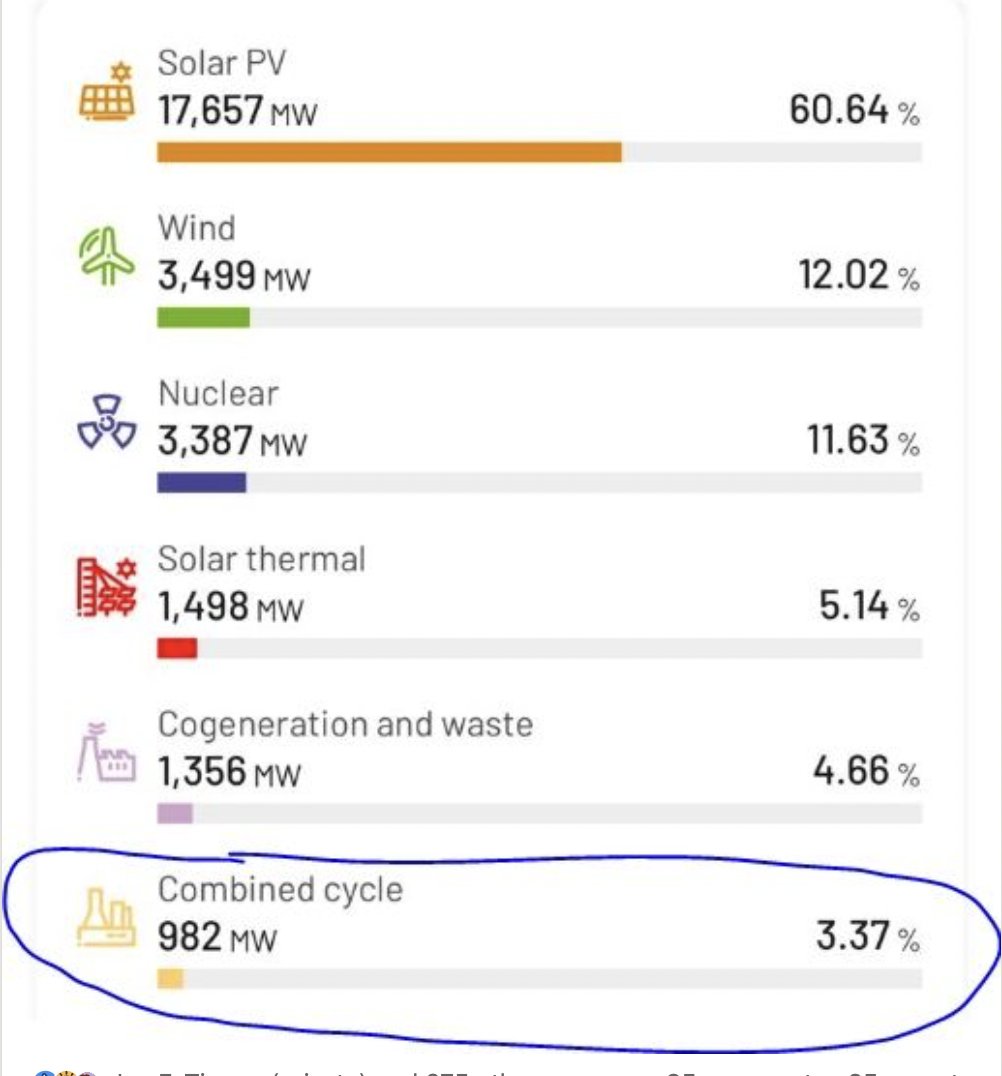
Before the outage hit, Spain was running its grid with very little of what's called "dispatchable spinning generation" (also known as inertia).
The image below is a snapshot from 12.30pm local time, 5 minutes before the outage occurred.
"Dispatchable spinning generation" means power plants, like gas or nuclear, that can quickly adjust their output to keep the grid stable. The name "spinning" refers to the turbines that traditional generation plants such as coal, gas, nuclear that use spinning turbines help with this.
Traditional plants provide this with their spinning turbines, but renewables don't, making the grid more fragile if you don't have a way to very rapidly load-balance in the case of an outage.
This likely contributed to the outage that hit Spain, Portugal, and parts of France, as the grid couldn't handle sudden disruptions well.
We don't need to speculate what would have happened had they had wide-scale Bitcoin mining operations: Texas provides a blueprint of what would have happened: Bitcoin minings would have been instantly notified of the major outage, and within under a second would have adjusted their demand, stablizing the frequency of the grid by preventing a major demand-supply imbalance.
Texas for context has the highest solar&wind penetration of any grid in US. On one recent day power from solar and wind was 76% of total Texas grid demand (canarymedia.com/articles/cle…), but Texas' (ERCOT) grid also has 3 GW of controllable load in the form of Bitcoin mining that it uses heavily in the case of outages or sudden unanticipated peak demand.
What happened in Spain and Portugal is not an inherent risk of renewables, its what happens when the renewable energy transition is done in a partial way, without due considerable to load balancing.
Batteries are part of the solution too. Bitcoin mining and Batteries have different unique advantages. Bitcoin mining has the advantage of being modular, and low cost to deploy. Bitcoin mining also keeps the cost of power low for retail users by reducing the expensive curtailment fees that grid operators would otherwise have had to pay solar and wind operators.
We have the solutions right under our noses, let's start using them.
29
152
608
46,199
15 Apr 2025
Our capacity for math and software capabilities as a society is directly proportional to our capacity to produce electricity.
@ericschmidt awesome interview at TechNatSec.
@tmskulyk @pete_rizzo_ @MarkYusko @nic_carter @DavidFBailey
youtube.com/watch?v=L5jhEYof…
1
3
253
Josh Metnic𐤊 🏗️ 🇺🇸 retweeted

6 Apr 2025
The countdown begins ⏳
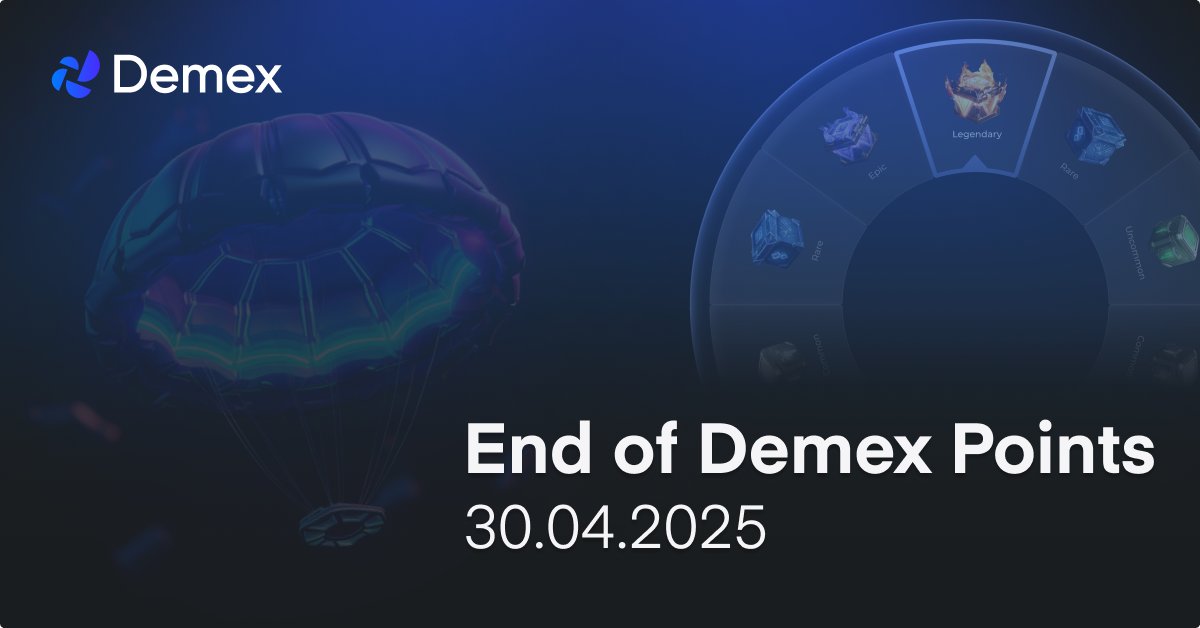
On April 30, the Demex Points system will come to an end.
This is your last chance to boost your points and lock in your allocation for the $DMX airdrop ⬇️
4
4
26
2,292
4 Apr 2025
On tariffs & #BitcoinMining. One of my favorite minds in the industry @notontweetter quoted by Bloomberg @crypto.
@swicktalk @pete_rizzo_ @elinagar @LynAldenContact @DavidFBailey @Leo_Peng_Li
“In recent years, the US emerged as a preferred destination—not merely due to energy costs, but because it offered legal, regulatory, and economic stability,” said Gadi Glikberg, CEO of CodeStream. “The newly imposed tariffs are unlikely to trigger a mass exodus. However, they may slow down or redirect future expansion plans, as miners reassess the long-term cost-efficiency of scaling operations within the US.”
bloomberg.com/news/articles/…?
3
2
6
422