
Techno optimism for technical founders. Hosted by @garrytan, @snowmaker, @sdianahu, and @harjtaggar.
Joined April 2024
- Tweets 59
- Following 20
- Followers 3,781
- Likes 51
14 Photos and videos





Lightcone Podcast retweeted

May 27
Over the past year, we've been building our own internal agent infrastructure at YC: over 350 tools, self-improving skill loops, and a shared organizational brain that gets smarter overnight.
In this episode of the @LightconePod, we sat down with YC General Partner Pete @koomen to talk about how he led the effort from the ground up.
We cover how giving agents unrestricted access to one database was the key unlock, the self-improving skill loops that get smarter overnight, and why he thinks we've arrived at the personal computer moment for AI.
00:39 — YC's AI Stack
02:15 — The Finance Team Problem That Started It All
05:07 — SQL Access Changes Everything
07:20 — One Database to Rule Them All
09:14 — Jevons Paradox
10:07 — Denormalizing for Agents
12:15 — The Single-Player Era of Agents
14:16 — 350 Tools and a Shared Registry
16:24 — Skillify, DRY, and MECE Resolvers
18:23 — The Self-Improving Dream Cycle
20:26 — The Two-Sentence Pitch Skill
23:06 — How Super Intelligence Compounds
25:10 — Recording Everything as a Building Layer
27:10 — The Shared Organizational Brain
29:18 — Trust-Default Culture as a Requirement
30:44 — Raising the Floor for New Employees
32:35 — Horseless Carriages
34:24 — Why Chat Is the Best Interface for Agents
38:50 — Just-in-Time Software
40:49 — Centralizing vs. Decentralizing AI
43:32 — The Personal AI Revolution
83
118
807
750,851
Lightcone Podcast retweeted
Apr 16
Physical Intelligence (@physical_int) is building a foundation model that can control any robot to do any task — what the team describes as the GPT moment for robotics. The company's cross-embodiment approach trains across many different robot platforms, and recent results show tasks being performed zero-shot that last year required hundreds of hours of data collection.
In this episode of the @LightconePod , co-founder Quan Vuong (@QuanVng) sat down with @garrytan, @snowmaker, @sdianahu, and @harjtaggar to talk about why robotics is finally ready for its scaling moment, how PI runs its models in the cloud rather than on-device, and the playbook for what Quan sees as a Cambrian explosion of vertical robotics companies.
00:00 — Robotics just got cheaper
00:41 — The GPT moment for robotics
02:24 — Why robots didn’t work before
05:30 — The breakthrough that changed everything
09:12 — The data problem
13:33 — Robots learning without data
15:05 — Robots folding laundry (for real)
22:18 — From engineering problem → ops problem
29:12 — The startup playbook
38:46 — Thousands of robotics startups are coming
26
56
425
115,427
Lightcone Podcast retweeted
Mar 27
François Chollet (@fchollet) has spent years asking a different question than most of the AI world. Instead of scaling what already works, he’s trying to understand what intelligence actually is and how to build it from first principles.
In this episode of the @LightconePod, he traces that path from his early work on deep learning to the creation of the @arcprize, and the launch of ARC V3, a new benchmark designed to measure something deeper than performance: the ability to learn, adapt, and reason efficiently in entirely new environments. He explains why today’s systems may be hitting limits, what recent breakthroughs really mean, and why reaching true general intelligence may require a fundamentally different approach.
00:00 - AGI by 2030?
00:31 - Introducing Ndea: A New Path Beyond Deep Learning
01:08 - A New ML Paradigm
01:30 - Replacing neural nets with compact symbolic programs
03:04 - Why Ndea Isn’t Competing With Coding Agents
05:20 - Why Everyone Might Be Wrong About Scaling LLMs
07:22 - Why Coding Agents Suddenly Work So Well
08:50 - The Limits of LLMs in Non-Verifiable Domains
10:48 - What AGI Actually Means (And Why Most Definitions Are Wrong)
13:30 - Why Deep Learning Hits a Wall
14:00 - ARC’s Origin Story
18:20 - ARC Benchmarks Explained: From V1 to V3
22:49 - The RL Loop Powering Coding Agents Today
27:03 - ARC-AGI V3: Measuring “Agentic Intelligence”
31:14 - Inside the ARC Game Studio
35:31 - Could AGI Fit in 10,000 Lines of Code?
44:01 - Building Ndea: From Idea to Compounding Research Stack
46:46 - The Future of ARC: Benchmarks That Evolve With AI
47:21 - Why There’s Still Huge Opportunity for New AI Paradigms
53:37 - How to Build a Breakout Open Source Project - Lessons From Keras
56:39 - Advice For How To Think About AI
41
95
619
151,015
Lightcone Podcast retweeted
Feb 21
With the takeoff of OpenClaw and MoltBook, a new agent-driven economy is taking shape.
On the @LightconePod, we took a look at the explosive growth of AI dev tools and whether the time has come for builders to make something agents want.
00:00 - Intro
02:12 - No human involvement is changing the experience
04:55 - Does YC need to change its motto?
07:48 - Email tools and agent infrastructure
09:36 - Agent-driven documentation
13:00 - Swarm intelligence
15:36 - Content generation and dead Internet theory
18:12 - Growth, rules, and founder insights
262
226
1,986
1,239,832
Lightcone Podcast retweeted
Feb 6
Wondering why your maker-turned-manager suddenly seems distracted in meetings? Maybe they're addicted to coding agents!
In this episode of Lightcone, @calvinfo — a co-founder of Segment and former engineer on OpenAI's Codex team — joins us to talk about why coding agents suddenly feel so powerful, the differences between Codex, Claude Code, and Cursor, and what the future of work will look like.
0:00 Intro
1:15 Garry can’t stop using Claude Code!
4:00 Contrast with IDE’s, context-splitting
6:23 Distribution models, top down vs bottom up
9:11 Licensing and optimization
12:28 Tips on becoming a top 1% user of coding agents
17:36 When can the agents work 24-48 hour running jobs on their own?
21:34 Can the agent teach things like architecture?
26:27 Will the next generation have even better taste and multitasking ability?
29:58 Maker vs manager schedules
31:36 How would Calvin build Segment now?
35:52 The importance of testing
38:52 The Claude bots are talking (to each other!)
40:10 Examples of complex issues, how will the tools evolve
43:00 Outro
14
13
98
18,397
Lightcone Podcast retweeted
3 Dec 2025
.@SpenserSkates has spent more than a decade building Amplitude from a YC startup into a public company, and in that time, he's had to reinvent himself just as much as the product.
Joining the @LightconePod, he talks through the shift from founder to large-company CEO, the skepticism his team initially had toward AI, and the moment they realized the next wave of analytics would require a full reset.
He walks through the hard reorgs, the bottom-up experiments, and the mindset changes that let Amplitude move fast again.
03:40 - Embracing AI at Amplitude
11:00 - Product roadmap, AI native priorities
15:32 - Org changes & hierarchy
18:40 - “AI killing SaaS”, changing the Amplitude roadmap
23:30 - The “features, not companies” debate, advantages for incumbents
32:14 - Finding good mentors, hyper focus
38:09 - The difference between being a founder vs a big company executive
22
22
161
83,899
Lightcone Podcast retweeted
14 Nov 2025
Logistics is a multi-trillion-dollar industry that quietly powers the entire global economy — and it's shockingly manual.
Ryan Petersen (@typesfast), founder & CEO of Flexport, joins the @LightconePod to break down how AI is finally touching the physical world: making shipping cheaper, speeding up global trade, and automating work that used to live inside emails, spreadsheets, and phone calls.
03:17 - When did AI tools become serious at the company
06:27 - The benefit of internal hackathons
12:03 - What internal AI projects have been most impactful at Flexport
14:40 - What software can do better and faster in logistics
19:08 - Goods get cheaper if more logistics get automated
21:18 - The spiritual/philosophical implications of AI in society
23:51 - How does AI change the model structure for companies?
26:38 - Would Ryan have built Flexport differently today?
36
56
415
152,969
Lightcone Podcast retweeted
30 Oct 2025
MIT's new State of AI in Business report went viral for claiming that 95% of enterprise AI projects fail. But the real story isn't that AI doesn't work — it's just big companies can't build it.
On the @LightconePod, @garrytan, @harjtaggar, @sdianahu, and @snowmaker break down what the study really says, why in-house enterprise AI efforts keep stalling, and how startups are filling the gap with products that learn, integrate, and actually deliver value.
2:08 - The enterprise AI adoption gap and why the failure rate is high
3:32 - Even Apple can be bad at software
4:30 - Why getting enterprise software to actually work is so hard
11:08 - The Reducto case study
13:39 - The type of enterprise employee you should find as a founder
14:39 - Meet founders who’ve been acquired by enterprises
15:25 - Enterprise/startup tension and symbiosis
31
56
306
118,551
Lightcone Podcast retweeted
17 Oct 2025
Nine out of ten people might tell you you're crazy. The tenth might see what you see.
This week on the Lightcone, @garrytan, @harjtaggar, @snowmaker, and @sdianahu discuss contrarian bets — the ideas that look impossible until they work. From Uber and Coinbase to DoorDash and Flock Safety, they share how founders find opportunity where others see dead ends.
0:00 - Intro
2:00 - AI verticals are becoming more crowded
6:22 - Non-obvious successes
9:50 - End users can get regulations changed
18:05 - Finding contrarian ideas, what founders should look for
25:10 - Flock Safety and selling to local governments
33:40 - The sci-fi founder and "impossible" big ideas
36:42 - Outro
20
29
186
147,506
Lightcone Podcast retweeted
3 Oct 2025
In the early days, the only moat that startups have is speed. Once you make something people want, the question becomes what deeper moats can you build on to defend against the competition.
On the @LightconePod, @garrytan, @harjtaggar, @sdianahu, and @snowmaker dive into Hamilton Helmer’s Seven Powers framework to find out how these moats show up in practice today in AI startups.
00:00 - The Moat Problem
01:30 - The Seven Powers Framework
04:20 - When to Think About Moats
08:40 - Forward Deployed Engineering
10:18 - Process Power
14:34 - Cornered Resources
19:30 - Switching Costs
24:54 - Counter Positioning
31:24 - The Workforce Displacement Reality
34:00 - Brand & Speed as Moats
37:30 - Network Economies
41:00 - Scale Economies
43:44 - Final Advice
31
38
413
240,289
Lightcone Podcast retweeted
18 Sep 2025
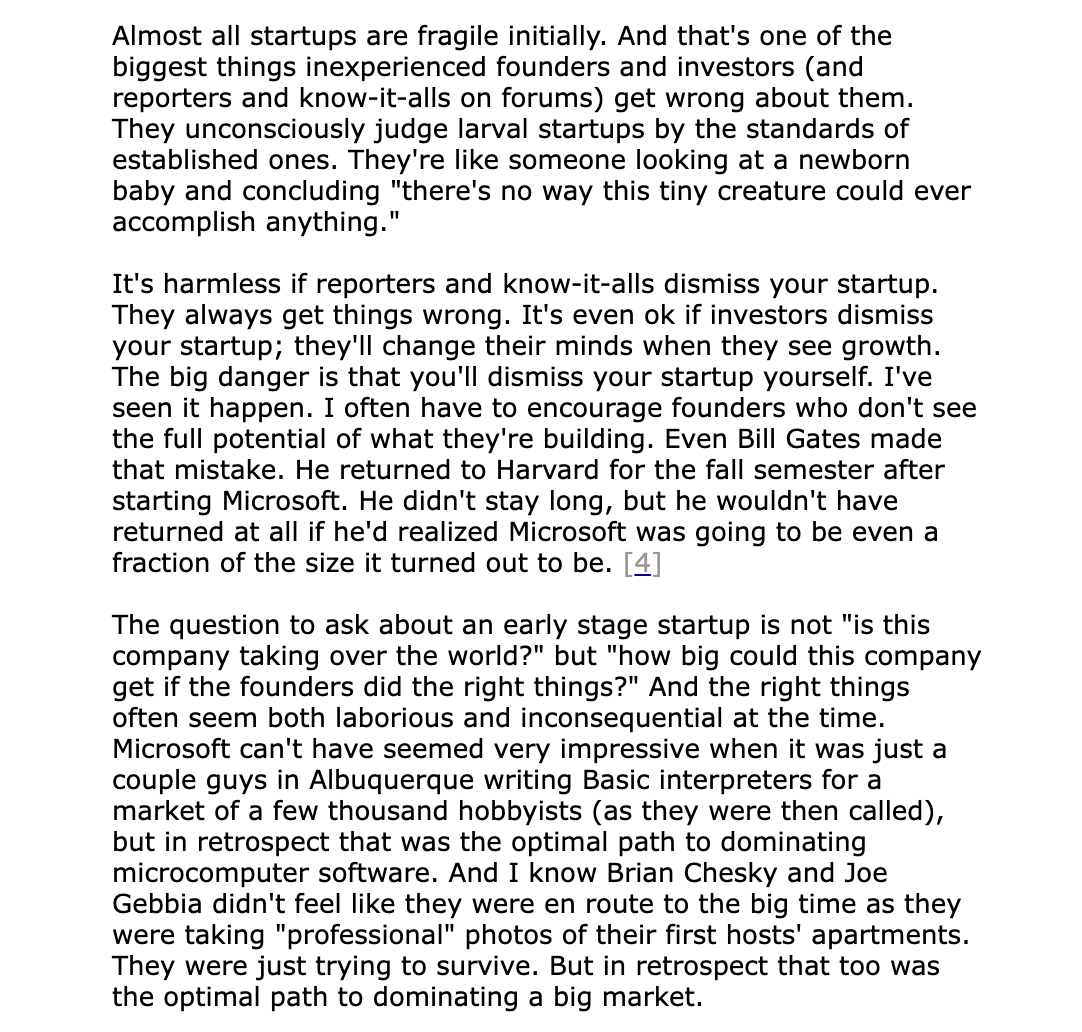
"It's harmless if reporters and know-it-alls dismiss your startup. They always get things wrong. It's even ok if investors dismiss your startup; they'll change their minds when they see growth.
The big danger is that you'll dismiss your startup yourself."
23
99
682
82,225
Lightcone Podcast retweeted
8 Sep 2025
Bob McGrew (@bobmcgrewai) helped build some of the most influential technologies of the past two decades.
He was an early engineer at PayPal, an early executive at Palantir—where he helped pioneer the Forward Deployed Engineer (FDE) model— and was recently Chief Research Officer at OpenAI - where he led the development of ChatGPT, GPT-4, and o1.
On this episode of @LightconePod, he explains how FDEs became central to today's startups, why "doing things that don't scale at scale" works, and where he sees the biggest opportunities for founders working in AI.
00:29 – From PayPal to Palantir to OpenAI
02:19 – The Role of a Forward Deployed Engineer
03:19 – How Palantir Invented It
07:56 – Product Discovery in the Field vs. Sales
09:51 – Echo and Delta Teams Explained
13:34 – Training Ground for Founders
14:35 – Consulting or Real Software?
17:54 – The Birth of Palantir’s Ontology
23:04 – Why AI Companies Adopt It
36:17 – What Success Metrics Look Like
41:14 – Building with Demo-Driven Development
44:56 – Joining the US Army Reserve
47:43 – Opportunities for Founders
40
83
532
408,673
Lightcone Podcast retweeted

19 Aug 2025
Anthropic Co-Founder Tom Brown: Why Anthropic Models Are The Best at Coding
"The benchmarks are so easy to game. All the other big AI labs have teams whose job it is to make the benchmark scores good.
We don't have such a team. That is the biggest factor."
@AnthropicAI's @nottombrown on @ycombinator's @LightconePod with @garrytan, @harjtaggar, @sdianahu, and @snowmaker
10
36
432
62,959
Lightcone Podcast retweeted
19 Aug 2025
Tom Brown (@nottombrown) co-founded Anthropic after helping build GPT-3 at OpenAI. A self-taught engineer, he went from getting a B-minus in linear algebra to becoming one of the key people behind AI's scaling breakthroughs.
Today, Anthropic's Claude is the go-to choice for developers, and his team is overseeing what he calls "humanity's largest infrastructure buildout ever."
On the @LightconePod, he discusses his unconventional path from YC founder to AI researcher, the discovery of scaling laws that changed everything, and his advice for young engineers entering AI today.
0:00 - From Failure to Success
2:30 - Early Startup Days at Linked Language
4:12 - The Grouper Dating Experiment
6:10 - Making the Leap to OpenAI
8:42 - First Product Launch Challenges
10:12 - Self-Teaching AI Research
12:44 - Building GPT-3 Infrastructure
15:44 - The Anthropic Spinoff
18:23 - Early Days of Building Claude
20:21 - The ChatGPT Wake-Up Call
22:08 - Claude 3.5 Sonnet Breakthrough
24:13 - Why Benchmarks Don't Tell the Whole Story
26:20 - Claude Code's Secret Sauce
28:51 - Building for the AI Agent
31:11 - The Largest Infrastructure Buildout Ever
32:46 - Multi-Chip Strategy
34:38 - Advice for the Next Generation
32
77
542
96,247
Lightcone Podcast retweeted
8 Jul 2025
AI has upended the once "safe" CS career path.
New grads are facing unemployment rates twice those of art history majors, and a CS degree is no longer a surefire ticket to wealth. At the same time, small, focused teams are scaling from zero to eight-figure revenue in months.
In a special Lightcone Live at AI Startup School, Garry, Diana, Harj, and Jared discuss why it's now more important than ever to focus on building real skills, domain expertise, and agency rather than just chasing credentials.
04:18 - The Inverted Career Risk Paradigm
05:16 - AI's Impact on Education and Skills
07:08 - Agency vs. Credential Maxing
08:28 - Motivation: Fear or Excitement
09:43 - The Accelerated Growth of AI Startups
10:50 - Real Success over Fake Credentials
12:55 - Domain Expertise and Technical Expertise
15:05 - Gaining Domain Expertise as a Student
18:51 - Breaking the Student Mindset
20:39 - The Dangers of Entrepreneurship Programs
22:52 - Social Media Strategy for Startups
27:30 - The College Dropout Question
32:33 - When to Quit Your Job
44
113
565
258,083
Lightcone Podcast retweeted
18 Jun 2025
Alexandr Wang (@alexandr_wang) started Scale AI to help machine learning teams label data faster.
It started as a simple API for human labor, but behind the scenes, he was tackling a much bigger problem: how to turn messy, real-world data into something AI could learn from.
Today, that early idea powers a multi-hundred-million-dollar engine behind America's AI infrastructure—fueling everything from Fortune 500 workflows to real-time military planning.
Just last week, Meta agreed to invest over $14 billion in Scale, valuing the company at $29 billion.
Alexandr joined us on @LightconePod to share how Scale evolved from a scrappy YC startup into the backbone of some of the world's most advanced AI systems, how he thinks about competition with Chinese AI labs, and what it takes to build infrastructure that shapes the frontier.
01:15 - Alexandr’s early days at YC
07:25 - Dialing in on what worked
10:24 - Model improvements, evals
19:18 - The techno-optimist view of work
27:47 - The turning points for Scale AI
37:37 - Agentic workflows
41:55 - “Humanity’s Last Exam”
47:48 - U.S. vs China in AI and hard tech
56:57 - How to be hardcore
21
68
426
396,916
Lightcone Podcast retweeted

30 May 2025
Prompting AI agents to consistently do what you want is becoming the most important skill for founders to learn and build their companies around. We share some of the more advanced techniques we've learned from founders, and building AI agents ourselves at YC, in the latest @LightconePod episode.
30 May 2025

At first, prompting seemed to be a temporary workaround for getting the most out of large language models. But over time, it's become critical to the way we interact with AI.
On the @LightconePod, Garry, Harj, Diana, and Jared break down what they've learned from working with hundreds of founders building with LLMs: why prompting still matters, where it breaks down, and how teams are making it more reliable in production.
They share real examples of prompts that failed, how companies are testing for quality, and what the best teams are doing to make LLM outputs useful and predictable.
0:58 - Parahelp’s prompt example
4:59 - Different types of prompts
6:51 - Metaprompting
7:58 - Using examples
12:10 - Some tricks for longer prompts
14:18 - Findings on evals
17:25 - Every founder has become a forward-deployed engineer (FDE)
23:18 - Vertical AI agents are closing big deals with the FDE model
26:13 - The personalities of the different LLMs
27:26 - Lessons from rubrics
29:47 - Kaizen and the art of communication
24
97
830
335,233
Lightcone Podcast retweeted
30 May 2025
At first, prompting seemed to be a temporary workaround for getting the most out of large language models. But over time, it's become critical to the way we interact with AI.
On the @LightconePod, Garry, Harj, Diana, and Jared break down what they've learned from working with hundreds of founders building with LLMs: why prompting still matters, where it breaks down, and how teams are making it more reliable in production.
They share real examples of prompts that failed, how companies are testing for quality, and what the best teams are doing to make LLM outputs useful and predictable.
0:58 - Parahelp’s prompt example
4:59 - Different types of prompts
6:51 - Metaprompting
7:58 - Using examples
12:10 - Some tricks for longer prompts
14:18 - Findings on evals
17:25 - Every founder has become a forward-deployed engineer (FDE)
23:18 - Vertical AI agents are closing big deals with the FDE model
26:13 - The personalities of the different LLMs
27:26 - Lessons from rubrics
29:47 - Kaizen and the art of communication
32
90
577
352,051

28 May 2025
In the AI era, the playbook is changing.
Instead of “fail fast,” it’s about following your curiosity and building with the latest tech.
Jared (@snowmaker) talks about why living at the edge of the future makes discovering great startup ideas much easier.
5
14
70
38,984