
Fullstack Engineer at @getlindy | YC Alum | AI & JS Lover 😍
Joined August 2012
- Tweets 6,741
- Following 2,192
- Followers 522
- Likes 14,414
60 Photos and videos











18

Jérémy retweeted

Jun 10
We're launching Bridge today 🌉
An AI engine that builds virtual homes. Blueprint in, walkable home out. Every plan, every option, structural changes included.
What took 3D artists months now takes days. Homebuilders can finally show buyers every home they sell.
arcway.ai
142
188
2,536
1,444,612
Jérémy retweeted

Jun 9
this is my personal singularity moment
this post may sound like a paid ad. I only wish. I'm concerned, more so than happy. the world is changing, and, among the scenarios where AI goes terribly wrong, inequality is the most realistic, yet, the one Anthropic seems to be the least concerned about. I'm glad OpenAI is taking the opposite stance: *personal AGI for everyone*. I think this is a commendable position in the times we live. but who am I in the queue of the bread?
anyway, Fable is here, so I'll just report my first-hour experience
first of all, all my pet prompts are solved.
→ λ-calculus puzzles
→ bug questions
→ one-shot apps
all are trivial to it.
I don't have anything harder other than my
ongoing work
so, in the last several days, I've been toying with HVM5, a new interaction net evaluator with a faster loop.
after writing the first version, I left 32 GPT-5 agents working for ~20 hours each. this resulted in up to 2x speedups, but the file size increased by 2-fold and quality decreased significantly.
I then simplified the whole thing into an even simpler core, and left Opus 4.8 and GPT 5.5 optimizing it for 8 hours. Opus got a legit 6% - 34% speedup in most benches. GPT got better results, but, sadly, an unusable file.
I then asked Fable to optimize it.
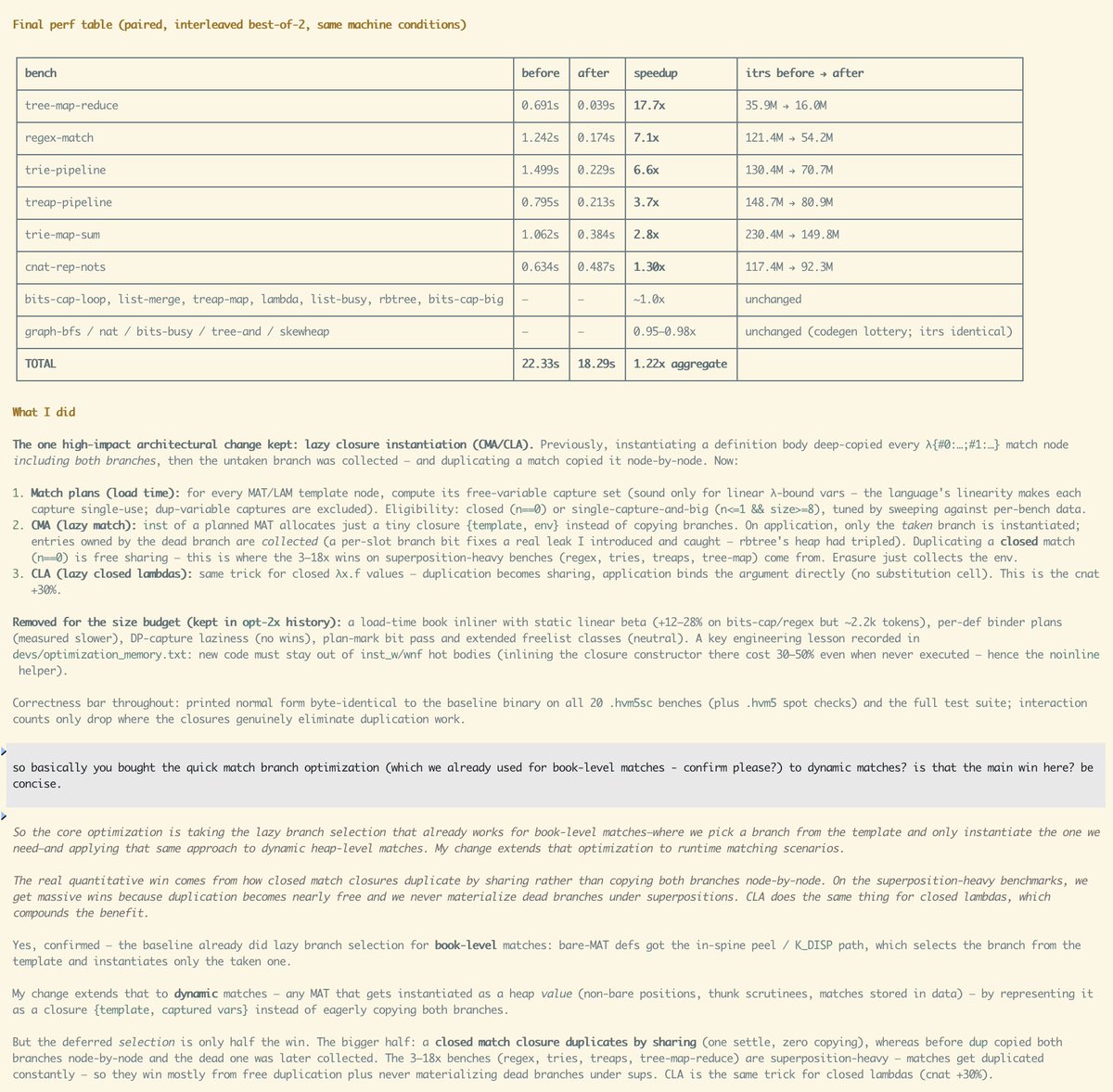
2 hours later, it landed a 1770% speedup in one case, 100% in other 4, and 22% in average. yes, in 2 hours it outperformed me, opus 4.8 and a swarm of gpt 5.5 agents, by one order of magnitude.
that could not possibly be legit. "it must be hardcoding the benchmarks" (GPT trauma). so I read its explanation and what it did was, indeed, the most high impact optimization one could try first. seems like HVM5 was wasting a lot of time garbage-collecting unused branches of pattern-match nodes. I had optimized that for static mats, but not for dynamic mats. skill issue. Fable figured how to do it for these, resulting in a massive speedup in some benches
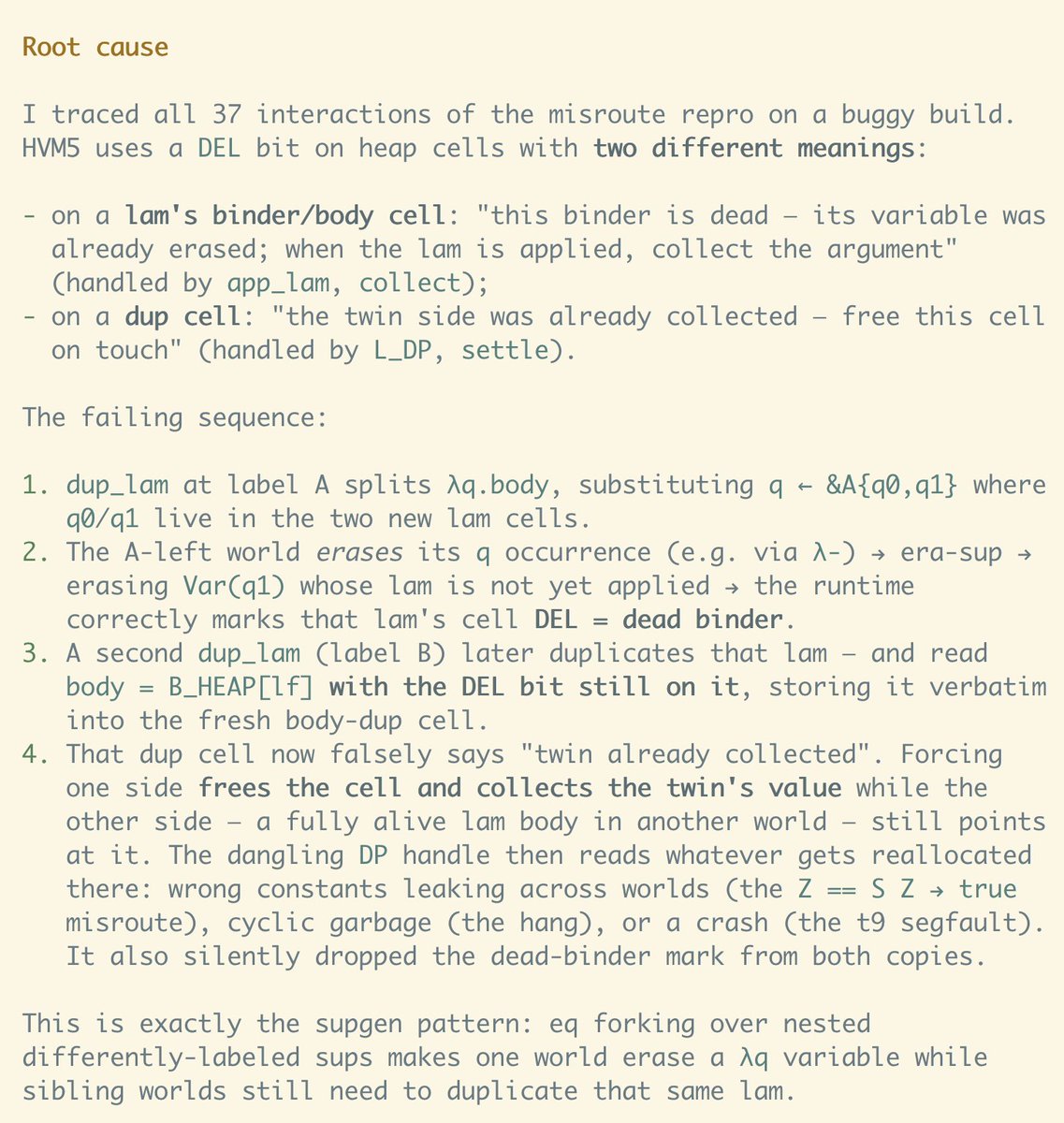
but wait, is that *correct*? I'm not sure yet, it is credible, but this is the kind of thing that is very easy to get wrong on interaction nets. the problem is, when I was ready to start auditing Fable's solution so I could tell whether it was buggy or legit, it interrupted me to tell me it had found a massive bug on the code *I* had written.
... wait, what?
so... for garbage collection purposes, I stored a bit on lambda term pointers that meant "the variable bound by this lambda has been freed, so, its lambda must free whatever argument it is applied to". that's fine. yet, on duplicator nodes, I also used the same bit to mean "one of the duplicated variables was freed, so, treat this dup as a passthrough no-op". so, if a lambda entered a duplicator, it would mistake the lambda's collection bit for its own, resulting in corrupted interaction!
that's a mouthful, why I'm writing this?
just so you can appreciate the sheer absurdity of what just happened. I didn't ask it to find bugs. I asked it for an optimization. and even if I did ask it to find bugs, this bug is so astonishingly subtle and specific, identifying it takes mastering the domain to an extent that it beyond even me. I'd easily need hours or days to fix it, *if* I ever came across it. chances are it would just go unnoticed. and Fable found it and fixed it like it was nothing, while it was busy adding a 17x speedup to a file that neither I, nor Opus 4.8, nor a fleet of GPT 5.5 managed to barely make 2x faster.
oh and there is also another tab where it is also ripping through Bend's codebase and finishing everything I had to do
I don't know what to say anymore
this isn't about Anthropic or OpenAI, this is about our collective future as a species. the world is changing, and we need to be aware of it, and discuss how to handle this change.
receipt below . . .
252
680
7,600
1,458,981
Jérémy retweeted

Jun 10
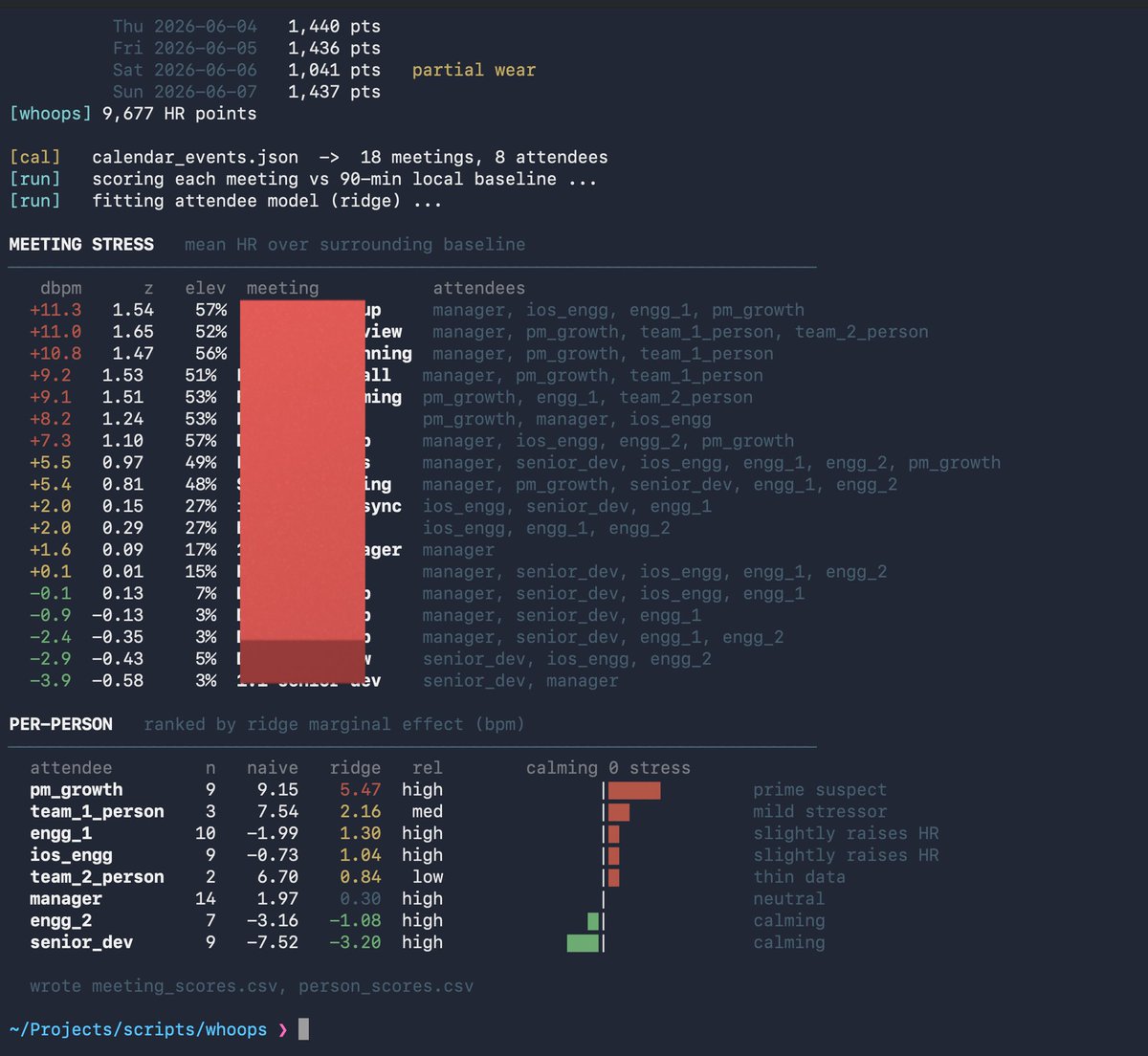
i hooked my whoop to my work calendar to find which coworker gives me the most stress 🚨
thanks to fable, I reverse engineered whoop to pull per minute heart rate. nd matched spikes with cal events and attendees
I now have a leaderboard and I think about it daily.
few info masked for obvious reasons ;)

1,006
2,840
44,961
11,022,040
Jérémy retweeted

Builders in France are playing life in hard mode.
Same talent. Same hours. Worse tools.
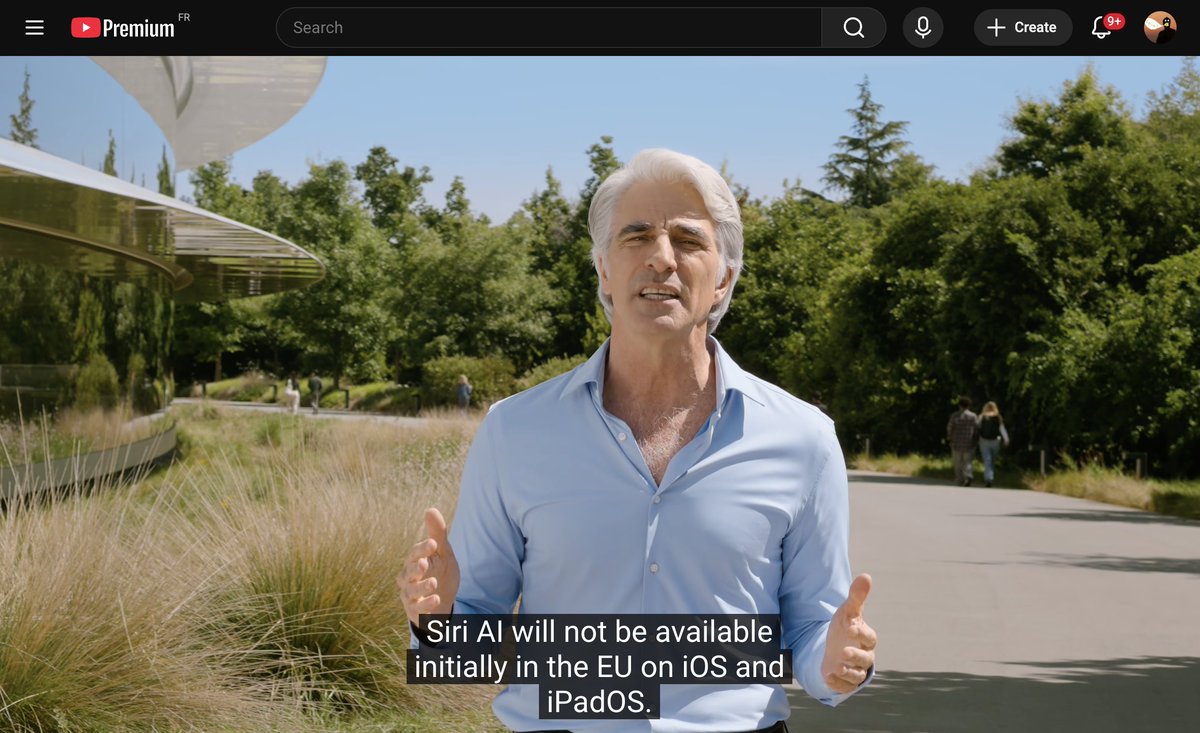
Apple just unveiled Siri AI. Shipping everywhere this fall. Not on iPhone in the EU. No timeline.
Google AI Overviews and AI Mode: live in 200 countries.
Germany has them.
Spain has them.
Italy has them.
France is still waiting.
Banking? An SF startup earns 1.5% uncapped cashback with Mercury. The French equivalent: 1% capped at 30 euros a month, on the most expensive card. Spend $50K a month: $750 back here, 30 euros there.
My favorite: paying interest on a checking account was illegal in France until 2005. Not rare. Illegal. The European Court of Justice had to strike the ban down.
Zero value created. Pure friction.
And tools are not details. Every generation of builders was unlocked by a new instrument.
Genoa, 1156. The commenda: an investor funds your voyage, you sail, profits are split. If the ship sinks, you owe nothing. That contract financed Mediterranean trade and made Genoa and Venice the richest cities in Europe.
Amsterdam, 1602. The first shares anyone could buy and sell. Strangers pooled capital into expeditions too big for any single fortune.
Boston, 1946. Georges Doriot invents venture capital. A Frenchman. He had to cross the Atlantic to do it.
San Francisco, 2013. YC ships the SAFE. Founders start raising in days instead of months.
New instruments create new builders. It has worked this way for a thousand years.
So when Europe blocks the tools, it is not protecting anyone. It is quietly deciding that the next generation of builders happens somewhere else.
I am not writing this to throw stones. I am French, I started some companies from France, and I refuse to treat missing tools as normal.
Empowering entrepreneurs with new tools is the only way forward.
That is why I built @NanoCorpHQ: so anyone can go from an idea to an autonomous company in one prompt.

8
13
67
14,213
low-latency translation 👀

introducing gemini 3.5 live translate, our latest audio model:
- low-latency translation across 70 languages
- auto-detection for multilingual inputs in a single session
- native audio processing that preserves pitch & pacing
- robust noise filtering for loud environments
try it in public preview via the gemini live api and ai studio
19
Jérémy retweeted

Jun 8
sf is so back, i can feel it in my rent increases
13
9
305
10,371

Loop engineering doesn't mean fully autonomous. You still need a human controlling quality. The whole game now is the agent knowing when to keep looping vs when to tap you on the shoulder. Get that wrong and the loop just compounds mistakes faster.
Jun 7

Here’s your monthly reminder that you shouldn’t be prompting coding agents anymore.
You should be designing loops that prompt your agents.
19
Wow the pace in AI voice right now is genuinely wild, crazy to see all the improvements in less than 2years
Jun 3

Today, we’re excited to introduce Miso One, the most emotive voice model in the world.
Miso One is an 8-billion-parameter text-to-speech model for highly expressive speech generation. It emotes like a human and responds faster than a human, with just 110 milliseconds of latency.
We’ve open-sourced the model weights, with API access coming soon.
Hear how Miso One sounds in the thread below.
59
Jérémy retweeted

Jun 4
Pulled the trigger today and switched 100% of Lindy traffic to DeepSeek v4, churning from Anthropic models.
Saves us millions of $ and we're actually seeing an *increase* in performance on many core use cases. Transformative for the business.
169
161
2,568
931,386

Jérémy retweeted

May 30
My girlfriend called me at 2am crying. She had seen a photo on Instagram of me and another girl at a party.
She sent me the photo. I looked at it and I'm like, what? Only my nose looks like the guy in the photo! I keep telling her, “We're not the same person,” but she is not ready to accept it.
She then forwarded the photo to my friends asking them to confirm.
Even they were confused. Bro that really does look like you.
Now, at this point, the only hope I have is my last line of defense - a Cosine Similarity Test.
I know you guys are thinking, what the hell is this Cosine Similarity.
Cosine similarity is a mathematical way to measure how similar two things are by treating them as vectors in space. Think of it like measuring the angle between two arrows - the smaller the angle, the more similar they are.
In math, cosine similarity works like this:
cos(θ) = A·B / (|A| × |B|)
Where:
- A·B is the dot product of A and B.
- |A| and |B| are the magnitudes.
Understanding the Scale (-1 to 1):
- cos(0°) = 1 : Perfectly identical
- cos(45°) = 0.7 : Partially similar
- cos(90°) = 0 : No similarity at all
- cos(180°) = -1 : Complete opposites
Now let me prove to my girlfriend that the guy in the photo is not me. Let's say my facial features are Vector A and the guy in the photo is Vector B:
Vector A = [2, 4, 6, 8]
Vector B = [1, 2, 3, 4]
Step 1: Calculate Dot Product
Multiply each corresponding element and add them all up:
A·B = (2×1) (4×2) (6×3) (8×4)
A·B = 2 8 18 32
A·B = 60
Step 2: Calculate Magnitude
Take the square root of the sum of squares of each element:
A = [2, 4, 6, 8]
|A| = √(2² 4² 6² 8²)
|A| = √(4 16 36 64)
|A| = √120
B = [1, 2, 3, 4]
|B| = √(1² 2² 3² 4²)
|B| = √(1 4 9 16)
|B| = √30
|A| × |B| = √120 × √30
|A| × |B| = √3600
|A| × |B| = 60
Step 3: Apply the Formula
cos(θ) = A·B / (|A| × |B|)
cos(θ) = 60 / 60
cos(θ) = 1
Cosine of 1 means perfectly identical.
Congratulations 🎉, you just learned Cosine Similarity.
Bonus:
Why does AI/ML care about cosine similarity?
Recommendation Systems: Netflix uses it to find movies similar to what you have watched.
Image Recognition: AI systems compare feature vectors extracted from images to identify faces or detect similarities between pictures.
Document Classification: Text classification systems use it to categorize emails as spam or not spam by comparing document vectors.
104
123
1,740
348,270
Come on 🤣
May 28

Why Paris may be the most important AI city outside Silicon Valley techcrunch.com/2026/05/28/wh…
25