
Joined July 2013
- Tweets 7,647
- Following 1,601
- Followers 5,412
- Likes 22,534
976 Photos and videos



Pinned Tweet

2 May 2025
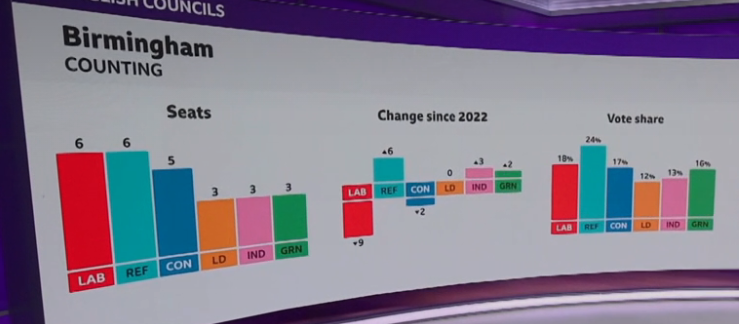
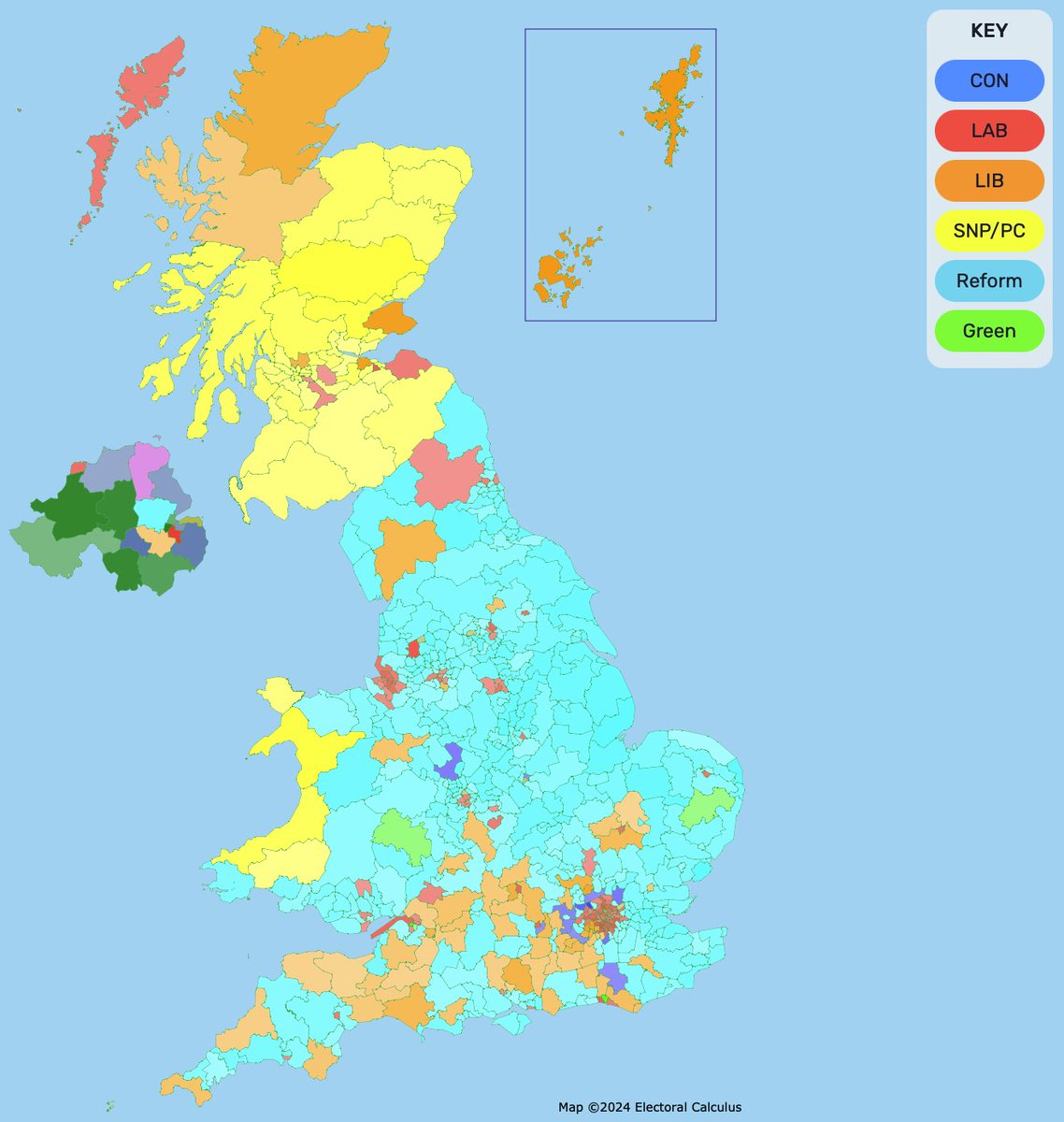
The BBC's Projected National Share in GB translates into the following seat tally:
➡️REF: 376 ( 371)
🌹LAB: 113 (-299)
🔸LD: 71 (-1)
🌳CON: 12 (-109)
🟢Green: 5 ( 1)
Reform Majority of 100.
114
281
1,574
349,015
I'm calling it.
Burnham wins by a margin that exceeds the vote share of Restore Britain.
🌹LAB: 47%
➡️REF: 35%
🇬🇧RES: 7%
BOOKMARK THIS TWEET.
8
44
2,961
Very astute observation here.
Many people who voted Labour in the Manchester mayoral race would have voted Reform in 2024 GE.
If people are conflating the two elections then the weighting in the constituency polls could be all wrong.

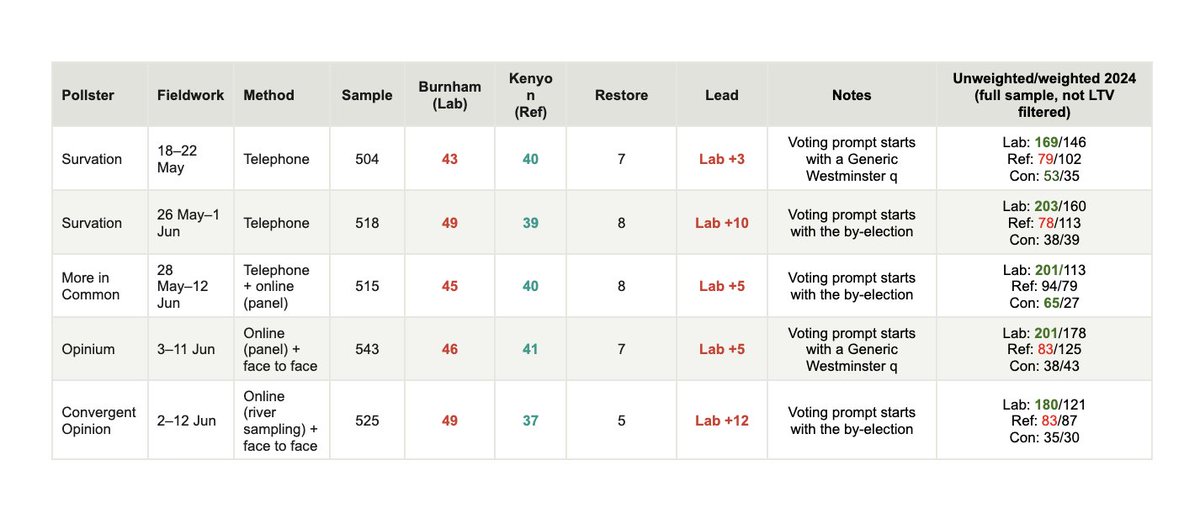
A shared methodological puzzle across all Makerfield polls: unweighted Labour 2024 recall clusters nearer to the Burnham Mayoral figure (66%, Wigan), not the GE figure (45% for Josh). Weighting corrects to GE PV. But if the recalled vote isn't the GE vote, the correction misfires - suppressing Labour VI and inflating Reform.
There's fighting talk from the PM today but what's the plan in the event of a complete Burnham blow-out?
1
14
3,151
And by all wrong, I mean that Labour's lead is massively understated, as this overlooks the Reform to Labour switchers, thinking they were Labour voters all along.
1
2
458
Jun 15
Unless Restore pulls in a HUGE number of non-voters and the turnout in Makerfield far exceeds the turnout in the 2024 GE, then I think this is a massive stretch.
That said, one prediction I will make is that the turnout in this by-election will be higher than in the GE.
Jun 15

.@RestoreBritain will get between 9,000 and 12,000 votes in Makerfield.
4
30
4,496
Jun 15
Around 40k votes were cast in GE 2024.
Given the significance of this by-election, I can see the turnout going up to around 45k.
1
5
392
Jun 15
Oh yes. Who could forget about the Scottish seats as well?
There's not 1 parliamentary by-election taking place on Thursday, but 3:
Makerfield
Aberdeen South
Arbroath and Broughty Ferry
Outside chance of Tories gaining Aberdeen South (20% chance), but both Scottish seats should be SNP holds.
Anything else would be an upset especially considering the SNP was reduced to a rump in Parliament back in 2024.
Jun 15

New Swingometer! Another by-election post where I take a look at the Makerfield seat polling, prospects for Restore in the seat, and also take a look north at the two Scottish seats which vote on Thursday:
open.substack.com/pub/swingo…
2
35
8,094
Jun 15
What do the vote shares in the upcoming Makerfield by-election mean for the parties?
Here is my list of what bad/average/good/great looks like for the top 3 parties:
🌹 LAB: 37% / 42% / 46% / 50%
➡️ RFM: 32% / 36% / 40% / 45%
🇬🇧 RES: 3% / 7% / 10% / 15%
3
1
59
10,848
Jun 15
Judging by this response, the Labour Party may want to U turn on votes at 16.
Jun 15

🚨 WATCH: School children react to the UK social media ban for under-16s live on BBC News
11
7
154
6,395
Jun 8
There isn't an industry standard for defining what a 3 horse race is in British politics, but if 1st place and 3rd place are separated by a margin lower than 10%, then I will record myself eating a hat.
Jun 8

I was in Makerfield yesterday.
Anyone who thinks this is a two horse race, is wrong.
It's a three horse race, Labour, Reform AND Restore.
2
2
16
1,820
Jun 4
Three mutually exclusive scenarios from the Makerfield by-election and their probable outcomes.
1) Labour wins by a margin greater than Restore's vote:
Andy Burnham becomes PM and Reform pivots to the centre policy-wise to court a bigger pool of voters.
2) Labour wins by a margin that is lower than Restore's vote:
Andy Burnham becomes PM and Reform pivots right to win back disaffected Restore voters and in so doing alienates the Tory/ex-Labour waverers, but quashes Restore's momentum.
3) Reform wins:
Business as usual and pressure mounts to oust Starmer, except there is no obvious replacement. Starmer stays on until 2029 and Restore remains a threat on the right to Reform.
If this poll is anything to go by, then expect a Starmer sacking and a Burnham bounce.
Jun 4

Makerfield By-Election Update:
survation.com/makerfield-by-…
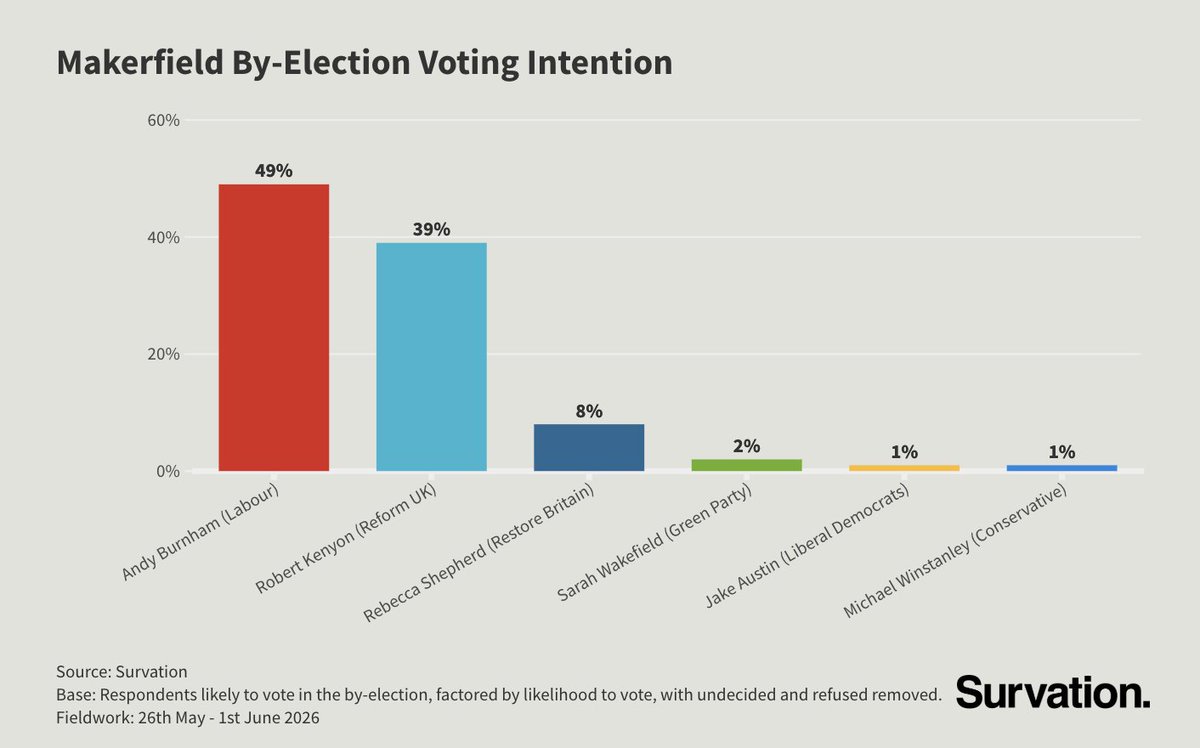
Survation conducted a new poll of the Makerfield constituency. Fieldwork was conducted by telephone among 518 adults in the constituency between 26th May and 1st June 2026. A combination of landline and mobile data were used.
Methodology Statement
Population Sampled: All residents aged 18 living in the Makerfield parliamentary constituency.
Total Sample Size: 518
Data Collection Method: Telephone interview. A combination of landline and mobile data were used.
Fieldwork Dates: 26th May – 1st June 2026
Data Weighting: Data were weighted to the profile of all adults in Makerfield constituency aged 18 . Data were weighted by age, sex, ward and 2024 General Election vote.
Targets for the weighted data were derived from Office for National Statistics data and the results of the 2024 UK General Election.
Margin of Error: Because only a sample of the full population was interviewed, all results are subject to a margin of error. For example, in a question where 50% gave a particular answer, with a sample of 518 it is 95% certain that the “true” value would fall within 4.8 percentage points of the sample result.
Headline by-election voting intention - Table V2 (likelihood-weighted, undecided/refused removed, no squeeze):
Candidate / Party / Vote share
Andy Burnham - Labour 49%
Robert Kenyon - Reform UK 39%
Rebecca Shepherd - Restore Britain 8%
Sarah Wakefield - Green Party 2%
Jake Austin - Liberal Democrat 1%
Michael Winstanley - Conservative 1%
Another party <1%
Base: likely voters, factored by likelihood to vote, with undecided and refused voters removed
Data tables are available here: cdn.survation.com/wp-content…
16
8
97
37,788
Jun 1
Very good analysis here.
Another point worth analysing is the proportion of voters in 2026 locals who didn't vote in 2024.
The party that can re-engage with non voters the most effectively will get the keys to Number 10.
Jun 1

A key point from the data we collected for this post is the importance of differential turnout in the local elections.
Reform 2024 voters were just much more enthusiastic than those of other parties. Had it been even their percentage would have fallen into the low 20s.

2
1
12
2,002
Marwan🇲🇦🇬🇧 retweeted

Jun 1
A key point from the data we collected for this post is the importance of differential turnout in the local elections.
Reform 2024 voters were just much more enthusiastic than those of other parties. Had it been even their percentage would have fallen into the low 20s.
May 31
New post:
"Playing on difficult mode"
Using data from an exclusive new mega-poll I look at how a new Labour leader can come up with a governing project that rebuilds the party's voter coalition.
And I explain why Blair's strategy wouldn't work.
open.substack.com/pub/samf/p…
3
13
28
25,724
May 28
I wonder.
If Labour beat Reform in Makerfield by a margin wider than Restore's vote share, will there be any fall out?
7
1
25
5,597

Restore Britain is a good eg of the Netflixification of British politics, where social media has reduced the barriers to entry so much you can now find and vote for a political party that is most entirely attuned to your preferences without needing to swallow bits you don’t like.
Why Netflixification? In the past with TV you’d have to watch one of four or five channels with content tailored to the median viewer. Some were habitual channel hoppers but for most you’d like some of it not all of it and switch between them if you were really unhappy.
Netflix, Disney, Prime change all of that, rather than watching median content you can watch exactly what you want when you want, no compromises needed.
So too with political parties. In the past most would stick with the big 3 or 4. Some people were habitual swing voters, most stuck with parties even if they didn’t like everything they advocated. It was best fit rather than perfect match.
Social media changes that, it reduces barriers to entry for new parties and enables more choice. Increasingly we find can vote for parties that directly fit our world view because of the platform
They are given to reach people directly as Lowe has shown.
Reform was a product of that opening, but what’s striking is Restore shows it’s not the end point. For some Reform involves too much compromise and so they are able to go for a more “full fat version” and so rather than the 7 party system in Britain being the new end point it could just be the start (an extreme end point is a form of direct democracy where parties are perfectly attuned to individual voter preferences).
Obviously there are still factors which pull against the personalisation of politics, greater fragmentation also incentivises more tactical voting which squeezes that individual choice.
Nor is social media the sole reason for fragmentation, the failure of the main parties to deliver post 2008 and the broken social contract are clearly the biggest drivers of the turn away from traditional mainstream, but social media enables it more.
In fact the internet/social media have enabled (for good or ill) more personalisation in every other area of life, politics was a bit slower getting there.
25
30
190
42,309
Marwan🇲🇦🇬🇧 retweeted

Makerfield by-election briefing. Data tables and all prior materials are on the link below:
Points to note.
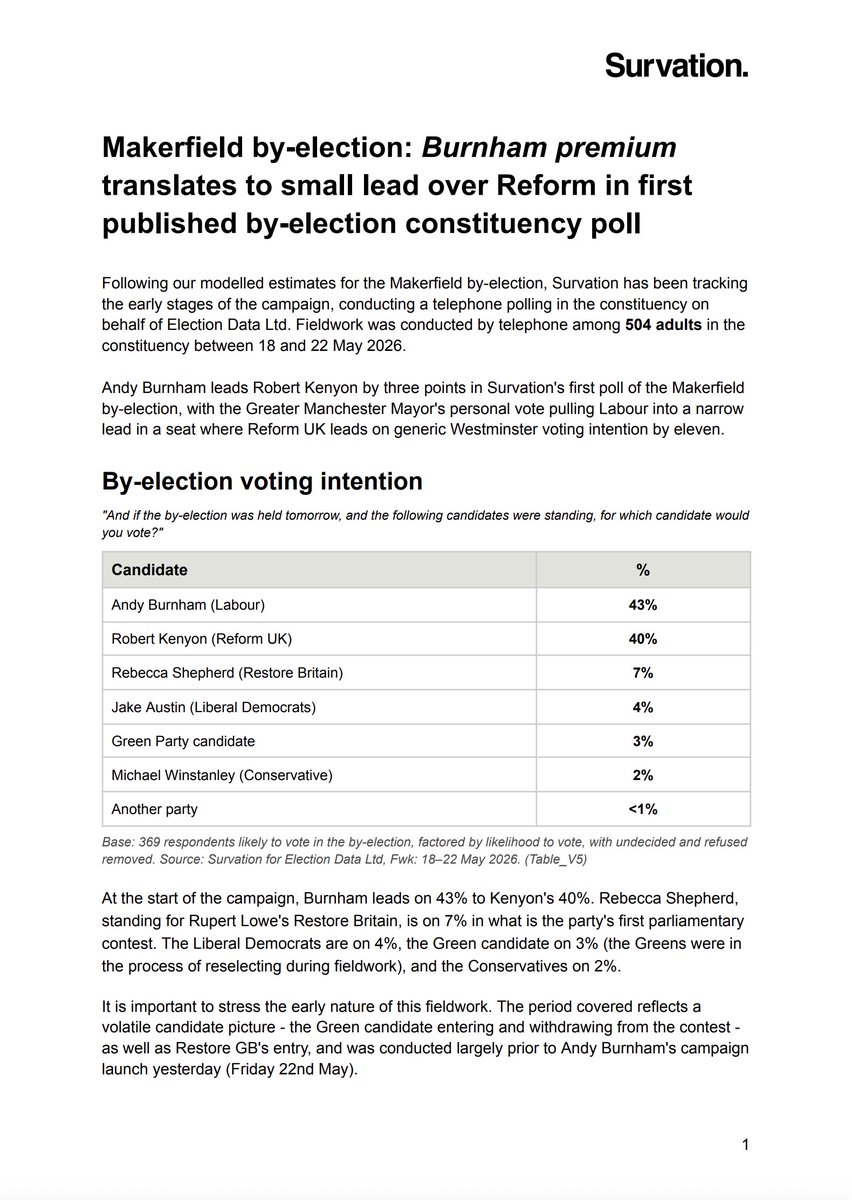
*This is a poll of 505 people in Makerfield this week and should be seen as an indicative early look.
*By-election headline voting intention with named candidates as were available is the 3 point Labour lead over Reform from table V5
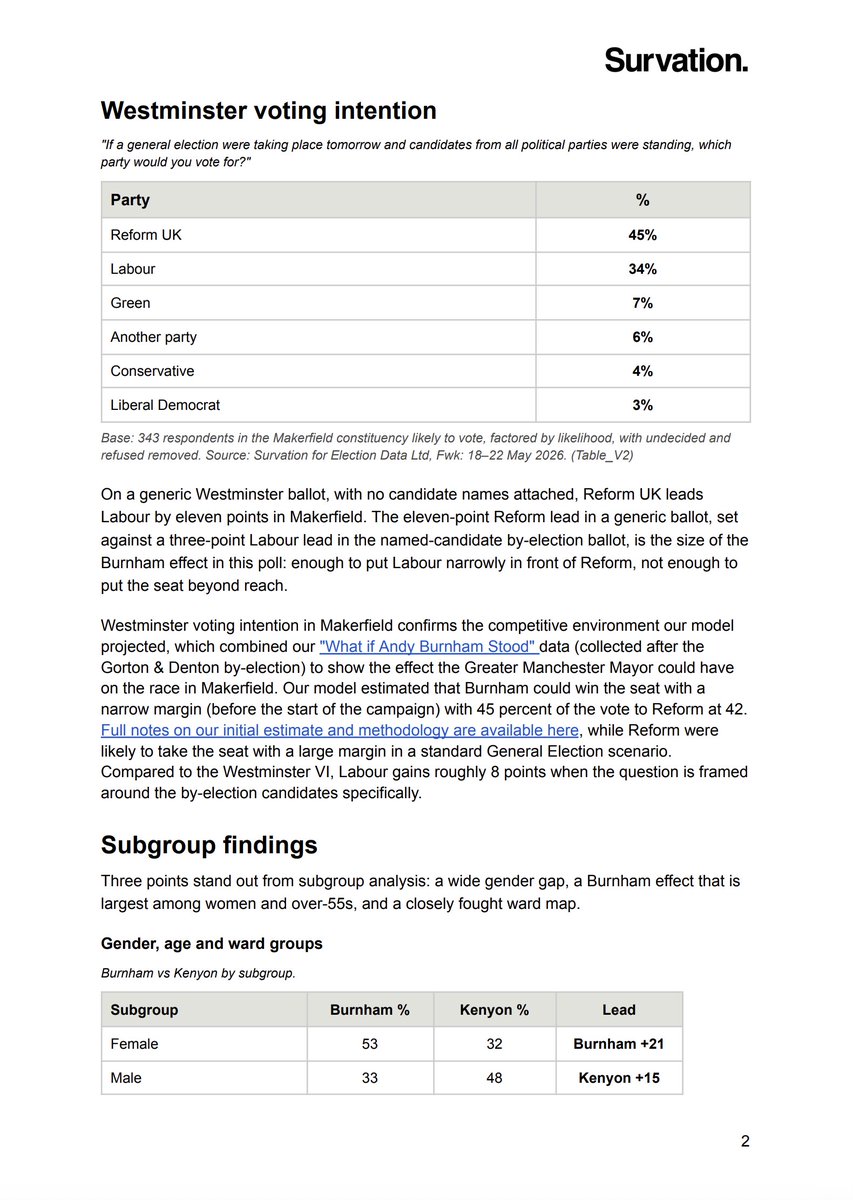
*Reform (45%) have a 9 point lead over Labour on a generic Westminster polling question
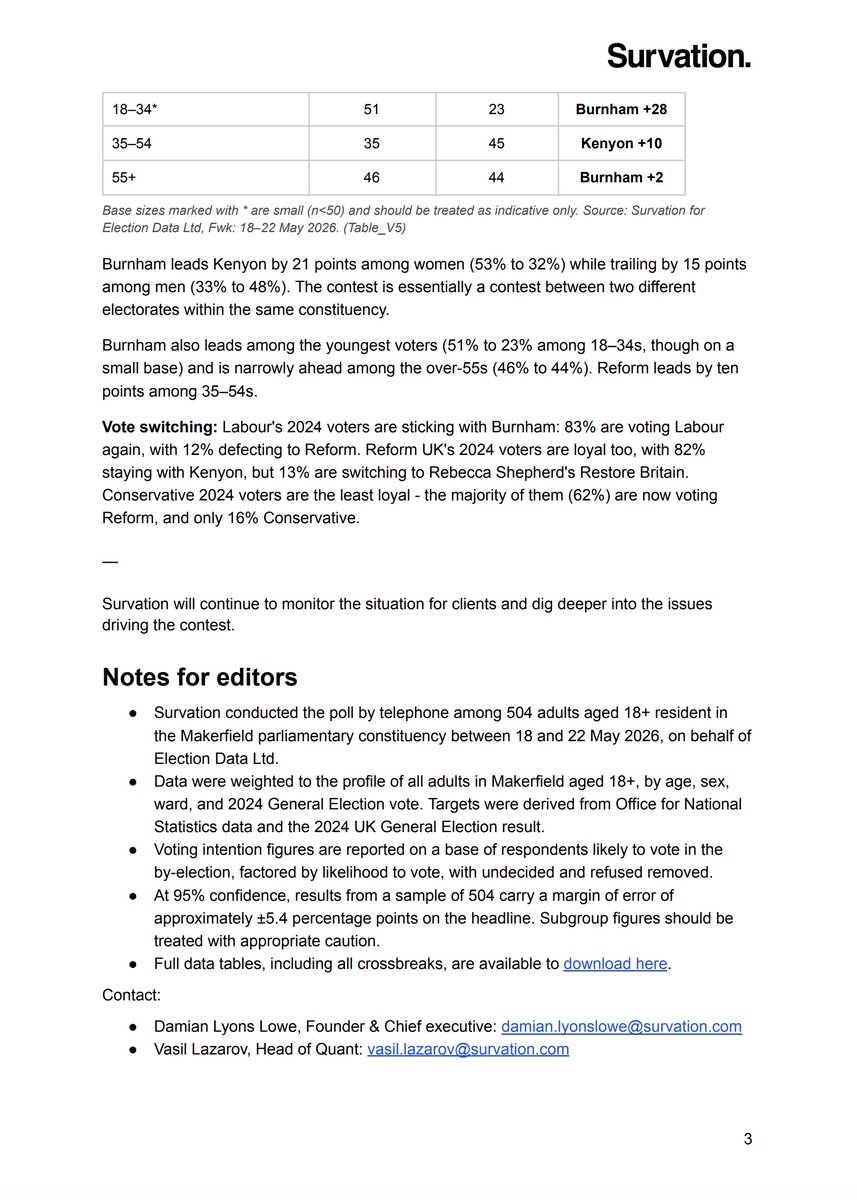
*Burnham has strong leads among women and younger groups, Kenyon fares better with older voters in general and leads among men.
*How the Green and Restore campaigns pan out could be key. There's also at least a 7% Green Westminster vote share up for grabs.
*Do get in touch if you have question or concerns and have a lovely Sunday!
mailchi.mp/survation/whats-t…]
16
30
88
54,038
May 23
If Labour's vote drops by only 2 points since 2024, then that is a real vindication of @AndyBurnhamGM's popularity in Greater Manchester.
Pincer movement from Restore doesn't help Reform much either.
Restore getting 5-7% in Reform target seats will cost Reform up to 100 seats.
May 23

🚨 Makerfield Voting Intention:
🌹 LAB: 43% (-2)
➡️ REF: 40% ( 8)
🟣 RES: 7% ( 7)
🔶️ LDEM: 4% (-3)
🟢 GRN: 3% (-1)
🌳 CON: 2% (-9)
☑️ OTH: 1% (=)
From @Survation
From 18th - 22nd May
Changes with GE2024
*26 DAYS TO GO*
13
25
251
35,916
May 12
Fasten your seatbelts.
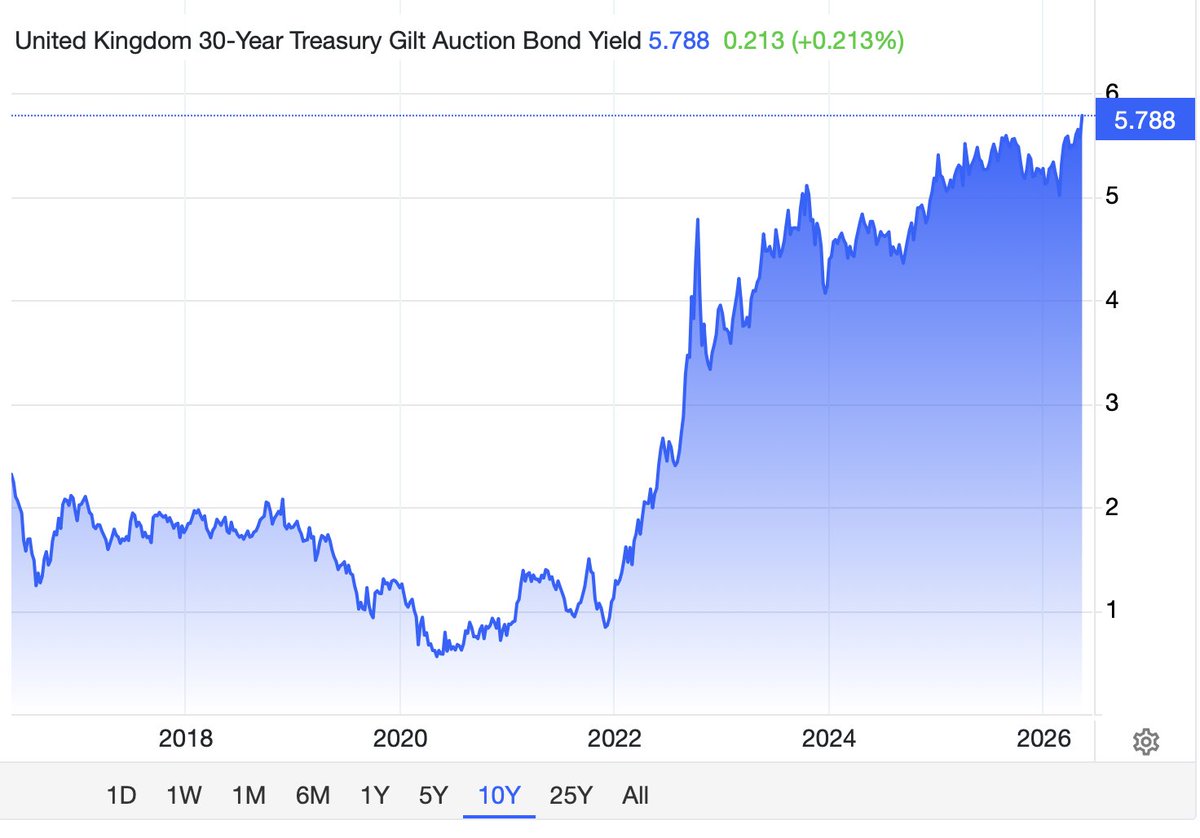
30-Year treasury gilts have reached a 10 year high.
Even higher than just after the Truss mini-budget was announced
1
12
1,042
May 11
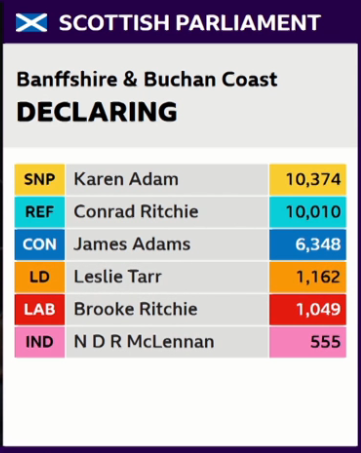
Reform may have fallen short in the Banffshire and Buchan Coast constituency by 300 votes, but they topped the vote there in the regional list by nearly 5%.
➡️ RFM: 33.8%
🟡 SNP: 29.0%
🌳 CON: 20.5%
🟢 GRN: 4.5%
🔸️LD: 4.4%
🌹 LAB: 4.0%
3
49
527
13,207