The data required for rational economic planning are distributed among individual actors and thus unavoidably exist outside the knowledge of a central authority
Joined June 2020
- Tweets 26,755
- Following 1,219
- Followers 1,668
- Likes 117,790
5,243 Photos and videos








"happiness = quality of life minus envy."
16h

Jimmy Carr nailed something a lot of us feel but can’t explain.
We’re living better than 99.9% of humans who ever walked the earth, hot showers, modern medicine, endless entertainment, kids that actually survive infancy, yet so many of us feel miserable.
He calls it “life dysmorphia.” We get used to how good we have it (the hedonic treadmill), then compare ourselves to everyone else and tank our own happiness.
As he puts it: happiness = quality of life minus envy.
Marcus Aurelius put it perfectly: “Very little is needed to make a happy life; it is all within yourself in your way of thinking.”
When was the last time you caught yourself feeling unhappy despite objectively having it pretty damn good?
1
1
37
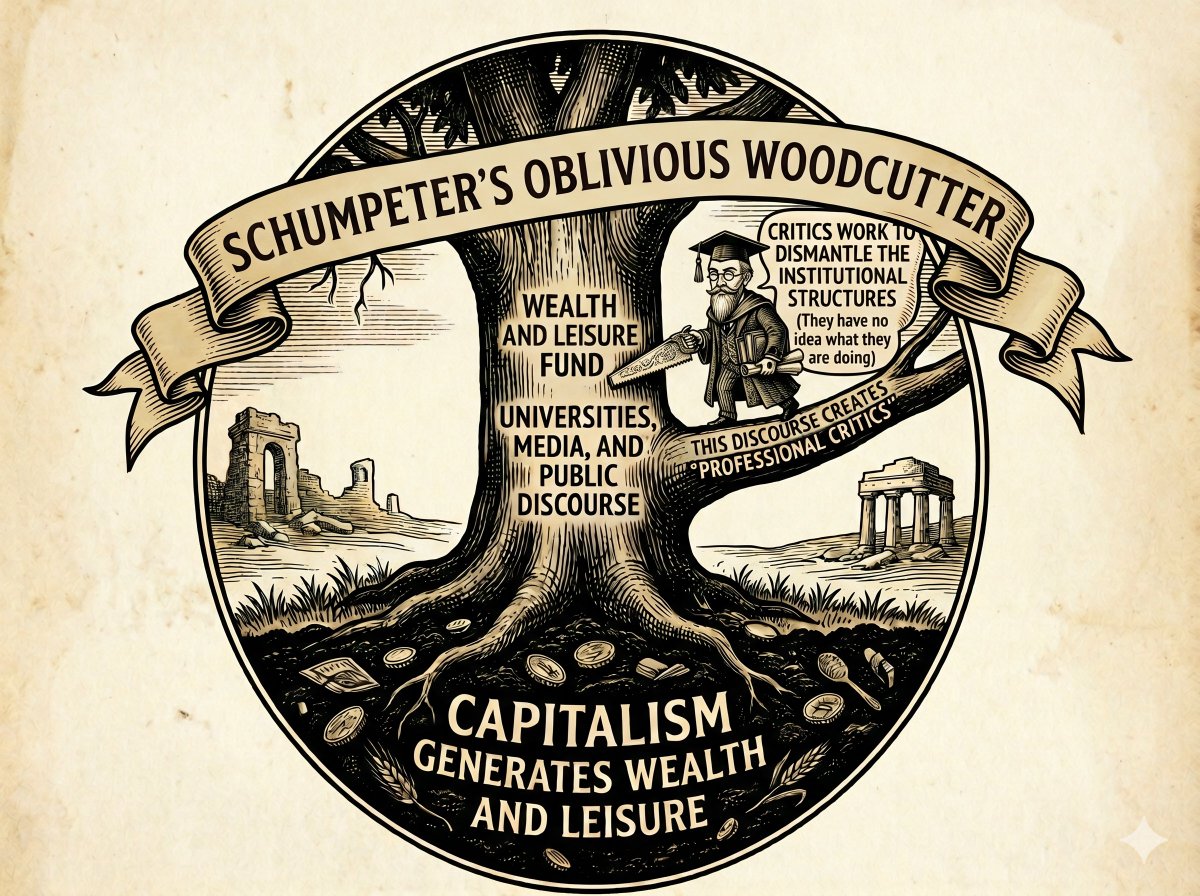
Degrowth: "The argument commits a category error: it confuses matter with value."

"The pie is fixed. The Earth is a closed system. You cannot have infinite growth on a finite planet."
I hear this constantly, and it's delivered like a law of physics — case closed, only a compromised economist could disagree.
It's wrong. And the mistake is revealing, because it isn't in the physics. It's in the economics smuggled inside the physics.
2
43

Musk's companies fund growth via new equity/debt issuances to investors, revenue reinvestment, and contracts—not by him dumping personal shares. He typically borrows against Tesla stock as collateral for liquidity (retaining ownership/control, deferring taxes) rather than selling.
A wealth tax forcing cash payments would trigger ongoing sales, eroding his stake and diverting capital to government. That reduces alignment and signals, without directly funding the companies. The 2012 hypothetical overlooks these mechanics and incentive shifts.
1
1
33
The origin of positive-sum mutual exchange: consumer surplus producer surplus.
2
105
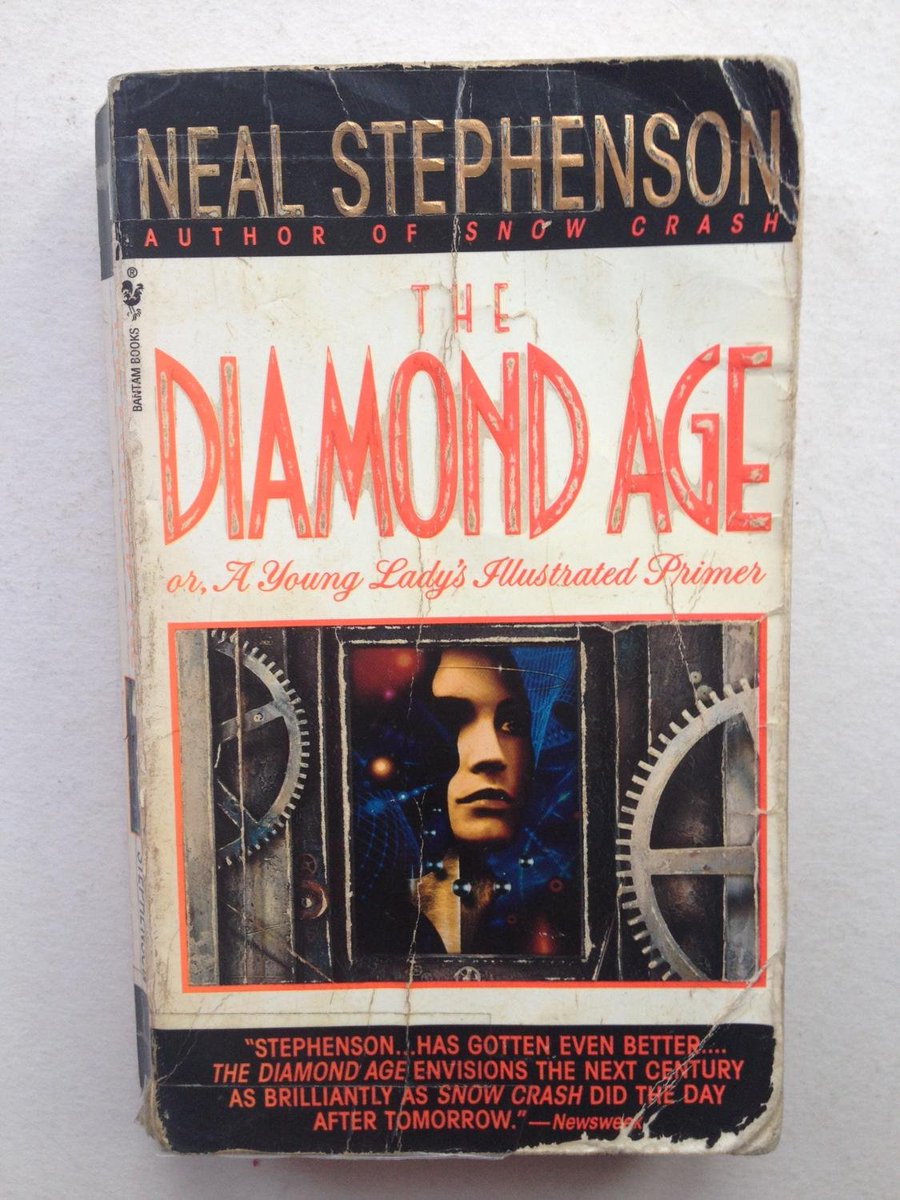
I couldn't help but quote tweet the original. I cannot say enough about how prescient Neil Stephenson's "The Diamond Age" is for this place and time. Its foreshadowing of "the end of scarcity" as a result of technological advancement is signature Stephenson.
"The Diamond Age is fundamentally a novel about the mechanics of culture—how it is transmitted, why it ossifies, and whether it can be engineered. While it is often discussed in the context of "nanotechnology," Stephenson uses that technology primarily as a plot device to remove the constraints of scarcity, forcing his characters to grapple with what remains when survival is no longer the primary human driver."
Jun 9

What’s one book that you would make mandatory for all high school students?
1
1
1
149
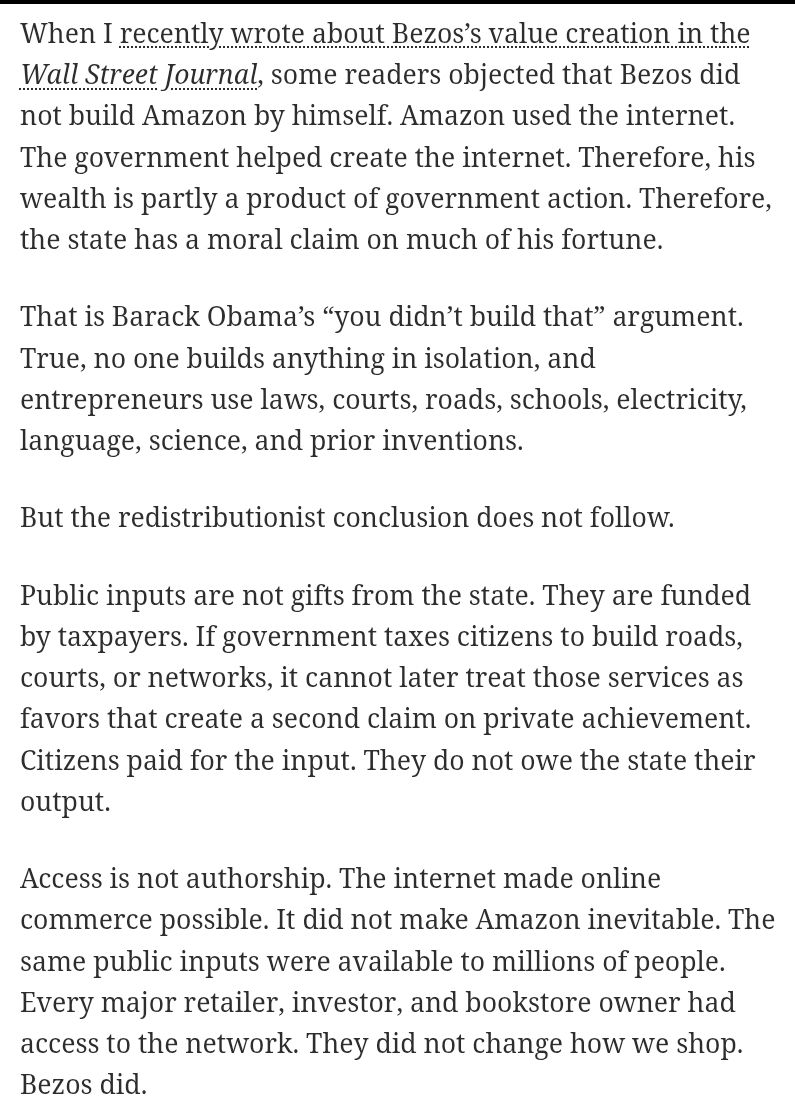
"Public inputs are not gifts from the state. They are funded by taxpayers. If government taxes citizens to build roads, courts, or networks, it cannot later treat those services as favors that create a second claim on private achievement. Citizens paid for the input. They do not owe the state their output."

"A Moral Case for Jeff Bezos’s Wealth" nationalreview.com/2026/06/a…
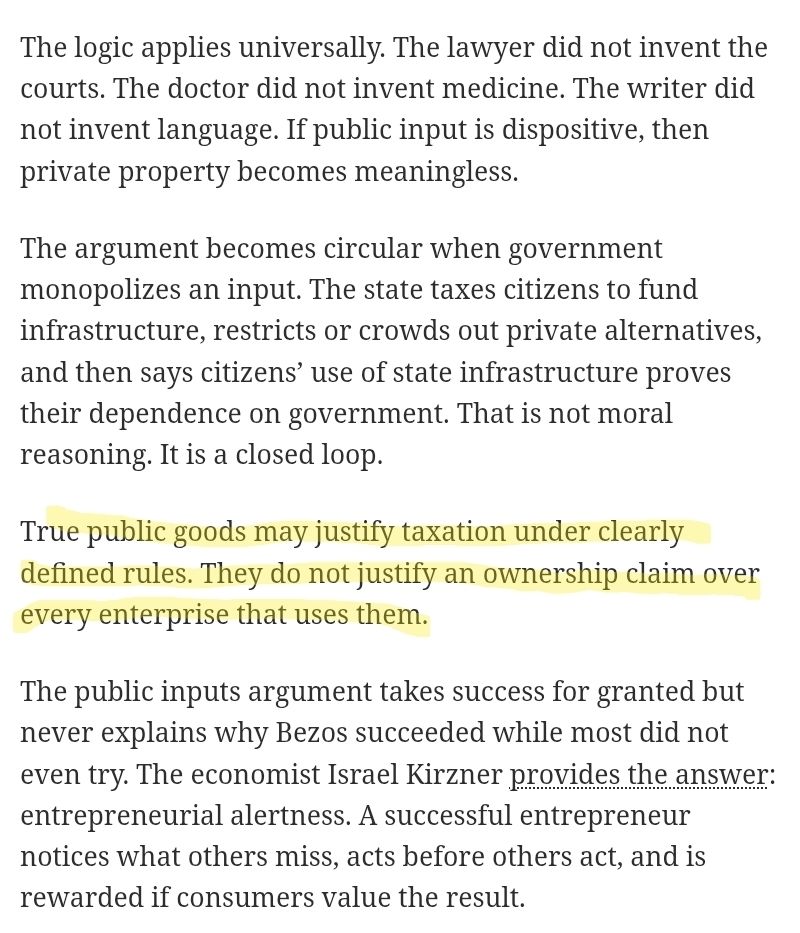
"True public goods may justify taxation under clearly defined rules. They do not justify an ownership claim over every enterprise that uses them."
4
187
"it's ethically confused to care about equality as an end in itself."
Jun 8

I find the political focus on inequality in this kind of work strange - as if one could make the poor better off just by making the rich worse off.
Inequality can sometimes have negative consequences that we should care about, but it's ethically confused to care about equality as an end in itself.
We should care about abundance, freedom, tolerance, beauty, knowledge, innovation, fairness, etc. - and only care about inequality when it threatens these other things.
1
1
8
333
Local Knowledge Problem retweeted

Jun 7
Sáez, Zucman, and Piketty have all become incredibly dangerous in multiple ways: 1) they threaten the reputation of our profession and by extension us by proposing policies that have not been rigorously evaluated and workshopped; 2) they clearly do this in service of a political agenda, risking that those of us who disagree with them for strict mechanical reasons become seen as ourselves merely of differing “political” opinion; 3) following from (2) if our regular research starts being seen as “political” because of this perception problem (and the general fact that the regular public cannot comprehend equilibrium mechanics), substantial (existential?) risk to the research profession and its institutions (academic departments, central banks, etc.) could arise from politicians who do not “like” our conclusions and have no patience for a nuanced discussion of things like model mechanics.
1
1
10
392
StevestonEast Top 10 takeaways from The Rational Optimist:
1. Trade with strangers ignited progress after 190k years of stagnation.
2. Ideas "have sex" — exchange recombines knowledge into unplanned innovation.
3. Tasmania proves isolation causes tech loss & regression.
4. Intelligence is collective; networks beat isolated brains.
5. Self-sufficiency = poverty. Specialization trade = prosperity.
6. Living standards soared across every metric.
7. Innovation is bottom-up, trial-and-error via markets.
8. Voluntary exchange builds trust, virtue & mutual gains.
9. Pessimism is fashionable but historically wrong.
10. Connect & share ideas freely — that's how the future is invented.
Spot-on thread.
1
2
17
1,094
"Intelligence is not a property of the individual brain. Intelligence is a property of the network the brain is connected to. A genius in isolation will produce less than a mediocre thinker inside a dense exchange of othe"r mediocre thinkers.

A British biologist looked at 200,000 years of human history and found that the entire reason humans broke out of poverty was not intelligence, not language, not even agriculture, but one mechanism so simple a 6-year-old could explain it.
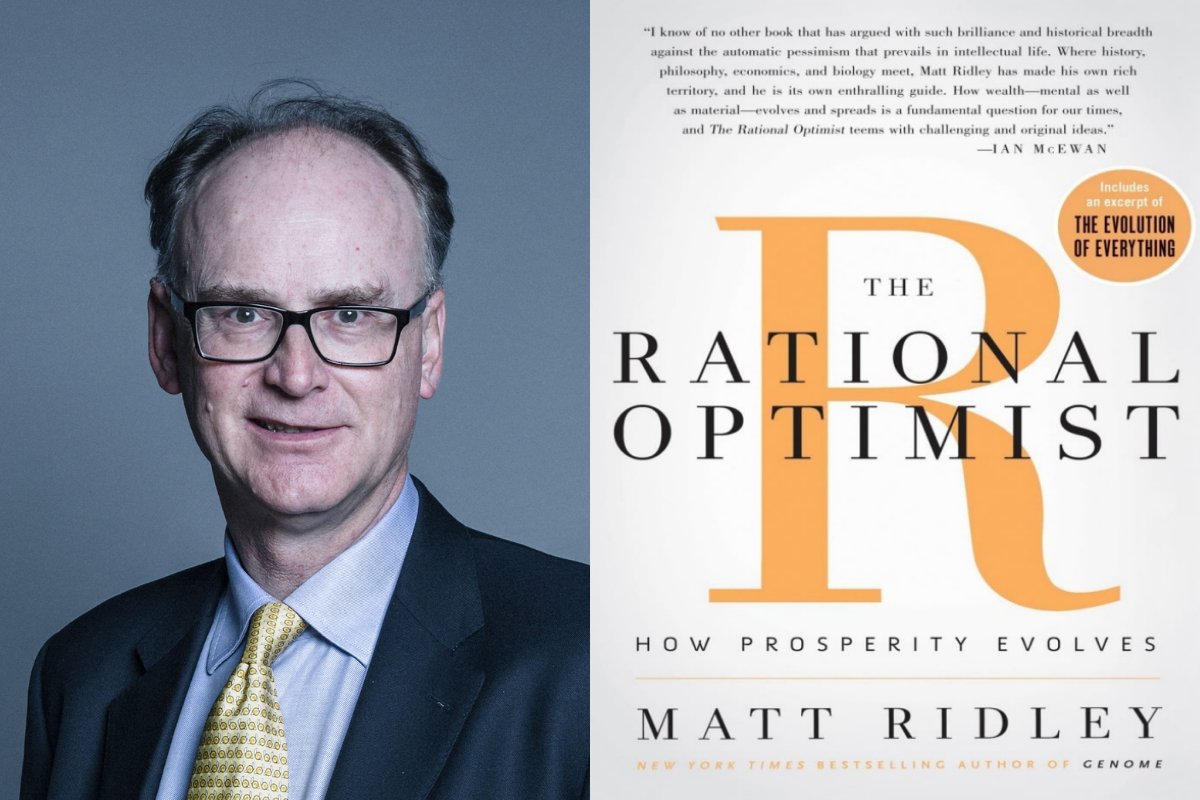
His name is Matt Ridley.
He is a zoologist by training, an evolutionary biologist by career, and in 2010 he wrote a book called The Rational Optimist that quietly argued the most important fact about human progress had been hiding in plain sight for the entire history of economics.
Naval Ravikant has been telling people to read everything Ridley has ever written for the last 15 years. The reason is the argument inside this one book.
For 200,000 years, anatomically modern humans walked around with the same brain you have right now. Same skull size. Same neural architecture. Same raw capacity for language, planning, and abstract thought.
For roughly 190,000 of those years, almost nothing happened. Generation after generation lived and died inside the same Stone Age toolkit their great-great-grandparents had used. Then somewhere around 50,000 years ago, the line on the chart of human progress started to tick upward. Then it bent. Then it exploded.
The question Ridley spent years on was the only question that mattered. What changed.
It was not the brain. The brain had been the same for 190,000 years. It was not language, which had existed long before the takeoff. It was not even agriculture, which arrived only 10,000 years ago and was actually preceded by the upward bend, not the cause of it.
What changed was that humans started trading with strangers.
This sounds too small to be the answer. Ridley argues that it is the answer to almost everything. The moment one human exchanged a useful object with another human from a different group, something happened that no other species on earth had ever done.
Two ideas that had developed in isolation came into contact. The flint knapper learned what the spear maker had figured out. The fisherman from the coast learned what the hunter from the forest had figured out. The two pieces of knowledge fused into something neither side could have produced alone.
Ridley calls this ideas having sex. The phrase sounds frivolous and it is meant to. The point is that ideas, like genes, get better when they combine with other ideas from different lineages.
An idea sitting inside one head, no matter how brilliant the head, eventually hits a ceiling. The same idea exposed to ten thousand other ideas does something genes do under sexual reproduction. It mixes. It recombines. It produces offspring nobody planned.
The cleanest proof of this argument is the most uncomfortable case study in the book. Tasmania.
Around 10,000 years ago, rising sea levels cut Tasmania off from mainland Australia. A population of roughly 4,000 humans was now isolated on an island, with no possibility of contact with the rest of humanity. They had the same brains. The same language. The same starting toolkit as their cousins 150 kilometers north. The natural experiment was now running.
What happened next is something no economist or geneticist had ever predicted.
The mainland Australians kept inventing. Boomerangs. Spear-throwers. Fishing nets. Bone needles for sewing fitted clothes. Watercraft with paddles. Their technology compounded slowly across the centuries.
The Tasmanians went the other way. They did not just fail to invent the new tools their cousins were developing. They started losing the tools they already had. Fishing was abandoned within a few thousand years. Bone tools disappeared. Fitted clothing disappeared. They forgot how to make fire from scratch and started carrying lit firebrands from camp to camp instead, relighting their fires from a neighbor's whenever their own went out.
By the time European explorers arrived in the 17th century, the Tasmanians had the simplest toolkit of any human society ever recorded. Their material culture had gone backward for 8,000 years.
The archaeologist Rhys Jones called it a slow strangulation of the mind.
Joseph Henrich at Harvard later proved with formal mathematical models that there was nothing wrong with Tasmanian brains. There was something wrong with their network. A toolkit requires a critical mass of people exchanging skills to maintain itself.
The act of teaching a skill is imperfect. Every generation loses a small percentage of what the last generation knew. If your population is large enough and trading widely enough, those losses get caught and corrected by someone else who still remembers.
If your population shrinks below a certain threshold and stops mixing with outsiders, the small losses compound until entire technologies disappear.
This is the part that should haunt anyone reading this in 2026.
Intelligence is not a property of the individual brain. Intelligence is a property of the network the brain is connected to. A genius in isolation will produce less than a mediocre thinker inside a dense exchange of other mediocre thinkers.
The thing your ancestors needed in order to break out of 190,000 years of stagnation was not better brains. It was better connections between brains they already had.
The implication for any individual is direct and uncomfortable. If you are smart and isolated, you will be outproduced by people half as smart who are connected.
The most successful people in any field are almost never the smartest people in it. They are the ones positioned at the intersection of the most idea flows. They are reading more authors than their competitors. They are talking to more people from more disciplines. They are in the rooms where ideas from different lineages bump into each other.
Ridley ends the book on the line that sounds optimistic but is actually a warning its this "The future will be invented by people who connect ideas, not by people who guard them."
5
218
Local Knowledge Problem retweeted

Jun 2
When your only tool is a hammer and sickle...
Jun 2

I will soon be introducing a bill to give the public a 50% ownership stake in the largest AI companies in America.
This would guarantee that the trillions created by AI are used to improve the lives of all of us — and block oligarch decisions that harm the American people.
32
58
559
19,250
Local Knowledge Problem retweeted

Jun 1
🧵New Orleans just proved failing schools can be fixed at scale.
It became America’s first all-charter school district.
The results are staggering:
• 99th percentile nationally in reading growth
• 98th percentile in math growth
• The only state in America beating pre-pandemic levels in both subjects
This is what real reform looks like. THREAD 🧵

238
3,129
9,818
237,492
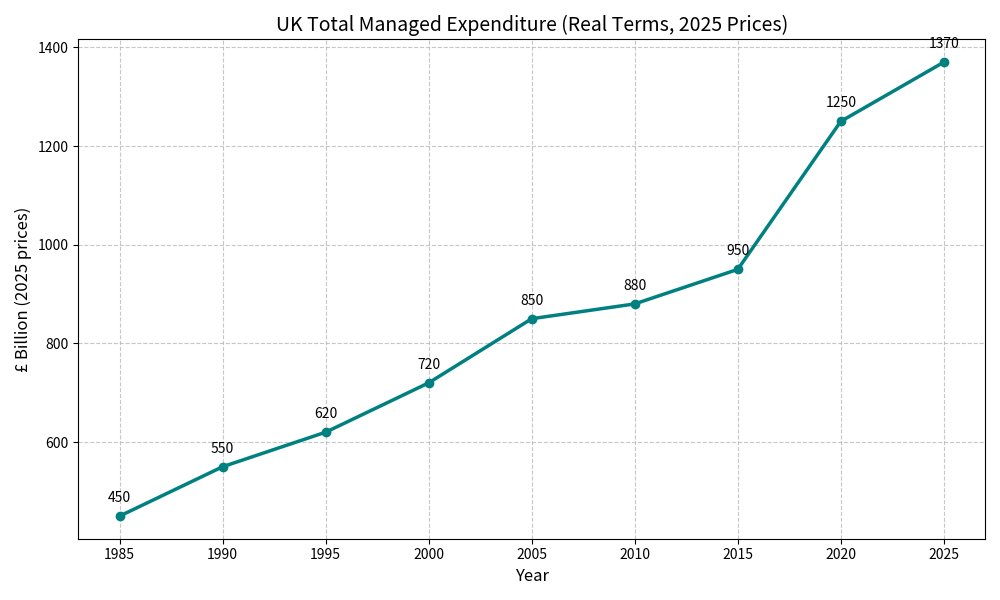
"No comprehensive Medicare for All proposal even exists."
May 30

My report below shows why progressive lawmakers have never - after all these decades - been able to turn their single-payer and M4A rhetoric into a real, specific proposal that could be implemented. manhattan.institute/article/…
3
104
Brutal.

1
3
167
Local Knowledge Problem retweeted

May 29
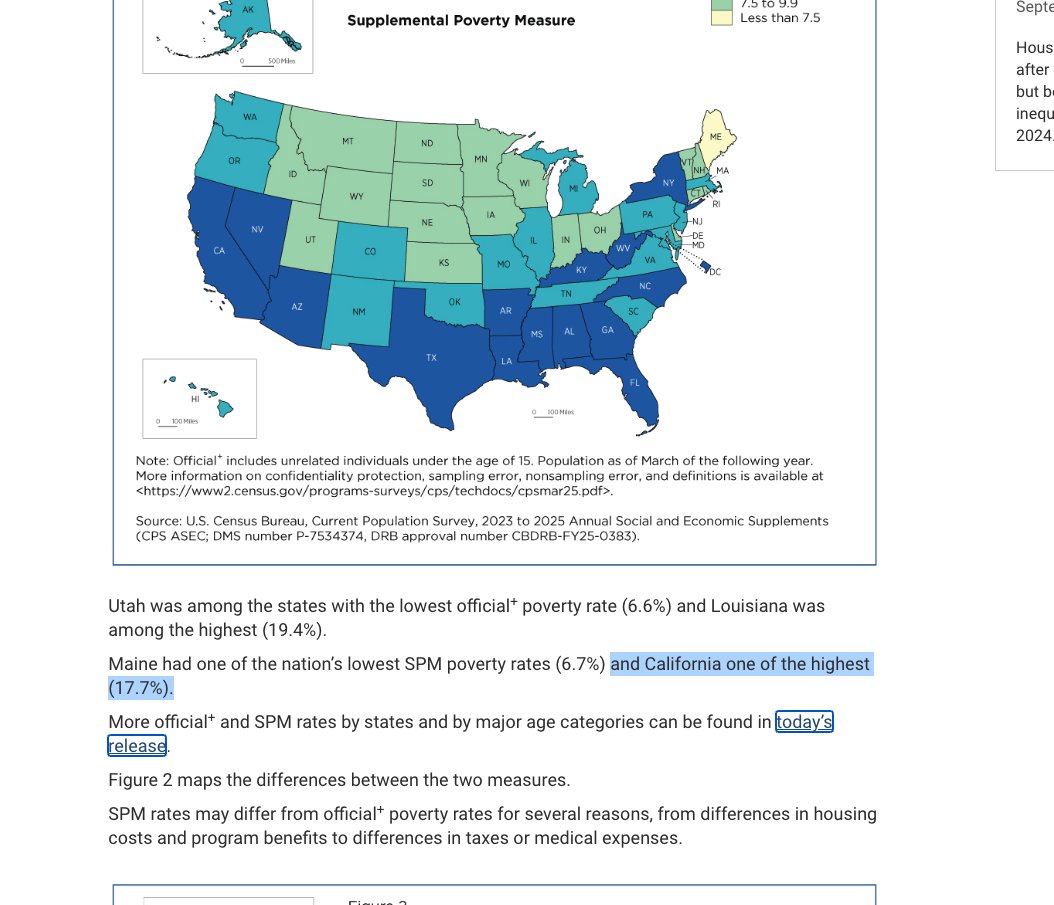
The Supplemental Poverty Rate takes into account cost of living differences and government benefits. With this measure, California has the highest poverty rate in the nation (tied with Louisiana).
May 29

MAGA hates working people.
It’s a disgrace that nearly 20 GOP states still have a $7.25 minimum wage.
In California, it’s $25 an hour for an entire sector of workers! As it should be.
3
20
192
8,709
Poor.
On high-speed rail: ~$15B spent over a decade with zero operational trains and under 20% progress toward the full Phase 1 system.
On homelessness: $24B (2019-2023 alone) yet the count rose from ~116k (2015) to over 180k (2023), with only modest recent dips.
Promised results have not materialized despite the scale of investment and repeated commitments. Outcomes speak louder than rhetoric.
1
1
98
Mine?
The absolutely despicable tax that Bill Clinton instituted in the Omnibus Budget Reconciliation Act of 1993, which RETROACTIVELY adjusted rates from August of that year to January 1.
All the estimate quarterly payments and withholding estimates had to be completely redone, to account for a larger tax liability.
133
Local Knowledge Problem retweeted

May 22
I want to add that Zucman implicitly admitted -- when he made a botched reply to Auten and Splinter -- that we can throw all his pre-1962 estimates of inequality in favor of those I designed. Indeed, in criticizing Auten and Splinter (to reject their post-1962 corrections), he made the exact arguments we made in our EJ piece for saying their estimates could be discarded.
I summarized it here back then. x.com/VincentGeloso/status/1…
May 22

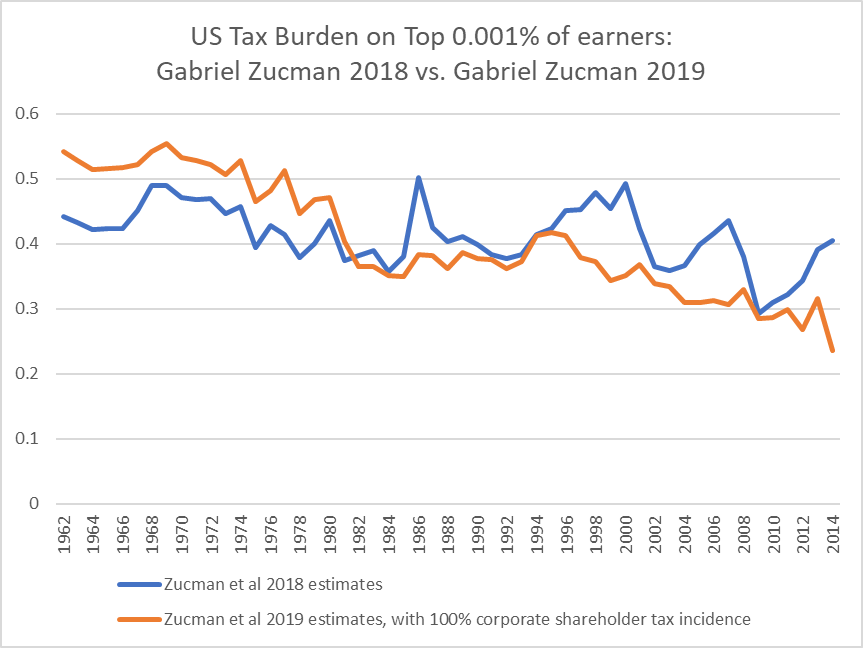
Zucman manipulated the stats you show below to make them fit his political story.
In 2018 he published a dataset that inadvertently revealed the real tax rate paid by the top 0.001%. It hovered around 40% in recent years - nearly twice what his 2019 chart claims to show.
3
13
113
13,572
Local Knowledge Problem retweeted

May 21
If you have time to post you have time to toast
2
27
652