
Assistant Professor @DukeU studying RNA biology and the epitranscriptome.
Joined July 2018
- Tweets 245
- Following 157
- Followers 1,689
- Likes 425
Photos and videos

6 Mar 2025
2
468
MeyerLab retweeted

3 Feb 2025
“And now thanks to this really interesting research, we know that cats—despite getting cast off as solitary and nonsocial—are doing this, too.” scim.ag/3PZyRNa @NewsfromScience
6
32
77
31,518
12 Nov 2024
Attention prospective postdocs: Are you interested in studying RNA modifications and using cutting edge technologies to uncover the role of m6A in physiology and disease? Come join our team! We are hiring!
themeyerlab.com
6
48
133
20,670
24 Sep 2024
Excited to share our latest work developing DART transgenic mice and using them to profile m6A in single cells of the mouse brain. A fantastic study led by Matt Tegowski with contributions from @TheHolleyLab nature.com/articles/s41593-0…
2
18
115
11,193
15 Sep 2024
We are excited to have our m6A sensor technology featured on the cover of the latest issue of Nature Biotechnology. Congratulations again to first author @RNAloops and @TheHornerLab and @TheHolleyLab for their great contributions! nature.com/nbt/volumes/42/is…
1
30
193
19,689
MeyerLab retweeted

13 Sep 2024
The September issue is live nature.com/nbt/volumes/42/is…
Our cover shows cellular mRNA modified by m⁶A, which is depicted as a gemstone. Marayati et al. develop GEMS, a genetically encoded m⁶A sensor that can report changes in m⁶A in living cells go.nature.com/41N2h67

26
104
17,798
MeyerLab retweeted

28 May 2024
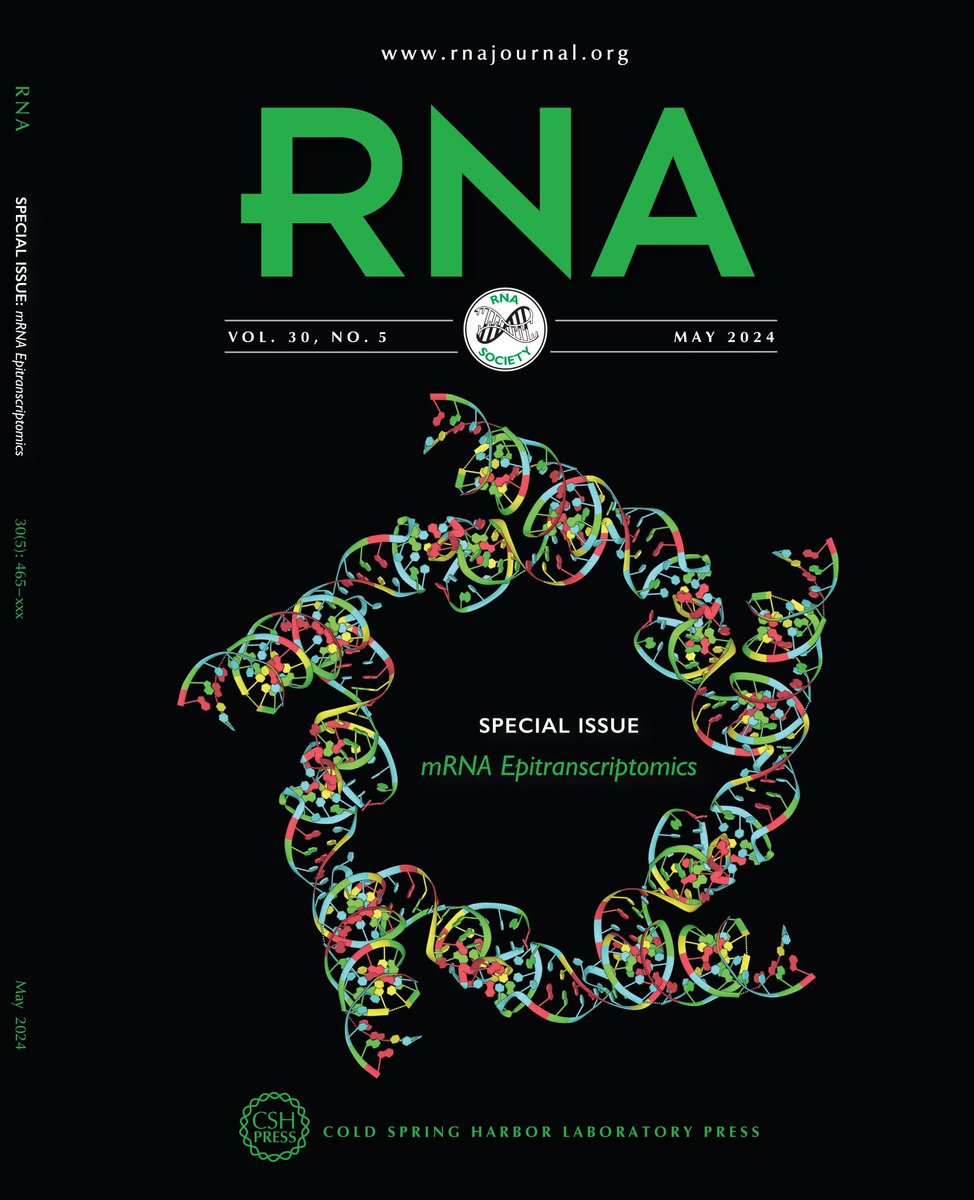
Special Issue of RNA presents the past, present, and future of epitranscriptomics research with a focus on mRNA. It includes perspectives from experts in
the field, with the goal of encouraging discussions that will further advance this area of research bit.ly/4bSEfur
1
26
79
7,893
3 May 2024
Could not be more proud of @Charlie_Sheehan who successfully defended his thesis today! Congratulations Dr. Sheehan!!
9
812
18 Mar 2024
I'm excited to join @theNASEM for a webinar on 3/21 that discusses a new report on sequencing RNA and its modifications, laying the foundation for a new era in biology and medicine. RSVP: events.nationalacademies.org…
11
1,441
1 Feb 2024
Very happy to have our new m6A sensor technology highlighted in Nature Chem Bio. Congratulations again to all authors @RNAloops, @TheHolleyLab, and @TheHornerLab on the great wok! nature.com/articles/s41589-0…
1
9
65
5,655
MeyerLab retweeted

29 Jan 2024
Congratulations to @HugoMedinaMunoz, @EricKofman et al in our paper describing systematic evaluation and nomination of RNA base editors for RNA binding protein-RNA interactome studies. #rna #RBPs #genomics link.springer.com/10.1038/s4…
2
15
73
15,660
2 Jan 2024
Excited to share our recent work developing a genetically encoded m6A sensor. We hope this will be of widespread use for studies of m6A dynamics and high throughout applications. Very proud of the talented Fadi Marayati (@RNAloops) who led this study! rdcu.be/duW2p
3
17
90
12,720
2 Jan 2024
And of course a special thank you to @TheHornerLab and @TheHolleyLab for their important contributions!
3
768
9 Oct 2023
Excited to share the work of incredibly talented PhD student @Charlie_Sheehan describing a new method for in situ visualization of m6A-modified and unmodified RNAs in cells! Enables new insights into methylated RNA localization. academic.oup.com/nar/advance…
5
26
155
24,069
1 Aug 2023
Happy #RNADay! Here's to the amazing members of the Meyer Lab and all of their hard work. Every day is RNA Day here...thank you all for making it so special!
1
19
1,711
MeyerLab retweeted

18 Jul 2023
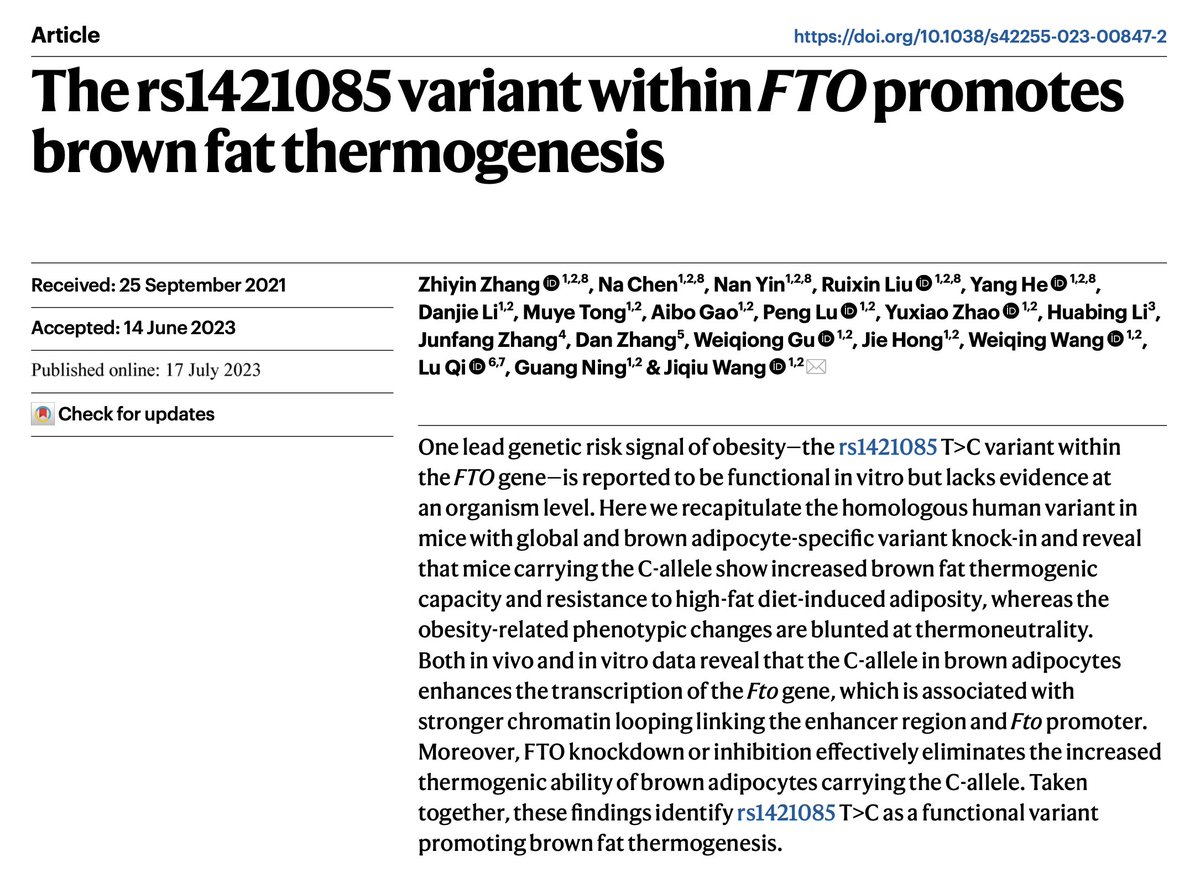
Buckle up! We're in for a wild ride today. A new @NatMetabolism paper by scientists from China adds a surprising twist to the long-known FTO GWAS story.
The FTO locus (16q12.2) is the first ever GWAS locus to be associated with obesity and even after 16 yrs now, scientists appear to be scratching their heads trying to make sense of this locus. Non-coding intronic variants within FTO strongly associate with BMI, where individuals homozygous for the top risk variant weigh ~3kg more than non-carriers (science.org/doi/10.1126/scie…).
Since its discovery in 2007, there have been tremendous efforts to identify the causal gene(s) at this locus. Given that the risk variants are sitting right within a gene, FTO was of course the primary suspect. How do you find out if FTO has an effect on BMI? Delete it in mice and see if the animal gains weight. And that's what scientists did and found out that Fto knockout mice were stunted and lean, and the leanness was mainly due to burning too much fat (nature.com/articles/nature07…). That's great. So FTO must be the causal gene.
But then contradicting findings appeared. If you knock out the Fto only in adipose tissue (science.org/doi/10.1126/scis…) or globally after the animal has grown (journals.plos.org/plosgeneti…), the mice actually gain weight!
Amidst this confusion came an even bigger one: two landmark papers, one in Nature (nature.com/articles/nature13…) and the other in NEJM (nejm.org/doi/10.1056/NEJMoa1…), said, forget about FTO, the causal genes are located far away. The FTO locus is an enhancer that folds in the 3d space and touches the promoter of distant genes IRX3 and IRX5. And deleting Irx3 in mice resulted in weight loss.
Then scientists were like, you know, a proper experiment would be not to knock out Fto or Irx3, but to delete the homologous noncoding region in mice. So, they deleted an 82 basepair-homologous region in mice and showed that without this region, the mice don't gain weight when fed with a high-fat diet, and deleting this locus increases Irx3 and Irx4 expression (science.org/doi/10.1126/scia…). So, the causal genes are IRX3 and IRX4 then.
And now, in the current paper, the scientists argue, you know, the most appropriate way to study the FTO locus is to recreate the exact genetic variant in mice and study the consequences.
What did they find? The exact opposite of what was found in humans. The risk allele that increased weight in humans, decreased weight in mice. Can it be because of some off-target effects of the CRISPR experiment? No. Even if you do the knock-in in an old-fashioned way, the results are the same. The weight loss is mainly via over energy expenditure via brown adipose tissue. Wait, there is another twist.
There is an interesting difference between humans and mice. Humans have brown adipose tissue only during infancy and then lose it as they grow into adults, which isn't the case in mice. The brown adipose tissue helps mainly during cold temperatures. The experiment mice are usually housed at around 20-22 degrees Celsius, which is an ambient temperature for humans but not for mice. It's substantially cooler than mice's "thermoneutral zone (29-31 degrees)".
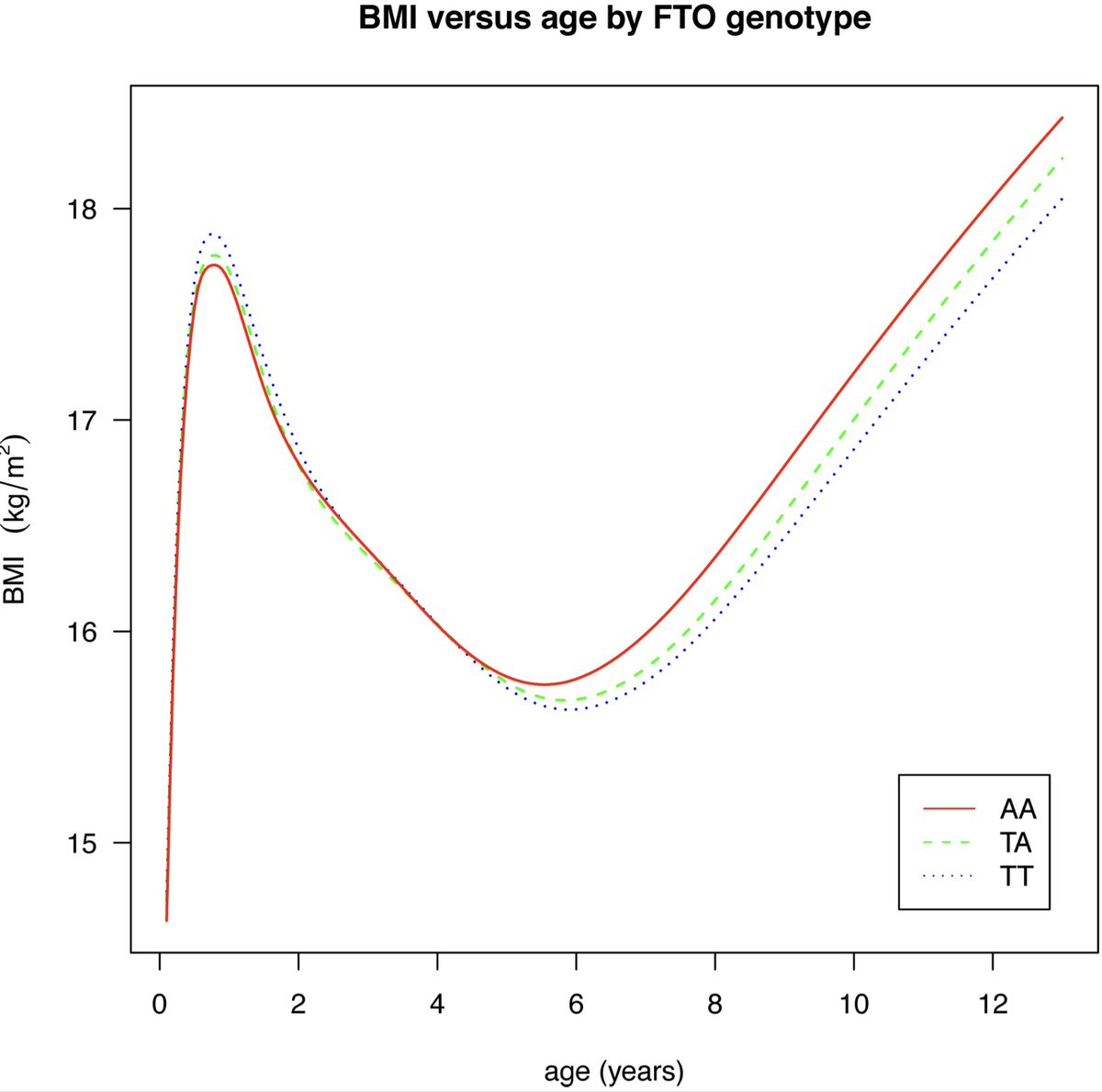
So what happens when you repeat the experiments in what might be the mice's ambient temperature--30 degrees? All the weight loss effects that were previously seen at 20-22 degrees are now blunted. So, the FTO locus effects are strongly dependent on two things: temperature and the presence of brown adipose tissue. And it turned out, in fact, it was previously shown in humans that the FTO variant has an age-dependent effect. It lowers the body weight in infants and then increases the body weight in adults, which aligns with the current finding. (journals.plos.org/plosgeneti…)
Overall, the current paper is an impressive work and will stand as a landmark in the long twisty road of FTO story. But above all, this paper is a remarkable example to show case the challenges behind translating mice physiology to human physiology.
nature.com/articles/s42255-0…
24
223
872
244,221
MeyerLab retweeted

19 Jul 2023
Our new story on the role of the Nab2 RBP in limiting m6A on Sxl mRNA in the drosophila CNS is online @eLife tinyurl.com/3e2t9vea This was a great collaboration with @MeyerLabDuke and @acorbe2. Congrats to all authors!
1
4
30
3,243
12 Jul 2023
Less than 2 weeks until the Epitranscriptomics: Methods, Technologies & Innovation virtual symposium on July 24-25! Register now to learn about emerging technologies for studying RNA modifications. Great lineup of speakers and registration is free! epitranscriptomics2023.org
9
21
3,958
29 Jun 2023
Spatially resolved single-cell translatomics at molecular resolution | Science science.org/doi/10.1126/scie…
1
17
1,544
28 Jun 2023
Interested in using new technologies to study how RNA modifications regulate gene expression? Come join our team! The Meyer Lab is currently hiring to fill 2 new postdoc positions. Please RT to spread the word!
themeyerlab.com
45
86
18,169