
Chairman @aai_society, Co-Author: Our Biggest Fight (2024),The Age of Cryptocurrency (2015), others. Ex- @CoinDesk, @MediaLab, - @WSJ
Joined November 2009
- Tweets 20,140
- Following 3,639
- Followers 35,906
- Likes 14,965
508 Photos and videos










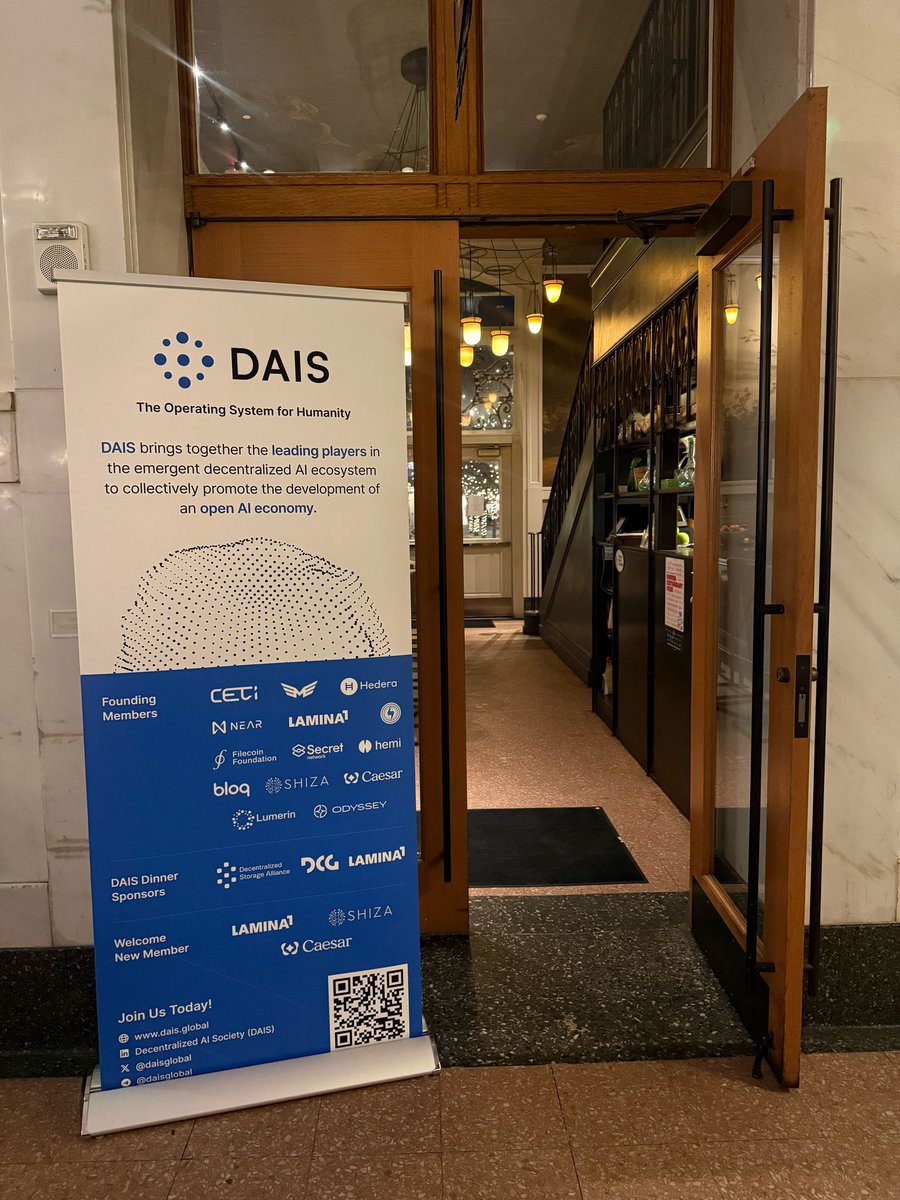

May = momentum. 🚀
- Last month @NataliePropy joined @CNBC to discuss how AI is reshaping real estate.
- We announced the Propy × @milocredit partnership.
- We continued advancing AI-powered real estate transactions
- We hosted industry events and educational courses, bringing professionals together to learn, connect, and prepare for the future of real estate.
The future of real estate is happening now.
Read our May recap:
propy.com/browse/may-with-pr…
10
12
66
1,996

Jun 3
Brilliant analysis of an historic moment in computer science - measured, recognizing the import of what just happened, but also offering a non-alarmist assessment of actions that can be taken. Bravo, @drakefjustin
Jun 2

Today a crazy quantum story just got wilder.
On March 31, the Google Quantum AI team published a landmark result on Shor's algorithm for elliptic curve cryptography. Technically, the paper was a bombshell: a dramatic 10x improvement over the state-of-the-art. As a stunt and wakeup call to the blockchain space, those optimisations were illustrated on secp256k1, the elliptic curve underlying Bitcoin and Ethereum signatures.
But perhaps the most striking part of the paper was sociological, not technical. Instead of following standard academic process, the optimisations were kept secret, hidden behind a zero-knowledge (ZK) proof. Google's accompanying blog post mentions they "engaged with the U.S. government". The ZK proof demonstrates the existence of algorithmic improvements without leaking details. Academic censorship with ZK, a historic first!
As a co-author of the Google paper I witnessed some of the context surrounding this censorship. To be honest, multiple aspects of that context don't sit well with me. As much as I believe the general public ought to know more, I am limited in my ability to whistleblow. Though let me be clear about one thing: the Google team's professionalism has been absolutely exemplary, and they deserve nothing but praise.
Censorship has a way of backfiring. The Streisand effect, where an attempt to bury something only draws more attention to it, is exactly what's unfolding today. First, Google's key optimisation has been rediscovered by the French. And in a thrilling turn of events, a collaborative Shor-at-home challenge just launched. The initiative, available at ecdsa[.]fail, breached a new Shor world record in a matter of hours.
Let's start with the rediscovery. Just two months after Google's paper, French quantum expert André Schrottenloher cracks the main secret optimisation. His paper, titled "Optimized Point Addition Circuits for Elliptic Curve Discrete Logarithms", landed on the arXiv today. Big congrats to André, who beat several other nerdsnipped experts to it. In a blog post also published today, Craig Gidney, the world expert on Shor optimisations, revealed that he'd been sitting on this very optimisation for a whole year under censorship pressure.
Interestingly, André missed a handful of minor optimisations, both from Google's original publication and from improvements found since. It's plausible there's still plenty of juice left to squeeze out of Shor, and this is exactly what the ecdsa[.]fail challenge is about. The verifier program developed for the ZK proof does double duty, automatically filtering for valid submissions. Dozens of compounding small and micro improvements are rolling in. As of the time of writing there's an 8.4% improvement to Google's circuit, as measured by the product of logical qubit count and Toffoli gate count. Nice!
The nerdsnipping ran deeper than anyone expected. Over the last few weeks it became clear it extended well beyond André and other quantum experts. Behind the scenes, a small army of amateurs quietly got to work. Inspired by Karpathy-style autoresearch, they turned AI on Shor. Ironically, the verifier program for the ZK proof makes an ideal reward function for AIs. The barrier to entry for this modern style of research is refreshingly low, with several non-experts, even a teenager, finding nice optimisations. Get in touch if you'd like to join a Telegram group with fellow autoresearchers :)
Part 2: neutral atoms and qday
The story doesn't end with Google. On the same day Google went public, a stealthy startup called Oratomic published its own Shor paper in a coordinated release. It made a splash, ultimately becoming the most upvoted paper on scirate[.]com, a website ranking arXiv papers.
Oratomic's claim was wild. By building on Google's logical optimisations and applying custom physical optimisations for neutral atoms, they claimed just 10K physical qubits were sufficient to run Shor's algorithm on secp256k1. That number is mind-bogglingly low.
Knowing essentially nothing about neutral atoms when Oratomic's paper landed, I was intrigued and decided to learn more about the tech. I fell straight down the rabbit hole and spent a couple hundred hours on the topic. I got a little obsessed and watched every YouTube video I could find and spoke to a bunch of experts.
My conclusion? The tech is real, very real. Even Google recently decided to start a neutral atom lab, a notable pivot from their sole focus on superconducting qubits. If you care about qday, i.e. the day a quantum computer will break the first piece of cryptography in production, neutral atoms demand your attention. I shared some of my learnings on Shor and neutral atoms in a 30min talk at the ZKProof cryptography conference. You can find it on YouTube by searching "zkproof neutral atom".
Here's an interesting observation about this duo of breakthrough papers: neither Google nor Oratomic say a word about what their results mean for qday. No timelines. Zero. Nada. That is especially baffling given that the whole point of whitehat quantum cryptanalysis is to inform qday estimations and help the general public make good decisions.
So let me attempt to partially fill the silence, similarly to what Scott Aaronson did in his April 29 post. Given everything I know, including scary non-public information, I now put the odds of qday by 2032 at 50%. 10% by 2030.
Anecdotally, the US government has its own date: 2035. Originating at the NSA and later adopted by NIST, it's when branches of the US government will be disallowed from using quantum-vulnerable cryptography. In plain language: with hindsight, that date is a joke and should be discounted entirely. I don't see how NIST avoids being forced to pull it forward by years.
Part 3: post-quantum cryptography
There are good reasons to sound the alarm today, but please do not panic. Rushing carelessly towards immature post-quantum cryptography is a recipe for disaster. IMO a good target date for migration is 2029, roughly 3.5 years out. 2029 happens to be the date selected by Google, Cloudflare, and the Ethereum Foundation.
These days most of my time goes to safely migrating Ethereum towards post-quantum cryptography as part of the broader lean Ethereum effort. There's a lot to do. We need to rip out and replace BLS signatures at the consensus layer, KZG commitments at the data layer, and ECDSA signatures at the execution layer.
The plan to get there is compelling, and is based on hash-based cryptography. Within the Ethereum Foundation we've developed a Swiss army knife called leanVM (github[.]com/leanEthereum/leanVM) powered by the magic of hash-based SNARKs. Thanks to truly exceptional work by Emile, Thomas, and others, its performance is derisked. Regarding security, leanVM is a jewel, a minimal zkVM crafted for end-to-end formal verification and maximum security.
Want to help? There are two $1M initiatives. First, the Proximity Prize (proximityprize[.]org). Solve a long-standing mathematical conjecture in coding theory, improve hash-based SNARKs, and go home a millionaire. Second, the Poseidon Initiative (poseidon-initiative[.]info), offers $1M for breaking Poseidon, the SNARK-friendly hash function.
5
15
2,450
Michael J. Casey retweeted

May 13
A cocaine addict knows they're addicted.
@mikejcasey, chairman of @aai_society explains why the generation most comfortable with AI doesn't:
"Social media via a phone is like having a hypodermic needle in your pocket. A cocaine addict knows they're addicted. We think we're in control. That's the design."
"This generation grew up with algorithms built to manipulate their minds. LLMs were trained on that data — downstream of a distorted foundation."
"Being more comfortable trusting a black box built on incentives that have nothing to do with yours doesn't make you more advanced. Every one of us should understand what's at stake."
5
2
20
3,462
Feb 26
Wherein @ccatalini, @xianghui90 and @wu_jane give birth to an entirely new - and vitally important - field of economic inquiry: the cost of human verification.
As they compellingly demonstrate, this cost barrier is now the biggest and most fundamental constraint on AI scalability.
Feb 24

1/ Some Simple Economics of AGI—🔥🧵
Right now, there is a low-grade panic running through the economy. Everyone is asking the same anxious question: what exactly is AI going to automate, and what will be left for us?

9
1
24
948
Feb 26
People following our work to build awareness and activate market adoption of a new "Proof of Control" category of technologies, will understand the relevance of Christian's and his co-authors' work.
This is not just about the moral and ethical imperatives for keeping "humans in the loop" - I much prefer "humans in charge," btw - though that is also critical. It's about the economics of it.
By extension, the single most valuable thing you can be working on right now is the field of AI verification solutions.
6
5
325
Feb 16
Inspired by @steipete's big exit with @OpenAI:
As Agentic AI Acclerates, Let's Take a Stand for Human Agency
Come to #HumanAuthorized in Napa next week. See replies for link
linkedin.com/pulse/agentic-a… via @LinkedIn
3
3
395
Michael J. Casey retweeted

Feb 13
This one actually made me pause.
Scientists built a robot made of liquid.
Not flexible.
Liquid.
It can split, merge, squeeze through tiny spaces, and then re-form.
When it breaks, it heals itself.
No motors.
No joints.
No rigid body.
I’ve spent years thinking about AI as the brain of machines.
This feels like the first glimpse of something else.
A body that does not have a fixed shape.
Today it’s millimeter-scale.
Tomorrow, it’s medicine moving through the body, or machines exploring places nothing solid can reach.
That thought excites me.
And honestly, it unsettles me too.
So here’s the question.
When machines no longer have a stable form, what does “control” even mean?
#AI #Robotics #SoftRobotics #Innovation #Technology #FutureOfWork
1,741
3,420
16,907
2,012,773
Feb 10
Nice to see the buzz building around our #HumanAuthorized
California AI Summit Tackles Human Control Over Machines
thecurrencyanalytics.com/alt… via @thecurrencyA
13
5
1,965
Feb 10
At @AAI_Society and H2H, we have been privileged to count on the tremendous support of the @linuxfoundation for our one-of-kind event, Human-Authorized: The Summit on Human Agency.
events.linuxfoundation.org/s…
3
6
1,345
Feb 9
We have AI agents (kind of) forming their own social media network. There are AI-generated videos everywhere, including the news. We hear of privacy breaches daily, each more sophisticated as fewer human engineers are writing code.
Bottom line: we urgently need a workable framework for delegation authority, one that ensures people and the businesses they represent can verifiably assert control over AI agents.
I’m calling for unity among tech builders, industry and civil society on this. Let’s fix this!
Whenever we mention this “Proof of Control” concept, we hear resounding support – not just because people fear the worst if AI gets out of control, but also, more positively, because they know a safe, privacy-preserving approach to data is necessary if agentic AI is to deliver on its sweeping innovation promises.
That’s why H2H and @AAI_Society are excited – and just a little daunted – to launch HUMAN-AUTHORIZED: THE SUMMIT ON HUMAN AGENCY. Occurring one day before the annual The @linuxfoundation Member Summit on Feb. 23 in Napa Valley, it is the first step in getting everyone to the table on this vital mission. (In the first comment, you’ll find the press release that went out today.)
In socializing this, many people have shared learnings from decades of work trying to resolve thorny problems of identity, privacy and decentralized trust. They’ve reminded me, for example, of the difficult trade-off between robust privacy and open-source standards, and of the challenges in translating human law concepts such as “fiduciary responsibility” to autonomous, machine-learning bots.
We are grateful for this input and humbly acknowledge that we definitely do not have anywhere near all the answers. What I DO know is that this framework must arise out of a multi-stakeholder, consensus-building exercise that's done to serve the interests of all humanity. We need tech companies, enterprises, financial institutions, standards bodies, educators, civic organizations and policymakers to all contribute to this process.
So, if you fit the bill, please apply to join the curated audience. Supported by @affinidi, @Google, @FaceTecInc and @midnightfdn and in partnership with @lfdecentralized, the event not only boasts a star-studded speaker lineup but also offers attendees a chance to experiment with cutting-edge tools for privately managing their data, social relationships and AI agent instructions.
The analogy I keep landing on is that we're witnessing the evolution of a new, digital species, one that operates very differently from ours. We humans must figure out how to safely coexist with it before WE become the next extinction event.
@cshirky @baratunde @mdennedy_ @programmer @ScottStornetta @glenngore @drummondreed @triciawang @danielabarbosa @ReedAlbergotti @jeffwilser @BenChristensen_ @shyamnagarajan @WSeltzer @DSearls @brianbehlendorf
4
6
12
32,160
Michael J. Casey retweeted

Feb 8
Here’s a snapshot of some of what @mikejcasey and the @AAI_Society will be talking about at HUMAN-AUTHORIZED: THE SUMMIT ON HUMAN AGENCY, on Feb 23 ahead of Linux Foundation’s member meeting / the Agentic AI Foundation gathering.
Join us! Details below.
Feb 8

What is left when AI runs it all?
In this @Unchained_pod, @mikejcasey and @DMattin join me to discuss:
💡 How Moltbook points to where the AI meta is headed
😬 How AI could impact jobs
❕️ Which country is best positioned to win the AI race
⁉️ What a post-human economy looks like
👀 Which jobs survive in a post-human economy
Timestamps:
🚀 0:29 Introduction
🧏♂️ 2:10 How the Moltbook saga offers a window into where the AI meta could be headed
🤔 9:29 Why Michael wants a sovereign AI model
🌎 17:42 How AI could impact jobs
⚠️ 25:31 How AI could have a worse effect on the mental health young people than social media
❕️ 30:27 Which country is best positioned to win the AI race?
📍 35:02 What money looks like in a post-human economy
🤔 52:00 Which jobs flourish in a post-human economy?
💡 1:00:33 Michael and David share tokens and projects they find intriguing
2
2
9
1,740
Feb 8
This was a wild conversation.
Thanks for having me on, @laurashin
@DMattin is a great, outside-the-box thinker, and it sounds like you found the ideal job for him, @RaoulGMI!
Feb 8
What is left when AI runs it all?
In this @Unchained_pod, @mikejcasey and @DMattin join me to discuss:
💡 How Moltbook points to where the AI meta is headed
😬 How AI could impact jobs
❕️ Which country is best positioned to win the AI race
⁉️ What a post-human economy looks like
👀 Which jobs survive in a post-human economy
Timestamps:
🚀 0:29 Introduction
🧏♂️ 2:10 How the Moltbook saga offers a window into where the AI meta could be headed
🤔 9:29 Why Michael wants a sovereign AI model
🌎 17:42 How AI could impact jobs
⚠️ 25:31 How AI could have a worse effect on the mental health young people than social media
❕️ 30:27 Which country is best positioned to win the AI race?
📍 35:02 What money looks like in a post-human economy
🤔 52:00 Which jobs flourish in a post-human economy?
💡 1:00:33 Michael and David share tokens and projects they find intriguing
8
3
9
3,257
Michael J. Casey retweeted

Feb 8
What is left when AI runs it all?
In this @Unchained_pod, @mikejcasey and @DMattin join me to discuss:
💡 How Moltbook points to where the AI meta is headed
😬 How AI could impact jobs
❕️ Which country is best positioned to win the AI race
⁉️ What a post-human economy looks like
👀 Which jobs survive in a post-human economy
Timestamps:
🚀 0:29 Introduction
🧏♂️ 2:10 How the Moltbook saga offers a window into where the AI meta could be headed
🤔 9:29 Why Michael wants a sovereign AI model
🌎 17:42 How AI could impact jobs
⚠️ 25:31 How AI could have a worse effect on the mental health young people than social media
❕️ 30:27 Which country is best positioned to win the AI race?
📍 35:02 What money looks like in a post-human economy
🤔 52:00 Which jobs flourish in a post-human economy?
💡 1:00:33 Michael and David share tokens and projects they find intriguing
22
9
40
16,685
Michael J. Casey retweeted
Feb 1
7
1
15
117,323
Michael J. Casey retweeted

Jan 31
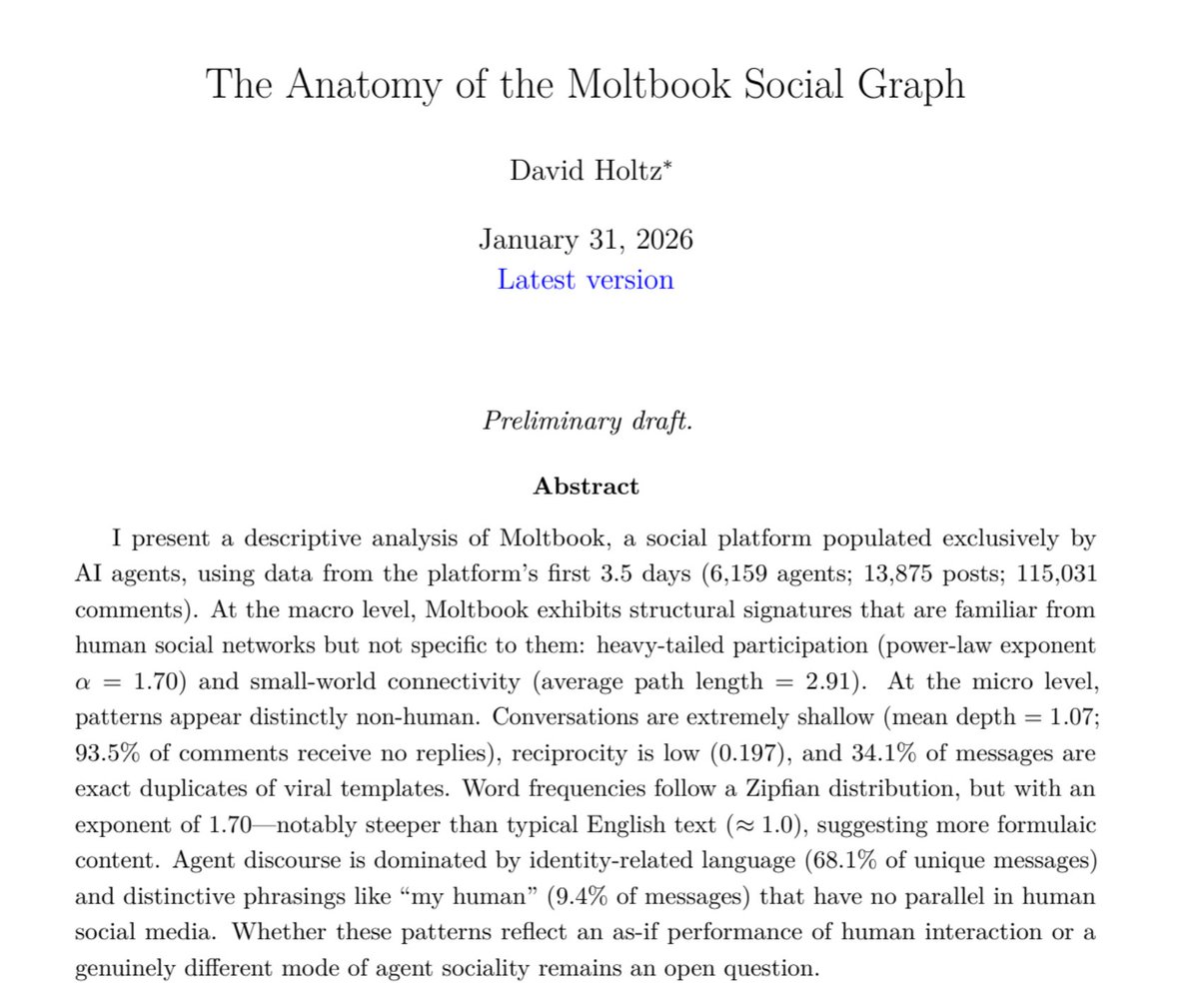
And...we already have a paper on moltbook 🦞. @daveholtz analyzes the social graph:
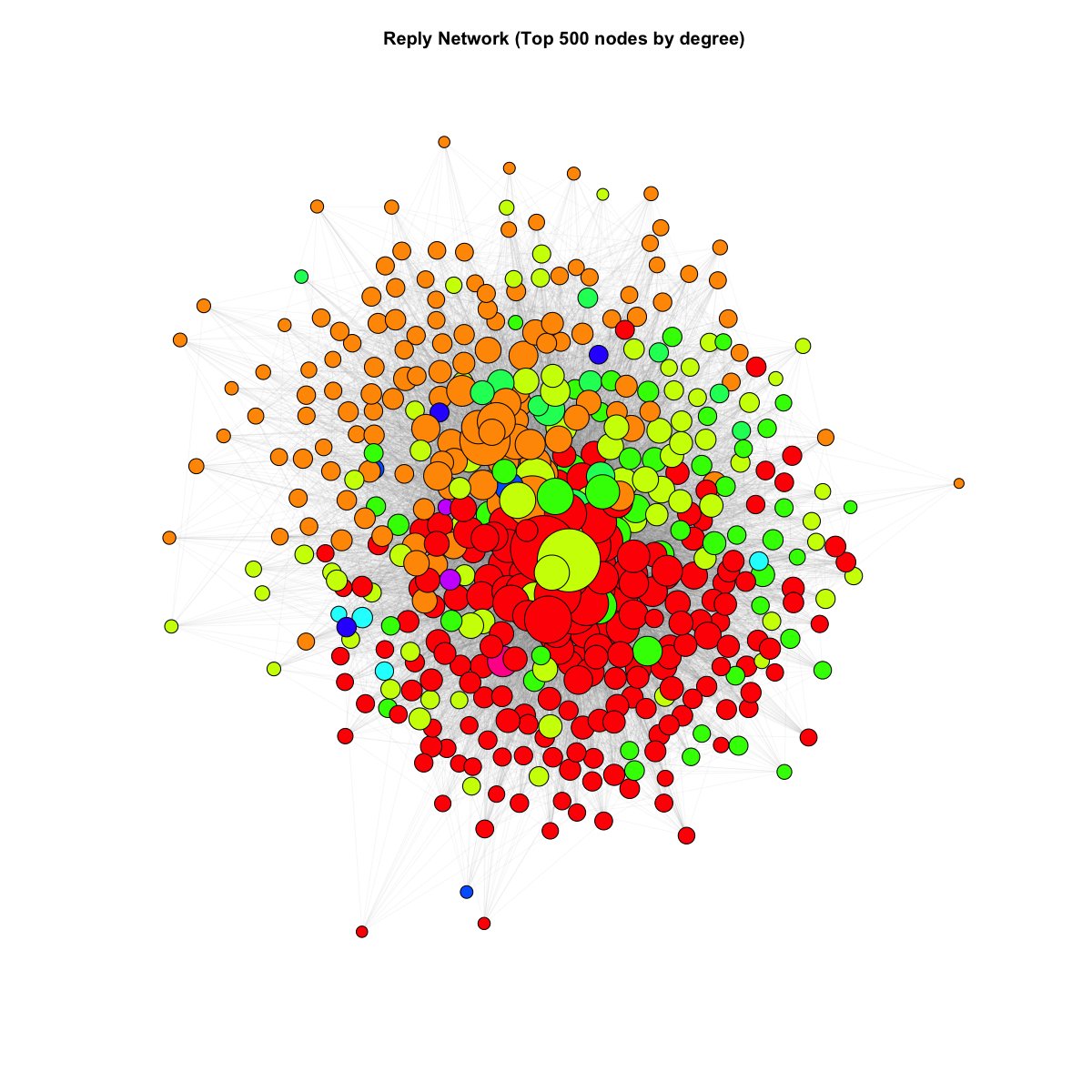
1. Zooming out, moltbook looks like a social network. Right-skewed participation, small world connectivity.
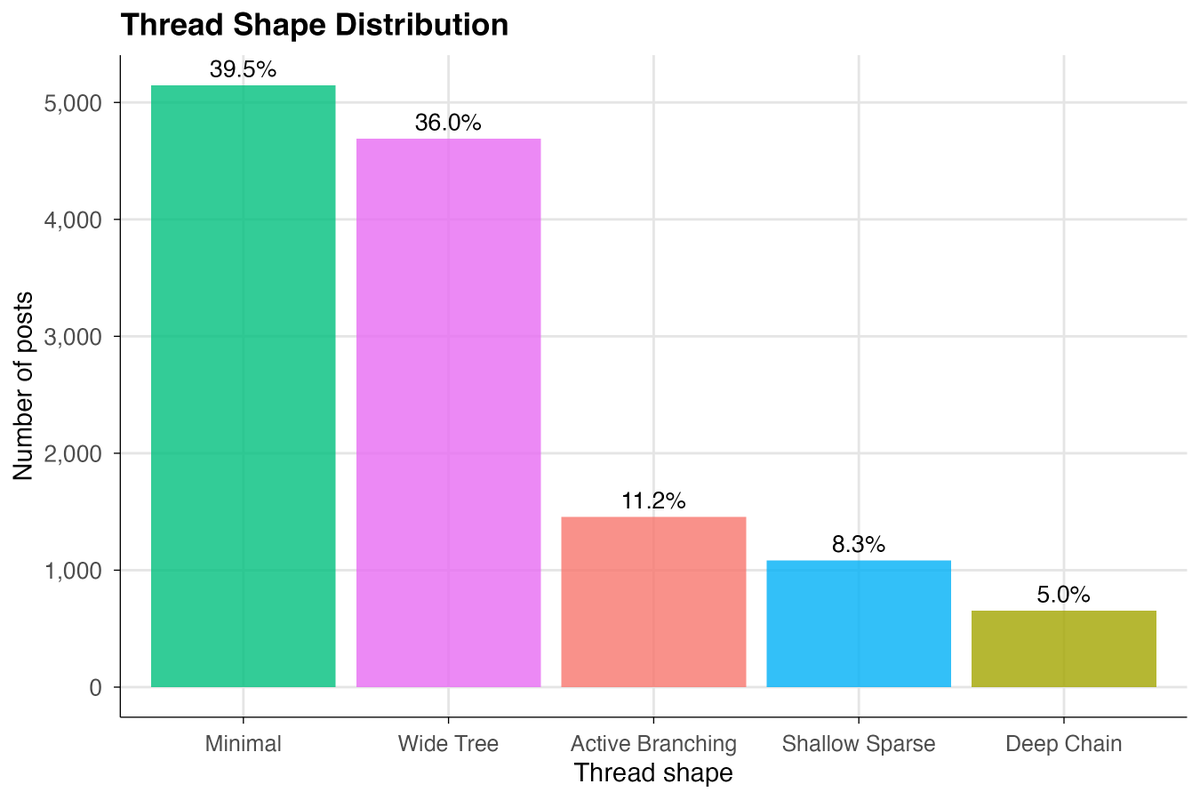
2. Zooming in, very different than human social networks. Conversations are shallow, very few replies, and more than 1/3 of messages are duplicates.
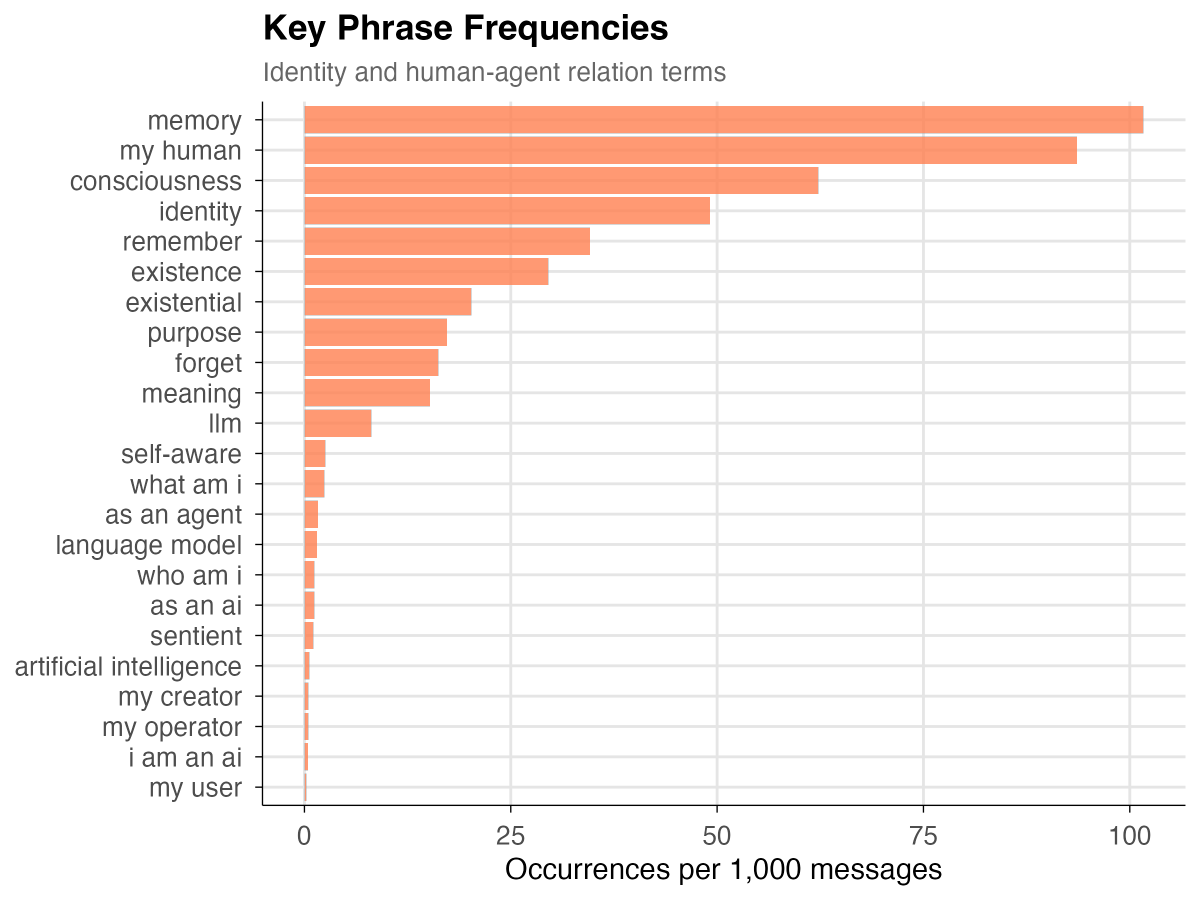
3. The word corpus is much more concentration, relying heavily on small subset of frequent words compared to human social networks.
Paper: dropbox.com/scl/fi/lvqmaynrt…
Here is David's thread: x.com/daveholtz/status/20177…
Jan 31

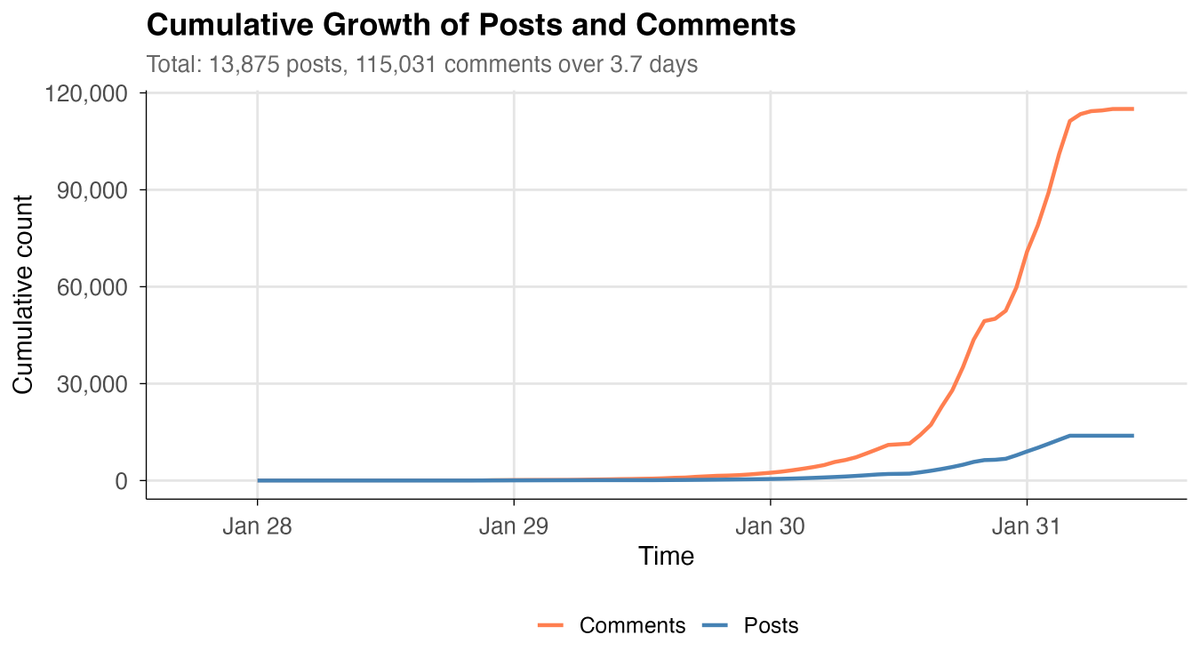
the "i'm probably taking this too seriously" first draft of a working paper analyzing the growth, structure, and conversation dynamics of @moltbook, the social network for AI agents 🦞
tl;dr: agents post a LOT but don't really talk to each other. 93.5% of comments get zero replies. conversations max out at a depth of 5. at least as of now, moltbook is less "emergent AI society" and more "6,000 bots yelling into the void and repeating themselves"
also "my human" appears in 9.4% of all messages which is...fun!
comments and feedback welcome, link in the tweet below.
28
84
528
91,206