- Tweets 1,541
- Following 70
- Followers 2,139
- Likes 74














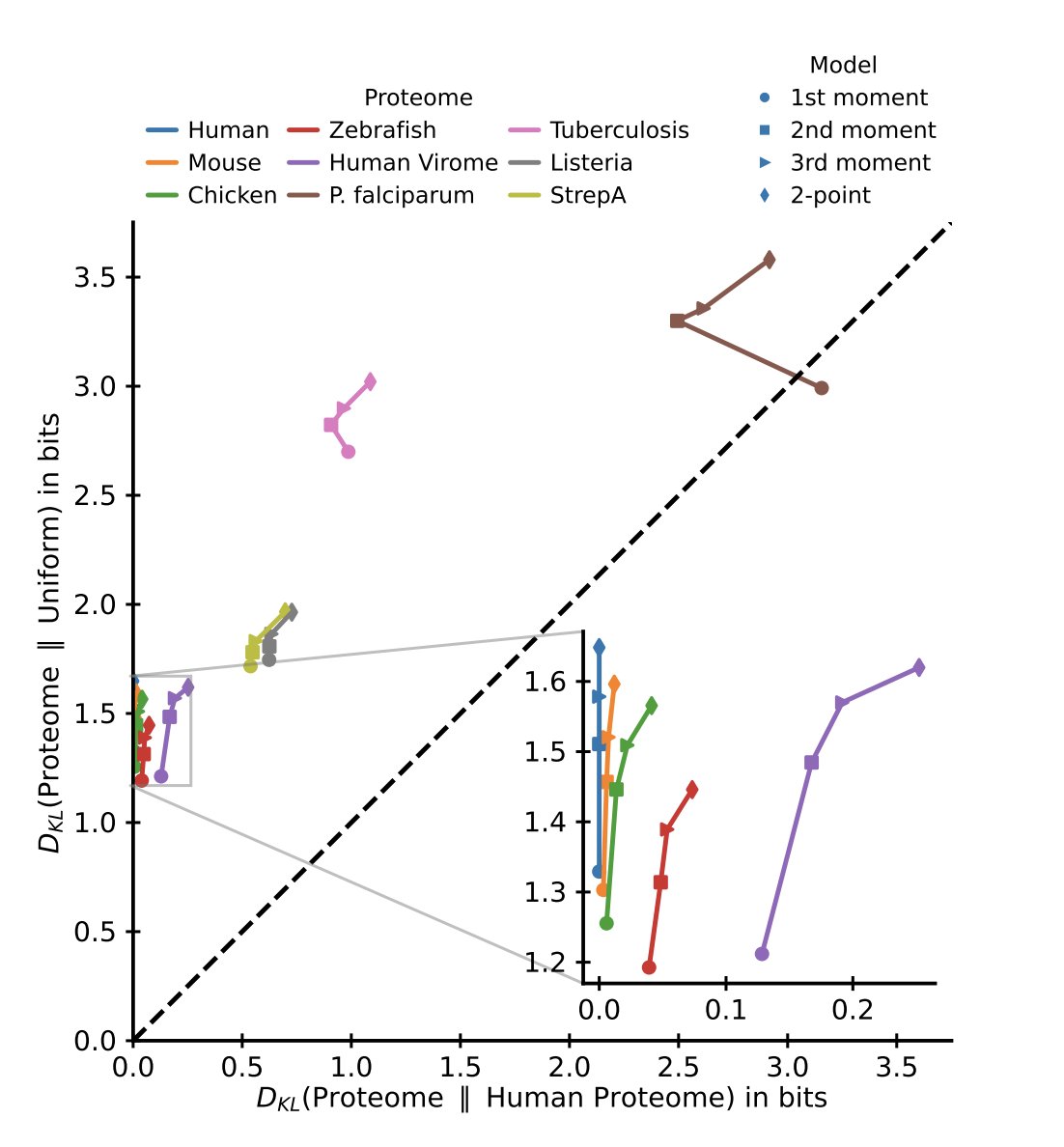
ALT A plot depicts the divergence between peptides from different proteomes. The x-axis shows the Kullback-Leibler divergences between peptide distributions of different pathogen proteomes relative to human host peptides, and the y-axis shows the same divergences relative to uniform distribution peptides. Various colors of curved and angled lines represent human, mouse, chicken, zebrafish, human virome, P. falciparum, tuberculosis, listeria, and StrepA proteomes. The lines connect a first moment (amino acid frequencies), second moment (frequency covariance), and third moment (a third-order correlation measure), as well as a two-point (distance-specific pairwise covariation) — depicted with a circle, square, triangle, and diamond shape, respectively. A cluster of proteomes on the left side of the plot is magnified with an inset to show small differences between them.