
856 Photos and videos










Jamie Lin 林之晨 retweeted

May 27
7
5
31
11,703
Jamie Lin 林之晨 retweeted
Apr 20
On @aave now, two groups of users are sitting on opposite sides of the same pool:
- wstETH holders are running a looping strategy — deposit wstETH as collateral, borrow ETH, swap the ETH back into more wstETH, repeat. A leveraged bet on staking yield.
- aWETH holders are the simple lenders — they just deposited ETH into Aave and hold aWETH as the receipt, expecting to redeem 1:1 anytime.
Now both sides are trapped:
- aWETH holders can't withdraw their ETH — the loopers borrowed all of it. Utilization is at 100%, the pool is empty.
- wstETH loopers are bleeding, because borrow rates have spiked past 30%, flipping their ~3% staking yield into deeply negative carry. And they can't unwind cleanly either — repaying Aave requires ETH, but they only hold wstETH. Dumping billions of wstETH into DEX pools would crack the peg and trigger a liquidation cascade.
This is where @0xfluid 's wstETH ↔ aWETH redemption channel comes in. Instead of forcing both sides to clear through the open market, Fluid lets them settle directly against each other: aWETH holders exit into wstETH (solving their liquidity problem), and loopers' collateral offsets the matching ETH debt (solving their negative carry). Both pressures release at the same time — without touching DEX liquidity, without breaking the peg.
This is the kind of move that justifies why DeFi still works. When one window closes, composability opens another. Real composability.

Introducing aWETH Redemption Protocol
With ETH utilization at 100% on Aave, many lenders are currently unable to withdraw and face increasing risk if markets move.
aWETH Redemption Protocol allows ETH lenders to:
• Exit into wstETH or weETH
• Regain immediate liquidity
• Reduce exposure to liquidation risk
If you’re just lending ETH — you can fully exit.
If you have ETH collateral and another debt — your collateral is seamlessly swapped into wstETH or weETH while your debt remains the same.
We’re working alongside @LidoFinance , @ether_fi, @0xProject, @1inch,
@KyberNetwork, and other ecosystem partners to:
• Reduce systemic risk in DeFi
• Ease utilization pressure
• Support a healthier DeFi market
Our goal is simple: protect users while reinforcing the foundations of DeFi.
Capacity is initially limited to $1B in ETH.
fluid.io/lite/aave-v3/eth-sw…
6
10
134
20,908

Introducing aWETH Redemption Protocol
With ETH utilization at 100% on Aave, many lenders are currently unable to withdraw and face increasing risk if markets move.
aWETH Redemption Protocol allows ETH lenders to:
• Exit into wstETH or weETH
• Regain immediate liquidity
• Reduce exposure to liquidation risk
If you’re just lending ETH — you can fully exit.
If you have ETH collateral and another debt — your collateral is seamlessly swapped into wstETH or weETH while your debt remains the same.
We’re working alongside @LidoFinance , @ether_fi, @0xProject, @1inch,
@KyberNetwork, and other ecosystem partners to:
• Reduce systemic risk in DeFi
• Ease utilization pressure
• Support a healthier DeFi market
Our goal is simple: protect users while reinforcing the foundations of DeFi.
Capacity is initially limited to $1B in ETH.
fluid.io/lite/aave-v3/eth-sw…
109
192
1,028
698,265
Jamie Lin 林之晨 retweeted

Feb 5
I have spoken to many investors at Sanctum. @AppWorks really stood out. their DD was very different. they flew me over to Taiwan, sat me down for an hour with their whole team and asked about my life story. they were scrupulously fair and generous with the terms, and after we signed with them, they have regularly followed up and proactively intro'd to partners and mentors.
appworks is a Taiwanese fund, 很講義氣,人情, I can feel the warmth and their sincerity. strongly recommend other founders take their money :)

3
5
56
6,044


Jan 18
跟最熟悉的陌生人 博恩 聊得很開心,從電信到創業、內容創作,一路聊到心理、健康,跟大家分享! @str_network
youtube.com/watch?v=2iXXGk6Z…
1
546
Jamie Lin 林之晨 retweeted
18 Dec 2025
4
4
27
4,612
Jamie Lin 林之晨 retweeted
28 Oct 2025
The internet already defined a payment layer decades ago. HTTP 402 reserved space for a payment layer, but the web never had a native way to fulfill it. x402 enables web requests to carry value natively, with onchain verification in the same flow.
The reason crypto is indispensable isn’t ideological. It’s architectural.
1. Machines can’t run on credit.
The fiat stack was built for humans: authentication, KYC, chargebacks, and manual dispute loops. It assumes the buyer has an email, an identity, and patience.
AI agents can sign, but not KYC. They speak in cryptographic proofs, not passports. Fiat rails still depend on human-centric checkpoints, all of which break at machine speed.
Crypto wallets fix this at the primitive layer. Signatures replace identity, tokens replace intermediaries. x402 lets agents just pay, triggered by an HTTP header, with ERC-20 transfers verified within the same flow. It’s not UX, it’s protocol design.
2. Micropayments collapse under fiat economics.
Card networks weren’t designed for micro-transactions. Their 2–3% fees and fixed settlement costs break down below a dollar. A $0.001 query would lose money before it even clears. That’s why the web ossified around ads and subscriptions: friction made precision pricing impossible.
x402 restores true atomic micropayments to the web. On L2s like Base, transfers typically cost under a cent, low enough to meter every API call or compute cycle. “Payment Required” finally means what it should: pay exactly for what you use, no more, no less.
3. Settlement becomes a feature, not a liability.
Traditional rails treat settlement as a batch process, reconciled by banks and acquirers. Crypto compresses that window from days to seconds, and more importantly, makes every outcome cryptographically verifiable.
No chargebacks, no reversals, just deterministic state updates. The trade-off is intentional: machine commerce favors finality over forgiveness. That’s what enables autonomous transactions. Agents can trust code, not counterparties.
4. Programmability changes the game.
Card networks can’t express conditional logic at the transaction layer. You can’t tell Visa to “pay only if the query succeeds” or “stream $0.01 every second.” Crypto can.
x402 turns payments into programmable primitives, composable, inspectable, and automatable. That’s the difference between digital payments and internet-native money.
5. Tokenized cards aren’t a bridge; they’re ballast.
Putting credit cards onchain doesn’t fix the architecture. It still relies on centralized issuers, fiat settlement, and identity-linked trust. That model is structurally incompatible with a world where APIs and agents transact peer-to-peer, without permission or intermediaries.
Tokenized cards extend fiat’s reach, but they don’t make it autonomous. They replicate the old logic of control inside a new wrapper.
Crypto isn’t an add-on for x402. It’s the substrate that makes it possible.
HTTP 402 finally has a foundation that matches its intent: an open, programmable economy where computation and value converge.
x402 doesn’t make payments cheaper. It makes them native, native to the web’s protocol layer, where value moves with the same atomicity as information.
#x402 #payment #base #crypto
5
3
15
2,382
13 Oct 2025
其實人可以不用過分的去專注在想要,而更應該花很多力氣,去了解自己真正需要的是什麼。如果你找到了自己的目標,那麼,在這個不完美的世界努力,即便有挫折、即便有痛苦、即便有傷心,無法發生什麼事情,你應該都是一個平靜的人
youtube.com/watch?v=rszO3FYz…
1
7
1,020
Jamie Lin 林之晨 retweeted

Onboard Stage:
交易所觀察:亞洲業者的挑戰與突圍
Jigglypuff Tsai, Blocktempo (@BlockTempo)
Jamie Lin (@mrjamielin), TWEX & Taiwan Mobile
Kimchi Lin, HOYA BIT Exchange (@HOYA_BIT)
Yvonne Chen, BitoGroup (@BitoEX_Official)
Huxuan (@huxuab), Ourbit (@ourbit)
#TBW2025 #台北區塊鏈週

12
6
39
17,339
Jamie Lin 林之晨 retweeted
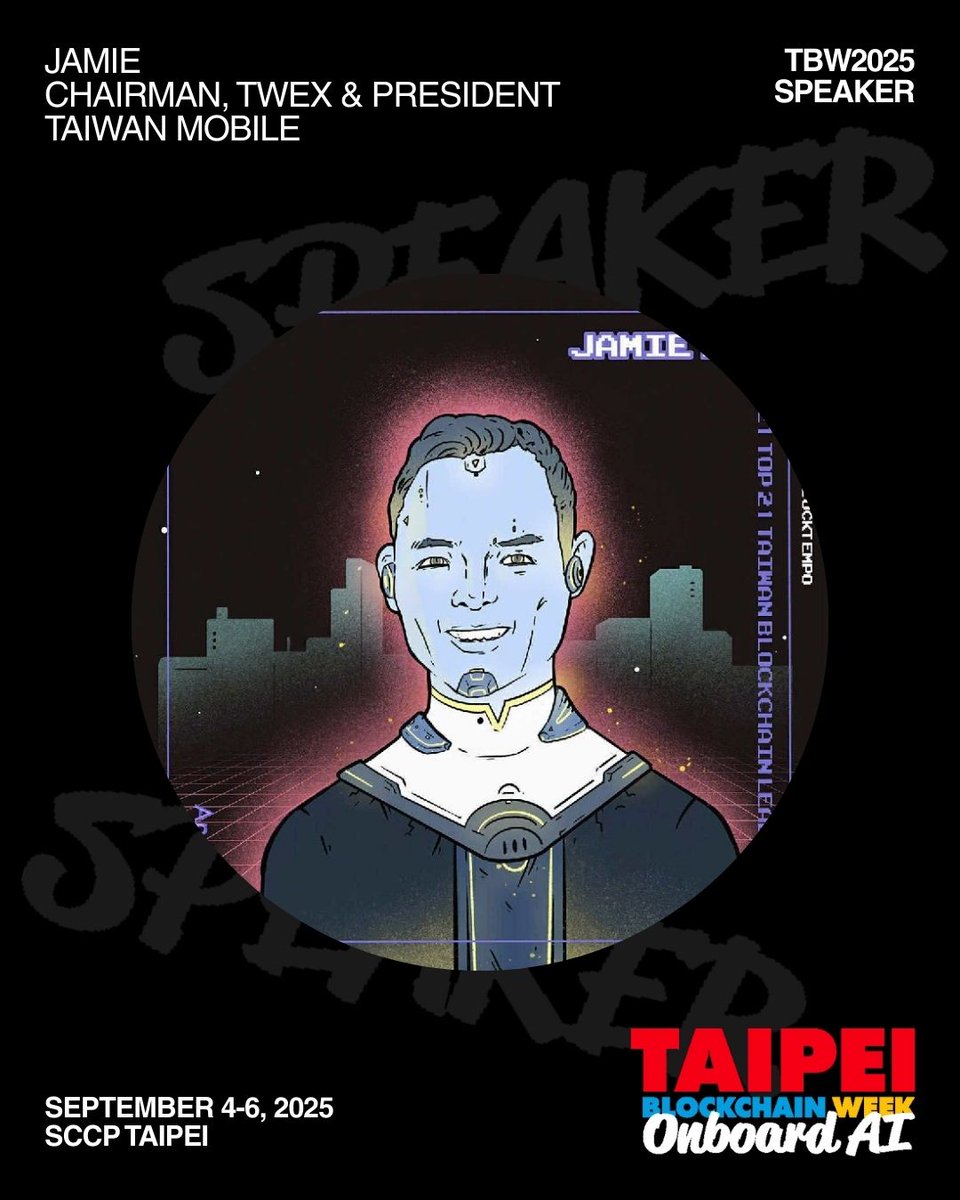
Jamie Lin (@mrjamielin), President of Taiwan Mobile & Chairman of TWEX, is building Taiwan’s trusted Web3 gateway—backed by Fubon Group and 23M users. He also chairs AppWorks, Asia’s top early-stage Web3 VC.
Meet Jamie this September at #TBW2025.
📍 Songshan Cultural and Creative Park | Sep 4–6th, 2025
🎟️ bit.ly/tbw2025
1
1
5
795

768
1,533
5,299
502,892
Jamie Lin 林之晨 retweeted

22 Apr 2025
Today, we're excited to announce Tally's Series A funding of $8 million to scale the software layer for onchain organizations and help protocol tokens accrue value.
What began as a DAO governance tool has evolved into the most widely adopted software stack for onchain organizations.
Tally powers infrastructure for leading organizations across Ethereum and Solana — including @arbitrum, @Uniswap DAO, @zksync, @wormhole, @eigencloud, @Obol_Collective, and many more.
With over 1 million active users and $1 billion moved using our tools, winning teams use Tally to support every phase of their onchain journey:
• Launch: distribute tokens and onboard users
• Operate: manage treasuries and govern protocols
• Grow: accrue value and create token utility
Tally launched in 2020. We are grateful to have built through the ups and downs of the last 5 years, and we haven't been on this journey alone. We want to thank our users, partners, and investors including: @AppWorks, @1kxnetwork, @bcap, @cyberfund, @placeholdervc, @BitGo, @Lemniscap, @CastleIslandVC, and @bloccelerate.
Tally is building the future of software onchain. To learn more about how we can help your organization, please reach out. We would love to chat.
308
73
909
90,787
Excited to share why we're leading SignalPlus's Series B alongside @OKX_Ventures, @HashKey_Capital, and Avenir Group.
Crypto option market volume keeps hitting ATHs in 2024 but still faces major structural challenges - many exchanges lack expertise to build proper trading & risk tools, leading to inefficient pricing and fragmented liquidity. Adding to this, crypto's 24/7 nature puts intense demands on trading teams globally.
SignalPlus, founded by GS/MS veteran Chris Yu and tech entrepreneur James Shan, is solving these with their automated platform. They've built Wall Street-grade tools including sophisticated risk analytics, 24/7 automated market making, and exotic product management.
Their technology together with the close partnership with Binance, Bybit, Deribit and OKX have grown the options market 3-4x over the past 2 years.
SignalPlus isn't just reshaping crypto trading - they're pioneering how all financial markets will operate through AI and automation. That's why we're excited to lead their Series B.
Please see full Why We Invested article: appworksweb3.substack.com/p/…
24 Jan 2025

🚀 Big News! SignalPlus has closed a $11M Series B led by @AppWorks and @OKX_Ventures , with participation from Avenir Group and @HashKey_Capital .
Read the official release: prnewswire.com/news-releases…
This milestone propels our mission to drive crypto derivatives innovation and global expansion.
#Crypto #Derivatives #Innovation #Funding
4
2
11
4,673
AppWorks Accelerator is now accepting applications for AW#30!
We understand that you might have questions about the application process, so we've compiled a list of frequently asked questions to help you get started.
FAQ 👉 appworks.tw/accelerator-faq/
Here are some of the questions we've answered for you:
1️⃣ Wondering if AppWorks is the right fit for you if you've already raised a Series A or are profitable?
2️⃣ Why does AppWorks now exclusively admit founders working on AI, web3, or SEA projects?
3️⃣ What qualities and criteria does AppWorks look for in applications?
4️⃣ How does AppWorks Accelerator assist founders in entering new markets and scaling their businesses?
5️⃣ Discover how AppWorks can support your startup with investment opportunities.
Early bird recruitment for AW#30 will close in November, and we use a rolling basis for review and admission. The earlier you apply, the sooner you'll have access to all of our resources before the accelerator starts in March 2025!
Apply now 👉 buff.ly/40HUxEf
If you have any more questions or need further clarification, don't hesitate to reach out! You can send us a direct message or email us at a@appworks.tw. We're here to help. We can't wait to receive your application!
2
2
12
13,452
Jamie Lin 林之晨 retweeted
12 Dec 2024
See you all on the 14th!
Will be on the VC panel with Vincent @a_year_from_now, Lingling @Lingersj, and Dan @dnpark_eth @TaipeiWeek

2
1
14
3,751