
Energy systems and information platforms. @Halcyon, and priors @BloombergNEF, @climate, @VoyagerVC.
Joined March 2009
- Tweets 41,943
- Following 859
- Followers 42,722
- Likes 4,140
Photos and videos
Pinned Tweet

30 Jan 2025
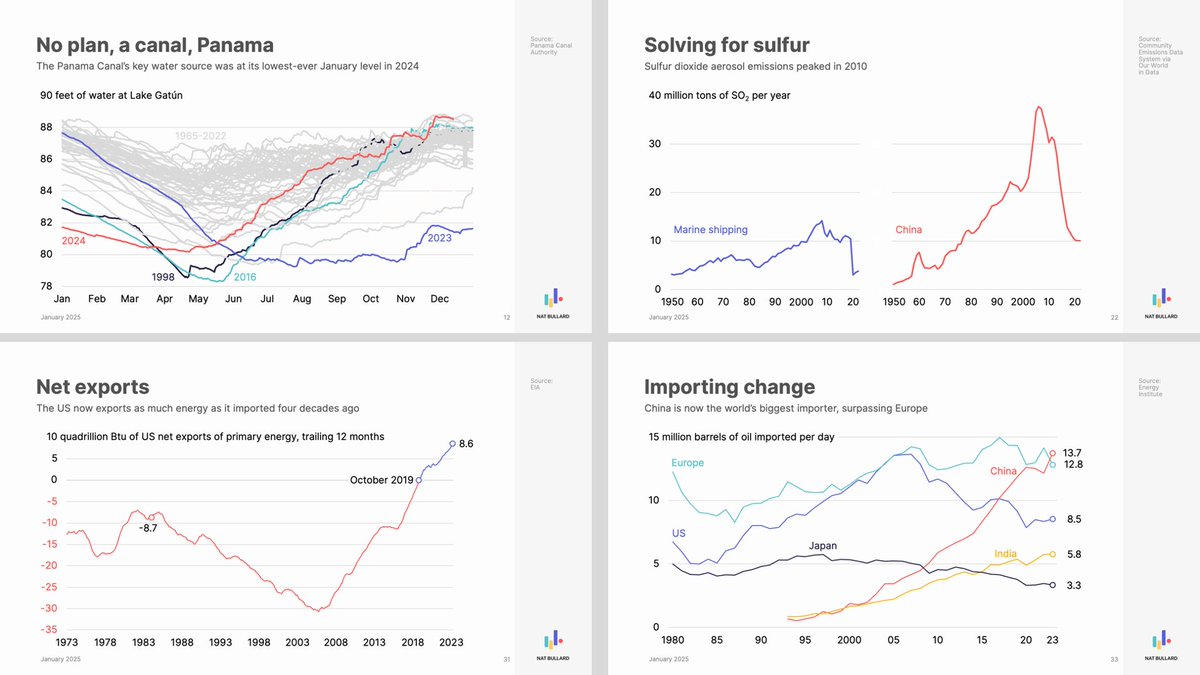
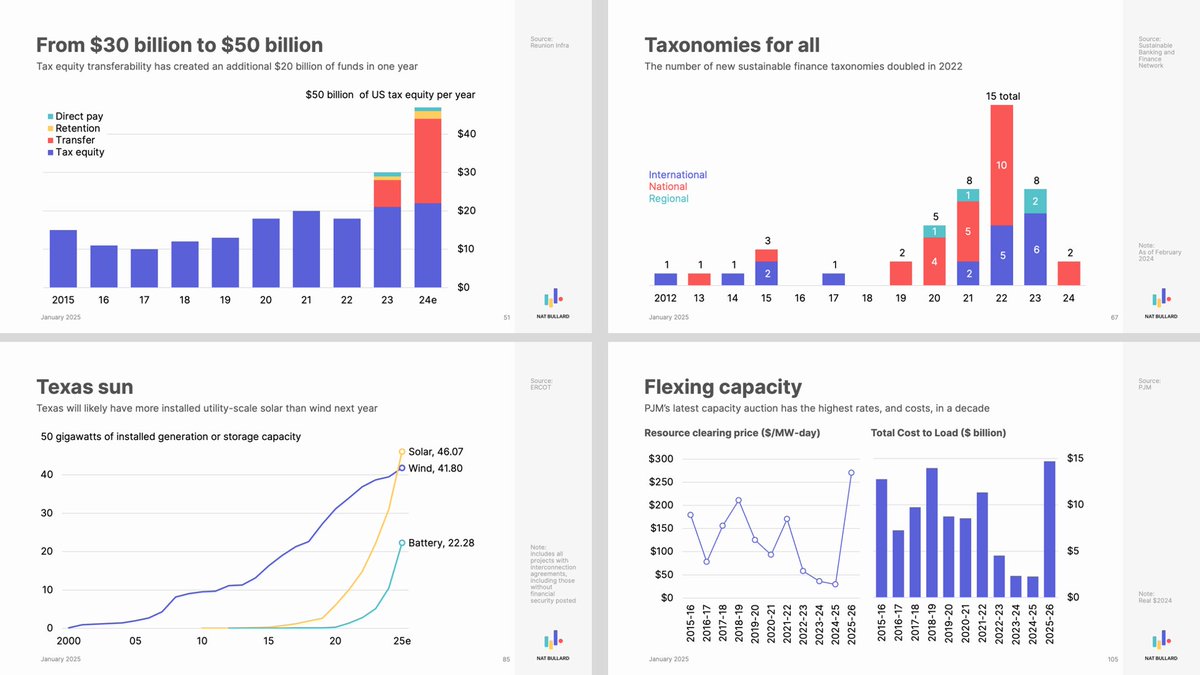
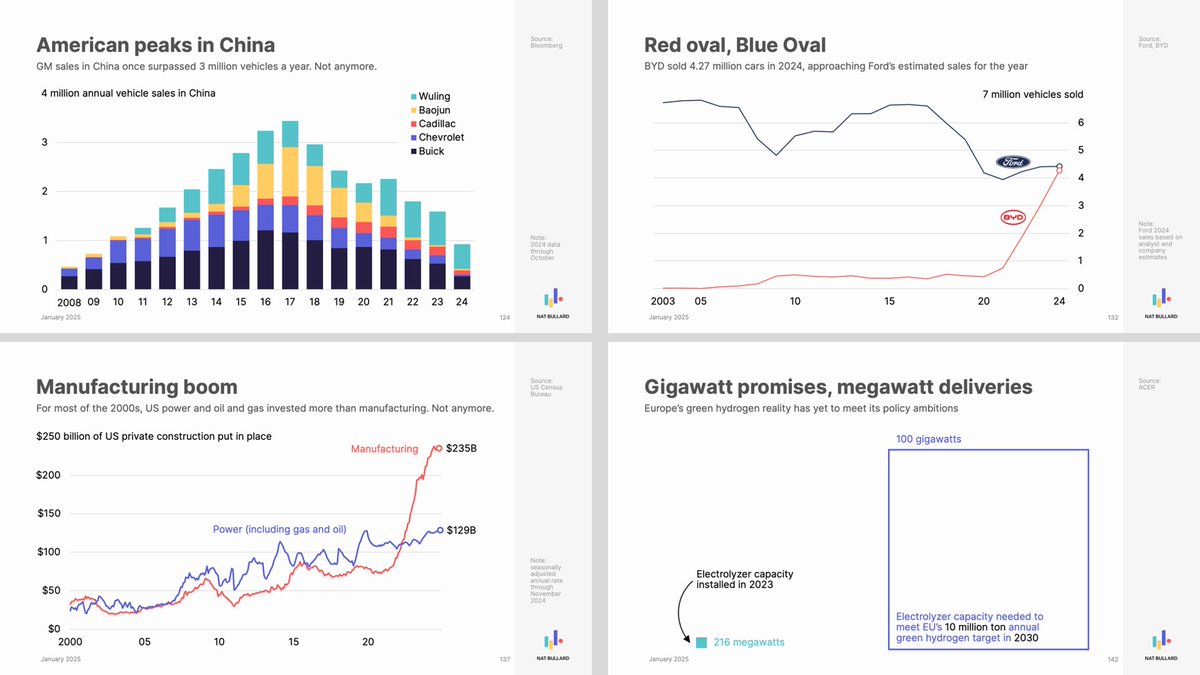
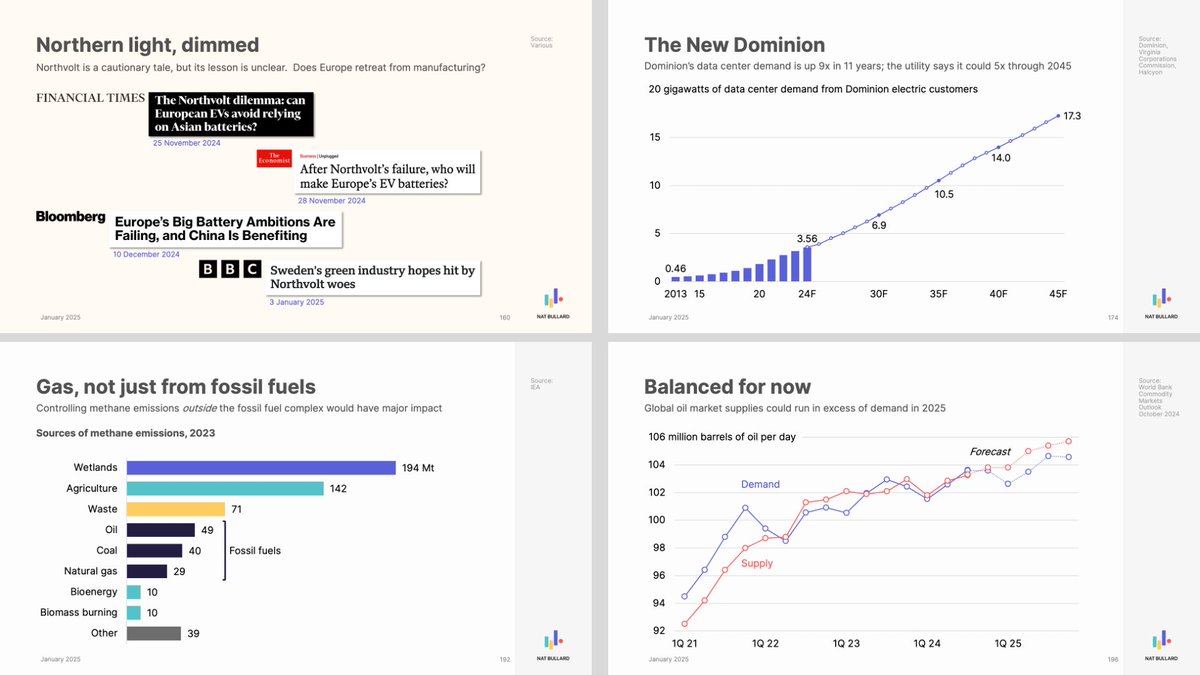
My annual decarbonization presentation is here.
200 slides, covering everything from water levels in Lake Gatún to sulfur dioxide emissions to ESG fund flows to Chinese auto exports to artificial intelligence.
Link in reply
53
198
812
166,275
Nat Bullard retweeted

Jun 12
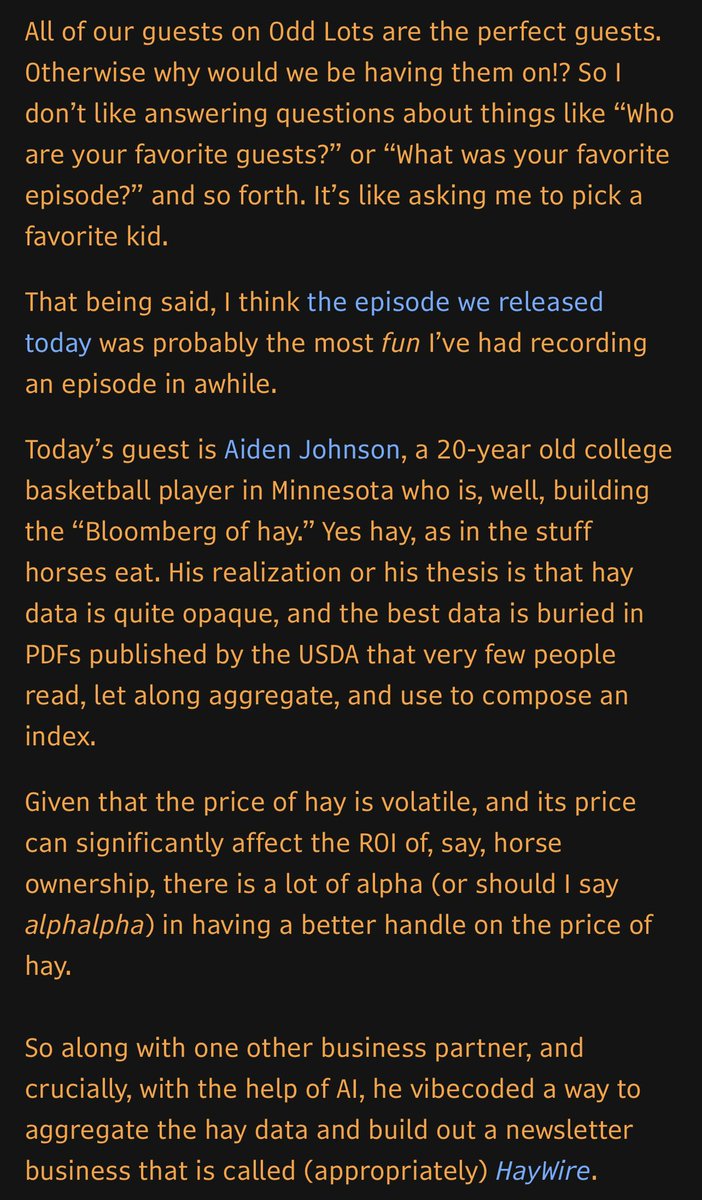
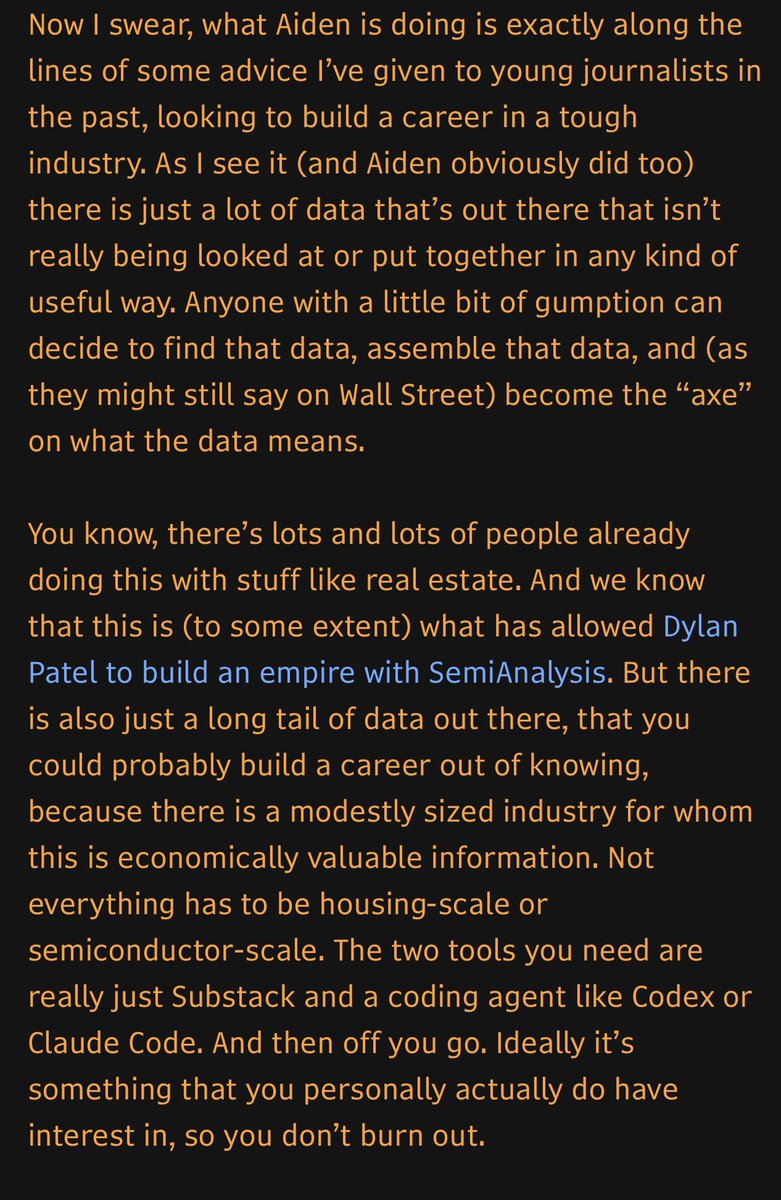
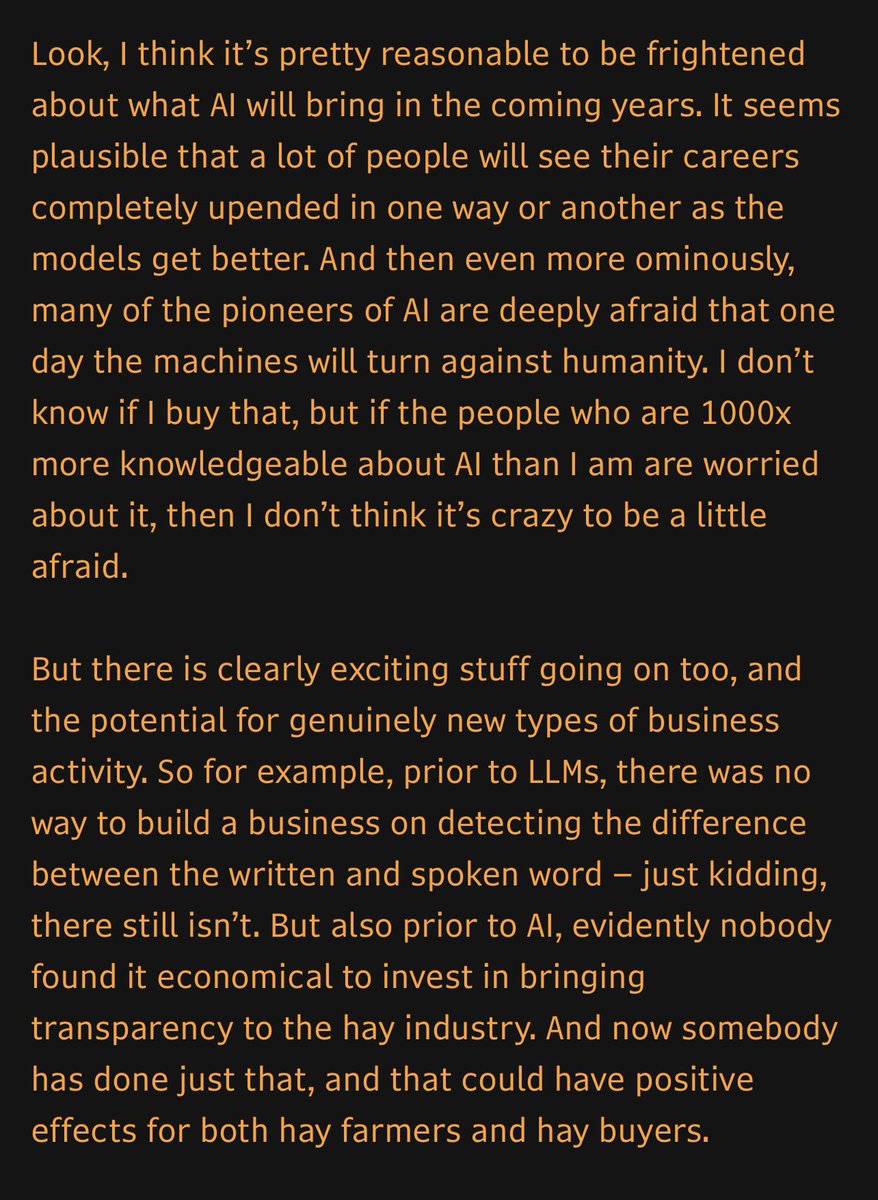
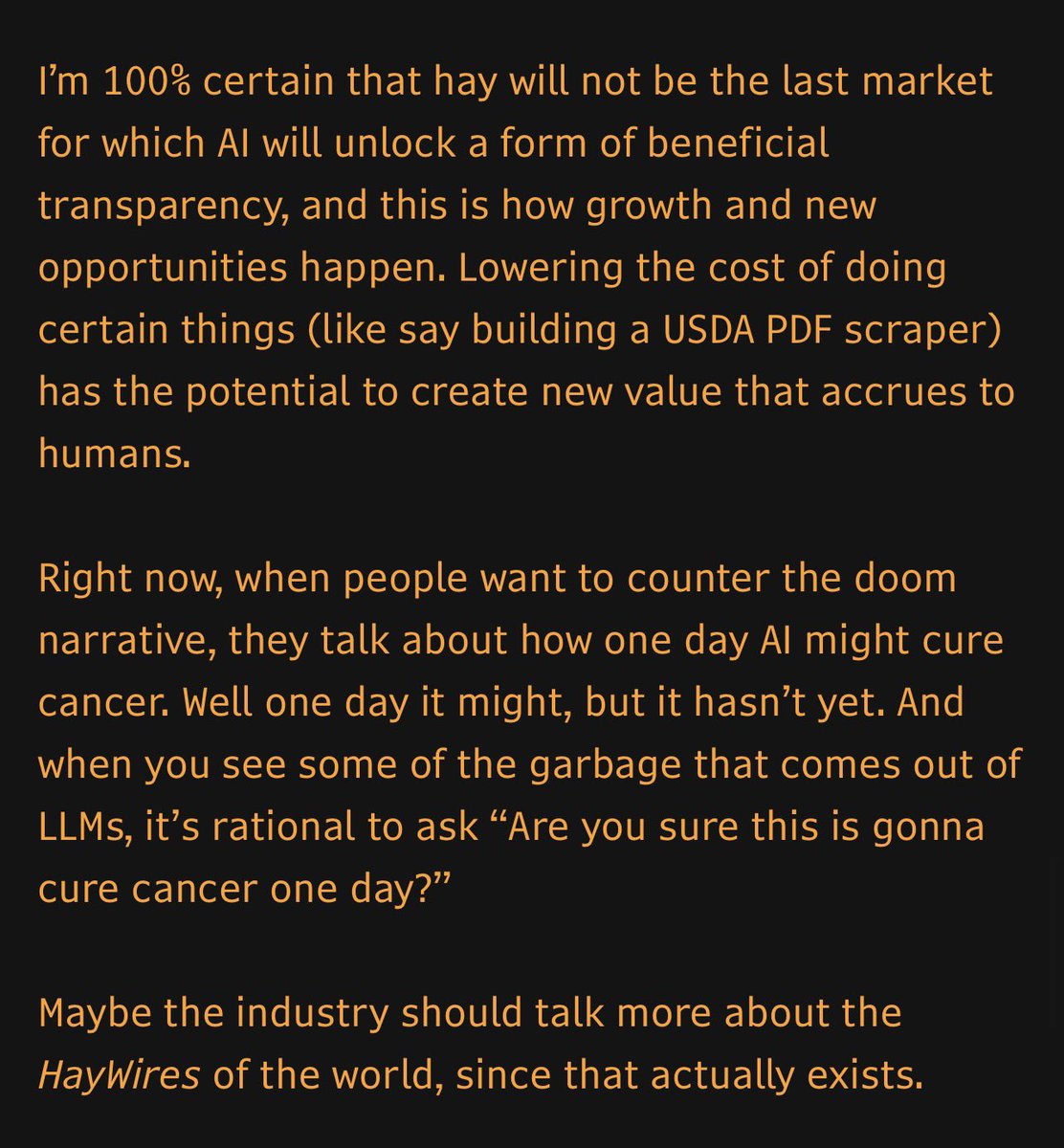
AN ACTUAL GOOD THING TO COME FROM AI
In today’s newsletter, I wrote about our new chat with @aidenjohnsonn_ and how stories like his are far more white-pilling than the typical “one day this might cure cancer” form of AI boosterism.
13
31
373
195,969
Nat Bullard retweeted

Jun 12
What a great story. There is so much latent demand out there for very specific products/services. This demand hasn’t been met because the market is usually relatively small and the overhead cost of providing it through traditional firms is too high to meet it.
AI changes this, @aidenjohnsonn_ is a perfect example of how: small team providing useful products to a market that would have otherwise been underserved.
My prediction is that we’ll see a ton of this going forward. Markets/people who were underserved/ignored because overhead costs were too high will have their demand met. Small teams/firms, but also teams within larger organizations targeting unmet demand with bespoke products. This is what a welfare improvement looks like.
Jun 12

AN ACTUAL GOOD THING TO COME FROM AI
In today’s newsletter, I wrote about our new chat with @aidenjohnsonn_ and how stories like his are far more white-pilling than the typical “one day this might cure cancer” form of AI boosterism.
9
23
174
36,309
Jun 12
Hard for me to say just how much I love Tracy's review of Nam Kee, and even more the reasons for that she wanted to review the chain restaurant
Jun 12

I was asked to do a Bloomberg restaurant review after coming back to Hong Kong for the first time in four years, so I wrote about my undying love of Nam Kee:
bloomberg.com/news/newslette…


5
2,115
Jun 11
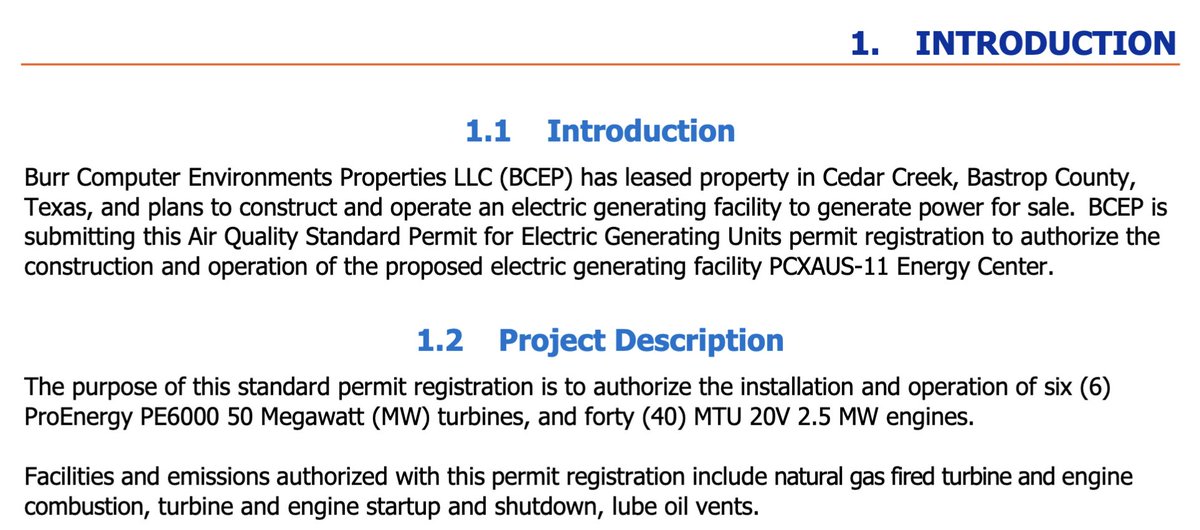
New Texas data center power plant just filed:
400MW, 6x50MW turbines and 40x2.5MW engines, behind the meter for @EdgeConneX.
Always read the fine print, or in this case, emails between developer and @TCEQ
via @Halcyon

2
9
59
9,559
Jun 11
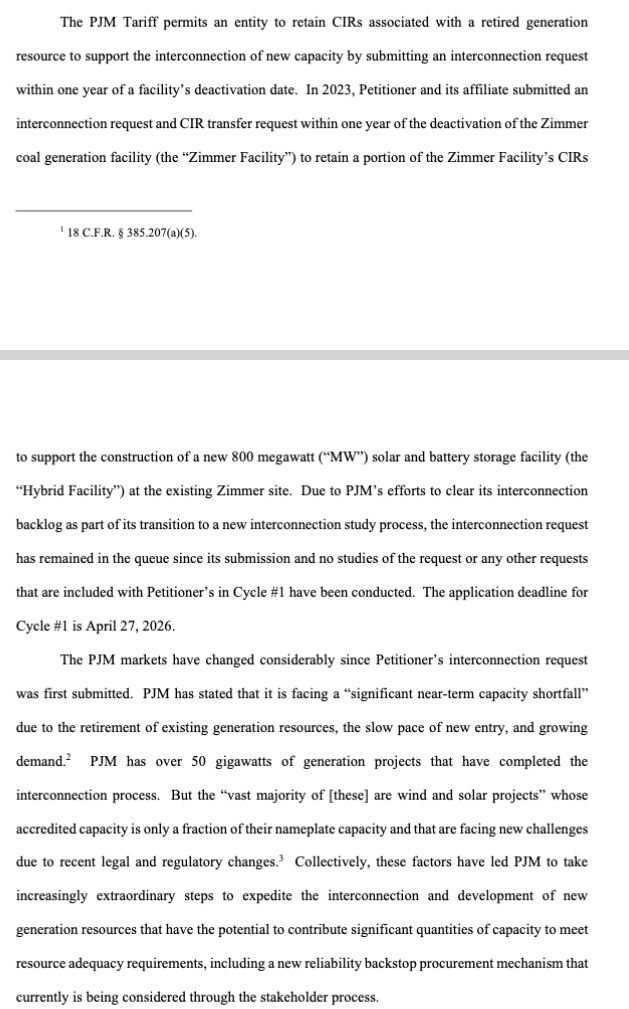
From late April, a bit of a sleeper: @VistraCorp files with @FERC to switch a solar storage conversion of the Zimmer coal power plant into Ohio...into a gas power plant. First of these I've seen.
Oh, and in the 1980s Zimmer was almost commissioned as a nuke!
Via @Halcyon
3
6
32
5,168

Jun 10
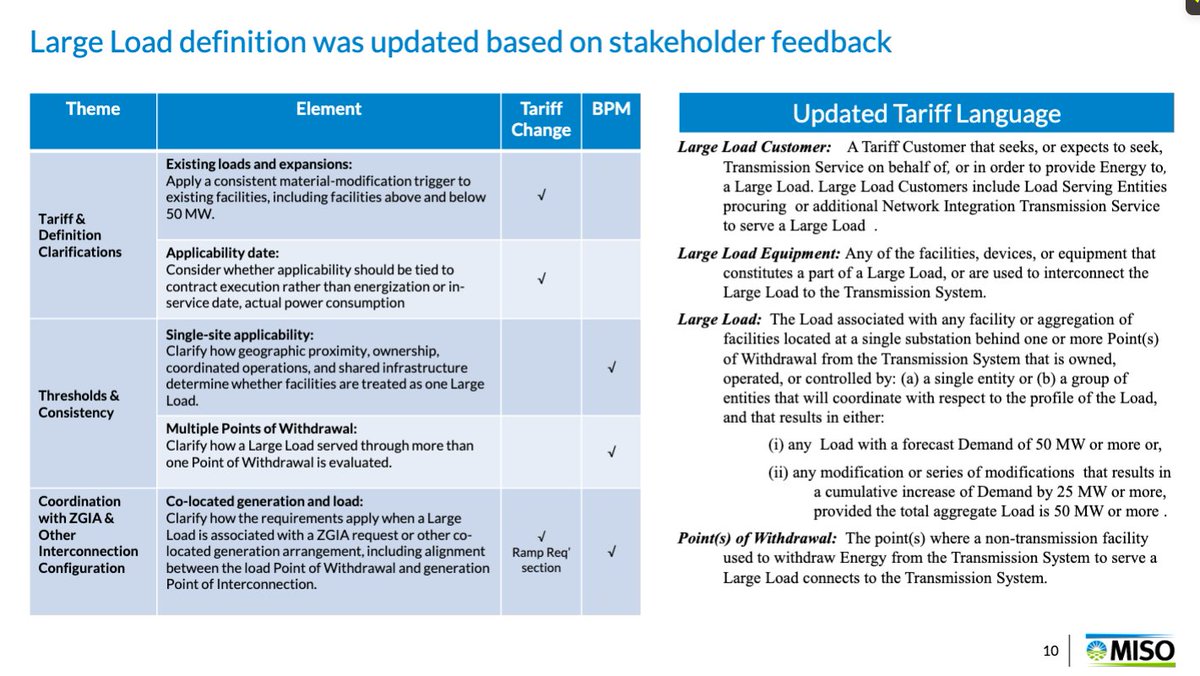
And now @MISO_energy is updating its tariff language on what constitutes a large load: any entity bigger than 50 megawatts, or a group that will coordinate to a load that big.
I get these filings pretty much instantly with @Halcyon
3
30
3,277
Jun 10
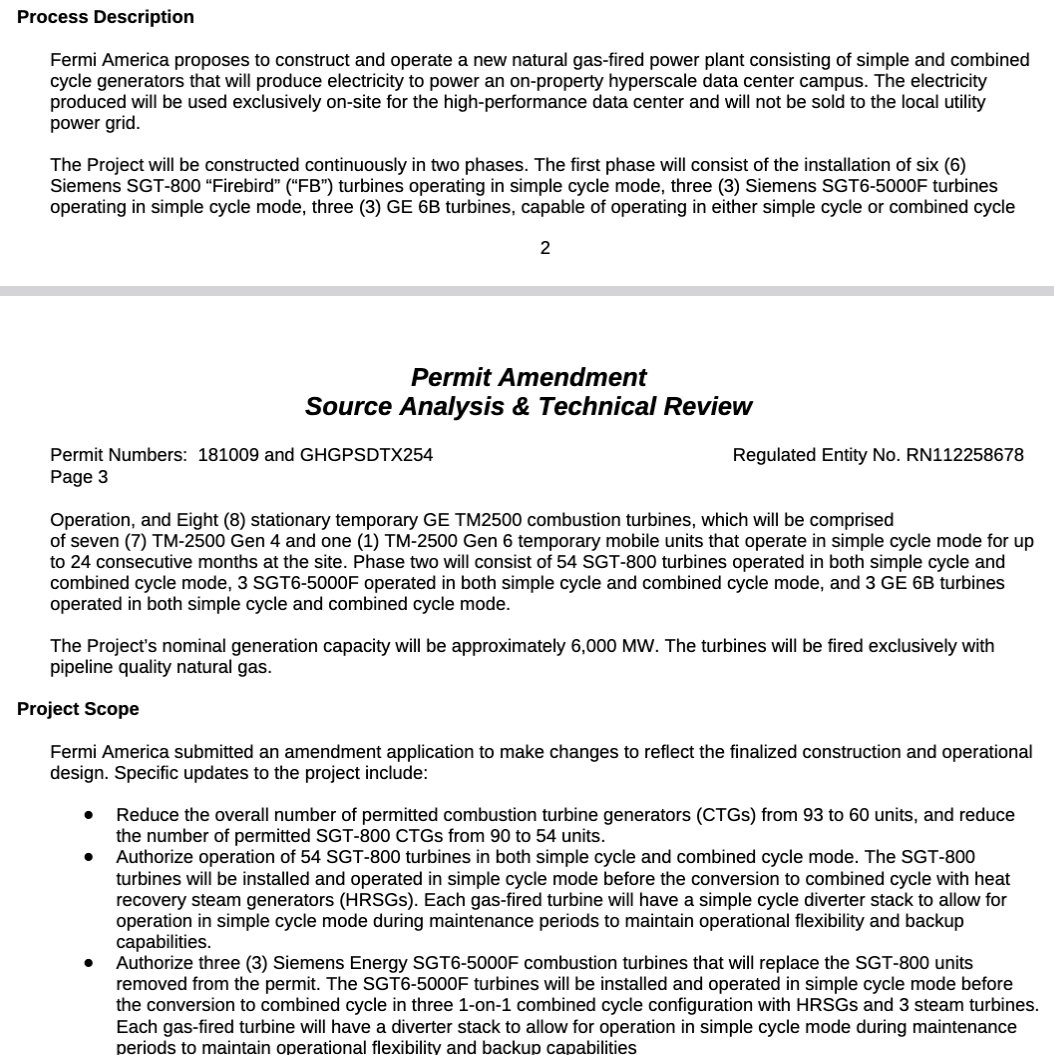
So @FermiAmerica has amended its TX air permit for its 6GW data center power project. Ditching 36 Siemens SGT-800 turbines, remaining 54 to be combined cycle-ready, and add three Siemens SGT6-5000F, run simple cycle at first, then combined cycle
3
7
75
10,520
Nat Bullard retweeted

Jun 10
Lot of consternation about this announcement.
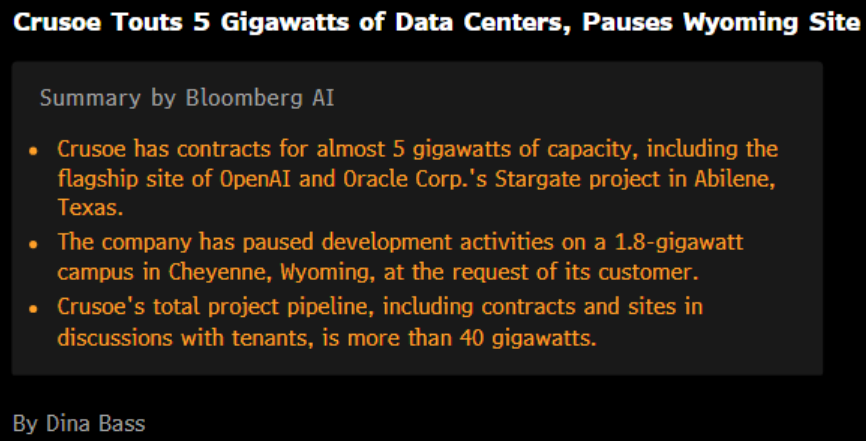
Crusoe’s June 9 release says it has 4.9 gigawatts of contracted AI infrastructure capacity across data center projects and Crusoe Cloud, against a 40 gigawatt total development pipeline. The contracted portfolio spans 5 US AI campuses: Abilene for Oracle, a second 900 megawatt Abilene campus for Microsoft, two additional large Texas campuses, and one in Missouri. Wyoming / Project Jade is not named in that contracted-campus list.
The original Wyoming plan was 900MW-1.8 GW in SE Wyoming scalable up to 10GW. Even assuming the most bearish read on impact (full capacity hit to contracted & pipe, that's still 3.1GW contracted and 30GW pipeline.
Assuming $10-$12M/MW, that represents $30-50B contracted and $300-400B pipeline of which Crusoe is going to take a fair share of. That math is not meant to imply Crusoe revenue dollar-for-dollar; it is a rough capex-sizing frame. But even haircutting the pipeline heavily, the scale remains meaningful.
The reporting is mixed. Third-party reporting says Crusoe has paused Project Jade at the customer’s request, while local reporting appears to have framed the situation more strongly as Crusoe having left the project. I would not treat “paused” and “exited” as economically equivalent until Crusoe, Tallgrass, AEP, Bloom, or the tenant clarifies. A pause can reflect cadence, customer timing, permitting, interconnection, equipment, financing, local opposition, or site prioritization; an exit would be a more material signal.
To be clear, this is a negative datapoint for Project Jade and potentially a timing / pipeline-conversion risk for Crusoe & Bloom, but I would not frame it as evidence that the AI infrastructure race is broadly slowing. More likely, it highlights that the bottleneck is not just raw megawatts but also customer cadence, siting, permitting, local acceptance, power architecture, and execution sequencing (as many of us have been saying for some time). Don't underestimate how unpopular AI and datacenters are becoming across the US.


*DATA CENTER DEVELOPER CRUSOE PAUSES AI PROJECT IN WYOMING
Crusoe, a data center developer for hyperscalers, announced they’re pausing development activities of a 1.8GW campus in Wyoming at the request of its customer.
“Crusoe was working with Blackstone Inc.-backed energy company Tallgrass to develop a 1.8-gigawatt campus in Cheyenne, Wyoming, for an undisclosed tenant. “At the request of our customer, Crusoe has paused its development activities” on the site, the company said Tuesday in a statement.””
Customer likely a hyperscaler hitting the pause button. At least partially being attributed to tech dump
2
7
81
97,746
Nat Bullard retweeted

Jun 10
Excellent essay. "The valuable work is illegible by construction: anything you can put on a leaderboard, you can train against, so anything measurable is already on its way to commodity."
Insights in every paragraph.

4
12
150
70,863
Nat Bullard retweeted
Jun 6
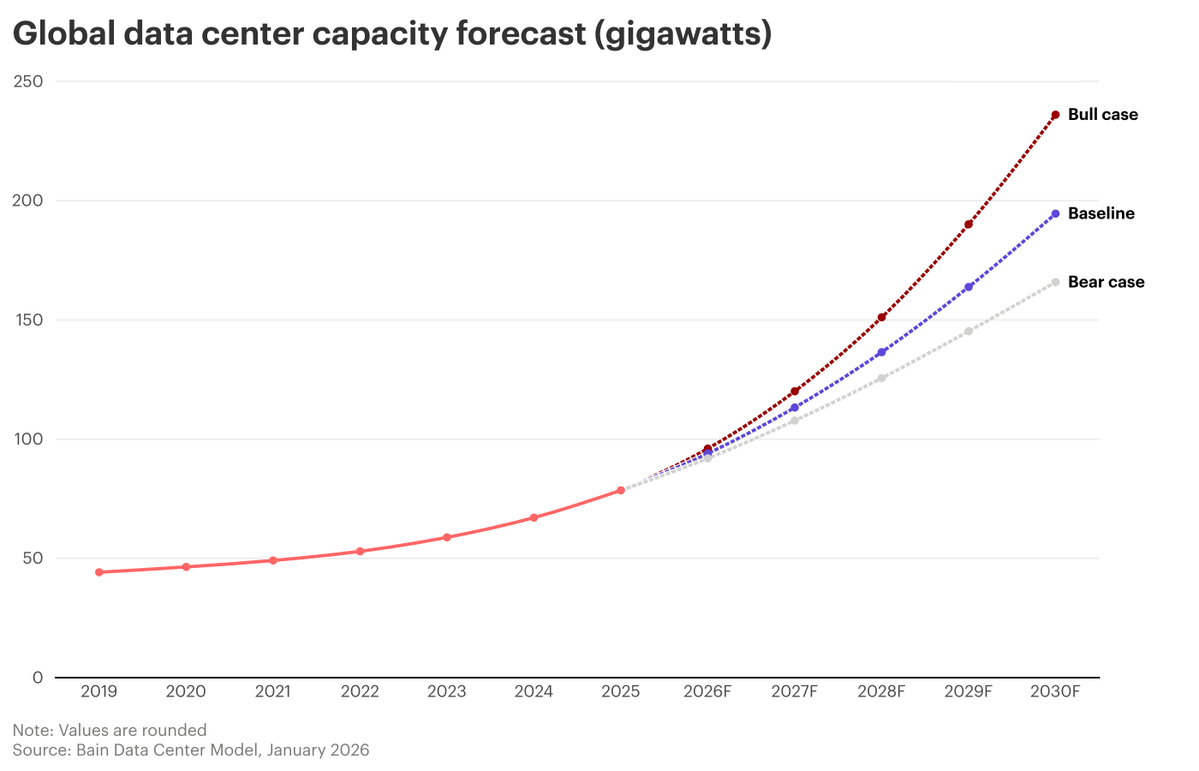
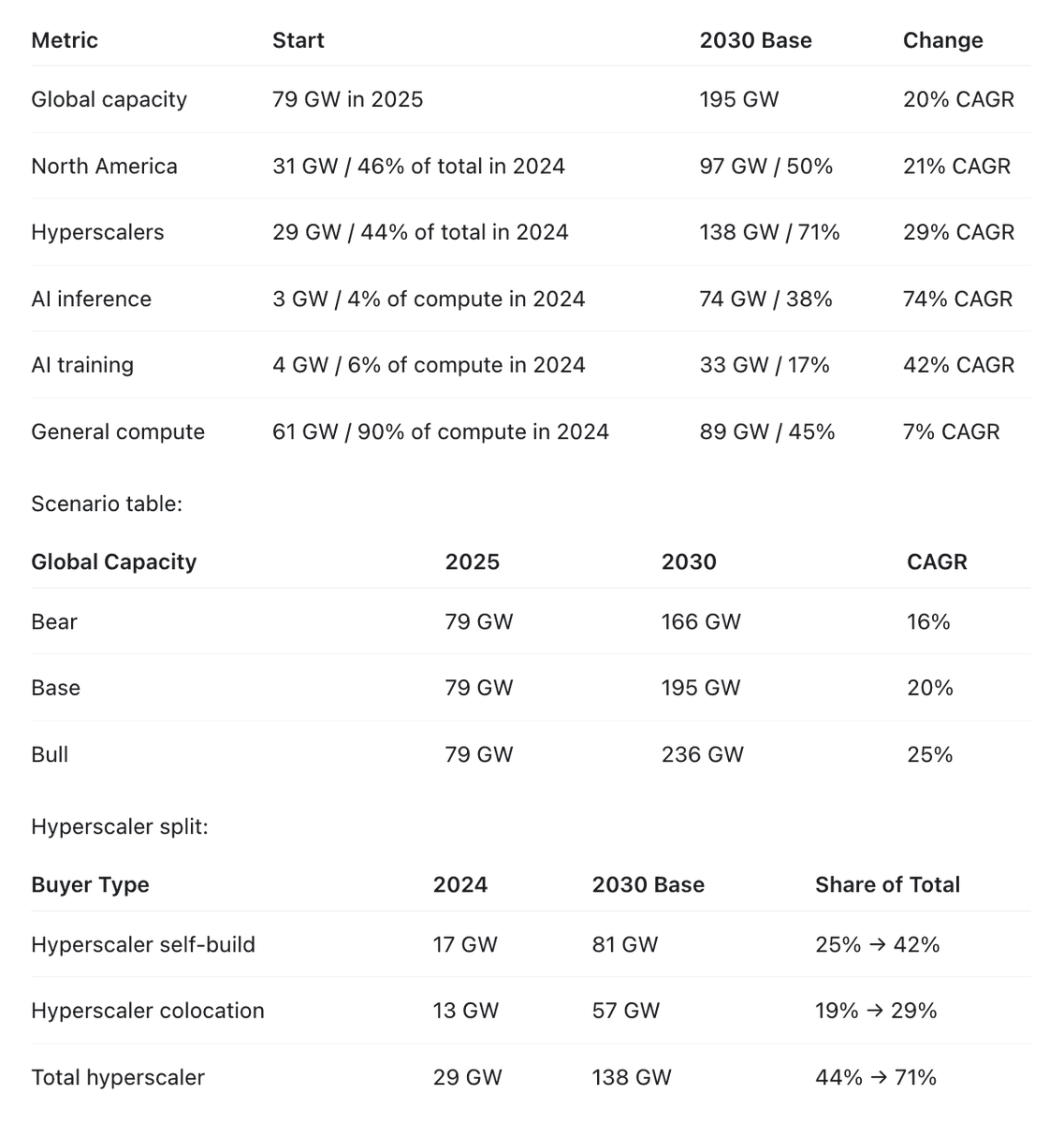
Bain’s latest AI data center forecast has global capacity going from ~79 GW in 2025 to:
Bear: 166 GW
Base: 195 GW
Bull: 236 GW
Implied 2025-30 CAGR: 16% / 20% / 25%.
Global data center capacity ~2.5x in Bain’s base case btwn 2025-2030 but the mix changes more than the headline number:
-North America stays ~50% of capacity
-Hyperscalers rise to ~70% compute capacity
-AI inference goes from ~4% to ~38% of compute capacity
9
23
108
11,231
Nat Bullard retweeted
Jun 5
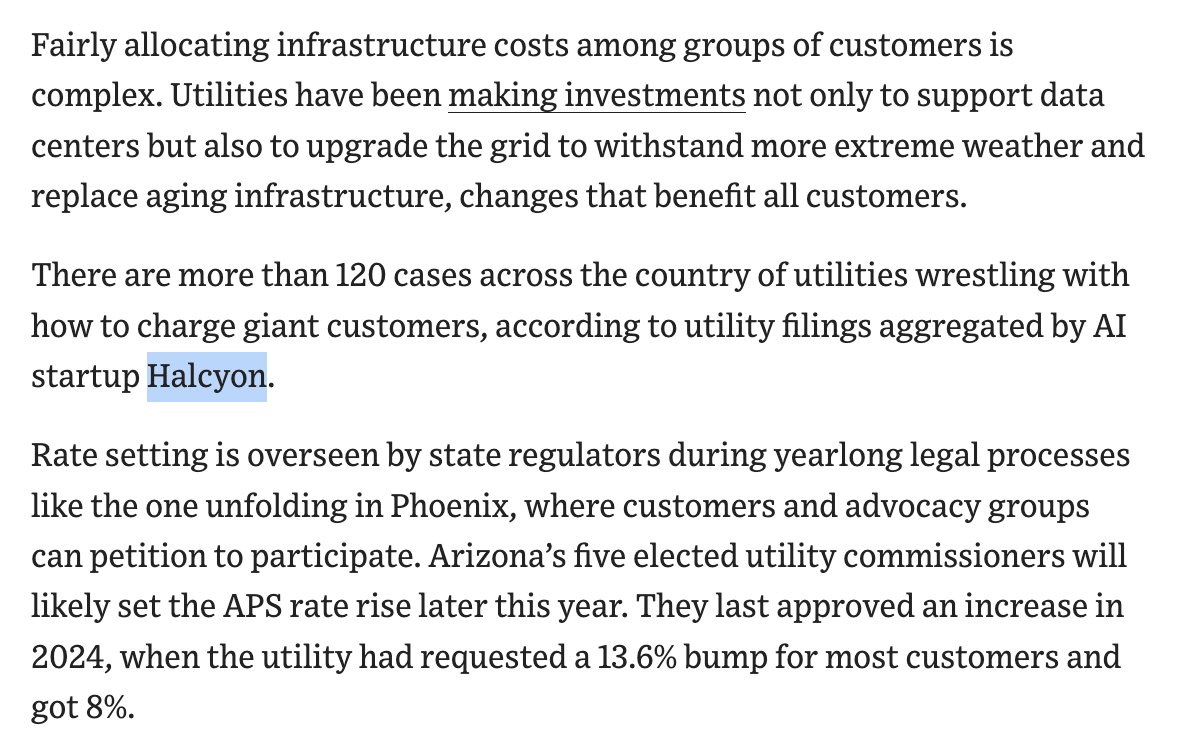
New, deeply-reported @WSJ piece by @Jennifer_Hiller on Arizona's data center cluster, the grid response, and how the Phoenix is becoming a test case for who pays what for power. Happy to see @Halcyon in there too!

3
8
44
5,269
Nat Bullard retweeted
Jun 5
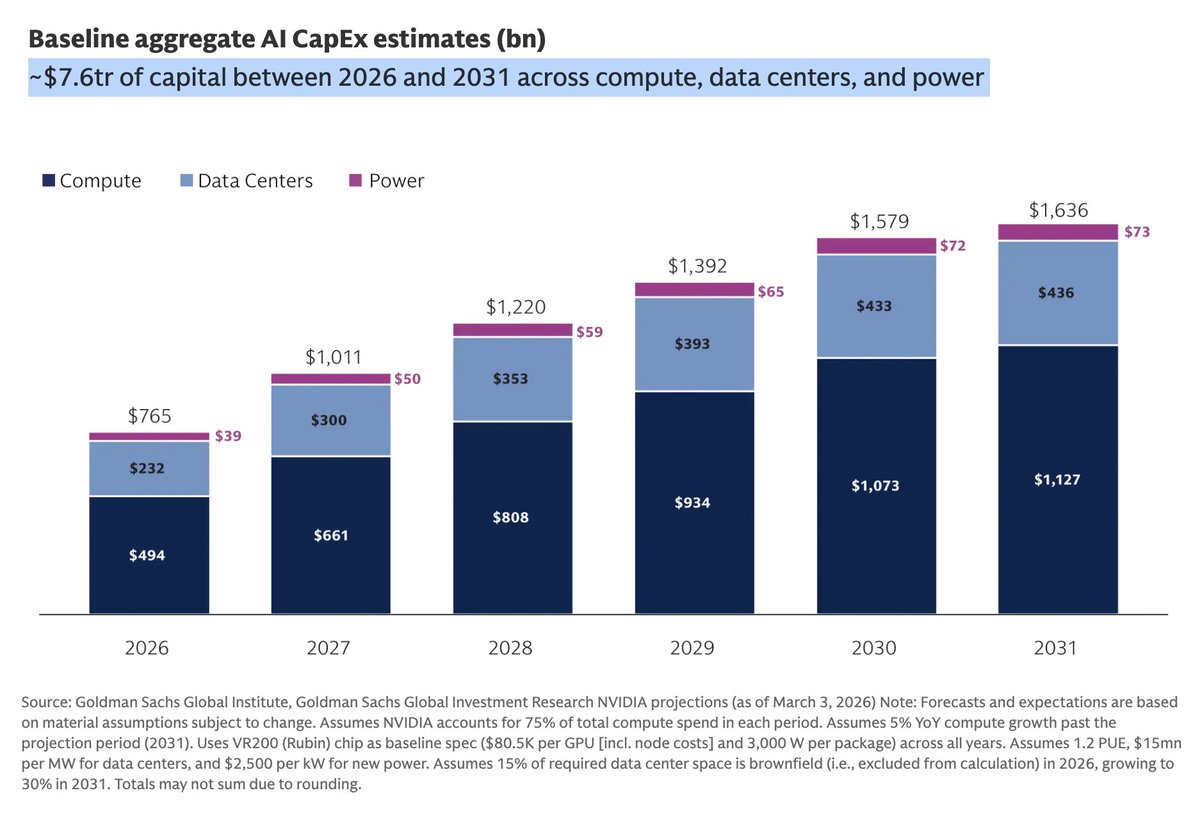
GS Global Institute's baseline model implies sees ~$7.6tr of capital between 2026 and 2031 across compute, data centers, and power
>The baseline model implies $765 billion in annual AI CapEx in 2026, growing to $1.6 trillion in annual CapEx in 2031
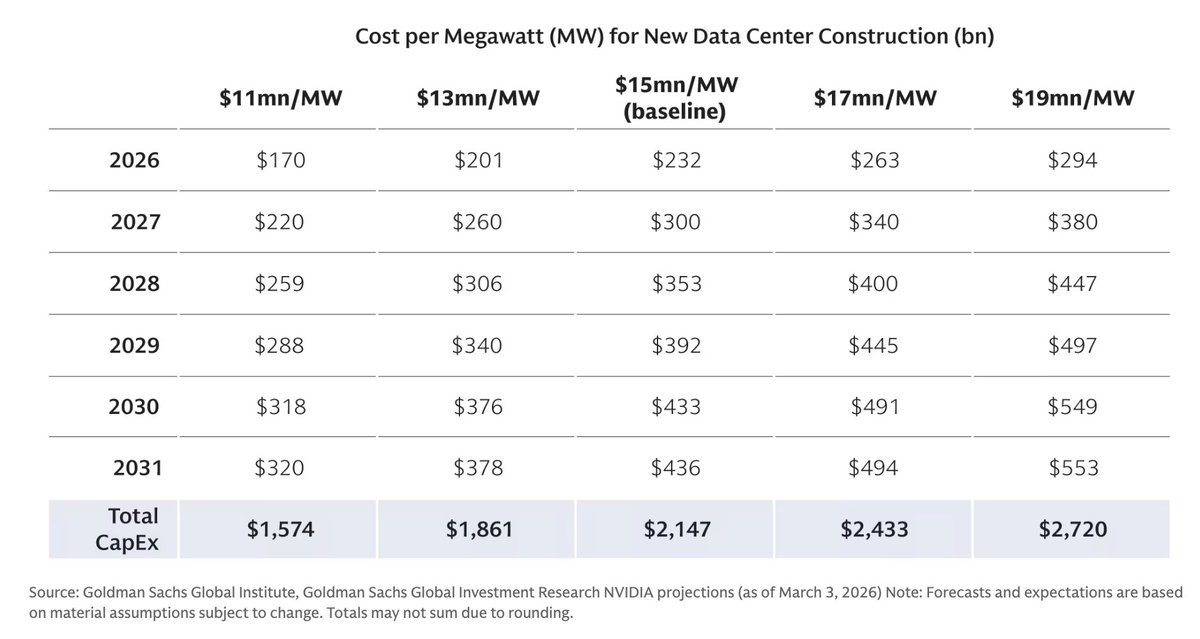
>Model assumes NVIDIA is 75% of total compute spend, 1.2 power usage effectiveness (PUE), $15M per megawatt for data centers, and $2,500 per kilowatt for new power; Goldman’s baseline uses the NVIDIA Rubin VR200 chip at $80.5K per graphics processing unit (GPU), including node costs, and 3,000 watts per package
>NVIDIA earns ~75% gross margins on its data center GPUs = well above alternative silicon providers, which is itself the economic motivation for buyers to look at custom architectures
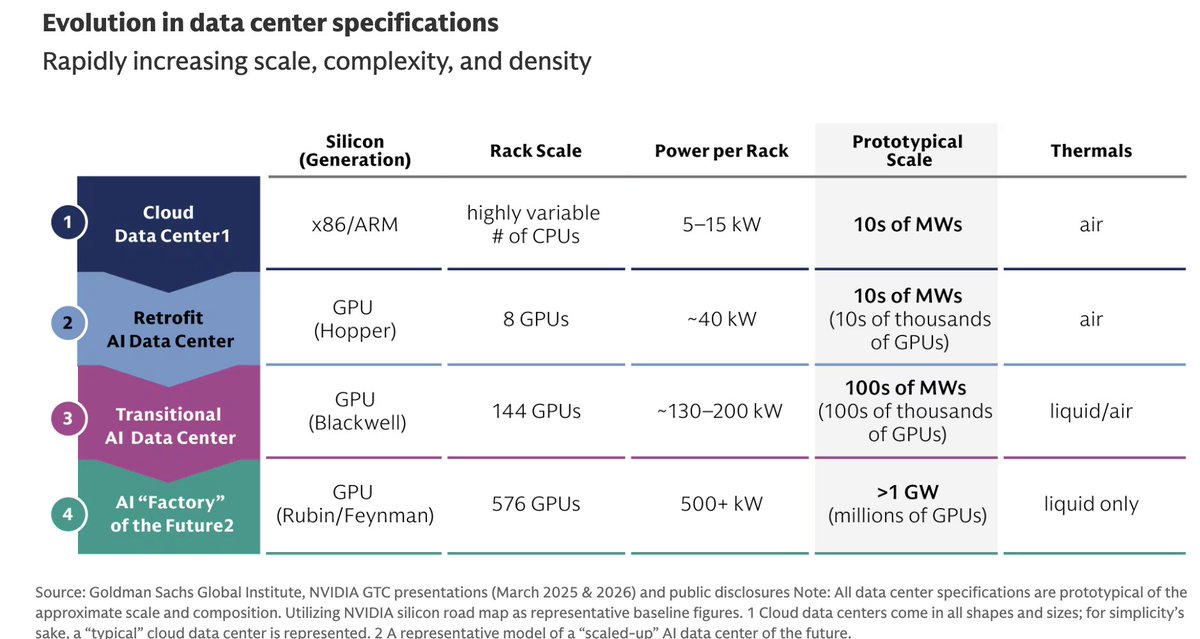
>Traditional hyperscale cloud data centers were roughly $10M/MW, while next-gen AI data centers are increasingly discussed at $15M–$20M/MW
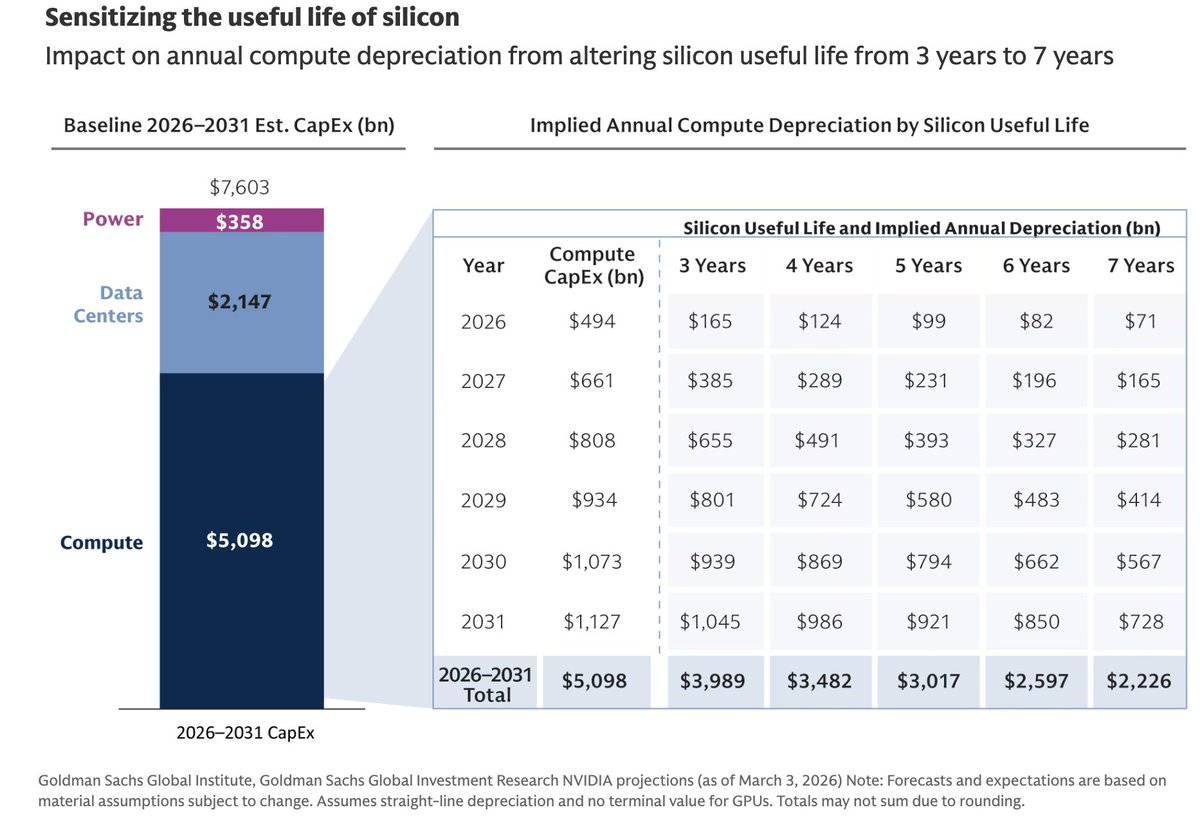
>AI silicon useful life is probably the biggest swing factor: chips are typically modeled at 4–6 years, while data center buildings are closer to ~20 years and power infrastructure 25 years
4
23
96
5,848
Nat Bullard retweeted

Japan plans to replace its aging nuclear reactors over the next few decades to meet rising power demand and curb dependence on imported fossil fuels
🇯🇵❤️☢️
The plan calls for as many as five new reactors by the 2040s and another nine the following decade
bloomberg.com/news/articles/…
4
24
78
7,195
Nat Bullard retweeted

Jun 4
Can the world live with 9% less oil? The answers are nuanced. This is a really insightful podcast with Natasha Kaneva, head of global commodities research at @jpmorgan.
She talks about structural changes in China, as electrification of road travel and high-speed trains have produced steep drops in gasoline, diesel, and jet fuel consumption. And she contrasts global energy adjustments to this energy shock to the 1970s. There is less room for economy-wide energy efficiency improvements today, but ready alternatives suggest gasoline and diesel demand declines could prove permanent. Jet and petrochemicals demand are stickier, as there are fewer substitutes. #oott #oil
Well worth a listen. Link below.
7
15
80
18,087
Jun 5
New, deeply-reported @WSJ piece by @Jennifer_Hiller on Arizona's data center cluster, the grid response, and how the Phoenix is becoming a test case for who pays what for power. Happy to see @Halcyon in there too!
3
8
44
5,269
Jun 5
1
4
1,148
Nat Bullard retweeted

Jun 4
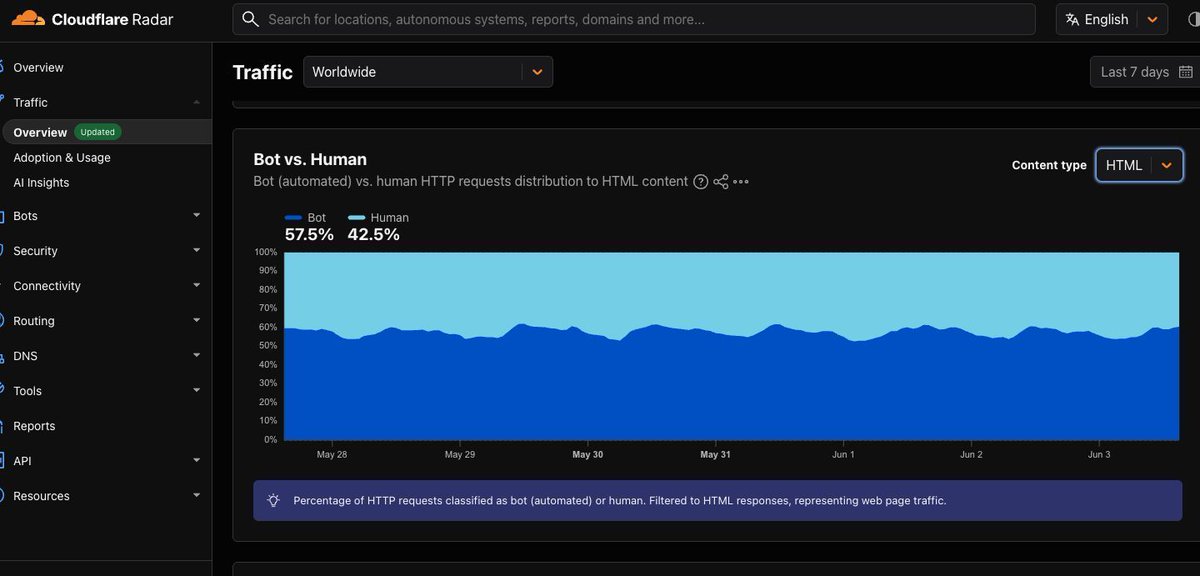
BREAKING NEWS: according to CloudFlare Radar Data, Agentic traffic has SURPASSED human traffic across the worldwide internet for HTML webpages.
84
363
2,268
358,730
Nat Bullard retweeted

Jun 3
Very kind of Dara to sprinkle some tasty morsels into every AI camp's feeding trough
For the AI-value skeptics: They blew thru their annual AI budget in a quarter and they're already pivoting
For skeptics who say the frontier labs have no moat: Once Uber figures out what works, Dara says they'll switch to "efficient models or even "open source."
For the AI boosters: He's still pushing teams to "fundamentally use the power of AI to rebuild systems and processes from the bottoms up"

Dara (CEO of Uber) on their AI spend:
"We blew through our AI budget in a quarter, for the whole year. It is forcing us to adjust.
We are going to meter headcount increases because to the extent that my engineers are getting much more efficient, their throughput is increasing. There's a cost to that, and it's a significant cost.
AI adoption has been occurring in all parts of the business –– whether it's engineers and how they scope projects, how they build, debugging, platform migrations.
I'm pushing the teams to fundamentally use the power of AI to rebuild systems and processes from the bottoms up.
I do think it's a combination for us right now of encouraging adoption, but then driving efficiency.
We're using the more expensive models to explore. Once we scale some of these experiences, we'll look to bring in more efficient models that are more efficient on a token basis or are open source."
13
24
319
140,775