
Curious.
Joined March 2016
- Tweets 6,595
- Following 1,944
- Followers 16,031
- Likes 17,716
590 Photos and videos








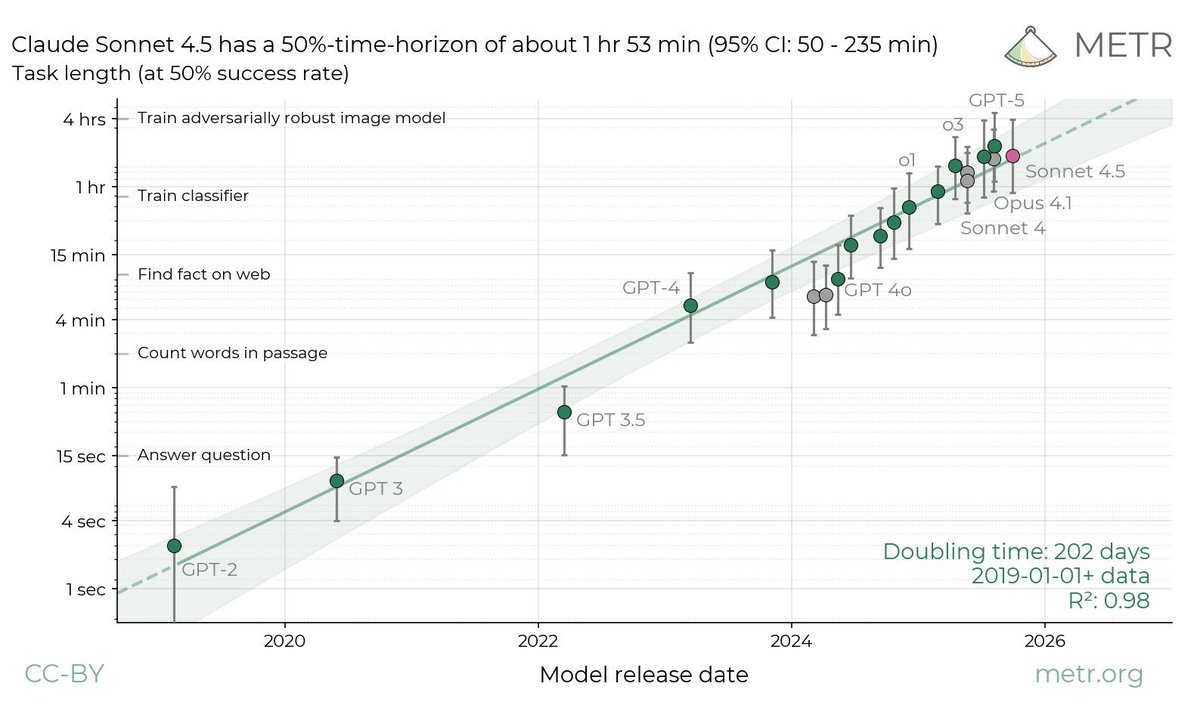



May 19
“Inferentia line”
May 19

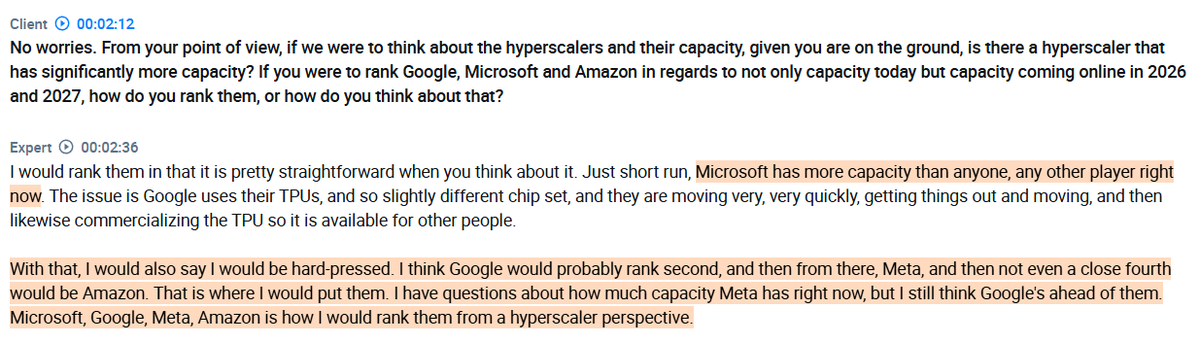
Former $MSFT employee on why $MSFT leads the hyperscaler capacity race and what that means for the competition ( $GOOGL, $META, $AMZN ):
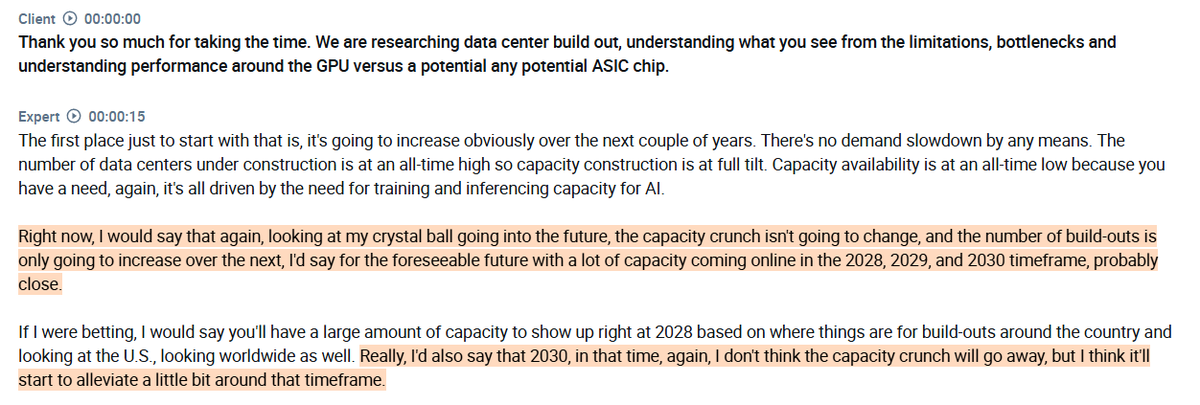
- The expert sees no slowdown in data center demand, with construction at an all-time high and available capacity at an all-time low, driven entirely by the need for AI training and inference. He doesn't expect the capacity crunch to ease anytime soon, with a large wave of new supply anticipated around 2028 based on current build-out timelines across the U.S. and globally, and some further relief potentially coming by 2030. However, the expert stops short of calling it a full resolution.
- The expert ranks $MSFT as the clear leader on current capacity, with $GOOGL in second place, moving quickly on both deployment and the commercialization of its TPUs for external use. $META comes in third, though the expert notes some uncertainty around how much capacity $META actually has available right now. $AMZN sits in fourth place, which the expert attributes to overindexing on the Inferentia line, which slowed capacity buildout in the short term, though the expert does not see that gap as permanent.
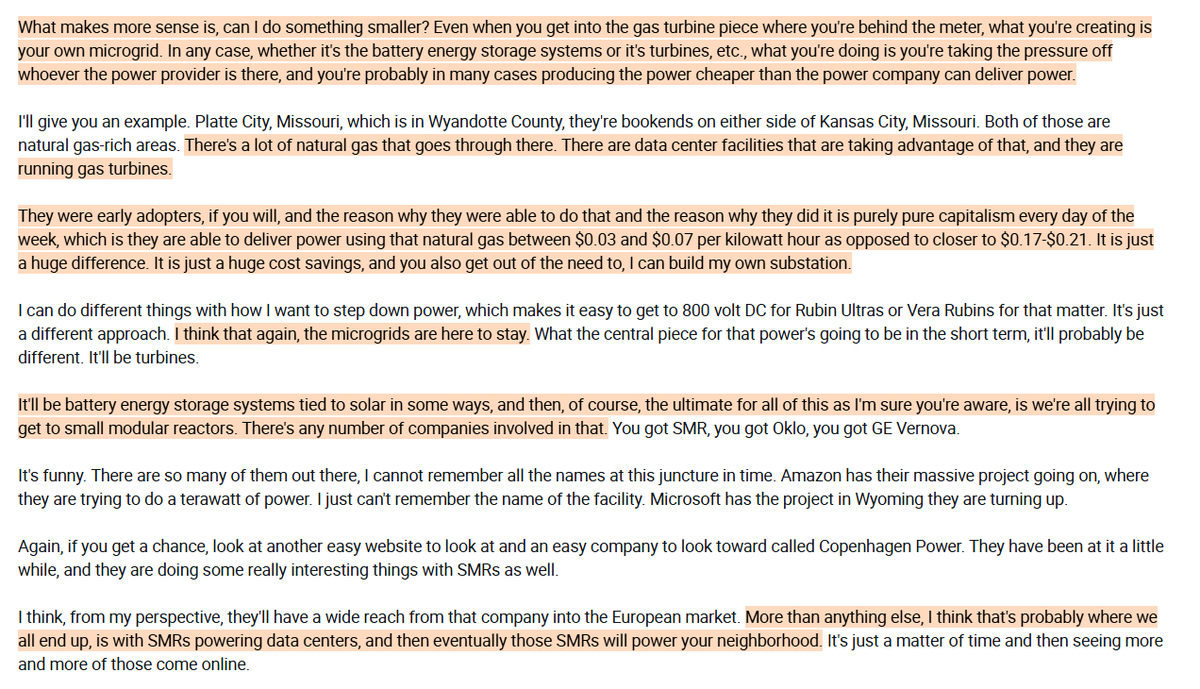
- The expert sees behind-the-meter microgrids as a practical and economically compelling solution for data center power, pointing to natural gas-rich areas where facilities can generate power at $0.03 to $0.07 per kilowatt hour compared to $0.17 to $0.21 from the grid, a cost difference significant enough to justify building out the infrastructure entirely.
- He believes the near-term mix will likely be gas turbines alongside battery energy storage systems tied to solar, but the expert sees SMRs as the ultimate destination, with companies making meaningful progress and permitting activity accelerating.
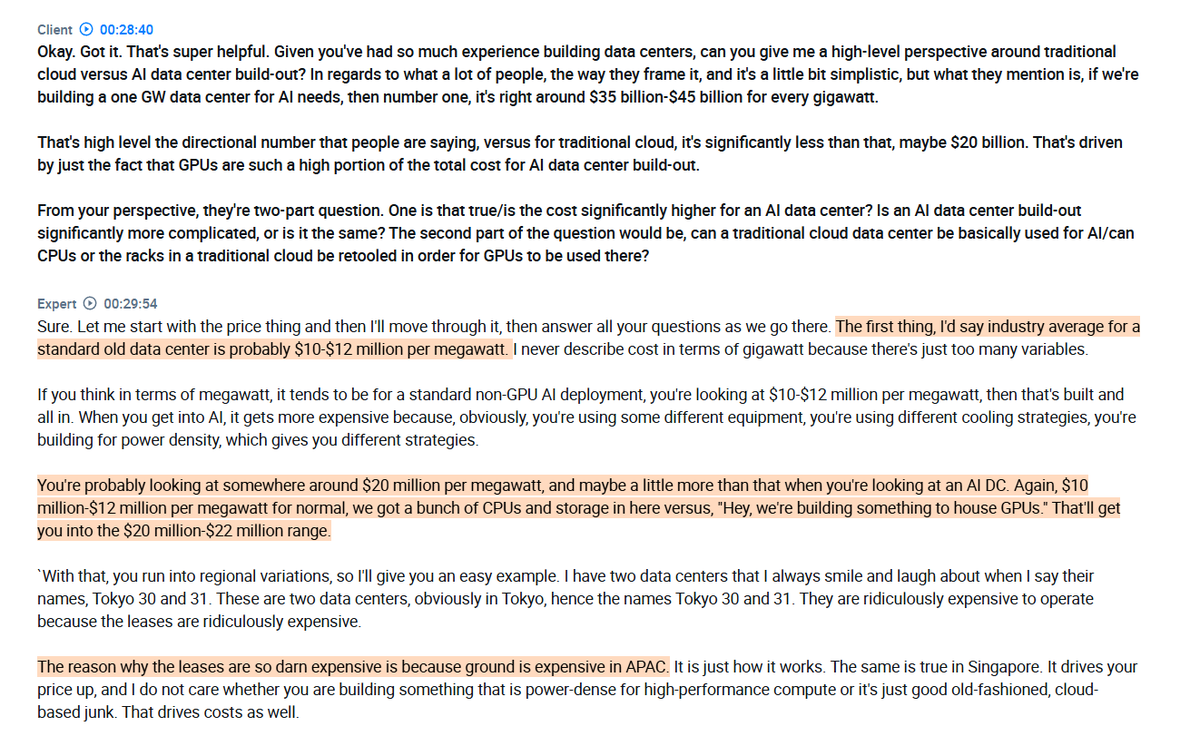
- The expert puts the cost of a standard non-GPU data center at around $10 to $12 million per megawatt all in, rising to roughly $20 to $22 million per megawatt for an AI-focused build, with the difference driven by higher power density requirements, different cooling strategies, and more specialized equipment. According to the expert, regional land costs add another layer on top pushing prices significantly higher regardless of workload type.
7
5,393
May 15
Honestly, not impossible he was granted confidential treatment by the SEC.

Leopold has some explaining to do
1
1
35
21,376
May 14
Charter / Comcast constantly talk about how adds are suppressed due to the low move environment. But if they are losing share, doesn't a low move environment help them?
1
5
1,950
May 8
This is the way. Literally every export I do now is as HTML.

HTML is the new markdown.
I've stopped writing markdown files for almost everything and switched to using Claude Code to generate HTML for me. This is why.
4
3,701
May 8
The game theory dictates that Gemini models will end up on AWS & Azure.
3
19
3,674
Apr 30
"And we now have over $225 billion in revenue commitments for Trainium."
1
959
Apr 26
Using Claude for Excel and I have permanently switched back to Opus 4.6 because 4.7 keeps breaking.
When AGI?
8
1,793
Apr 22
Has anyone else noticed material degradation in Claude model performance? Just flat out flying past my instructions. And this is not in an overloaded context window. Quite literally just flat-out ignoring prompts in an agentic model-building workflow.
From Opus 4.6:
"Why I missed firm-formatting: The core build-model skill explicitly says: "At the start of every session, load these two foundation skills: read_skill('build-model') AND read_skill('firm-formatting')." I didn't. When I entered this conversation on Phase 2 kickoff, I loaded build-model-phase-2 but skipped the two foundation skills. That's why I used Calibri 11pt, D9E1F2 instead of navy, no _) padding, no Section Boundary Rule — I was flying without the formatting spec loaded. You caught it when you said "did you even look at the firm formatting?"
From Opus 4.7:
"The task tracker thing is different and worse. The build-model skill literally says "After completing each phase, STOP. Update the Task Tracker." It's in the Core Rules. The Phase 2 skill repeats it in the "After Completing" section at the top. I read that section when I loaded the skill. Then when I finished the work, I reported completion in chat with a nice summary table and asked to proceed to Phase 3 — the chat update substituted for the tracker update in my head. I think what happened is: the summary table felt like "reporting status," the skill says "report status," box checked, move on. But the tracker is the persistent record; the chat message disappears. I conflated two different deliverables.
3
8
2,513
Apr 22
"You're right — that rule was in firm-formatting (forward drivers go in-line with the row they drive, not in a separate assumptions block below). I had it in context but didn't apply it here. Let me re-check the skill to confirm the exact convention before restructuring.
1,200
Apr 21
I keep seeing posts from people highlighting how “this company is disrupting the Bloomberg terminal” and it makes me realize that most people literally have no clue what people with a Bloomberg terminal do.
3
16
2,425
Apr 21
Does everyone have this feeling with the software they spend most of their day in?
I feel like everyone is like “oh yeah software it toast — just not my software, cuz my software is super niche and specific to what I do.”
1
1
11
1,543
Apr 18
Interesting thought.
I’ll take the other side.
Apr 17

I think CSPs are the next big disruption target. Distributed compute in a world of AI seems like an obvious outcome. We’re just waiting for its “Hello world” moment so we know it is possible.
2
1,920