
AI-Native & Agentic Founder/Operator (New AI company launching Summer 2026)
Joined January 2009
- Tweets 34,338
- Following 2,038
- Followers 13,054
- Likes 39,495
905 Photos and videos







Pinned Tweet

Apr 16
There are massive opportunity areas in AI adoption that no one is thinking about yet.
5
14
2,355
Rob Bailey retweeted

Jun 12
5 things @alanaagoyal does differently
> solo gp that commits code every single day
> doesn't take pitch meetings
> runs her agents in cmux on top of @mitchellh's ghostty
> built her personal website using a dozen of her own portco's products
> automated her investor updates without AI writing
ep 4 of show me your stack is live!
45
13
414
156,914
Jun 12
Dear NYC Friends: Where’s that best/most amazing place to watch the game tomorrow night?
3
2
665
Rob Bailey retweeted

Jun 12
Hot take: OpenAI may actually have a shot at enterprise vs Anthropic.
Pattern across some F500s right now: ChatGPT as the org-wide default, Claude ring-fenced for power users because of 1.) variable-cost fear and 2.) “more model than the median employee needs.”
The first is a trap of Anthropic’s own success. Claude’s identity is welded to agentic workloads like Claude Code, autonomous multi-step work. The horror-story AI invoices circulating in CFO Slacks are tied to Anthropic (for now).
The second is more damaging. “Too smart for the median employee” means frontier capability stops being the purchase criterion for 90% of seats, and a capability lead stops converting into distribution.
The second-order effect: the default surface accumulates the org’s connectors, permissions, and working context and maybe advanced users eventually converge on wherever their team already operates.
A possible end state: “our OpenAI relationship,” is board-level, vs “our Claude spend,” reviewable and cuttable.
What happens if you don’t have to win the model race to win enterprise, you just have to win the default?
45
13
340
51,860
Jun 12
Happy SpaceX IPO day to those that celebrate. Are you going to buy today?
1
3
281
Rob Bailey retweeted

Jun 11
in markets, to go long on something is to bet it grows more valuable over time. much of the conversation today is short on humans, wagering that ai makes people redundant. we believe the opposite is true for the industries @ThriveHoldings operates in.
we are long humans.
thriveholdings.com/long-huma…
86
132
2,057
562,475
Rob Bailey retweeted

Jun 11
What people think closing 8-figure AI deals with Fortune 100 companies looks like:
- steak dinners
- expense accounts
- business class
- mind blowing demos
What it’s actually like:
8
3
140
188,039
Rob Bailey retweeted

Jun 11
A founder asked me how to build an AI-services business without it turning into a consultancy. My answer: the whole game is in how you charge.
82
94
1,867
293,212
Rob Bailey retweeted

Jun 11
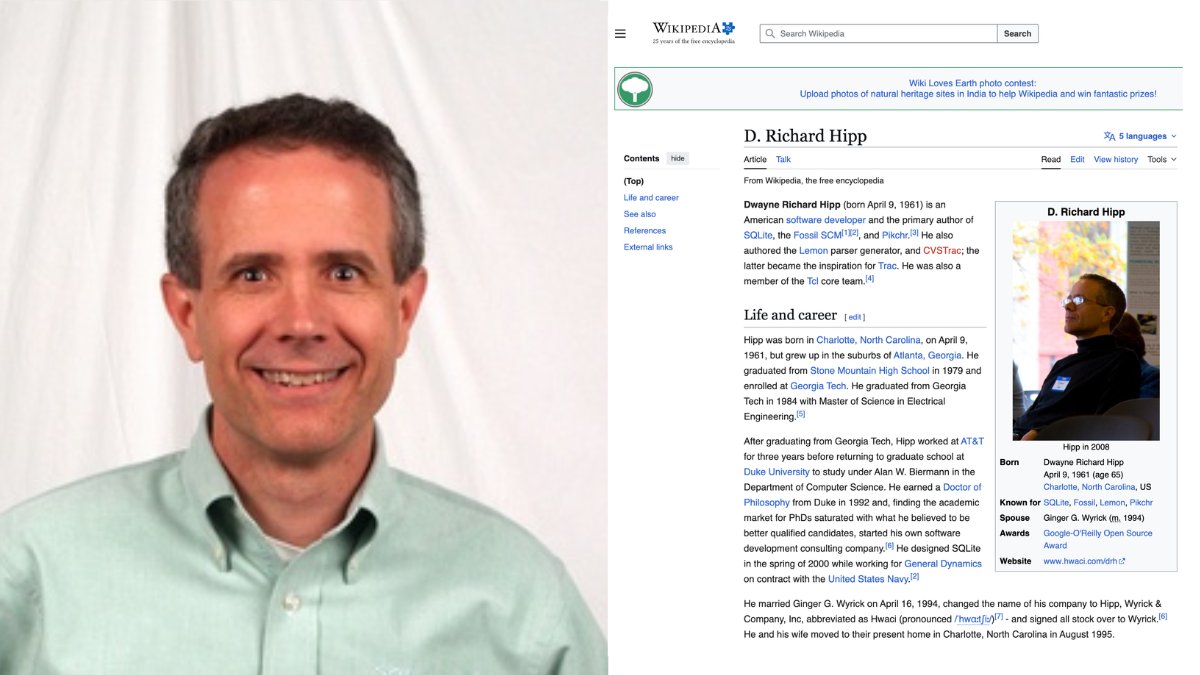
An engineer from Charlotte, North Carolina sat down in the spring of 2000 to write software for guided missile destroyers in the United States Navy. The ships needed a database that did not require a system administrator on board.
So he wrote one himself. 26 years later that database, SQLite, runs inside every iPhone on Earth, every Android phone, every Mac, every Windows machine, every major web browser, every airplane cockpit avionics system, and most of the cars built in the last decade. It is the most widely deployed software in human history. He still maintains it from his home in North Carolina.
His name is D. Richard Hipp. Most people call him Richard.
Here is the story, because the engineer behind the most replicated piece of code on the planet is a man almost nobody can name.
Richard was born in Charlotte on April 9, 1961. He grew up in the suburbs of Atlanta. He graduated from Stone Mountain High School in 1979 and went to Georgia Tech, where he earned both a bachelor's and a master's degree in electrical engineering by 1984. He spent three years at AT&T Bell Labs working in Unix and C. Then he went back to school at Duke University and earned a PhD in Computer Science in 1992. His dissertation was on spoken natural language dialog processing under Alan W. Biermann.
He could have stayed in academia. He told one interviewer the market for PhDs was saturated with better qualified candidates. He started a software consulting company instead. He married a musician and author named Ginger G. Wyrick in 1994 and renamed the firm Hipp, Wyrick and Company.
Then in 2000 he picked up a contract through General Dynamics to write software for the US Navy. The target was the Aegis class guided missile destroyer. The original system ran HP-UX with an IBM Informix database backend. The whole stack required a database administrator on board. The Navy did not want a database administrator on board. Richard's job was to make the database administrator unnecessary.
The design goals were simple. The database had to be self-contained. It had to run inside the application. It had to have zero configuration. It had to be transactional and reliable. It had to require no separate process. It had to be small.
On August 17, 2000 he released SQLite 1.0. He wrote it in C. The whole thing fit in less than a megabyte. The license he chose was the most extreme one possible. He released the source code into the public domain. No copyright. No royalties. No restrictions. Anyone could use it for anything forever.
The decision changed software history.
SQLite spread quietly. Mozilla adopted it for Firefox. Apple put it inside iOS. Google put it inside Android. Microsoft started shipping it inside Windows. Chrome, Safari, and Edge all use it. Photoshop uses it. Skype used it. Every major operating system you have ever touched runs SQLite somewhere underneath. The Airbus A350 uses it for flight software. Every Boeing 787 has SQLite onboard.
By 2026 SQLite was estimated to be running on more than 1 trillion devices. It is the most replicated piece of software ever written. Richard has personally turned down what is almost certainly hundreds of thousands of dollars in royalties over the past 26 years by keeping it public domain.
The SQLite team is tiny. Richard and a small group of core contributors. He maintains a separate version control system he wrote himself called Fossil. He maintains a parser generator he wrote himself called Lemon. He maintains a diagram language he wrote himself called Pikchr. He is a member of the Tcl core team and has been for over 25 years. He answers questions on Hacker News under the username SQLite.
The project's public commitment is to support SQLite through the year 2050.
A Christian engineer from North Carolina wrote a small database for missile destroyers and released it for free.
It is now running inside every device in your house.
32
246
1,356
204,062
Jun 11
It is insanely awesome how much Claude ChatGPT have transformed what it means to build product. I'm spending all day debating with them about UX, layouts, user flower and iterating screens.
1
317
Rob Bailey retweeted

Jun 10
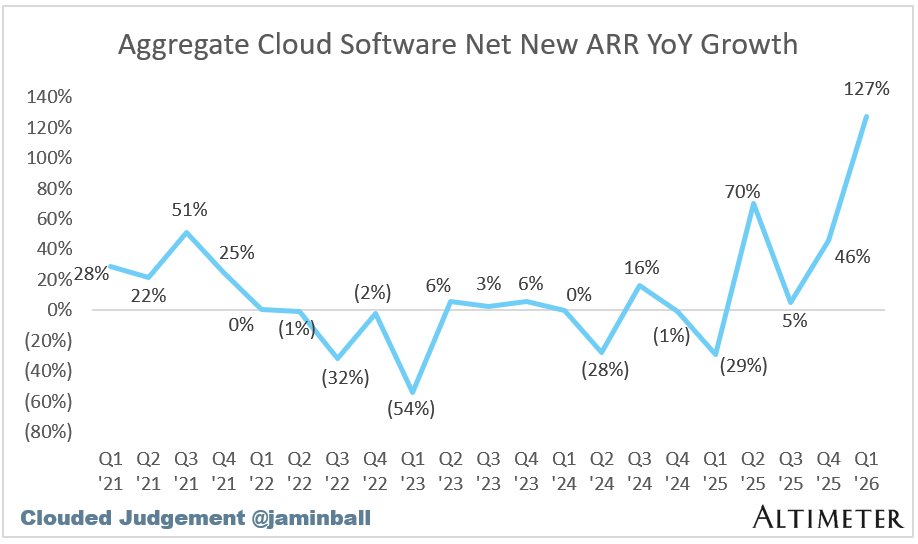
No SaaSpocalypse here! 🤷♂️
Jun 10

Q1 earnings season is just about done, and this Q has been great for software. Looking at the YoY growth in quarterly net new ARR added, this was the best quarter (by a long shot) in last ~5 years
12
36
503
126,886


Services are the future. Today we launched Ramp’s AI services motion.
It's easy to buy an AI subscription. It's hard to transform your company to actually run on agents.
Here’s our entire strategy.
1) Why now
Services are the new software (Sequoia)
Human labor TAM >> software license TAM. The market is bearish on seats and subscriptions.
Every enterprise AI company is doing this -- the labs have poured billions into services partnerships and their own deployment functions. Superintelligent models alone are not enough.
Palantir proved this is a strong business model: deeply embed engineers, build on top of a powerful platform, and customize extensively.
2) The real problem
Companies want AI. But the gap between "we have AI tools" and "agents run our workflows and we spend way less time" is enormous.
What we've found across over 50 companies we engaged with: agents start replacing real work when there is: complete data, read/write access across systems, agent-friendly policies. Most big companies struggle because:
- processes live in operators' heads
- dozens of disconnected systems (legacy ERPs, endless one-off excel sheets, etc.)
- archaic software with poor or no API access
Good data in the right place is a hard prereq to working agents.
Also, vibing in localhost ≠ a production system your enterprise can rely on. You still need hosting, ci/cd, observability, feedback loops, good interfaces. And taste to know what's even worth automating.
Everyone has a bulldozer, but most jobs just need a shovel pointed at the right spot.
What companies usually need is to be made agent-friendly. That's exactly what we do.
3) What we do
We focus on what Ramp does best -- finance.
And we embed FDEs that:
-> understand your problems
-> identify high-leverage, high-impact workflows that fit agents
-> scope the solution
-> connect your data
-> capture your context
-> deploy agents and often bespoke software for humans to collaborate with them
-> drive the business metrics that matter
Discovery and scoping are crucial. Building is easier than ever and thus judgement about what to build is more important than ever.
We're not a generic AI services arm, we're finance domain experts. Across the spectrum of financial operations, we help companies find and frame the problems worth automating -- similar to the taste a founder has in choosing which problems are worth solving (ex-founders make great FDEs).
Here’s the stack we deliver:
- Production infrastructure. Shipping an index.html from Claude isn't the same as creating a repo, hosting in a cloud service, ci/cd, testing, setting up evals, managing memories and skills, adding feedback loops, ensuring uptime, incident management, etc. Agents don't one-shot production systems yet. Production software is hard -- we build, host, and run it for you in a single-tenant, dedicated cloud environment. Most operators don’t have the time, knowledge, or experience to do this e2e. We help abstract the low-leverage plumbing so they can focus on the essential parts of their jobs.
- Data connectivity. Most enterprises have data lakes, but data is often incorrect, stale, or entirely missing. And write interfaces vary dramatically. Ideally we can use MCPs or CLIs, but usually it’s poorly documented APIs, SFTP, manual uploads, and email.
- A context layer. Things people have done for years aren't written down, so an agent can't do them until we capture that context -- ranging from simple policies to complex decisions. This usually involves creating policy documents, shared agent memories, and skills.
- Evals and feedback loops. How you know an agent is doing a good job, and how it improves over time.
4) Why Ramp AI Solutions
We focus on finance because it’s the vertical we know deeply, have structural advantages, and are most differentiated:
- Data. 70k customers use our core product, over $200B in annual payments, years of vendor data, millions of transactions and bills monthly.
- Money-movement primitives and partnerships. Global money movement rails, partnerships with banks, Visa, Stripe, etc. You don’t want to vibecode international wires for bill payments.
- An intelligence layer on top: fraud detection from hundreds of millions of expenses, PO-to-invoice matching, state-of-the-art OCR, and fine-tuned models for accounting coding, spend routing, policy review, etc.
Unlike the labs, we’re not incentivized to sell tokens.
Ramp is an AI fiduciary and an impartial broker to deliver AI that is:
- model-agnostic -- we benchmark all the leading models (labs, open source) and fit the right one to each task
- and token-efficient by design
Our main incentive is business outcomes -- which is Ramp’s mission, to save our customers time and money.
I’m extremely bullish about our motion, and the broad industry growth of AI-native services.
If you're a finance leader trying to be more agent-native,
If you’re interested in joining our FDE team,
I’d love to talk 🙂

57
44
545
156,020
Rob Bailey retweeted

LA: Have your agent talk to my agent.
SF: Have your agent talk to my agent.
47
164
1,698
955,183
Rob Bailey retweeted

Jun 10
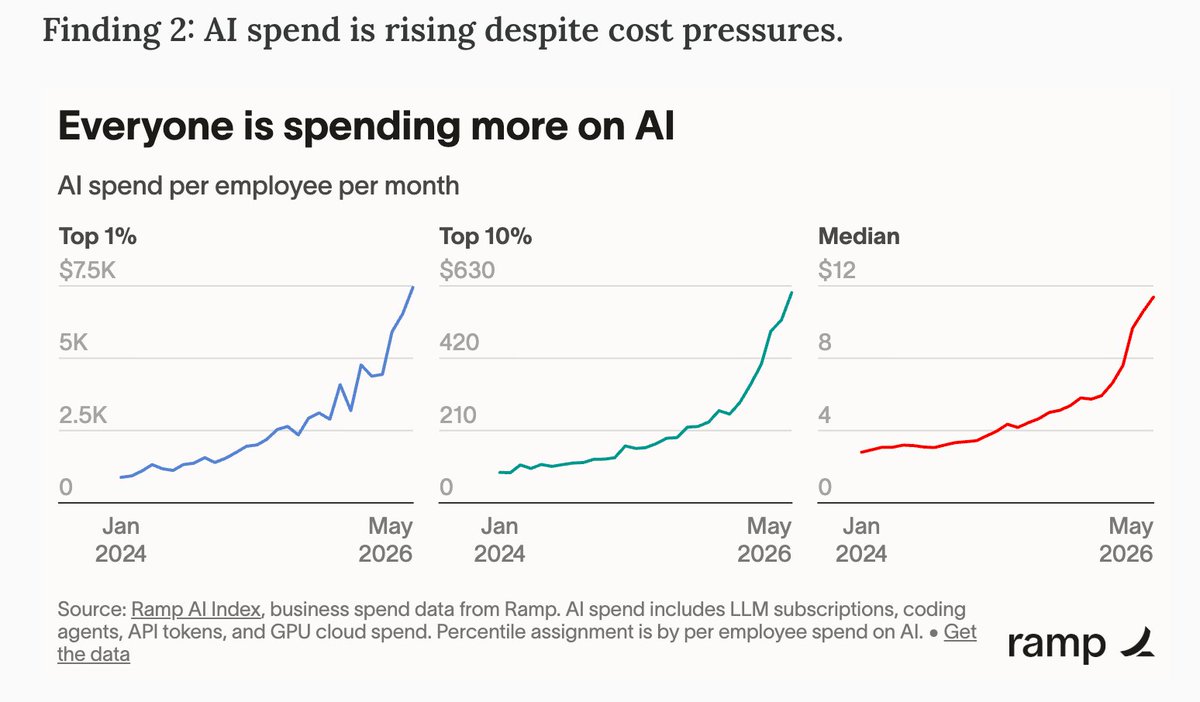
ai pilled companies spending $90k / employee per year 🤯
per employee, not per engineer.
where does this go in a year!? can't wait to find out...
from ramp's dataset (70k companies).
21
35
226
57,580
Jun 10
🔥🔥🔥
Jun 10

‘AI-pilled’ firms spend $7,500 per employee each month on AI techcrunch.com/2026/06/10/ai…
1
1
2
978

Rob Bailey retweeted

Jun 10
From Token-maxxing To Token-panic: Citrini Warns AI Goldilocks Narrative Hitting A Wall zerohedge.com/ai/token-maxxi…
15
22
118
44,829
Rob Bailey retweeted

Jun 10
there’s currently a cold start problem for folks getting started with agents, especially in organizations
everyone needs to discover best practices and the “right way” to do things. build skills. context. loops
we need better ways to discover what peers are doing and what the top 10% do better than everyone else
like @steipete suggestion of everyone sharing sanitized codex sessions
14
2
16
1,610
Jun 10
This is awesome. I consistently see India in top 5 for AI/agent adoption across different platforms.
Jun 10

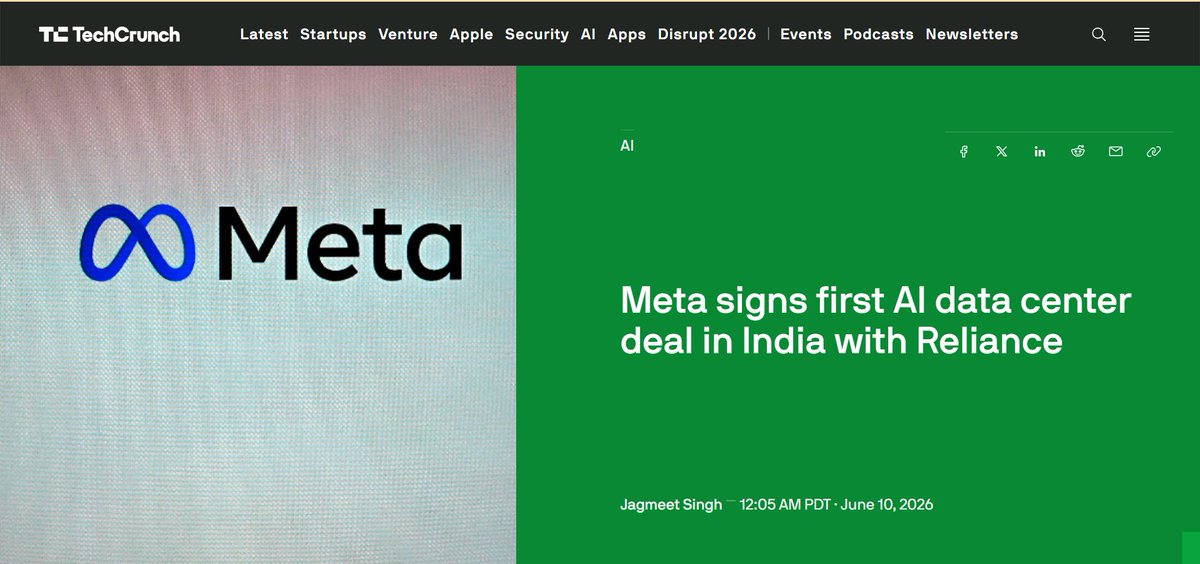
🚨News: Meta is building its first AI data center in India, and it's teaming up with Reliance to do it.
the project is a 168-megawatt AI-enabled facility in Jamnagar, Gujarat.
Meta is leasing the capacity while Reliance handles everything from design and construction to power, connectivity and day-to-day operations.
the center will run on renewable energy and use desalinated seawater for cooling.
Meta is covering the full cost of the energy and water it uses.
Reliance says it'll be ready within two years and can expand over time.
It will also plug into Meta's global AI computing network.
On top of that, Meta has contracted nearly 1 gigawatt of new renewable energy in India through CleanMax and Fourth Partner Energy.
the deal builds on Meta's $5.7B investment in Jio back in 2020. Value of the new agreement wasn't disclosed.

ALT source: https://techcrunch.com/2026/06/10/meta-signs-first-ai-data-center-deal-in-india-with-reliance/
1
1
6
1,593