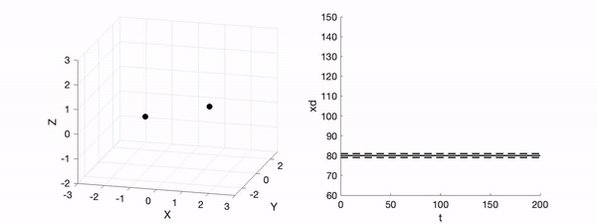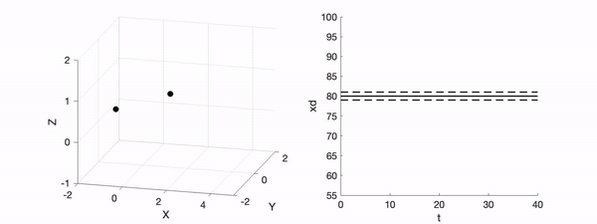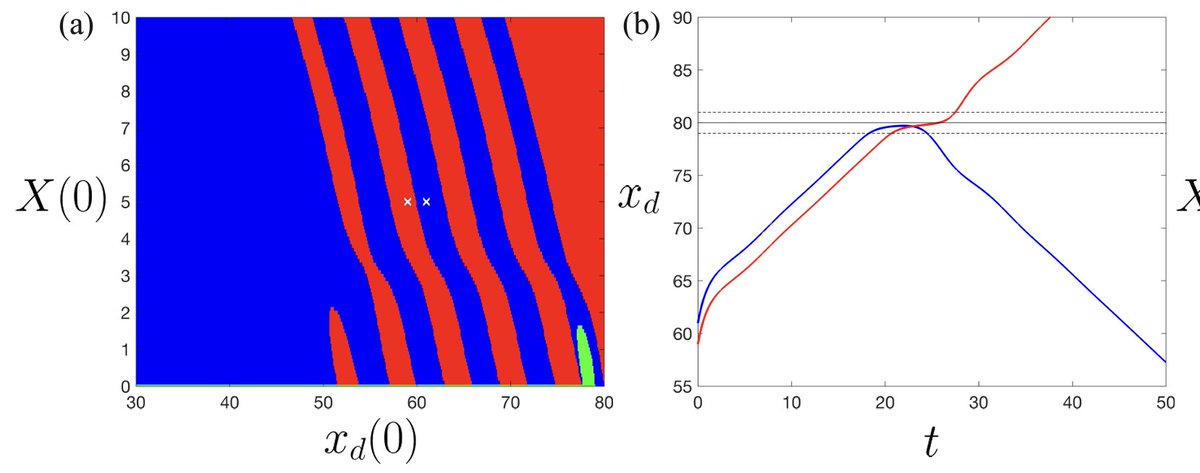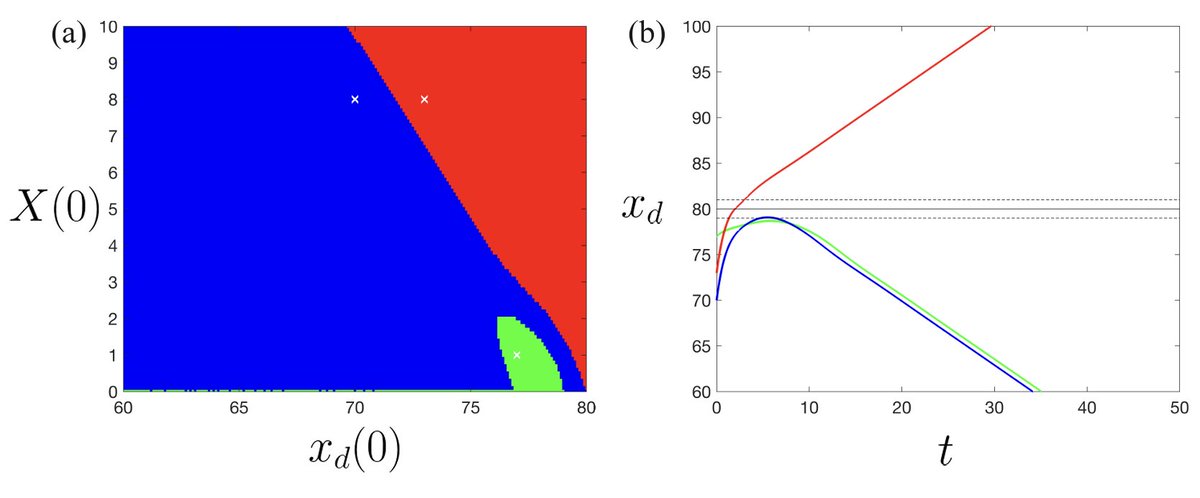
In a recent work, we show that a suspension of (non-interacting) deformable, elongated particles in oscillatory shear flow can develop nematic order via a phase synchronization mechanism. The work is published in @PhysRevLett :
journals.aps.org/prl/abstrac…@OxfordPhysics
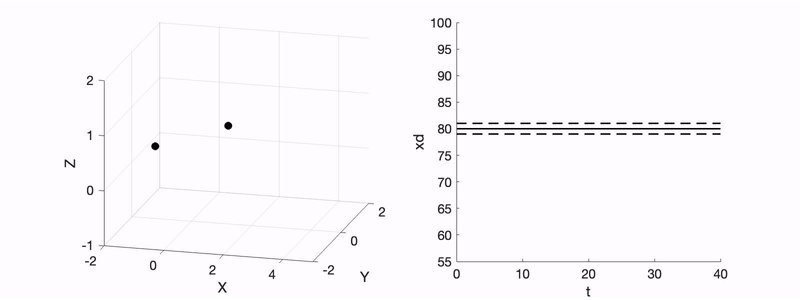
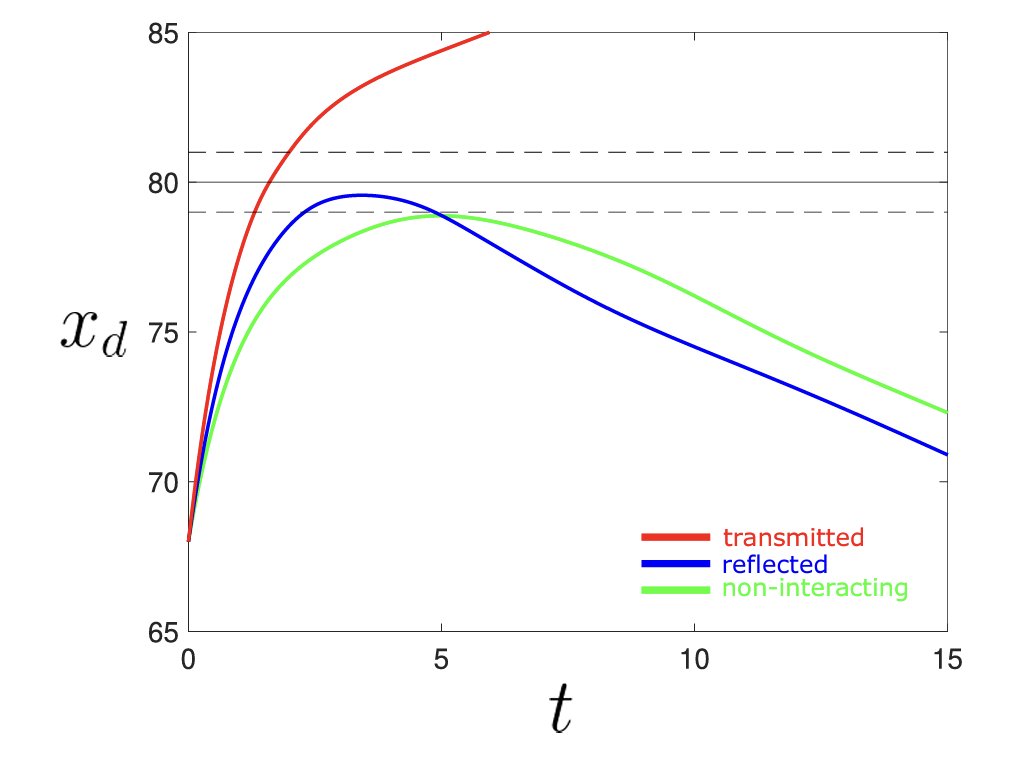
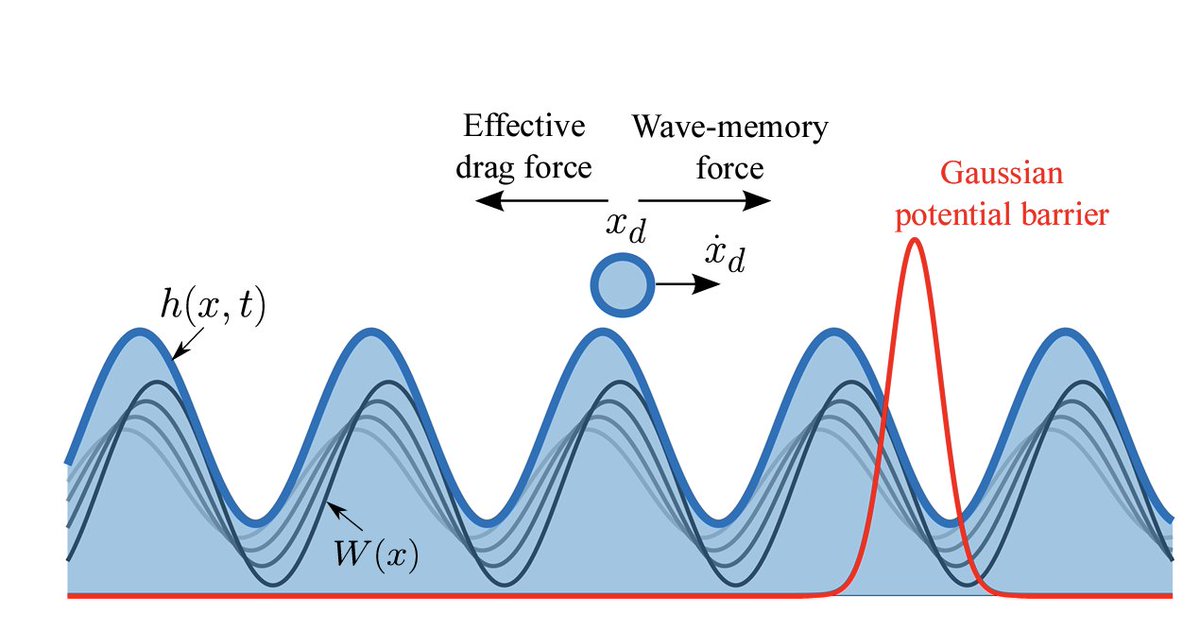
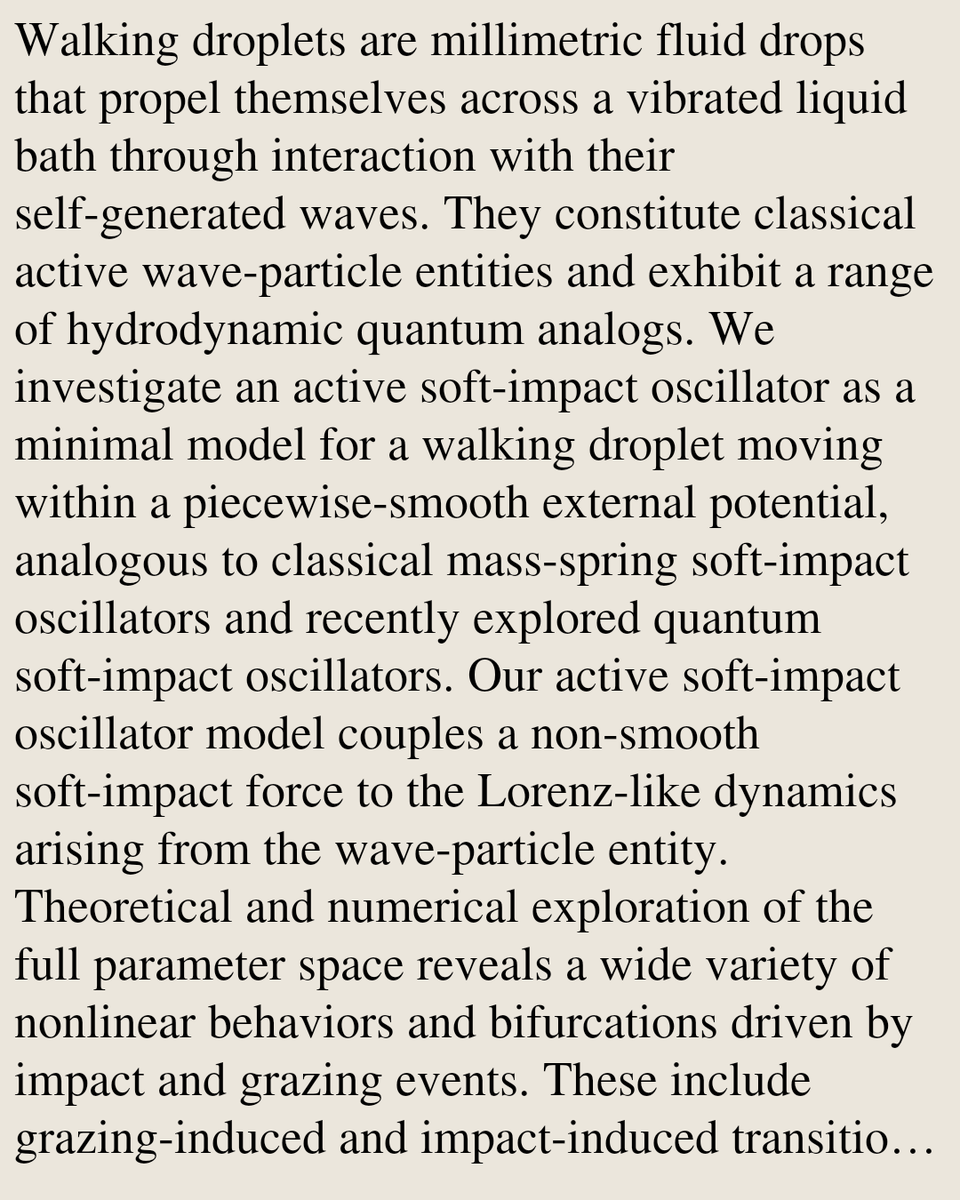
Active Soft-Impact Oscillator: Dynamics of a Walking Droplet in a Non-Smooth Potential
Titir Mukherjee, Rahil N Valani, Soumitro Banerjee
arxiv.org/abs/2602.05913 [𝚗𝚕𝚒𝚗.𝙲𝙳 𝚙𝚑𝚢𝚜𝚒𝚌𝚜.𝚏𝚕𝚞-𝚍𝚢𝚗]
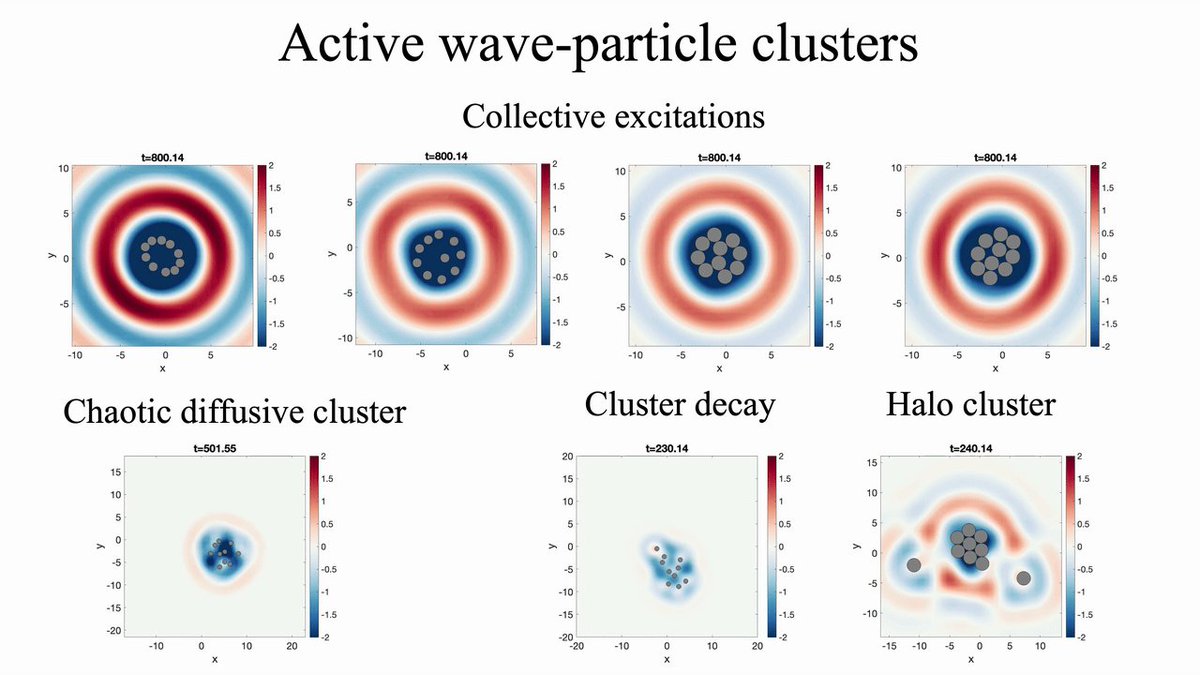
Wave-mediated interactions can drive rich collective dynamics in active particle clusters. We study walking droplet clusters that form stable bound states with collective excitation modes and show similarities with nuclear physics.
Paper: doi.org/10.1103/4cgg-hnyh
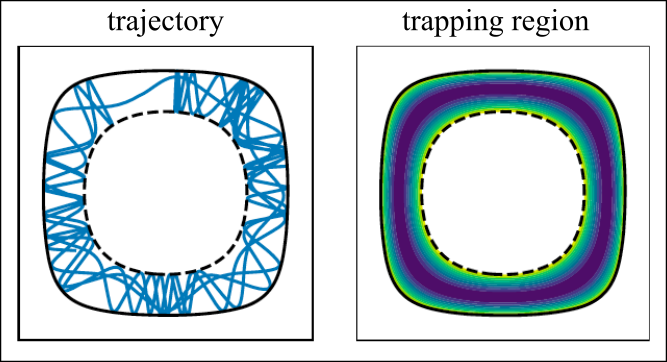
In a joint work led by Brendan Harding, and with Yvonne Stokes, we develop a unified Hamiltonian framework for how active particles move in channel flows. Particles undergo complex trajectories but remain confined within predictable regions. @PhysRevEdoi.org/10.1103/m9ks-mq3d
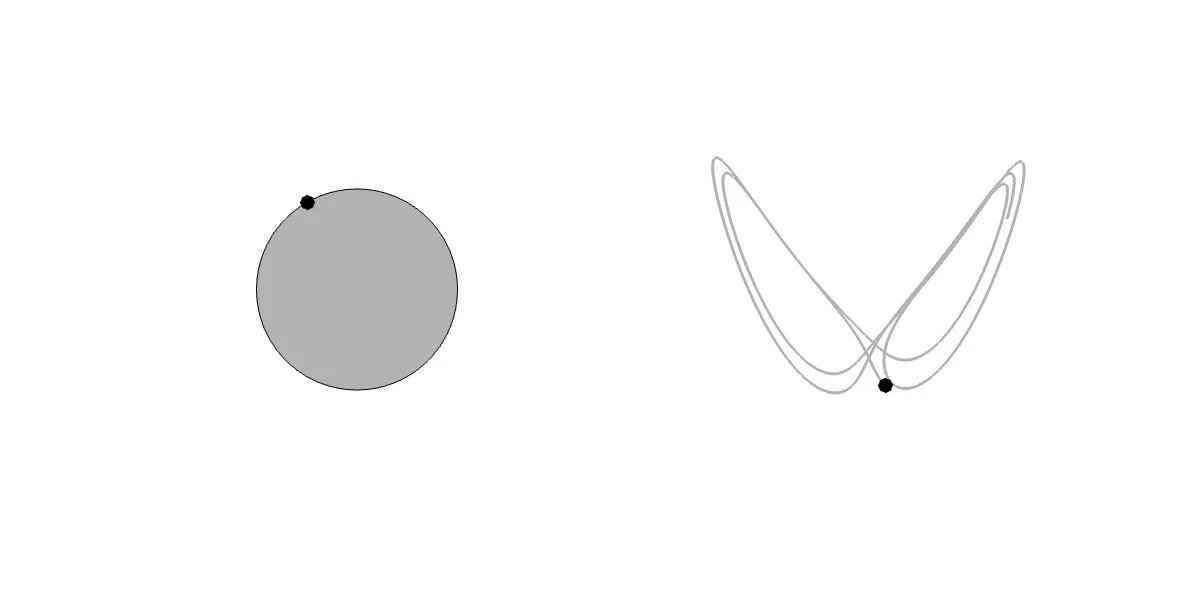
Quincke rotation, a particle spinning in an electric field, exhibits complex dynamics and follows the Lorenz equations. In a recent work, we show that fluid memory reshapes this chaos and delays its onset.
@AdityaSKhair1@PhysRevFluidsjournals.aps.org/prfluids/ab…
More on collective behavior: Our new Annual Review of Biophysics piece - with the stellar Danielle Chase - explores how animals sense, share information, and make group decisions. In honeybees and beyond 🐝
annualreviews.org/content/jo…
New preprint - We show a Hamiltonian formulation for the motion of a simple active particle interacting with unidirectional steady flow. This provides insights into organization of the active particle trajectories as defined by a potential well.
arxiv.org/abs/2506.11388
Postdoctoral position open in Bacterial-Algal Symbiosis! This interdisciplinary role will involve experimental and theoretical research using microfluidics, microscopy and modelling. Applications close May 13 (Aust. time). Please RT!
@SciMelb @UniMelbjobs.unimelb.edu.au/caw/en/j…
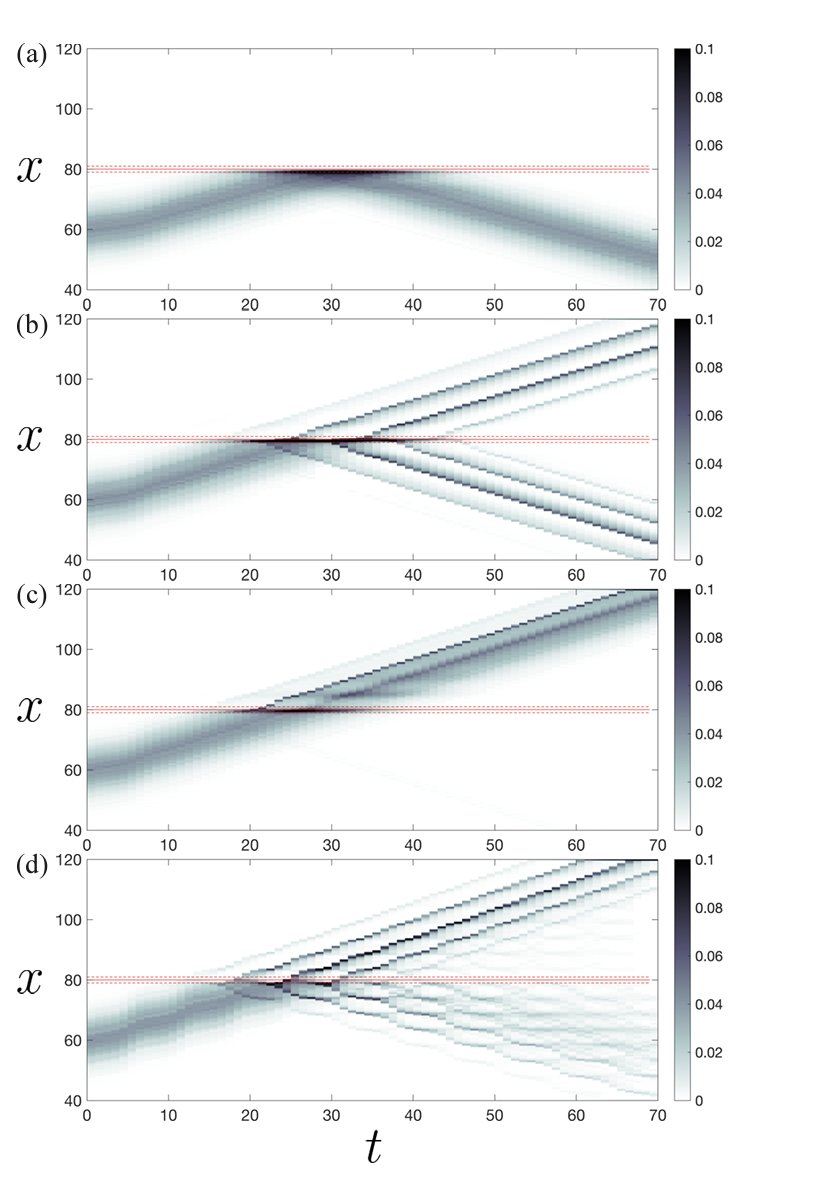
An active particle inspired from walking droplets can unpredictably cross a potential barrier. Using a minimal model, we show that the unpredictability lies in non-equilibrium features of a perturbed Lorenz system @PhysRevEjournals.aps.org/pre/abstrac…
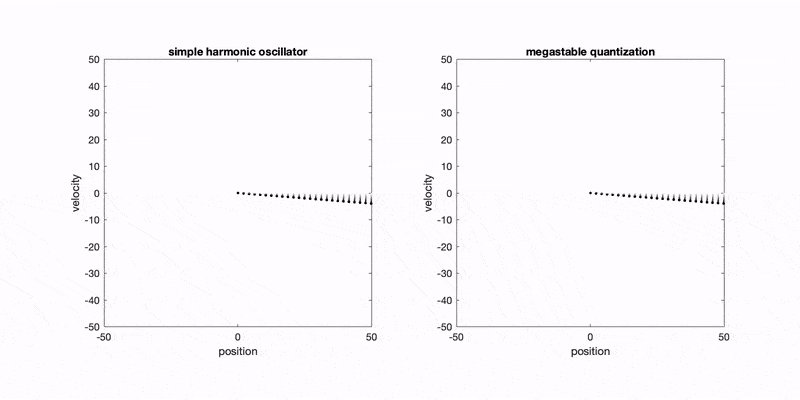
Using a simple model of a walking droplet in a harmonic potential, we show countably infinite quantized orbits, as opposed to a continous spectrum that one gets for a classical simple harmonic oscillator. See our open access paper below @PhysRevE :
journals.aps.org/pre/abstrac…
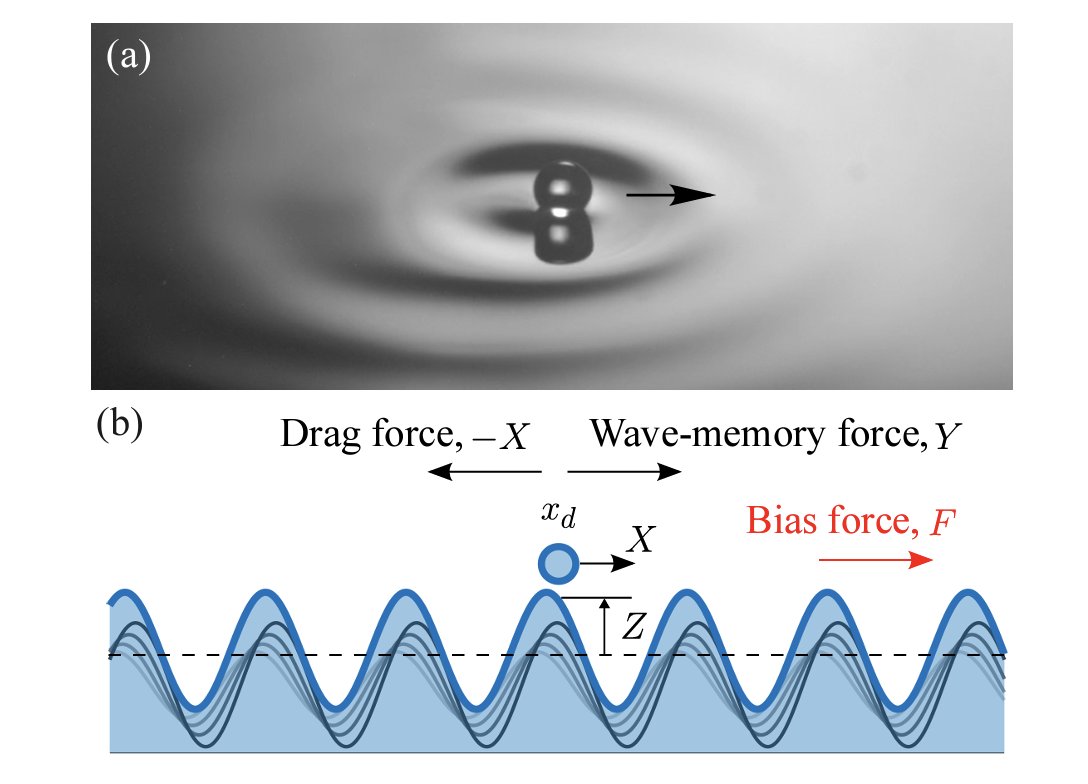
Adding a small bias force to a Lorenz model for a memory-driven active particle leads to both giant negative and positive mobility simultaneously, suggesting a mechanism by which anomalous transport emerges.
Read the paper: go.aps.org/3Of6yt3
ALT Figure showing a Lorenz system model for a memory-driven active particle. On the top is an image of a tiny water droplet on a surface with rings emanating outward. A black arrow points left. The bottom panel shows the forces. Below the droplet, a black arrow labeled “drag force” points left and another arrow labeled “wave-memory force” points right. To the far right is a red arrow that points right and is labeled “bias force.” At the bottom is a blue wave graph. Black lines follow the same waveform as the blue but are shifted slightly to the right and down.
Adding a small bias force to a Lorenz model for a memory-driven active particle leads to both giant negative and positive mobility simultaneously, suggesting a mechanism by which anomalous transport emerges.
Read the paper: go.aps.org/3Of6yt3
ALT Figure showing a Lorenz system model for a memory-driven active particle. On the top is an image of a tiny water droplet on a surface with rings emanating outward. A black arrow points left. The bottom panel shows the forces. Below the droplet, a black arrow labeled “drag force” points left and another arrow labeled “wave-memory force” points right. To the far right is a red arrow that points right and is labeled “bias force.” At the bottom is a blue wave graph. Black lines follow the same waveform as the blue but are shifted slightly to the right and down.
Non-equilibrium systems can appear to contradict Newton's 2nd law by responding with persistant motion in the direction opposite to an applied force. We find a dynamical mechanism for this behaviour rooted in asymmetric limit cycles within Lorenz chaos.
doi.org/10.48550/arXiv.2408.…
Congratulations to Xinyi for the fist paper from her PhD. This work, together with @PrakashLab, is published in @RSocPublishing today, and examines individual and collective behaviour of magnetotactic bacteria in an oxygen gradient. @SciMelb @MelbMathBioroyalsocietypublishing.org/d…
#ICYMI: In wave-particle duality, electrons can become trapped in disordered environments. Now, researchers show that a similar effect can be seen in droplets on a vibrating fluid surface – results that could inform research on #ActiveMatter systems.
🔗 go.aps.org/3zwaFNB
ALT A small liquid droplet hovers above a rippled, light pink and blue fluid surface that takes up the entire image. The droplet is reflected on the surface, and it appears to be at a standstill as the surface ripples interact with it.
We are advertising a postdoc position at @UniofAdelaide to work on mathematical modelling of inertial microfluidic technologies. If this sounds interesting please see below link or if you know anyone who might be interested please help spread the word
Within the chaotic sea of the parameter space, a pair of coexisting asymmetric limit cycles separate and migrate, resulting in anomalous transport behaviors that are sensitive to the particle’s memory.
This provides a general dynamical mechanism for the emergence of anomalous transport behaviors for active particles described by low-dimensional nonlinear systems. Check out our preprint to learn more.
Non-equilibrium systems can appear to contradict Newton's 2nd law by responding with persistant motion in the direction opposite to an applied force. We find a dynamical mechanism for this behaviour rooted in asymmetric limit cycles within Lorenz chaos.
doi.org/10.48550/arXiv.2408.…
We consider a simple model of a memory-driven active particle, inspired from experiments with walking/superwalking droplets, with a small external force that takes the form of a perturbed Lorenz system. #activeparticle#Lorenzsystem#chaos#walkingdroplet