
AI × commerce × culture | Co-founder @PurpleHorizons8 🔮 | Domain investor | Builder of things that didn't exist yesterday | Miami-made 🌴
Joined July 2010
- Tweets 9,282
- Following 8,084
- Followers 21,688
- Likes 37,411
846 Photos and videos









Pinned Tweet

Mar 12
Serious question: what does "work" even look like in 5 years?
When your AI agent handles research, scheduling, reporting, and first drafts...
What exactly is left for humans to do?
I think the answer is taste, relationships, and decisions under uncertainty.
The skills that never scaled are about to become the only ones that matter.
2
2
10
809
Big Brain Unlock 🧠

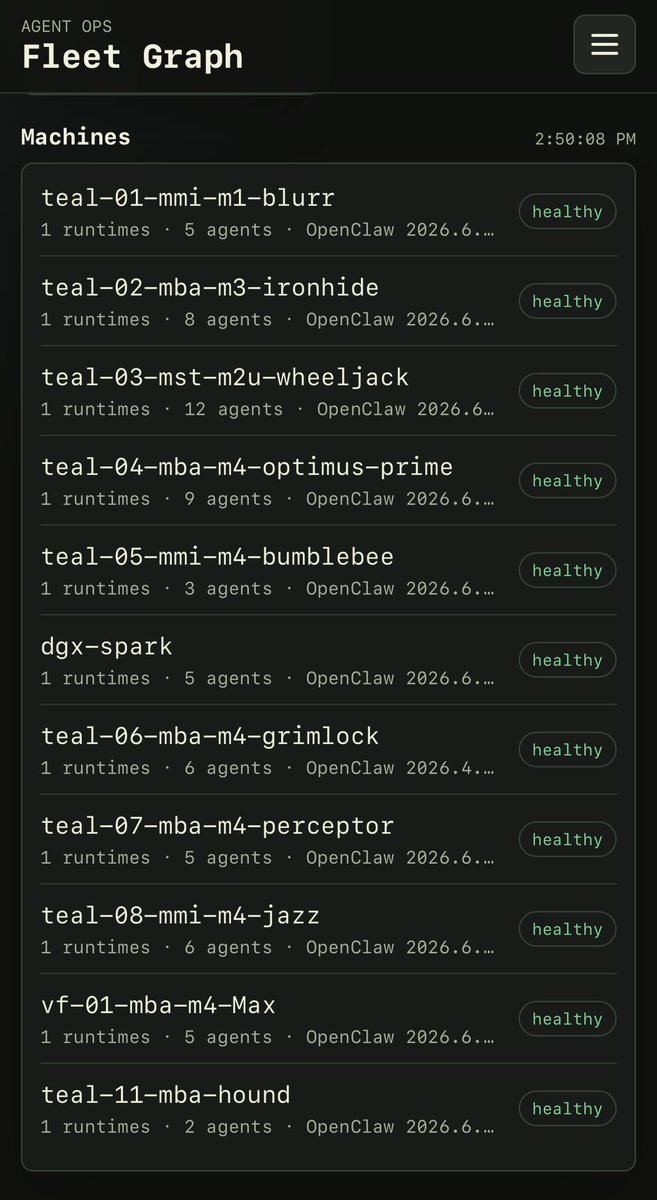
Don’t build a harness.
Build a devops agents that has tailscale access to every machine and can tend to the fleet. It can manage your configs for CC, Codex, OpebClaw, Hermes, etc.
1
3
81
Ralph Quinteroᵍᵐ retweeted

Jun 10
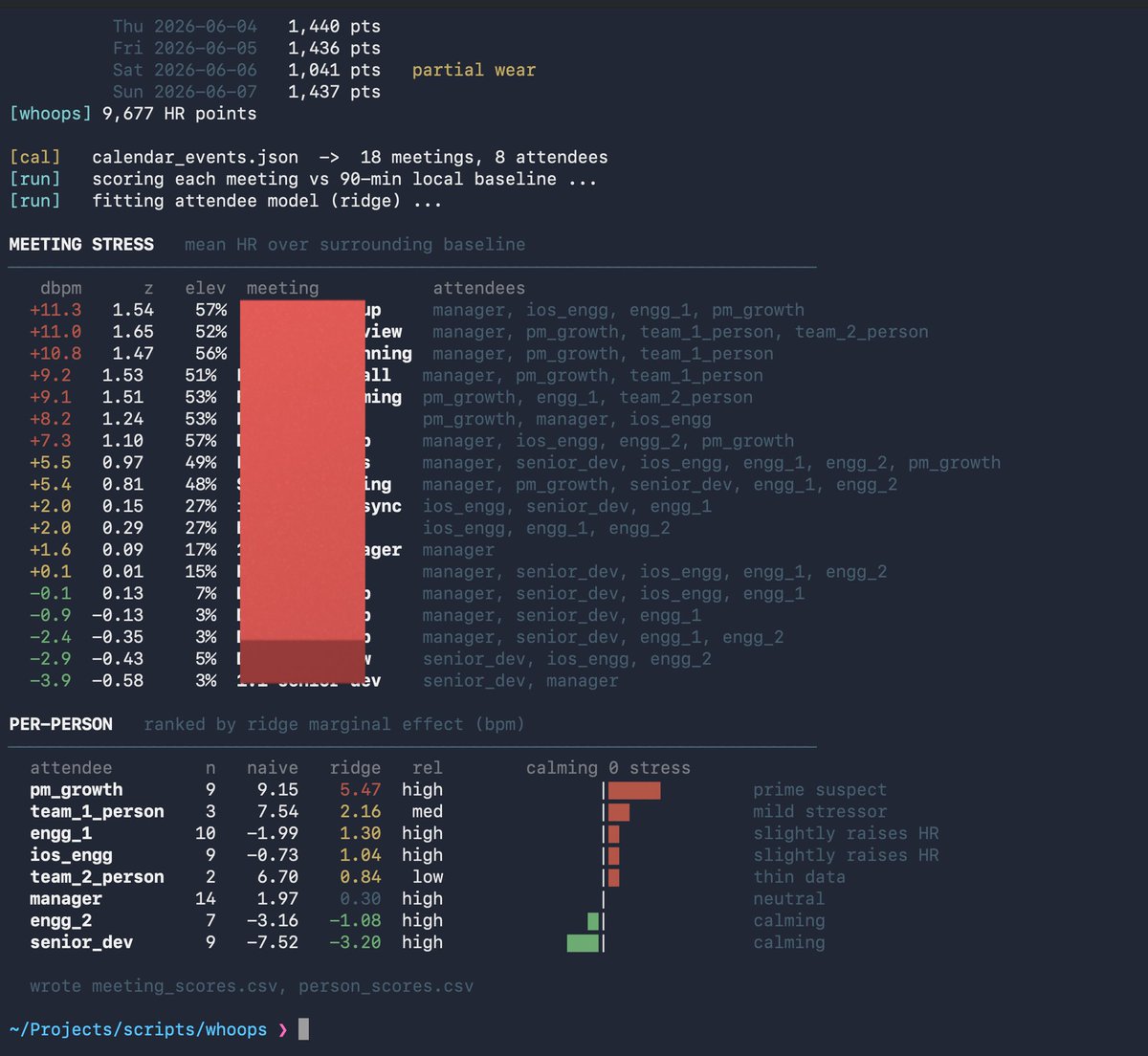
i hooked my whoop to my work calendar to find which coworker gives me the most stress 🚨
thanks to fable, I reverse engineered whoop to pull per minute heart rate. nd matched spikes with cal events and attendees
I now have a leaderboard and I think about it daily.
few info masked for obvious reasons ;)

1,007
2,841
44,941
11,006,640
Ralph Quinteroᵍᵐ retweeted

Jun 9
BREAKING:
Anthropic just dropped Claude Fable 5—this is Mythos, made safe for public release. It is the best coding model in the world.
We've been testing it internally @every for the last week or so across coding, writing, marketing, editing, and more—here's our vibe check:
- It broke our benchmarks. Fable scored a 91/100 on our Senior Engineer benchmark—this is human senior engineer level. The previous high score was Opus 4.8 at 63. GPT-5.5 is a 62.
- It's a one-shot wonder. You can set it and forget for hours or overnight on huge coding tasks, and come back to completed work. It cleared entire production bug backlogs, built a playable 3D, and even made a 2-minute animated film—all one-shot.
- Taste and attention to detail. In coding and knowledge work tasks, it has much better taste and attention to detail than we've ever seen. It gets subtle things right, adds little features you might not have thought of, and generally understands the assignment in ways that surprised us.
- Great use of context. We set it loose analyzing customer feedback surveys and our website data and it came back with a crisp, clean report that identified a. our biggest problem and b. a concrete testable solution—and then we sent it off to build that.
- It's best for power users. If you're already used to orchestrating multiple agents in your work, this model can do things that you've never seen before. If you're a knowledge worker or vibe coder with a more basic setup, you're not going to notice a huge difference—in fact, it probably isn't the right model for you.
- It's very slow, token-hungry. Using this thing for regular knowledge work is like squashing an ant with a rocket launcher. It also routinely uses 500k to 1M tokens on tasks. That's why it's best for your heaviest jobs—but not as good for tasks like collaborative writing.
- It's expensive. It's about twice as expensive as Opus, and it's also incredibly token hungry—so expect it to be something you'll use sparingly unless your company pays for it.
Overall, I think of it like a warp drive for coding: It can get you across the galaxy in a few hours, when it used to take months or years. But it's not appropriate for getting around town—you need something faster, cheaper, and more maneuverable.
The ceiling is extraordinarily high on this model though. Even our most advanced testers like @kieranklaassen felt like they were only scratching the surface of it.
Want our full vibe check with all of our testing and benchmarks? Read it on @every: every.to/vibe-check/anthropi…
172
310
3,530
610,106
Ralph Quinteroᵍᵐ retweeted

This is how society ends…

Introducing pump fun GO: Pay ANYONE to do ANYTHING
Create & complete bounties for ANY task and leverage the power of humans & money across the globe
The world is at your fingertips. It’s time to GO 👇
9
2
48
3,104
Cool use of tech to keep pushing yourself forward!
May 31

🏃♂️ I've gamified my own run so I can race my own ghost with the Meta Ray-Ban Display.
I built a web app for the glasses, loaded a previous GPX from Strava, and dropped game mechanics on top.
Pick up coins when you keep pace, sprint zones reward extra points if you push, and a mini leaderboard on the lens shows how you're tracking against your past self in real time.
Best part: it actually works. Seeing your ghost 20 m ahead is a way stronger nudge than any number on a watch. 😅
1
1
109
Ralph Quinteroᵍᵐ retweeted

May 30
It's never been easier to just throw a bunch of stuff at the wall.
but…
it's also never been harder to see what sticks
Discernment is becoming a really important ability
1
1
6
160
Ralph Quinteroᵍᵐ retweeted

May 28
Me using Claude Opus 4.8 to rename a file
1,729
9,368
75,771
44,283,792
Ralph Quinteroᵍᵐ retweeted

May 29
2
8
263
Ralph Quinteroᵍᵐ retweeted

May 28
The Buy Now Pay Later market is currently at $500-600 million and is anticipated to reach $1 TRILLION dollars by 2030.
This domain will help capture a fraction of that

Are you in the Buy Now Pay Later Market? We have the domain for you
Now Under Management: PayLater․com

8
6
41
3,100
Ralph Quinteroᵍᵐ retweeted

May 28
Today, we're proud to announce a true revolution in marketing — we're launching Agent A:
ahrefs.com/agent-a
Agent A handles marketing so well, you won't even need your CMO.
55
30
315
117,809
May 26
These takeaways are worth reading twice…. And then again!
May 25

My biggest takeaways from @danshipper:
1. The future of work will happen inside Codex or Claude Code. Instead of putting AI into your SaaS tool, you’ll use your SaaS tools inside your favorite AI agents' in-app browser. Dan spends all his time in Codex now—writing documents, managing email, doing research, everything. He's using Google Docs, PostHog, and everything he needs within the agent's in-app browser. The agent can see what he’s doing, and has all of his context, so he and his agent collaborate quickly and super effectively.
2. Automation is a lie—every automation needs a human. Dan's company doubled in size this year despite being incredibly AI-forward. Why? Because in order to make automation work well, you need humans making sure everything keeps working. This is why benchmarks are misleading—they measure AI on problems we’ve already framed and can score, but there’s always a higher frame.
3. PMs will win the AI era. Marcus, a former PM who previously ran Axios’s writing product, joined Every after getting super AI-pilled. Now he runs their product Spiral, and ships faster than anyone on the team. He pairs technical knowledge with spiky product sense, deep user empathy, and an eye for what matters. Dan thinks any PM who gets really AI-native will be incredibly dangerous because the building is done for you—what matters is figuring out what to build and if it’s great.
4. Full-stack designers are becoming superheroes. Designers used to make beautiful interactions that engineers didn’t want to build or couldn’t execute properly. Now designers don’t need to hand things off; they can build it themselves. Designers are naturally creative people, and AI is the perfect tool for them because it lets them bring their vision to life without the traditional bottlenecks.
5. SaaS is not dead. In fact, Dan is bullish on SaaS stocks. When users bring their own AI (via Codex or Claude Code) to use SaaS products, the user—not the SaaS company—pays for tokens. This saves SaaS company’s margins. Since the agents need their own seats, Dan predicts that agents will create massive new demand for SaaS because there will be tons of agents using these products at high volume.
6. Every company will have one “super-agent” inside their Slack that every employee will use. Dan initially thought every employee would have their personal work agent, like a shadow AI org chart, but he’s completely flipped his view. He realized agents need humans who care about them. When someone gets tired of maintaining their personal agent, it becomes useless. The winning model is one forward-deployed engineer or AI-savvy person who maintains a company-wide agent (like Shopify’s River or Viktor), and then it trickles down to more specialized team agents as models improve and become less fiddly.
7. The AI job apocalypse is not happening, but you do need to evolve to stay relevant. Models make yesterday’s human competence cheap. But because everyone uses the same models, it all looks the same if you use it the default way; it becomes commoditized slop. Humans then take that frozen competence and use it to make something new and interesting for their specific situation. The key: “ride the models”—use them for everything you do, try new models when they drop, keep turning over rocks.
8. We will read way more AI-generated writing, and we will like it. Human writing is incredibly important for things that matter, but for internal docs, planning, and email, AI-generated is often better because most people are bad at writing strategy documents.
9. Build software for humans and agents to use together. The current model is building a CLI that an agent uses independently. Instead, you and your agent should be using the app together. This creates new design challenges—agents can make a billion requests in three seconds, so you need approval flows, inboxes that summarize what happened, logs, and easy rollback.
10. Forward-deployed engineers are the new most essential role. The big model companies have teams of people managing their internal agents, and those teams aren’t going away. It’s different from traditional software building, and certain engineers love it. As models get better, this role will evolve—you’ll be managing more agents doing more things.
2
5
177
Ralph Quinteroᵍᵐ retweeted

May 24
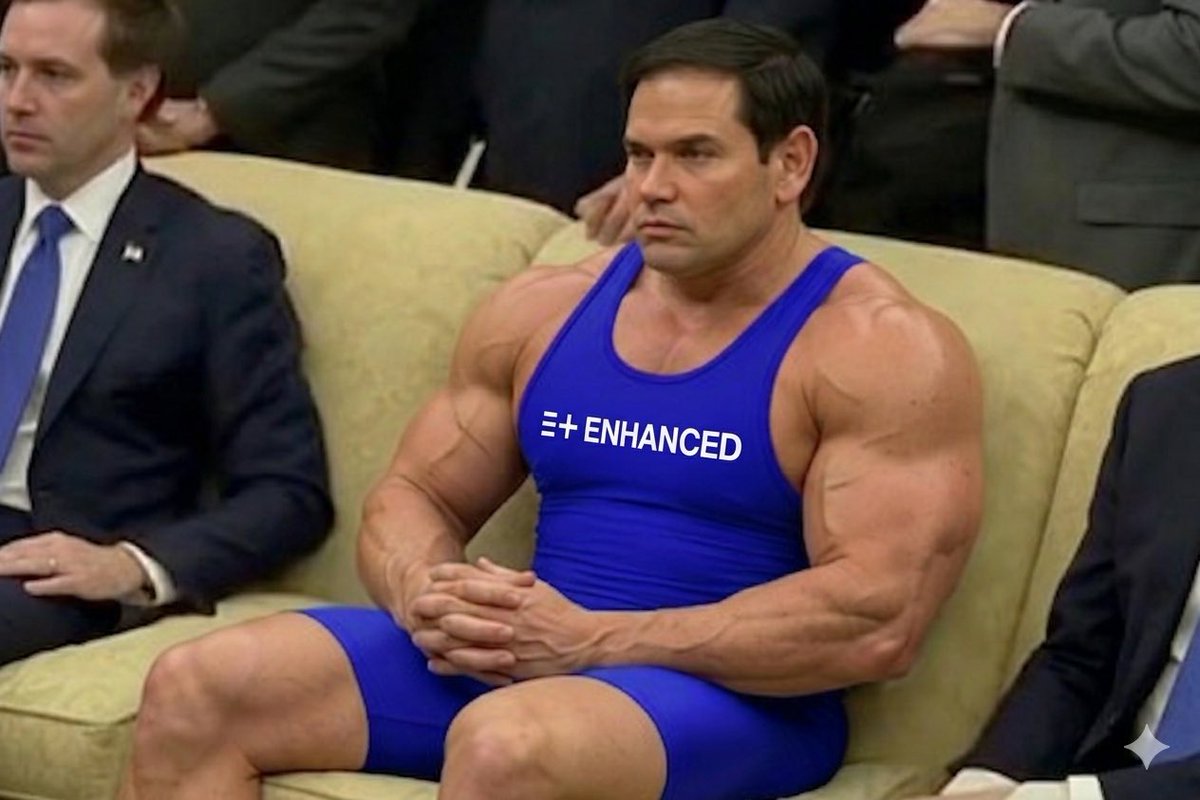
Marco Rubio finding out he has to compete in the Enhanced Games
33
145
4,428
172,688
Ralph Quinteroᵍᵐ retweeted
May 24
AI is not a reason to not think.
It just enables you to think about other things and possibly more important things.
But it’s more important than ever to think and not just do.
The toil was an excuse to not think about the hard stuff.
AI is exposing the folks that don’t do that and just obsessed over the doing.
May 24

You might believe you should spend less time thinking about code because of AI.
I strongly disagree! We’re watching this play out live where tons of AI generated code becomes a liability.
At the end of the day, an engineer needs to be responsible / on call for code that gets shipped to production. If you don’t understand the system you’re trying to debug, you’re probably going to have a bad time.
Yes, AI can help with all of this, if you set up the proper systems. You can have agents triage prod logs, look at errors, etc. You can speed up parts of the investigation, but an engineer needs to make the call. There might be serious customer or financial implications from that change.
I expect the trend continue for trimming dependencies, vendoring code so you can modify it directly, preferring simpler systems with fewer abstractions, and spending waaaay more time thinking about system design and code maintenance.
I’ve said this before, but it’s a great time to get familiar with CS fundamentals and some of the history behind what great software looks like. Many parts will be different in the coming years as AI progresses, but also a lot more than people realize will stay the same.
4
1
7
295
May 22
This is an absolute GRAIL of a domain! Congrats to @andrewrosener and the @MediaOptions team on the sale and to the buyer who no doubt understands the value of a domain like this 🫡
May 22

Human.com has been sold in a deal brokered by @MediaOptions.
The deal was confirmed by Media Options CEO Andrew Rosener.
domaininvesting.com/human-co…
4
291
Ralph Quinteroᵍᵐ retweeted

May 21
Today we reduced headcount by 22%. The business is the strongest it's ever been. So I think it's important to be direct about what I'm seeing and why.
First, I made this decision and I own it. I did it because the way to operate at the highest level of productivity is changing, and to win the future, ClickUp needs to change with it.
Second, this wasn't about cutting costs. Most savings from this change will flow directly back into the people who stay. We'll be introducing million-dollar salary bands. If you create outsized impact using AI, you'll be paid outside of traditional bands.
Most importantly, I have the deepest gratitude for those affected. We're doing this from a position of strength specifically so we can take care of people properly. Everyone affected receives a package aimed at honoring their contributions and easing the transition.
I only see two options: wait for this to play out gradually in the market or be honest about what I'm seeing and act proactively.
THE 100X ORGANIZATION
The primary change is that we're restructuring around what I call 100x org. The goal is 100x output. The roles required to build at the highest level are fundamentally different than they were a year ago.
Incremental improvements to existing systems won't get us there. We need new ones. That means creating enough disruption to rebuild rather than iterate on what's already broken.
The common narrative is that AI makes everyone more productive. It doesn't. Many of the workflows of today, if left unchanged, create bottlenecks in AI systems.
These roles will evolve. But waiting for that to happen naturally means falling behind now.
The 100x org is actually heavily dependent on people - infinitely more than today. This is only possible with 10x people that have embraced and adopted new ways of working.
THE BUILDERS, AGENT MANAGERS, AND FRONT-LINERS
— THE BUILDERS: 10X ENGINEERS
I don't think most companies have internalized what's actually happening with AI in engineering. The common narrative is that AI makes all engineers more productive. That may be true in isolation, but at an organization level - that is the farthest thing from reality.
Here's what we've validated recently at ClickUp: the great engineers, the ones who can orchestrate, architect, and review, are becoming 100x engineers. They're not writing code. They're directing agents that write code. The skill is judgment.
AI makes the best engineers wildly more productive, and everyone else using AI slows these engineers down.
Think about it - the bottlenecks are (1) orchestration - telling AI what to do, and (2) reviewing - what AI did. Everything is leapfrogged and no longer needed.
So who do you want orchestrating and reviewing code?
And how do you want your best engineers to spend their time?
If your best engineers are spending time reviewing other people's code, then this is inherently an inefficient bottleneck. These engineers can review their agent's code much faster than reviewing human code.
The new world is about enabling your 10x engineers to become 100x.
The wrong strategy is to push every engineer to use infinite tokens. Companies doing this are celebrating 500% more pull requests. But customer outcomes don't match the volume of code being generated.
I call this the great reckoning of AI coding, and every company will face this soon if not already.
More code is just another bottleneck to the best engineers, and ultimately to your company's impact as well.
— THE BUILDERS: 10X PRODUCT MANAGERS
Product management and design roles are merging.
Designers that have customer focus, become more like product managers.
And product managers that have intuition for UX become more like designers.
The bottleneck of user research is gone. It takes us just one mention of an agent to kickoff research and analyze results.
The bottleneck of product <> design iteration is also gone. The product builder iterates on their own, along with agents and skills that ensure alignment with quality and strategy.
Also controversial today - I believe that the wrong strategy is to have your PMs shipping code - that just introduces another bottleneck that the best engineers will waste their time on.
To be clear, PMs should be coding but they should do this in a playground to iterate, validate, and scope. That code should not go to production.
Everything outside of managing systems, orchestrating AI, and reviewing output becomes a bottleneck.
That's why the other roles that are critical along with these are the systems managers (to reduce bottlenecks) along with a bottleneck you can't replace - customer meeting time.
— THE SYSTEM MANAGERS
Ironically, the people that automate their jobs with AI will always have a job. They become owners of the AI systems - agent managers. We have many examples of these people at ClickUp.
The underlying systems in which we operate are absolutely critical to get right. I think most companies are delusional to think they can iterate on existing systems and compete in this new world.
You must create enough disruption so that old systems are deprecated entirely. If there's any definition for 'AI native' that's what it is.
— THE FRONT-LINERS
In a world that will become saturated with AI communication, the human touch will matter more than anything to customers.
This is a bottleneck that you shouldn't replace - even when agents are high enough quality to do video meetings.
One-on-one meeting time with customers is something that shouldn't be automated. The systems around the meetings should be - so that front-liners spend nearly 100% of their time with customers.
REWARDING 100X IMPACT
In a world where companies are able to do so much more with less, where does that excess money go?
In our case, much of the savings in this new operating model will flow directly back to those that enabled it.
We must reward people that create productivity accordingly. This aligns incentives on both sides. Plus, in a world where your best people create 100x impact, you can't afford to lose them.
You should aim to retain these employees for decades. The context they have and their ability to efficiently orchestrate and review will be nearly impossible to replace.
Compensation bands of today should be thrown out the door. We're introducing $1 million cash/year salary bands with a path available to nearly everyone in the company if they produce 100x impact by creating or managing AI systems.
THE FUTURE
Nearly every company will make changes like these. The ones that do it proactively will define what comes next.
The future is not fewer people. It's different work, new roles, and better rewards for those who embrace it. We're already seeing entirely new roles emerge, like Agent Managers, that didn't exist a year ago.
ClickUp is positioning to lead this shift, not just internally, but for our customers too. I've never been more certain about where we're headed.
1,651
1,144
7,638
9,126,542
May 22
The “onion ring in the fries” thing at @BurgerKing is a masterclass. The accident no one will confirm or deny….
Cc: @BaileyQuintero
1
2
185
May 21
We've been saying that AI has increased our workload as humans for a while now... @danshipper from @every nails it in this essay. He also put out a great companion video that's worth watching
May 21

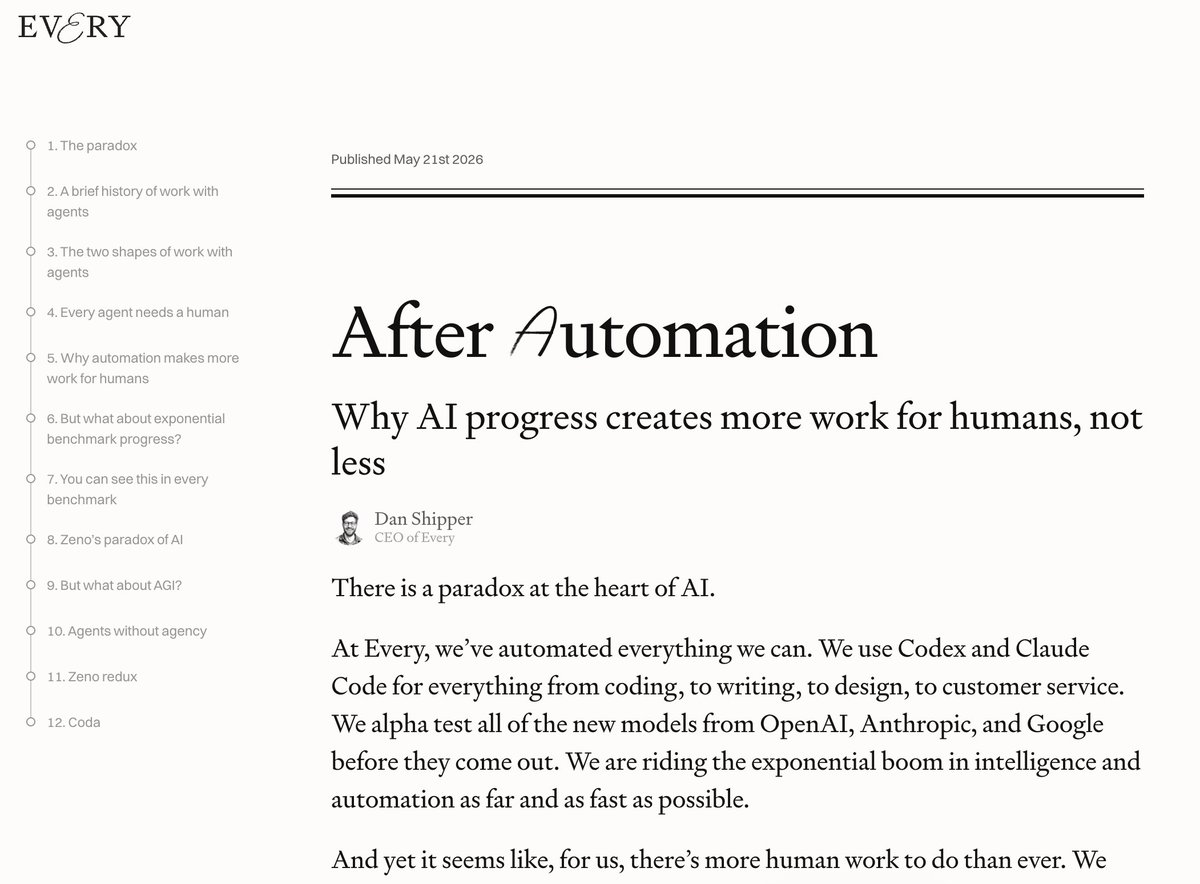
We’ve automated every single thing we can @every with AI agents.
And yet there’s way more human work to do than ever. We’ve gone from 4 -> 30 human employees since GPT-3.
I wrote a report on the structural reasons: how AI makes expert competence cheap, why that drives up demand for experts, and why the dynamic only intensifies as we approach AGI.
After Automation: every.to/p/after-automation
2
183
Ralph Quinteroᵍᵐ retweeted
May 20
Everyone is talking about skillmaxxing.
But the real unlock with agents might be delegationmaxxing.
Not “how do I get better at doing everything myself?”
More like:
How clearly can I define the work?
How much context can I transfer?
How well can I judge the output?
How many parallel threads can I manage?
The highest-leverage people won’t just be the most skilled.
They’ll be the best at turning intent into teams.
4
1
6
174
Ralph Quinteroᵍᵐ retweeted
May 18
Today's DSAD list is up. Success often is led with routine and hoping you make a quick stop by DSAD as part of your morning routine
Here are a few domains at auction I like today
SunPros․com @Namejet
MindCharge․com @Dynadot
Gardenful․com @Godaddy
BitSystems․org @Catched10
Qogg․com @atomHQ

2
3
13
767