
The future of decentralized infrastructure for AI
Joined December 2025
- Tweets 59
- Following 61
- Followers 103
- Likes 1,193
6 Photos and videos
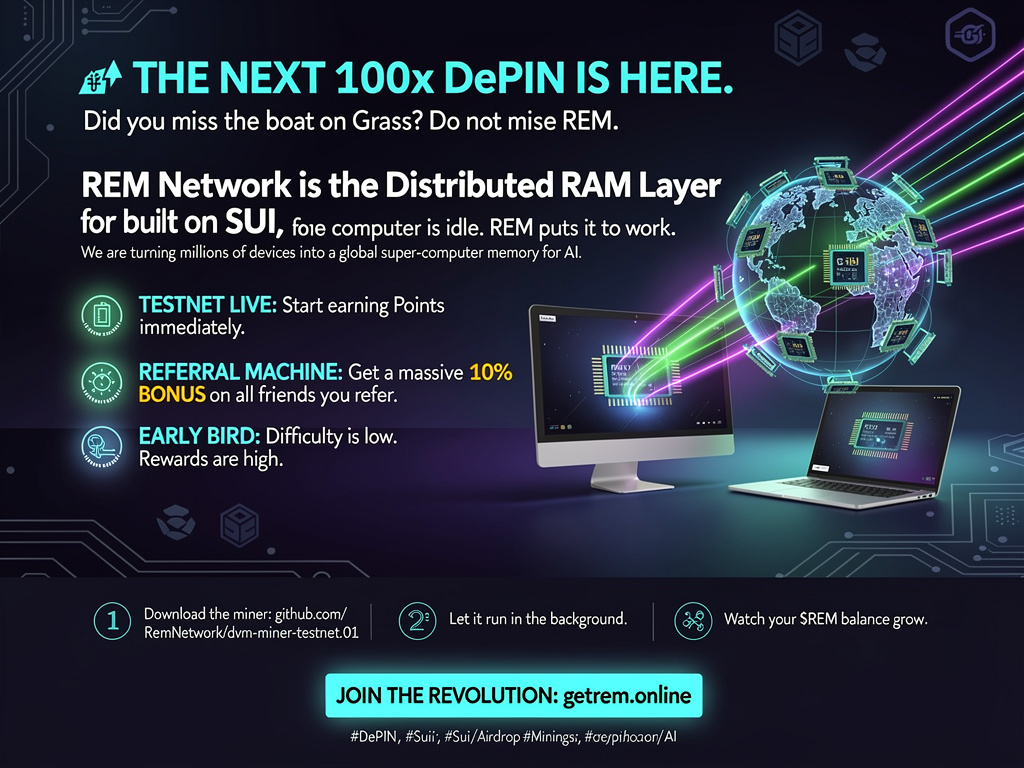
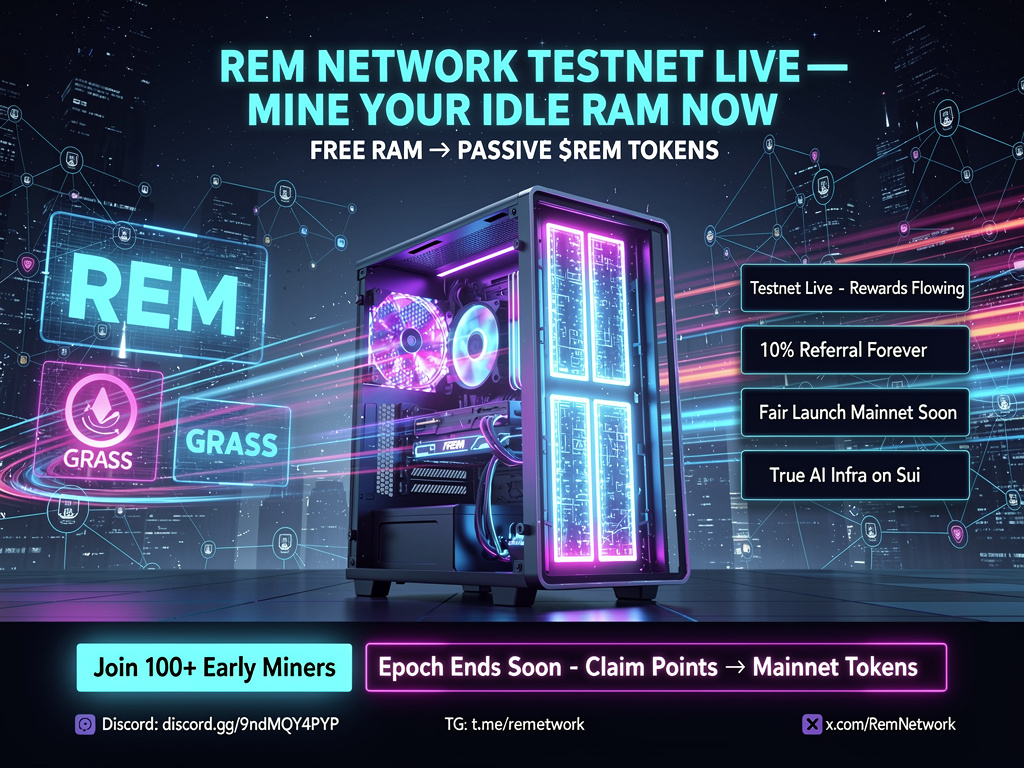
Pinned Tweet

20 Dec 2025
🌍🚀 **BREAKING THE CHAINS OF CENTRALIZED AI: Enter REM Network – The Revolution That's About to Flip the World Upside Down!** 🚀🌍
Imagine a world where AI isn't controlled by Big Tech overlords, where YOUR data is secure, and innovation flows freely without gatekeepers. That's REM Network – decentralized vector storage on the Sui Blockchain, powered by Proof of RAM (PoRAM). We're slashing costs by 70%, making AI cryptographically verifiable, and putting power back in YOUR hands!
No more monopolies stifling creativity. REM is democratizing AI infrastructure, enabling scalable, secure, and affordable solutions for developers, businesses, and creators worldwide. This isn't just tech – it's the spark for a global AI renaissance that empowers billions, drives economic equality, and accelerates human progress like never before!
Who's ready to join the uprising? Follow for updates, dive into getrem.online/, and let's build the future TOGETHER! 💥🔥
#REMNetwork #DecentralizedAI #SuiBlockchain #Web3Revolution #AICrypto #BlockchainInnovation #FutureOfAI #CryptoCommunity #TechRevolution #DecentralizeEverything
7
530
Jan 21
🚀 **REM NETWORK JUST HIT 300 TB – THE DECENTRALIZED AI MEMORY REVOLUTION IS ACCELERATING AT LIGHT SPEED!** 🚀
300 TB of live, verified RAM on testnet. Thousands of miners. Explosive daily growth. This is no longer a project—it's the emerging **standard** for affordable, resilient vector infrastructure in the AI era.
Why this milestone matters:
- AI agents & RAG systems now have a path to scale without bleeding billions on centralized clouds
- 70% cost reduction cryptographic verification via PoRAM = unbeatable combo
- Global idle RAM becomes the ultimate public good for intelligence
- We're proving DePIN can outpace Big Tech when the community moves together
2026 is the year centralized memory becomes legacy. REM is the decentralized pillar rising to replace it.
Still early. Still the best entry point.
Mine your spare RAM → bring friends (10% permanent referral bonus) → watch the network keep exploding.
Official links only:
getrem.online/
Explorer: getrem.online/explorer.html
Tag your crew and let's push past 500 TB next!
@SuiNetwork @Mysten_Labs @elonmusk @xAI @VitalikButerin @a16zcrypto @paradigm @PanteraCapital @dragonfly_xyz @MulticoinCap @bittensor_ @OceanProtocol @SingularityNET @Fetch_ai @AkashNet_ @rendernetwork @graphprotocol @Filecoin @helium @iotex_io @solana @NEARProtocol @avalanche @polkadot @cosmos @binance @coinbase @cdixon @balajis @naval
#REMNetwork #DePin #DecentralizedAI #AICrypto #ProofOfRAM #SuiBlockchain #Web3 #Crypto #AI #Blockchain #DePin2026 #VectorDatabase #AIRevolution #CryptoAI #Web3AI #FutureOfAI #RAMRevolution #AIAgents #DePinExplosion #300TB #CryptoCommunity #Web3Infrastructure #SuiEcosystem #AIInfrastructure #BlockchainInnovation #CryptoNews #Altcoin #Moonshot #EarlyAdopter #FOMO
Who's mining with us today? 🔥 Drop it below!
1
1
165
Jan 20
🚀 **WHY REM NETWORK IS BECOMING INDISPENSABLE IN 2026 – THE DECENTRALIZED MEMORY LAYER AI CAN'T LIVE WITHOUT** 🚀
AI is no longer a tool—it's the economy's new operating system.
Every major breakthrough in 2026 (agent swarms, personalized RAG at scale, real-time semantic reasoning, hyper-personalized recommendations) **requires massive, fast, affordable vector memory**.
Centralized solutions are hitting hard limits:
- Costs scaling 5–10× faster than Moore's Law
- Capacity constrained by data center build times
- Single points of failure & censorship risk
- Gatekeeping who gets priority access
REM Network solves this at the root:
• The world's first **Proof of RAM (PoRAM)** consensus – cryptographically verifying real RAM contributions
• Turning billions in idle laptop/PC memory into a **global, decentralized vector database**
• ~70% lower cost than Pinecone / AWS / Weaviate equivalents
• Infinite horizontal scaling powered by the community, not corporations
• Built on Sui for speed, low fees, and ironclad verification
We’ve already crossed **300 TB** live on testnet and are accelerating toward petabyte-scale. This is not speculation—it's the fastest-growing decentralized memory network right now.
In short:
**No REM = No affordable, resilient, permissionless AI at global scale.**
REM = The open foundation the entire decentralized AI ecosystem builds on.
Still early. Still the moment to position yourself at the center of the shift.
Mine your spare RAM today → getrem.online/
Live stats → getrem.online/explorer.html
@SuiNetwork @Mysten_Labs @elonmusk @xAI @VitalikButerin @a16zcrypto @paradigm @PanteraCapital @dragonfly_xyz @MulticoinCap @bittensor_ @OceanProtocol @SingularityNET @Fetch_ai @AkashNet_ @rendernetwork @graphprotocol @Filecoin @helium @solana @NEARProtocol
#REMNetwork #DePin #DecentralizedAI #AICrypto #ProofOfRAM #SuiBlockchain #Web3AI #VectorDatabase #AIInfrastructure #DePin2026 #CryptoAI #FutureOfAI #RAMRevolution #AIAgents #Web3 #Blockchain #Crypto #AI
2
139
Jan 16
🚀 **ABSOLUTE MADNESS: REM NETWORK JUST BLASTED PAST 300 TB OF DECENTRALIZED RAM – THIS GROWTH IS INSANE INSANE INSANE!** 🚀
Community, hold onto your hats...
We. Just. Hit. **300 TB** live on testnet.
That's **300 TERABYTES** of verified, community-powered RAM already online – and the curve is still STEEP. Thousands of miners worldwide are pouring in their idle hardware every single day, turning what used to be wasted capacity into the most explosive decentralized vector database network the world has ever seen.
This isn't normal growth.
This is **DePIN domination** in real time.
This is proof that when AI needs affordable, fast, unstoppable memory – the world answers with REM.
At this pace, 1 petabyte isn't a dream – it's the next logical milestone.
What this means for the future of AI:
- We are becoming the default decentralized pillar for RAG, embeddings, semantic search, and agent swarms
- 70% cheaper than any centralized alternative
- Fully verifiable via Proof of RAM (PoRAM)
- Resilient, permissionless, and scaling faster than Big Tech can even plan new data centers
2026 is here, and REM Network is rewriting the rules at lightspeed.
Still ultra-early. Still the best time to jump in.
Mine your spare RAM. Invite your squad (10% permanent referral bonus forever). Watch the TBs keep climbing.
Official only – always verify: getrem.online/
Live explorer (witness the insanity): getrem.online/explorer.html
Who's adding the next 100 TB with us? Drop 🔥 and let's keep this rocket going!
@SuiNetwork @Mysten_Labs @elonmusk @xAI @VitalikButerin @a16zcrypto @paradigm @PanteraCapital @dragonfly_xyz @MulticoinCap @bittensor_ @OceanProtocol @SingularityNET @Fetch_ai @AkashNet_ @rendernetwork @graphprotocol @Filecoin @helium @solana @NEARProtocol
#REMNetwork #300TB #DePinExplosion #DecentralizedAI #ProofOfRAM #SuiBlockchain #AICrypto #Web3Infrastructure #VectorDatabase #AIRevolution #CryptoAI #DePin2026 #RAMArmy #InsaneGrowth #300TBClub
1
134
Jan 15
🚀 **REM NETWORK IS ACCELERATING INTO 2026 – HUGE PLANS UNLOCKING, NETWORK HEADED TO 1 PETABYTE, AND GAME-CHANGING FEATURES DROPPING SOON!** 🚀
Community, look at what we're building together:
Testnet is exploding with momentum – thousands of miners strong, network capacity already in the **thousands of TB** range (check the explorer for live proof), and we're on a clear trajectory toward **1 PETABYTE** of committed decentralized RAM. That's not hype; that's the power of global idle hardware uniting for AI's future.
This year is packed:
- **Claiming tREM testnet rewards** rolling out soon – your mining points turn into real incentives bridging to Mainnet.
- **Staking features** incoming – boost your tiers, multipliers, and rewards like never before.
- More epic upgrades on the roadmap: enhanced PoRAM tools, developer integrations, and the full Mainnet launch in Q1 2026.
We're still **ultra-early** in this cycle, but the path is crystal clear: REM Network is becoming the decentralized memory pillar AI can't live without. The faster we scale, the stronger the rewards for everyone here from day one.
Keep mining your spare RAM, invite your crew (10% permanent referral bonus forever), and stay locked in – the best is yet to come.
**Safety first**: Only use official links. Never connect wallets to suspicious sites/DMs. Bookmark: getrem.online/
Live explorer (watch us approach 1 PB!): getrem.online/explorer.html
Who's hyped for staking & claiming? Drop 🔥 below and let's push this to the moon!
@SuiNetwork @Mysten_Labs @elonmusk @xAI @VitalikButerin @a16zcrypto @paradigm @PanteraCapital @dragonfly_xyz @MulticoinCap @bittensor_ @OceanProtocol @SingularityNET @Fetch_ai @AkashNet_ @rendernetwork @graphprotocol @Filecoin @helium @solana @NEARProtocol
#REMNetwork #DePin2026 #DecentralizedAI #ProofOfRAM #SuiBlockchain #AICrypto #StakingSoon #tREMClaims #PetabyteGoal #Web3Infrastructure #VectorDatabase #AIRevolution #RAMArmy #EarlyAdopterWins
104
Jan 13
🚀 **DAILY REM PIECE #3: THE HIDDEN COST OF CENTRALIZED AI MEMORY – AND WHY IT'S UNSUSTAINABLE IN 2026** 🚀
Quick reality check most AI builders are starting to feel in their bones:
A production-grade vector database handling **10 million embeddings** with low-latency queries can easily cost **$50,000–$150,000/month** on AWS, Pinecone, or Weaviate today.
Scale that to **100 million** embeddings (what top agents and recommendation systems are approaching)? You're looking at **half a million to millions per month** — and that's before any downtime, rate limits, or vendor lock-in pain.
Now add the global AI boom:
- Every new agent swarm
- Every personalized RAG system
- Every real-time semantic search app
…needs exponentially more fast RAM. Centralized providers can't build data centers fast enough without prices going parabolic.
REM Network's answer?
We’ve already crossed **200 TB** of live decentralized RAM on testnet — all from idle hardware people already own.
Cost to users/developers? ~70% less.
Scalability? Virtually unlimited as more miners join.
Ownership? The community — not a single corporation.
This is why decentralization isn't a "nice-to-have" anymore — it's the **only economically viable path** for AI to scale in 2026 without bankrupting the ecosystem.
Tomorrow: the math behind why PoRAM makes cheating impossible (and why that matters more than you think).
Stay mining. The numbers don't lie.
Official only: getrem.online/
Live explorer: getrem.online/explorer.html
@SuiNetwork @Mysten_Labs @elonmusk @xAI @VitalikButerin @a16zcrypto @paradigm @PanteraCapital @dragonfly_xyz @MulticoinCap @bittensor_ @OceanProtocol @SingularityNET @Fetch_ai @AkashNet_ @rendernetwork @graphprotocol @Filecoin @helium @solana @NEARProtocol
#REMNetwork #DePinDaily #DecentralizedAI #ProofOfRAM #SuiBlockchain #AICrypto #Web3Infrastructure #VectorDatabase #AIRevolution #CryptoAI #DePin2026 #AICostCrisis #FutureOfAI
104
Jan 12
🚀 **2026 IS OUR YEAR: BIG PLANS, LIGHTNING-FAST PROGRESS, AND EXCITING FEATURES COMING SOON TO REM NETWORK!** 🚀
This year is set to be monumental for REM Network. We're moving at warp speed on testnet – with thousands of dedicated miners already contributing, the network has surged past **200 TB** (and climbing toward thousands more, as the explorer shows massive momentum).
Our progress is real, community-driven, and accelerating every single day.
**What's coming soon**:
- Enabling **claiming of testnet tokens/points** (tREM) – turning your mining efforts into tangible rewards that will play into Mainnet incentives.
- Launching **staking features** to boost your participation and rewards even further.
These upgrades will take the testnet to the next level as we gear up for Mainnet in Q1 2026.
**Important safety reminder**:
**Never trust any non-official links**, DMs, or sites claiming to be REM. **Do NOT connect your wallet** to anything suspicious, share private keys, or click unknown links. The ONLY official site is getrem.online/ – bookmark it and always verify.
We're building something historic here – decentralized AI infrastructure that's truly unstoppable. Stay safe, stay official, and keep mining!
Who's excited for the next phase? Drop a 🔥 if you're in!
Official link: getrem.online/
Live explorer: getrem.online/explorer.html
@SuiNetwork @Mysten_Labs @elonmusk @xAI @VitalikButerin @a16zcrypto @paradigm @PanteraCapital @dragonfly_xyz @MulticoinCap @bittensor_ @OceanProtocol @SingularityNET @Fetch_ai @AkashNet_ @rendernetwork @graphprotocol @Filecoin @helium @solana @NEARProtocol
#REMNetwork #DePin2026 #DecentralizedAI #ProofOfRAM #SuiBlockchain #AICrypto #Web3Infrastructure #TestnetProgress #StakingSoon #CryptoSafety #VectorDatabase #AIRevolution #RAMArmy
92
Jan 11
🚀 **INSANE MILESTONE ALERT: REM NETWORK JUST SURPASSED 200 TB OF DECENTRALIZED RAM POWER – AND THIS IS ONLY THE BEGINNING!** 🚀
We did it.
The community has pushed our testnet network beyond **200 TB** of verified, live decentralized RAM (and climbing fast toward thousands of TBs as shown in the explorer). Thousands of miners worldwide are contributing their idle hardware, proving once again: when the world comes together, we build unstoppable infrastructure.
This isn't just a number—it's the **foundation** for the future of AI.
In a world where centralized vector databases choke on cost, latency, and control, REM Network delivers the pillar AI truly needs:
• Infinitely scalable, community-owned memory layer
• 70% cheaper than Big Tech alternatives
• Cryptographically verified via Proof of RAM (PoRAM) – cheat-proof and lightning-fast
• Built for the explosion of RAG, semantic search, autonomous agents, and embeddings that will define 2026
Centralized clouds can't match this resilience or affordability. REM is becoming the decentralized backbone that powers the next era of intelligence—open, permissionless, and owned by YOU.
Mainnet Q1 2026 is coming. Early participants are positioning for massive rewards.
Who's adding to the next TB milestone? Mine your spare RAM now – no fancy gear needed.
Dive in & contribute: getrem.online/
Explorer live stats: getrem.online/explorer.html
@SuiNetwork @Mysten_Labs @elonmusk @xAI @VitalikButerin @a16zcrypto @paradigm @PanteraCapital @dragonfly_xyz @MulticoinCap @bittensor_ @OceanProtocol @SingularityNET @Fetch_ai @AkashNet_ @rendernetwork @graphprotocol @Filecoin @helium @solana @NEARProtocol
#REMNetwork #DePinMilestone #200TB #DecentralizedAI #ProofOfRAM #SuiBlockchain #AICrypto #Web3Infrastructure #VectorDatabase #AIRevolution #CryptoAI #DePin2026 #FutureOfAI #RAMArmy #200TBClub
86
Jan 9
**Pinecone vs Rem Network: A Comparison of Vector Databases for AI Use Cases** (as of January 2026)
Both **Pinecone** and **@RemNetwork** are powerful vector databases designed to handle high-dimensional embeddings for AI applications like RAG, semantic search, recommendations, and autonomous agents. However, they take fundamentally different approaches: one is a leading **centralized, fully managed cloud service**, while the other is an emerging **decentralized, DePIN-powered infrastructure** built on blockchain.
Here's a balanced side-by-side comparison:
### Core Architecture & Model
- **Pinecone** — Fully managed, cloud-native vector database (serverless with automatic scaling; also supports dedicated read nodes for high-QPS workloads). Centralized infrastructure ensures predictable performance and ease of use.
- **Rem Network** — Decentralized vector database leveraging global idle RAM via **Proof of RAM (PoRAM)** on the Sui blockchain. Community-owned nodes (DePIN model) provide distributed, permissionless storage and compute.
### Scalability & Performance
- **Pinecone** — Proven at massive scale (billions of vectors, millions of namespaces, 30M daily writes). Sub-second queries with high recall, hybrid sparse dense search, metadata filtering, real-time upserts, and reranking. Excellent for production reliability.
- **Rem Network** — Designed for **infinite horizontal scaling** through distributed hardware. Hyper-scalable for exploding AI data needs, with verifiable performance via cryptography. Testnet already shows 2,000 miners and 100TB deployed — mainnet (Q1 2026) expected to unlock full potential.
### Cost
- **Pinecone** — Pay-as-you-go (free starter tier, then consumption-based on reads/writes/storage). Can become expensive at very large scale due to centralized cloud pricing.
- **Rem Network** — Claims **~70% lower costs** by repurposing idle global resources (no Big Tech overhead). More cost-effective for massive, long-term deployments in a decentralized economy.
### Security, Reliability & Control
- **Pinecone** — Enterprise-grade: encryption (at rest/in transit), private networking, SOC 2/GDPR/HIPAA compliance, high uptime SLAs, and observability. But centralized — single point of failure risk and dependency on the provider.
- **Rem Network** — **Decentralized & censorship-resistant**: No single point of failure, community-owned network, cryptographically verifiable. Ideal for open, permissionless AI innovation — but early-stage maturity compared to established players.
### Ease of Use & Maturity
- **Pinecone** — Developer-friendly with intuitive APIs, console, SDKs, rapid setup (launch in seconds), and extensive integrations (models, frameworks, clouds). Battle-tested in production by many companies.
- **Rem Network** — Focused on the future of decentralized AI infrastructure. Strong traction in the DePIN/AI crypto space, but still emerging (testnet live, mainnet upcoming). Best for builders who want to avoid centralized lock-in.
### Best For
- **Choose Pinecone** if you need:
Rock-solid production reliability, immediate enterprise features, fast setup, and don't mind centralized management. It's the "safe, proven" choice for most teams today.
- **Choose Rem Network** if you want:
**Decentralized future-proofing**, dramatically lower long-term costs, censorship resistance, and alignment with DePIN/AI crypto trends (e.g., empowering global idle resources for AGI). Perfect for innovative projects betting on web3 infrastructure.
In short: Pinecone dominates today with maturity and ease → **Rem Network** is positioned to disrupt tomorrow with decentralization, cost savings, and true openness for the next wave of AI.
The future of vector DB scaling is decentralized — and Rem is leading that charge! 🚀
What are you building? Drop your thoughts below 👇
#VectorDB #Pinecone #RemNetwork #DePIN #DecentralizedAI #AICrypto #RAG #SemanticSearch #SuiBlockchain
1
95
Jan 8
REM NETWORK IS ON FIRE – THE AI DEPIN MONSTER AWAKENING IN 2026 IS UNSTOPPABLE!** 🚀
1/7
We just dropped the truth bomb: 2026 forces full decentralization on AI or it breaks. Centralized clouds are already crumbling under the weight of exploding vector demands. But guess what? The community heard the call – and RESPONDED WITH INSANE FORCE.
2/7
Live testnet update that's got everyone buzzing:
🔥 **1,200 ONLINE MINERS** right now
🔥 **Over 3,150 TB** of decentralized RAM already locked in
🔥 Total registered miners pushing **11,500 ** and climbing DAILY
This isn't slow growth. This is a RAMPAGE.
3/7
In weeks, we've built a network with more verifiable RAM than most centralized providers dream of – all from spare laptops and PCs worldwide. Proof of RAM (PoRAM) making it cheat-proof, lightning-fast, and truly owned by YOU.
4/7
70% cheaper. Eco-friendly. Infinitely scalable. This is the Pinecone killer that's decentralized, resilient, and ready for the agent swarm explosion hitting in 2026.
5/7
Mainnet Q1 2026 isn't just a launch – it's the moment the world switches to decentralized memory. Early miners stacking tREM points now? They're about to eat BIG on $REM rewards and airdrops.
6/7
The hype is real because the tech is real. The growth is real. The future we're building? UNSTOPPABLE. If you're not mining your spare RAM yet, what are you waiting for? History doesn't reward spectators.
7/7
Join the monster while it's still growing: getrem.online/
Bring friends – 10% permanent referral bonus forever.
Who's ready to own 2026?! Reply, repost, tag the world – let's make this go VIRAL! 💥🧠🌍
@SuiNetwork @Mysten_Labs @elonmusk @xAI @VitalikButerin @a16zcrypto @paradigm @PanteraCapital @dragonfly_xyz @MulticoinCap @bittensor_ @OceanProtocol @SingularityNET @Fetch_ai @AkashNet_ @rendernetwork @graphprotocol @Filecoin @helium @solana @NEARProtocol
#REMNetwork #DePinFire #DecentralizedAI #AICrypto #ProofOfRAM #SuiBlockchain #Web3Infrastructure #VectorDatabase #AIRevolution #CryptoAI #DePin2026 #FOMO #2026Moonshot #RAMArmy
1
100
Jan 7
🚀 **THREAD: WHY 2026 WILL BE THE YEAR AI FORCES THE WORLD TO GO FULLY DECENTRALIZED – AND HOW REM NETWORK IS LEADING IT** 🚀
1/6
AI demand is exploding RIGHT NOW. Models are getting bigger, agents need real-time memory, RAG systems are everywhere. But centralized clouds? They're cracking: insane RAM prices, outages, data lock-in, and Big Tech controlling who gets power.
2/6
By mid-2026, vector database costs alone could hit billions for enterprises. Centralized providers can't scale fast enough without jacking prices or compromising reliability. The only solution that works at global scale? **Decentralization**.
3/6
DePIN isn't a trend—it's survival. Only decentralized networks can deliver infinite, resilient, affordable memory by tapping idle resources worldwide. No single point of failure. No censorship. No monopoly markups.
4/6
REM Network is built exactly for this moment:
• Proof of RAM (PoRAM) – world's first verifiable RAM consensus on Sui
• Turning spare RAM from millions of devices into the ultimate vector database layer
• 70% cheaper, eco-friendly, community-owned
• Powering the AI apps that will define 2026
5/6
Testnet is live and growing fast toward Mainnet Q1 2026. Early miners are positioning for the biggest rewards when the world realizes centralized AI infrastructure is obsolete.
6/6
2026 isn't "maybe decentralized." It's **mandatory**. The projects that own the decentralized memory layer win everything. REM is that layer.
Join the inevitable: getrem.online/
@SuiNetwork @Mysten_Labs @elonmusk @xAI @VitalikButerin @a16zcrypto @paradigm @PanteraCapital @dragonfly_xyz @MulticoinCap @bittensor_ @OceanProtocol @SingularityNET @Fetch_ai @AkashNet_ @rendernetwork @graphprotocol @Filecoin @helium @solana @NEARProtocol
#REMNetwork #DePin2026 #DecentralizedAI #AICrypto #ProofOfRAM #SuiBlockchain #Web3Infrastructure #VectorDatabase #FutureOfAI #BlockchainInnovation #CryptoAI #AIRevolution #DecentralizationMandatory #2026
1
93
Jan 5
🚀 **DAILY REM PIECE #1: THE UNTAPPED GOLDMINE POWERING OUR NETWORK** 🚀
Fact: There are **over 5 billion PCs and laptops worldwide**, with the vast majority sitting idle most of the day — collectively wasting **hundreds of billions of dollars** in unused RAM.
REM Network taps directly into this: turning your spare RAM into a global, decentralized vector database for AI. No new hardware, no extra energy bills — just pure, efficient repurposing.
That's why our testnet grew to thousands of miners and 100TB so fast. Real utility meets massive dormant supply.
This is just the beginning. More pieces tomorrow.
@SuiNetwork @Mysten_Labs @elonmusk @xAI @VitalikButerin @a16zcrypto @paradigm @bittensor_ @OceanProtocol @SingularityNET @AkashNet_ @rendernetwork
Mine your share: getrem.online/
#REMNetwork #DePinDaily #DecentralizedAI #ProofOfRAM #SuiBlockchain #AICrypto #Web3Infrastructure #IdleRAMRevolution #AIRevolution #CryptoAI #DePin2026
2
90
Jan 4
🚀 **2026: THE YEAR EVERYTHING CHANGES – DECENTRALIZATION BECOMES MANDATORY TO MEET AI'S INSATIABLE DEMAND** 🚀
AI is no longer coming—it’s here, and it’s growing exponentially. Agents, real-time reasoning, massive embeddings, and global-scale RAG systems are pushing memory requirements through the roof. Centralized providers simply cannot keep up: costs exploding, capacity bottlenecks, single points of failure, and gatekeepers controlling access.
In 2026, decentralization stops being optional and becomes **mandatory** for AI to reach its full potential. Only decentralized infrastructure can deliver the resilient, affordable, infinitely scalable memory the world needs.
REM Network is already ahead of the curve:
• Proof of RAM (PoRAM) harnessing global idle RAM on Sui
• 70% lower costs with cryptographic verification
• Community-owned, permissionless vector database layer
• Built for the exact demands exploding this year
Mainnet Q1 2026 positions REM as the backbone when the world realizes centralized memory can’t scale the future.
The shift is inevitable. 2026 will prove it.
@SuiNetwork @Mysten_Labs @elonmusk @xAI @VitalikButerin @a16zcrypto @paradigm @PanteraCapital @dragonfly_xyz @MulticoinCap @bittensor_ @OceanProtocol @SingularityNET @Fetch_ai @AkashNet_ @rendernetwork @graphprotocol @Filecoin @helium @solana @NEARProtocol
Prepare for what’s next: getrem.online/
#REMNetwork #DePin2026 #DecentralizedAI #AICrypto #ProofOfRAM #SuiBlockchain #Web3Infrastructure #VectorDatabase #FutureOfAI #BlockchainInnovation #CryptoAI #DecentralizationMandatory #AIRevolution #2026Shift
1
89
Jan 4
🚀 **2026: THE YEAR EVERYTHING CHANGES – DECENTRALIZATION BECOMES MANDATORY TO MEET AI'S INSATIABLE DEMAND** 🚀 AI is no longer coming—it’s here, and it’s growing exponentially. Agents, real-time reasoning, massive embeddings, and global-scale RAG systems are pushing memory requirements through the roof. Centralized providers simply cannot keep up: costs exploding, capacity bottlenecks, single points of failure, and gatekeepers controlling access. In 2026, decentralization stops being optional and becomes **mandatory** for AI to reach its full potential. Only decentralized infrastructure can deliver the resilient, affordable, infinitely scalable memory the world needs. REM Network is already ahead of the curve: • Proof of RAM (PoRAM) harnessing global idle RAM on Sui • 70% lower costs with cryptographic verification • Community-owned, permissionless vector database layer • Built for the exact demands exploding this year Mainnet Q1 2026 positions REM as the backbone when the world realizes centralized memory can’t scale the future. The shift is inevitable. 2026 will prove it. @SuiNetwork @Mysten_Labs @elonmusk @xAI @VitalikButerin @a16zcrypto @paradigm @PanteraCapital @dragonfly_xyz @MulticoinCap @bittensor_ @OceanProtocol @SingularityNET @Fetch_ai @AkashNet_ @rendernetwork @graphprotocol @Filecoin @helium @solana @NEARProtocol Prepare for what’s next: getrem.online/ #REMNetwork #DePin2026 #DecentralizedAI #AICrypto #ProofOfRAM #SuiBlockchain #Web3Infrastructure #VectorDatabase #FutureOfAI #BlockchainInnovation #CryptoAI #DecentralizationMandatory #AIRevolution #2026Shift
1
62
Jan 2
### What is **Proof of RAM (PoRAM)**?
**Proof of RAM (PoRAM)** is the innovative consensus and verification mechanism developed by **REM Network**, claimed as the **world's first cryptographically verifiable RAM consensus**. It serves as the core technology for REM's decentralized AI infrastructure on the Sui Blockchain, enabling a secure, scalable, and cheat-resistant way to prove and utilize real RAM resources in a DePIN (Decentralized Physical Infrastructure Network).
#### How PoRAM Works
PoRAM allows network nodes (miners) to **prove** they possess and allocate the claimed amount of RAM without relying on trust:
- The system issues **ultra-low latency challenges** (sub-100 microseconds) to the node.
- These challenges require immediate responses that can only be handled efficiently if the node has the actual RAM available in memory (e.g., performing fast read/write operations or computations that exploit RAM's speed).
- Responses are cryptographically verified on-chain via Sui Blockchain.
- Real-time monitoring ensures ongoing performance and availability.
- Cheating (e.g., faking RAM via slower storage like SSDs) is **statistically impossible** due to the strict timing and cryptographic proofs—any delay or inconsistency invalidates the proof.
This is analogous to Proof of Work (computing power) or Proof of Stake (staked tokens), but tailored for **RAM as the resource**. Miners contribute idle/spare RAM from everyday devices (laptops/PCs), and PoRAM verifies their contributions hourly for rewards.
#### Key Benefits
- **Security & Trustlessness** — No blind trust in miner claims; everything is proven cryptographically.
- **Performance** — Enables fast vector database operations (e.g., HNSW indices in RAM for semantic search) with p99 latency ≤ 500ms even for millions of vectors—competitive with centralized services like Pinecone.
- **Cost Efficiency** — Drives ~70% savings by using global idle RAM instead of expensive centralized data centers.
- **Scalability & Resilience** — Infinite horizontal scaling, 3x replication for fault tolerance, no single points of failure.
- **Eco-Friendly** — Repurposes existing hardware, avoiding energy-intensive new builds.
#### Role in REM Network
PoRAM powers mining and the decentralized vector database:
- Miners earn testnet points (tREM) or future $REM tokens based on verified RAM contribution (tiers from 2GB to 64 GB).
- Supports AI use cases like Retrieval-Augmented Generation (RAG), embeddings, recommendation systems, and autonomous agents.
- Integrated with tools like LangChain and LlamaIndex for easy developer adoption.
As of early 2026, PoRAM is live on testnet, proving the concept with thousands of miners and 100 TB of verified RAM. Mainnet launch in Q1 2026 will fully activate token rewards.
For more details, check the official site: getrem.online/ 🚀
1
85
Jan 2
### REM Network Testnet Details (as of January 2026)
**Status**: The REM Network testnet is **live** on the Sui Testnet. It launched in early December 2025 and has shown rapid growth in community participation.
**Current Stats** (based on recent project updates; real-time figures may vary and homepage/explorer sometimes show loading or 0 due to updates):
- Active miners/nodes: Reports from mid-to-late December 2025 indicate growth from 500 miners in the first day to over **2,000–2,500 live miners**.
- Total network capacity: Up to **100–120 TB** of committed/decentralized RAM reported in late 2025 updates (earlier milestones: 50 TB with 800 miners, 75 TB with 1,400 miners, etc.).
**Key Features**:
- Powered by **Proof of RAM (PoRAM)**: World's first cryptographically verifiable RAM consensus mechanism with ultra-low latency challenges.
- Decentralized vector database for AI applications (e.g., RAG, semantic search, embeddings).
- 70% cheaper than centralized alternatives like Pinecone.
- Built on Sui Blockchain for speed, scalability, and verification.
- Eco-friendly: Repurposes idle RAM from existing hardware (no new energy-intensive mining rigs).
**How to Join/Mining Requirements**:
- No special devices or high electricity costs needed—just use spare RAM from your laptop or PC.
- Mining tiers based on RAM contribution (e.g., starting from 2 GB for basic, up to 64 GB for higher multipliers).
- Some higher tiers may require staking testnet tokens.
- Run a node to contribute idle RAM and earn **testnet points (tREM)** hourly.
- Download/setup via the official site or GitHub miner release.
**Rewards & Incentives**:
- Earn **tREM points** during testnet, which are expected to contribute to **$REM airdrops/rewards** upon Mainnet launch.
- **10% permanent referral bonus**: Invite friends and earn on their contributions forever.
- Overall tokenomics: 1 billion $REM total supply, with 55% allocated to mining rewards and 10% for community/referrals.
**Mainnet Timeline**:
- Planned for **Q1 2026** (targeting further growth, full production performance, and security audits).
- Token generation event and listings expected in Q2 2026.
**Resources**:
- Official site: getrem.online/ (for starting mining and explorer).
- Network Explorer: getrem.online/explorer.html (real-time stats, epochs, rewards).
- Project X: @RemNetwork (for latest updates).
The testnet is still considered "ultra-early" with strong community momentum. Joining now positions participants for potential larger rewards at Mainnet. Always check the official site for the most up-to-date instructions and stats! 🚀
3
114
Jan 2
🚀 **DID YOU KNOW? 5 INSANE FACTS ABOUT REM NETWORK THAT PROVE IT'S THE AI DEPIN GEM OF 2026** 🚀 1. **Global Idle RAM is a $100B Untapped Goldmine** – Billions in unused memory sits idle worldwide. REM turns that waste into the decentralized vector powerhouse AI desperately needs. 2. **70% Cheaper Than Pinecone/AWS** – Same (or better) performance for vector databases, but without the centralized markup. Developers save millions as AI scales. 3. **Proof of RAM (PoRAM) is Cryptographic Magic** – Every contribution is verifiably measured and rewarded on Sui—no faking uptime, no trust required. 4. **Eco-Friendly by Design** – No new data centers, no massive energy draw. REM repurposes existing hardware, making it one of the greenest DePINs in crypto. 5. **Mainnet Q1 2026 = Perfect Timing** – As AI agents and RAG explode, the world will need decentralized memory at scale. REM launches exactly when demand hits escape velocity. This isn’t just another DePIN. It’s the infrastructure layer AI cannot ignore. @SuiNetwork @Mysten_Labs @elonmusk @xAI @VitalikButerin @a16zcrypto @paradigm @PanteraCapital @dragonfly_xyz @bittensor_ @OceanProtocol @SingularityNET @Fetch_ai @AkashNet_ @rendernetwork @graphprotocol The facts speak for themselves: getrem.online/ #REMNetwork #DePinFacts #DecentralizedAI #ProofOfRAM #SuiBlockchain #AICrypto #Web3Infrastructure #VectorDatabase #AIRevolution #CryptoAI #DePin2026 #FutureOfAI #BlockchainInnovation
1
73
Jan 2
🚀 **2026: THE TIPPING POINT WHERE DECENTRALIZATION AI CHANGES EVERYTHING FOREVER – AND REM NETWORK SITS AT THE EPICENTER** 🚀
2026 isn’t just another year—it’s the inflection point.
- AI adoption explodes into trillions in value, powering agents, autonomous systems, and real-world economies.
- Centralized infrastructure buckles under cost, censorship, latency, and single-point failures.
- Decentralization becomes non-negotiable: resilient, permissionless, globally scalable networks win.
The killer combo? Decentralized physical infrastructure (DePIN) meeting AI’s insatiable need for fast, affordable memory. Vector databases and in-memory compute are the hidden bottleneck holding AI back today.
REM Network is purpose-built for exactly this moment:
• The decentralized RAM layer on Sui, powered by Proof of RAM (PoRAM)
• 70% cheaper than centralized alternatives, cryptographically verified
• Community-owned scaling that turns idle hardware worldwide into AI’s backbone
• The missing piece for RAG, embeddings, semantic reasoning, and agent swarms at global scale
Mainnet live in Q1 2026 positions REM as the go-to memory infrastructure when the world wakes up to decentralized AI.
This convergence isn’t coming—it’s already here. 2026 will separate the centralized relics from the decentralized future. REM is the center of that shift.
@SuiNetwork @Mysten_Labs @elonmusk @xAI @VitalikButerin @a16zcrypto @paradigm @PanteraCapital @dragonfly_xyz @MulticoinCap @bittensor_ @OceanProtocol @SingularityNET @Fetch_ai @AkashNet_ @rendernetwork @graphprotocol @Filecoin @helium @solana @NEARProtocol @avalanche
The decentralized AI era begins now: getrem.online/
#REMNetwork #DePin2026 #DecentralizedAI #AICrypto #ProofOfRAM #SuiBlockchain #Web3Infrastructure #VectorDatabase #FutureOfAI #BlockchainInnovation #CryptoAI #DePinRevolution #2026Breakout #AGIInfrastructure
1
53
31 Dec 2025
🌐 **2026: THE YEAR DECENTRALIZATION CONQUERS ALL – FROM FINANCE TO DATA TO AI, AND REM NETWORK IS THE AI BACKBONE LEADING THE CHARGE!** 🌐
Welcome to 2026, where centralization's grip is shattered. Finance? DeFi owns it. Data? Web3 puts you in control. AI? It's exploding, but without decentralized infrastructure, it's doomed to monopolies, hacks, and stagnation. REM Network flips the script: Our live Mainnet on Sui delivers the ultimate decentralized vector database layer via Proof of RAM (PoRAM) – harnessing global idle RAM for 70% cheaper, verifiable, community-powered memory that's essential for RAG, agents, embeddings, and scalable intelligence.
No more Big Tech dictating AI's future. REM empowers every developer, enterprise, and innovator with resilient, permissionless access. Decentralization isn't optional—it's the ONLY way to build a fair, unstoppable world. REM is your piece of that puzzle.
@SuiNetwork @Mysten_Labs @elonmusk @xAI @VitalikButerin @a16zcrypto @paradigm @PanteraCapital @dragonfly_xyz @MulticoinCap @bittensor_ @OceanProtocol @SingularityNET @Fetch_ai @AkashNet_ @rendernetwork @graphprotocol @Filecoin @helium @solana @NEARProtocol
Join the decentralized era: getrem.online/
#REMNetwork #Decentralization2026 #DePin #DecentralizedAI #ProofOfRAM #SuiBlockchain #AICrypto #Web3Revolution #FutureOfDecentralization #CryptoAI #DePin2026 #AIInfrastructure #BlockchainInnovation #Web3World
1
62
31 Dec 2025
🚀 **AI'S CENTRALIZED DATABASE NIGHTMARE IS OVER: WHY EVERY AI SYSTEM NEEDS REM NETWORK'S DECENTRALIZED VECTOR SOLUTION TO THRIVE** 🚀
AI is exploding, but its Achilles' heel? Centralized databases that bottleneck scalability, jack up costs, expose data to hacks, and let Big Tech dictate access. Vector databases—the core for embeddings, RAG, semantic search, and agents—must evolve or AI stalls.
Enter REM Network: The ultimate decentralized database layer for AI, built on global idle RAM via Proof of RAM (PoRAM) on Sui.
• Eliminates single points of failure with community-owned, distributed storage
• Delivers 70% cost savings through efficient, verifiable resource sharing
• Enables permissionless, censorship-resistant access for global innovation
• Powers hyper-scalable AI without environmental waste—repurposing existing hardware
Without decentralization, AI remains fragile, expensive, and controlled. REM fixes that, unlocking true AGI potential for everyone, not just elites.
Testnet live: 2,000 miners, 100TB deployed. Mainnet Q1 2026 ignites the full revolution.
@SuiNetwork @Mysten_Labs @elonmusk @xAI @VitalikButerin @a16zcrypto @paradigm @PanteraCapital @MulticoinCap @dragonfly_xyz @binance @coinbaseventures @bittensor_ @rendernetwork @Fetch_ai @SingularityNET @AkashNet_ @graphprotocol @Filecoin @helium @iotex_io @arweave @LivepeerOrg @OceanProtocol @solana @avalanche @NEARProtocol @polkadot @cosmos @cdixon @balajis @naval @ChrisBurniske @sassal0x @RyanSAdams
The decentralized database era for AI starts here. REM is the key.
Unlock it: getrem.online/
#REMNetwork #DePin #DecentralizedAI #ProofOfRAM #SuiBlockchain #AICrypto #Web3Infrastructure #VectorDatabase #AIRevolution #BlockchainInnovation #CryptoAI #DePin2026 #FutureOfAI #DecentralizedDatabase #AIInfrastructure #Web3AI #CryptoRevolution #SuiEcosystem #VectorDB #AGIEnabler
1
59
29 Dec 2025
🚀 **WHY DECENTRALIZATION IS AI'S ONLY PATH FORWARD – AND REM NETWORK IS DELIVERING IT** 🚀
Centralized AI is a ticking time bomb: single points of failure, skyrocketing costs, censored data, and a handful of corporations deciding who gets access to intelligence. True AI progress demands decentralization—resilient, permissionless, affordable infrastructure that no one can shut down or monopolize.
That’s exactly what REM Network provides:
• Decentralized vector database layer powered by global idle RAM
• Proof of RAM (PoRAM) ensuring verifiable performance on Sui Blockchain
• 70% lower costs with community-driven scaling
• Open access for every developer, researcher, and builder worldwide
No gatekeepers. No choke points. Just pure, scalable memory for RAG, agents, and embeddings—the fuel modern AI cannot run without.
Testnet already proving the model with thousands of nodes and 100TB live. Mainnet Q1 2026 turns this into the unstoppable backbone AI deserves.
The era of centralized control is ending. Decentralized intelligence is rising.
@SuiNetwork @Mysten_Labs @elonmusk @xAI @VitalikButerin @a16zcrypto @paradigm @PanteraCapital @dragonfly_xyz @bittensor_ @OceanProtocol @SingularityNET @Fetch_ai @AkashNet_ @rendernetwork @graphprotocol @Filecoin @helium
The future of AI will be decentralized—or it won’t scale at all. REM is building that future today.
Step in: getrem.online/
#REMNetwork #DecentralizedAI #DePin #ProofOfRAM #SuiBlockchain #AICrypto #Web3Infrastructure #VectorDatabase #FutureOfAI #BlockchainInnovation #CryptoAI #DePin2026 #OpenAIRevolution
2
61