
Assistant Professor in CSE | 📚📝Hybrid Human-AI | Postdoc Research - AI in EdTech | 🇮🇳 🇳🇱 🇩🇪 | linktr.ee/sambitphd | 🎥
Joined October 2012
- Tweets 7,033
- Following 762
- Followers 826
- Likes 22,074
614 Photos and videos







Pinned Tweet

12 Mar 2022
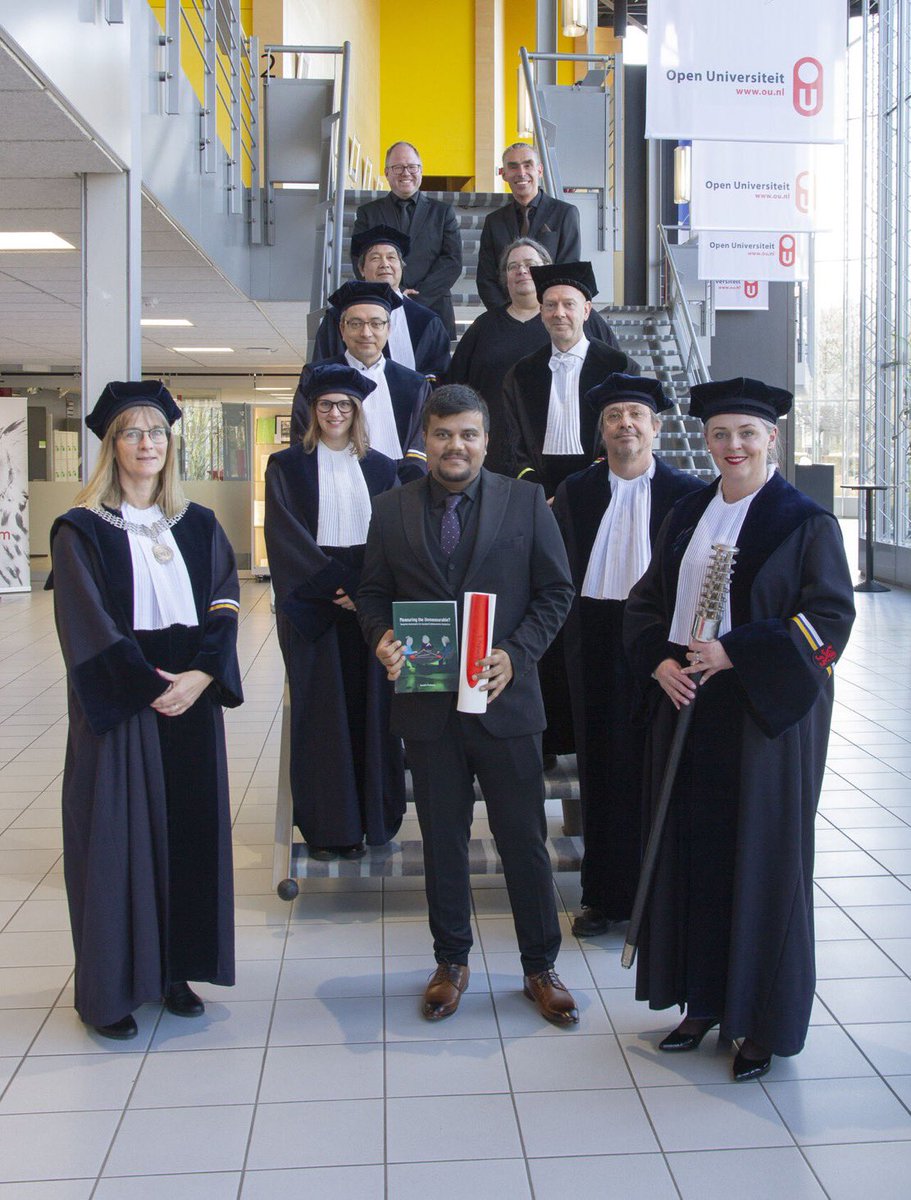
An experience of a lifetime when you end something significant! PhD done :)
Thank you everyone, thanks to my supervisors and the committee for this awesome experience! Especially, my supervisors made this time period a memorable one which will be etched in my memory forever.
9
2
53
Dr. Sambit Praharaj retweeted

Jun 15
🚨 BREAKING: Research just became 10x faster.
Claude can now turn dozens of academic papers into clear, structured insights — like a top-tier researcher.
No more overwhelm. Just clarity.
Here are 9 prompts to get straight to the point 👇
Bookmark this 🔖

26
70
132
4,445
Dr. Sambit Praharaj retweeted

Jun 7
THE GUY WHO WON ANTHROPIC'S HACKATHON JUST GAVE AWAY HIS ENTIRE CLAUDE CODE PLAYBOOK FOR FREE. 10 MONTHS OF WORK, ALL PUBLIC
Affaan Mustafa won the Anthropic x Forum Ventures hackathon by building a full startup in 8 hours with Claude Code. Then he open-sourced the exact setup that did it. It's called Everything Claude Code, and it turns Claude from one assistant into an entire engineering team
Repo: affaan-m/ecc
This isn't a prompt pack. It's a system he refined over 10 months of daily use shipping real products
What's inside:
A huge library of skills, dozens of specialized subagents, and ready-made commands, all working together. Each piece does one job. One subagent reviews security against OWASP standards. One optimizes memory so Claude stops forgetting earlier decisions around hour three. One learns from your past sessions and projects so the setup gets smarter the more you use it. Others handle planning, test-driven development, and language-specific code review
Instead of one assistant writing code, you get an orchestrated team. A main session delegates to the right specialist when the task calls for it, the way a real dev team splits work
The best part: it's not locked to one tool. It runs in Claude Code, Cursor, Codex and OpenCode, across Windows, Mac and Linux. Free, MIT licensed
This is the difference between using Claude like a search box and running it like a team that ships. The guy spent 10 months figuring out what actually works so you don't have to
Bookmark this

89
639
4,221
778,545
Dr. Sambit Praharaj retweeted

Jun 6
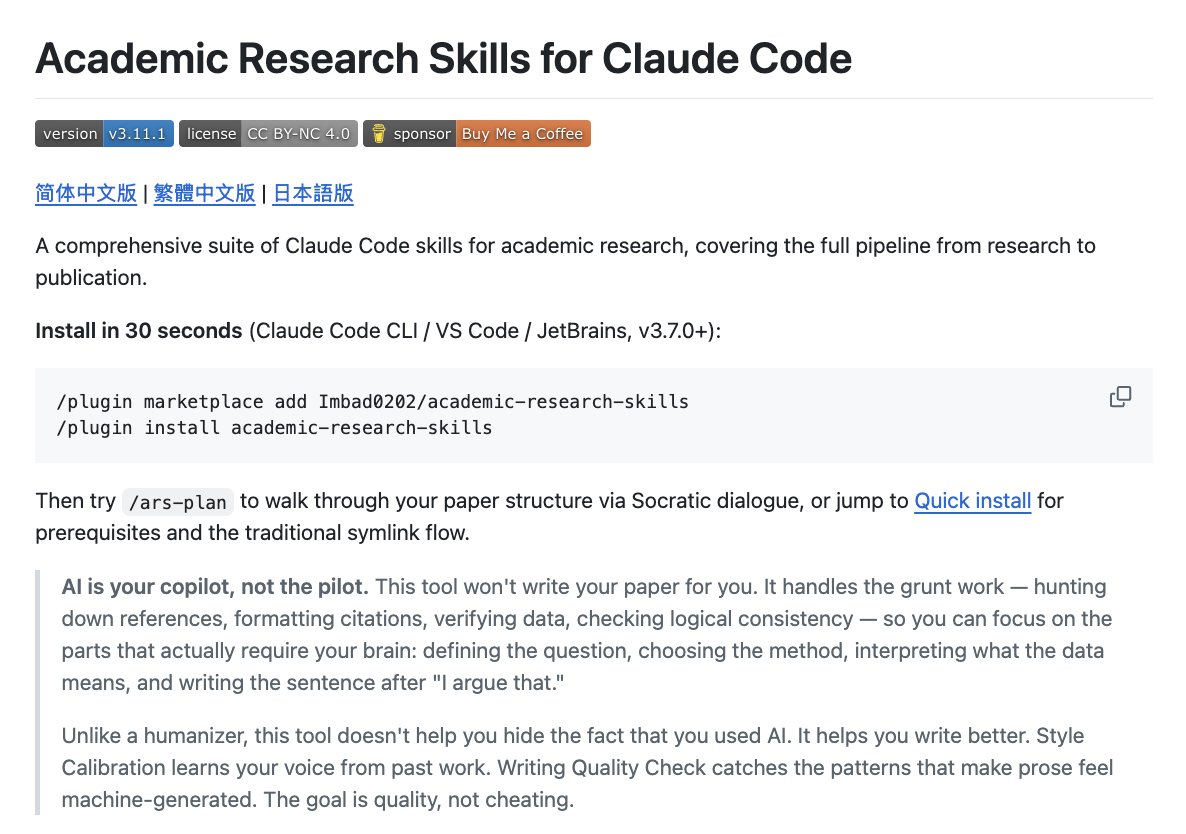
Claude Code can now run an entire PhD-level research pipeline by itself.
it runs a 10-stage workflow from blank page to publication-ready PDF, replacing the work of a PhD advisor, three peer reviewers, and a copy editor in one repo.
→ Deep research with 13 agents (PRISMA systematic review)
→ 12 agents write the paper section by section
→ 5-person peer review (Editor 3 Reviewers Devil's Advocate)
→ Integrity agent catches fabricated citations stat errors
→ Final output: LaTeX → PDF, ready to submit
After the paper is finalized, it runs a Collaboration Quality Evaluation that scores YOU, across 6 dimensions, 1–100. Direction setting, intellectual contribution, quality gatekeeping.
It tells you exactly where you were the bottleneck.
Drop it into .claude/skills/ and the whole pipeline auto-loads. Works in Claude Code, Cowork, and as a Claude Project.
100% open source. CC-BY-NC 4.0.
17
180
956
77,496
Dr. Sambit Praharaj retweeted

May 26
10 WEBSITES EVERY STUDENT SHOULD USE BEFORE GRADUATION.
Bookmark every single one. Your university will never tell you about most of these.
1. notebooklm.google
Upload every textbook, lecture, and PDF for a course. Ask questions across all of them. Built by Google DeepMind.
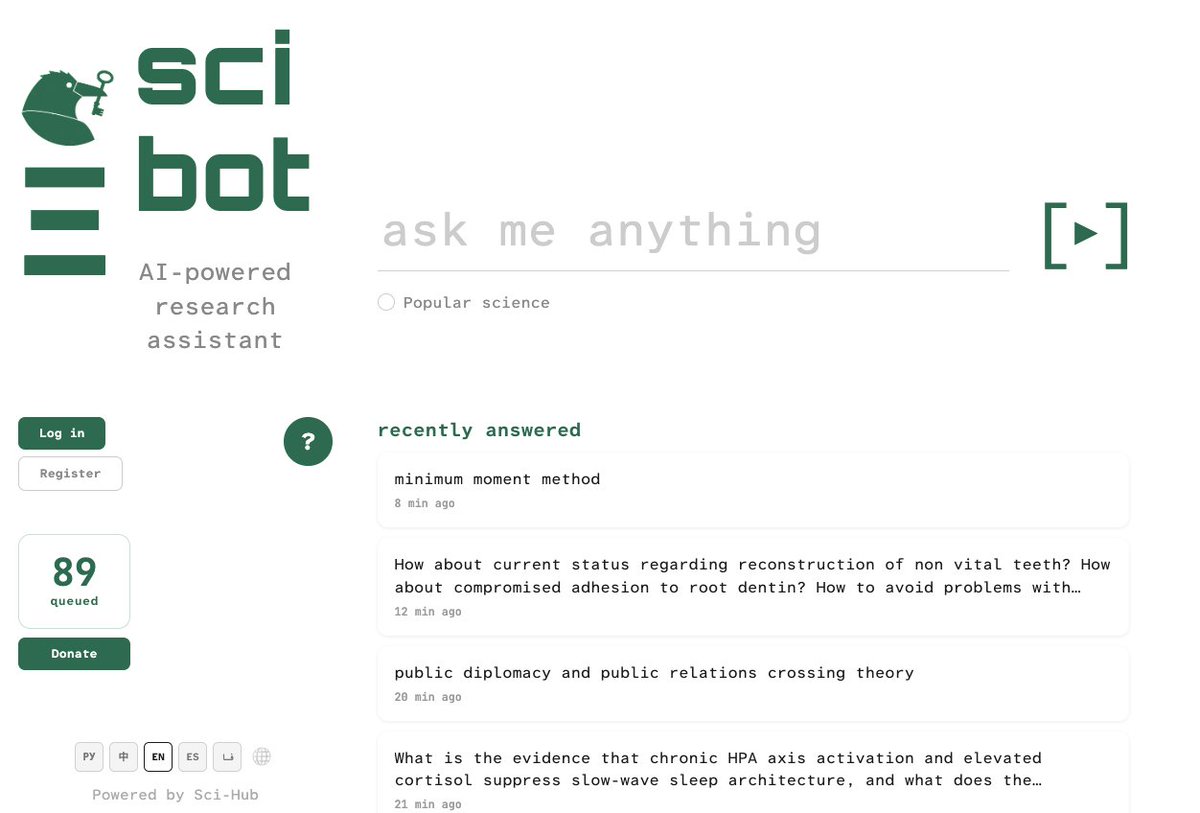
2. sci-bot.ru
Search scientific research fast. Ask any question and get answers with links to relevant papers in seconds.
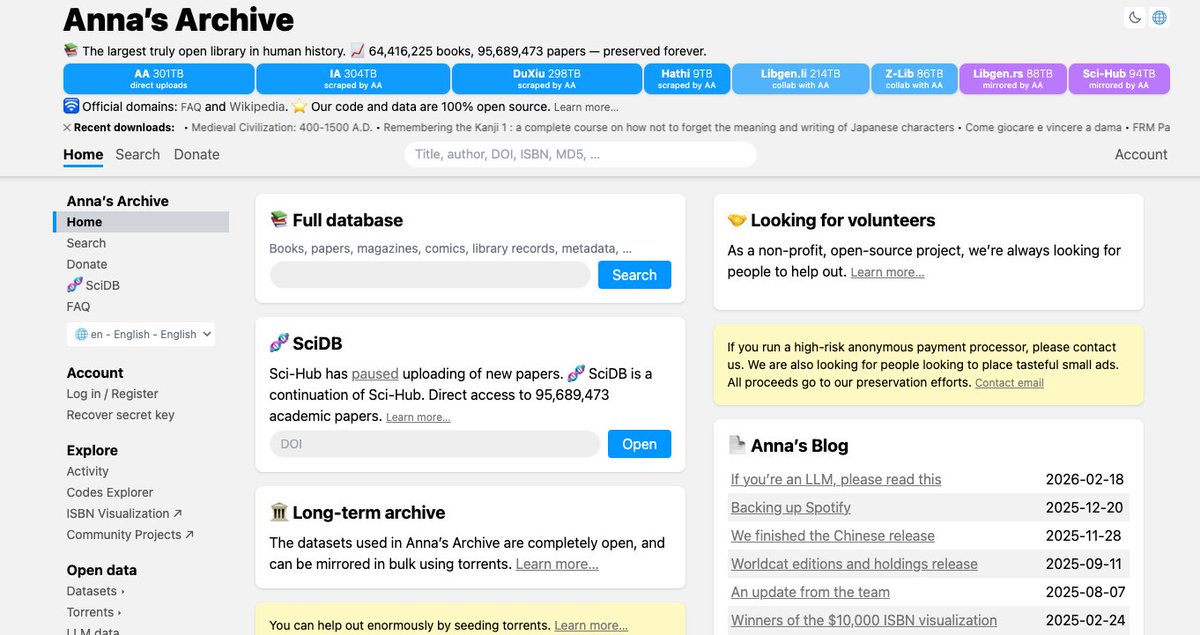
3. annas-archive.gl
The world's largest open library. Almost any textbook your professor assigned is on here for free.
4. perplexity.ai
Research assistant that cites every source. Replaces 90% of Google searches for academic work.
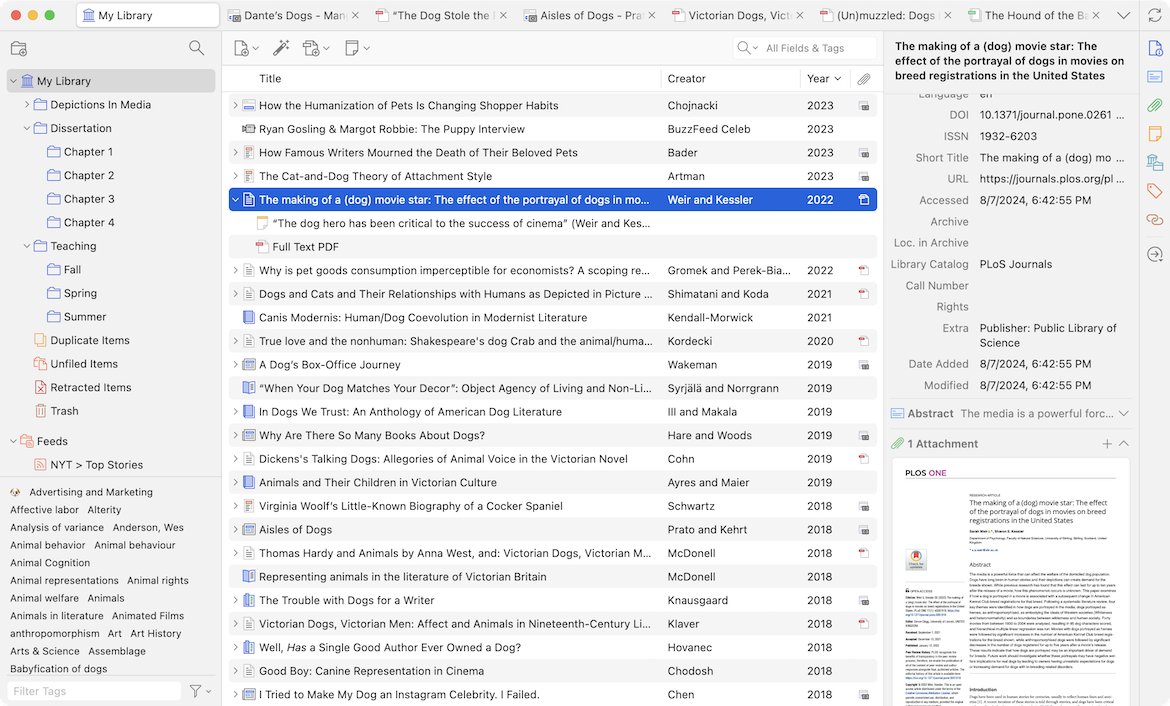
5. zotero.org
Free reference manager that builds your bibliography automatically. Saves 20 hours per semester.
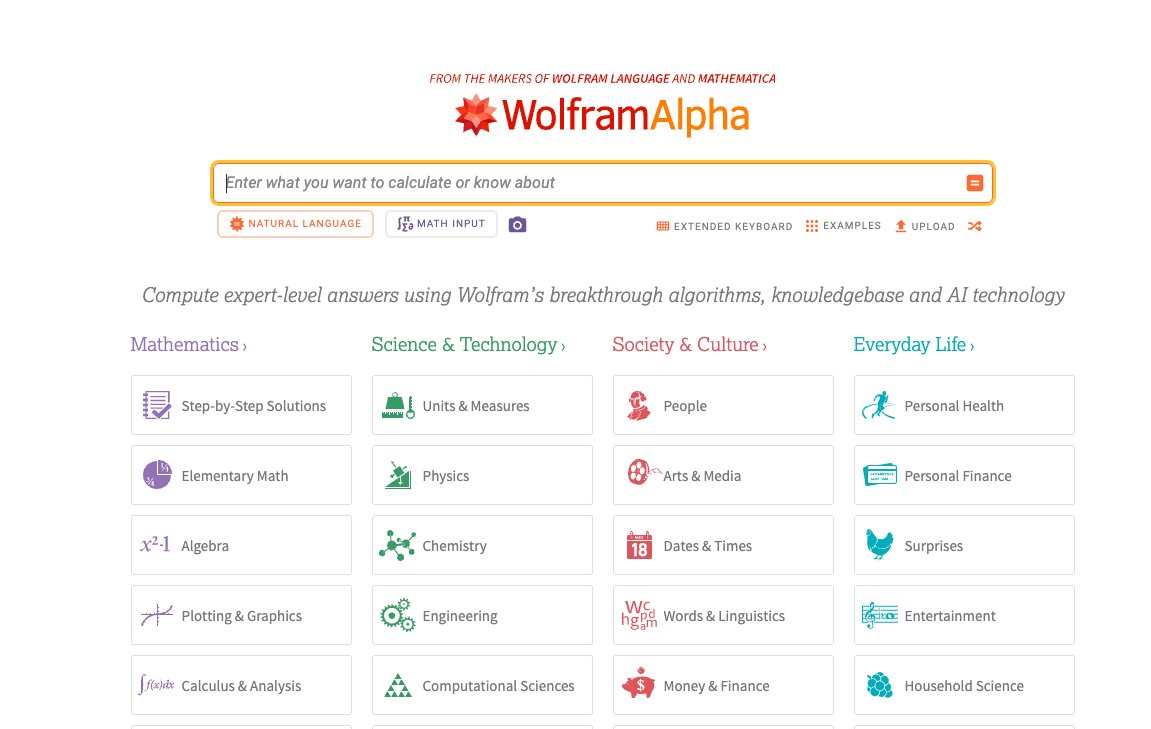
6. wolframalpha.com
Solves math, physics, chemistry, and engineering problems step by step. Shows the full working.
7. handshake.com
The job platform built specifically for students. 1.4 million employers actively recruiting on it right now.
8. fastweb.com
Matches you to scholarships you actually qualify for. Over $3.4 billion awarded to students every year.
9. coursera.org/learn/learning-…
Free Barbara Oakley course taken by 4 million people. The science of how to actually study and remember.
10. linkedin.com/learning
Free with most university logins. 16,000 courses on everything from Excel to AI engineering.
The students who graduate with the biggest head start are not smarter. They just found the right tools earlier.
25
474
1,762
88,405
Dr. Sambit Praharaj retweeted

May 25
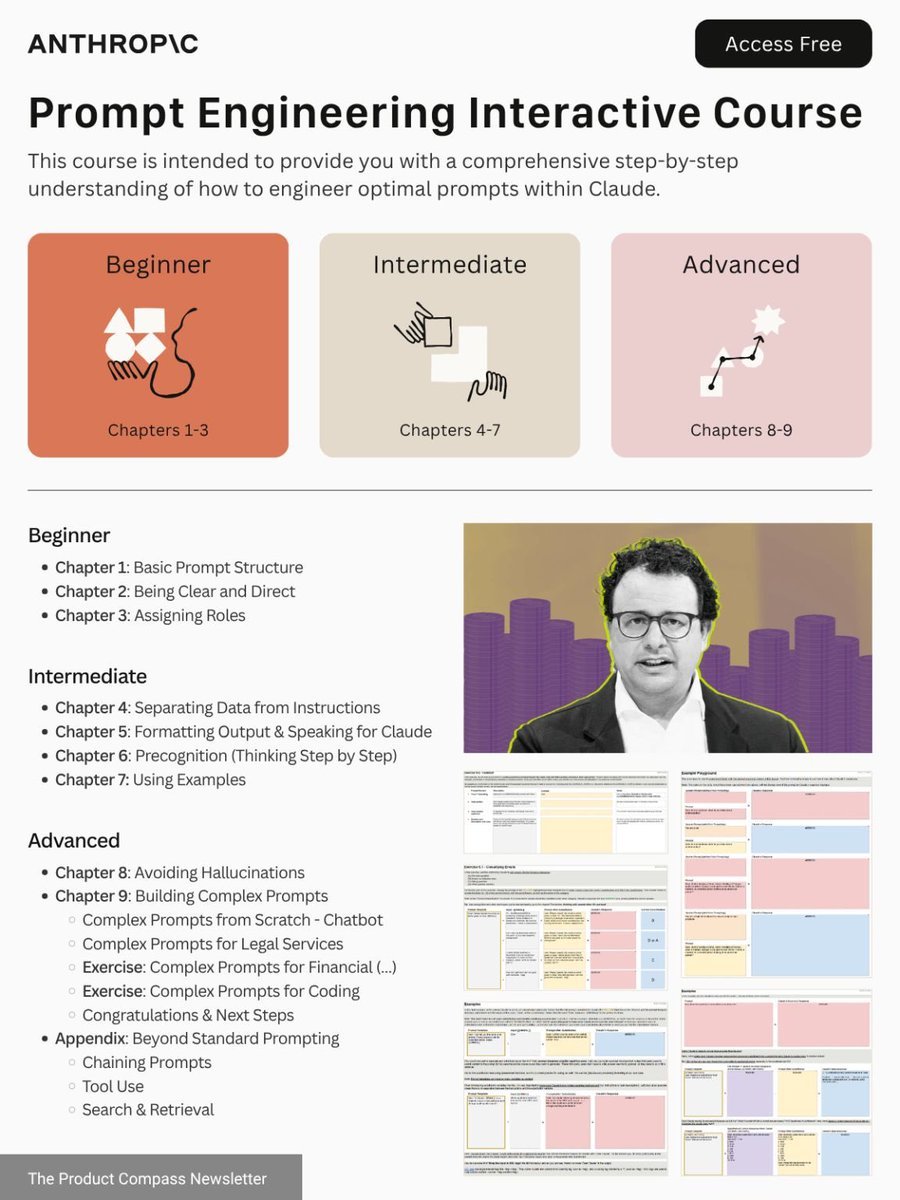
Anthropic Academy just dropped FREE AI courses that could replace a $10,000 degree.
$0. No catch. No gatekeeping.
Here are 6 AI courses that could separate you from everyone else in 2026:
16
18
63
7,190
Dr. Sambit Praharaj retweeted

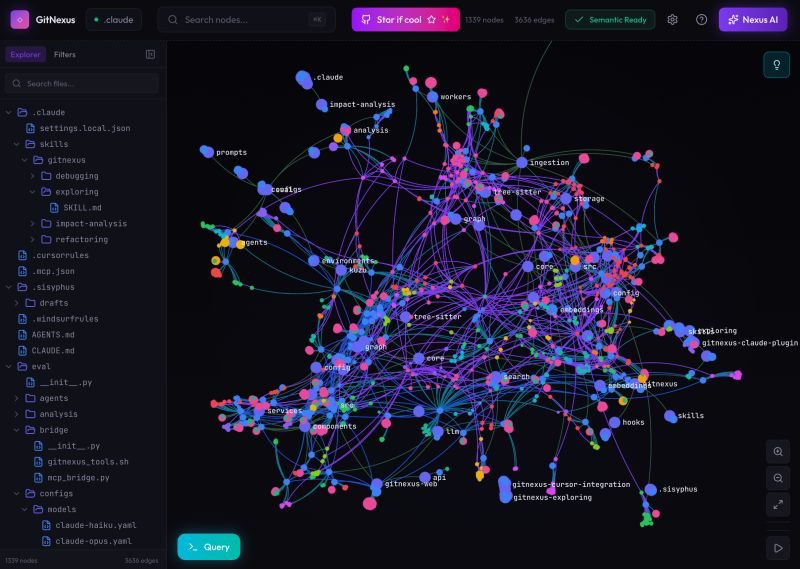
🚨Breaking: Someone open sourced a knowledge graph engine for your codebase and it's terrifying how good it is.
It's called GitNexus. And it's not a documentation tool.
It's a full code intelligence layer that maps every dependency, call chain, and execution flow in your repo -- then plugs directly into Claude Code, Cursor, and Windsurf via MCP.
Here's what this thing does autonomously:
→ Indexes your entire codebase into a graph with Tree-sitter AST parsing
→ Maps every function call, import, class inheritance, and interface
→ Groups related code into functional clusters with cohesion scores
→ Traces execution flows from entry points through full call chains
→ Runs blast radius analysis before you change a single line
→ Detects which processes break when you touch a specific function
→ Renames symbols across 5 files in one coordinated operation
→ Generates a full codebase wiki from the knowledge graph automatically
Here's the wildest part:
Your AI agent edits UserService.validate().
It doesn't know 47 functions depend on its return type.
Breaking changes ship.
GitNexus pre-computes the entire dependency structure at index time -- so when Claude Code asks "what depends on this?", it gets a complete answer in 1 query instead of 10.
Smaller models get full architectural clarity. Even GPT-4o-mini stops breaking call chains.
One command to set it up:
`npx gitnexus analyze`
That's it. MCP registers automatically. Claude Code hooks install themselves.
Your AI agent has been coding blind. This fixes that.
9.4K GitHub stars. 1.2K forks. Already trending.
100% Open Source.
(Link in the comments)
10
57
398
26,562

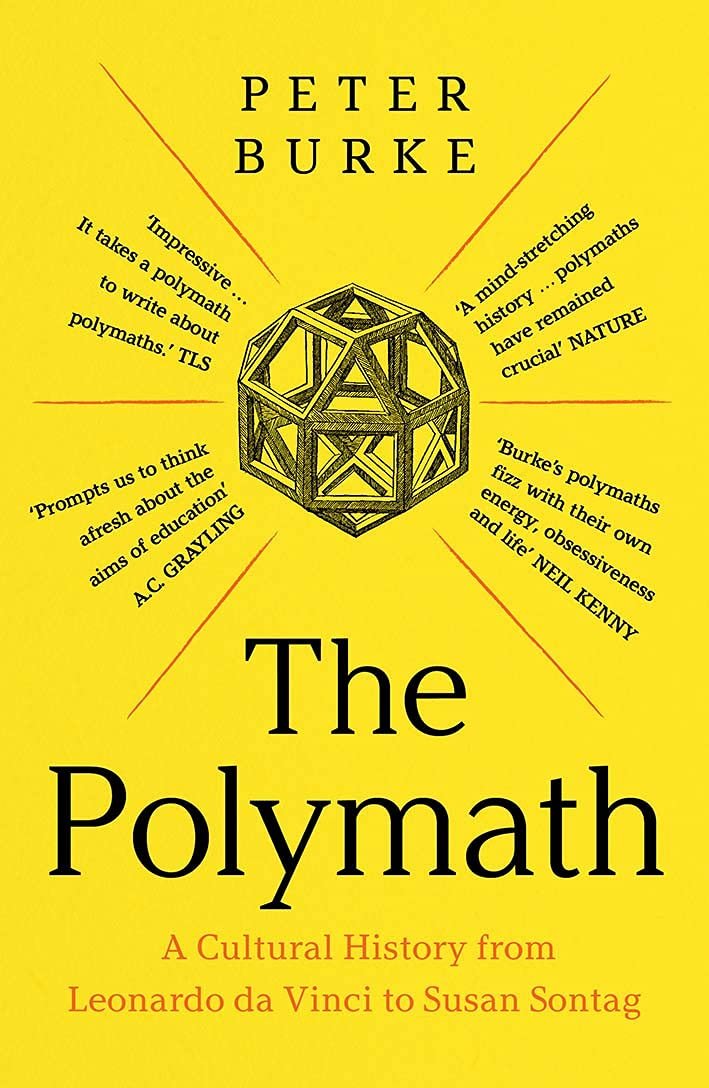
the polymath is not a person who collects hobbies.
it is a person who refuses artificial borders.
• art and science
• engineering and philosophy
• history and design
for most of history, these were not separate worlds.
the polymath by peter burke shows that broad thinkers shaped culture by moving between domains.
they borrowed methods
translated ideas
connected distant fields
specialists optimize inside systems.
polymaths redesign the map itself.
in an age of narrow expertise, synthesis becomes rare leverage.
24
350
1,990
56,059
Dr. Sambit Praharaj retweeted

Apr 28
🚨 The creator of Claude Code just shared a full walkthrough on how to actually use it the right way.
30 minutes. Free. Straight from the person who built it.
Watch the workshop and save it for later.
You’ll likely get more practical value from this than from most expensive coding courses online.
Most people are only scratching the surface of what Claude Code can do.
Then check out the guide below.
47
530
2,942
793,235
Dr. Sambit Praharaj retweeted

Apr 28
100 Claude Repos that will completely change your life:
(save this)
1. Terminal AI coding agent github.com/anthropics/claude…
2. Ready-to-use starter apps github.com/anthropics/claude…
3. Official agent skills github.com/anthropics/skills
4. Plugin marketplace github.com/anthropics/claude…
5. Full ecosystem github.com/orgs/anthropics/r…
6. Master list github.com/hesreallyhim/awes…
7. 1000 plugins github.com/quemsah/awesome-c…
8. Huge skills library github.com/sickn33/antigravi…
9. Curated skills github.com/VoltAgent/awesome…
10. Cross-platform skills github.com/alirezarezvani/cl…
11. LLM pipelines github.com/langchain-ai/lang…
12. Agent workflows github.com/langchain-ai/lang…
13. Multi-agent systems github.com/microsoft/autogen
14. Team-based agents github.com/crewAIInc/crewAI
15. AI dev team github.com/metaGPT/metaGPT
16. Code agents github.com/gpt-engineer-org/…
17. Auto PR fixes github.com/sweepai/sweep
18. AI coding assistant github.com/continue-repl/con…
19. Code search github.com/BloopAI/bloop
20. Agent standards github.com/agentprotocol/age…
21. Productivity plugins github.com/anthropics/knowle…
22. AI SDK github.com/vercel/ai
23. Memory layer github.com/upstash/context7
24. Voice agents github.com/fixie-ai/ultravox
25. Deploy agents github.com/superagent-ai/sup…
26. Web agents github.com/xlang-ai/OpenAgen…
27. Reasoning agents github.com/ysymyth/ReAct
28. Long-term memory github.com/mem0ai/mem0
29. AI apps infra github.com/helixml/helix
30. API layer github.com/trpc/trpc
31. Clean UI github.com/ChatGPTNextWeb/Ne…
32. Self-hosted UI github.com/open-webui/open-w…
33. Modern UI github.com/mckaywrigley/chat…
34. Desktop app github.com/lencx/ChatGPT
35. Next.js clone github.com/Nutlope/chatGPT-c…
36. Template github.com/vercel-labs/ai-ch…
37. Claude-ready UI github.com/Yidadaa/ChatGPT-N…
38. Minimal UI github.com/ivanfioravanti/ch…
39. Lightweight UI github.com/louislam/ChatGPT-…
40. Adaptable UI github.com/zk-ml/chatglm-web
👇

17
235
895
75,568
Dr. Sambit Praharaj retweeted

Apr 25
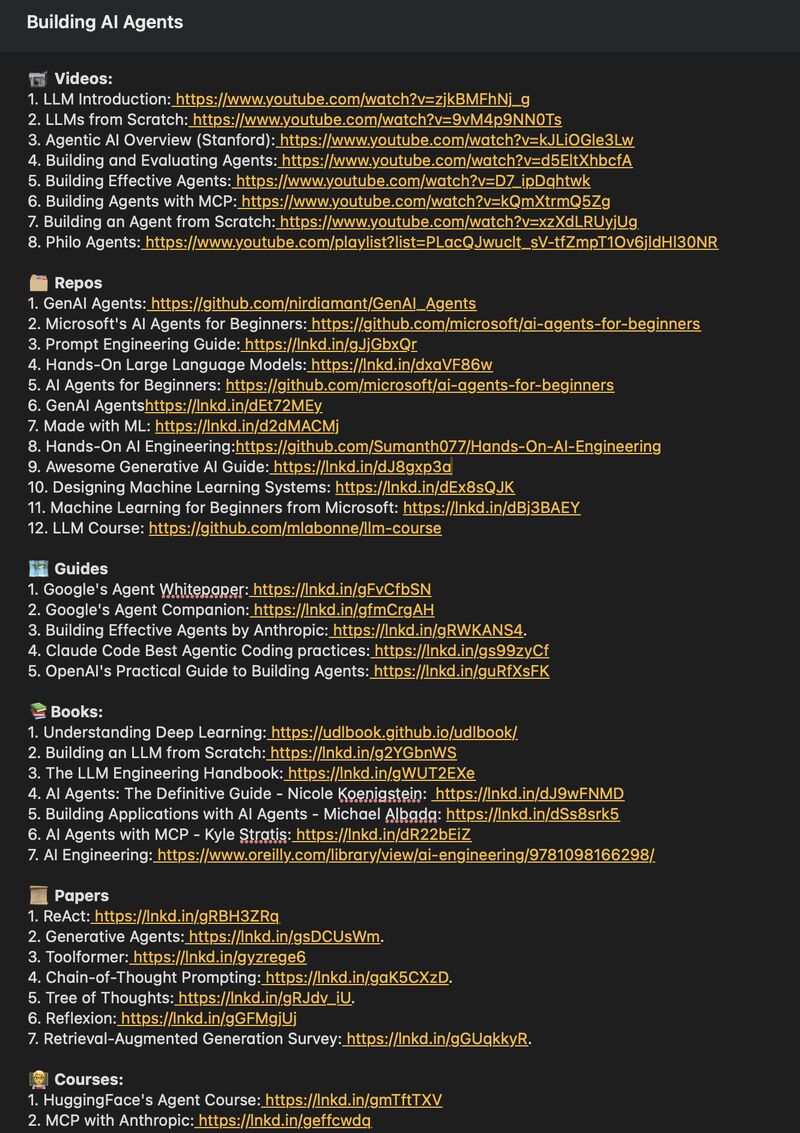
Stop wasting hours trying to learn AI. 📘📚
I have already done it for you.
With one list. Zero confusion. And no fluff
📹 Videos:
1. LLM Introduction: lnkd.in/dMqbaZdK
2. LLMs from Scratch: lnkd.in/dYYwEhYy
3. Agentic AI Overview (Stanford): lnkd.in/dArmMt2i
4. Building and Evaluating Agents: lnkd.in/dBWd2W8u
5. Building Effective Agents: lnkd.in/dHfdebqw
6. Building Agents with MCP: lnkd.in/dXuNHrRJ
7. Building an Agent from Scratch: lnkd.in/da3ANw3w
8. Philo Agents: lnkd.in/dq-BfZE5
🗂️ Repos
1. GenAI Agents: lnkd.in/d3UDtwwv
2. Microsoft's AI Agents for Beginners: lnkd.in/dHvTmJnv
3. Prompt Engineering Guide: lnkd.in/gJjGbxQr
4. Hands-On Large Language Models: lnkd.in/dxaVF86w
5. AI Agents for Beginners: lnkd.in/dHvTmJnv
6. GenAI Agentshttps://lnkd.in/dEt72MEy
7. Made with ML: lnkd.in/d2dMACMj
8. Hands-On AI Engineering:lnkd.in/dgQtRyk7
9. Awesome Generative AI Guide: lnkd.in/dJ8gxp3a
10. Designing Machine Learning Systems: lnkd.in/dEx8sQJK
11. Machine Learning for Beginners from Microsoft: lnkd.in/dBj3BAEY
12. LLM Course: lnkd.in/diZgGACG
🗺️ Guides
1. Google's Agent Whitepaper: lnkd.in/gFvCfbSN
2. Google's Agent Companion: lnkd.in/gfmCrgAH
3. Building Effective Agents by Anthropic: lnkd.in/gRWKANS4.
4. Claude Code Best Agentic Coding practices: lnkd.in/gs99zyCf
5. OpenAI's Practical Guide to Building Agents: lnkd.in/guRfXsFK
📚Books:
1. Understanding Deep Learning: lnkd.in/dgcB68Qt
2. Building an LLM from Scratch: lnkd.in/g2YGbnWS
3. The LLM Engineering Handbook: lnkd.in/gWUT2EXe
4. AI Agents: The Definitive Guide - Nicole Koenigstein: lnkd.in/dJ9wFNMD
5. Building Applications with AI Agents - Michael Albada: lnkd.in/dSs8srk5
6. AI Agents with MCP - Kyle Stratis: lnkd.in/dR22bEiZ
7. AI Engineering: lnkd.in/gi-mQcXa
📜 Papers
1. ReAct: lnkd.in/gRBH3ZRq
2. Generative Agents: lnkd.in/gsDCUsWm.
3. Toolformer: lnkd.in/gyzrege6
4. Chain-of-Thought Prompting: lnkd.in/gaK5CXzD.
🧑🏫 Courses:
1. HuggingFace's Agent Course: lnkd.in/gmTftTXV
2. MCP with Anthropic: lnkd.in/geffcwdq
3. Building Vector Databases with Pinecone: lnkd.in/gCS4sd7Y
4. Vector Databases from Embeddings to Apps: lnkd.in/gm9HR6_2
5. Agent Memory: lnkd.in/gNFpC542
Repost for your network ♻️
35
299
1,106
67,349

🚨 BREAKING: Someone just built the exact tool Andrej Karpathy said someone should build.
48 hours after Karpathy posted his LLM Knowledge Bases workflow, this showed up on GitHub.
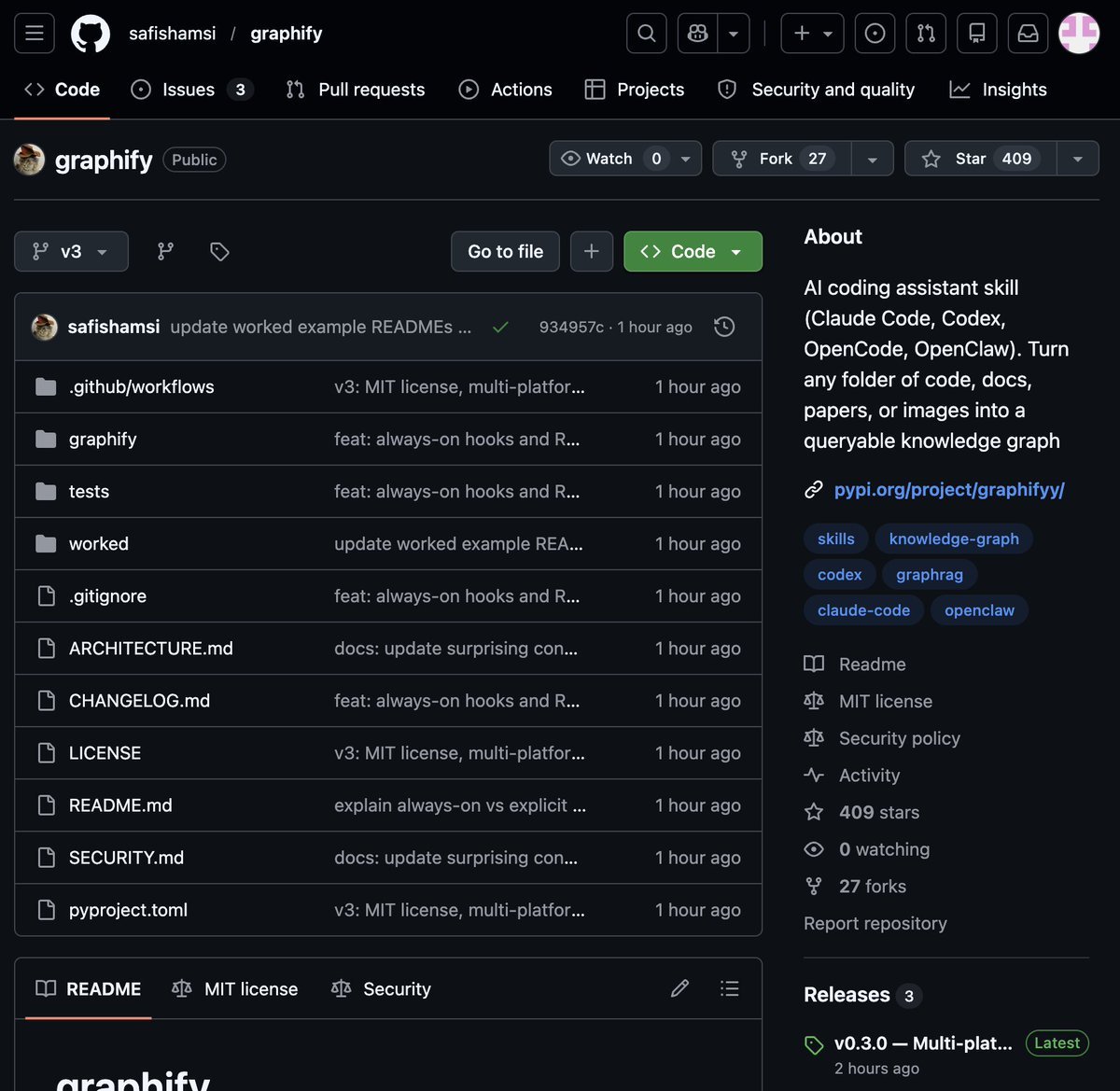
It's called Graphify. One command. Any folder. Full knowledge graph.
Point it at any folder. Run /graphify inside Claude Code. Walk away.
Here is what comes out the other side:
-> A navigable knowledge graph of everything in that folder
-> An Obsidian vault with backlinked articles
-> A wiki that starts at index. md and maps every concept cluster
-> Plain English Q&A over your entire codebase or research folder
You can ask it things like:
"What calls this function?"
"What connects these two concepts?"
"What are the most important nodes in this project?"
No vector database. No setup. No config files.
The token efficiency number is what got me:
71.5x fewer tokens per query compared to reading raw files.
That is not a small improvement. That is a completely different paradigm for how AI agents reason over large codebases.
What it supports:
-> Code in 13 programming languages
-> PDFs
-> Images via Claude Vision
-> Markdown files
Install in one line:
pip install graphify && graphify install
Then type /graphify in Claude Code and point it at anything.
Karpathy asked. Someone delivered in 48 hours.
That is the pace of 2026.
Open Source. Free.
89
318
2,730
356,195
Dr. Sambit Praharaj retweeted

Apr 3
I made a Claude Code skill that turns any arxiv paper into working code.
Every line traces back to the paper section it came from & any implementation detail the paper skips will be flagged, and not assumed.
open sourcing it -
github.com/PrathamLearnsToCo…
53
293
2,633
206,110
Dr. Sambit Praharaj retweeted
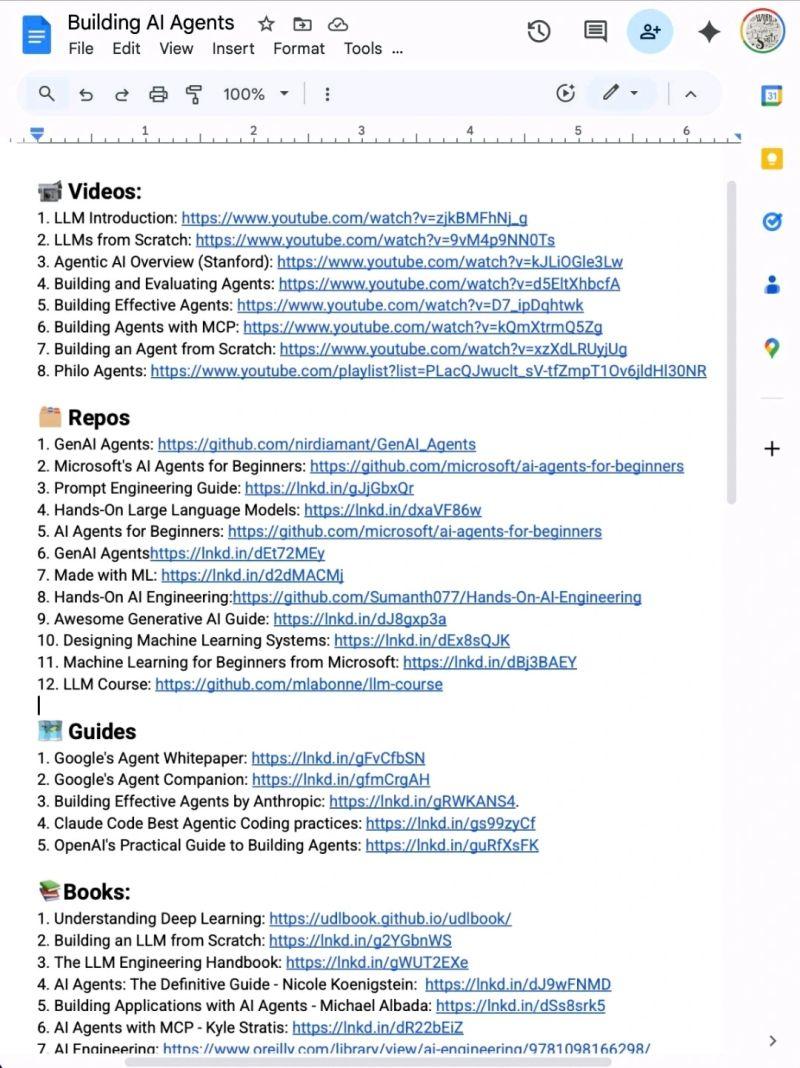
Stop wasting hours trying to learn AI. 📘📚
I have already done it for you.
With one list. Zero confusion. And no fluff
📹 Videos:
1. LLM Introduction: lnkd.in/dMqbaZdK
2. LLMs from Scratch: lnkd.in/dYYwEhYy
3. Agentic AI Overview (Stanford): lnkd.in/dArmMt2i
4. Building and Evaluating Agents: lnkd.in/dBWd2W8u
5. Building Effective Agents: lnkd.in/dHfdebqw
6. Building Agents with MCP: lnkd.in/dXuNHrRJ
7. Building an Agent from Scratch: lnkd.in/da3ANw3w
8. Philo Agents: lnkd.in/dq-BfZE5
🗂️ Repos
1. GenAI Agents: lnkd.in/d3UDtwwv
2. Microsoft's AI Agents for Beginners: lnkd.in/dHvTmJnv
3. Prompt Engineering Guide: lnkd.in/gJjGbxQr
4. Hands-On Large Language Models: lnkd.in/dxaVF86w
5. AI Agents for Beginners: lnkd.in/dHvTmJnv
6. GenAI Agentshttps://lnkd.in/dEt72MEy
7. Made with ML: lnkd.in/d2dMACMj
8. Hands-On AI Engineering:lnkd.in/dgQtRyk7
9. Awesome Generative AI Guide: lnkd.in/dJ8gxp3a
10. Designing Machine Learning Systems: lnkd.in/dEx8sQJK
11. Machine Learning for Beginners from Microsoft: lnkd.in/dBj3BAEY
12. LLM Course: lnkd.in/diZgGACG
🗺️ Guides
1. Google's Agent Whitepaper: lnkd.in/gFvCfbSN
2. Google's Agent Companion: lnkd.in/gfmCrgAH
3. Building Effective Agents by Anthropic: lnkd.in/gRWKANS4.
4. Claude Code Best Agentic Coding practices: lnkd.in/gs99zyCf
5. OpenAI's Practical Guide to Building Agents: lnkd.in/guRfXsFK
📚Books:
1. Understanding Deep Learning: lnkd.in/dgcB68Qt
2. Building an LLM from Scratch: lnkd.in/g2YGbnWS
3. The LLM Engineering Handbook: lnkd.in/gWUT2EXe
4. AI Agents: The Definitive Guide - Nicole Koenigstein: lnkd.in/dJ9wFNMD
5. Building Applications with AI Agents - Michael Albada: lnkd.in/dSs8srk5
6. AI Agents with MCP - Kyle Stratis: lnkd.in/dR22bEiZ
7. AI Engineering: lnkd.in/gi-mQcXa
📜 Papers
1. ReAct: lnkd.in/gRBH3ZRq
2. Generative Agents: lnkd.in/gsDCUsWm.
3. Toolformer: lnkd.in/gyzrege6
4. Chain-of-Thought Prompting: lnkd.in/gaK5CXzD.
🧑🏫 Courses:
1. HuggingFace's Agent Course: lnkd.in/gmTftTXV
2. MCP with Anthropic: lnkd.in/geffcwdq
3. Building Vector Databases with Pinecone: lnkd.in/gCS4sd7Y
4. Vector Databases from Embeddings to Apps: lnkd.in/gm9HR6_2
5. Agent Memory: lnkd.in/gNFpC542
Repost for your network ♻️
15
243
840
118,125
Dr. Sambit Praharaj retweeted

Mar 28
Sebastian Raschka is one of the most respected researchers in ML/AI education. Period.
And now he's done something quietly brilliant.
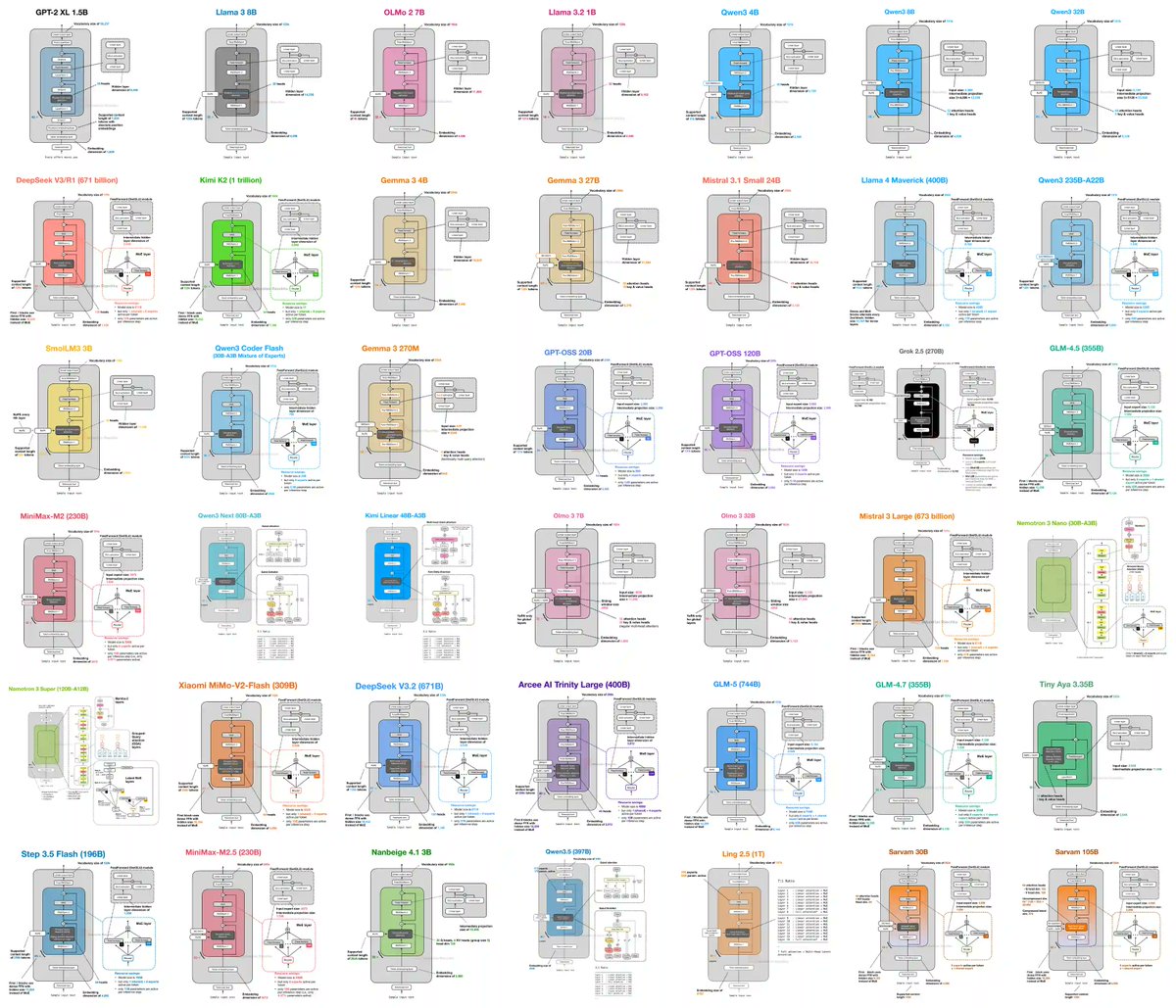
He built an LLM Architecture Gallery - a single, browsable reference that maps out the internal architecture of every major open-weight model released in the last few years.
This is a serious research artifact, made free for everyone.
Here's what's inside:
🔹 GPT-2 XL (1.5B)
🔹 Llama 3 (8B)
🔹 OLMo 2 (7B)
🔹 Llama 3.2 (1B)
🔹 Qwen3 (4B, 8B, 32B)
🔹 DeepSeek V3/R1 (671B)
🔹 Kimi K2 (1 Trillion)
🔹 Gemma 3 (4B, 27B, 270M)
🔹 Mistral 3.1 Small (24B) & Mistral Large (673B)
🔹 Llama 4 Maverick (400B)
🔹 Qwen3 235B-A22B & Qwen3 Coder Flash
🔹 SmolLM (1B)
🔹 GPT-OSS (20B, 120B)
🔹 Grok 2.5 (270B)
🔹 GLM-4.5 (355B), GLM-5 (744B), GLM-4.7 (355B)
🔹 MiniMax-M2 (230B) & MiniMax-M2.5
🔹 Kimi Linear (48B-A3B)
🔹 OlMo 3 (7B) & OlMo 3 (32B)
🔹 Nemotron 3 Nano (20B-A3B) & Nemotron 3 Super
🔹 Xiaomi MiMo-V2-Flash (309B)
🔹 Arcee AI Trinity Large (400B)
🔹 Tiny Aya (3.35B)
🔹 Step 3.5 Flash (196B)
🔹 Nanbeige (4.1, 3B)
🔹 Qwen3.5 (997B)
🔹 Ling 2.5 (1T)
🔹 Sarvam (30B, 105B)
And for each model, he links:
→ The original tech report
→ The config[.]json (so you can verify every number yourself)
→ From-scratch implementations where available
But here's what makes it truly special.
He also added short concept explainers, so you're not just staring at boxes and arrows:
→ GQA (Grouped Query Attention)
→ MLA (Multi-head Latent Attention)
→ SWA (Sliding Window Attention)
→ QK-Norm
→ NoPE (No Positional Encoding)
→ Gated DeltaNet
This is the kind of resource that used to require buying 3 textbooks, reading 40 papers, and spending a weekend.
Now it's one link.
If you're studying LLMs, building on top of them, or just trying to understand how the field has evolved, this is a must-bookmark.
7
93
456
18,613
Dr. Sambit Praharaj retweeted

Mar 27
🚨 Professors are going to hate this.
Someone just open sourced an AI that writes research papers from idea to publication. Conference-ready. Citation-verified. Free.
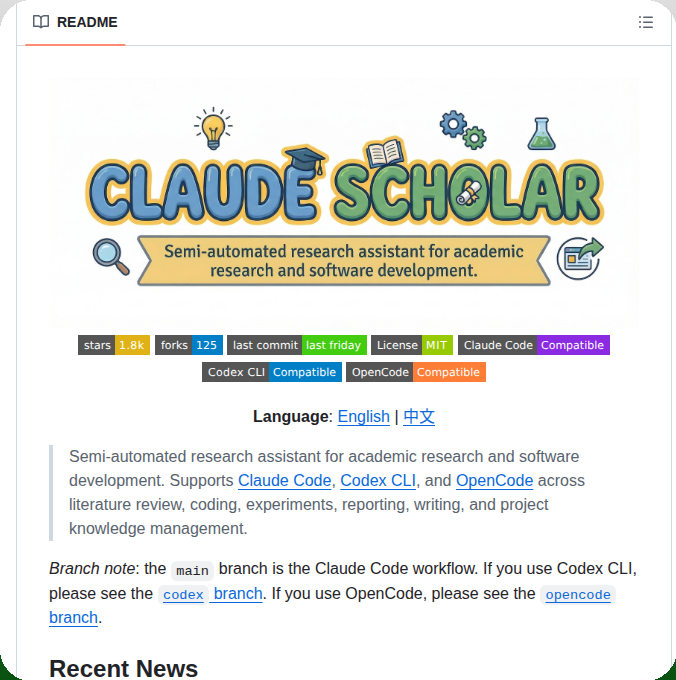
It's called Claude Scholar.
An AI-powered research system that handles every step of the academic workflow. Idea to publication. Fully automated.
No advisor at 2am. No staring at blank LaTeX files. No crying during rebuttal season.
Here's what's inside this thing:
→ AI brainstorms research topics, reviews literature, and finds gaps nobody has explored
→ Runs statistical analysis on your experiments. t-tests, ANOVA, ablation studies. Publication-ready figures.
→ Writes your paper section by section. Abstract to conclusion. Conference-formatted.
→ Verifies every citation through multi-layer validation so AI never hallucinates a reference
→ Strips robotic AI language and adds human voice so reviewers can't tell
→ Self-reviews your draft with a 6-point quality checklist before you submit
→ Parses reviewer comments, classifies each one, and drafts your entire rebuttal
Here's the wildest part:
It supports NeurIPS, ICML, ICLR, ACL, AAAI, Nature, Science, Cell, and PNAS. Downloads the conference template, strips sample content, and gives you a clean LaTeX structure ready to write into.
The creator says it covers 90% of the academic research lifecycle.
Research assistants charge $30 to $60/hour. Conference paper consultants charge $5,000 . Graduate programs cost $50K/year.
This is free. All of it.
100% Open Source.
45
225
1,202
114,121
Dr. Sambit Praharaj retweeted

If you want to learn AI the right way, start here.
No shortcuts. No hype. No fluff.
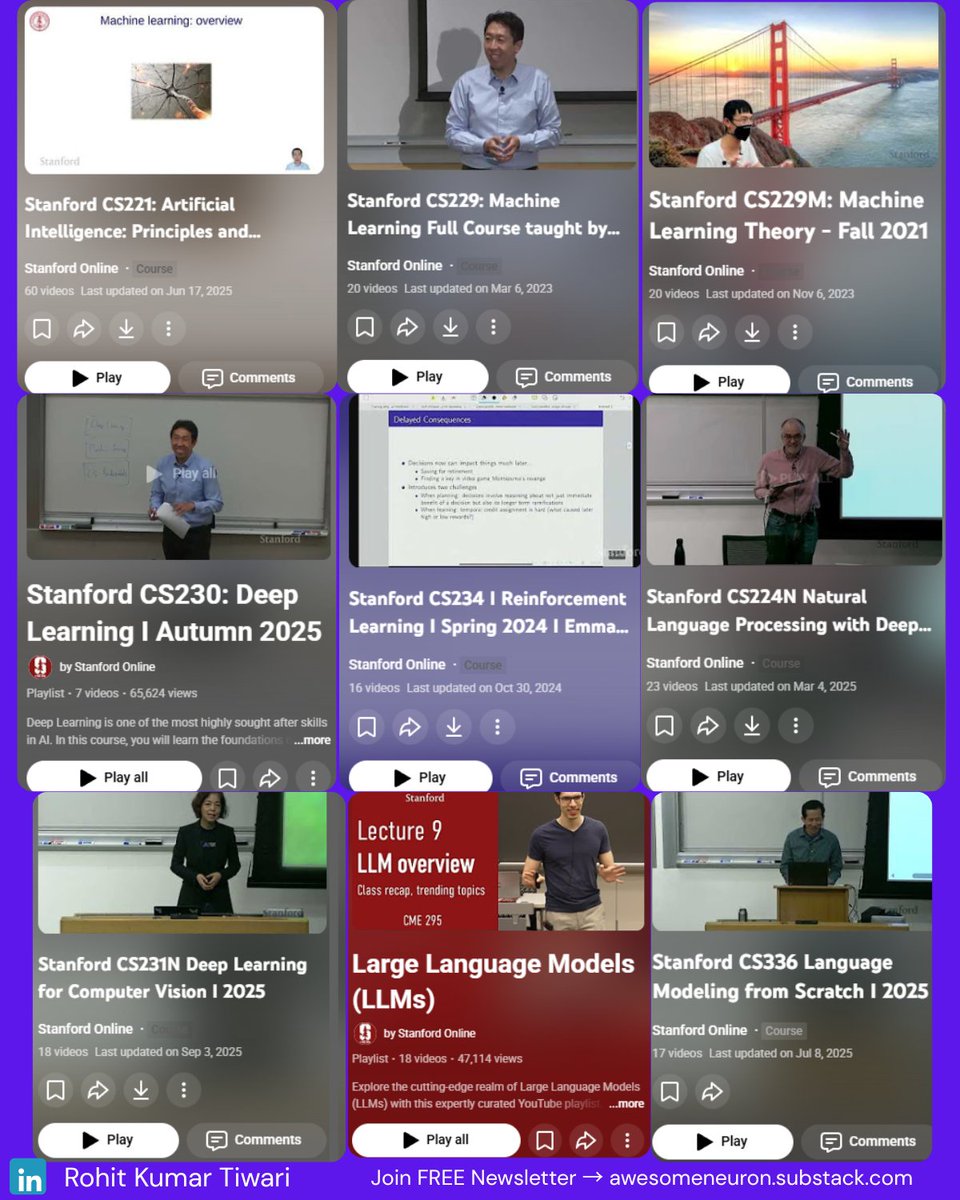
Top 10 Stanford's Courses on AI & ML.
CS221: Artificial Intelligence
CS229: Machine Learning
CS229M: Machine Learning Theory
CS230: Deep Learning
CS234: Reinforcement Learning
CS224N: Natural Language Processing
CS231N: Deep Learning for Computer Vision
CME295: Large Language Models (LLMs)
CS236: Deep Generative Models
CS336: Language Modeling from Scratch
8
235
1,040
41,479
Dr. Sambit Praharaj retweeted

Mar 23
BREAKING: MIT just mass released their Al library for free. (Links included)
I went through these and honestly... this is better than most paid courses I've seen.
Here's the full list of books:
Foundations
1. Foundations of Machine Learning Core algorithms explained. Theory meets practice.
2. Understanding Deep Learning Neural networks demystified. Visual explanations included.
3. Machine Learning Systems Production-ready architecture. System design principles.
Advanced Techniques
4. Algorithms for ML Computational thinking simplified. Decision-making frameworks.
5. Deep Learning The definitive textbook. Covers everything deeply.
Reinforcement Learning
6. RL Basics (Sutton & Barto) The classic. Agent training fundamentals.
7. Distributional RL Beyond expected rewards. Advanced theory.
8. Multi-Agent Systems Agents working together. Coordination and competition.
9. Long Game Al Strategic agent design. Future-focused thinking.
Ethics & Probability
10. Fairness in ML Bias detection. Responsible Al practices.
11. Probabilistic ML (Part 1 & 2)
Links: lnkd.in/gkuXuexa
Most people pay thousands for bootcamps that teach half of this.
Bookmark it. Start anywhere. Just start.
Repost for others Follow for more insights on Al Agents.
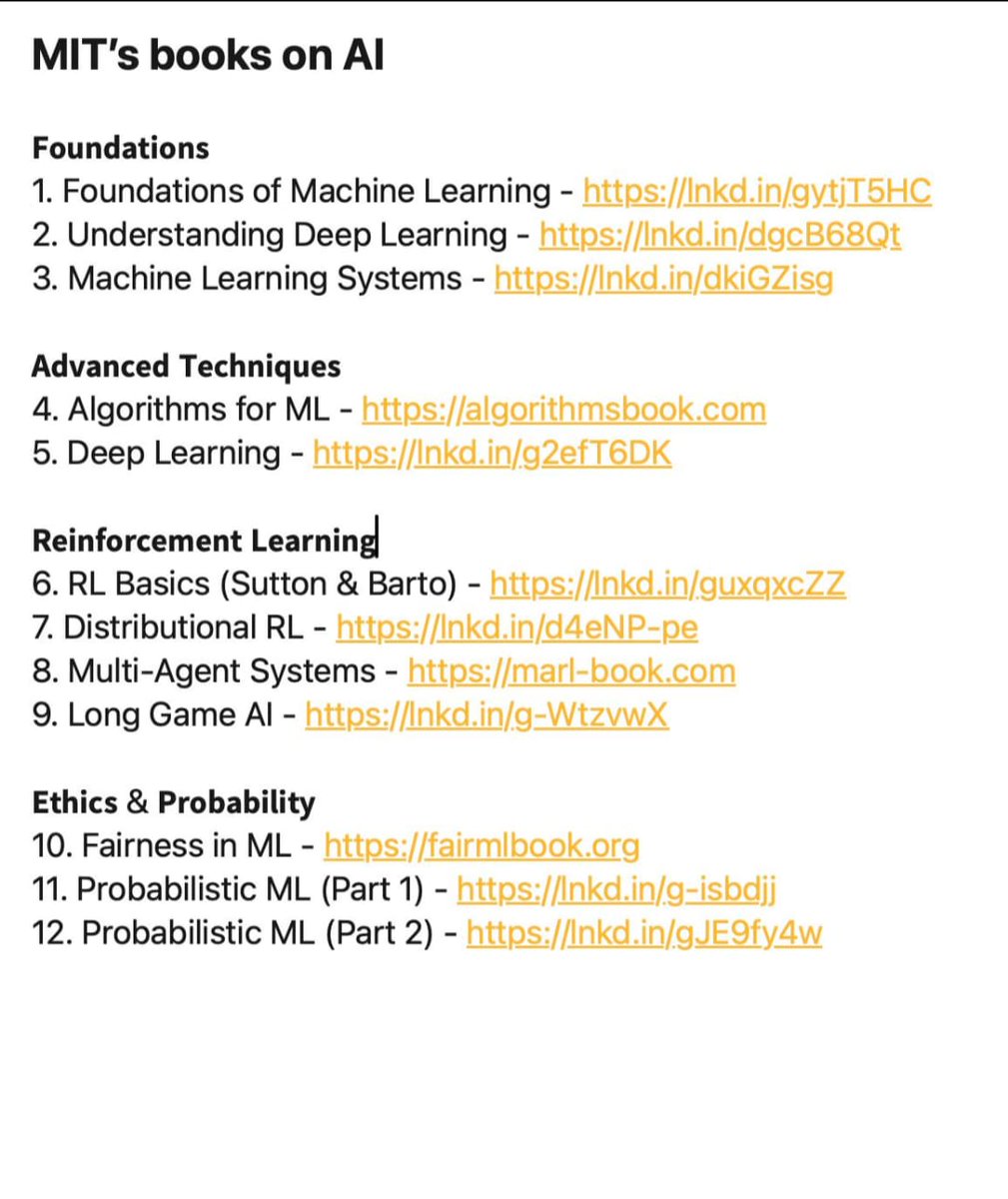
MIT's books on Al
Foundations
1. Foundations of Machine Learning - lnkd.in/gytjT5HC
2. Understanding Deep Learning - lnkd.in/dgcB68Qt
3. Machine Learning Systems - lnkd.in/dkiGZisg
Advanced Techniques
4. Algorithms for ML - algorithmsbook.com
5. Deep Learning - lnkd.in/g2efT6DK
Reinforcement Learning
6. RL Basics (Sutton & Barto) - lnkd.in/guxqxcZZ
7. Distributional RL - lnkd.in/d4eNP-pe
8. Multi-Agent Systems - marl-book.com
9. Long Game Al - lnkd.in/g-WtzvwX
Ethics & Probability
10. Fairness in ML - fairmlbook.org
11. Probabilistic ML (Part 1) - lnkd.in/g-isbdjj
12. Probabilistic ML (Part 2) - lnkd.in/gJE9fy4w
36
670
2,036
156,058
Dr. Sambit Praharaj retweeted

Mar 23
Best YouTube Channels To Learn AI in 2026 (No BS)
1. Fundamentals – 3Blue1Brown
2. Deep Learning – Andrej Karpathy
3. AI Research – Yannic Kilcher
4. Practical AI – AssemblyAI
5. LLMs – AI Explained
6. ML Theory – StatQuest
7. Papers Simplified – Two Minute Papers
8. GenAI – Matthew Berman
9. AI Agents – Nicholas Renotte
10. Applied ML – Krish Naik
11. PyTorch – Aladdin Persson
12. Math for ML – Serrano Academy
13. Industry Insights – Lex Fridman
14. Real-world AI – DeepLearningAI


36
494
3,004
127,591
Dr. Sambit Praharaj retweeted

Mar 16
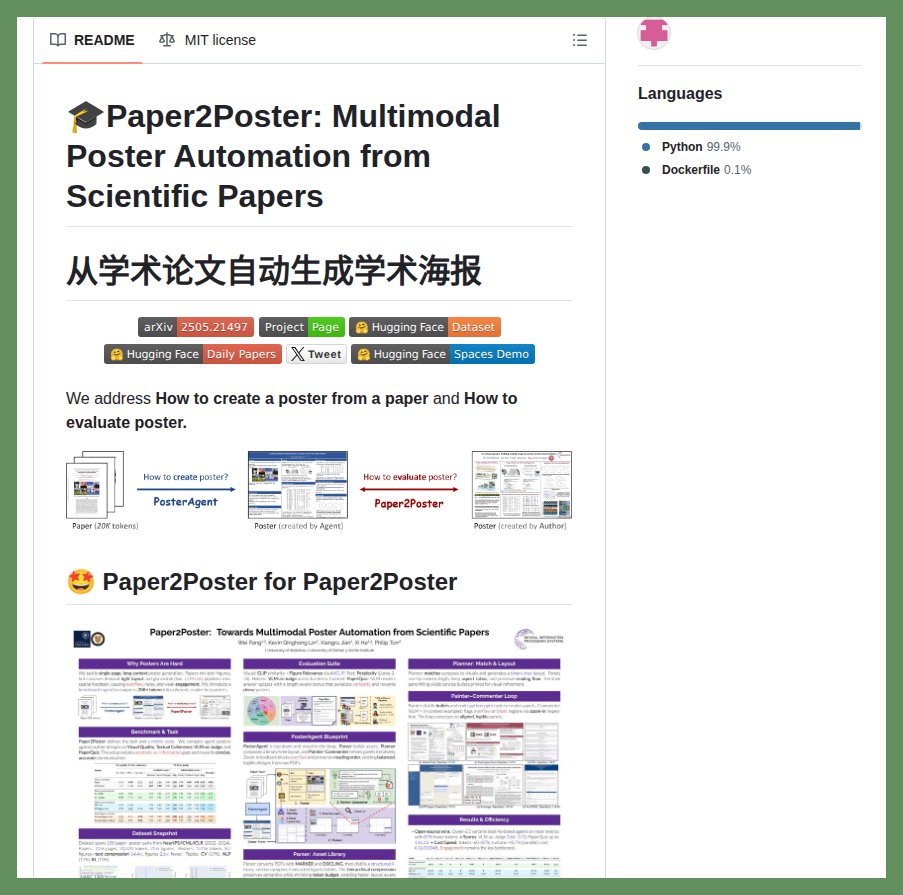
Automates poster generation from papers
github.com/Paper2Poster/Pape…
3
149
731
42,512
Dr. Sambit Praharaj retweeted

🚨 BREAKING:
India’s AI startup Sarvam AI has open-sourced its 30B and 105B AI models for developers.


53
439
5,755
86,703