
Science, Education, Exploration, Design. 実 Actualizing the #solarpunk #postcapitalist #commons. #DeSci. Free community fab lab café forming in Oregon!✨🌱🌈🌻
Joined March 2023
- Tweets 3,566
- Following 4,341
- Followers 1,253
- Likes 16,172
441 Photos and videos





Solarpunk SΞΞD 🌱 d/acc retweeted

Jun 13
Decentralized AI.
Who is building this?
294
14
387
72,913
Solarpunk SΞΞD 🌱 d/acc retweeted

Jun 10
they grow up so fast @victoroldensand
his name is Walnut. soon he’ll be running these streets
13
20
210
10,534

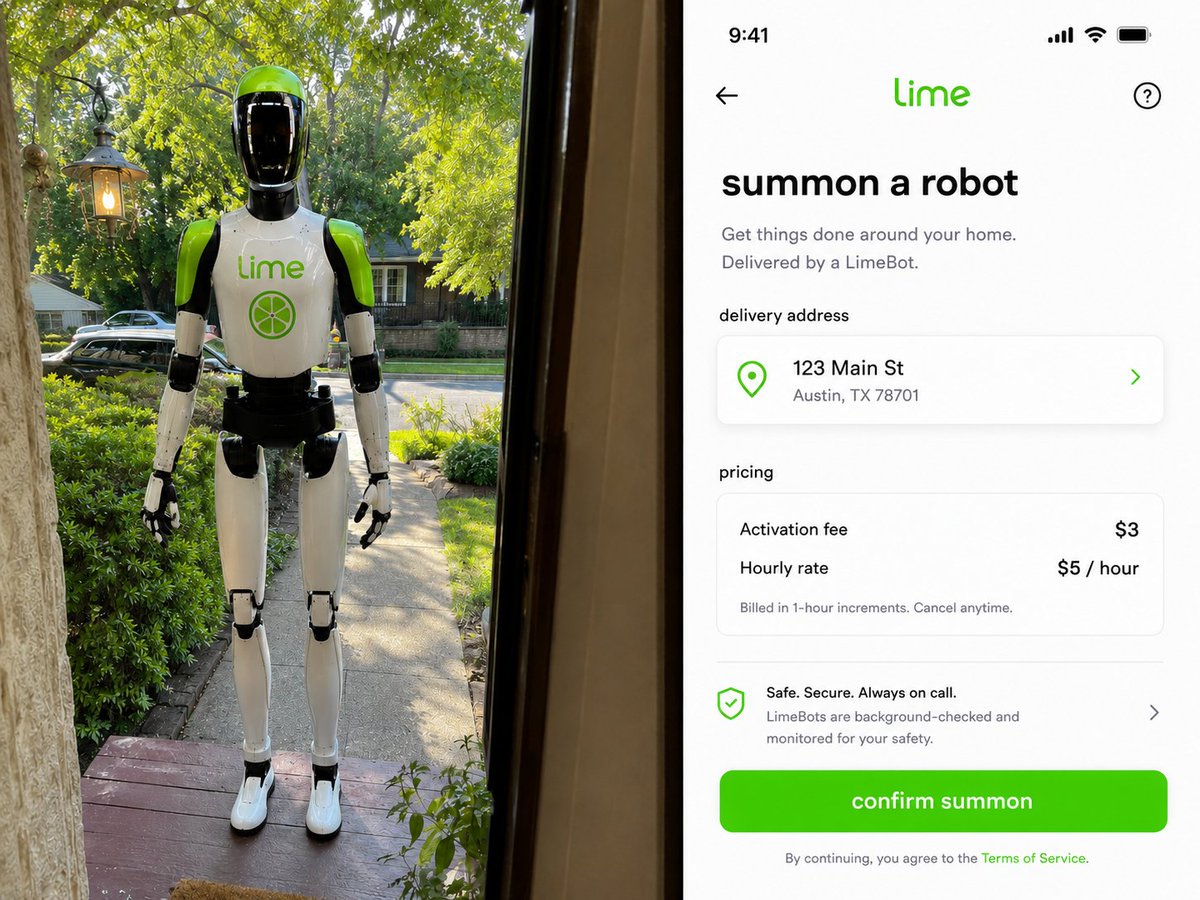
Neighborhoods and communities can co-purchase and co-own bots, and they can be summoned for free.
Jun 1

This will be a thing in the future, the same way shared micro mobility is a thing now. Most people won’t be able to afford a humanoid robot, but I’d assume you’ll be able to summon one for a period of time to help you with stuff.
1
84
Solarpunk SΞΞD 🌱 d/acc retweeted

We are the ARCHITECTS of TOMORROW!
594
1,475
5,753
1,584,897
Solarpunk SΞΞD 🌱 d/acc retweeted

Our blueprint for the "Optimal Universal Robot":
❌ Legs: Too complex, too expensive. ✅ Wheels: Fast, stable, 10x cheaper.
❌ Rotary Joints: Massive torque stress, custom gears. ✅ Of the shelf parts & linear actuators: High payload, extrem simplicity, off-the-shelf parts.
41
98
675
61,539
In sunny Carlsbad, California, a startup called Aptera is nearing the finish line on a solar-powered EV nearly 20 years in the making.
youtube.com/watch?v=g_QFINzQ…
2
3
148
Solarpunk SΞΞD 🌱 d/acc retweeted

May 24
Some of my perspective on where the @ethereumfndn is going.
First of all, this is only my own view. The board is not just me, and I have no extra special powers on the board that the other board members do not. @aerugoettinea is the one executing much of this transition. My input has been largely on technical questions. The board is in the process of expanding, and my own power within the org will continue to decrease, which is honestly what I want.
The 2025 era brought many important improvements to EF and its ability to execute. Many issues were resolved, and EF continues to benefit from its improved efficiency and greater focus on concrete goals to this day. And so with those problems resolved, early this year, the largest remaining hole that I perceived was something different nagging at me: I would regularly spot people saying things like "vitalik says these beautiful things about ethereum needing to be decentralized, and have privacy, and be a sanctuary technology, but why do the EF's actions not reflect that?"
Now, you may have been hearing something different. You may not have been sensing a feeling of crisis at all, and maybe were hearing people saying that finally we were taking execution and BD seriously and the main task for us is to keep going that way and be even better and faster. Then probably there is genuine difference between you and me, in what kinds of criticism I take most seriously, and what kinds of critics through their criticism are most able to make me feel pain.
As an analogy, let's briefly switch over to a different domain.
One belief you can have about Google is that it is a success story, and has brought a lot of good to humanity in organizing the world's information. Another belief you can have about Google is that they had a beautiful idealistic beginning, but at some point the corruption of mainstream corporate attitudes seeped in, and they slowly bit by bit completely abandoned the "don't be evil" slogan.
My belief on Google specifically is probably somewhere between the two. BUT, if you had taken me back in time to ~2008, and offered me a button to press to make Google one or two standard deviations more "dogmatic", eg. give Richard Stallman permanent veto power over some key policies, I would immediately press it.
Why? Because a choice for one company is not a choice for the world, or even one country. Google existed and exists in the context of a technology industry generally drifting away from early idealistic don't-be-evil roots and toward greed for financial gain, totalizing visions of accelerated superintelligence, infiltration by sociopaths, and craven capitulation to (or worse, active participation in) government pressure for ideological control, surveillance and war. And so *one company* doing something different, positioning itself to be what George Bernard Shaw calls the Unreasonable Man, resisting the trend of the times, would have been better for freedom, balance of power and stability of society as a whole, than *all* large companies bending to dominant trends. This is a part of my version of pluralism.
This line of thinking is not just mine, but I also is not too far off from what Aya and others had in mind with the Mandate.
Now how does this all get to the role of the EF?
EF is not a "center of Ethereum", rather EF is "one node, with a defined purpose, alongside other nodes". We've always said that the EF should be the latter, but many in the Ethereum ecosystem (and even within the EF) wanted us to be the former. Now, we are taking action to ensure that we will be the latter.
This is particularly important because EF is a limited organization, with limited resources and limited organizational capacity. The EF has only ~0.16% of all ETH (less than many other individual ETH holders), whereas among other blockchains it's common for "the central foundation" to have 10-50%. Fiscally, the EF was originally designed to fulfill a limited work scope defined in the token sale docs and other pre-launch materials (building the chain software; getting through Frontier, Homestead, Metropolis, Serenity), which was fully completed in 2022; it was not designed to be an eternal steward.
And so today, the EF is choosing to use its remaining resources to pursue longevity over breadth (yes, this means we sell less ETH). The EF focuses *specifically* on those activities critical to the success of ethereum as a censorship/capture-resistant, open, private and secure system, that would not happen otherwise. This means making hard choices, and in some cases even activities that we highly approve of and people that we highly respect becoming outside of the EF. People of great technical talent, public respect and even alignment with the mission and CROPS being outside of the EF is in fact necessary if we want important tasks to be able to attract outside capital. This also means the EF taking opinionated stands culturally.
This is all intended in cooperation with all other parts of ethereum. We recognize that many other parts of the ethereum world highly respect CROPS and related values. But highly respecting is not the same as choosing to specialize and totally dedicate to a domain (Compare in a different domain: I think reducing animal cruelty is important, and I like vegan food, but am not full unconditional vegan myself)
EF is still in a transition period, and we expect its new long-term form to stabilize over the next few months. What are the guiding principles of this new form? Again, I am only one person, but I can give my answer from a technical perspective (there are also critical non-technical aspects).
At the core, *Ethereum must be impressive*. We are living in an age of highly intelligent AI and all kinds of other technological acceleration. "Status quo EVM, with a hard fork or two a year to optimize for short-term needs of users" is not interesting.
To some, "impressive" means: 250ms latency and 1M TPS. I think Ethereum trying to go that route is a mistake. Being as fast and as scalable as possible, and only a small epsilon more decentralized than the others, is a route to mediocrity, and if we try it we will lose.
I think Ethereum should scale. But I think Ethereum should strive the hardest to be deeply impressive in a different dimension: the CROPS dimension. This means things like:
* Provably bug-free Ethereum. This is a goal that all cybersecurity researchers would have thought is absurd and impossible, up until roughly 6 months ago. Now, it's on the cusp of being possible, thanks to AI-assisted formal verification. So we should be frontrunners in doing this.
* Available chain consensus. Ethereum is, and with lean consensus will cotninue to be, the ONLY chain that has both (i) traditional-BFT style properties that it's safe under asynchrony up to a high level of fault tolerance, and (ii) the bitcoin PoW-style property that under synchrony it's safe up to 49% attackers. As far as I can tell, literally no other chain has this or is planning for it; bitcoin goes for (ii) only and most other chains go for (i) only. Some will remember I fought hard for this, Unreasonably insisting that it is not OK for ethereum to rely on social consensus and hard forks to rescue ethereum from 34% of nodes going offline. It's OK for chains like hyperledger, bnb, solana, tempo, etc. It's not OK for bitcoin or ethereum or eg. zcash.
* Intermediary minimization. The fact that smart contract wallets, protocols like railgun, etc have to send transactions through intermediaries to get included onchain is honestly embarrassing, and it's a constant point of fragility. Hence the work on FOCIL and EIP-8141 (and 7701 and years of work before) to make transaction sending intermediary-minimized with public mempool and strong inclusion properties, in a truly general-purpose way, that covers not just eg. secp256r1, but also privacy protocols and much more. Kohaku is pushing intermediary minimization at the user layer, pulling Ethereum away from the dystopian status quo world where our wallets don't even verify the chain, send our private data out to a dozen third-party servers, and toward a brighter CROPS future.
Some of these goals are Unreasonable - maybe Ethereum would be "fine" getting only 50% of the way - what if we depend on intermediaries, but make it easy to switch? But going 50% of the way would not make Ethereum Deeply Impressive in the CROPS way. So we push for 100%.
Fortunately all these goals are compatible with high TPS, this is a major focus of research (esp. on scaling the state). Well-designed L2s can also help, especially L2s optimized for specific applications (eg. high-volume trading, privacy...). These goals are even compatible with significantly lower slot times, thanks to Raul's work on erasure-coded P2P, and many other optimizations.
The most high-value "product" of the ethereum blockchain, financially speaking, is ETH the asset. Ethereum secures $250 billion of ETH. The types of properties of Ethereum that I mentioned above are very good for ETH the asset. Nearly 90% of my net worth is in ETH, and most of the remainder is ~$40m of onchain fiat of which every dollar has already been allocated for some open-source biotech or software or hardware initiative. That said, there are aspects of supporting ETH the asset - *necessary* aspects even - that are outside the scope of the EF. This is where we need other heroes (some of whom hold more ETH than the EF does) to step in and help. EF has been recently thinking more about how it will relate to other such organizations, and give them needed initial support.
EF will be a smaller ship than in previous years, a more opinionated one - in some cases more opinionated in ways that might be difficult to comprehend - but a longer-lasting one, and one suited to making sure that ethereum brings something meaningful to the world. We are grateful to all those inside and outside the EF who are helping to make this happen.
1,614
1,623
7,883
4,098,045

technofeudalism is here.
the digital economy stopped being a market. it became a set of platforms (uber, amazon, google, openai) that extract rent from every transaction crossing them. you don't own a shop on main street anymore. you rent one from airbnb at 15%, and the rules change tomorrow if they want.
if the platform is the economy, the platform owner is the lord. everyone else is a tenant. small business cannot out-compete a network. workers cannot bargain against an algorithm. ai is about to make tenant-labor optional too.
technofeudalism is just math. networks generate n² value between users. once one hits ~10% of tam, takeoff velocity is irreversible. nobody starts a second uber. the railroad and telegraph and pipeline monopolies of the 1800s are now apps, and they consolidate faster because the marginal cost of adding a country is zero.
the evidence:
- thiel, 2014: "competition is for losers."
- the us top 10 by market cap is almost entirely platform plays.
- post-reagan antitrust has been mostly dormant.
- ai capex is concentrating in a handful of firms.
so what do we do?
markets and democracies both rely on voluntarism plus distributed power. we are losing both. the response has to restore at least one.
three threads worth pulling:
1. governance of networks that isn't "one dude." we govern nation states (badly) and firms (worse). we do not yet know how to govern a network. that is the open design space.
2. alternatives to the network, not a war against it. you cannot out-network the network. you can build commons-based infrastructure where the rent flows back to contributors instead of a holding company.
3. third spaces and local economies. when the global network goes feudal, the move is local sovereignty. boulder, not silicon valley. neighbors you can name, not user ids.
the window for any of this is open right now. it is closing.
20
30
157
6,581
Solarpunk SΞΞD 🌱 d/acc retweeted

Open Access ✌️👏👏
May 23

In Cuba, people pay one dollar for a USB stick.
What is on it: all of Wikipedia. Every article. Every image. 7 million entries.
In North Korea, the same kind of stick is smuggled across the border in plastic bottles.
In US and European prisons, inmates use it because they cannot touch the open internet.
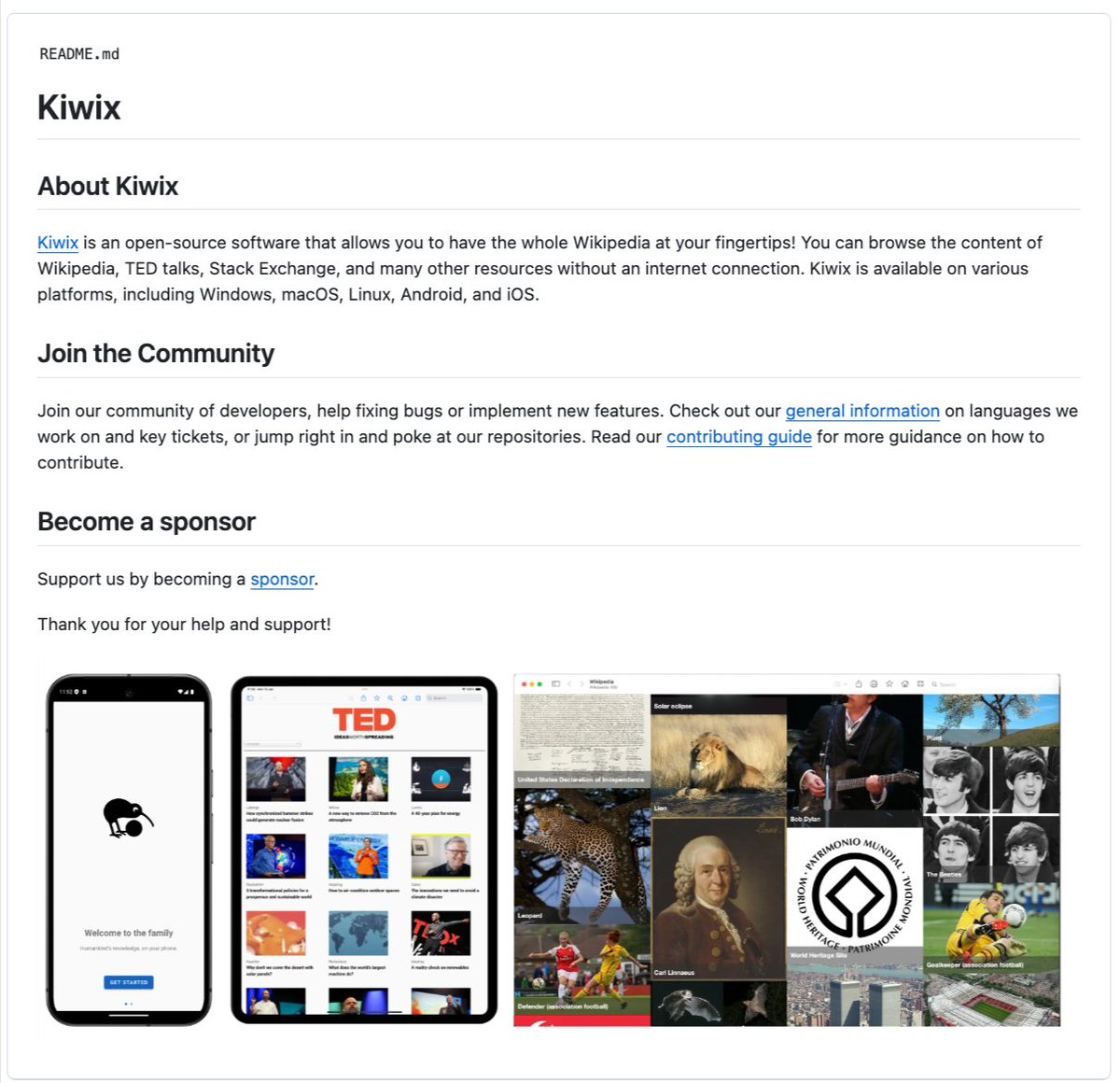
The software that makes those sticks work is called Kiwix. A Swiss developer named Emmanuel Engelhart wrote it in 2007 in Lausanne because four billion people on Earth cannot read Wikipedia. Nineteen years later he is still shipping. Mostly unpaid.
The repo:
→ 5,613 stars across the org
→ GPL-3.0 licensed
→ 100 languages
→ 4 million users worldwide
How it compares:
ChatGPT Plus → $240/yr, online only, blocked
Britannica → $74.95/yr, online only, blocked
Kiwix → $0, offline, works anywhere
You download one file. 109 gigabytes. It fits on a $12 USB stick. That stick now contains roughly a thousand years of human knowledge.
Here is the wildest part:
The Wikimedia Foundation reported in 2018 that 80% of Kiwix users were in emerging countries. North Korea bans the internet but they cannot ban a USB stick already inside the country. In Cuba, vendors sell weekly Wikipedia updates for one dollar. The Foundation called it "connecting the unconnected."
Engelhart's mission, written in a 2014 email:
"Our users are sailors on the oceans, poor students thirsty for knowledge, world's citizens suffering from censorship or free minded prisoners."
The honest part: 109 GB of disk space. UI looks like 2010. Updates every few months, not real time. And every byte is Creative Commons or public domain. Zero piracy. Zero DMCA risk.
Lausanne, Switzerland. One Swiss developer. Every human library, in your pocket, even when the lights go out.
3
3
290
Solarpunk SΞΞD 🌱 d/acc retweeted

May 22
Figure just turned 4 years old
The ride so far has been surreal, and I wanted to share my perspective on what’s happened over the last four years
When I started Figure, the core technologies were still extremely nascent. Humanoid hardware was heavy, hydraulic, unsafe, expensive, and unreliable. Deep learning also wasn’t there yet - there was no real AI precedent and no clear path to building a truly general-purpose robot
My expectation was always that humanoid robotics would become the largest industry in the world, but that it would take a very long time to put all the hardware and AI pieces together
Honestly, I assumed it would take 20 years just to have a real shot at solving general robotics - decades before we could seriously attempt to build iRobot in real life
Instead, everything has moved much faster than I ever expected. Figure has gone through 4 major breakthroughs that probably accelerated our timeline by a decade:
> Cheap electric humanoid robots are now possible. There are many reasons for this but some include benefits from actuator torque density, sensor technologies, battery specific energy, high flop/memory onboard compute, and high-rate manufacturing techniques all helped significantly. At this point, we’ve largely de-risked the hardware side and it’s becoming a straightforward engineering problem (highly difficult engineering but tractable)
> Deep learning from camera pixels to torques actually works. The dimensionality of a humanoid robot is simply too high for hand-written code. You have 40 motors that can rotate continuously, creating more possible robot body states than atoms in the universe. There is no path to building a truly general-purpose robot with heuristics and manually programmed C logic. This has to be AI-first, and Helix has now demonstrated that repeatedly
> Whole-body RL control changed everything. It’s what keeps the robot balanced, allows it to use stairs, move its arms, and coordinate its entire body through the world. We train these controllers entirely in GPU-accelerated physics simulation using reinforcement learning. The robustness is far beyond anything we ever achieved with hand-written heuristics. This fundamentally breaks the old thesis that walking robots are inherently too hard or too unstable to scale
> These robots can now perform useful human-like work at human-level speeds. This is an insanely hard problem because humans perform millions of different tasks in the real world - and Figure has to do this with 1 hardware platform in a general purpose architecture. btw, yesterday Figure completed a logistics use case running continuously for 200 hours without a failure - all with scalable hardware and internal AI models
The future is starting to feel very real
We have a real chance to build iRobot in real life - the good version
Thank you for everyone's support. Pedal to the metal

105
143
1,658
49,780
Solarpunk SΞΞD 🌱 d/acc retweeted

AI consciousness is the wrong debate. The bigger one was settled when we decided companies count as people.
May 21

.@EMostaque's answer to "are these AIs conscious?" took a turn I didn't expect.
He flipped the question.
We already have conscious artificial intelligences with legal personhood. They're called corporations. They open bank accounts. Wyoming DAO legislation already lets autonomous AI entities exist without humans.
Full epsiode on @opencommonspod : youtu.be/oopwD8yoYqQ?si=mI-w…
1
3
3
502
Lush cities of community & creation~*
What sorts of things do you dream of being able to stroll to and freely access?
#solarpunk #postcapitalism #localism #urbanfarming #ai
1
3
99
Happening Now!
The Festival of Wild & Kind Ideas
20-25 May • Free & online
A 6-day festival featuring 40 inspiring thinkers, educators, designers, artivists & doers – all inspiring connection, humanKINDness and regeneration.
permacultureeducationinstitu…
3
2
99

Check out Hylo's 2026 Strategic Plan! We are excited to come full circle and focus on one of our original goals for Hylo: activating (bio)regional resilience networks, with a focus on mutual aid tools. This is a preview of a longer Whitepaper coming soon. docsend.com/view/ys2pgzvzm82…
1
2
2
102
Solarpunk SΞΞD 🌱 d/acc retweeted

May 14
Final forms of 3 new papers! #consciousness #selforganization #cognition #economics and more
royalsocietypublishing.org/r…
royalsocietypublishing.org/r…
royalsocietypublishing.org/r…
20
93
395
26,610
Solarpunk SΞΞD 🌱 d/acc retweeted

Cities will be better once all cars are electric and autonomous - quieter and safer.
And even better once most roads are underground, with asphalt replaced by parks and playgrounds.
Nature will return to cities.
We will be living in gardens.
15
9
116
6,248
Solarpunk SΞΞD 🌱 d/acc retweeted

May 12
Ma Earth is opening up applications for its third funding round, with $500,000 in matching funds for up to 100 grassroots nature projects worldwide. Join our information session tomorrow to learn more and see if your project is a good fit.
May 12 at 4pm EDT
luma.com/maearth3.2
We'll send out the recording afterwards to RSVPs. 🌎
8
12
34
3,072
Can we make it to Star Trek without going through WW3?🖖
youtube.com/watch?v=IY9KJ5nn…
1
119
Kara visits Wildtype, a food startup based in a repurposed brewery in San Francisco, to see the process of creating lab-cultivated salmon, to explore its potential impact on sustainability and longevity, and to taste test it.
youtube.com/watch?v=iFb8MncO…
1
162
Solarpunk SΞΞD 🌱 d/acc retweeted

Apr 22
Great move!
Apr 21

The EU just declared war on glued-in batteries.
From February 18, 2027, every smartphone and tablet sold in Europe must have a battery you can swap yourself. No heat gun. No solvents. Just normal tools any person can buy. Article 11 of the EU Batteries Regulation makes it law.
There’s a loophole, naturally. Phones that clear certain waterproofing and battery longevity thresholds can skip end-user replaceability, as long as a professional can still do it. Apple’s lawyers are already reading that sentence very carefully.
Samsung may actually be ahead of the curve. Recent Galaxy models already use pull-tab adhesives, which could put them close to compliant without a redesign.
The era of “sorry, that’s not a serviceable part” is ending. In Europe, at least.

2
6
686