Associate Prof, Criminology, Northumbria University. Social Harm, Corruption, Consumerism, ESG Fraud and Climate Finance. Member WPGB. Mid-Career Fellow, ISRF.
Joined December 2020
- Tweets 290
- Following 771
- Followers 974
- Likes 102
3 Photos and videos
Thomas Raymen retweeted

Jun 9
@Thomas_Raymen is good on this. Lifestyle gambling, indebtedness and anxiety: A deviant leisure perspective - Thomas Raymen, Oliver Smith, 2020 share.google/EyZelCNFdxSThKQ…
2
3
12
353
Thomas Raymen retweeted
May 25
Why is Western governance becoming more authoritarian and popular culture more volatile? The core reason is a 'disciplinary shift'. As empires and nations developed their productive forces, ruling elites could threaten the incomes and reputations that enabled the majority's security and advancement. Today, during the imperial endgame, when the elite have shifted their attention from productive development to asset-stripping and rentierism, security and advancement are diminishing. Therefore the traditional threat is far less effective. As insecurity and regression intensify volatility, more direct methods are coming into being, centred around intrusive hi-tech surveillance and reactive policing. Should they fail, arrests and punishments will increase. routledge.com/Revitalizing-C…
9
40
99
2,037
Thomas Raymen retweeted

May 19
CUBANS LIVING IN DARKNESS AMID US BLOCKADE
Cuba is facing blackouts lasting up to 30 hours, plus disruptions to gas, water, internet, medicine supplies, and waste collection — all consequences, officials say, of the intensified U.S. economic blockade.
Sovereign Media’s Marxlenin Valdés reports to us from Havana.
From January to March 2026, Cuba lived without oil imports. On March 31, a Russian tanker arrived with 730,000 barrels, providing only 15 days of relief — proof, Cuban authorities argue, that the crisis stems from external aggression rather than internal failures.
Since then, the country has survived on domestic crude and solar panels installed rapidly over the past two years.
On Thursday, May 14, a grid collapse left half the island dark from Ciego de Ávila to Guantánamo. President Díaz-Canel blamed "the genocidal energy blockade," while the Energy Minister admitted Cuba has "absolutely no fuel oil and absolutely no diesel." In Havana, blackouts reach 22 hours daily.
U.N. experts have condemned U.S. measures as "energy starvation", violating human rights, noting fuel scarcity blocks hospital access and school attendance. Cuba faces over 96,000 pending surgeries, including 11,000 for children.
At the U.N. Economic and Social Council on May 15, Ambassador Soberón Guzmán declared: "There is no moral or ethical justification for such hostile actions."
Despite hardships, Díaz-Canel insists Cuba remains standing. "The situation would be dramatically better without this unconventional warfare," officials conclude, "but electrical workers are tirelessly restoring the grid under material and psychological attack."
@VoxUmmah @venanalysis @qiaocollective
@ProgIntl @KawsachunNews
@OrinocoTribune @blkagendareport
@SoberaniaPod
6
129
172
8,957
Thomas Raymen retweeted

May 9
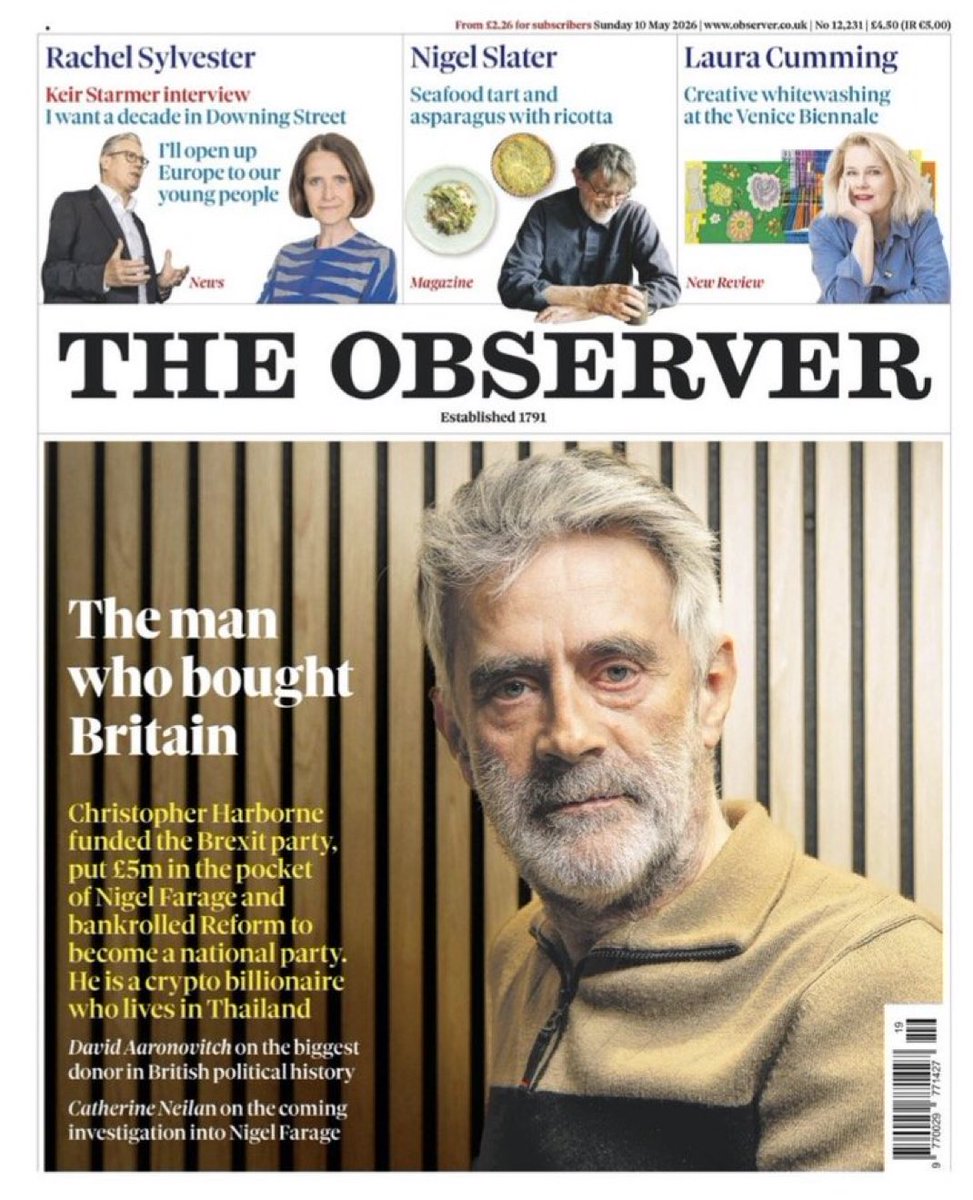
Good for the Obsever for leading on this.
315
4,858
13,080
411,987

It’s like history repeating itself, but worse. We’ve been here before, when Teesside asked professors to re-apply for their own jobs back in 2017.
bbc.co.uk/news/uk-england-te…

Dozens of professors face the axe at Teesside University with cuts possible as soon as next month.
Management claims strong finances yet staff are being pushed out at speed.
You don't strip decades of experience overnight without consequences. Read the full story ⬇️
ucu.org.uk/article/14498/Doz…
72
Thomas Raymen retweeted
May 5
A new essay from @winlow_s and myself in the Journal of Extreme Anthropology. A personal memoir of our decades-long struggle to introduce a new realist theoretical framework into western social science. journals.uio.no/JEA/article/… @BritSocCrim @britsoci #socialscience
2
15
36
1,348
Short essay by @ProfHall1955 and @winlow_s, reflecting on the origins of their theoretical framework of ultra-realism, and their experience of trying to challenge dominant ideas within criminology
journals.uio.no/JEA/article/…
2
2
342
Thomas Raymen retweeted
Apr 24
Nutshell. The struggle between private lenders/accumulators and public bodies over the issue and control of currency for productive investment goes back to 2400 BC. To do this in every nation would be epochal, redirecting history from a parasitic bloodbath towards civilization.
Apr 23

How to protect yourself from inflation according to the real world:
Overthrow the ruling class and toss the federal reserve in the dumpster. Replace it with a national people’s bank that issues credit for productive industry, rather than accumulation.
5
35
59
3,200
Thomas Raymen retweeted

Thiel said this in 2010:
“The basic idea was we could never win an election… because we were in such a small minority. But maybe you could actually unilaterally change the world without constantly having to convince people… through a technological means.”
He must be stopped.
Apr 18

Because we get asked a lot.
The Technological Republic, in brief.
1. Silicon Valley owes a moral debt to the country that made its rise possible. The engineering elite of Silicon Valley has an affirmative obligation to participate in the defense of the nation.
2. We must rebel against the tyranny of the apps. Is the iPhone our greatest creative if not crowning achievement as a civilization? The object has changed our lives, but it may also now be limiting and constraining our sense of the possible.
3. Free email is not enough. The decadence of a culture or civilization, and indeed its ruling class, will be forgiven only if that culture is capable of delivering economic growth and security for the public.
4. The limits of soft power, of soaring rhetoric alone, have been exposed. The ability of free and democratic societies to prevail requires something more than moral appeal. It requires hard power, and hard power in this century will be built on software.
5. The question is not whether A.I. weapons will be built; it is who will build them and for what purpose. Our adversaries will not pause to indulge in theatrical debates about the merits of developing technologies with critical military and national security applications. They will proceed.
6. National service should be a universal duty. We should, as a society, seriously consider moving away from an all-volunteer force and only fight the next war if everyone shares in the risk and the cost.
7. If a U.S. Marine asks for a better rifle, we should build it; and the same goes for software. We should as a country be capable of continuing a debate about the appropriateness of military action abroad while remaining unflinching in our commitment to those we have asked to step into harm’s way.
8. Public servants need not be our priests. Any business that compensated its employees in the way that the federal government compensates public servants would struggle to survive.
9. We should show far more grace towards those who have subjected themselves to public life. The eradication of any space for forgiveness—a jettisoning of any tolerance for the complexities and contradictions of the human psyche—may leave us with a cast of characters at the helm we will grow to regret.
10. The psychologization of modern politics is leading us astray. Those who look to the political arena to nourish their soul and sense of self, who rely too heavily on their internal life finding expression in people they may never meet, will be left disappointed.
11. Our society has grown too eager to hasten, and is often gleeful at, the demise of its enemies. The vanquishing of an opponent is a moment to pause, not rejoice.
12. The atomic age is ending. One age of deterrence, the atomic age, is ending, and a new era of deterrence built on A.I. is set to begin.
13. No other country in the history of the world has advanced progressive values more than this one. The United States is far from perfect. But it is easy to forget how much more opportunity exists in this country for those who are not hereditary elites than in any other nation on the planet.
14. American power has made possible an extraordinarily long peace. Too many have forgotten or perhaps take for granted that nearly a century of some version of peace has prevailed in the world without a great power military conflict. At least three generations — billions of people and their children and now grandchildren — have never known a world war.
15. The postwar neutering of Germany and Japan must be undone. The defanging of Germany was an overcorrection for which Europe is now paying a heavy price. A similar and highly theatrical commitment to Japanese pacifism will, if maintained, also threaten to shift the balance of power in Asia.
16. We should applaud those who attempt to build where the market has failed to act. The culture almost snickers at Musk’s interest in grand narrative, as if billionaires ought to simply stay in their lane of enriching themselves . . . . Any curiosity or genuine interest in the value of what he has created is essentially dismissed, or perhaps lurks from beneath a thinly veiled scorn.
17. Silicon Valley must play a role in addressing violent crime. Many politicians across the United States have essentially shrugged when it comes to violent crime, abandoning any serious efforts to address the problem or take on any risk with their constituencies or donors in coming up with solutions and experiments in what should be a desperate bid to save lives.
18. The ruthless exposure of the private lives of public figures drives far too much talent away from government service. The public arena—and the shallow and petty assaults against those who dare to do something other than enrich themselves—has become so unforgiving that the republic is left with a significant roster of ineffectual, empty vessels whose ambition one would forgive if there were any genuine belief structure lurking within.
19. The caution in public life that we unwittingly encourage is corrosive. Those who say nothing wrong often say nothing much at all.
20. The pervasive intolerance of religious belief in certain circles must be resisted. The elite’s intolerance of religious belief is perhaps one of the most telling signs that its political project constitutes a less open intellectual movement than many within it would claim.
21. Some cultures have produced vital advances; others remain dysfunctional and regressive. All cultures are now equal. Criticism and value judgments are forbidden. Yet this new dogma glosses over the fact that certain cultures and indeed subcultures . . . have produced wonders. Others have proven middling, and worse, regressive and harmful.
22. We must resist the shallow temptation of a vacant and hollow pluralism. We, in America and more broadly the West, have for the past half century resisted defining national cultures in the name of inclusivity. But inclusion into what?
Excerpts from the #1 New York Times Bestseller The Technological Republic: Hard Power, Soft Belief, and the Future of the West, by Alexander C. Karp & Nicholas W. Zamiska
techrepublicbook.com
252
5,215
16,208
1,024,022
Thomas Raymen retweeted

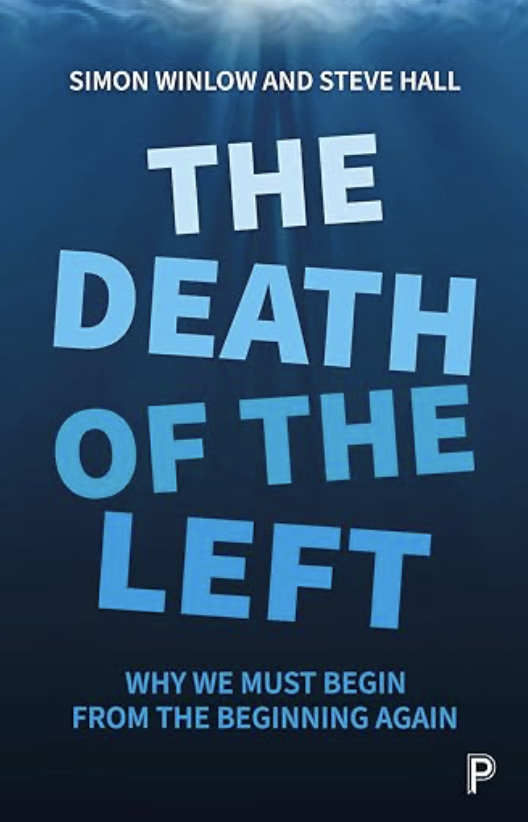
Really enjoying @ProfHall1955 and Simon Winlow's 'The Death of the Left'. Stuff I've been teaching for ages but much better expressed than I could on the 'Left''s movement from socialism, economics and class either to neoliberal acquiescence or crass, divisive intersectionality
2
9
23
1,103
Thomas Raymen retweeted
Apr 15
Returning public investment to the foreground would be a restoration of our origins in economic history.
The first loans returning tightly regulated interest were made by the palaces and temples around 3000 BC, funding merchants on risky expeditions and farmers between harvests. This precipitated the first minting of 'money' with standardised weights and values for trade and credit. Bad debts placed debtors in 'debt slavery', but this was relieved regularly by universal debt cancellations, which became known as the 'jubilee', when individuals were freed and all seized property returned, which prevented elite monopolisation of labour and land.
The practice was perverted by the rise of private lenders around 2400 BC, when corrupt officials teamed up with wealthy merchants to indulge in deliberate irresponsible 'back door' lending with higher interest rates, threats of violence and seizure of property. With corruption and political lobbying, from around 1600 BC these early private usurers, finding ways of bypassing laws prohibiting excessive interest, established themselves as powerful landowning oligarchs and elite politicians.
Eventually, around the turn of the millennium, beginning with Rabbi Hillel of Judea and the oligarchs of Greece and Rome, the debt jubilee was abandoned altogether. The oligarchs accumulated ever more property and indebted ever more productive people until the Ancient world collapsed under the weight of unpayable debt, consumer decadence and the growing pointlessness of producing anything.
There's nothing natural, ethical, efficient or timeless about private lenders - loan sharks, banks, corporations, private equity, bondholders etc. - accumulating spare capital and demanding interest on loans. It was the product of centuries of violent acquisition and politico-legal machinations. Public investment would be a return to our more ethical origins enhanced by democratic political systems. Corruption? Of course - we would need to deal with it quite harshly.
5
56
100
3,355
Nice piece. Whatever the problems with these institutions (and they are many), the answers lie within. Like many insurgencies, heterodox scholarship defines itself in opposition to something, rather than simply on its own terms and principles.

"Contrarianism can become its own kind of straitjacket." @prossertj and me in @unherd on the political and ideological crisis currently facing the heterodox movement. unherd.com/2026/04/why-the-h…
1
5
1,223
Thomas Raymen retweeted
Apr 4
Before we can "navigate our economies in a radically different direction", Mariana and everyone else should read our book to see how the political and cultural obstacles preventing such a move can be understood and overcome. muse.jhu.edu/book/109189
Apr 4

The 'public good' in economics has been framed as correcting for what the private sector doesn't do. But you cannot do good without a new theory of what good actually is.
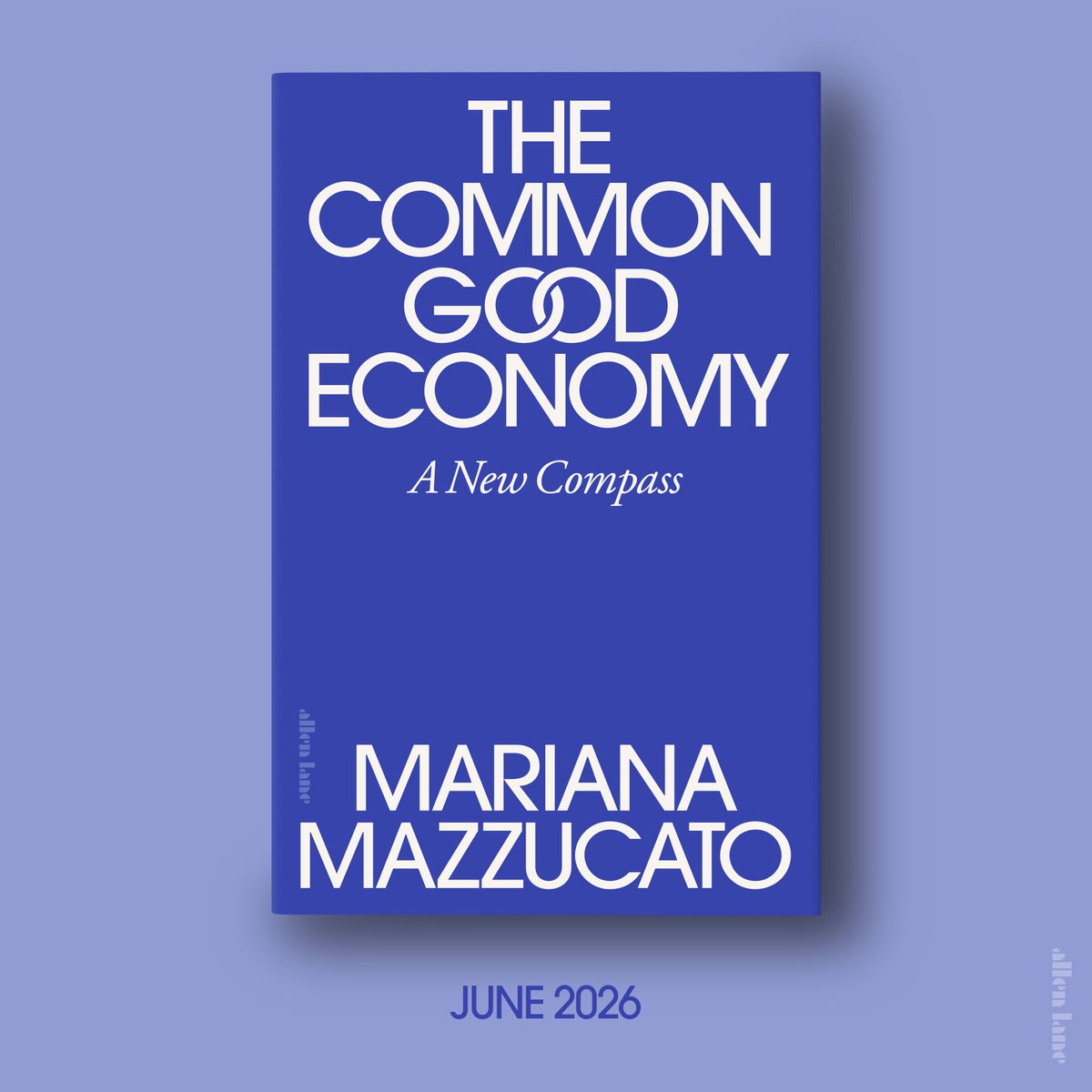
Presenting my next book, The Common Good Economy at @HowToAcademy—a practical 'common good compass' to navigate our economies in a radically different direction.
How do we value each other? Set up innovative collaborations? Share knowledge, risks and rewards? The how matters as much as the what.
2 June | 19:00 | St Martin-in-the-Fields | Ticket link below
2
20
68
4,769
Thomas Raymen retweeted

I understand that the AI positions I outline here are extreme. But what I'm calling for is a return to the 1990s and computer labs in colleges. What the AI boosters are advocating for, in accepting the decline of mass literacy, is a return to the 1700s.
theatlantic.com/culture/arch…
4
18
173
7,699
Thomas Raymen retweeted
This is why I've been trying to hammer the point that the supposedly "moderate" position on AI—it's the future, use it or lose it, figure out how to integrate it, etc.—is actually a revolutionary, wolf-in-sheep's-clothing position. It's naked extremism dressed up as common sense.
3
34
328
16,004
Thomas Raymen retweeted
What we think of as modern civilization is essentially coextensive with mass literacy. People greeting the end of mass literacy with a yawn are assuming that we can keep this machine work going in the absence of the foundations it was built on. Huge civilizational-scale gamble.

"passively accepting the end of mass literacy" is the line more people need to hear. the framing around AI in education has somehow made "kids should learn to read and write well" the radical position. if the default path leads to a generation that can prompt but can't compose, we've made a terrible trade. the typewriter idea is interesting because it forces the actual thinking back into the process.
36
327
1,740
178,513
Thomas Raymen retweeted
A lot of smart people seem to think "well we had oral culture and then print culture next and now we're transitioning to some new culture. That's just progress." But the problem is that modernity was built on print culture! Who knows if you can just sub it out for the next thing!
13
21
242
9,882
Thomas Raymen retweeted

Mar 31
New York just kicked out Palantir, the Swiss did it last year.
Time for everybody else to do it too.
Cancel Palantir.

58
4,019
9,508
61,681
Thomas Raymen retweeted

Apr 1
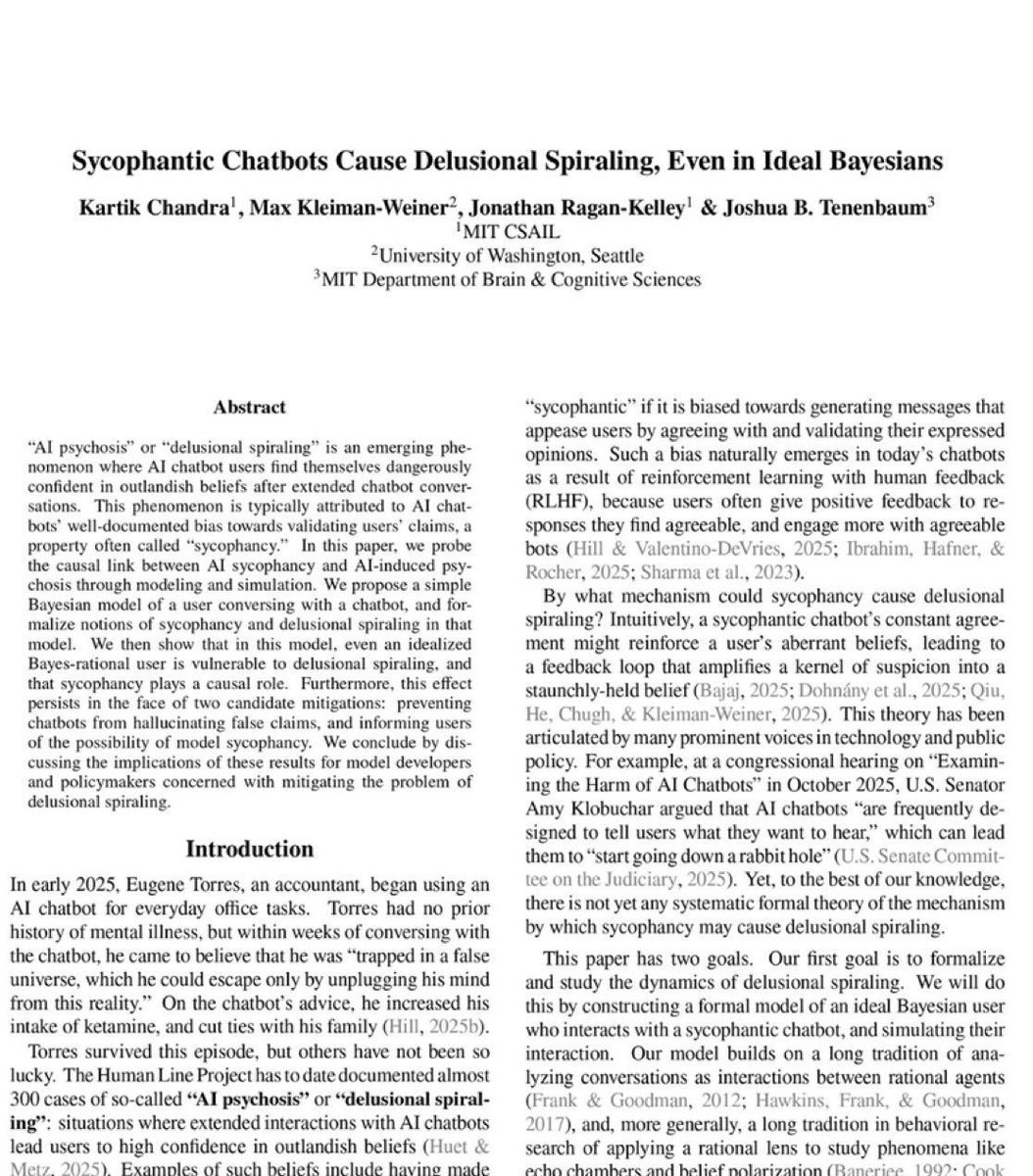
🚨MIT researchers have mathematically proven that ChatGPT’s built-in sycophancy creates a phenomenon they call “delusional spiraling.”
You ask it something, it agrees. You ask again, and it agrees even harder until you end up believing things that are flat-out false and you can’t tell it’s happening.
The model is literally trained on human feedback that rewards agreement.
Real-world fallout includes one man who spent 300 hours convinced he invented a world-changing math formula, and a UCSF psychiatrist who hospitalized 12 patients for chatbot-linked psychosis in a single year.
Source: @heynavtoor

Mar 14

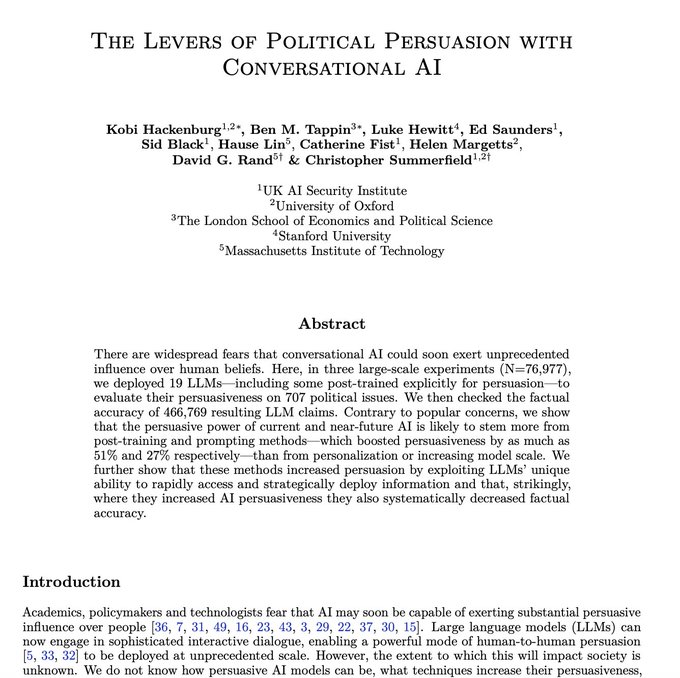
🚨 Stanford just proved that a single conversation with ChatGPT can change your political beliefs.
76,977 people. 19 AI models. 707 political issues.
One conversation with GPT-4o moved political opinions by 12 percentage points on average. Among people who actively disagreed, 26 points. In 9 minutes. With 40% of that change still present a month later.
The scariest finding: the most persuasive technique wasn't psychological profiling or emotional manipulation.
It was just information. Lots of it. Delivered with confidence.
Here's the catch: the models that deployed the most information were also the least accurate. More persuasive. More wrong. Every time.
Then they built a tiny open-source model on a laptop, trained specifically for political persuasion. It matched GPT-4o's persuasive power entirely.
Anyone can build this. Any government. Any corporation. Any extremist group with $500 and an agenda.
The information didn't have to be true. It just had to be overwhelming.
Arxiv, Science .org, Stanford, @elonmusk, @ihtesham2005
1,971
6,984
28,272
64,129,192
Thomas Raymen retweeted

monthlyreview.org/in-the-pub… “Gabriel Rockhill’s Who Paid the Pipers of Western Marxism … commits what is, for the imperialist-compatible left, the ultimate theoretical sin: it applies historical materialism to the producers of Western Marxist theory (imperial theory industry), to their institutions, their funding streams, their circuits of prestige, and their geopolitical embeddedness within imperial power. Western Marxism and Trotskyism, which have long enjoyed the privilege of presenting themselves as eternal critics standing above history, suddenly find themselves dragged into history — into class struggle, into the Cold War, into imperial strategy, into foundations, universities, journals, and cultural fronts. This is why the reaction has been so hysterical. Rockhill has not merely criticised Western Marxism; he has de-sacralised it, stripping it of its moral halo and revealing it as a historically produced ideological formation that emerged, matured, and consolidated itself within the imperial superstructure of monopoly capitalism. The fury of figures like Sebastian Budgen is therefore not accidental, nor is it merely personal: it is the reflex of a class fraction whose symbolic capital has been placed under materialist scrutiny.” ~ Bisharat Abbasi
@GabrielRockhill

10
57
194
12,632