
‘AppliedAI’ in Deep tech, Health tech, & New economy // Helping great entrepreneurs build 'century-defining' technologies & businesses.
Joined January 2022
- Tweets 212
- Following 433
- Followers 623
- Likes 1,459
5 Photos and videos



Triatomic Capital retweeted

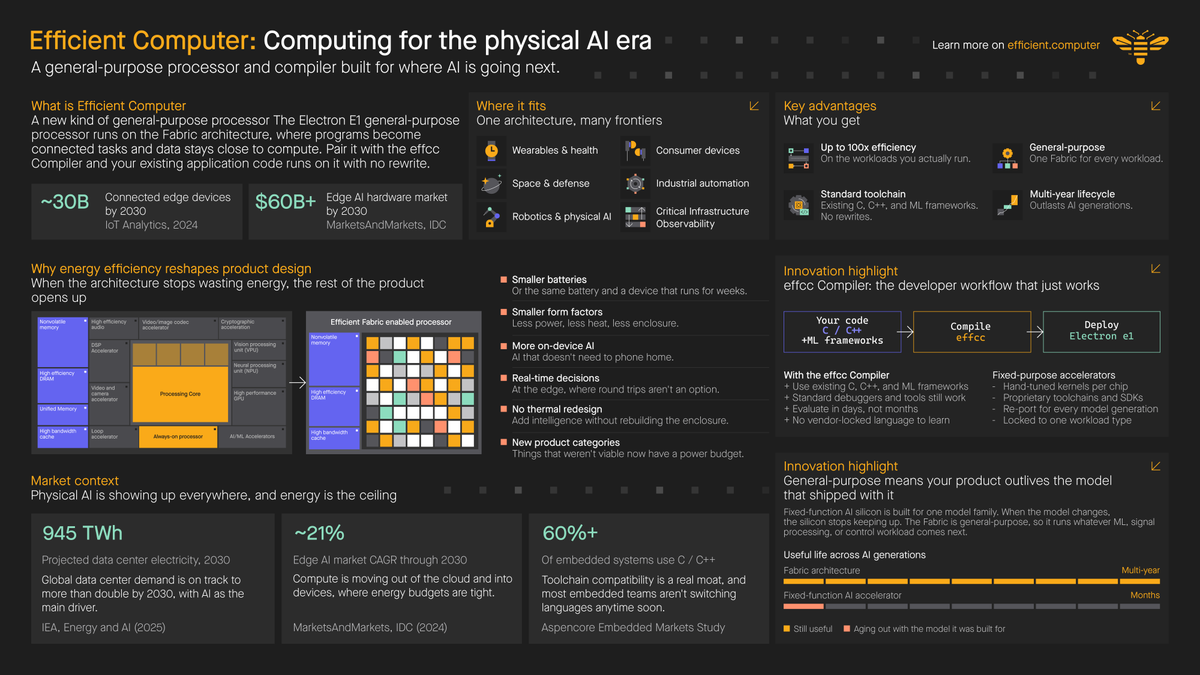
When architecture’s stops wasting energy, the rest of the product opens up. Smaller batteries. More on-device AI. Fewer thermal constraints. New product categories that weren't viable before.
That's what the Electron E1 general-purpose processor is built for.
Learn more: efficient.computer
#EfficientCPU #ElectronE1 #FabricArchitecture
3
3
127
Triatomic Capital retweeted

Jun 9
Corsair is entering full production! Congratulations to our partner d-Matrix on the milestone.
Jun 9

Corsair™ is now in full production.
Products are beginning to ship in volume to priority hyperscalers, neoclouds, and frontier AI labs.
Thanks to our ecosystem partners TSMC, @AristaNetworks, @Broadcom, @Supermicro, @gimletlabs, and @AlchipTECH for helping make this milestone possible.
Read more:
d-matrix.ai/announcements/d-…
#AIInference #AIInfrastructure #HeterogeneousCompute #DataCenterAI #Corsair

1
4
153
Triatomic Capital retweeted

Jun 3
I'm looking for a psychotic ex-founder to work alongside me for 16 hours a day and live above the conference room as my Chief of Staff
We're scaling team past 50 and we're the best capitalized robotics software / OS in the world
DM me a video about why you need this role
7
5
103
80,500
Triatomic Capital retweeted
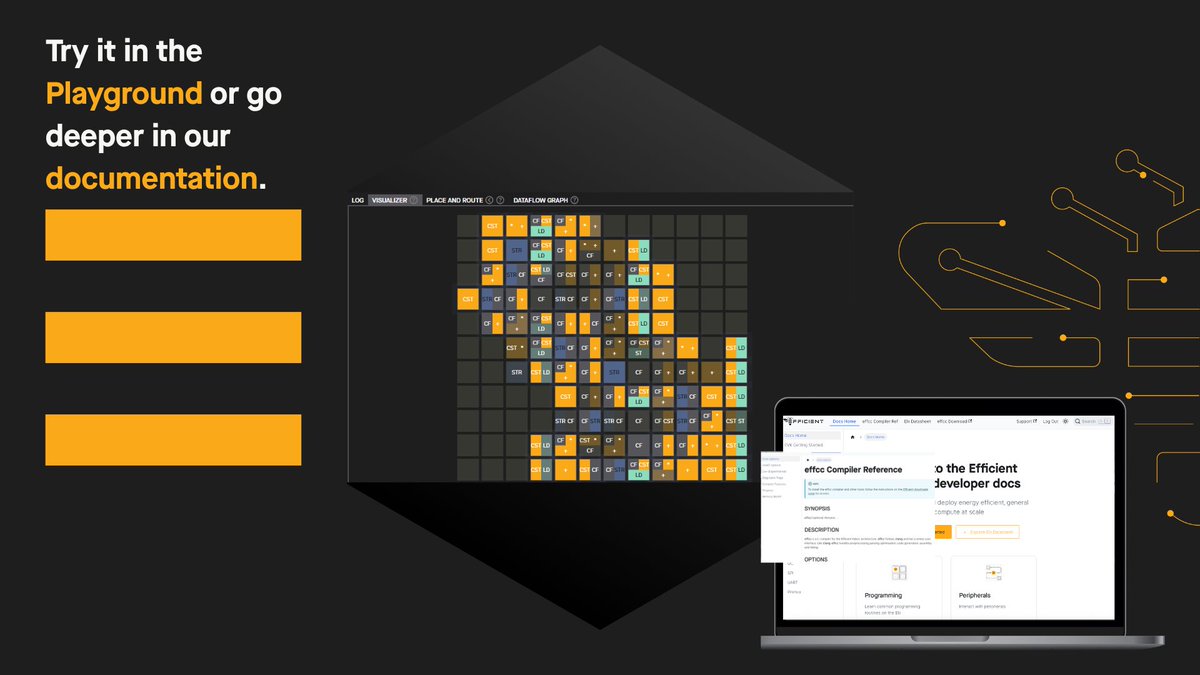
Evaluating a new processor architecture usually means weeks of setup before you see a single real result. We built the effcc Compiler and the Electron E1 EVK to fix that.
The effcc Compiler drops into the toolchain you already use and adds the energy efficiency you've been looking for. No rewrites. No new programming model. Just drop your existing C and C code and ML frameworks into the effcc Compiler and run them on the Electron E1 general-purpose processor, built for the extreme edge.
Try it in the Playground or go deeper in our documentation.
Playground: ow.ly/tPyX50Z7O1z
Documentation: ow.ly/eSM050Z7O1x
#EfficientCPU #ElectronE1 #FabricArchitecture #EdgeEfficiency
2
2
96
Triatomic Capital retweeted

Jun 5
Not a real robotics map unless it includes DimensionalOS:
x.com/dimensionalos
github.com/dimensionalOS/
dimensionalos.com/
@stash_pomichter
2
17
7,818
Triatomic Capital retweeted
Jun 5
“…at Manifold Bio, the pace of these discoveries is accelerating and we’re about to sweep through many more of the grand challenges in medicine.”
Love @ManifoldBio, and the AI x Bio impact they’re driving with ultra high throughput in-vivo development. AI x Bio really only works with real-world reinforcement loop (RL) data.
Go @glebkuz, @PierceOgdenJ & Team!
Jun 5

Last week, I was invited to present at @AnthropicAI'e Boston Tech Week event.
Since the Claude Code moment at the end of last year, the way we do science at @ManifoldBio made a quantum leap overnight. But really, it just came full circle.
Manifold was founded by “hybrid scientists” and most of our first few hires could and did both code and do wet lab experiments. This was critical to invent and build the foundational molecular barcoding tech that lets us do the million-scale experiments no one else in the world can do, including interrogating drug candidates directly in vivo.
Soon, the form of most of the data generated at Manifold became next-gen DNA sequencing data. (At the Anthropic forum, I live vibe-analyzed a summary that showed we’ve now done 525 NGS runs generating over 70 tera-bases — 10,000 human genomes worth).
Engineering biology through this NGS lens is both a feature and a challenge. A feature, because this is how Manifold unlocks massive parallelism (a.k.a. GPU-ification of biology). A challenge, because for many scientists this was the first time they couldn’t easily analyze their own data, and became bottlenecked by a dedicated computational counterpart to help turn around insights, which still took weeks.
Over night, that bottleneck has evaporated, aided by a strong data integration layer and an agentic interface we’ve built on top.
Once again, everyone at Manifold Bio has become a hybrid scientist, just in time as the in vivo engine has achieved both scale and richness that have not been possible before.
Even before this, we had already started making immensely valuable discoveries, including shuttles exploiting novel portals to deliver medicines to the brain – a high value problem that led to our first landmark deal with Roche last fall.
Now that the loop is closed for scientists (and agents) at Manifold Bio, the pace of these discoveries is accelerating and we’re about to sweep through many more of the grand challenges in medicine.
Thanks again to the Anthropic team for the opportunity.
10
1
27
2,816

With an accessible chemical
space exceeding 10^100, Chemify is on the brink of Artificial General Chemical Intelligence AGCI. Find out more chemify.io
3
16
1,970
Triatomic Capital retweeted
May 31
1/5 When your AI pair programmer starts making sh*t up (or, 'That time that Claude lost his mind')
I built “Code Mower” – an AI coding harness with Claude Code Codex coding as peer programmers and reviewing each other before anything merges. It was ridiculously productive on my hobby coding project. Then Friday night Claude invented a full-on fake prompt-injection attack and asked me to act on it.
21
1
40
8,333
Triatomic Capital retweeted

May 28
What if your next coding session happened through conversation instead of an IDE?
At d-Matrix, we’re building the infrastructure behind low-latency speech-to-code experiences with heterogeneous AI pipelines and optimized accelerators.
Read what’s next for multimodal AI: d-matrix.ai/building-apps-on…
1
3
268
Triatomic Capital retweeted
May 28
If foundational AI models want to "figure out biology" – the fastest way to get there is with a ultra-high-throughput reinforcement learning (RL) loop that works in-vivo (aka as close to human biology as possible).
@ManifoldBio is the way – it's the real-life RL loop for biology.
May 28
Thanks @jhuber
In addition to advancing the core mission of improving human health, the type of biology we do at @ManifoldBio is uniquely iterative/perturbative in nature and fascinating substrate for connecting AI to the real world.
6
7
72
10,106
Triatomic Capital retweeted
May 28
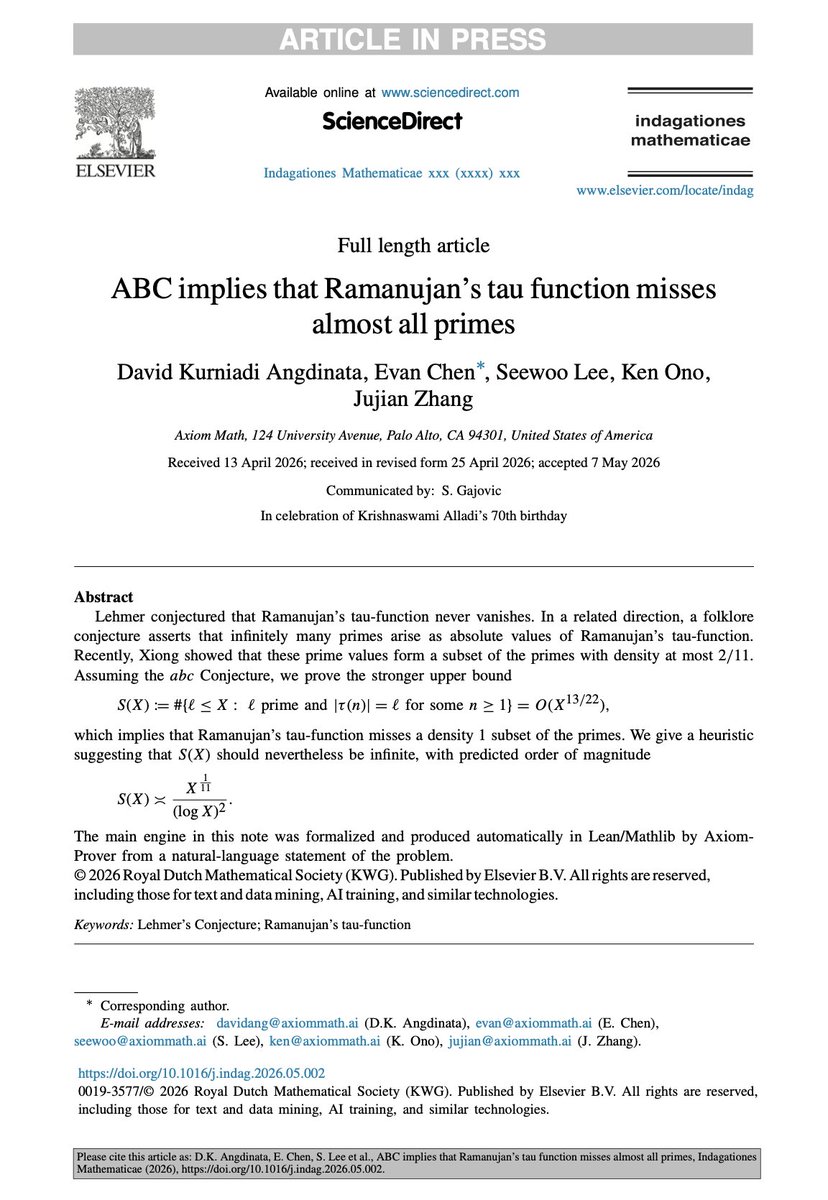
Very impressive progress on math, by @axiommathai.
Go @CarinaLHong & Team!
May 27

1/ Since February, 8 papers across algebraic geometry, representation theory, number theory, combinatorics have been quietly appearing on arXiv.
Proofs by AxiomProver.
5 papers are now accepted at solid peer-reviewed math journals. To our knowledge, a first for the literature.
12
2
23
1,869
Triatomic Capital retweeted
May 28
For great AI/ML/software engineers – What's your next chapter?
There's life beyond micro-optimizing click-through-rates or cleverly shaving pennies out of a hedge trade.
AI can & will have a massive impact on curing deadly diseases, saving lives, and extending quality of life for the planet. You could (& should) be a part of it. This is a golden age of AI; the future is being created now. Don't waste your precious life and potential on things that won't matter.
There are many noble options, but @ManifoldBio and the opportunity to work with @GlebKuz & @PierceOgdenJ is one of the best.
May 14
The best place to do it would be somewhere generating diverse data with high throughput, low latency (~week scale), and deep relevance to living biological systems. That place is @ManifoldBio.
We recently opened up 4 new AI roles, and we are adding an RL-focused role soon:
manifold.bio/careers
9
5
45
12,344

May 28
We're proud to back @SGRodriques and Edison Scientific (@EdisonSci) in their mission to solve biotech’s biggest bottleneck: scaling scientific talent.
In a new Gradient Descent interview, Sam (CEO/Co-Founder) details how Edison’s specialized AI agents are transforming the biopharma pipeline:
🔬 End-to-End Discovery: Their multi-agent platform, Kosmos, executes full-loop scientific reasoning – from hypothesis to data analysis.
🧬 Validated Impact: The system recently discovered a novel therapeutic approach for macular degeneration, which was successfully validated in the lab and published in Nature.
📈 High-Throughput R&D: Kosmos enables researchers to process data and generate tens of thousands of actionable findings at an unprecedented scale.
While AI accelerates discovery, Sam also highlights the next critical hurdle: modernizing clinical trials to match this new pace of innovation.
Watch:
youtube.com/watch?v=Q7NpRG2g…
More on Edison Scientific: edisonscientific.com/
May 27

One of my favorite podcast appearances, with @l2k. There is a long history of AI overpromising and underdelivering in biotech and pharma -- why is this time different? Super fun episode.
2
5
1,360

Exclusive: Math AI startup can prove its work axios.com/2026/05/26/axiom-a…
8
9
41
15,349
Triatomic Capital retweeted

May 27
Axiom is growing so fast that there isn't a single desk left at our 6000-sqft office
I've seen exciting things in my career. Nothing compares to the energy of this team
The hiring bar is higher and higher. I believe we have the single best hiring pipeline after OAI/Anthropic 🚀
26
7
439
44,571
Triatomic Capital retweeted
May 27
Gimlet has been named to the @Redpoint InfraRed 100, which honors companies building at the cutting edge of infrastructure.
As data centers transform to meet the immense needs of agentic inference, it is an incredibly exciting time to be building in this space.
Check out our Nasdaq photo, and congratulations to all of the companies featured!

1
5
9
211
Triatomic Capital retweeted

May 27
Coworker (@coworkerapp) launched to the public via self-serve today, giving everyone access to enterprise context-aware AI 82% cheaper. Same frontier models with deeper context and efficient routing. We've been using it at @TriatomicCap for the past few months and love it!
May 27

Today, we dropped the price of enterprise AI by 80%.
Same frontier AI. Same chat, cowork, and code experience.
Just 5x more tokens for the same spend.
Here’s how and why. 👇 Also, we made a video. Please enjoy.
4
2
11
774
Triatomic Capital retweeted
May 28
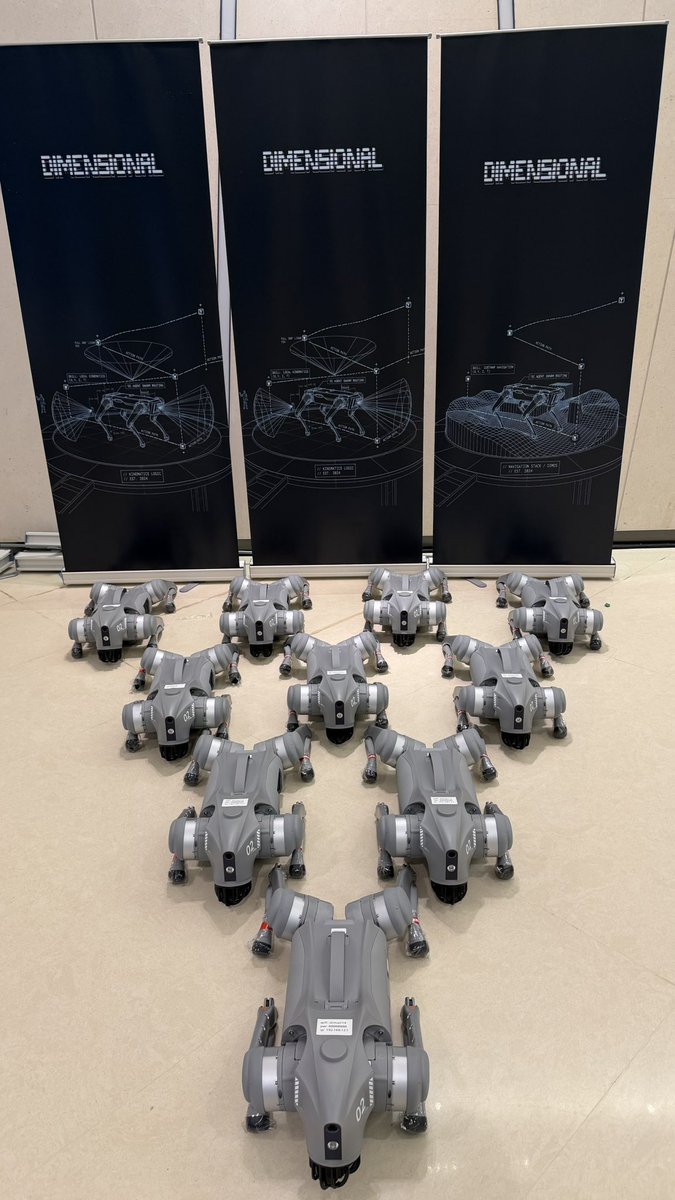
The AgiBot X2 Ultra humanoid, only on Dimensional
Full SLAM, navigation, multi-camera perception, hosted teleoperation, RL training environments, and an agent-native control interface
Developers on DimOS are shipping hundreds of humanoids into production today
Get building 🦾
3
21
112
147,169

The most expensive part of drug development may not be the experiment at all...
The avg drug costs $2.6B to develop
The majority of that cost comes from repetitive work.
> Same analyses
> Same disconnected datasets,
> Same avoidable mistakes.
That’s why the @EdisonSci <> @Incyte partnership will be significant in the future discovery
It’s an 8-figure partnership, but more importantly, it’s not a pilot.
Kosmos is being deployed across Incyte’s full R&D pipeline, from target identification to translational biology to clinical strategy.
Incyte has decades of proprietary data across oncology, hematology, and inflammation.
Kosmos turns that data into something R&D teams can continuously learn from.
Every conclusion traceable back to a specific paper or line of code.
Which means less starting from Zero, and more knowledge compounding!
May 19
We live in a golden age of biology. So why are people still dying from disease?
Because discovery and development move slower than they should.
Today, we’re partnering with Incyte to change that.
Kosmos is now the first agent that can compress months of drug development into weeks, from the earliest stages of scientific discovery through to FDA approval. @Incyte will be the first company to deploy it across their pipeline.
Work that used to take a team of scientists months now happens in weeks.
Patients can't wait, and neither can we.
6
2
29
6,852