
Touching grass. ex head of BD at @Bankless, @myBraavos, @influenceth | Building hangtime.co on the weekends.
Joined November 2021
- Tweets 9,752
- Following 3,382
- Followers 2,809
- Likes 17,377
1,672 Photos and videos














Jun 8
In the era of social media, typical supply and demand is no longer an effective way to measure potential price.
It’s been too easy to manipulate intangible goods for over a decade, but seeing how oil, one of the most structurally important commodities, is trading like a meme stock makes me realize we don’t operate under typical economics anymore.
Curious if anyone has a good book or article that considers the effectiveness of disinformation in the social media age on typical supply and demand economics.
2
2
63
Jun 6
The therapeutic bear


2
113
Jun 5
Buying SpaceX at IPO is going to be one of the worst investments of people’s lives.
Truly generational grift.
Publicly having to buy in at 1.5T is disgusting and disgraceful.
Congrats to the equity holders though, you’ll become instantly part of the ruling class.
1
1
118
Jun 4
Nvidia saw the problem in 1999: "Computing needs will scale exponentially."
Then they spent two decades building GPUs largely for gamers, to keep the lights on.
Then AI took off and their bet finally paid off. Compute became insatiable.
Now institutions, AI, governments, etc. are all falling over themselves to try and buy the next shipment of chips. They simply don't have enough for the demand.
I see Ethereum in a similar light. Meaningful growth over a decade, but has largely been serving a niche customer base (DeFi, degens, trading), compared to the actual TAM of what Ethereum is building: Neutral base layer for software and money.
However, we are starting to see institutions lean in. But the demand curve has yet to hit the inflection point, where the credible neutral, decentralized, base layer and money actually sees the lion share of its value.
1
1
109
May 31
Touching grass is cool and all, but what about wood? Fresh piece hot off the press.
1
1
127
May 29
.@safe has never had a clearer path to revenue growth and token accrual.
Revenue funds product velocity
Shield, Safenet, and Enterprise ship faster
High-TVP customers convert
Safenet usage scales
Validator stake deepens
Security guarantees harden
Token captures the value

Safe is moving from adoption to economic scale.
Q1 showed the smart account standard is not just widely used, but increasingly monetizable.
1
2
142
May 21
In 2019, I started listening to @TrustlessState and his buddy debate philosophy, Bitcoin, and Ethereum.
Then in 2020 Bankless formed, @RyanSAdams joined in, and I was hooked. I went from interested to fully Ethereum-pilled, read everything, listened to everything, and tried to share it with every friend I had.
(Most thought I was crazy)
I knew I wanted to work in crypto. So I wrote down a goal: "Work with Bankless one day."
It took 5 more years in the industry before that chance came. Thanks @shaaa256 for opening the door. I joined in Q3 last year to lead BD, and it's been everything I hoped, going deeper into the industry I love and getting to talk directly with teams building across the space.
Today is my last day at Bankless.
What's next? Not exactly sure yet. I've been going deep on agentic payments, security, trading, and Stablecoins. If you're building in any of those, my DMs are open.
But first: the Puget Sound. Free diving, kayak fishing, hiking, photography, mushroom foraging, live concerts, and finally getting my backyard garden into shape.
"So long and thanks for all the fish" 🐟
8
2
80
39,500
May 18
It will become increasingly obvious that micropayments enabled by x402, MPP, and stablecoins will create a new trillion dollar economy.
A few people are already building apps that could kick it off.
2
3
154
May 14
Read this now.
May 13

I think ambient intents are going to be a big deal.
There are so many intentions we have that would make our lives better, but the cost of surfacing them to a market it too high, so they never become legible to the world.
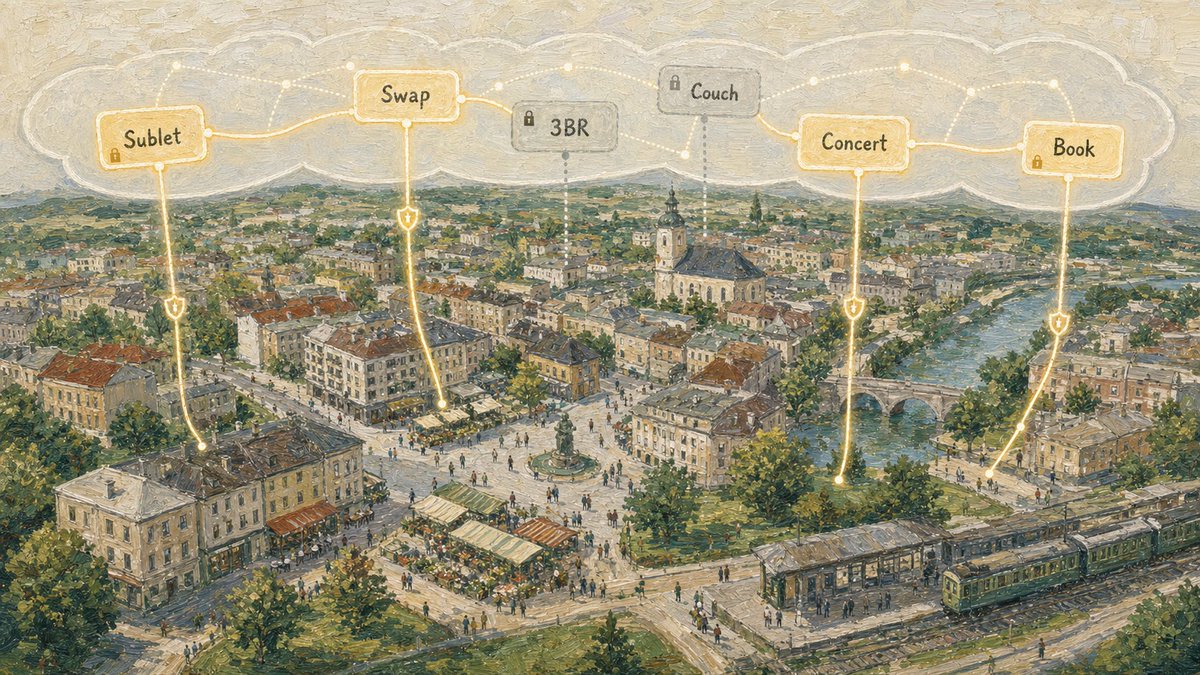
You want a better job, you want to swap your couch, you would apartment-swap with someone in your web-of-trust, you would upgrade from a two-bedroom to a three-bedroom if there were some graceful way to find the person who wants to size down, and you would love to sublet you place in New York without posting on Instagram and making 95% of you friends read a logistical errand that has nothing to do with them.
Right now, the cost of expressing these intents is high. You have to remember the want, decide it is worth acting on, find the right channel, phrase it socially, tolerate the inbound, filter for trust, negotiate details, and then keep the whole thing alive in your head.
So most of the long tail dies.
Agents change this because they can keep the low-grade, half-formed wants running in the background. They know your calendar, your travel plans, your music, your reading, your friends, your constraints, and maybe your willingness to be interrupted.
You listen to a band on repeat on Spotify and your agent notices they are playing 20 minutes from where you will be in California next month. You highlight a book you love in Readwise and it tells you that your friend is reading it too, and you will both be at the same dinner next week. You mention wanting Berlin in June and it quietly checks whether any trusted people from there want to apartment swap in New York then.
The magic is lowering the cost of noticing, holding, matching, and negotiating these things. It will feel like a higher level of serendipity.
This will require a web-of-trust that has yet to be built because there is an important privacy aspect to this. The dystopian version is "AI companies capture your intentions and auction them to whoever wants to manipulate you." The useful version is user-owned intents, where your agent can prove enough to match or negotiate without dumping your private life into a marketplace.
Some of this already has been solved in cryptography: private set intersection for finding overlaps without revealing all non-matches, secure multiparty computation / homomorphic encryption for computing matches or scores over private inputs, zero-knowledge credentials for proving things like membership, attendance, reputation, or trust path without exposing everything underneath.
If this works, a lot of modern life gets more liquid. Idea sharing, couches, apartments, reading groups, dinner plans, travel overlaps, introductions, tiny labor exchanges, borrowing a camera, finding the one person at an event who cares about the same weird thing. All the stuff that currently relies on posting into the void and hoping the right person happens to see it.
The hard parts are real: consent, spam, weird incentives, agent loyalty, social context, and making sure this becomes a tool for people rather than a new ad exchange with better vibes.
But I increasingly think the big unlock is giving our unexpressed intentions a safe place to live, and giving our agents permission to help them find each other.
I know of @indexnetwork_ working on this. Anyone else?
1
249
May 8
Dripstack may be one of my new favorite platforms, and showcase apps using x 402.
One the cleanest onboarding experience I have had in all of crypto (and non-crypto for that matter).
May 1

I paid for several premium financial newsletters and built a chat interface on top of them.
Writers get paid each time their posts are used in an answer via @mpp on @tempo and x402 on @base.
Check it out: dripstack.xyz
2
1
8
511
May 8
10000% Agree. Current payment rails are non-starters for the agent and micro-service economy.
May 8

Everyone assumes AI agents will pay through Stripe. They won't. The unit economics make it mathematically impossible.
Do the math: that flat $0.30 represents 15,000% overhead on a sub-cent call. Economically dead.
The real shift isn't "stablecoins are cool." It's that agents will hit thousands of paid endpoints they don't even know about yet, testing OpenAI, Anthropic, Replicate, ElevenLabs, scraping APIs, and 50 others in parallel.
With per-request stablecoin micropayments through a smart account, the marginal cost of trying a new API drops to a fraction of a cent.
That's not a feature. It's a different unit economics regime entirely.
Why current rails won't hold:
– Fixed vs variable cost: Visa/Mastercard are built for $50 baskets. At $0.002 per call, the ratio collapses.
– Latency: 2–5s authorization per transaction. An agent running 50 APIs in parallel can't wait.
– Authentication: 3DS, SCA, OTP, all designed to verify a human. Autonomous agents break the fraud model.
– Reversibility: chargebacks make no sense between two machines.
– Geography: an agent doesn't care about issuer country. A card does.
The agent-native stack that's emerging:
– Smart accounts (ERC-4337): Coinbase Smart Wallet, Dfns, Privy, Dynamic, Crossmint, Turnkey, Biconomy.
– Stablecoin rails: USDC on Base, Solana, Polygon Labs, sub-cent costs, sub-second finality (Solana: ~400ms at ~$0.00025).
– x402 protocol: the dormant HTTP 402 status code, revived by Coinbase and Cloudflare in May 2025, now run by the x402 Foundation. ~150M transactions on Base and Solana, ~$600M annualized volume, zero protocol fees.
– Agent identity & spend permissions: Skyfire, Nevermined, Payman, defining what an agent can spend and where.
– The big platforms are in: AWS just shipped Bedrock AgentCore Payments built on x402 with Coinbase and Stripe. Cloudflare, Google, Vercel, Anthropic, Circle, Visa TAP, Stripe ACP, all part of the ecosystem.
Why this matters now:
– LLM API prices dropped ~80% in the last 12 months. At this rate, $0.30 will soon be 1,000,000% of the underlying cost.
– A serious agentic workflow makes 20–200 API calls per task.
– Stablecoin B2B payment volume crossed $400B in 2025, before agent-to-agent flows show up.
Stripe won't lose human commerce. But machine-to-machine commerce will be built on an entirely different stack, likely with players legacy fintech isn't watching yet.
The question isn't "will agents pay in stablecoins?" It's "who becomes the Stripe of agents?"
1
5
441
May 8
As an example I built an app where people with inside access or early knowledge for discount or early access event tickets.
The premise was simple:
- Users who want to attend events and get early access codes pay $1
- Code providers earn 80 cents for each time the code was used
- Platform takes 20 cents
Unfortunately with traditional rails, 30 cents 2.9% fees means you're left with ~67 cents. Fees were equivalent to 33% of the business, for simply doing the handshake.
With x402, MPP, Tempo, Suby, and a few other services/protocols that can all be abstracted away to the point the provider (me) can eat the cost per service provided, because my margin is large enough.
2
64
May 7
The next stage is eliminating the need to think about wallets and collapsing the fees of normal payment rails.
Once this happens, agents and humans can scale micropayment services to a trillion dollar a year industry.
From API on demand to simple services that people today are typically blocked by the traditional service flow.
Today services force customers to:
- Find service
- Make an account
- Pay for subscription
- Use partial capacity of what they pay for
- Cancel when done
x402 micropayment services flip this to:
- User/agent finds service
- Pays for exactly what they need
- Done
No more saving account details and passwords for N number of sites.
No more watching your credit card transactions for subscriptions you forgot to cancel.
No more 30 cents per transaction 2.9% fees backed into the service providers cost structure.
It's faster, granular, safer, and much more flexible. There's a reason Agentic payments feels like a gold rush right now.

2
149
May 6
For decades, the internet reserved a slot for native payments, HTTP 402, "Payment Required" and left it empty.
The infrastructure to fill it didn't exist. Centralized payment providers owned the rails, and any attempt to build payments into the protocol layer would have routed through them anyway.
Then came blockchains, which provided the infrastructure to enable peer-to-peer (or agent-to-agent) value transfer without going through traditional payment providers.
Combining HTTP 402 with blockchain payment rails closes a loop the web has had open since 1996. Any server can demand payment. Any client (human or machine) can pay it.
No merchant accounts, no chargebacks, no platform sitting between request and response.
And it's all happening at the exact time we see AI and the "Agent Economy" take off.
It's the substrate for an internet where every API call, every piece of content, every model inference, and every agent action can carry its own price and settle its own bill in real time.
It's hard to put in words just how much this can change how the world transacts from today, but one thing is certain, it will change how commerce online flows.
Congrats @CoinbaseDev, @kleffew94, and the rest of the x402 team.
6 May 2025

Introducing x402 by @CoinbaseDev — a new open payment standard that brings HTTP 402 payments to life.
Agents with wallets can now pay for GPU inference and context on the fly. No keys. No config.
Let’s build autonomous agents. x402.org
2
2
9
737
May 6
We continue to see AI accelerate the exploitation of DeFi. Each day it feels like another 1M hack hits the time line.
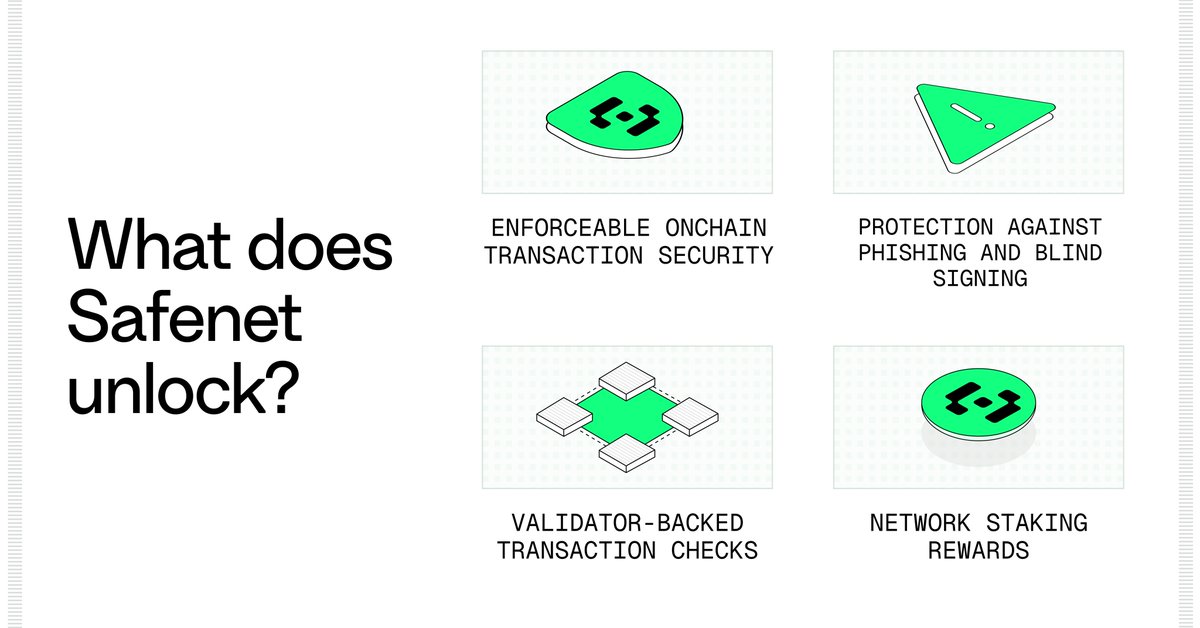
I believe Safenet is one of the core ingredients to stopping this.
Basic flow:
- User transacts onchain
- Safenet identifies typical transaction types, amounts, receivers, etc.
- If anything smells like an outlier Safenet node stops the transaction and gives user the ability to confirm
- If malicious it's user gets saved, if it's legit it get's confirmed
For anything high value, Safenet is your security guard. Excited to see more information be released.
Crypto security has spent years improving warnings.
Safenet takes a different path: onchain enforcement.
Instead of telling users a transaction might be risky, Safenet checks transactions before execution and verifies cryptographic attestations onchain.
Not better pop-ups.
a stronger line of defence
1
3
7
1,841