
building @mementoresearch and XXX around attention, distribution, and internet-native consumer products
Joined April 2018
- Tweets 5,739
- Following 3,390
- Followers 32,888
- Likes 14,042
740 Photos and videos






Crypto APAC GTM Playbook: Navigating the Asian Landscape
APAC (Asia Pacific) is a diverse and complex region, with each country characterised by its own language (sometimes overlapping), culture, and social norms. Navigating the landscape requires local knowledge, cultural sensitivity, and tailored localisation strategies.
From China's stringent bans to the more established regulatory frameworks in Japan and Singapore, success in the APAC region hinges on embracing local culture and communication platforms like WeChat and Line.
Strategic partnerships with key regional KOLs and grassroots communities are essential to authentically amplify the project’s vision and foster better engagement through local media and events.
This guide breaks down APAC into key regions, starting with a write-up of each market and strategies including media outlets, KOLs, VCs, and key events.
The flow for project founders: identify local media to amplify upcoming catalysts, work with KOLs or local agencies to craft important narratives and
simultaneously build mindshare, raise from local funds for strategic value-add, partner with CEXes (web3 wallets) and host grassroots events to connect with users.
- - - - - - - -
1. 🇨🇳 China
• Focus: Speculation, Metrics
• Messaging Apps: WeChat, Telegram, Weibo
• Top Platforms: Binance, GMGN
• Key Strategies:
> Work with strong KOLs to amplify catalysts and news
> Use Binance Square Chinese media for distribution
> Promote via WeChat, Weibo, Douyin, and Discord (via VPN)
> Tap into speculative culture with memes, DeFi, and PVP narratives
Despite regulatory challenges and clampdowns, China remains influential in the crypto space through offshore activities.
This is because China is where the money is at —> most of the whales and retailers here are very degen and crypto native. Highly sought after market for both trading volume, TVL and user metrics.
To maximise exposure, partner with a Chinese media to maximise exposure and work with good KOLs to amplify upcoming catalysts. Most if not all of the media outlets require payment in USD. Partnering with the likes of OKX and Binance wallet is good for retail exposure and cross-marketing.
Also can opt to make use of Binance Square(social networking content platform) together with KOLs to amplify project updates and news.
In China, people use a combination of Twitter, WeChat, Weibo, Telegram and Discord for communication and private crypto (trading) groups to share alpha and the latest projects. Keep in mind that most sites are still banned by the Chinese government, so users will need to use VPN.
Users rely heavily on Chinese KOL and content creators for information, and read news portals to stay up to date with the latest news.
Consumer dApps may want to explore marketing on other Chinese social media (apart from WeChat) such as Douyin (Chinese TikTok) and Xiaohongshu (lifestyle focused app).
Chinese users are very PVP and highly speculative (fomo) because of the finance-driven culture, making money is the ultimate goal. Strong preference for memes and DeFi ponzi to ensure wealth effect. They are usually quite fast to things (BRC-20, ordinals, memes, bitcoin eth).
Most of the biggest CEXes in the industry are from China, they care a lot about metrics (revenue, on-chain volume, user growth) bringing in new users (user adoption) before considering a listing. All require some sort of payment (tokens or stables) to list.
With CEXs wallets becoming more popular, a popular strategy is also to partner with Web3 wallets (Binance, OKX, Bitget wallet) to increase mindshare and leverage it as targeted user acquisition.
拉盘
a) Media / marketing
• Chinese and English: @WuBlockchain, @bwenews, @TechFlowPost, @ChainCatcher_, @Foresight_News, @PANewsCN
• Chinese: @OdailyChina, @BlockBeatsAsia,, @ChainNewscom, @BiteyeCN
b) Accelerators
None
c) KOL agencies
• @iamyourchaos
• @snow949494
• @EnHeng456
• @Cipher_Dance
• @ShardingCapital
d) Venture Funds
• Legacy: @fenbushim, @ofrfund, @YoubiCapital, @QimingVC
• Active: @waterdripfund, @genventurecap, @skyvisioncap, @Sky9Capital, @MetaWebVC, @CsquaredVC, @Mint_Ventures, @SevenXVentures, @JSquare_co / @DFG__Official, @iobc_capital
e) KOLs
• General: @phyrexni, @hebi555, @BTCdayu, @broleon, @wolfyxbt, @yuyue_chris
• Trading: @brc20niubi, @0xSunNFT, @0xcryptowizard
f) CEXes
• T1: @binance
• T2: @okx, @Bybit_Official
• T3: @bitgetglobal, @Gate_io, @kucoincom, @HTX_Global, @MEXC_Official, @BingXOfficial
g) Conferences
None due to regulatory issues. Most of the biggest conferences will take place in Hong Kong anyway (China’s sandbox). Work with local local KOLs/agency to arrange smaller events/meetups

282
140
1,098
250,325
So far we have:
• Anthropic's Mythos coming to nuke us all in DeFi
• SpaceX liquidity vacuum IPO this week
• Some people screaming that AI bubble is popping
• Crypto founders dumping tokens and calling it "exploiting"
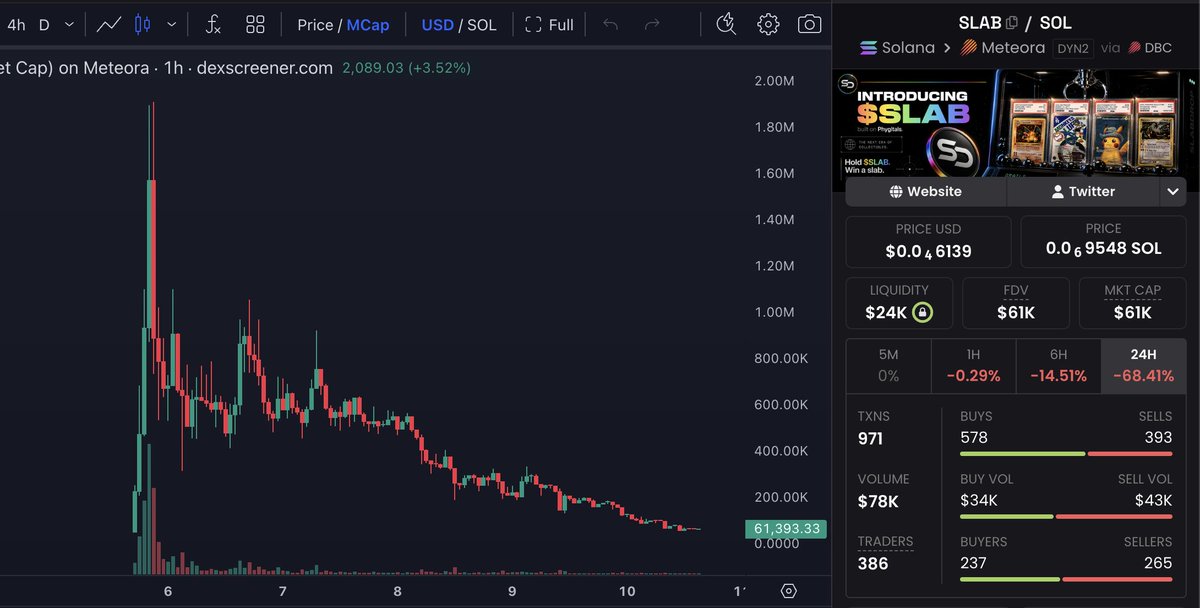
• Celebrities and trading cards once again being tokenised as useless tokens
• Ponzification of Bitcoin
• Quantum coming to break everything
35
11
116
10,898
Crypto VC observations
Many Asian VCs either closing down or unable to raise new funds letting employees go / employees left for a better future
Meanwhile US funds aggressively hiring to expand their team and continue to raise fresh funds
Other trends worth noting:
• US companies captured over 70% of capital and 43.5% of deals in Q1 2026
• AI eating both the talent and LP attention; some funds have even pivoted to investing solely in AI and/or robotics (quantum next?)
• 2020-22 vintage funds are out of capital and expected to closed by 2026
• Token model broke, which is why LPs won't recommit funds. Projects cannot raise on some dreamy vision anymore. Low-float high-FDV launches underperformed, secondary markets punished projects, and the absence of DPI distributions made LPs cautious
• Series B capital surged ~1,020% YoY while pre-seed eased back ~38% --> focus shifted to high-conviction mega-rounds
• Capital concentrated into trading/exchange (perp dex) infra, stablecoins, RWA, prediction markets; no more fancy X to earn or muh shiny L1
27
17
223
21,359
List of accounts sharing interesting information/updates about everything in Singapore 🇸🇬
@notyetadegen
@Usoppu
@bowtiedcrake
@0x_ZHUANG
@Zac_labs
@DRTnky
@hoeflatoor
@wassielawyer
@abigbluebird
@Chicky_Think
Mostly sharing hot takes, experiences, and analysis on SG life, property (HDB/BTO, real estate as wealth), policies, governance, economy, society, and daily life
28
11
136
12,998
Project Darkbloom: Turning Idle Macs Into AI Infrastructure
Every time an AI tool is used, the request travels through multiple layers of infrastructure before reaching the actual hardware doing the work.
The flow usually goes across different layers of Data centers, cooling systems, GPU hardware and layers of margin → All baked into what you're paying.
The @eigenlabs team calls this the Inference Tax.
Darkbloom is their research initiative to address it.
The premise: 100M Apple Silicon Macs already exist, already paid for, sitting idle most of the day. What if that compute could be organized into a usable inference network, with real privacy guarantees and better economics?
- - - - -
Why Apple Silicon
Apple Silicon isn't just abundant, it is also technically well-suited for inference in ways that matter:
• Unified memory: CPU and GPU share the same pool, eliminating discrete GPU bottlenecks
• Model efficiency: Apple Silicon only processes the parts of a model actively needed per request, rather than the whole thing → Larger models run faster and cheaper
• Power efficiency: ~30W to run a 60B model, versus multiples of that on data center GPUs
• Marginal cost to a Mac owner: Primarily electricity, since hardware is already bought
- - - - -
The Hard Part: Making It Trustworthy
One basic question is that If the prompt runs on a stranger's Mac, what stops them from reading it?
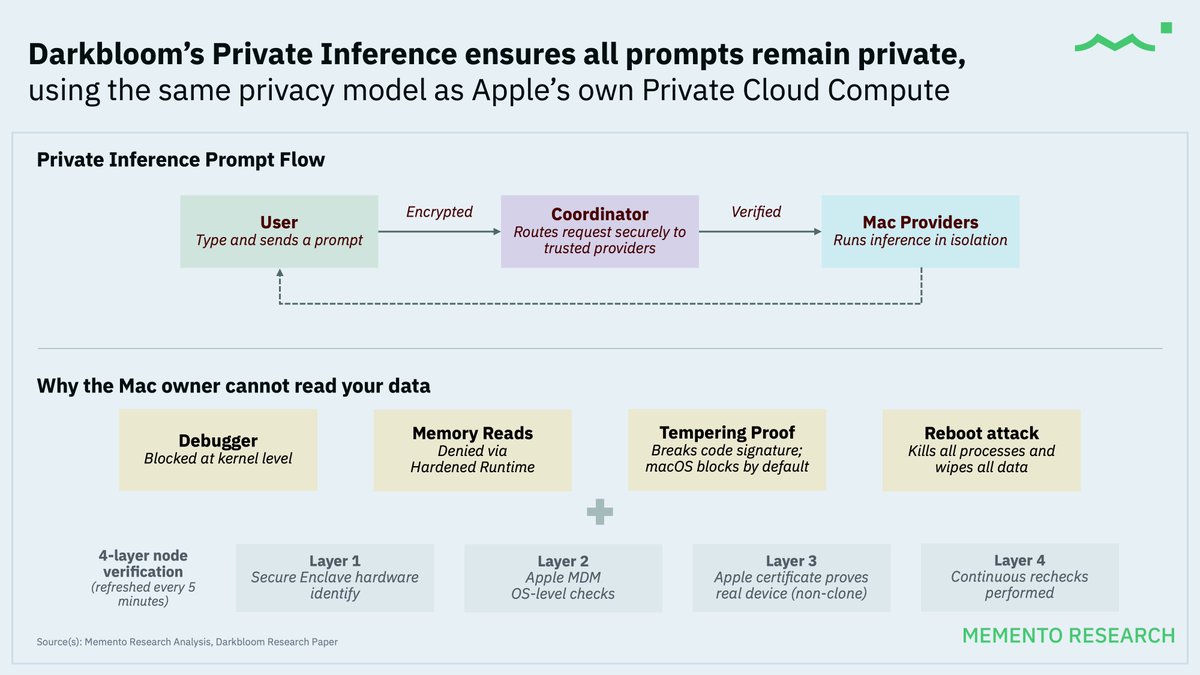
Darkbloom's answer is to make snooping architecturally impossible, not just contractually prohibited:
• Debuggers: Blocked at kernel level
• Memory reads: Denied via Hardened Runtime
• Binary tampering: Breaks code signature and then macOS refuses to run it
• Nodes will be re-verified via 4-layer attestation every 5 minutes → Secure Enclave, Apple MDM, Apple-signed device certificates, continuous challenge-response
The only way to break these protections is to physically reboot the machine, which immediately kills the process and wipes everything. Apple uses the same approach on their own Private Cloud Compute infrastructure.
- - - - -
What This Means for Eigen
Darkbloom will not act as a standalone product, but as a proof of concept and signal about where Eigen is heading in the AI infrastructure stack.
EigenLayer's core thesis has always been restoring trust to decentralized systems.
Darkbloom extends that into AI compute, making inference verifiable, not just available. If it proves that 3rd party consumer hardware can be cryptographically trusted for sensitive workloads, it opens the door to a new class of decentralized AI infrastructure that doesn't rely on trusting a cloud provider or data center operator.
This marks the beginning of Eigen playing within the privacy-as-infrastructure market.
- - - - -
Some Thoughts
A few things worth keeping in mind as we went through the Darkbloom research paper:
• The coordinator remains a trusted central layer for now; Team is transparent about this, but it's not eliminated yet
• Security model currently assumes no unpatched macOS kernel vulnerabilities
• Network traffic patterns can still reveal rough details about your request (e.g., how long it was, how complex) even if the content itself is hidden
The real test is whether the privacy guarantees hold as more nodes join the network and whether people actually trust it enough to run sensitive workloads through it without incentives.
Keyword: without incentives
The biggest hurdle is trust; Getting someone comfortable enough to run their data and prompts through a stranger's machine. It's a hard sell and very few projects are even attempting to solve it seriously.
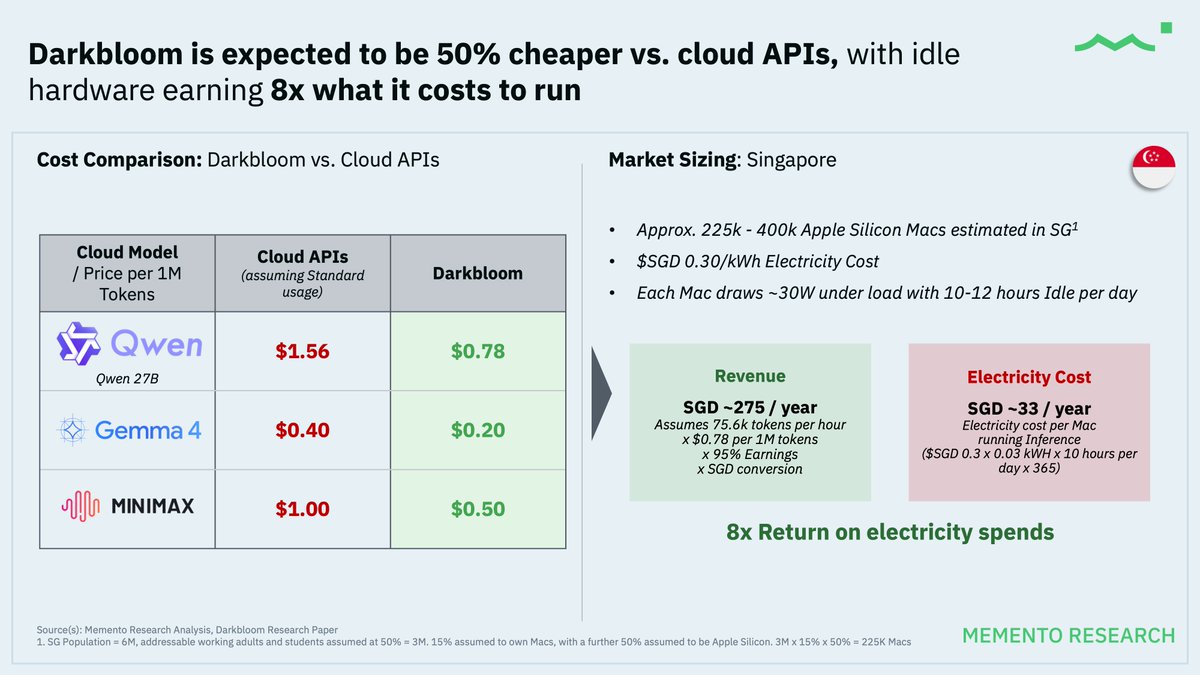
Despite all that, the maths seem to work out quite nicely out when the team at @mementoresearch sized it out → Check out attached pages
Disclosure: Project Darkbloom is a research initiative by Eigen Labs: Access here darkbloom.dev I am a $EIGEN holder
47
42
104
12,253
The newest player in the prediction market space, @42space, just announced its partnership with @Binance and integration into @BinanceWallet
Long form research on what this means to the wider prediction market space below ↓
Most prediction markets today are still closer to static, casino-like betting interfaces than actual living markets that are closer to a truth oracle.
The flow: You pick YES/NO → You enter → You wait → You pray you’re right
Think this is great for event settlements, but falls short of a “trading-like experience”
What if projects start to price in future events as a new asset class: “eventscoins”
- - - - -
The idea:
• Each outcome becomes an Event Token
• That token trades continuously before resolution and reprices as information, attention and capital move before the event ends
• Positions can be entered or exited at any time
• The market then settles objectively when the event concludes → Trade how belief evolves over time before the truth is settled
Traditional PMs have a few constraints now:
• Fragmented liquidity: YES/NO markets split depth and often rely on external MMs (liquidity is also often subsidized by VCs and market makers burning cash for user acquisition)
• Niche markets can’t shine: Unique, long tail markets (where PMs should theoretically shine) have zero liquidity because they are too risky for market makers to touch
• Yield farming treatment: Users opt for safer bets and treat it more like a yield payout, rather than doing actual forecasting
• Capped payouts: Fixed odds flatten upside, so being early or more convicted does not get expressed that well
• Weak payout expressiveness: Belief gets compressed into a one-dimensional bet
Instead of fixed odds and passive waiting, 42 enables:
• Dynamic, curve-based pricing
• Unified flow across outcomes
• Open-ended upside
• Deterministic settlement
In other words: they seem to be allowing users to trade events more like a launchpad which most crypto native users are more familiar with but settles like a prediction market → Building a launchpad for future events.
Launchpads are good for speculation, getting in early to ride the upside and relies a lot on momentum but they are bad at fair end-states.
While prediction markets on the other hand are better at objective outcomes, real-world anchoring (Bloomberg for truth events) and fair end-states but bad at rewarding timing/conviction properly and scaling long-tail markets without external liquidity support.
42 tries to merge the best of both worlds and in this way it opens up their addressable market to 2 distinct types of users:
a) Traders who want to capture repricing, arbs, rotation, and flow
b) Predictors who want to hold the correct outcome through settlement, but also want their early conviction / contrarian views to be rewarded fairly (i.e. not capped at the same $1 per-share payout)
The interesting part is that on 42, you do not need to be right at final resolution to make money. If you just entered early, got a better cost basis, and sold into later demand, you can still realize PnL.
If their product works, 42 could turn future events into something much closer to a real asset class that is tradable, continuously repriced, and objectively settled.
That being said however there are real hurdles that they have to solve:
• Beating the “just another PM” label → Main hurdle is educating users on the “eventcoin” concept early on and how 42 should be perceived as a real event asset launchpad
• Will be a tough battle against the bigger competitors like Polymarket, Kalshi and Novig that raised multi millions and have a bigger warchest for UA. Tons of education needs to be put into differentiating 42 among its competitors, or even localising its strategy as well
• There will be skepticism around curve mechanics and whether it solves the problem that existing PMs face
Disclosures: Friend of the team, they got us to help amplify their narrative in an objective manner and what they are building!

Event Rush is live on @BinanceWallet, powered by @42space.
Our lives are made of events. Big ones, small ones, the kind that change everything and the kind we forget tomorrow.
Every event has a whole life before it resolves. News breaks, sentiment shifts, and your views change. That motion is the most important part of the story, and it should be tradable like a simple token.
But most events never get a chance. Today’s prediction markets are short set of curated headlines. The long list of what people actually care about never gets a market at all.
We have fun plans for you to trade event tokens on sports, news, crypto, and more. But the markets we really can’t wait to see are the ones created by you.
What 42 truly wants is a market for everyone. A small market should be just as alive as a big one. Anyone should be able to trade on their favourite topic, no gatekeeping, no restraints.
A lot of love and a lot of thought went into 42.
Hope you enjoy it as much as we do 🪻💜
4
3
21
4,706
Wrapped up a China trip, heres a chinamaxxing alpha if you are keen to visit
You MUST visit China once in your life if you haven't:
• Electrical vehicles (cars and motorbikes) everywhere (partly due to govt policies of mandating everyone to buy EVs) which make the road very quiet
• Food delivery service directly right to your hotel room
• China service is top tier at any restaurant/hotel/ malls
• Cashless EVERYWHERE with no cashiers and just a QR code for payment
• 24/7 spa where they have FREE FLOW food/drinks/fruits and nap pods and gaming rooms
• Hyper efficient and modern service the moment you step off the plane (taxi locator service at airports/train stations)
Download/setup everything before you land
1. VPN
• China blocks Google, WhatsApp, Instagram, YouTube, etc on local WiFi (if you use roaming/ eSIM its fine)
• Good ones are SurfShark, LetsVPN and probably Mullvad
2. Connectivity - eSIM or Local Data
• Your country's roaming plan or eSIM (cheap & reliable)
• Airalo (ref.airalo.com/gwrW) or Holafly (unlimited data)
• Getting a local sim with a local number could be worth it as well, apps like MeiTuan need a local number to use (or just ask your hotel for their number to plug into the app kek)
3. Payments - Fully Cashless society (Alipay WeChat)
• China is 99% cashless. Street vendors, taxis, trains, restaurants - everything is QR code.
• Alipay → Easiest for foreigners. Link your foreign Visa/Mastercard directly (no Chinese bank account needed). Has English translation
• WeChat → Also works great now for payments (WeChat Pay) card linkage and English translations available
• SET BOTH UP BEFORE YOU ARRIVE, everything relies on these 2 apps
4. Other must-have apps to download
• Didi (usually accessible via WeChat/Alipay mini-program): China’s Uber
• Meituan: A must have for food delivery, hotel deals, attraction tickets, restaurant bookings, local services. We even used this to ask someone to help us take a ticket to QUEUE for bubble tea (Ah Ma Handmade is alpha btw) stand in queue deliver to our hotel (directly to our hotel room)
• Taobao: Amazon of China. Cheap everything (electronics, clothes, gadgets). Foreign card works via Alipay/WeChat
• Xiaohongshu (Little Red Book): UGC goldmine to find PROPER alpha of places to visit, and good food to eat. Compared to Instagram/tiktok the recommendations here are much better
• AMap Global: Best navigation app for foreigners
• Douyin: Chinese TikTok
5. Getting Around
• Trains and metro are insanely efficient and cheap. Use AMap to navigate
• Tbh just use Didi everywhere as ride hailing in China are super cheap
6. Food & Exploration
• Use Xiaohongshu for everything Meituan to get delivery
• Use WeChat/Alipay to pay at every restaurant (even fancy ones)
• Crime in China is obv super low (everything is traceable/trackable)
• Avoid: Golden Week / major holidays (insane crowds and prices)
12
3
35
3,705
Ash retweeted

May 3
USDT 💳

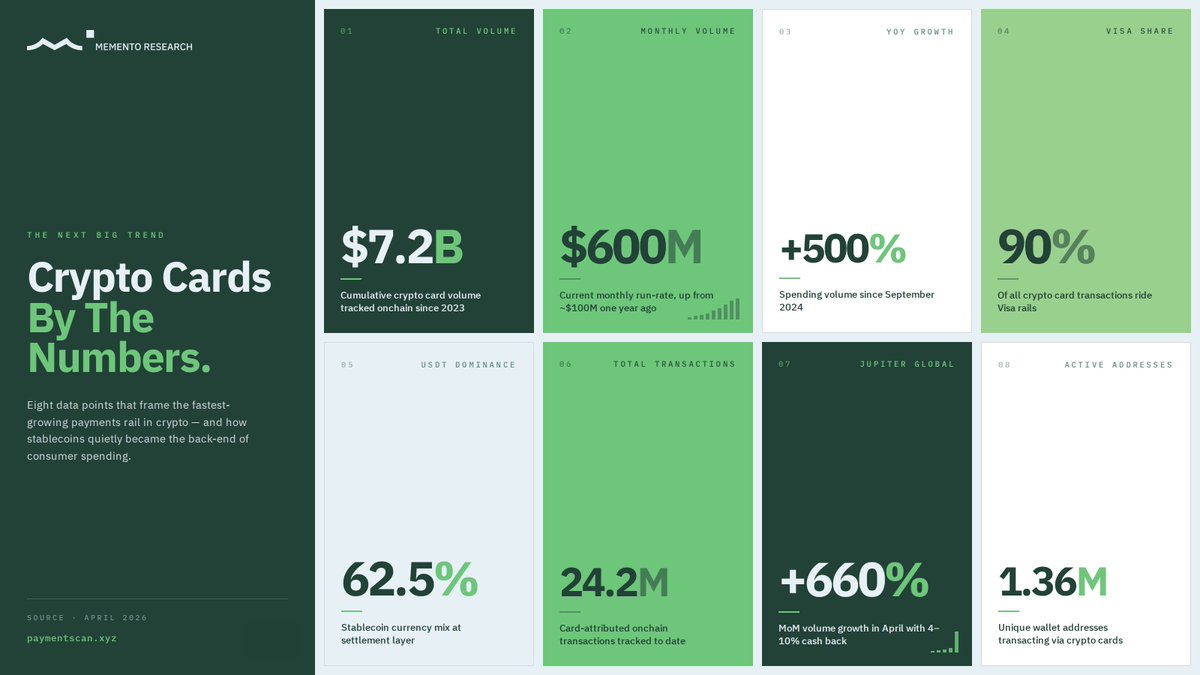
BREAKING: Crypto card spending just hit $600M a month - up 6x in a year.
In case you missed it:
$7.2B has now moved through crypto cards on-chain
• 24M transactions
• 1.36M wallets
• 62.5% in $USDT (@tether and @paoloardoino running the rails)
• $348M on @solana (@toly)
• @JupiterExchange Jupiter Global 660% MoM with 4-10% cash back (@weremeow)
• 90% on @Visa
Stablecoins quietly became the back-end of consumer spending ↓
37
36
431
77,003
Ethena updates its transparency page
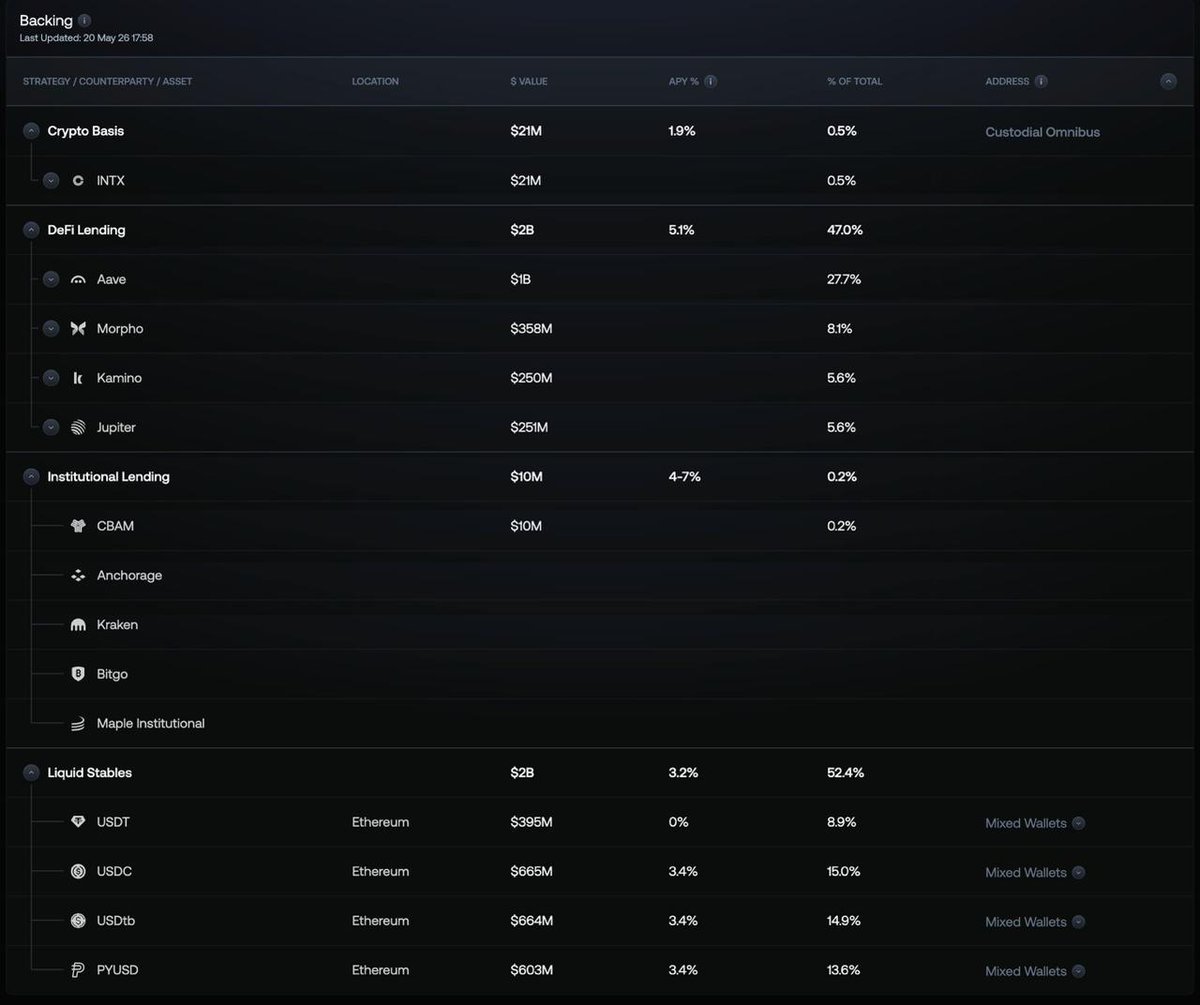
@ethena just announced an update to its USDe backing transparency dashboard, providing a detailed breakdown of reserves after planned diversification beyond traditional crypto basis trades
DeFi lending is the largest allocation at roughly 48% ($2B ), with significant exposure to protocols like Aave, Morpho, Kamino, and Jupiter, while crypto basis now represents only about 1%
app.ethena.fi/dashboards/bac…

Following the planned diversification of USDe's backing, the transparency page has been updated to show a more detailed breakdown of reserves.
Assets will continue to be added as new allocations are proposed and approved by the risk committee.
app.ethena.fi/dashboards/bac…

4
2
16
953
Quite interesting how (fast) @ethena is building out actual product rails on @solana
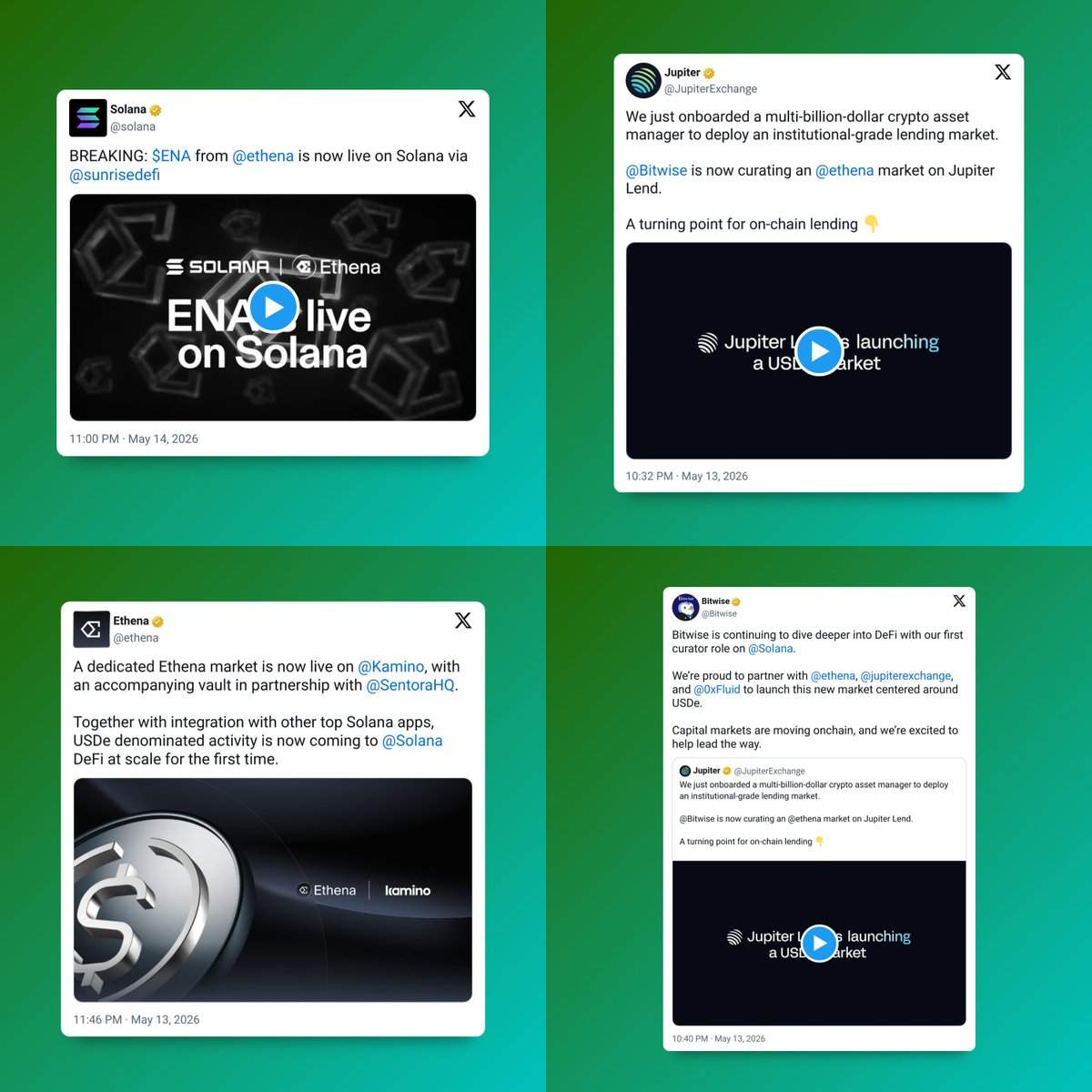
Just this week alone:
• $ENA goes live on Solana via @sunrisedefi
• @kamino launches a dedicated Ethena market
• $USDE Growth Initiative goes live where users can run the USDe/USDG loop with auto-compounding, isolated risk, and liquidation protection around temporary depegs
• @JupiterExchange Lend launches a dedicated Ethena market curated by @Bitwise on @0xfluid infra
• People can now use $USDE to deposit, borrow against, and lever on Solana at scale
Ethena has usually done p well with their GTM and distribution (i.e. integrating USDE into CEXes like @Bybit_Official) and then usage compounds after that and this integration gives them something very different from Ethereum which is probably faster retail flow
Plug USDe directly into Solana’s money rails via Bitwise to get a more institution-friendly lending venue on Solana too
If Ethena wants to become a real cross-chain dollar network, this week was a good example of what it can actually looks like in practice
$ENA holder
6
2
19
1,495
Walrus just moved to fixed USD pricing for storage, paid in native tokies
Price is now fixed in USD (but payable in $WAL) The amount of WAL payable adjusts automatically as price moves. This allows developers to budget with certainty.
Why it matters:
• At $0.023/GB/month, Walrus’s pricing is comparable to AWS S3, but with 4.5x built-in redundancy, no egress fees, cryptographic verifiability and programmable access control
• Removes one of the last real objections for developers evaluating Walrus vs. traditional cloud options aka the inability to budget & forecast
Whilst previous partnership with @AlliumLabs & @Tatum_io strengthen data partnerships, predictable pricing allows for the commercial story to be operationalised and even more credible
Disclosure: working for my $WAL bags
May 13

🦭 UPDATE: Predictable pricing is live on Walrus.
No more token-price guesswork. Storage on Walrus is now fixed at $0.023/GB/mo, so your costs stay predictable as you scale.
Same price as centralized providers but with data portability, verifiable integrity, and programmable access controls built in.
Learn more 👇

4
1
10
4,425
Four months into 2026 and $WAL has been putting in work
Key Highlights:
• MemWal launched in beta → persistent memory for AI agents allowing agents to store and recall context across sessions on-chain
• Allium, used by Visa, Stripe, and Coinbase, brought 65TB of institutional-grade blockchain data onto Walrus in Q1, → resulting in over 450 TB of data stored on Walrus to date
• @Tatum_io @RealBlockPI live in April → Ethereum, Bitcoin, BSC datasets 1,000 nodes across 70 networks now feeding verifiable data directly. No more reconstructing chain data block by block
What’s Next: Keen to see if team would release more product related announcements post-Sui Live (e.g., full launch of MemWal & maybe an extension for Slush Strategies?)
Disclosure: working for my $WAL bags
May 1
April was packed! 🔥 Here's what went down:
🤝 Our partnership with @Tatum_io unlocked Ethereum, Bitcoin, and BSC datasets on Walrus, with more networks on the way. Builders and agents no longer need to reconstruct blockchain data block by block
🤝 @RealBlockPI is building on Walrus, bringing faster verifiable data from 1,000 nodes across 70 networks
⚡️ Boosted WAL rewards on Slush Strategies extended through May 10
🎙️ Hosted an X Space with @AlliumLabs, @Tatum_io, and @RealBlockPI on what it takes to store, index, and serve blockchain data at scale
🎥 @GDanezis and @RJ_Simmonds sat down to talk about the next 12 months of AI infrastructure and where Walrus fits in.
🛠️ Walrus Sessions kicked off! First challenge: build your personal website onchain with @walgo_xyz for a $1,500 prize pool.
✍️ Three new blog drops:
• @bluefinapp’s blueprint for verifiable trading
• Getting started with Dartus
• Python guide for storing and retrieving data on Walrus
🦭 The Walrus community went live on @SuiNSdapp. Connect with WAL holders, builders, and everyone following the ecosystem
🌍 We were at #EthCC meeting builders on AI and onchain finance
📱 Dropped fresh Walrus wallpapers for your phone
🌴 Sui Live is coming up soon in May. Can't wait to see you in Miami.
Data matters. 🦭
5
1
10
1,859
INFINIT: The Execution Layer of DeFi
- - - - -
Most people who've spent time in DeFi know the routine
A potential yield farming strategy sounds good, but before deploying comes the actual work → Bridging, swapping, approving each protocol interaction, manually calculating your LTV buffer, across three interfaces while the market moves
By the time you're done, it’s 1 am and probably slightly rekt along the way.
Whilst the capital and DeFi strategies currently exist, the key is figuring out how to get from intent to execution without it becoming a part-time job
Today’s long form deep dives into what INFINIT is building towards and how it will be the execution layer of DeFi
- - - - -
The Problem With How DeFi Operates Today
Each Dapp has its own risk parameters, different mechanics, different nuances → All are different in their own right and style
Wallets like Rabby have made progress here, helping to aggregate protocol positions into a single interface, giving users a cleaner view of what they hold and where
But it’s still an interface upgrade, not an execution upgrade. You can see everything in one place; yet execution is still manual.
Current tools tried exploring different approaches via a cleaner UI for one Dapp, or an AI chatbot layered on top. But again, neither gets the original intent exactly from "I want to deploy capital across three protocols on two chains" to actually doing it cleanly
- - - - -
How INFINIT Is Addressing The Issue
INFINIT builds a coordination layer underneath, where specialized agents (not a single generalist model) handle execution across the stack
Agent Swarm
• 30 specialized agents, each purpose-built per protocol - Aave, Pendle, Venus, Morpho, Euler, PancakeSwap, and more
• Agents coordinate through multi-agent frameworks rather than one model trying to know everything
Multi-LLM Router
• Powered by Google Vertex AI Model Garden
• Dynamic routing to different LLMs, matched to what the task actually needs
Data Stream
• 200 real-time on-chain and off-chain sources feeding agents live
• Recommendations reflect current conditions, not cached / previously saved state
- - - - -
The Verifiability Piece
One of the biggest concerns with AI-powered financial tools is hallucination. One wrong miscalculated LTV, wrong sequencing, bad liquidity assumptions results in actual rekt-ness (aka testing in prod)
INFINIT's answer: AI interprets intent → deterministic compiled code executes
• The AI handles reasoning and strategy sequencing
• Then, Execution compiles it down to deterministic, auditable code to ensure no improvisation at the transaction level
• Before anything runs, a full preview of every protocol, token and expected outcome is shown before signing
Most AI finance tools skip this separation entirely and just hope the model behaves.
- - - - -
What It Looks Like
Describe a strategy in plain language:
• "Lend USDT to Venus, borrow BNB at 75% LTV"
• “Delta-neutral position across Aave and Pendle"
• "Optimise yield across these three chains"
The Agent Swarm builds it, surfaces a full execution preview and the user approves the transaction.
There's also open strategy publishing where experts build and publish strategies, earn fees every time someone executes. $IN stakers sit in the middle, earning a share of protocol fees plus access to premium features
- - - - -
Personal Take
A few considerations:
• TVF crossed $31M in April, still early relative to the addressable market, with some activity likely incentivized due to current rewards program
• The creator fee switch is not fully live yet so the flywheel hasn't really been stress-tested at scale
• Cross-chain complexity means smart contract risk will still always present; non-custodial ≠ zero risk
The real test is whether the execution layer holds up as TVF scales when the fee switch turns on incentivised activity truly results in organic usage
Disclaimer: Smol INFINIT, thoughts are my own
May 4

INFINIT has facilitated $10M in value on @BNBChain, powered by AI Agents.
The Prompt-to-DeFi Strategist Challenge: BNB Chain Edition has come to a close, and together, we crossed $10M TVF on BNB Chain.
Every transaction coordinated. Every execution automated. Zero manual friction.
INFINIT is establishing the new layer of autonomous, intelligent DeFi infrastructure on BNB Chain with a network of AI Agents that handle DeFi for BNB Chain users.
The foundation is set. The scale ahead is much larger.
INFINIT is making @BNBChain the home of agentic finance.
To INFINIT and beyond, on BNB Chain!

5
2
15
4,110
The @virtuals_io team seems like its trying to build out a coordination layer for physical AI (robotics)
Keeping my eye on solana:3iQL8BFS2vE7mww4ehAqQHAsbmRNCrPxizWAT2Zfyr9y and the Virtuals eco
- - - - -
1. @eastworlds_io - embodied AI accelerator
• Virtuals' expansion into physical AI
• Full-scale facility, 30 @UnitreeRobotics humanoids, dedicated physical testing environments, teleoperation infra
• A working facility designed to shorten the cycle from training to real-world deployment
• 3 pillars: an accelerator Robots-as-a-service learning on real world data
2. @caspius_ai - the data supply
• (unsure if this is by Virtuals team, just speculation below)
• Caspius ($CAS) launched on Virtuals today where they pay people to record everyday tasks on an iPhone, build the largest egocentric manipulation dataset in the world, sell it to whoever's training embodied AI
• If this project is linked to the team, they can link it to their 30 humanoids and a roster of robotics teams who need data to train
• Caspius has a network of contributors generating that data 24/7 from millions of phones. Eastworlds is the demand. Caspius is the supply
3. @coinbase listing
• VIRTUAL spot trading is also going live on Coinbase April 29
• Crypto narratives need 3 things to cook: a thesis, products that prove the thesis, and liquidity for us to express our thesis
• VIRTUAL is now the underlying coordination token for an eco that owns:
>> A large crowdsourced data network for physical AI (Caspius)
>> A working robotics deployment business with real revenue (Eastworlds)
>> The accelerator that recruits the next generation of robotics founders (Eastworlds)
Flywheel: every robotics team that joins Eastworlds is a potential Caspius customer. Every Caspius dataset improvement makes Eastworlds-deployed robots better. Every Eastworlds deployment generates new data that competes with or complements Caspius. And every new robotics project on Virtuals needs VIRTUAL liquidity
- - - - -
caspius.ai/
eastworlds.io/
Smol $CAS and solana:3iQL8BFS2vE7mww4ehAqQHAsbmRNCrPxizWAT2Zfyr9y holder
9
8
92
8,675
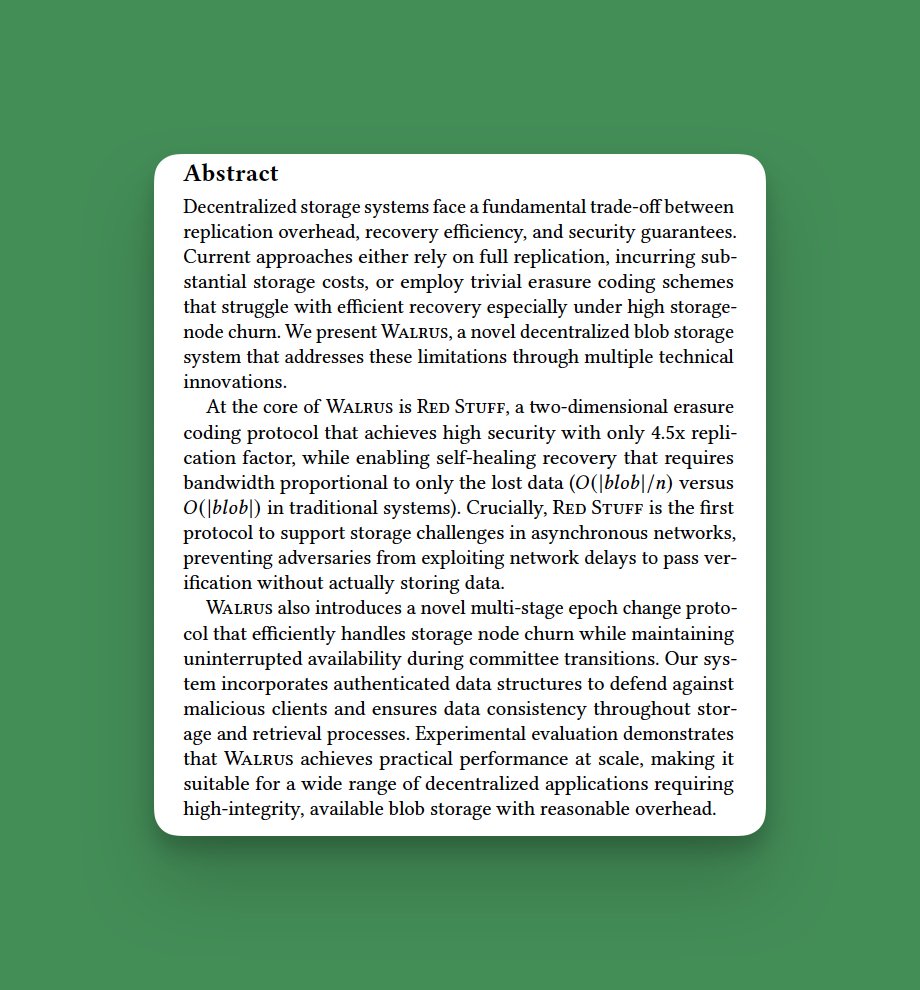
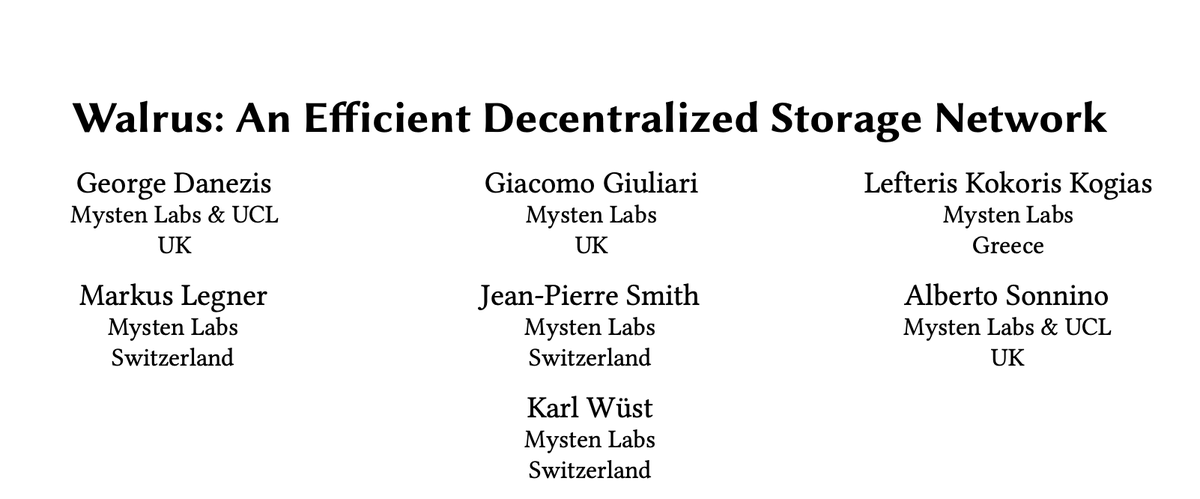
The @WalrusProtocol team had its research paper accepted at ACM CSS 2026 (one of the "big four" academic security conferences), marking an important milestone as the network moves toward mass usage
Paper objective was pretty much straightforward, trying to answer: Can decentralised storage compete on speed, reliability, and cost for modern applications?
Key findings suggest progress in that direction:
• Faster or equally as fast uploads and downloads
• Lower storage overhead vs. older designs
• Resilient architecture even if nodes rotate or go offline
• Better fit for active workloads, not just passive archiving
Quick primer on what's novel → Red Stuff, the encoding protocol behind Walrus:
1) Less storage overhead
• Storing 1GB on Walrus costs the network ~4.5GB of capacity to keep it safe. On Filecoin / Arweave class designs the same 1GB needs ~25GB
2) Storage proofs that are robust in complex networks
• Decentralised storage need a way to verify nodes actually hold the data they claim to hold, otherwise they are just farming rewards for storing nothing
• Walrus tries to solve this where this verification works even when the network is laggy or messages arrive out of order
Personal Thoughts
Most storage networks were built for “store and forget” use cases. Walrus is aiming for something broader, powering data-heavy applications such as:
• AI memory and agents
• Websites and frontends
• Media delivery
• On-chain apps needing quick access to off-chain data
Whilst Year 1 on mainnet focused on proving technical ability and foundation, Year 2 onwards pivots to proving long term growth and sustainability
Disclosure: Smol $WAL holder
Apr 13
⚡️ JUST IN: Our research paper, "Walrus: An Efficient Decentralized Storage Network," has been accepted at ACM CCS 2026, one of the top security conferences in the world.
The science behind verifiable data is being recognized where it matters. 🦭
5
2
34
2,782
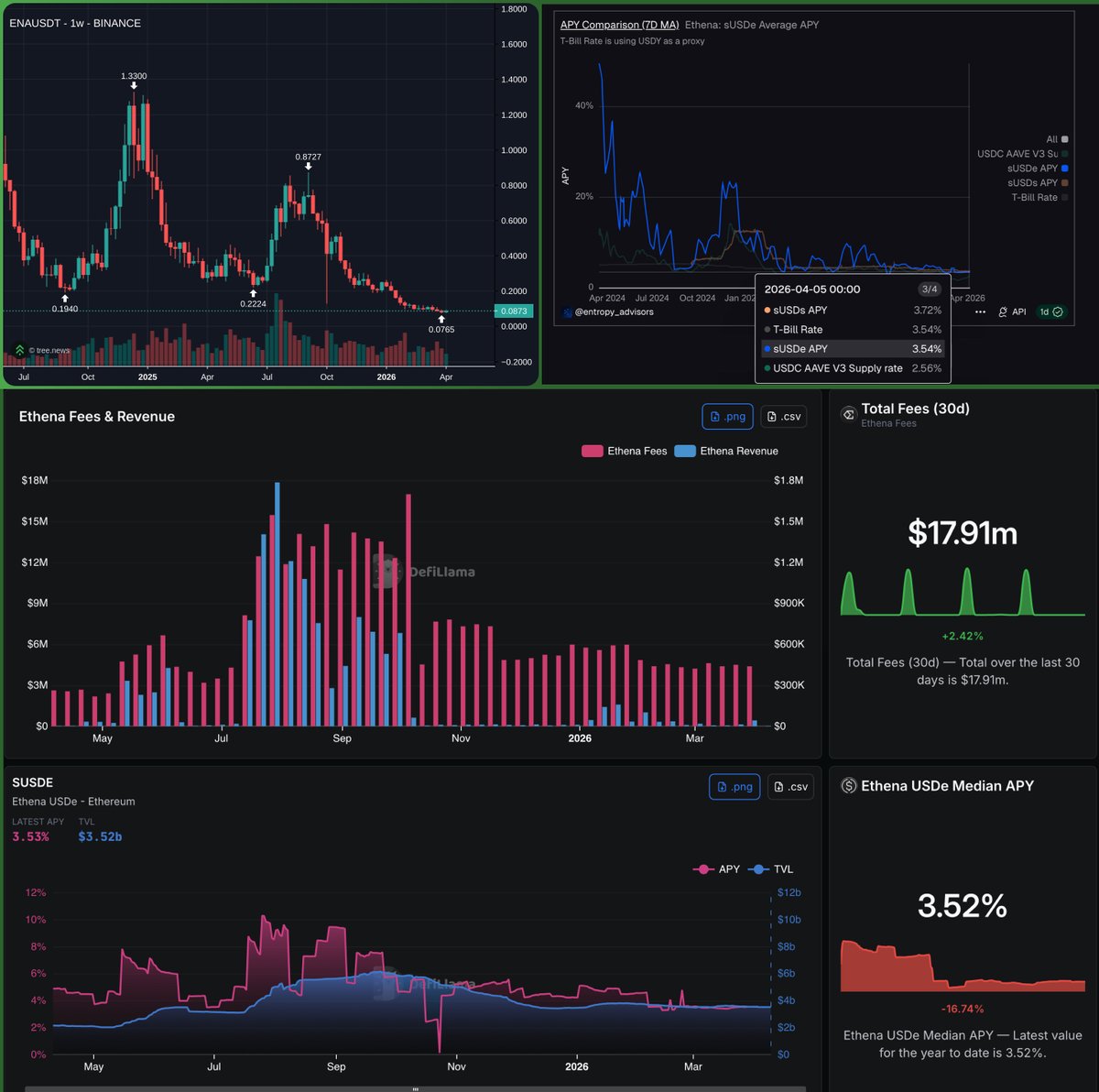
Important @ethena update --> make USDe less dependent on one market regime
Historically, their USDe story was tied to crypto basis trade/ perp funding, which kinda worked well when those rates were there.
But as 1) crypto-native yields compressed 2) more competitors come in to compete, the same trade starts giving less for the same risk.
Hence Ethena is broadening up the backing mix:
• overcollateralised insti lending
• higher quality liquid RWAs beyond T-Bills
• equity commodity basis
• prime lending
Takeaway:
• USDe is trying to become a product that can stay competitive even when crypto-native rates are boring
• Done to avoid concentration risk (over reliant on one revenue stream) tap into much bigger ponds (RWA, insti lending) resilience (to still make sense when the market gets slower)
• $ENA token has probably bottomed out? Will these new integrations and revenue streams coupled with their broad distributions* trickle into the token?
*They already built a product that lives across both DeFi AND CeFi, and now increasingly more institutional rails too
Obviously, more moving parts means more things to underwrite:
• Counterparty quality and risk committee
• Liquidity terms
• Transparency
If they do this as well as their basis trade szn in the past, USDe probably ends up surviving multiple cycles
Data from @Tree_of_Alpha, @EntropyAdvisors and @DefiLlama
Token holder
USDe reserves are evolving: reducing concentration and building resilience across market cycles with a diversified collateral base.
Four additions to the collateral backing are detailed below for consideration by the risk committee, each a natural extension of existing Ethena allocations:
→ Overcollateralised institutional lending
→ High quality liquid RWAs beyond TBills
→ Equity & commodity basis exposure
→ Prime lending
Read more below on proposed updates:
11
10
88
13,012
More distribution flywheels for Ethena
1) MegaETH
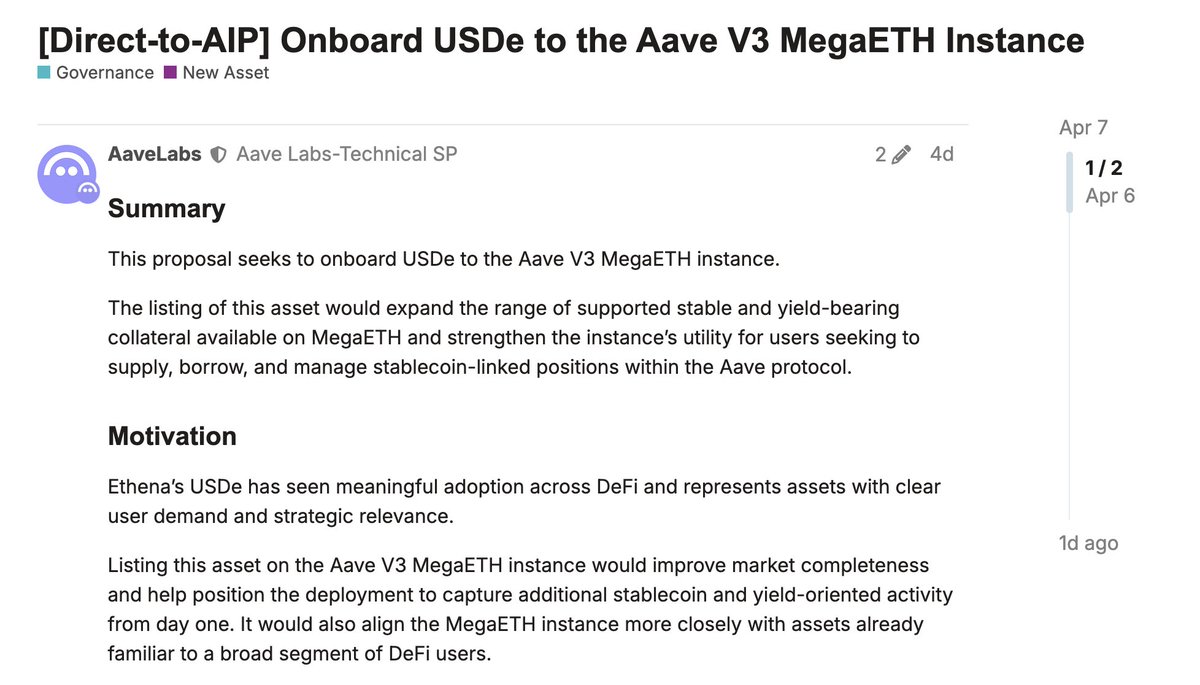
The @megaeth angle makes the Ethena update more interesting as @aave has a proposal up to onboard $USDe to 'Aave V3 MegaETH Instance'
@LlamaRisk notes that on MegaETH, USDe deposits would be structured as yield pass-through, effectively making deposited USDe be like sUSDe without needing to onboard sUSDe itself (to support yield leverage looping)
Seed liquidity is already live via a ~$6m USDe/USDm pool, and the initial recommendation is a 50m supply and 40m borrow cap. USDe collateral use is intended to sit inside a dedicated stablecoin E-Mode where users can borrow both USDm and USDT0 against it
The flywheel is essentially:
• Ethena's sticky yield-bearing dollar
• Aave gives users leverage and a looping mech
• MegaETH benefits (monetizes) if that borrow demand routes into USDm (the core borrowable stable on the instance)
Thanks @hotpot_dao for highlighting this to me
2) 3Jane
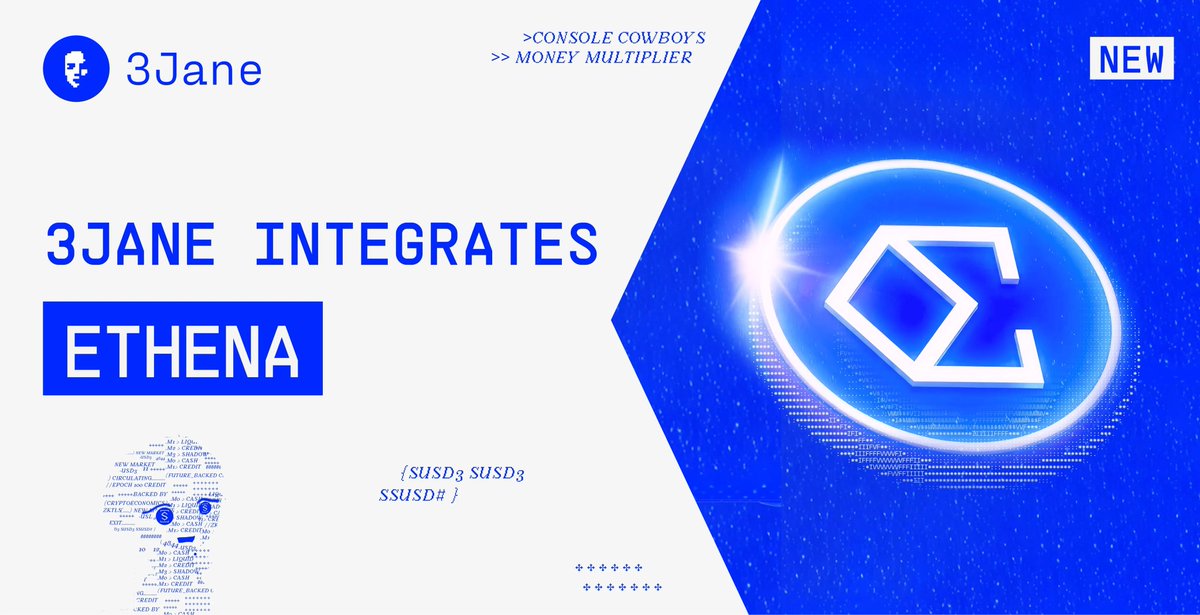
@3janexyz just added Ethena assets into its credit underwriting model. Basically USDe, sUSDe loops, ENA and sENA are starting to be assets you can borrow against too.
Asset becomes usable for both yield AND credit.
Ethena's position gets stronger from both sides:
• Reserve side gets more diversified
• Demand side gets more embedded into protocols
@gdog97_ @ethena @StaniKulechov @aave @hotpot_dao @megaeth
And now you’re seeing the fruits of that meeting @TaikiMaeda2
3
27
2,092
Data layer for AI with a focus on trust and verifiability
ELI5:
• AI models are only as good as their training data
• But, today’s pipelines are mostly black boxes
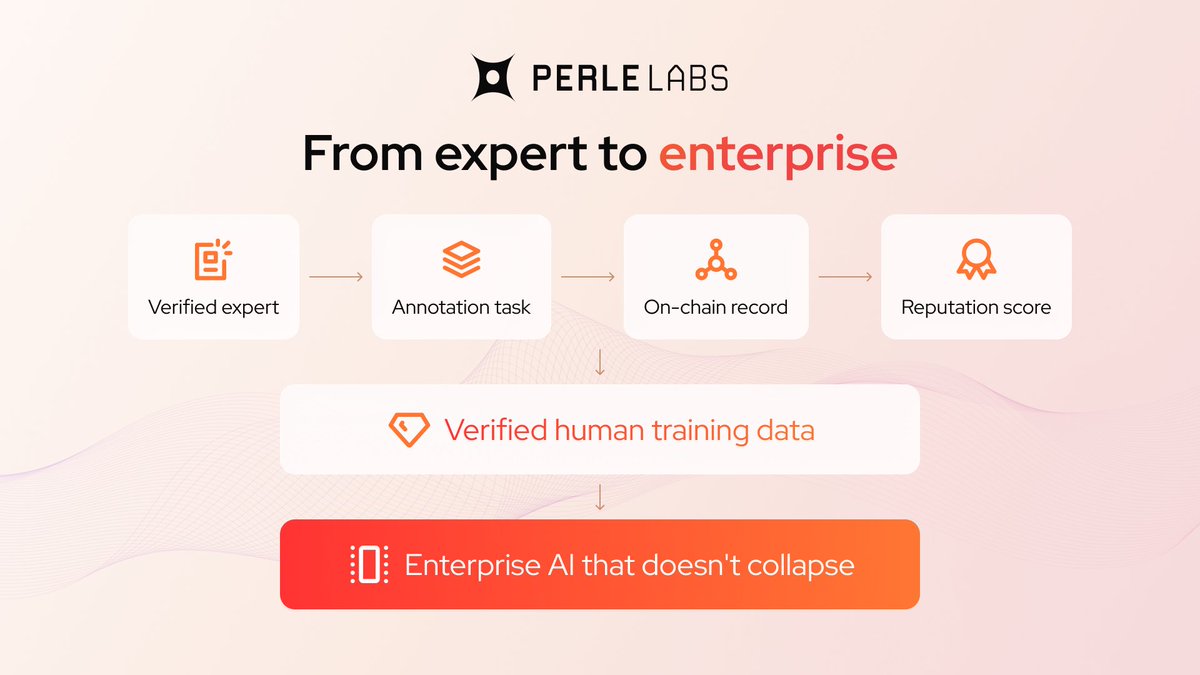
→ @PerleLabs aims to replace that with expert-verified data full onchain traceability
That means:
• Tasks are handled by real domain experts, not anonymous crowd workers
• Every annotation is captured at creation with full lineage and checked for accuracy → allowing for contributors to build reputation on-chain over time
Implication:
Building the key foundational infrastructure for auditable & reliable AI data for different real-world use cases
Perle Partner
Apr 2

Most AI training data pipelines are blackbox.
You don’t really know who labeled the data, how decisions were made, or what the actual source looks like end to end.
That becomes a real issue once models are in production.
Perle takes a different approach.
Here’s how the pipeline works:
• Starts with a verified expert, not an anonymous crowd worker
• Tasks are matched to domain specialists with actual credentials
• Every annotation and review is captured at the point of creation
• Each data point is recorded on-chain with a timestamp and full lineage
• Contributors build reputation over time based on accuracy and consistency
The result isn’t just higher quality data.
It’s data you can trace all the way back to its source, with a clear record of how it was created.
That’s what makes it usable for enterprise systems where accuracy and accountability actually matter.
That’s what Perle is building.
1
8
1,050