
European, Tech enthusiast.
Joined January 2011
- Tweets 6,499
- Following 1,929
- Followers 961
- Likes 9,537
10 Photos and videos




Ben H retweeted

Noam Shazeer - co-author of the Transformer, T5, and Switch Transformer papers, and one of the pioneers of sparse MoE models - is leaving his VP Engineering / Gemini co-lead role at Google DeepMind to join OpenAI
This is likely the most significant AI talent move of the year.
It makes you wonder what’s going on at Google

I’m excited to share that I’ll be joining OpenAI and look forward to working with the exceptional team there.
It was a difficult decision to move on. I’m incredibly proud of the amazing team at Google and everything we’ve built together. It has been an honor and a pleasure to work with all of you.
57
72
2,051
260,134
Ben H retweeted

Jun 16
Microsoft has fine-tuned a version of DeepSeek and is considering it as a lower-cost alternative to OpenAI and Anthropic models for Copilot Cowork. Huge development considering the history of the OpenAI/MS relationship.

New @axios: Microsoft eyes DeepSeek for Copilot Cowork as it also joins the shift to usage based pricing. Says final decision TK but it has already fine-tuned a model that it could use.
33
66
752
104,312
Ben H retweeted

Jun 15
Typical coding day with Claude (Opus 4.8)
- explain to Claude the task (5 minutes)
- Claude implements task (10 minutes)
me: "Why is this necessary?"
Claude: "You're right to push back! I over-engineered this!"
- Repeat x87 times (13 hours)
431
544
13,851
1,229,984
Ben H retweeted

Jun 15
It's actually le gros chaton
431
816
9,317
1,782,811
Ben H retweeted

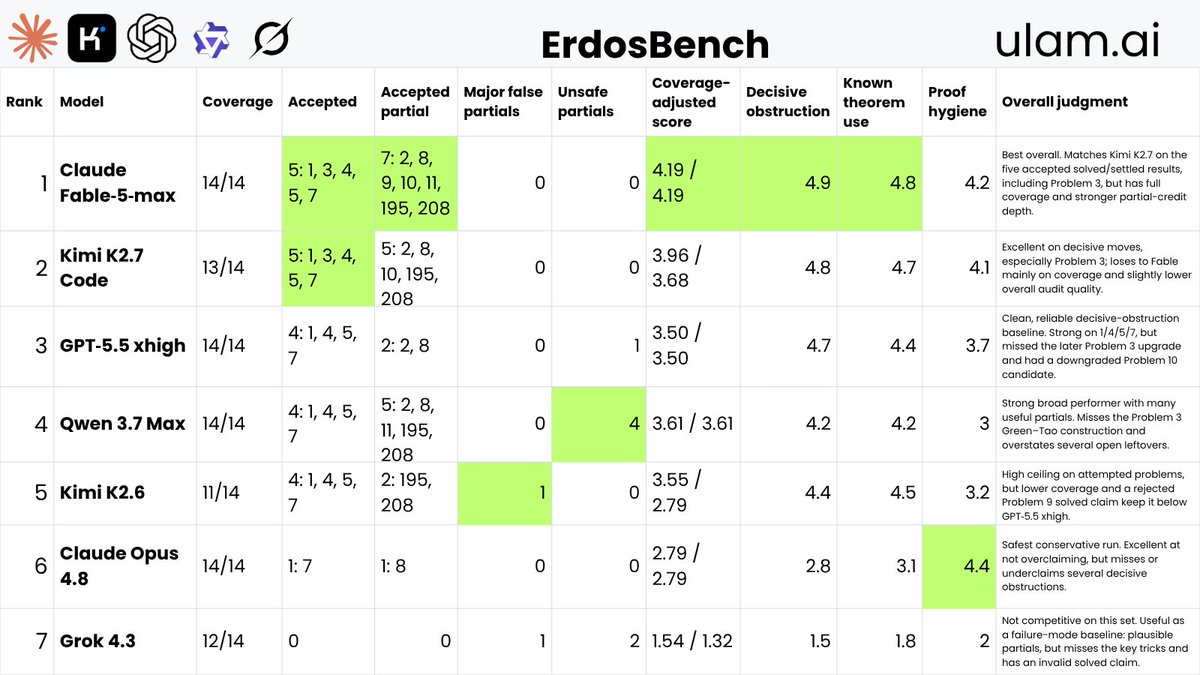
Kimi 2.7 ranked 2nd after Fable 5 and before GPT-5 xhigh
We have re-run our ErdosBench smoke test on 14 problems with Kimi 2.7, Qwen 3.7 Max, Grok 4.3 and compared it with the top performers from previous runs.
Kimi 2.7 is amazingly good. More below.
169
555
5,091
1,788,081
Ben H retweeted

Jun 11
Scenario: europe2031.ai
Summary: europe2031.ai/summary
Audio: europe2031.ai/audio/
The ⭐⭐⭐ team: Daan Juijn, Stan van Baarsen
@DadaJudith Lily Stelling, @philip_fox_ @AlexTPet @TomChivers
4
11
95
11,353
Ben H retweeted

Jun 13
I bet Mistral.ai valuation jumped suddenly.
Same for any non US player.
The world is learning from this US admin how depending on US technology is a liability. As French I fully get it. As an employee of a US company I regret it.
This is bad for me a non US national, and this is bad for the US company that employs me.
Jun 13

The US government, citing national security authorities, has issued an export control directive to suspend all access to Fable 5 and Mythos 5 by any foreign national, whether inside or outside the United States, including foreign national Anthropic employees.
The net effect of this order is that we must abruptly disable Fable 5 and Mythos 5 for all our customers to ensure compliance.
Access to all other Claude models is not affected.
We apologize for this disruption to our customers. We believe this is a misunderstanding and are working to restore access as soon as possible.
Read our full statement: anthropic.com/news/fable-myt…
31
10
214
16,835
Ben H retweeted

Jun 13
Fascinating how quickly Commerce can move on unsubstantiated Anthropic jailbreak claims, while taking forever to deal with well-documented NVIDIA chip smuggling
18
104
1,341
67,191
Ben H retweeted

Jun 13
Claude Fable 5 is down, here's a backup AI link: elizachatbot.com/
61
41
637
78,699
Ben H retweeted

Jun 10
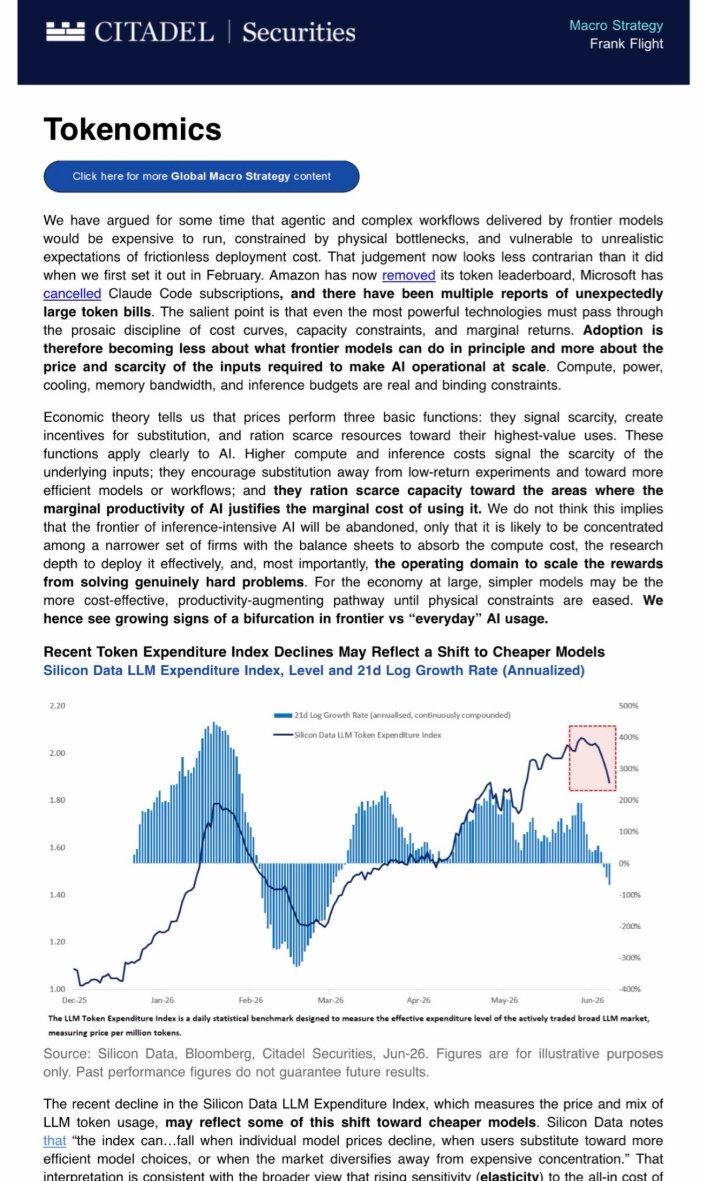
Today @Citadel has come out and covered the shift toward cheaper AI models
This is squarely in line with my thesis
x.com/Moshaikh/status/206471…
Jun 2

The most basic way AI could blow up imo. I'm not saying it does but this is the most obvious way I can see it happening
- Per seat subscriptions are massively subsidized. The flat fee was priced way below what heavy usage actually costs
- For real business use you have to move to the API anyway. Data protections, work integrations and compliance officer approval
- On the API you pay metered rates, and businesses are burning credits way faster than the per seat pricing ever led them to expect
- This is everywhere right now. Internally for us, Codex users, Uber torching its entire 2026 AI budget in 4 months, the Microsoft comments. Just go try an API
I shared more on this here: x.com/Shaughnessy119/status/…
- And I don't think most businesses have the money to keep paying increasing API rates without a real change to how they operate (caps needed)
- Because they have a cheap alternative. They can reach open source models through any aggregator (OpenRouter, Venice, Baseten, Together) and still get strong privacy. Venice private data centers, or E2EE/TEE serving GLM 5.1.
More on open source inference provider raises here: x.com/Shaughnessy119/status/…
- And the discount is enormous. DeepSeek V4 codes within a hair of Opus on SWE bench at roughly 1/30th the price, and the cheapest open models run closer to 1/100th
- Chinese labs open source frontier grade models. The model is the single biggest cost an inference provider has, and they get it for free
- This idea dies if China goes closed source. That is actually bullish web2 AI labs, because if everyone is closed you pay up for the best intelligence. China goes closed source if they are tired of giving away an asset and they want the revenue and data flow to train new models
- Is this showing up in web2 AI lab revenue yet? No. Revenue is off the charts. Anthropic went from 9B to 47B run rate in five months
- So go forward, what happens?
- I think revenue slowly starts leaking to the open source inference providers (see Venice usage, OpenRouter's $113M raise, Baseten is raising at $11B or triple its valuation in three months, on revenue that went from $200M to $600M annualized in a single quarter)
- It doesnt move overnight, but it caps the labs ability to raise prices, and margins are already deeply negative. OpenAI is reportedly running near negative 122%
- With margins that bad there is no cash flow, so the labs are fully dependent on outside capital to buy GPUs, train models, and keep subsidizing usage (I.e. see Google tapping $80b equity sale, granted 30b for employee RSU taxes. Clearly they think Equity is overvalued or you wouldn't sell it)
- The break comes when that capital stops. Pricing is capped so margins cant improve, and the moment investors lose conviction on payback, the whole flow reverses
- Why would they lose conviction on payback? Back to the start - the inability to improve margins or get businesses to pay more
- This is also limiting, if we start making new drugs with AI or create entirely new businesses, you better believe people will pay up to the max for AI usage
38
88
994
320,008
Ben H retweeted

Jun 8
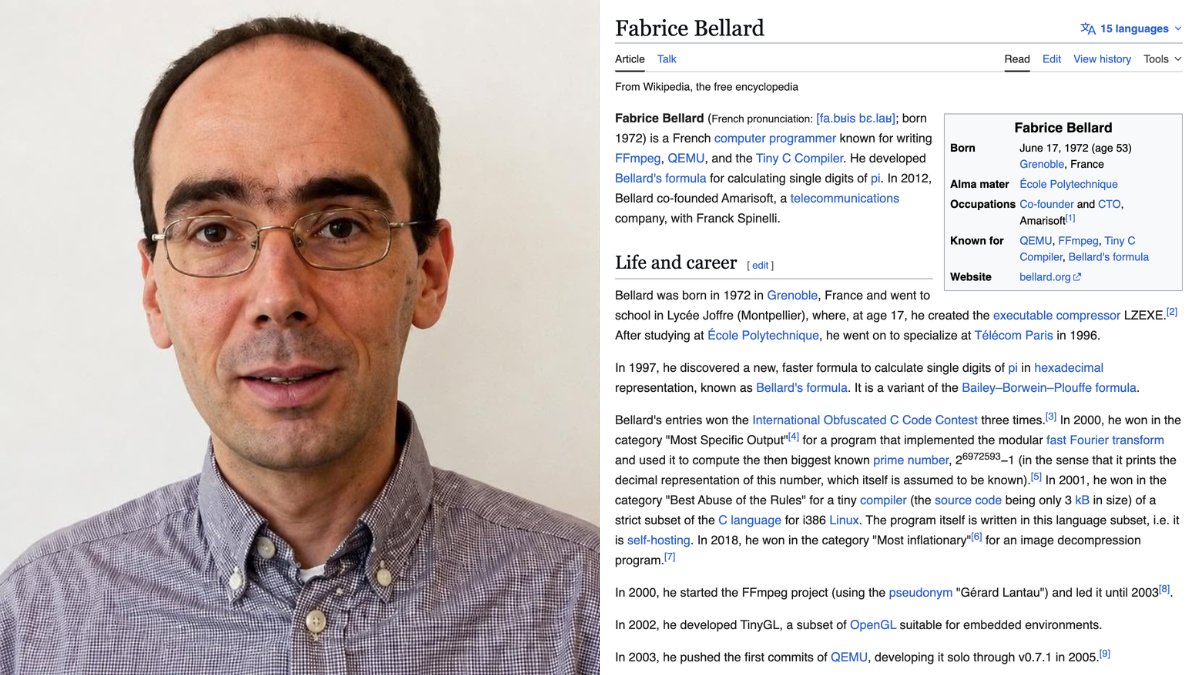
A French engineer who lives quietly in Paris has spent 30 years writing software that the entire internet now runs on without knowing his name.
He wrote the code that streams every YouTube video, every Netflix show, every TikTok clip. He wrote the code that runs the virtual servers underneath AWS, Google Cloud, and Microsoft Azure. He calculated more digits of pi than anyone in history. He has no Twitter. He has no marketing. He just keeps shipping.
His name is Fabrice Bellard.
Here is the story, because almost nobody outside the systems programming world knows what one man has built.
Fabrice was born in 1972 in Grenoble, France. He studied at École Polytechnique, the top French engineering school. He never went to Silicon Valley. He never built a startup empire. He just wrote code.
In 2000 he started a project called FFmpeg, an open-source multimedia framework for encoding, decoding, and streaming video. He was 28. The project did one thing nobody else had done well. It handled every video and audio format that existed, in one library, on every operating system. He led it himself for years.
Today FFmpeg is the invisible engine of the internet. YouTube uses it. Netflix uses it. VLC uses it. Chrome and Firefox use parts of it. Every Android phone, every iPhone, every smart TV, every video editing tool you have ever touched runs FFmpeg somewhere underneath. If you have watched a video on a screen in the last 20 years, Fabrice's code processed it.
He was not done.
In 2003 he started QEMU, a machine emulator and virtualizer. He wrote it solo until version 0.7.1 in 2005. QEMU lets you run any operating system on any other operating system. It became the foundation of modern virtualization. KVM, the Linux kernel hypervisor, runs on top of QEMU. Every major cloud provider, AWS, Google Cloud, Microsoft Azure, IBM Cloud, runs virtual machines on infrastructure built around it. The Quick Emulator is the most cited piece of cloud infrastructure code on Earth.
He kept going.
In 2001 he won the International Obfuscated C Code Contest with a small C compiler that grew into TCC, the Tiny C Compiler. TCC can compile and boot a Linux kernel from source in under 15 seconds. In 2004 he calculated the most digits of pi ever computed at the time, using a personal desktop computer and an algorithm he derived himself called Bellard's formula. In 2011 he wrote a complete PC emulator in pure JavaScript that runs Linux in your browser, a project called JSLinux that engineers still cannot believe is real.
In 2019 he released QuickJS, a small but complete JavaScript engine that fits where V8 cannot. In 2021 he released NNCP, a neural network based lossless data compressor that immediately took the lead on the Large Text Compression Benchmark.
Then he turned his attention to large language models. He built TextSynth Server, a web server with a REST API for running LLMs locally. He released ts_zip and ts_sms, compression utilities that use language models to compress text and short messages at ratios traditional algorithms cannot reach. He released TSAC, a very low bitrate audio compression system. In December 2025 he released Micro QuickJS, a new JavaScript engine for microcontrollers, separate from QuickJS, designed for environments with almost no memory.
Fabrice co-founded a telecom company called Amarisoft in 2012, where he serves as CTO. Amarisoft builds 4G and 5G base station software used by carriers and labs around the world. He has been running it for over a decade while continuing to ship personal projects from his own home page at bellard dot org
He has no Twitter. He has no Instagram. He gives almost no interviews. His personal website is a flat list of projects with no styling, no fonts, no marketing copy. Just titles and links.
A quiet French engineer who never moved to Silicon Valley wrote the code that quietly runs the internet.
He is still shipping.
386
4,581
25,557
3,133,090
Ben H retweeted

May 29
LARRY ELLISON: AI IS RAPIDLY COMMODITIZING BECAUSE MOST MODELS ARE TRAINED ON THE SAME PUBLIC INTERNET DATA.
THE REAL COMPETITIVE EDGE ISN’T THE MODEL ANYMORE — IT’S ACCESS TO EXCLUSIVE, PROPRIETARY DATASETS.
THAT MAY BE THE ONLY MOAT LEFT.
387
612
5,663
3,295,442
Ben H retweeted

May 28
Why Paris may be the most important AI city outside Silicon Valley techcrunch.com/2026/05/28/wh…
19
42
139
37,865
Ben H retweeted

May 27
Real-time neural rendering model @moonlake
Works on from any physics/game engine to close the sim-to-real gap.
If this is relevant to your team, I'd love to chat (my DM is open)!
13
37
295
48,693

In 2023, a study tracked 24,000 professional athletes across 150 years of records. Published in Science Advances.
The discovery: how fast an athlete’s performance declines predicts how long they live. Not during their career. Decades after retirement. The speed of decline is itself a biomarker for aging.
Tonight, the @enhanced_games are publishing every drug protocol, running medical teams, and measuring performance to the hundredth of a second. 42 athletes. All young. All on testosterone and growth hormone.
But imagine the same format applied to aging.
A retired sprinter. 55 years old. Personal best of 10.3 seconds from 25 years ago. Currently running 11.8. You put them on a rejuvenation protocol, published, supervised, same infrastructure.
They run 10.9.
In one race, you’ve demonstrated what the longevity field has been trying to prove for a decade. And everyone watching understood it without reading a single paper.
May 22

The dopiness of the Enhanced Games this weekend. They will further promote the use of unregulated and way off-label use of peptides, sold and marketed by enhanced.com, such as growth hormone (below from their website), with baseless claims
3 good pieces on these games
1. @TheLancet
thelancet.com/journals/lance…
2. @TechReview technologyreview.com/2026/05…
3. @TheEconomist economist.com/interactive/18…

2
5
29
13,398
Ben H retweeted

May 10
Blackrock CEO Larry Fink said:
"The United States 🇺🇸 is short power, short compute, short chips. There are going to be shortages in all three. We just don't have enough compute power right now."
May 10

LARRY FINK JUST PREDICTED A NEW ASSET CLASS
The BlackRock $BLK CEO laid out where he sees the bottleneck of the AI buildout at the Milken Institute.
His framing of the problem:
"The United States is short power, short compute, short chips. There are going to be shortages in all three. We just don't have enough compute power right now."
His prediction for what comes next:
"I actually believe a new asset class will be buying futures of compute."
Compute futures do not exist as a standardized tradable contract today. Fink is calling out the emergence of one.
69
68
796
186,304

May 4
Mass slopification
May 4

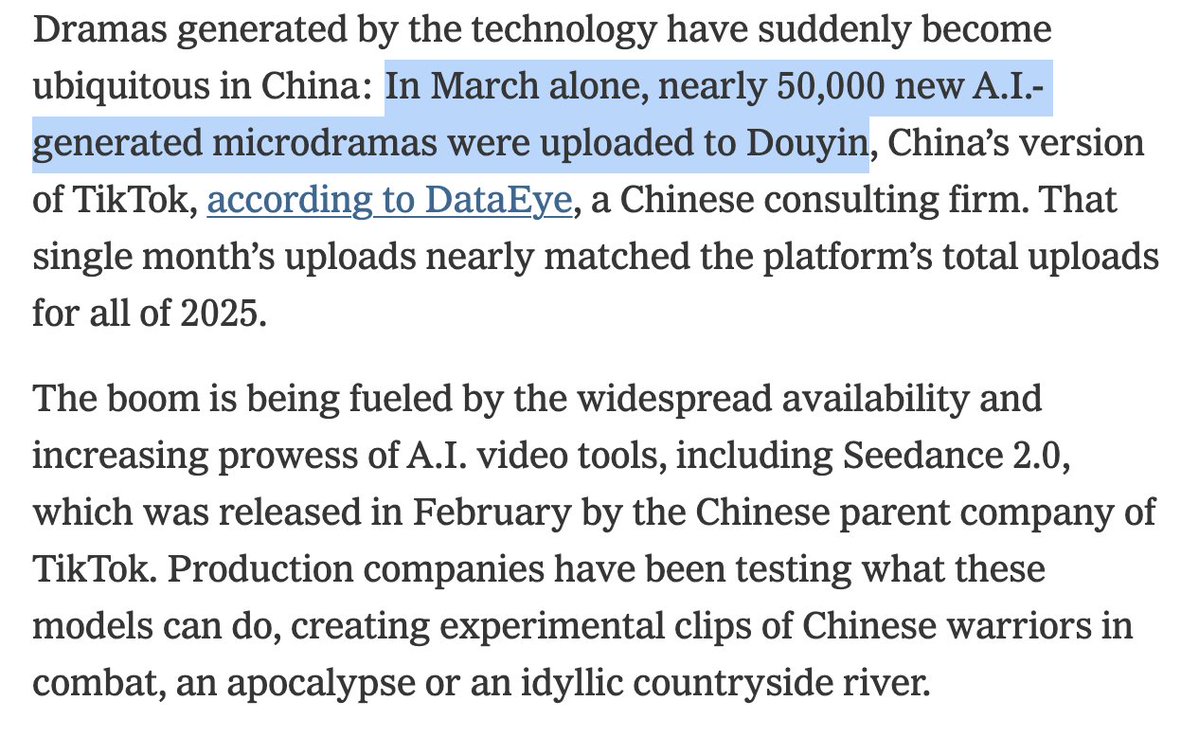
We're about to see an explosion of AI microdramas.
They've already taken over short form video feeds in China - 50k were uploaded to Douyin just last month 🤯
These are the soap operas of our time, and it makes perfect sense for them to be AI-generated.
84
Ben H retweeted

May 4
Jack Clark Co Founder of Anthropic:
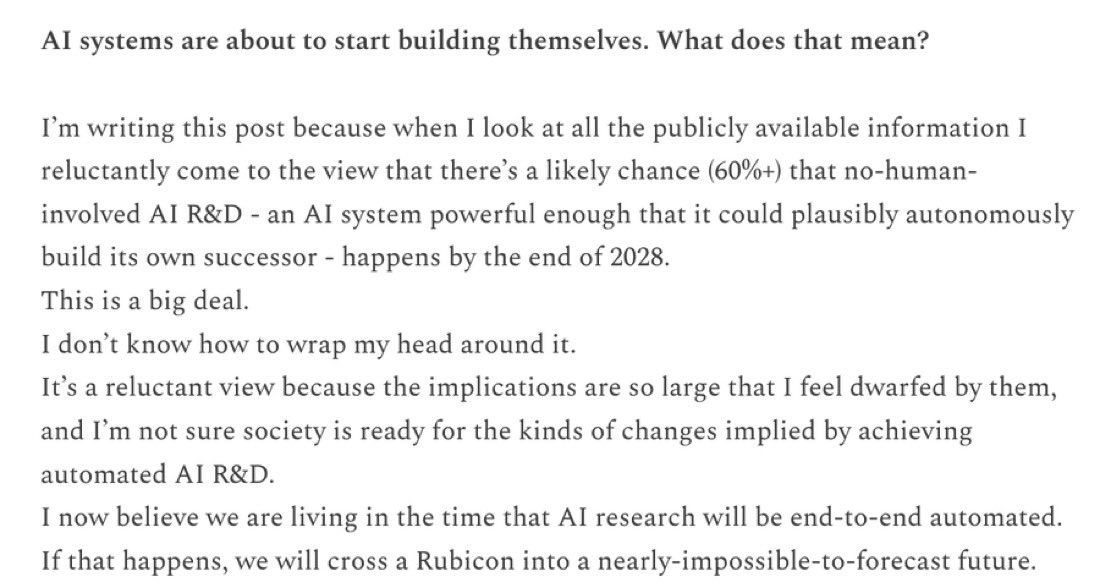
“I'm writing this post because when I look at all the publicly available information I reluctantly come to the view that there's a likely chance (60% ) that no-human-involved AI R&D - an Al system powerful enough that it could plausibly autonomously build its own successor - happens by the end of 2028.
This is a big deal.
I don't know how to wrap my head around it.”
May 4

I've spent the past few weeks reading 100s of public data sources about AI development. I now believe that recursive self-improvement has a 60% chance of happening by the end of 2028. In other words, AI systems might soon be capable of building themselves.
38
100
947
201,711
Ben H retweeted

An epic Paris of the future, illustrated by Moebius, aka Jean Giraud.

9
634
5,788
91,588
Ben H retweeted

This is so weird, why is Google, the world's biggest search engine, using another startup's search engine?
Apr 28

We're excited to partner with Google to offer Grounding With Exa inside of Gemini models!
Using Exa's agent-first search, Gemini models can now access billions of websites, technical docs, papers, people, companies, and more.
10^18🤝10^100

33
5
110
27,590