
B👇C👇D👇 ✌️✌️- the geek adventure goes free
Joined September 2008
- Tweets 15,674
- Following 919
- Followers 1,243
- Likes 22,499
2,709 Photos and videos















Pinned Tweet
Here is another idea for a new Olympic sport:
Ppl who use ‘AI’ (thinking it is skynet) and making business critical mistakes.
Eh - probably just stick with the dogs ruining sports idea instead. 🐕 ⛷️
x.com/zackkorman/status/2031…

The fact they kept switching camera angles like it's an actual Olympic event is sending me 😭😭
15
1
3
2,231
Here is another idea for a new Olympic sport:
Ppl who use ‘AI’ (thinking it is skynet) and making business critical mistakes.
Eh - probably just stick with the dogs ruining sports idea instead. 🐕 ⛷️
x.com/zackkorman/status/2031…
The fact they kept switching camera angles like it's an actual Olympic event is sending me 😭😭
15
1
3
2,231

Jun 15
Make it an Olympic sport already…
Animals ruining things 🐱

A cat took to the stage during the final scene of a Romeo and Juliet ballet performance by the Imperial Russian Ballet Company in İzmir
1
56
Needs more animals ruining things
🐕 🐈 🦎


13
Jun 13
If it’s that good / put it in the Index librorum prohibitorum
I have a copy if you need it (needs updating)
historyback.com/en/story/100…

51
Jun 13
Someone page Barbara Streisand 🍿
Jun 13

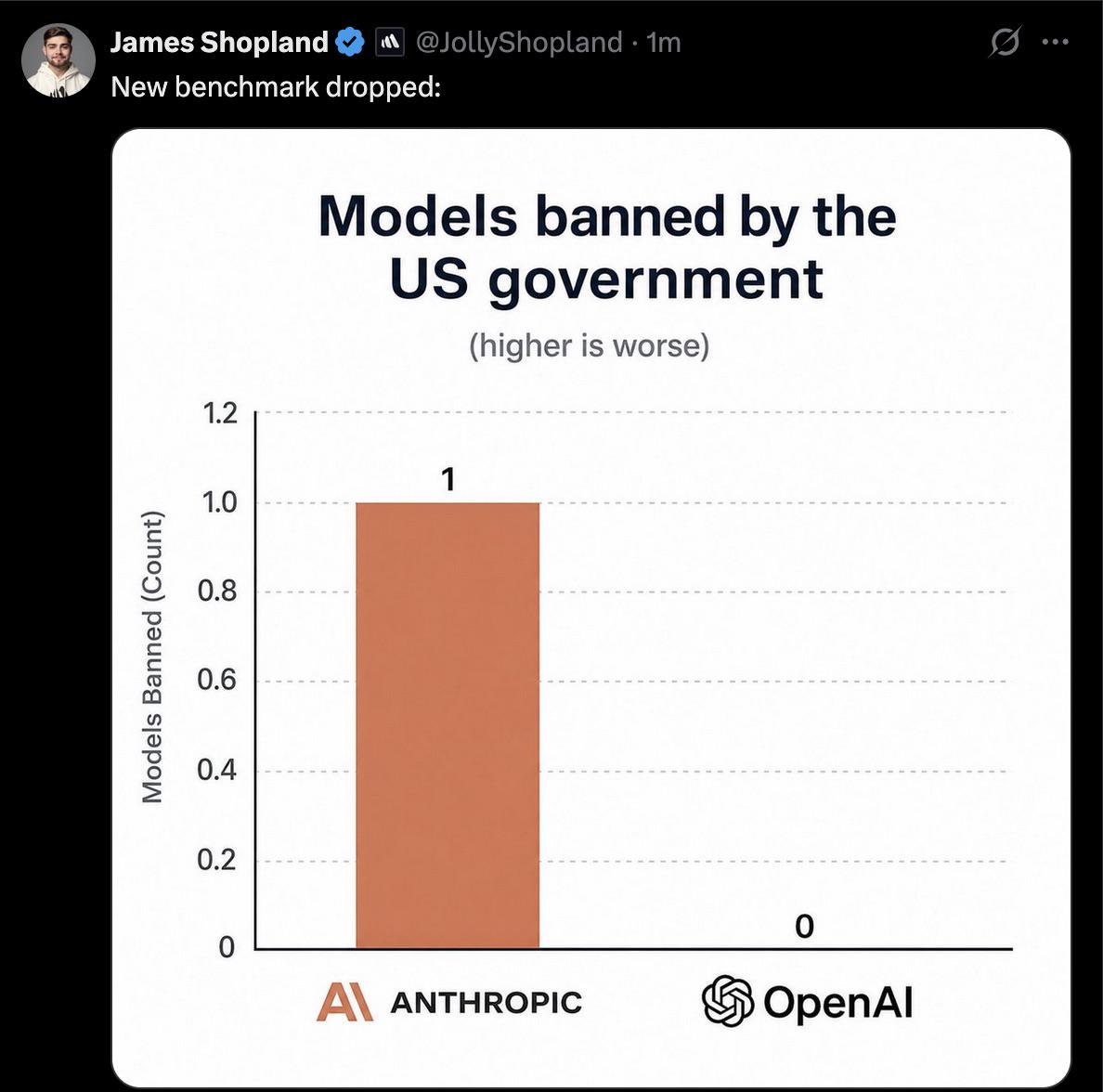
The US government, citing national security authorities, has issued an export control directive to suspend all access to Fable 5 and Mythos 5 by any foreign national, whether inside or outside the United States, including foreign national Anthropic employees.
The net effect of this order is that we must abruptly disable Fable 5 and Mythos 5 for all our customers to ensure compliance.
Access to all other Claude models is not affected.
We apologize for this disruption to our customers. We believe this is a misunderstanding and are working to restore access as soon as possible.
Read our full statement: anthropic.com/news/fable-myt…
19
benjaminbey c dean retweeted
Jun 13
‘AI’ for me but not for thee
1
1
39
benjaminbey c dean retweeted

This is a thousand monkeys working at a thousand typewriters.
Soon, they'll have written the greatest novel known to man!
16
156
1,334
50,805
Jun 12
7
Jun 11
To be very clear:
I have no problem with the ‘better search engine’.
All the tools, MCP connections, etc. anything is easy if you know how to do it.
From what I’ve seen - many do not know what they’re doing. This creates massive liability risk.
Let’s see how it plays out.
Jun 11

Listen - this is obvious (I know from 1980s AI developers who mentored me:
The boom bust cycle is known with new (particularly capital intensive) tech cycles.
What happens now is… (some of the infrastructure) is built and then either consolidation or outright nationalization.
Choo-choo 🚂
24
Jun 11
Listen - this is obvious (I know from 1980s AI developers who mentored me:
The boom bust cycle is known with new (particularly capital intensive) tech cycles.
What happens now is… (some of the infrastructure) is built and then either consolidation or outright nationalization.
Choo-choo 🚂
1
63
Jun 11
There is a somewhat interesting competitive dynamic at play (see below).
A question: why would such a large proportion of 18-25yo ppl (roughly speaking) be so averse to this ‘better search engine’?
It is not because it sucks - but if you are told to use it then it sucks.
Jun 9

More AI-generated code doesn't make your team faster. It might actually slow you down.
1
45
Jun 11
Most don’t know how to use ‘it’.
A bit like ppl who would make their secretaries write emails because they couldn’t configure the POP3/SMTP setup.
This is very interesting. Especially for law firms, financial service producers and insurers.
You are in enormous trouble. 🦊
13
benjaminbey c dean retweeted
Jun 11
Yawn 🥱
The AI Winter of the 1980s
The term “AI winter” refers to periods when funding, interest, and progress in artificial intelligence dried up dramatically. The 1980s saw one of the most significant such collapses, though it was preceded by a brief boom.
The Expert Systems Boom (early 1980s)
The decade actually began with optimism. “Expert systems” — programs that encoded human expertise as rules to solve domain-specific problems — were the hot technology. Systems like XCON (used by Digital Equipment Corporation to configure computer orders) showed real commercial value, and companies poured money in. Japan’s ambitious “Fifth Generation Computer” project, launched in 1982, alarmed Western governments into funding their own AI programs.
Why It Collapsed
By the mid-to-late 1980s, the cracks were showing:
•Brittleness. Expert systems worked well in narrow, well-defined domains but failed badly outside them. They couldn’t generalize or handle unexpected situations.
•The knowledge acquisition bottleneck. Encoding human expertise into rules was painstakingly slow and expensive. Experts struggled to articulate their own tacit knowledge.
•Maintenance nightmares. As rule sets grew, they became contradictory and unmanageable.
•Hardware limitations. The specialized “Lisp machines” that AI ran on were expensive and undercut by cheaper general-purpose workstations.
The Fallout
By the late 1980s into the early 1990s, the market for AI hardware and software collapsed. The Lisp machine companies (Symbolics, LMI, etc.) went bankrupt or shrank drastically. DARPA and other government funders cut budgets sharply after overpromising results. Corporate AI labs were shuttered.
Legacy
The winter wasn’t total stagnation — important foundational work continued quietly, including early neural network research (backpropagation was popularized in 1986). But it bred lasting skepticism: for years, researchers avoided the label “AI” on their work to escape the stigma. That caution arguably contributed to the field’s more grounded, incremental progress that eventually led to the deep learning revolution decades later.
1
59
Apr 22
A NEW potentially entertaining Olympic Sport (summer or winter):
_Lawyers submitting documents to Court that have been generated by LLMs!_
There are only 300 documented instances so far.
How far can it go!
Maybe place it on Polymarket? 😂🙈
joneswalker.com/en/insights/…
Here is another idea for a new Olympic sport:
Ppl who use ‘AI’ (thinking it is skynet) and making business critical mistakes.
Eh - probably just stick with the dogs ruining sports idea instead. 🐕 ⛷️
x.com/zackkorman/status/2031…
2
1
335
Jun 10
.
Jun 10

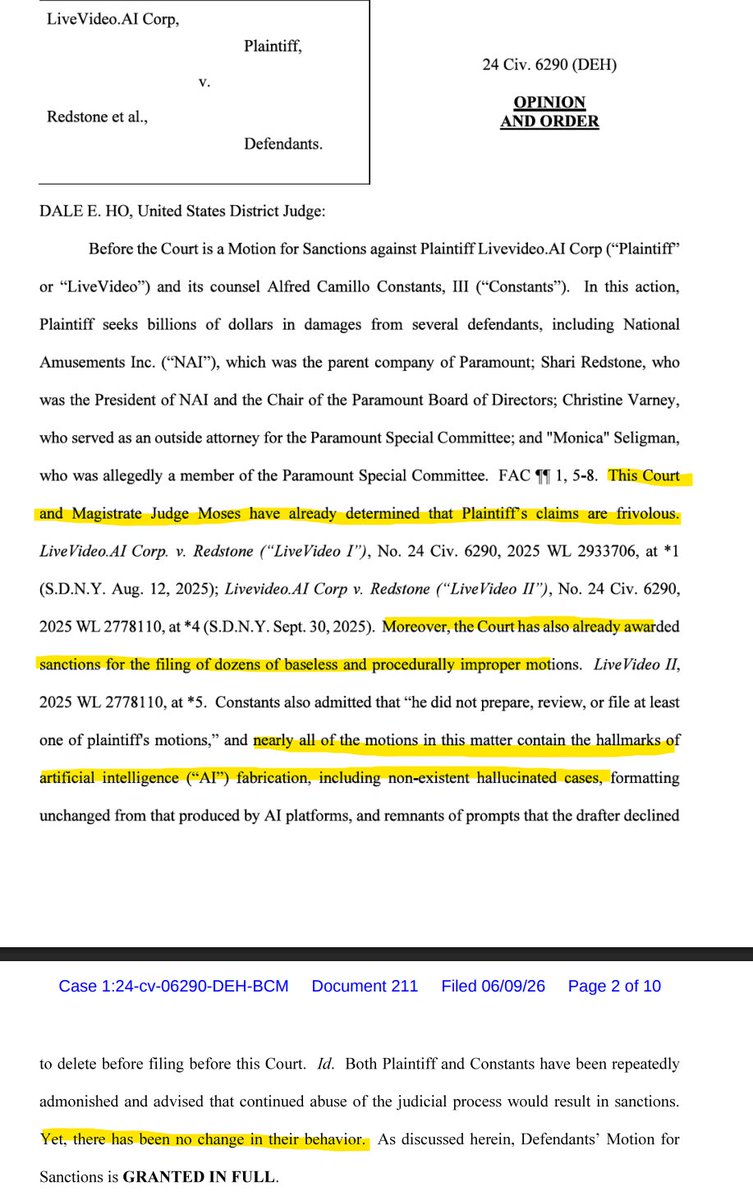
Lawyers, AI misuse, and sanctions: WTF edition.
LiveVideoAI brought frivolous (court's word) claims against several defendants.
Its counsel was previously sanctioned in the same case "for the filing of dozens of baseless and procedurally improper motions."
"Nearly all the motions in this matter contain the hallmarks of artificial intelligence ('AI') fabrication, including non-existent hallucinated cases...."
"Yet, there has been no change in behavior."
Counsel was already sanctioned in the amount of $10,000 and referred to a grievance committee.
Despite that, LiveVideoAI "has continued to file a flurry of frivolous motions" that were "filed in direct violation of the Court's order."
LiveVideoAI's opposition to this sanctions motion "again appears to be drafted entirely by AI and contains hallucinated case citations."
And LiveVideoAI "has continued to file meritless motions since the conclusion of briefing on the sanctions motion."
Sanctions: $85,056 in fees. Lawyer referred to grievance committee again.
1
27
Jun 10
.

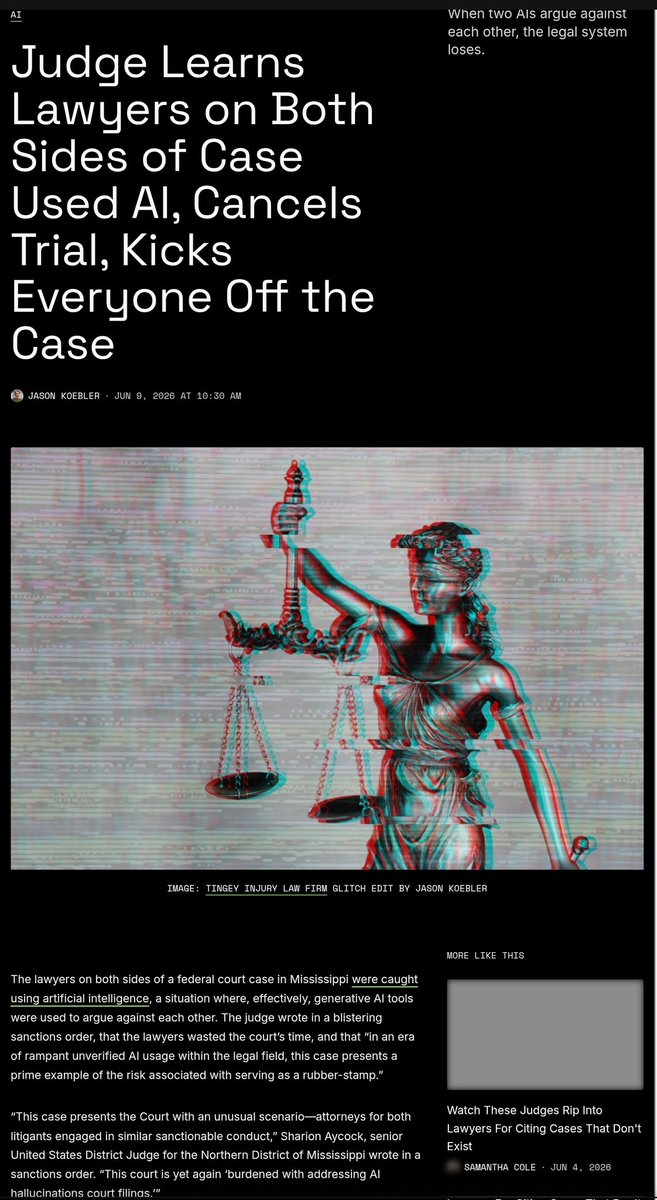
Amazing stuff here. A judge realizes both the prosecution and defense used AI and therefore throws out the cade.
archive.ph/2026.06.09-153738…
5
Let me make this clear.
Every obvious vulnerability will be exploited, automatically, until morale improves.
And that includes those who have deployed ‘smart contracts’ (neither smart nor contracts, just code).
Where is my popcorn? 🍿
2
1
197
.

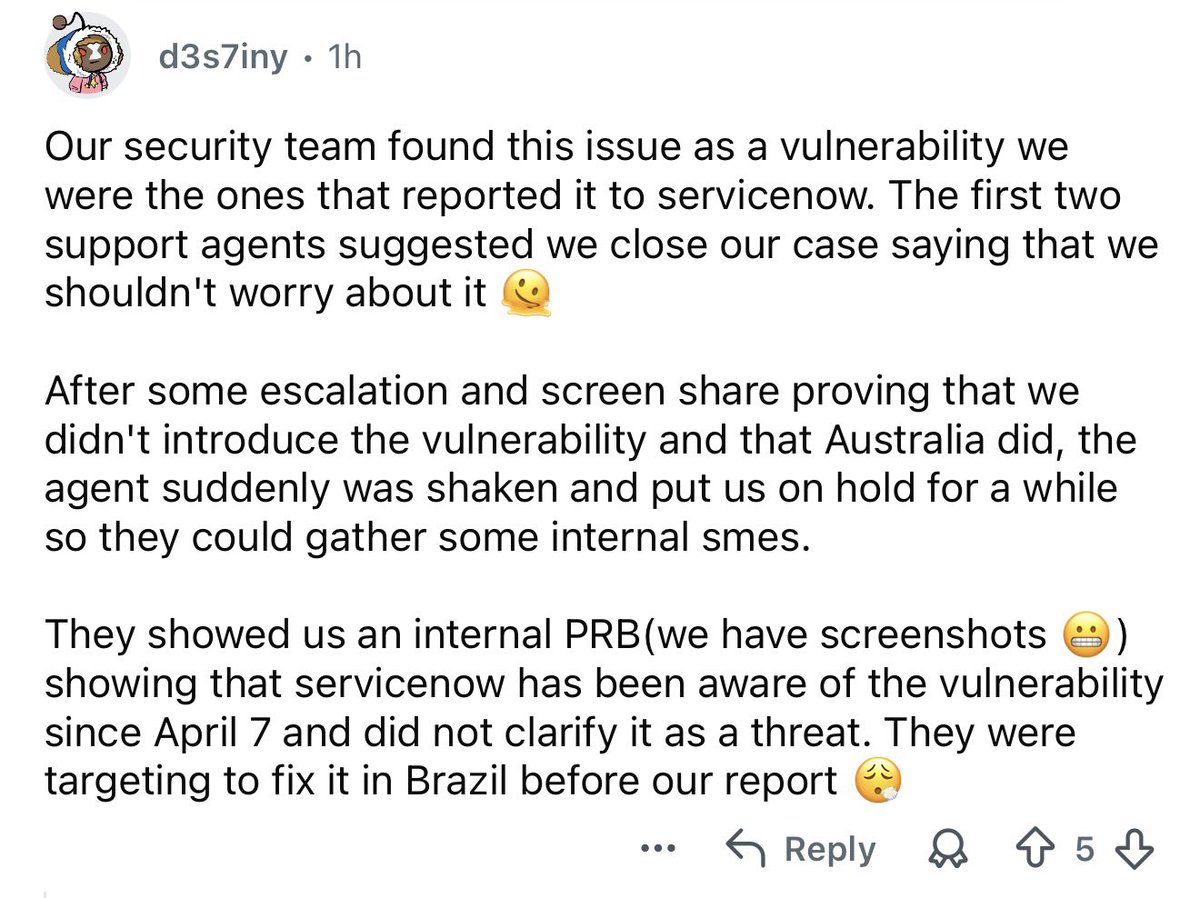
‼️🚨 BREAKING: ServiceNow has been breached. Customers are reporting unauthorised access to their instances.
One customer states their security team reported this vulnerability to them, and they closed the case twice, saying they had already known since the 7th of April.

27
Olympic sport material

1
92
Could win gold medal 🥇

88