
Joined October 2018
- Tweets 5,635
- Following 1,376
- Followers 3,726
- Likes 16,643
437 Photos and videos





- a tam greater than any individual public company (non-sovereign sov)
- a team as mission-driven, capable, and resilient as anyone (a decade in the making)
- confluence of strong tailwinds (surveillance, wealth tax, quantum, reduced supply inflation)
- going thru a (completely solvable) crisis
greatest venture bet in the world since ethereum 2014

zcash is starting to feel exactly like the early days of bitcoin. some of the smartest ppl contributing to the project. some of the biggest midwits on the other side. bugs and existential threats. vomit-inducing price volatility. but also insanely asymmetric upside if it catches on.
28
44
334
53,304



Jun 12
Wow 🤩
Jun 12

Thanks, Anthropic, for helping protect Zcash users. At Shielded Labs’s request, they ran a security audit of Zcash with Mythos. It did not find any more serious bugs in the Zcash protocol. Shielded Labs and others are continuing security hardening work. Stay tuned for updates.
5
238
Jun 12
Everyone framing the Zcash Orchard bug as an AI win. A model finds in a day what world-class cryptographers missed for four years. Great headline.
But that's the less interesting half of the story. The part actually worth talking about is formal verification, and the fact that barely anyone uses it.
We already have tools built to catch this exact class of bug. Picus, Ecne, QED2, Coda. And under-constrained circuits aren't some new exotic threat, they've already turned up in Tornado Cash and Aztec. The field knows this failure mode well.
So why did none of them catch Orchard? The answer is kind of boring. Most of those tools were built for R1CS and Circom. Taking a real production Halo2 circuit and turning it into something a solver can actually chew through at scale is still half-built. Veridise hit the same wall extracting SP1 circuits: production zk systems are still ahead of what these solvers can ingest at scale. So it was never about whether the math works. It was cost and coverage. Nobody had pointed the heavy machinery at that circuit.
That's the part AI changes, and it has nothing to do with "AI finds bugs."
Two things. First, it tells you where to look. Hornby model didn't prove anything. It narrowed down which gadget to stare at, inside a circuit way too big to formalize by hand. It's basically a targeting system for methods that are otherwise too expensive to point at everything. Second, the proofs themselves. Writing a spec and closing the proof has always been months of PhD-level grind, which is exactly why so few teams bother. The Lean 4 and LLM work coming out now is starting to pull that from months toward weeks. That's the real shift.
And the actual guarantee still comes from the prover, not the model. The model's a guessing machine. Prompt it right, it finds the bug. Prompt it wrong, it walks straight past it. The formal verifier is the only piece that checks every possible adversarial input with no exceptions.
So the way I see it: AI is what finally makes formal verification cheap enough to be worth doing. And the proof is what turns an AI finding into something you can stand behind, instead of one more result you're just trusting.
This matters most where you can't see the damage. An audit can only ever tell you nobody's found a problem yet. It can't promise there isn't one. A proof can. And when a bug leaves zero trace on-chain, that gap is the whole game.
Certora already moving on this, wiring formal verification into the AI codegen loop. Zcash is going to formally verify its own circuits.
So this isn't some hunch about where security's heading, it's already underway. The gap is everyone else, the thousands of teams that'll never get a custom Zcash-style verification project.
That's the gap we're building QuillShield to close: an AI auditing agent that puts formal verification right inside the loop, so proof-backed assurance stops being a luxury reserved for teams that can fund a bespoke engagement. The bug is the easy part. Making the proof something every serious protocol can actually reach is the thing worth building.

2
12
424
Jun 12
Men used to text close friends when they stepped outside.
Now they just open Dispatch.
4
75
Rajat Gahlot retweeted

Jun 11
We're excited about the US CLARITY Act.
We think all YC companies will use crypto technology, like stablecoins, before long. Not just crypto startups, not just fintech startups, but every company.
Here's why this law is such a big deal 🧵
x.com/SenLummis/status/20637…

The Clarity Act passed committee. The floor is next. We did not come this far to quit at the 5 yard line.
70
268
1,561
265,292
Rajat Gahlot retweeted

Jun 11
4
14
1,608
Rajat Gahlot retweeted

Jun 10
Crypto is entering a consolidation phase.
In the dotcom era, the markets simultaneously (a) overpriced the losers and (b) underpriced the eventual winners.
The winners and the market size turned out to be way bigger than we imagined.
Top crypto projects with sufficient cash and runway to dominate their respective verticals will sweep the upcoming market.
44
61
339
68,837
Rajat Gahlot retweeted

Jun 10
DeFi will have quietly died by the end of this year.
It is now reborn as “onchain finance”.
77
43
598
70,802
Rajat Gahlot retweeted
Jun 8
This week, I'm attending @ethconf in New York City.
I'm also hosting an event, "AI & Formal Verification for Onchain Finance," alongside it.
if you're building or securing onchain finance, come say hi 👇
luma.com/qwsnw8n2
2
6
19
560
Rajat Gahlot retweeted

Jun 10
hot take (?): people should think more and “grind” less
models increase productivity and execution speed but that also means it increases the cost of making the wrong decision/taking the wrong path
it becomes increasingly important what decisions you make and people should think more about what they do before doing it
11
8
120
9,461
Rajat Gahlot retweeted
Jun 7
New York has quietly become the capital of onchain finance.
Last week @stable_summit and @Vault__Summit were the best events I've been to in 8 years, less for the crypto crowd than for who's now in it: Fidelity, JPMorgan, Goldman Sachs, DTCC, BNY Mellon, S&P Global, AON, Bitwise.
The retail side of crypto is the quietest it's been in years.
The institutional side just had its loudest week ever.
1
4
32
824
Rajat Gahlot retweeted
Jun 8
🔥 QuillAudits is now officially ISO/IEC 27001:2022 certified.
The gold standard in information security, independently audited, not self-declared.
Your security is verified, not assumed.
Full breakdown of what our ISO certification means for your audit 👇

4
9
24
529
Rajat Gahlot retweeted
Jun 8
🥷 QuillAudits is coming to New York
ETHConf NYC and our CEO @raopreetam_ & CPO @bigrkg will be on the ground the entire time.
If you're building in DeFi, stablecoins, or RWAs and want to talk security, this is your shot to sit down with the people who've investigated some of the biggest exploits of 2026.
Find us at the Javits Center across all 3 days.
Whether it's a 10-minute coffee or a deeper conversation, we're there for it 🤝
📅 June 8 – 10 | Javits Center, NYC

2
4
13
696
Rajat Gahlot retweeted
Jun 6
Right now crypto investors are quietly jealous of AI, SpaceX.
What is easy for anyone to forget, is that overnight success stories are usually a decade or two in the making.
SpaceX was founded in 2002. Almost died many times.
OpenAI was founded in 2015; ChatGPT was launched 7 years later; has almost died many times even in the last 18 months.
Bitcoin was created in 2009, Ethereum 2015, Solana 2018, Hyperliquid 2024.
Transformational technology stories don't plat out in a month or a quarter. And it's never a straight line — all have moments in the sun, and moments in the storm.
If your goal as an investor is to own the most important technology platforms of the future, you should expect winding journies, measured in decades.
Jun 5

Bitwise CEO: There's a tempo mismatch that most crypto natives are missing.
In crypto, "an hour is fast. A day is pretty fast. A week is a meaningful time frame, and nobody can remember what happened 4 weeks ago."
But the mainstream investor now entering the space?
For them a month is really fast and a year is a reasonable time frame.
They move at a completely different pace. The progress is real - it just doesn't feel like it to people used to measuring time in hours.
FT @HHorsley @KevinWSHPod @Bitwise.
40
30
285
70,395
Rajat Gahlot retweeted

Jun 5
Two of our worst VC stories:
1. A Sequoia partner passed on Cloudflare because he didn’t think a woman could lead a security infrastructure company. Seriously. 🙄
2. I got introduced to @pmarca. Meeting got scheduled for a Monday, which should have been a clue. I thought it was just a casual meeting. He thought it was a pitch and brought the whole @a16z partnership team. Hilarity ensued. 🤪 At one point one of them said: “You don’t seem very prepared.” Which was true because I wasn’t. I framed the rejection letter they sent.
Jun 2

I was once pitching in a board room at a top 3 VC firm for a $15M Series A.
12 people in the meeting. One of the GPs fully fell asleep. Out cold for 30 minutes. Nobody acknowledged it. Everyone just kept going.
I kept presenting my Series A slides to an unconscious man in a Herman Miller chair and somehow that was considered normal. That's venture capital.
You might fly across the country to perform for people who may or may not be conscious.
It's a dance.
And sometimes you lead and sometimes you follow and sometimes your partner is unconscious.
If you're raising right now, just know: every founder has a story like this. The process is weird. The power dynamic is weird. You're not crazy for thinking it's weird.
No one talks about it because they want to continue raising. But I'm happy to stick my neck out there.
It is weird.
184
258
7,359
4,431,536
Rajat Gahlot retweeted
Jun 5
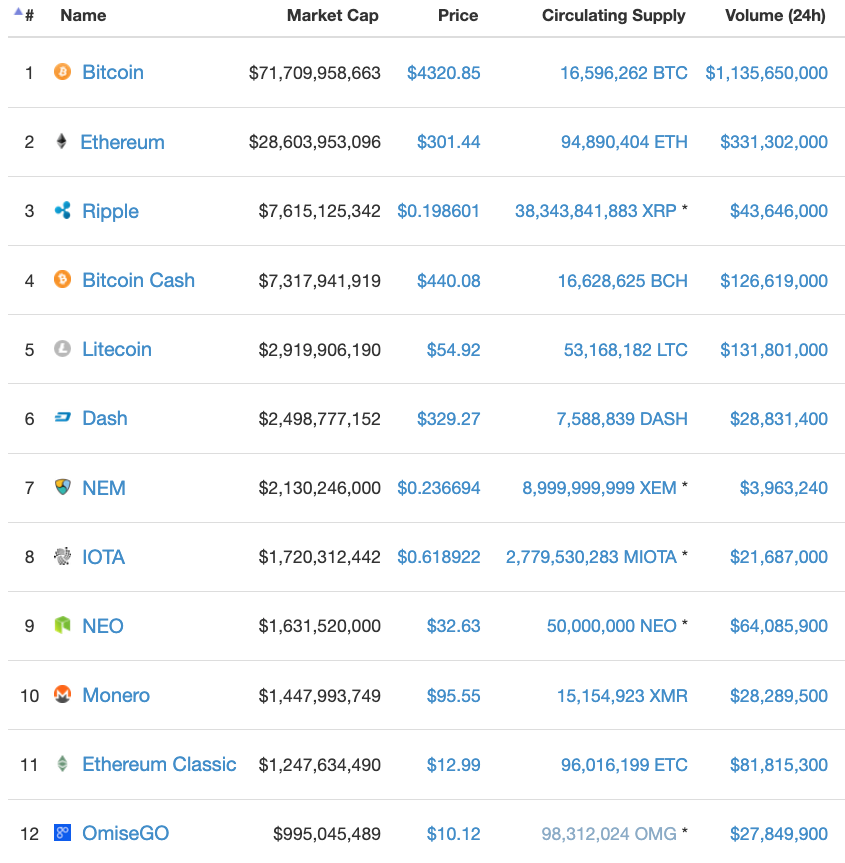
When @Bitwise started in 2017, these were the leaders:
* Leading custodians: Xapo, Kingdom Trust
* Leading crypto funds: Metastable, Polychain, Blockchain Capital, Pantera
* Leading exchanges: Poloniex, Bittrex, Bitfinex, BitMEX, Bitstamp, Kraken, GDAX, Coinbase
* Leading assets included: NEO, OmiseGo, NEM, DASH, IOTA, BCH, ETC, BTC, ETH, XRP
Every few years, crypto has a changing of the guard.
Some of the leaders who got us here don't continue. Others do.
2026 is a changing of the guard. A new vintage is beginning.
The crypto community feels it. People are feeling an subconscious sense of loss, nostalgia, uncertainty.
But remember too, there's a rebirth, and great new things around the corner.
20
18
141
19,414