
I've been called a business savvy techno geek. I solve hard problems with technology (yes, even AI). Take pictures of stuff when I can.
Joined March 2008
- Tweets 10,607
- Following 1,299
- Followers 847
- Likes 4,581
545 Photos and videos












Pinned Tweet

19 Sep 2023
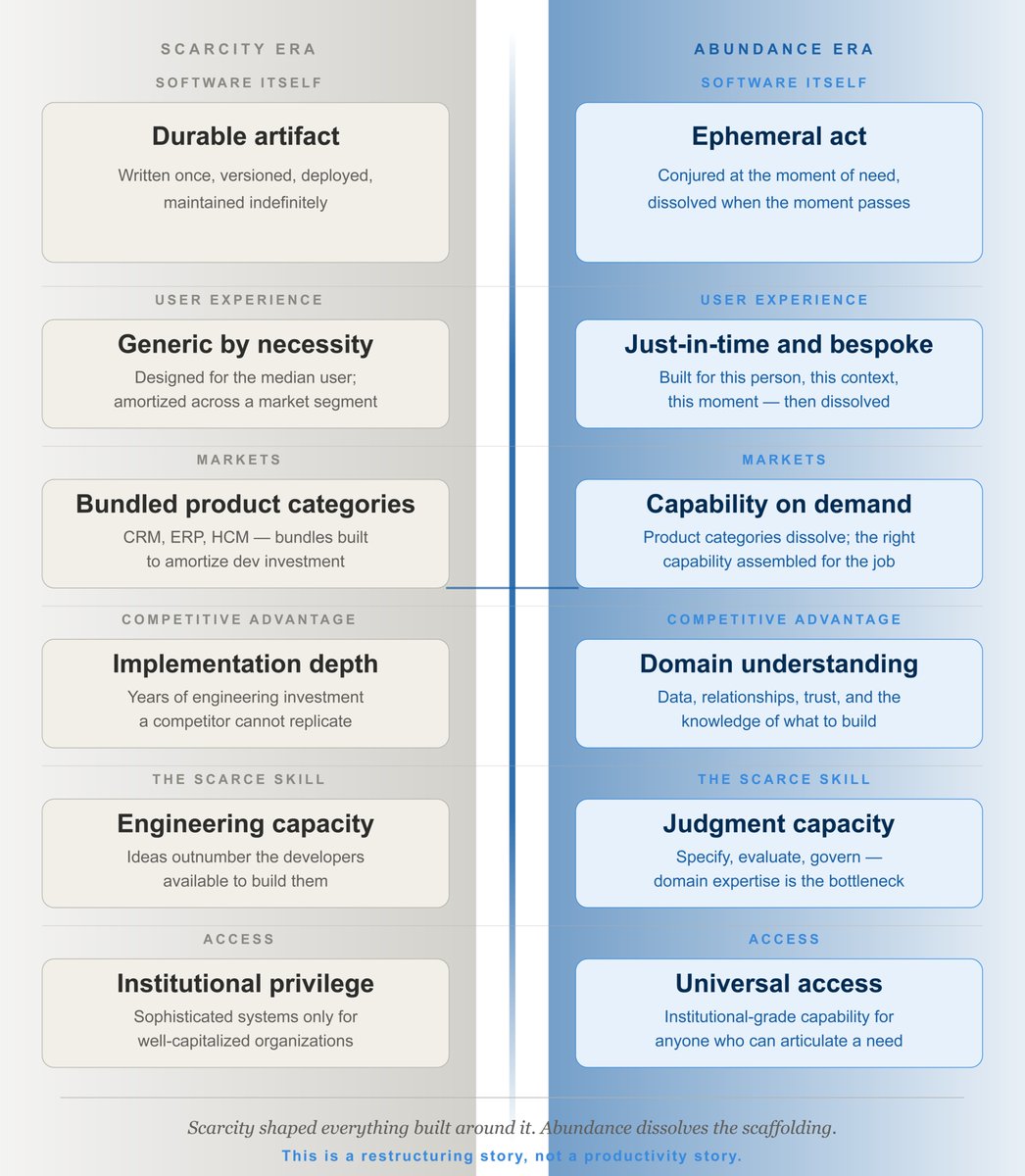
There is a story behind this image. You can't see the story just by looking at it though. But, I've watermarked this image, which means a lot of things...

2
1
14
5,115
Jun 15
Feed cleanse. The Milky Way above the Big Thompson River and Moraine Park in Rocky Mountain National Park. From last weekend.
The East side of the park can be tough for Milky Way early in the year as the light pollution from Estes Park, Boulder, and Denver is very visible.
But, conditions were great, and there was a lot of airglow (green stuff in the sky) which add a little something.
1
56
Jun 15
The AI deployment gap isn't closing on its own.
Enterprises are stuck between two unsolved problems: workflows designed for humans, not machines, and governance infrastructure that doesn't exist yet.
If you're building for enterprise AI adoption, that's your whitespace.
For reference, 4 out of 5 otters agree. (One of the otters lives off grid, so...)
medium.com/@bstg/the-diffusi…
1
2
228
Jun 15
BTW - watch the Keynote from @sequoia Ascent event, it's fab. youtube.com/watch?v=LRo33rnv…
2
71
Jun 4
Of course you need context to enable workflows run by autonomous AI.
The trap is getting so focused on harnessing that context and rebuilding the agentic AI workflow around it, you forget to optimize the workflow. And maybe even forget to start capturing new context once you launch.
The question to ask before "Where is the context we need?" is "How could this be optimized now that smart little agents are running the workflow?"
Otters would never catch fish with a rod and reel, even if they discovered how to keep knots out of the line and when to use a net (OK, I don't have any scientific evidence to back this up, but I'm comfortable with my statement)
medium.com/p/39152d269735?po…
2
3
150
Ken Sickles retweeted

May 28
State of Enterprise AI 2026: @levie on Tokenmaxxing, The Rise of Headless, and AI-Proofing Your Job
00:00 Intro
01:18 Silicon Valley engineering vs. everyone else
05:35 Are enterprise CIOs actually bullish on AI?
08:51 Tokenmaxxing & why your AI bill is about to explode
11:34 The myth of falling token costs and AI spend escaping IT budgets
17:37 The $5B startup hiding in AI compute
18:14 The mosaic of models inside every enterprise
21:28 Why coding works and the rest of knowledge work doesn't
25:53 The Bob and Sally problem: access control breaks agents
30:31 Will enterprise AI really take 10 years to roll out
32:24 The capability overhang: why faster models slow diffusion
34:23 Data is the bottleneck (it always was)
39:02 The rise of internal forward-deployed engineers
41:23 Why the AI doomers are wrong about jobs
43:43 Headless software is inevitable
46:14 What replaces per-seat pricing
47:37 How Box itself is going headless
49:42 How the org chart actually evolves
1:00:33 Future-proofing yourself as an enterprise employee
1:06:40 Are we all just going to work for OpenAI and Anthropic?
1:07:11 Where startups can still win as the labs move up
9
25
155
49,207

Everyone thinks "do things that don't scale" is about building relationships with early users.
Yes AND it's about generating mistakes at maximum density.
When you're doing everything manually (onboarding, support, delivery) you hit errors every hour. Each error teaches you something the dashboard never will.
The manual work IS the learning. Automate too early and you freeze your ignorance in code (and now markdown).
104
127
1,413
76,783
Ken Sickles retweeted

May 21
Founder after discovering the enterprise agreement requires SOC 2 compliance, a 12-hour breach notice, unlimited indemnity, customer audit rights, and service credits for downtime caused by the customer.
36
47
903
125,460
May 21
The real opportunity, when you have over hired and are still profitable and growing, is to let the “measurers” use AI to automate their jobs, become experts in it. Now you have AI experts that understand how your business operates today, and could operate in the future with AI at its core. What CEO wouldn’t want to be in that position in 18 months??
May 21

Cloudflare CEO Prince on how AI changes who gets laid off first:
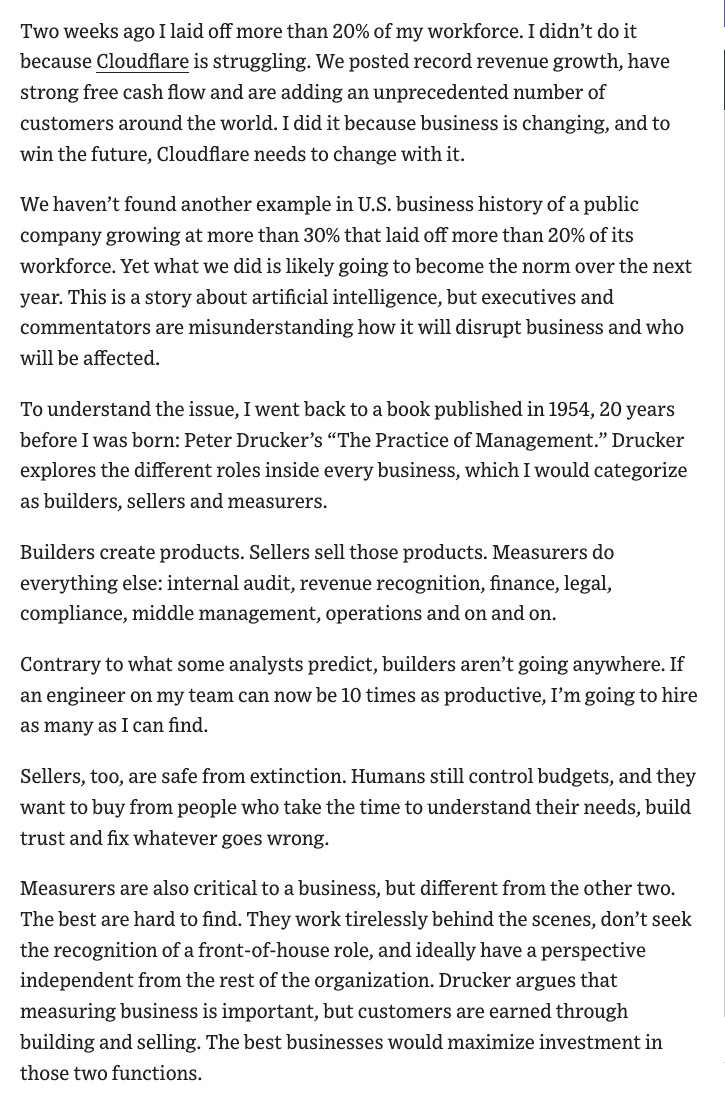
Two weeks ago I laid off more than 20% of my workforce. I didn’t do it because Cloudflare is struggling. We posted record revenue growth, have strong free cash flow and are adding an unprecedented number of customers around the world. I did it because business is changing, and to win the future, Cloudflare needs to change with it.
We haven’t found another example in U.S. business history of a public company growing at more than 30% that laid off more than 20% of its workforce. Yet what we did is likely going to become the norm over the next year. This is a story about artificial intelligence, but executives and commentators are misunderstanding how it will disrupt business and who will be affected.
AI isn’t coming for builders or sellers, but it is coming for measurers. Tireless, independent, efficient and available, AI systems can now measure an organization with a level of objective detail and precision that was previously impossible even for the best employees.
For Cloudflare, internal audit previously picked a handful of business risk areas to scrutinize each quarter. Now we’re moving to a system in which every business risk is audited continuously. We’re closing our books faster. We’re making fewer mistakes and catching the ones we do more reliably. And, as CEO, I’ve never had better tools to measure exactly how the business is performing, including identifying our rising stars.
The vast majority of those we laid off last week were measurers. We cut middle managers across the organization because AI allows us to have more direct reports per manager while still measuring and mentoring our teams effectively.
We consolidated our operations functions into a single group that can support teams across the business, using AI to gain specific expertise when needed. We significantly reduced our marketing team, which, like in most companies, was teeming with measurers. Across our finance team, we found opportunities to consolidate and automate.
We received almost a million applicants for 1,111 paid internships this summer. The interns we hired are extremely qualified and AI-native. They’re all builders or sellers, and we expect that the majority will get full-time offers.
1
1
130
May 21
It’s like when 10 people in the kitchen try to boil pasta. Everyone ends up hungry and confused, dinner is bland and the children are crying.
May 20

it’s in gemini, just create it in ai studio. oh, that’s for your personal google one account. for workspace you need gemini business. no, not gemini advanced, that’s ai pro now. unless you need ai ultra. oh agents? you do that in spark actually. no, not gemini api managed agents, that’s different. for coding use jules. unless you mean the agentic ide, that’s antigravity. no, that’s the old antigravity, download the new one. actually gemini cli is being deprecated, use antigravity cli. no the flash model is smarter than the pro model. unless you need pro. if it’s video, use flow. no, flow uses veo. no, nano banana is images. actually that’s in gemini now. unless you’re in search, then it’s ai mode. no, research is notebooklm. anyway it’s all very simple.
1
2
73
May 18
Robots are already in your warehouse. Your factory. Your hospital.
Agents are about to become their brain.
Here's the thing nobody is saying out loud:
Most authenticity system protecting physical objects was designed for human eyes. Human hands. Human judgment.
Not for an AI that trusts its inputs completely and acts at machine speed.
That gap is going to matter. A lot.
medium.com/@bstg/agents-get-…
1
66
May 14
This.
May 14

Everyone switching from Markdown to HTML is missing the nuance.
The optimal approach (most of the time):
If it's for a human to read, yeah, use HTML.
BUT
If an agent is consuming it, use Markdown!
1
1
81
May 4
One of the few remaining "moats" - distribution. Also why if you think Apple is "behind" on AI, you're in for a surprise.
May 4

WSJ: Anthropic is wrapping up a deal to set up a joint venture with Blackstone, Goldman Sachs, and other Wall Street firms, with the goal of selling AI tools to private-equity backed companies, according to people familiar with the matter.
Anthropic, Blackstone, and Hellman & Friedman are expected to put in about $ 300M each, while Goldman Sachs is expected to invest about $ 150M.
The new company would work like an AI deployment arm, meaning it would not just sell Claude access, but help companies rebuild workflows around LLMs, from customer support and finance to coding, legal review, and internal research.
Private-equity firms are the target because they own many companies, measure every cost tightly, and can force software changes faster than slow public companies.
Anthropic gets distribution, Wall Street gets a stake in the AI services layer, and portfolio companies become a large testing ground for enterprise AI.
The deeper move is that AI labs are no longer only competing on model quality, but on who controls the path from model to business process.
---
wsj .com/business/deals/anthropic-nears-1-5-billion-joint-venture-with-wall-street-firms-8f5448ee

1
1
4
234
May 4
Whose side will your shopping agent actually be on? Only 17% of consumers are comfortable letting AI complete a purchase for them. Google just spent a keynote at NRF building the rails. 83% of passengers aren't boarding.
Google made $264B in ad revenue last year. The idea that Gemini is going to recommend the best product for you and not the one that's best for Alphabet requires a leap of faith most consumers aren't making.
And who blames them? Watch a couple otter videos, and ads for otter t-shirts follow you until the end of time (wait until they break the digital/physical barrier on ads and you get a personalized ad on an airport poster...)
The trust gap in agentic commerce is real. And it's foundational and architectural, not cosmetic.
Someone will fix it, and consumers will finally have the upper hand they deserve.
medium.com/@bstg/the-trust-g…
1
1
80
May 2
Not sure about the API, but probably eventually. UI is a no brainer.
Some day we will look back and be like "Wait, so some poor designer had to guess what a user may want to do at any given time, and create a screen that would accommodate that? Sounds like a nightmare."
medium.com/@bstg/the-dawn-of…

2
1
112
May 1
Hot take: Zero Trust was never really zero trust. It was still perimeter thinking with better marketing. Agentic AI exposes that. Identity and provenance are the only perimeter that survives a world where your "users" are autonomous machines.
Agree or not?
medium.com/p/02a721023ddc?po…
1
2
77
Apr 27
Directionally this feels right. We need new hardware and new OS for agentic systems. The hard part will be making the hardware product one that people enjoy using, especially when it comes with switching costs because the iPhone is deeply routed in our digital footprints surrounded my services we use daily.

SITUATION BREWING: OpenAI is reportedly working on its own phone to take on the iPhone, targeting a 2028 release.
It will use custom processors from MediaTek and Qualcomm, running OpenAI's own OS that replaces traditional apps with AI agents.
1
157
Apr 27
Agree with the sentiment - this is the long term outcome. Agentic system Hyperscalers as harnesses for any business. Business simply ask AI to build the software they need to run what they think is the best process.
There is definitely a window before this however, where vertical AI native companies will have a chance to grow quickly. How they adapt into the long term play is tbd.
Apr 27

I'm convinced that the biggest vertical SaaS companies of the AI era will not be vertical.
They will be horizontal AI harnesses that let the customer build the vertical themselves.
For my entire career, vertical SaaS meant the software company learned the industry and built product/marketing specific for it.
The moat was domain knowledge, and the vendor was the expert, and the customer was the user.
The harness era flips it. Inference has disrupted the moat.
The customer is the expert... again.
The vendor's job is not to know the industry. It's to build the rails the customer assembles their own software on top of.
The industry is about to split in two.
The companies that own the rails, payments, identity, compliance, data, become infrastructure.
The companies that owned only domain knowledge become a feature on someone else's harness.... There is no third outcome.
Vertical SaaS was built on the premise that the vendor was smarter than the customer about the customer's own business.
The premise was always weirdly insulting and now it is also obsolete.
4
80
Apr 27
Of course. The meta perspective here is that computers today are largely a tool built for humans to use.
Personal computers and OS are like a paper map: a tool built for human eyes, requiring us to manually orient and interpret every turn.
Then, maps evolved into GPS databases. They weren't just "pictures" anymore; they were transformed into structured data specifically for computers to process. This shifted the human role from navigator to monitor.
New OS and compute architectures aren't a matter of if, but a matter of when. Like most technologies, personal computing will seamlessly blend into our everyday lives, and not be a "thing" we use.
Apr 26

feels like a good time to seriously rethink how operating systems and user interfaces are designed
(also the internet; there should be a protocol that is equally usable by people and agents)
1
2
71