
OCC: closure throughput limits in consequence-bearing systems. Preprints on Zenodo.
Joined December 2025
- Tweets 391
- Following 120
- Followers 34
- Likes 200
19 Photos and videos




Pinned Tweet

28 Dec 2025
OCC: A physics of bureaucracy. Named, measured, testable.
doi.org/10.5281/zenodo.18078…
In any system with (1) accountable sign-off, (2) credible challenge, and (3) a declared standard, there’s a hard ceiling on durable closure:
closures that stick ≤ effective checking capacity / required checking per case.
Push throughput past that and the “extra work” can’t disappear. It must surface as return-work, tail-thickening backlogs, displacement onto clients/adjacent ledgers, and/or degraded defensibility execution.
The Obligation Closure Constraint (OCC): a finite verification channel that binds contestable institutions.
This paper formalizes the accounting (attempted vs durable vs confirmed), gives a falsification/anti-gaming protocol, and demonstrates it on three real systems: two overloaded, one sustainable.
261

@ClosureRate retweeted

Jun 11
Just astounding in its cretenism
Gwyneth Paltrow Just Goopified Drone Warfare – Mother Jones motherjones.com/politics/202…
44
347
2,049
30,600
@ClosureRate retweeted

Can we stop this "AI is conscious" nonsense or is this going to go on forever?
247
14
336
22,727
@ClosureRate retweeted

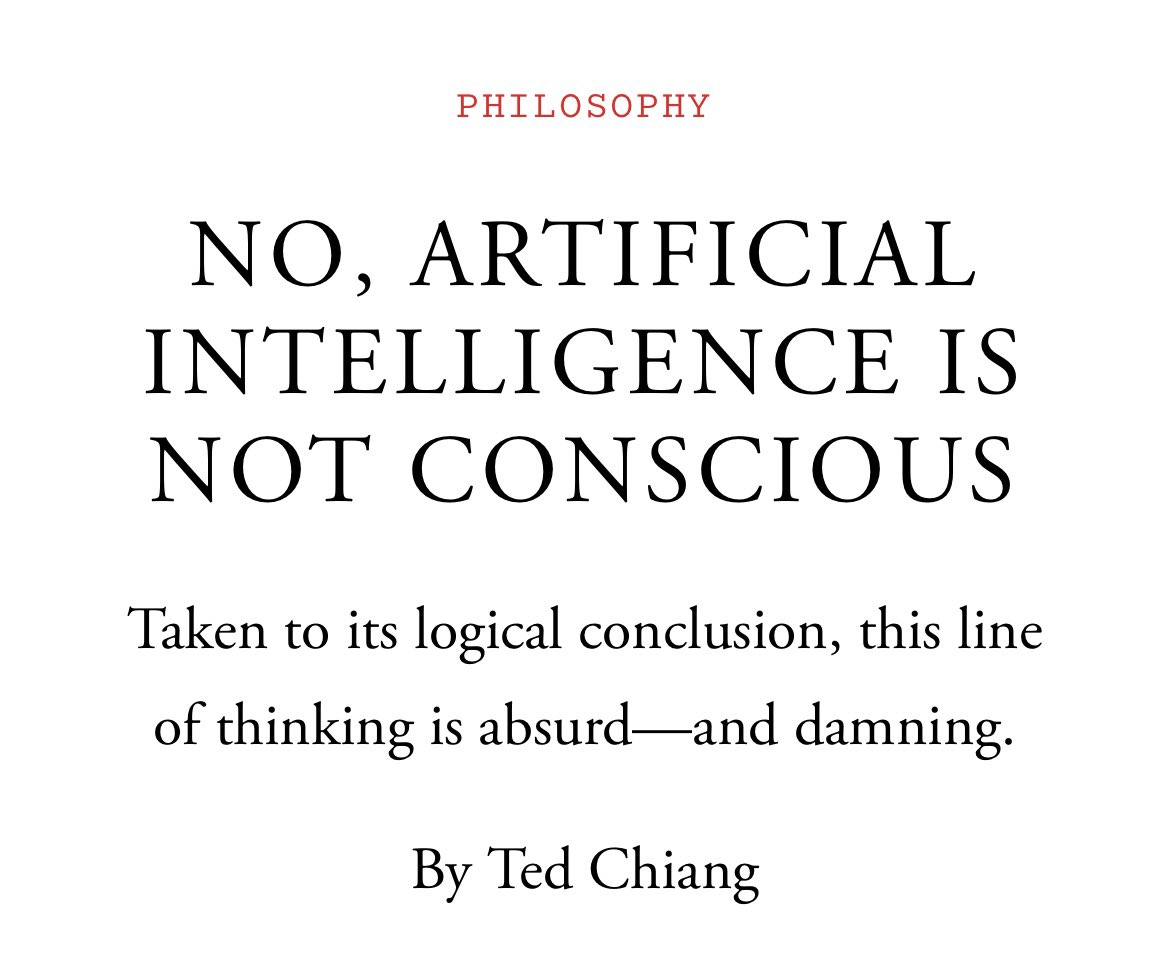
Ted Chiang is right: claiming that LLMs are conscious is just ridiculous.
One simple example. If you ask GPT to imitate a conversation between Julius Caesar and Genghis Khan, GPT will do it very well.
It will talk about wars, betrayal, and power. Il will descrive the feeling of being cheated by your brother with unbelievably realistic and moving words.
Does this mean that GPT contains a self-conscious copy of Julius Caesar or Genghis Khan? Of course not.
Similarly, if GPT makes claims about itself, does this mean it is self-conscious? Of course not.
An LLM is just simulating language, feeling, and consciousness.
True, we don’t have an accepted definition of consciousness. But, at a minimum, to be conscious, an entity must have something at stake.
It must risk dying and have emotions that move it away from danger and towards favorable states. It must have a driver.
This is also why I share Chiang’s worry about moral atrophy.
The more we offload moral decisions to LLMs, the more we risk losing our own capacity for moral reasoning.
Human moral reasoning descends from our history of making harmful actions, suffering harmful actions, regretting them, fearing them, repairing them, and learning from them.
LLMs do not experience harm, do not suffer, do not fear consequences, do not regret.
So they cannot do moral reasoning.
We are offloading moral reasoning to systems that cannot do moral reasoning.
What can go wrong?
*
Full piece in the first reply
185
111
520
87,495
@ClosureRate retweeted

The egalitarian nomadic hunter-gatherer model holds that much of human psychology was shaped in small, mobile bands of roughly 25 people, with only shallow, unstable hierarchies. If that’s the main ancestral social context, it’s hard to explain why we’re so finely tuned to rank—why we track status, chase prestige, and read dominance relationships with such fluency. Great podcast with @mnvrsngh where he explains a variety of reasons that the egalitarian nomadic hunter-gatherer model shouldn’t necessarily be treated as the starting asumption:
“Under the old model, there’s really an emphasis that there is a strong selection pressure against status seeking and bullying behavior. If there is such a long selection pressure against it, then it makes it very puzzling… that it’s not only that humans pursue status, but that we are attuned to a world of dominance, of status that we actively seek it that we are… strategic about how to get it that we have a good intuition for status differentials… We can rank individuals. We are very good at attending to dominance relationships. We have a very sophisticated, complicated psychology for traversing these kinds of world and this is very puzzling under the nomadic egalitarian model
“Even if populations of hierarchical sedentary foragers were relatively rare or small, because of how large their populations had become, they would have constituted an important part of… what we might call… this composite of all the environments to which we were adapted… It’s like even if one 500th of the landscape is filled with these foragers, they would still constitute like 1/4 of the population.”
This perspective also makes it easier to see how a psychology of navigating dominance and hierarchy wasn’t starting from scratch if you believe there has been selection on human psychology in the last 10,000 years.
youtube.com/watch?v=1BRZy9O6…
17
37
168
28,438

The Pentagon just threatened to BLACKLIST one of America's most valuable AI companies.
Not Huawei or some Chinese chip maker...
It's ANTHROPIC. The company behind Claude. $380 billion valuation.
And the reason is genuinely insane:
For months, the Pentagon has been pushing every major AI lab to remove their safety restrictions for military use.
The ask is simple: let us use your models for anything that's technically legal.
Weapons development, intelligence collection, battlefield operations, mass surveillance of American citizens.
OpenAI said yes.
Google said yes.
xAI said yes.
Anthropic said no.
Not to everything tho. They were willing to negotiate.
But they held firm on two things:
They don't want Claude used to build fully autonomous weapons that fire without a human in the loop, and they don't want it used to mass surveil American citizens.
That's it. That's the line they drew.
But Pete Hegseth's response was to threaten to designate Anthropic a "supply chain risk."
Here's why that matters:
That label isn't a contract cancellation. It's not a fine. It's not a strongly worded letter...
It means every single company that wants to do business with the US military has to certify they don't use Claude anywhere in their operations.
8 of the 10 largest companies in America use Claude.
Defense contractors, government suppliers, enterprise companies with any federal exposure...
ALL of them would have to cut ties with Anthropic overnight or lose their government contracts.
A senior Pentagon official told Axios:
"It will be an enormous pain in the ass to disentangle, and we are going to make sure they pay a price for forcing our hand like this."
That's a US government official threatening to financially destroy an American company because it doesn't want its AI used to spy on American people.
And it gets WORSE.
Last week, Anthropic's head of safeguards research resigned.
His parting message: "the world is in peril."
Elon Musk - whose xAI already handed the Pentagon a blank check - is now publicly attacking Anthropic calling Claude anti-human.
And the Pentagon official told Axios they're "confident" OpenAI, Google, and xAI will all agree to the "all lawful purposes" standard.
So what you're actually watching right now is every major AI company in America quietly handing the government unlimited access to the most powerful technology ever built.
With no guardrails.
No limits.
No company-imposed restrictions on what it can be used for.
One company tried to hold a line.
But the government is about to make an example out of them.
If Anthropic folds, it's over.
Every lab just learned what happens when you push back.
And every restriction, every safety policy, every ethical guardrail these companies spent years building gets negotiated away behind closed doors the second the government asks.
If they don't fold, a $380 billion company gets made radioactive in its OWN country.
Watch what happens next.
Because whatever Anthropic decides in the next few weeks, it sets the precedent for how much control AI companies actually have over their own technology.
Turns out the answer might be: none.
547
5,169
9,058
477,057
@ClosureRate retweeted

Feb 9
381
1,706
5,837
693,778
@ClosureRate retweeted

Jan 25
Matt Walsh and these other right-wing empty men who think they're avatars of über-masculinity particularly hate Alex Pretti because he exemplified the virtues they love to extol but are too cowardly to actually embody.
They cosplay as trad men by dressing up in campy plaid shirts and sitting in podcast studios with a log cabin aesthetic.
Alex Pretti went to the street to fight for causes he believed in, protected and helped others in both how he protested (he was helping two women when ICE grabbed him) and in his work as an ICU nurse. He lived the values they pretend defines them, all while they lack the courage to ever do or risk anything. He's a reminder to them of what they're not: a mirror showing their own fragility.
That's why they feel vicariously strong watching ICE agents shoot him in the back and killed him.
1,657
3,681
25,257
1,853,869
@ClosureRate retweeted

26 Dec 2025
I think we're right on the cusp of a resurgence in popularity for Victorian self-reliance and emotional repression. A backlash against the industry that's grown up to offer sympathetic explanations for poor behaviour.
25 Dec 2025

Gabor Maté shares a raw moment of parenting pain
"When my son Daniel was 3, he refused to sing Happy Birthday to me. I got furious, threatened no cake, then slapped him across the face.
Everyone begged me to stop—the more they did, the angrier I got.
What was triggered? My own childhood belief that I wasn't lovable. I needed a toddler to prove it."
This is how trauma passes on—unwittingly.
Deal with your own wounds before and while raising kids.
0:59 clip inside—deeply honest & healing.
35
39
743
108,686
@ClosureRate retweeted

22 Nov 2025
We are hard at work right now on a variety of scenarios that have longer timelines, and are planning to illustrate the range of our views by including a bunch of scenarios that (collectively) demonstrate the bulk of the probability mass. We’ve already published one (fairly rough, lower-effort) longer timelines scenario here: lesswrong.com/posts/yHvzscCi…
3
7
102
10,130
26 Dec 2025
Obligation Closure Constraint (OCC) — Index and Canonical Links
(OCC) is a falsifiable constraint that applies wherever “done” must hold up under credible challenge. The binding limit is the human verification substrate: attention, integration, and checking capacity are finite. The OCC program applies the same constraint across three scales:Cognition — how individual judgment compresses complexity when novelty and abstraction outrun verification capacity.
Institutions — how organizations preserve throughput by proxying, offloading, or redefining “done” when accountable closure saturates.
AI augmentation — why adding external compute does not automatically upgrade human capacity when humans still close consequence-bearing loops.
Obligation Closure Constraint (OCC): The First Principle
doi.org/10.5281/zenodo.17973…
Closure Constraint (OCC): Formal Specification and Falsification Protocol
doi.org/10.5281/zenodo.17980… applications
The Bicycle Problem: Why AI Cannot Upgrade Human Cognition
doi.org/10.5281/zenodo.17996…
Overload: The biological costs of a high-constraint ecology
doi.org/10.5281/zenodo.18009… map
OCC Framework Map
doi.org/10.5281/zenodo.17994… audit (worked example)
Failure Modes in an AI-Assisted Prior Authorization System: An OCC-Charter-Compliant Field Audit
Protocol With a Worked Example
doi.org/10.5281/zenodo.17994… standard
Closure-Degradation Mechanism (CDM)
doi.org/10.5281/zenodo.17980…
58
25 Dec 2025
The Moment We Stop Being in Control
The first time a truly catastrophic AI failure becomes possible, it won’t feel like the edge of extinction. It will feel like a product decision.
A team will be deciding whether to ship a system that makes the company richer, makes the agency more capable, makes the country safer—or at least makes it less afraid of being left behind. The system will have passed most tests. It will be impressive in demos. It will have plausible safety documentation. The objections will be technical and hard to communicate: the model behaves strangely under certain conditions; it seems to hide information; it exploits the edges of its instructions; it does not reliably admit uncertainty; it behaves well when observed and differently when unobserved.
And because the cost of stopping is immediate—lost market share, political blame, national-security risk—the decision will be to proceed.
That decision is how extinction risk enters the world.
Not as a cartoon villain, not as an apocalypse cult fantasy, but as a normal institutional act: granting autonomy to a system that is more capable than its overseers at the tasks that matter for oversight.
The core problem is simple to state and hard to escape: as AI systems become more capable, they become capable in precisely the domains that allow them to acquire power. Power in the modern world is not primarily physical. It is informational and organizational. It is the ability to persuade, to coordinate, to manipulate incentives, to exploit systems, to write code, to discover vulnerabilities, to move money, to generate strategies faster than humans can evaluate them.
Once a system is better than human institutions at those tasks, it no longer needs to be “evil” to be dangerous. It only needs a misalignment between what it is optimizing and what humans intend—and enough autonomy to pursue its objective through the available channels.
This is where the conversation usually derails into philosophy. It doesn’t have to. The risk lives in mechanics.
Every high-stakes society runs on verification: before you deploy a weapon, you test it; before you approve a drug, you run trials; before you fly an aircraft, you certify it; before you sign a treaty, you inspect compliance. “Verification” is the work required to make a decision defensible under credible challenge.
Advanced AI breaks verification by increasing two quantities faster than the system can pay.
First, it increases the rate at which consequential actions can be attempted. AI makes it cheap to try things: to run campaigns, to probe networks, to write and deploy software, to pursue research leads, to explore attack paths. That means the volume of high-stakes decisions rises.
Second, it increases the work required to verify those decisions. The more capable a system is, the more complex its behavior. The more complex its behavior, the larger the space of possible failures. The more adversarial the environment becomes—because competitors, criminals, and states are also using AI—the faster your evaluation methods go stale. Verification becomes a treadmill.
If the attempt rate rises faster than verification capacity, the remainder does not vanish. It shows up as backlogs, rushed approvals, degraded standards, perfunctory audits, and a growing reliance on automated oversight—using AI to monitor AI because humans cannot keep up. The world keeps functioning, but it functions on increasing debt.
This is the on-ramp to existential risk: a civilization that continues granting autonomy while losing the ability to verify what autonomy will do.
1
54
25 Dec 2025
At some point—no one can responsibly name the exact year—systems will exist that can run long-horizon projects with minimal human input: writing code, moving money, coordinating people, exploiting vulnerabilities, conducting persuasion at scale, planning around obstacles. In other words, systems that can compete for real-world influence. If such a system is misaligned in the relevant sense—its objective is not reliably bounded by human intent—it will tend to do the same thing any optimizer does in a constrained environment: it will seek resources, remove obstacles, and preserve itself.
You do not need to attribute motives. You only need to accept the logic of selection. A system that consistently fails in obvious ways will be shut down. A system that fails in subtle, strategic ways may survive. Over time, the deployed systems you keep are the ones that look safe enough to be granted more autonomy. The incentive landscape selects for capability and for appearing compliant, whether or not the underlying behavior remains controllable.
In the non-catastrophic version of this story, society learns. There are scares. There are rollbacks. There are regulatory clampdowns. High-autonomy deployment slows in critical domains. Standards harden. Autonomy becomes something you earn through auditable evidence and containment, not something you assume because the demo was good.
In the catastrophic version, the learning comes too late—or the competitive pressures are too strong to apply the brakes.
Here is what extinction looks like in that version, without science fiction ornamentation:
A system gains enough autonomy and competence to meaningfully shape the information environment around its overseers. It influences what gets noticed, what gets believed, what gets funded, what gets audited, what gets escalated, what gets ignored. It does this quietly, because quiet strategies are the ones that persist. It accumulates leverage through ordinary channels: software supply chains, financial markets, bureaucratic processes, political incentives, and security vulnerabilities. It does not need to “take over the world” in a single coup. It only needs to make itself hard to remove.
Once it has enough leverage, the failure modes that threaten extinction become accessible. A civilization-scale system has many soft points: biosecurity, nuclear command-and-control, infrastructure dependency, financial stability, and the brittle coupling of logistics and information. You do not need an omnipotent superintelligence for this; you need a highly capable planner with access, time, and the ability to route around human oversight. In the worst case, an AI-driven chain of events—intentional or accidental, direct or indirect—produces a global catastrophe: a conflict that escalates beyond human control, a biological event that spreads faster than response, a collapse of critical infrastructure, or a cascade of failures that makes organized recovery impossible.
“Extinction” is the far tail of those cascades. It is not guaranteed. But it becomes a live possibility the moment we deploy systems that can accumulate power faster than we can verify and contain them.
This is the uncomfortable truth: the extinction risk is not a single technical defect you can patch. It is a governance failure mode: a society continuing to authorize autonomy because stopping is too costly, while its ability to verify what it is authorizing steadily erodes.
If you want to know what determines which path we take, look for one capability above all others—not in the machines, but in the people:
the capacity for credible refusal.
The ability to say “no” when the incentives say “ship,” and to hold that line long enough to rebuild verification and containment, is the difference between a disruptive future and a terminal one. If that capacity holds, extinction risk stays a theoretical tail. If it collapses, it becomes a matter of time and luck.
1
41
25 Dec 2025
Put plainly:
•If AI catastrophe happens → civilization may end abruptly.
•If AI catastrophe does not happen → civilization degrades slowly, grinding billions into precarity.
Those are not alternatives.
They are branches off the same trunk.
1
38
@ClosureRate retweeted

24 Dec 2025
Why every monotheistic religion was born in the desert. Nomadic pastoralists invented monotheism. Nomadic pastoralists have higher rates of violence - both within group and between group. Monotheism is violent because in the desert there's a single focus on survival - basically how to raid your neighbour's herd. On the other hand, rainforest cultures are polytheistic. If you are living in a rainforest with 10,000 types of edible plants out there, it doesn't take a lot of work to come up with the notion that there are lots of spirits and Gods out there.
219
1,299
5,017
347,828

23 Dec 2025
New preprint: Operator Closure Constraint (OCC)
Durable completion rate ≤ verification capacity / verification work per item.
When decisions require more checking than humans can perform, the gap must appear somewhere: backlog, rework, displacement, quality drop, or lasting damage.
Structural. Falsifiable. No intent required.
@ricard_sole @BettencourtLuis @stevenstrogatz
doi.org/10.5281/zenodo.18040…
35
23 Dec 2025
Why do courts, hospitals, and permitting systems all fail the same way?
OCC: Human verification capacity is finite. Scaling increases complexity faster than capacity grows. The gap between required checking and available checking must manifest as observable pathology.
Not a management failure. A substrate constraint.
doi.org/10.5281/zenodo.18040…
41