
A magazine about what matters in America, from @AmerCompass. commonplace.org
Joined February 2024
- Tweets 1,860
- Following 434
- Followers 4,101
- Likes 2,681
368 Photos and videos




Pinned Tweet

Jun 11
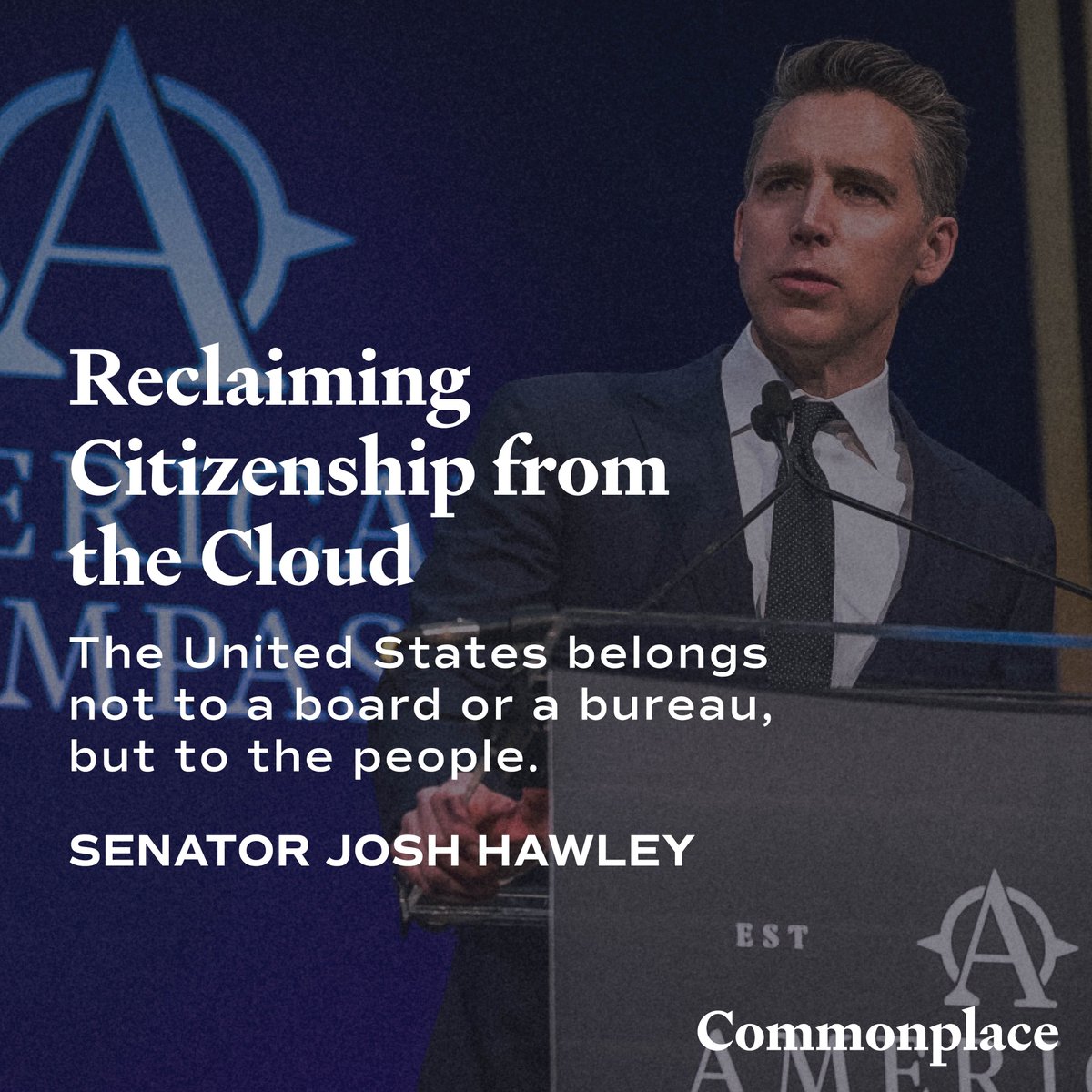
"Let me be blunt. Left to itself, artificial intelligence will not choose moral liberty. It will choose the passions. It will choose appetite. It will gather power into the fewest hands the world has ever seen and call the result progress. That is the rule of the strong over the weak. That is the dissolution of our moral covenant. It is the oldest temptation in the history of humanity, now just dressed up in silicon.
"Make no mistake about which liberty so many of the barons of big tech have chosen. Listen to how they talk of disruption, of moving fast, of breaking things, of a world to be remade by whoever is bold enough to seize it. You strip away that jargon and the sometimes-good intentions, and you’ll find the temptations of an old creed that says the strong should rule because they are strong, that the future belongs to whoever is powerful enough to make it, that might, in the end, makes right.
"That is not progress, it is the state of nature. That’s the law of the jungle, scaled now to the cloud and bankrolled to the tune of hundreds of billions of dollars. It is the very thing John Winthrop and his hearty band of Puritans crossed an ocean to escape, a world in which no covenant stands above the will of the powerful." Read @HawleyMO on how we can Reclaim Citizenship from the Cloud.
1
2
7
2,299
Commonplace retweeted

Jun 11
"When there’s no healthy identity to commit to, people will choose a perverse one."
"The line between what is perceived as commonplace human behavior and outright addiction has been blurred tremendously."
College students share their thoughts @commonplc commonplace.org/p/the-vibes-…
‘The Vibes Are Not Good’
Two college students discuss America’s broadest challenges.
commonplace.org 2
5
15
8,001
Jun 11
"Let me be blunt. Left to itself, artificial intelligence will not choose moral liberty. It will choose the passions. It will choose appetite. It will gather power into the fewest hands the world has ever seen and call the result progress. That is the rule of the strong over the weak. That is the dissolution of our moral covenant. It is the oldest temptation in the history of humanity, now just dressed up in silicon.
"Make no mistake about which liberty so many of the barons of big tech have chosen. Listen to how they talk of disruption, of moving fast, of breaking things, of a world to be remade by whoever is bold enough to seize it. You strip away that jargon and the sometimes-good intentions, and you’ll find the temptations of an old creed that says the strong should rule because they are strong, that the future belongs to whoever is powerful enough to make it, that might, in the end, makes right.
"That is not progress, it is the state of nature. That’s the law of the jungle, scaled now to the cloud and bankrolled to the tune of hundreds of billions of dollars. It is the very thing John Winthrop and his hearty band of Puritans crossed an ocean to escape, a world in which no covenant stands above the will of the powerful." Read @HawleyMO on how we can Reclaim Citizenship from the Cloud.
1
2
7
2,299
Commonplace retweeted
Jun 10
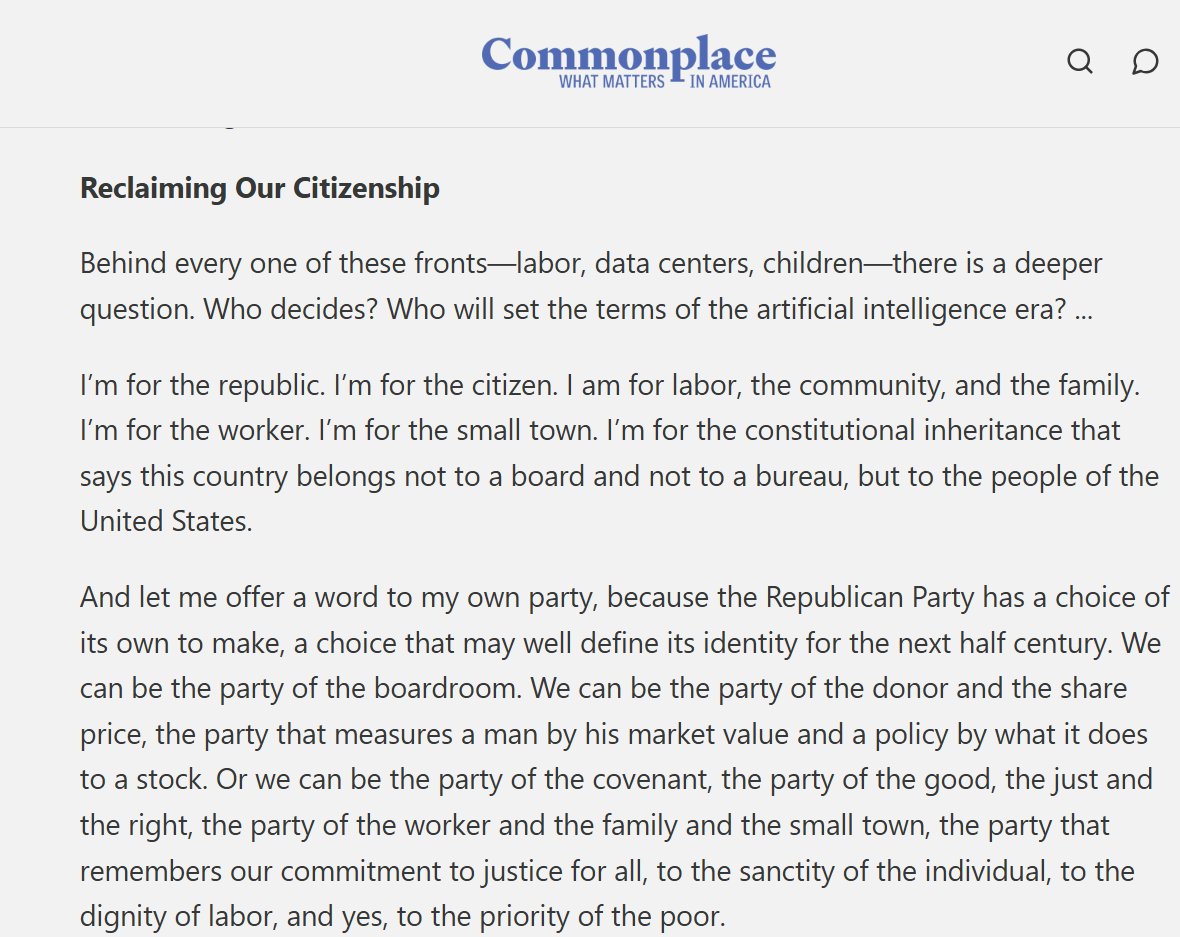
From @AmerCompass gala, @HawleyMO @commonplc on Reclaiming Citizenship from the Cloud:
"Behind every one of these fronts—labor, data centers, children—there is a deeper question. Who decides? Who will set the terms of the artificial intelligence era?" commonplace.org/p/sen-josh-h…
2
15
51
20,264
Jun 9
"For hardworking Americans, the game is rigged. You can vote to secure union representation, you can reach the bargaining table, and you can press your boss for higher wages, guaranteed benefits, and a secure retirement. But in today’s America, employers are afforded every opportunity under the law to drag out those negotiations, orchestrate a corporate campaign to decertify your union, and intimidate you during mandatory meetings to abandon your struggle for a better way of life.
"Now, a bipartisan bill before Congress—the Faster Labor Contracts Act—strives to dismantle this broken system and put American workers first in our pursuit of economic prosperity. And it needs to pass." @TeamsterSOB on the case for the FLCA, from September. @Teamsters commonplace.org/p/sean-m-obr…
1
3
10
2,530
Commonplace retweeted
Jun 8
1/ Most people struggle even to find the language to explain what ails America, though we can sense the country we thought we knew, and the future we want for ourselves and our children, slipping away.
After a year of research, deliberation, and drafting, @AmerCompass...
4
20
77
32,198
Jun 8
"From time to time, throughout American history, the question of whether the United States should remain a republic or evolve into an empire reenters political discourse. It is upon us again, though perhaps not in the way many expected when President Trump returned to office.
"Adventurism and democratic evangelism dominated American foreign and defense policy for much of the post-Cold War era. Forever wars, expanding alliance obligations, and an obsession with dominating the global commons produced limited strategic gain at immense cost. Many Americans came to associate these doctrines of the “liberal world order” with stagnation and hardship: depleted public trust, rising fiscal strain, and a growing sense that Washington attended more closely to the world stage than to conditions and interests at home.
"The America First movement challenged all that. But while the second Trump administration has accomplished a number of significant doctrinal shifts toward greater realism and restraint, its actions signal a continued—and in some cases growing—imperial ambition. The pursuit of empire was unwise even when America stood alone as the world’s hyperpower and could afford to make such mistakes. In the current environment, constrained by limited resources and sharp tradeoffs, facing a peer competitor with ambitions of its own, the United States risks overextending itself in ways that could prove catastrophic for its citizens.
"Though we are teetering on the edge, all hope is not lost for restoring a republic that prioritizes its citizens first. What is abundantly clear is that choosing the republic requires ruthless discipline in both doctrine and implementation. We lack that discipline now and must quickly regain it. A republic can survive the discomfort and fallout of difficult tradeoffs. It cannot survive more of the same bad decision-making rebranded under improved doctrine," Katherine Thompson explains.
2
3
7
3,198
Commonplace retweeted
Jun 8
"Agreeing on republican virtues is much easier than renouncing imperial ambitions."
Read Katherine Thompson @commonplc on the danger of Trump admin's continued foreign adventurism in the face of its doctrinal turn back toward a more restrained republic. commonplace.org/p/katherine-…
4
3
12
2,330
Commonplace retweeted
Jun 5
"Wall Street came and kind of ate everything, just the financialization of the world."
- @SecScottBessent
In our conversation at the @AmerCompass New World Gala on Tuesday, Secretary Bessent discussed how to ensure Main Street prospers too.
3
4
30
9,624
Commonplace retweeted

Jun 3
Fantastic messages from @HawleyMO and @SecScottBessent tonight at the @AmerCompass Gala. This is the future of the right.


6
13
70
18,852
Commonplace retweeted
Jun 4
At @AmerCompass's New World Gala on Tuesday, I asked @SecScottBessent what we can do about young people no longer believing the system works for them.
He said we need to move away from "the gambling society" and the desire "to economically play the lottery."
8
6
38
15,001
Commonplace retweeted
Jun 5
"We cut off China," Treasury @SecScottBessent told me, highlighting how @FCC action is helping to reshore technologies critical to our economic and national security.
From the @AmerCompass New World Gala on Tuesday night:
8
23
74
24,102
Commonplace retweeted

Jun 3
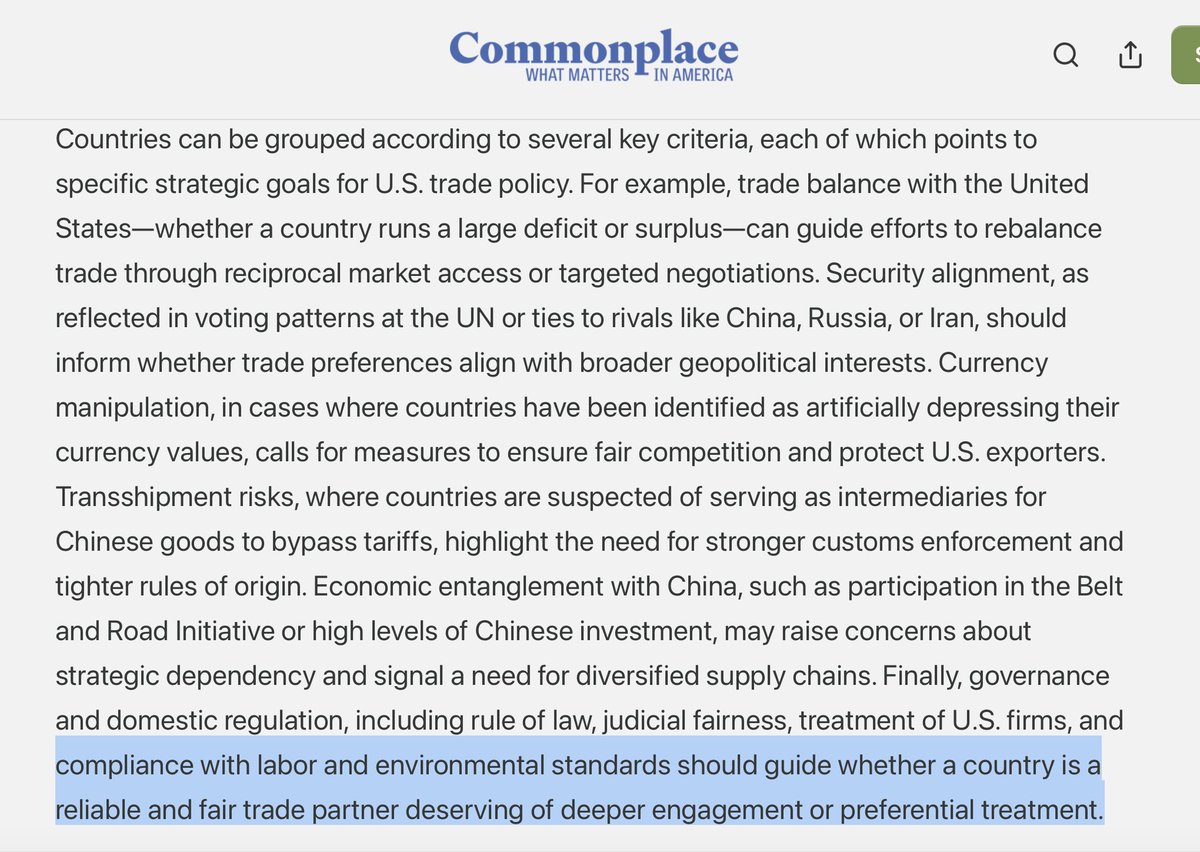
Surprised by USTR’s sweeping Section 301 decision on forced labor today?
You shouldn’t be.
I’ve been saying this was coming since last year in my @commonplc essay:
commonplace.org/p/the-art-of…
1
12
1,444

Jun 4
In a new episode of the American Compass Podcast recorded live at the New World Gala, @oren_cass and @SecScottBessent discuss the Trump administration's plan to revitalize American manufacturing—and what's at stake when industry atrophies.
youtu.be/DVrlwvwjsUc?si=ArS1…
3
5
3,739
Commonplace retweeted

May 28
In 1858, a South Carolina senator defended slavery with what he called the "mudsill theory": every society needs a permanent underclass to do its menial work. His argument survives to this day.
Jasmine Crockett: "We done picking cotton… you can't pay us enough to find a plantation."
Nancy Pelosi: "We need them to pick the crops down here."
George W. Bush, famously, said there are "jobs Americans won't do."
Same logic, applied to immigration policy and updated for the 21st century.
My new essay for @commonplc @AmerCompass
commonplace.org/p/from-human…
9
67
9,890
Commonplace retweeted

May 28
My new article is out at @commonplc about the revival of the local train line!
commonplace.org/p/when-the-t…
3
6
501
Commonplace retweeted

May 31
Had a ton of fun talking Magnifica Humanitas, Butlerian Jihad, my proposal for a whispering earring that is only allowed to say “Memento mori”, and more with @oren_cass, @LeahLibresco, and @Chris_Griz!
May 31

How human can AI really be?
This week's American Compass podcast brings @oren_cass together with @Chris_Griz, @LeahLibresco, & @maxbodach to discuss Pope Leo XIV’s highly anticipated new encyclical on what AI means for the future of humanity. youtu.be/Tcc5qIKw6r0?si=ZCPW…
1
8
33
10,701
Commonplace retweeted

Jun 1
Economic and labor policy is often nauseating because it reacts to everything after it occurs, and rarely seems to wrestle with cultural, moral and technological shifts with effective premeditation. I really appreciated this @amercompass podcast. podcasts.apple.com/us/podcas…
2
1
3
219