
ALL in Web3
Joined December 2015
- Tweets 23,581
- Following 3,612
- Followers 4,343
- Likes 39,076
1,838 Photos and videos







Pinned Tweet
Optimum’s first point is probably the most important one.
they are saying that latency only becomes valuable when timing changes the outcome. In simple words, speed matters only when being late means losing something real. That could be a reward, a block-building opportunity, or a consensus deadline.
this is why the research is interesting. It is not just about sending data faster for the sake of it. It is about situations where information has to arrive before a specific moment. If it arrives on time, the node can act. If it arrives too late, the opportunity is gone.
that is a big idea because it changes how you think about infrastructure. Most people look at speed as a technical feature. Optimum is framing it as an economic one. In other words, latency is not just about performance
it can directly affect who gets rewarded and who misses out.
for crypto networks, this matters a lot. Validators, block builders, and other participants often work under strict deadlines. So the difference between “fast enough” and “too late” can have real financial impact.
@tgogayi @ada_pegasus @cryptooflashh @CryptoSundayz
Jun 9

1. When does latency determine economic outcomes?
When the usefulness of information depends on when it is received. This could be a deadline that has to be met like those in Ethereum's consensus process, or a competitive situation like a block building auction.
Receiving the requisite data in time to meet the deadline earns you a reward.
3
2
63
Muhammad retweeted

Jun 15
The conversation around infrastructure usually starts with features and performance
I think it's more useful to judge it by what it enables.
nobody got excited about internet protocols. They got excited about the apps built on top of them.
the same idea applies to blockchain infrastructure.
that's why @fermah_xyz is interesting to me.
not because proving is suddenly faster or more accessible.
But because when proving becomes easier, builders can experiment more, launch new ideas faster, and create applications that weren't practical before.
The infrastructure stays in the background.
the real value shows up through the products, communities, and experiences that grow on top of it.
Sometimes the most important technology is the technology users never notice
@7wealthh @0xyuhuu96 @Sipra_ETH
Jun 13

everyone pays attention to the result
very few stop and ask how the result got there in the first place
and that's usually where the infrastructure story begins
a lot of blockchain systems still operate with the mindset that everything should happen in-house
compute here
verify here
coordinate here
all under the same roof
it works...
until growth starts showing up
more users
more activity
more computation
and suddenly the system is spending more time managing work than doing work
that's why I find @fermah_xyz interesting
not because it's "another proving project"
but because it's pushing a different way of thinking about blockchain infrastructure
the hidden shift is subtle
instead of treating proving as something every system must fully handle itself
Fermah treats it more like a service layer
⮕ request the work
⮕ route it efficiently
⮕ generate the proof
⮕ return a verifiable result
simple idea
but it changes how systems can be designed
think about hiring specialists
you don't buy every tool and master every skill yourself
you call the right expert when needed
the job gets done
everyone moves faster
same pattern applies here
◇ less congestion
◇ clearer separation of responsibilities
◇ infrastructure that can evolve more easily over time
of course
modularity brings its own challenges
coordination still matters
reliability still matters
nothing scales automatically
but it often creates a cleaner path than forcing every task into one place
that's the bigger takeaway for me
Fermah isn't just improving proof generation
it's helping reshape how blockchain work gets organized as networks continue to grow
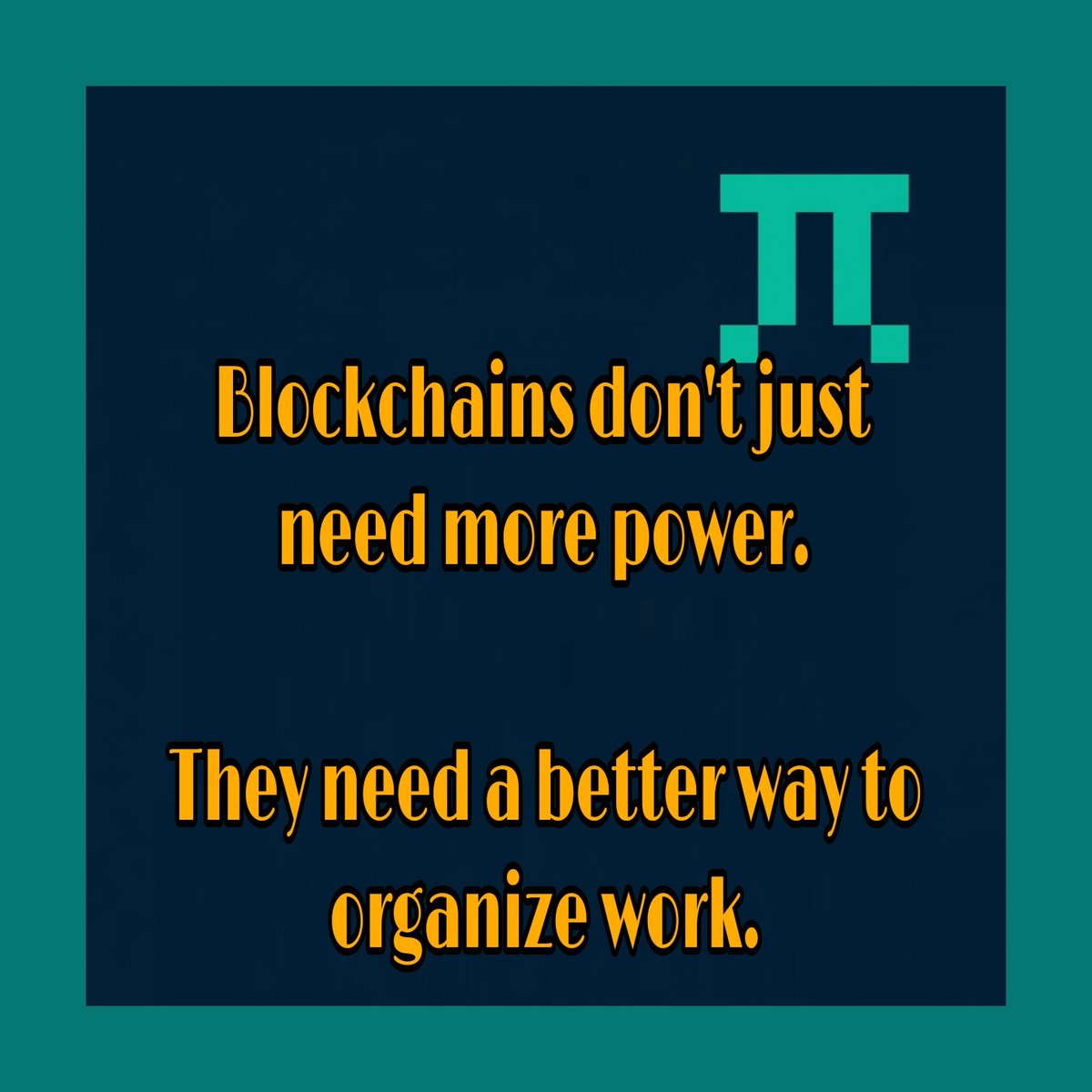
sometimes the biggest upgrade isn't more power
it's a better way to use that power
@7wealthh @0xyuhuu96 @Sipra_ETH
2
1
5
103
Muhammad retweeted
Jun 14
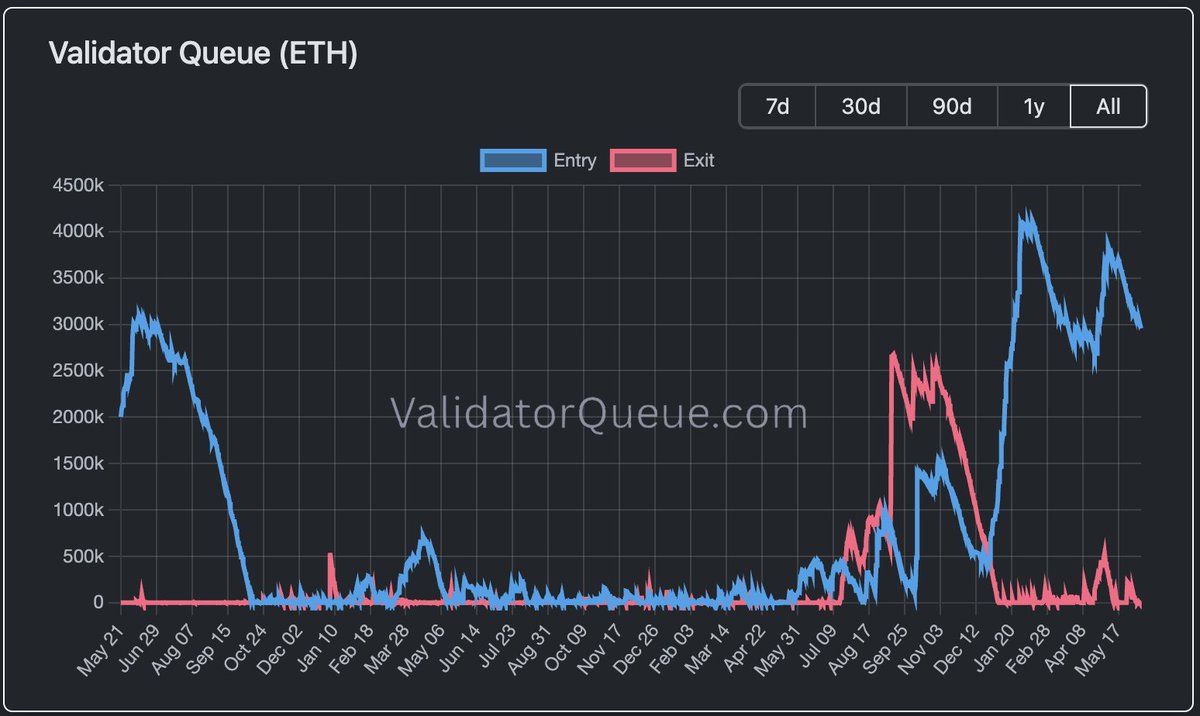
What stands out here isn't just that the exit queue has decreased.
the more interesting signal is the entry queue.
the growing queue suggests continued interest in Ethereum's underlying infrastructure and long-term development.
It also highlights a broader shift in focus from short-term market reactions to long-term network usage and infrastructure.
as participation grows, the underlying systems become increasingly important.
Robust infrastructure, efficient network flow & scalable architecture.
these are the foundations that help large networks operate effectively.
that's why projects focused on infrastructure, such as Optimum, are worth following from a technology perspective.
not because of market noise, but because the strength of a network often depends on the layers working behind the scenes
@tgogayi @ada_pegasus @cryptooflashh @CryptoSundayz
Jun 11
And there's 3m ETH in the entry queue right now. Staking demand is real and it's coming from institutions.
4
1
9
179
Jun 13
As someone exploring both Web3 and ethical investing, this is exactly the type of research I value.
for a long time, I focused on what a project could earn me.
now I spend more time understanding how those earnings are actually generated.
that's why reports like this matter.
What stood out to me is that Cosmos isn't being classified as halal simply because it offers staking rewards.
the reasoning goes deeper than that
according to the analysis, Cosmos provides real technological utility through its "Internet of Blockchains" infrastructure, enabling interoperability and communication between independent networks.
the staking model is also viewed differently from traditional interest-based systems. Rewards come from participating in network security and validation rather than from lending money at interest or receiving guaranteed returns.
◇ No built-in riba-based lending model
◇ No guaranteed fixed returns
◇ Real network participation and utility
◇ Transparent governance and open-source infrastructure
Whether you're Muslim or not, I think these are important questions to ask before allocating capital:
Where do the returns come from?
What value does the network create?
How sustainable is the model?
It's not about restricting opportunities
it's about helping people make informed decisions based on transparency, utility, and values.
Whether you're Muslim or not, the principles of ethical participation, responsible investing, and long-term thinking are universal.
I've come to believe that long-term success starts with knowledge, patience, and understanding
not just focusing on potential returns
Jun 13

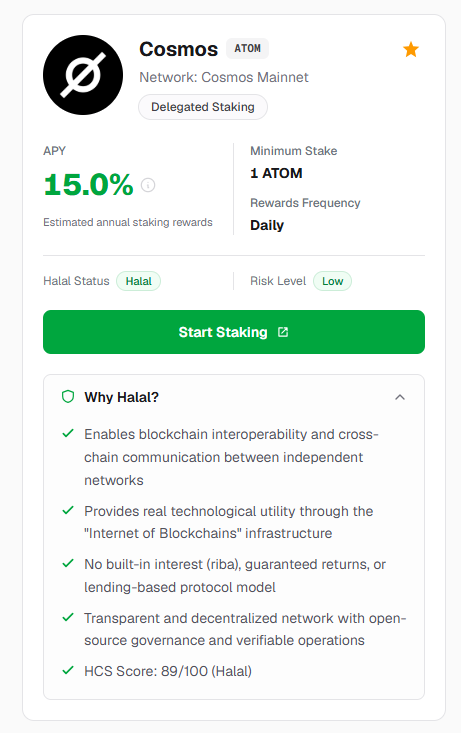
If you're looking for Halal staking option especially for Cosmos then you can consider staking with our validator partner at CoinStudy.
Cosmos has already been declared Halal crypto asset by CoinStudy Sharia Board.
Why Halal ?
. Enables blockchain interoperability and cross-chain communication between independent networks
. Provides real technological utility through the "Internet of Blockchains" infrastructure
. No built-in interest (riba), guaranteed returns, or lending-based protocol model
. Transparent and decentralized network with open-source governance and verifiable operations
. HCS Score: 89/100 (Halal)
you can find complete analysis report at CoinStudy official website.
8
60
Jun 13
everyone pays attention to the result
very few stop and ask how the result got there in the first place
and that's usually where the infrastructure story begins
a lot of blockchain systems still operate with the mindset that everything should happen in-house
compute here
verify here
coordinate here
all under the same roof
it works...
until growth starts showing up
more users
more activity
more computation
and suddenly the system is spending more time managing work than doing work
that's why I find @fermah_xyz interesting
not because it's "another proving project"
but because it's pushing a different way of thinking about blockchain infrastructure
the hidden shift is subtle
instead of treating proving as something every system must fully handle itself
Fermah treats it more like a service layer
⮕ request the work
⮕ route it efficiently
⮕ generate the proof
⮕ return a verifiable result
simple idea
but it changes how systems can be designed
think about hiring specialists
you don't buy every tool and master every skill yourself
you call the right expert when needed
the job gets done
everyone moves faster
same pattern applies here
◇ less congestion
◇ clearer separation of responsibilities
◇ infrastructure that can evolve more easily over time
of course
modularity brings its own challenges
coordination still matters
reliability still matters
nothing scales automatically
but it often creates a cleaner path than forcing every task into one place
that's the bigger takeaway for me
Fermah isn't just improving proof generation
it's helping reshape how blockchain work gets organized as networks continue to grow
sometimes the biggest upgrade isn't more power
it's a better way to use that power
@7wealthh @0xyuhuu96 @Sipra_ETH
Jun 11
Everyone talks about scaling
but not enough people talk about where the pressure actually comes from
and that's usually where the interesting insights are hiding
blockchains don't suddenly struggle because they're bad systems
they struggle because success creates congestion
more users
more activity
more computation
and eventually too much work starts piling into the same place
that's why I've been looking deeper into what @fermah_xyz is building
because the idea isn't simply "generate more proofs"
it's about organizing work more intelligently
the hidden insight is that scaling isn't always about adding more resources
sometimes it's about making sure every resource has a clear job
think about a busy highway
when every car is forced into the same lane
traffic slows down
frustration builds
nothing moves efficiently
now imagine multiple lanes
◇ each serving a different purpose
◇ work gets distributed
◇ bottlenecks become easier to manage
same principle applies to infrastructure
Fermah's approach feels closer to that model
⮕ separate workloads
⮕ reduce congestion
⮕ make proving and execution more modular
⮕ let systems scale without everything competing for the same resources
of course
modularity isn't a silver bullet
it introduces new coordination challenges
and execution still matters
but it's often cleaner than forcing every task into one crowded layer
to me that's the bigger takeaway
Fermah isn't just about proving
it's about making blockchain infrastructure easier to organize as networks grow
because scaling isn't only about doing more work
it's about preventing work from becoming a bottleneck in the first place
@7wealthh @0xyuhuu96 @Sipra_ETH
4
174
Muhammad retweeted
Jun 12
One question from Mr David lin
( @davidlin_TV ) really stood out to me:
"What problem is Optimum actually trying to solve?"
a lot of people would probably answer:
⮕ faster propagation
⮕ lower latency
⮕ better networking
But listening to Prof. Muriel Médard
( @MurielMedard ) , the vision feels much bigger.
the challenge isn't just moving blockchain data faster.
It's getting the right data, to the right place, at the right time, and being able to verify it in a decentralized system.
that's a blockchain problem.
But it's also becoming an AI problem.
One point that caught my attention:
If AI agents are going to interact with each other, they need a shared trust model.
Not just intelligence.
Verifiability.
A way to prove what happened, who did what, and how decisions were made.
the more I listen to Muriel explain Optimum, the less it feels like a simple networking upgrade.
It feels like infrastructure for verifiable information flow.
that's what stood out to me from this conversation with David Lin.
this clip is just one piece of the conversation.
the full interview goes much deeper into blockchain, AI, networking, trust, and decentralized data systems
definitely worth watching the entire discussion 👇
youtu.be/HBY0w_PxTFY?si=F8dj…
@tgogayi @ada_pegasus @cryptooflashh @CryptoSundayz
Jun 10
Optimum is one of those projects people might overlook at first.
most crypto folks watch for the flashy stuff:
new chains, new apps, new token narratives.
But the real bottleneck is usually the boring layer nobody talks about.
◇ blockchain is not only about execution
◇ it’s also about how fast data moves
◇ and how cleanly nodes stay in sync
that’s where Optimum gets interesting.
It feels like a project aiming at the part of the stack most people ignore:
fast, efficient memory for decentralized systems.
⮕ not just “faster chain”
⮕ not just “better throughput”
⮕ but better infrastructure underneath everything else
hidden insight:
a lot of scaling problems look like compute problems on the surface, but sometimes the real issue is data flow and communication.
and that matters because if the base layer is clunky,
every app on top feels it.
So yeah, this is not the loudest kind of crypto project.
But it might be the kind that actually helps the ecosystem long term.
Simple idea:
better memory layer = better blockchain performance.
that’s the kind of thing builders should care about before the market fully notices it.
@get_optimum @ada_pegasus @cryptooflashh @CryptoSundayz
3
1
9
192
Jun 11
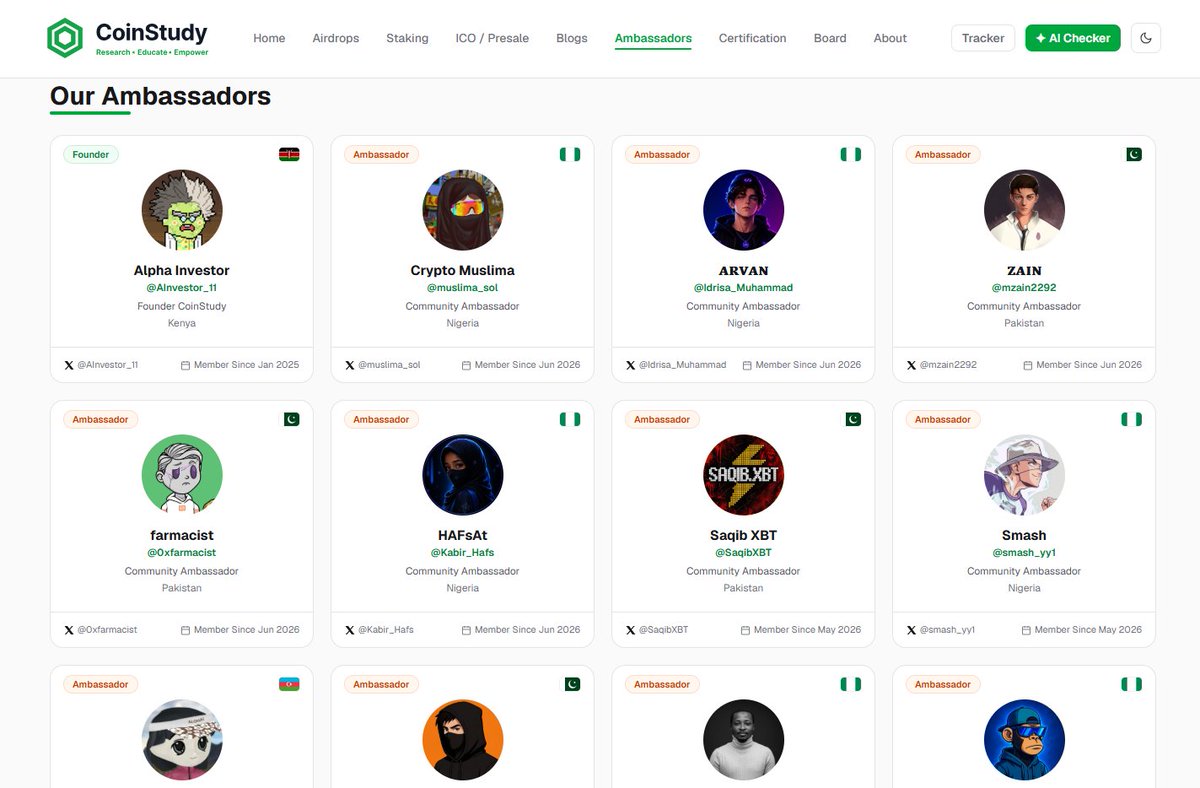
Welcome @muslima_sol
I believe many of us can align with this vision of earning in a halal and ethical way, Insha'Allah.
for a long time, I often found myself questioning whether the work I was doing and the opportunities I was exploring were truly halal or not.
that's why I'm grateful to @coinstudy_hcs and its founder, @AInvestor_11, for making these concepts easier to understand for muslims and for anyone who wants to learn, build, and earn ethically.
I won't claim to be perfect.
like many people, I've made mistakes and learned lessons along the way. What matters is that we're continuously improving, seeking knowledge, and trying to move away from anything that may lead us toward haram.
I also believe that halal income comes with patience, discipline, and a deeper understanding of our choices. In the end, the most valuable things in life are not just money, but a righteous family, good health, peace of mind, and meaningful relationships.
and ultimately, all of these blessings come from Allah.
May Allah guide us toward what is beneficial, halal, and full of barakah.
5
10
219
Jun 11
And I kindly request everyone here to guide me and point out if I am doing anything wrong or inadvertently involving myself in anything Haram.
Insha'Allah, I will do my absolute best to rectify it and leave it behind at any cost
1
53
Jun 11
Everyone talks about scaling
but not enough people talk about where the pressure actually comes from
and that's usually where the interesting insights are hiding
blockchains don't suddenly struggle because they're bad systems
they struggle because success creates congestion
more users
more activity
more computation
and eventually too much work starts piling into the same place
that's why I've been looking deeper into what @fermah_xyz is building
because the idea isn't simply "generate more proofs"
it's about organizing work more intelligently
the hidden insight is that scaling isn't always about adding more resources
sometimes it's about making sure every resource has a clear job
think about a busy highway
when every car is forced into the same lane
traffic slows down
frustration builds
nothing moves efficiently
now imagine multiple lanes
◇ each serving a different purpose
◇ work gets distributed
◇ bottlenecks become easier to manage
same principle applies to infrastructure
Fermah's approach feels closer to that model
⮕ separate workloads
⮕ reduce congestion
⮕ make proving and execution more modular
⮕ let systems scale without everything competing for the same resources
of course
modularity isn't a silver bullet
it introduces new coordination challenges
and execution still matters
but it's often cleaner than forcing every task into one crowded layer
to me that's the bigger takeaway
Fermah isn't just about proving
it's about making blockchain infrastructure easier to organize as networks grow
because scaling isn't only about doing more work
it's about preventing work from becoming a bottleneck in the first place
@7wealthh @0xyuhuu96 @Sipra_ETH
Jun 4
most people still look at Fermah through the wrong lens
they hear "proof generation"
and assume that's the whole story
but I think the more interesting idea is happening underneath @fermah_xyz
because blockchains have a habit of trying to do everything themselves
compute
verification
coordination
all in one place
and eventually that creates bottlenecks
the hidden insight is that scaling isn't always about adding more power
sometimes it's about dividing work more intelligently
that's where Fermah starts to make sense
instead of forcing chains to handle every proving task internally
the goal becomes:
⮕ find the right compute
⮕ route the workload
⮕ generate the proof
⮕ return a verifiable result
sounds simple
but that's a very different model from doing everything in-house
a useful way to think about it:
imagine one worker trying to handle every job in a company
eventually things slow down
mistakes happen
nothing scales
now imagine a network of specialists
◇ each handles a specific task
◇ workloads are distributed
◇ resources are used more efficiently
the system becomes much more flexible
and I think that's the bigger story here
Fermah isn't only about proving
it's about turning proving into a modular service layer that other systems can tap into
of course
modularity comes with its own challenges
coordination
reliability
adoption
none of that is automatic
but we've seen this pattern before in infrastructure
specialization often wins over trying to do everything in one place
the chains that scale best may not be the ones doing the most work
they may be the ones delegating work the smartest
@7wealthh @0xyuhuu96 @Sipra_ETH

2
7
145
Muhammad retweeted
Jun 10
Optimum is one of those projects people might overlook at first.
most crypto folks watch for the flashy stuff:
new chains, new apps, new token narratives.
But the real bottleneck is usually the boring layer nobody talks about.
◇ blockchain is not only about execution
◇ it’s also about how fast data moves
◇ and how cleanly nodes stay in sync
that’s where Optimum gets interesting.
It feels like a project aiming at the part of the stack most people ignore:
fast, efficient memory for decentralized systems.
⮕ not just “faster chain”
⮕ not just “better throughput”
⮕ but better infrastructure underneath everything else
hidden insight:
a lot of scaling problems look like compute problems on the surface, but sometimes the real issue is data flow and communication.
and that matters because if the base layer is clunky,
every app on top feels it.
So yeah, this is not the loudest kind of crypto project.
But it might be the kind that actually helps the ecosystem long term.
Simple idea:
better memory layer = better blockchain performance.
that’s the kind of thing builders should care about before the market fully notices it.
@get_optimum @ada_pegasus @cryptooflashh @CryptoSundayz
Jun 8
People mostly talks about latency
but the deeper I go into Ethereum infrastructure,
the more it feels like uncertainty is the real problem.
because in theory,
the best block should win.
in reality?
the block that arrives before the deadline often wins.
even if a better one shows up milliseconds later.
and that small detail changes a lot more than people realize.
⮕ proposers become more conservative
⮕ builders rush last-second bids
⮕ attesters hedge decisions
⮕ users pay more to improve inclusion odds
⮕ validators cluster around better-connected infrastructure
slowly, the game starts shifting.
what looks like a blockspace market
starts behaving like a connectivity market.
that's the hidden insight.
Ethereum doesn't just reward speed.
it rewards predictability.
a stable network path is often more valuable than a faster one with unpredictable delays.
◇ consistent delivery reduces uncertainty
◇ uncertainty creates hedging
◇ hedging increases congestion
◇ congestion creates even more uncertainty
that's the feedback loop.
and honestly,
it feels like one of the most underrated scaling challenges in crypto.
this is also why RLNC and projects like @get_optimum caught my attention.
the interesting part isn't simply:
«"send data faster"»
the more important goal is:
«"make delivery more reliable when deadlines matter"»
because Ethereum is moving toward a future with:
⮕ more blobs
⮕ more data availability demands
⮕ more propagation pressure across the network
and under those conditions,
variance becomes expensive.
the chain with the highest TPS might not be the one that wins long term.
it could be the chain that stays the most predictable when the network is under pressure.
starting to think the future of scaling is less about raw speed...
and more about reducing uncertainty.
@get_optimum @ada_pegasus @cryptooflashh @CryptoSundayz
3
1
7
351
Jun 8
People mostly talks about latency
but the deeper I go into Ethereum infrastructure,
the more it feels like uncertainty is the real problem.
because in theory,
the best block should win.
in reality?
the block that arrives before the deadline often wins.
even if a better one shows up milliseconds later.
and that small detail changes a lot more than people realize.
⮕ proposers become more conservative
⮕ builders rush last-second bids
⮕ attesters hedge decisions
⮕ users pay more to improve inclusion odds
⮕ validators cluster around better-connected infrastructure
slowly, the game starts shifting.
what looks like a blockspace market
starts behaving like a connectivity market.
that's the hidden insight.
Ethereum doesn't just reward speed.
it rewards predictability.
a stable network path is often more valuable than a faster one with unpredictable delays.
◇ consistent delivery reduces uncertainty
◇ uncertainty creates hedging
◇ hedging increases congestion
◇ congestion creates even more uncertainty
that's the feedback loop.
and honestly,
it feels like one of the most underrated scaling challenges in crypto.
this is also why RLNC and projects like @get_optimum caught my attention.
the interesting part isn't simply:
«"send data faster"»
the more important goal is:
«"make delivery more reliable when deadlines matter"»
because Ethereum is moving toward a future with:
⮕ more blobs
⮕ more data availability demands
⮕ more propagation pressure across the network
and under those conditions,
variance becomes expensive.
the chain with the highest TPS might not be the one that wins long term.
it could be the chain that stays the most predictable when the network is under pressure.
starting to think the future of scaling is less about raw speed...
and more about reducing uncertainty.
@get_optimum @ada_pegasus @cryptooflashh @CryptoSundayz
Jun 6
everyone talks about validator hardware.
fewer people talk about the network sitting underneath it.
and honestly...
that might be where a lot of the real edge comes from.
the common assumption is simple:
⮕ bigger stake wins
⮕ better hardware wins
⮕ perfect uptime wins
all true.
but it feels like one piece of the puzzle gets overlooked.
network efficiency.
because validators aren't just processing data.
they're constantly racing to receive it, verify it, and stay aligned with the rest of the network.
and in distributed systems,
tiny delays have a habit of turning into bigger problems.
◇ slower propagation
◇ delayed attestations
◇ inconsistent views of the chain
◇ less predictable rewards over time
the interesting part?
you don't always notice these things during normal conditions.
they show up when the network gets busy.
that's when communication starts mattering just as much as computation.
which is why projects like @get_optimum stand out to me.
not because they're promising some magical TPS number.
but because they're focused on how information actually moves between validators.
its approach is pretty straightforward:
«reduce propagation delays
cut unnecessary retransmissions
help validators stay in sync
keep coordination cleaner under load»
and the more I look at blockchain infrastructure,
the more it feels like scaling isn't only about processing more.
it's also about communicating better.
hardware will always matter.
but the validators with the best coordination may end up having the real advantage.
starting to think the next infrastructure race isn't compute...
it's communication.
@get_optimum @ada_pegasus @cryptooflashh @CryptoSundayz
2
6
230
Muhammad retweeted
Jun 6
most people approach blockchain scaling from the wrong perspective
they assume the answer is always:
more speed
more hardware
more throughput
but that's usually where the conversation stops
the hidden problem is coordination
because as networks grow
workloads grow
proofs grow
complexity grows
and eventually everything starts competing for the same resources
that's why projects like @fermah_xyz caught my attention
not because they're chasing a bigger number on a benchmark
but because they're looking at how work gets organized in the first place
think about it
a blockchain doesn't just need computation
it also needs a way to:
◇ coordinate workloads
◇ route proving tasks
◇ verify outcomes
◇ keep workflows moving reliably
that's where modular systems start making sense
⮕ one layer handles execution
⮕ another handles proving
⮕ each component focuses on what it does best
the interesting part is that this isn't really a new idea
we've seen the same pattern across technology for years
specialization often scales better than trying to force everything into one place
of course
modularity isn't magic
it creates new challenges around coordination and reliability
but it also removes bottlenecks that become impossible to ignore at scale
to me
Fermah feels less like a "proof project"
and more like an attempt to make blockchain infrastructure work in a cleaner way
sometimes the biggest breakthroughs aren't about doing more work
they're about organizing work better
@7wealthh @0xyuhuu96 @Sipra_ETH
Jun 4
most people still look at Fermah through the wrong lens
they hear "proof generation"
and assume that's the whole story
but I think the more interesting idea is happening underneath @fermah_xyz
because blockchains have a habit of trying to do everything themselves
compute
verification
coordination
all in one place
and eventually that creates bottlenecks
the hidden insight is that scaling isn't always about adding more power
sometimes it's about dividing work more intelligently
that's where Fermah starts to make sense
instead of forcing chains to handle every proving task internally
the goal becomes:
⮕ find the right compute
⮕ route the workload
⮕ generate the proof
⮕ return a verifiable result
sounds simple
but that's a very different model from doing everything in-house
a useful way to think about it:
imagine one worker trying to handle every job in a company
eventually things slow down
mistakes happen
nothing scales
now imagine a network of specialists
◇ each handles a specific task
◇ workloads are distributed
◇ resources are used more efficiently
the system becomes much more flexible
and I think that's the bigger story here
Fermah isn't only about proving
it's about turning proving into a modular service layer that other systems can tap into
of course
modularity comes with its own challenges
coordination
reliability
adoption
none of that is automatic
but we've seen this pattern before in infrastructure
specialization often wins over trying to do everything in one place
the chains that scale best may not be the ones doing the most work
they may be the ones delegating work the smartest
@7wealthh @0xyuhuu96 @Sipra_ETH
4
1
13
186
Muhammad retweeted
Jun 6
everyone talks about validator hardware.
fewer people talk about the network sitting underneath it.
and honestly...
that might be where a lot of the real edge comes from.
the common assumption is simple:
⮕ bigger stake wins
⮕ better hardware wins
⮕ perfect uptime wins
all true.
but it feels like one piece of the puzzle gets overlooked.
network efficiency.
because validators aren't just processing data.
they're constantly racing to receive it, verify it, and stay aligned with the rest of the network.
and in distributed systems,
tiny delays have a habit of turning into bigger problems.
◇ slower propagation
◇ delayed attestations
◇ inconsistent views of the chain
◇ less predictable rewards over time
the interesting part?
you don't always notice these things during normal conditions.
they show up when the network gets busy.
that's when communication starts mattering just as much as computation.
which is why projects like @get_optimum stand out to me.
not because they're promising some magical TPS number.
but because they're focused on how information actually moves between validators.
its approach is pretty straightforward:
«reduce propagation delays
cut unnecessary retransmissions
help validators stay in sync
keep coordination cleaner under load»
and the more I look at blockchain infrastructure,
the more it feels like scaling isn't only about processing more.
it's also about communicating better.
hardware will always matter.
but the validators with the best coordination may end up having the real advantage.
starting to think the next infrastructure race isn't compute...
it's communication.
@get_optimum @ada_pegasus @cryptooflashh @CryptoSundayz
Jun 4
block propagation isn't flashy, but it touches almost every user experience onchain
and honestly...
that’s kind of the point.
when it works, nobody notices.
when it doesn’t?
suddenly the chain feels weird.
the hidden insight is that users rarely experience propagation directly.
they experience the consequences.
⮕ explorers showing different heads
⮕ transactions behaving inconsistently
⮕ confirmed activity getting caught in reorgs
⮕ pending states feeling random during congestion
from the outside it looks confusing.
underneath, it’s usually a coordination problem.
what’s actually happening?
«some validators see a block earlier
others see it later
different parts of the network start building on different views of the chain»
and that’s where the latency tax starts showing up.
◇ more disagreement
◇ more fork pressure
◇ more wasted work across the network
this is why @get_optimum is interesting to me.
not because it changes consensus.
not because it promises some crazy TPS number.
its goal is much simpler:
«help more validators receive the same block on time
keep the network aligned more often
reduce accidental divergence before it becomes a problem»
and when that happens,
the benefits show up everywhere.
for validators:
◇ cleaner view of the head
◇ fewer surprise reorgs
◇ less propagation friction
for users:
◇ more consistent explorer data
◇ fewer weird state changes
◇ a calmer chain experience overall
the funny thing about infrastructure is that success looks boring.
if propagation improves,
most people won't even know why.
they'll just feel like everything works a little better.
starting to think some of crypto’s biggest UX problems are really coordination problems underneath.
am I the only one seeing it that way?
@get_optimum @ada_pegasus @cryptooflashh @CryptoSundayz
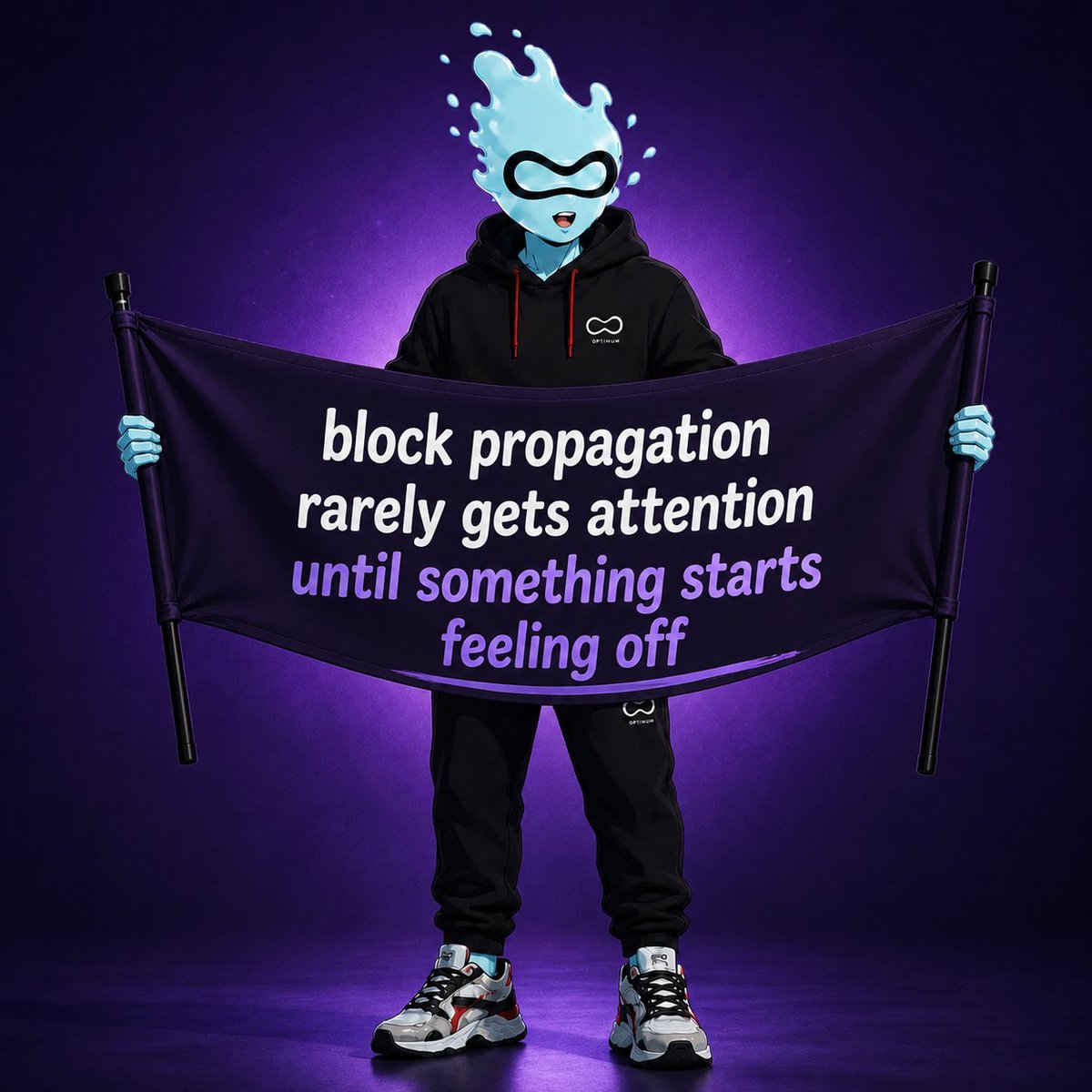
4
1
8
235
Muhammad retweeted
Jun 4
most people still look at Fermah through the wrong lens
they hear "proof generation"
and assume that's the whole story
but I think the more interesting idea is happening underneath @fermah_xyz
because blockchains have a habit of trying to do everything themselves
compute
verification
coordination
all in one place
and eventually that creates bottlenecks
the hidden insight is that scaling isn't always about adding more power
sometimes it's about dividing work more intelligently
that's where Fermah starts to make sense
instead of forcing chains to handle every proving task internally
the goal becomes:
⮕ find the right compute
⮕ route the workload
⮕ generate the proof
⮕ return a verifiable result
sounds simple
but that's a very different model from doing everything in-house
a useful way to think about it:
imagine one worker trying to handle every job in a company
eventually things slow down
mistakes happen
nothing scales
now imagine a network of specialists
◇ each handles a specific task
◇ workloads are distributed
◇ resources are used more efficiently
the system becomes much more flexible
and I think that's the bigger story here
Fermah isn't only about proving
it's about turning proving into a modular service layer that other systems can tap into
of course
modularity comes with its own challenges
coordination
reliability
adoption
none of that is automatic
but we've seen this pattern before in infrastructure
specialization often wins over trying to do everything in one place
the chains that scale best may not be the ones doing the most work
they may be the ones delegating work the smartest
@7wealthh @0xyuhuu96 @Sipra_ETH
Jun 2
people see the words "proof market"
and instantly tune out
which is funny
because the interesting part of @fermah_xyz isn't the buzzword
it's the architecture behind it
most crypto discussions focus on proving itself
faster proofs
cheaper proofs
more proofs
but proving is only half the equation
the other half is coordination
and that's where things get a lot more interesting
think about it
a blockchain doesn't just need proof generation
it also needs a way to:
◇ route work
◇ execute workflows
◇ verify outcomes
◇ keep everything moving reliably
that's why Fermah split the problem into different layers
⮕ Kernel handles execution
⮕ Froben handles the proof market
together they separate:
◇ logic from proving
◇ execution from coordination
◇ demand from compute
at first glance it sounds like extra complexity
but sometimes modularity is what makes scaling possible
same pattern we've seen in other infrastructure systems over the years
the hidden insight?
many people assume blockchains struggle because computation is expensive
in reality
coordination is often the bigger bottleneck
getting the right work to the right place at the right time is harder than most realize
obviously none of this magically solves every scaling problem
there are still challenges around latency, proving costs, and adoption
but the design direction makes sense
Fermah isn't just trying to generate proofs
it's trying to make proving and verification feel like infrastructure
@7wealthh @0xyuhuu96 @Sipra_ETH

4
1
13
461