
504 Photos and videos



liam retweeted

Jun 11
Looks like the options thing is happening already!
See also: various people thinking through and building different versions of the idea in the thread: ethresear.ch/t/building-inde…
Though I do strongly urge that if any of these get on mainnet quickly, we formally verify it first. I hope @vyperlang and/or github.com/lfglabs-dev/verit… folks ( @Fricoben) can help!
(Also, now is a good time to be thinking about robustness-optimized oracles)
firefly.social/post/x/206494…
445
247
1,607
250,916
liam retweeted

The punchline here is that @circle built its own L1 and still launches new products on Ethereum first.
Probably nothing.

cirBTC is live on @ethereum.
Circle helped establish the institutional standard for dollar collateral with USDC.
Now cirBTC brings that same approach to Bitcoin, bringing 1:1 BTC-backed collateral to institutional DeFi markets with neutrality, transparency, and Circle infrastructure.
Arc is next.
circle.com/blog/cirbtc-is-no…
2
15
194
10,990

Here’s a new summary page for our sequencing research!
Check it out now to see how different architectures compare and what you can expect in case of different kinds of censorship. Starting with @gnosis_, @aztecnetwork and @0xPolygon, you will find more projects there in the future.
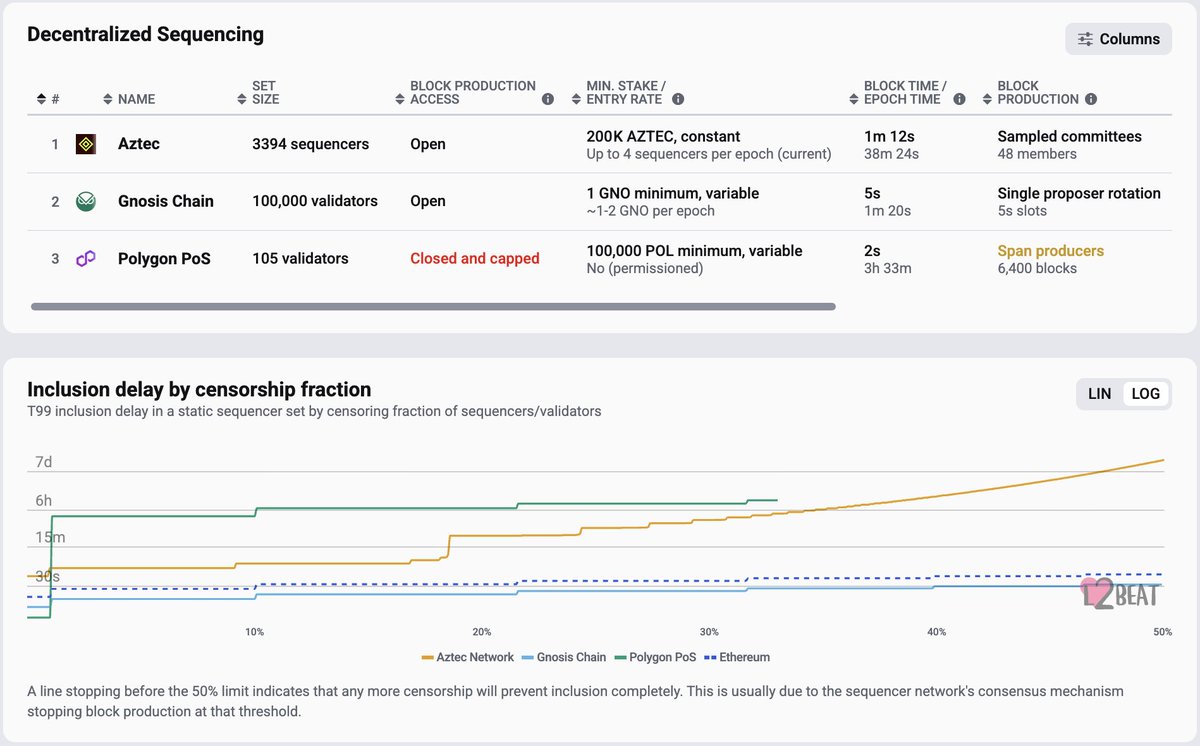

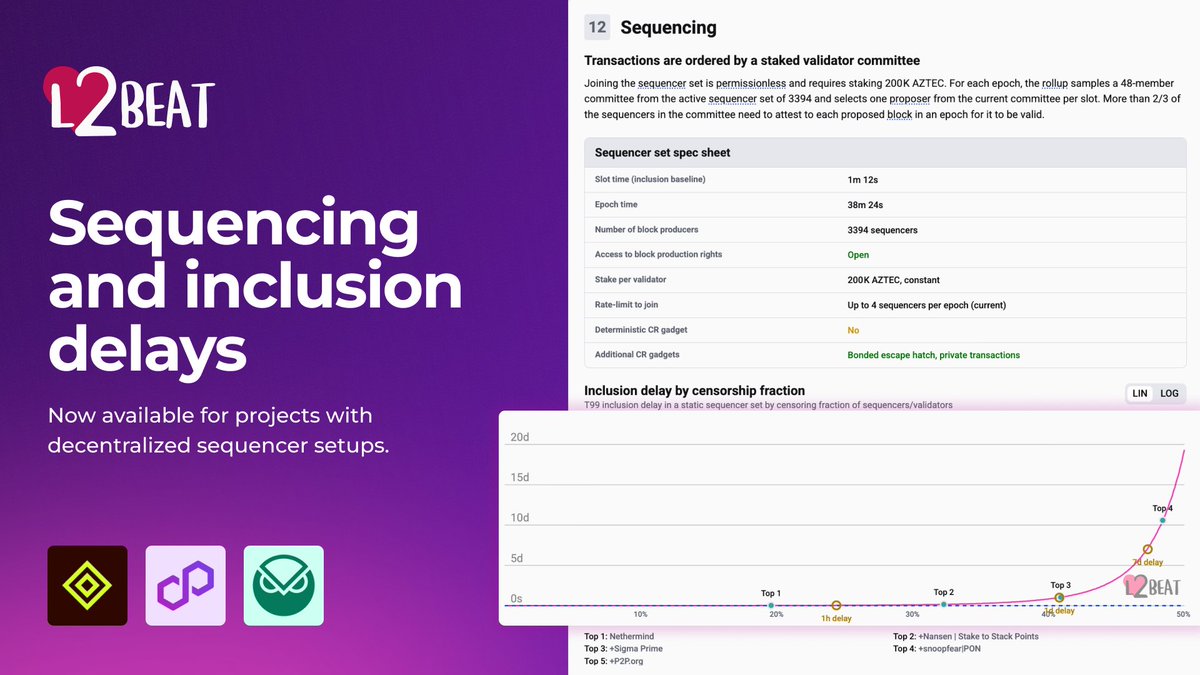
Why even decentralise the sequencer?
We just shipped some additions to the Sequencing sections of the projects that have decentralised sequencer setups to answer the question: if part of the sequencer set is censoring you, how long until your tx actually gets in?
Live for @gnosischain, @aztecnetwork & @0xPolygon. 🧵
3
3
42
3,639
liam retweeted

Jun 5
1/ ETH is the best positioned asset:
- To become self sovereign money
- To have a native, uncorrelated yield
- To be globally censorship resistant
- To have customizable privacy
- To be quantum resistant
- To stay decentralized
- To achieve the potential BTC was supposed to
37
82
655
20,443

liam retweeted

Jun 7
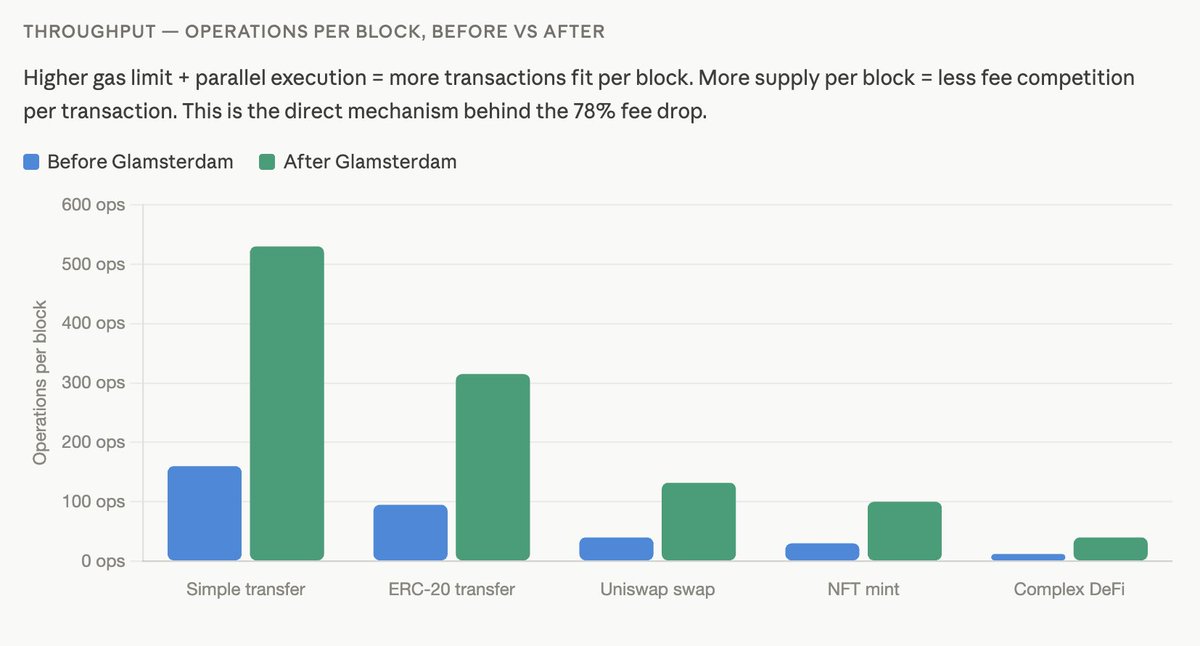
Ethereum gas fees could drop ~78% after Glamsterdam.
Every transaction on L1 today executes sequentially through a 60M gas limit. An ethereum:native swap, a USDC transfer, and an NFT mint queue one after another even when none of them touch the same contract.
A simple token transfer costs $0.0386 because of that.
Glamsterdam fixes it in three moves:
1. Block Access Lists require transactions to declare which state they touch upfront, so validators run non-conflicting transactions simultaneously.
2. The gas limit moves from 60M to a 200M floor because parallel execution makes that safe.
3. EIP-7976 cuts worst-case block size by 37% so home validators stay viable at the higher limit.
More transactions per block means less congestion per transaction.
A $0.0386 transfer could become roughly $0.0085.
Glamsterdam targets Q3 2026.
Jun 6

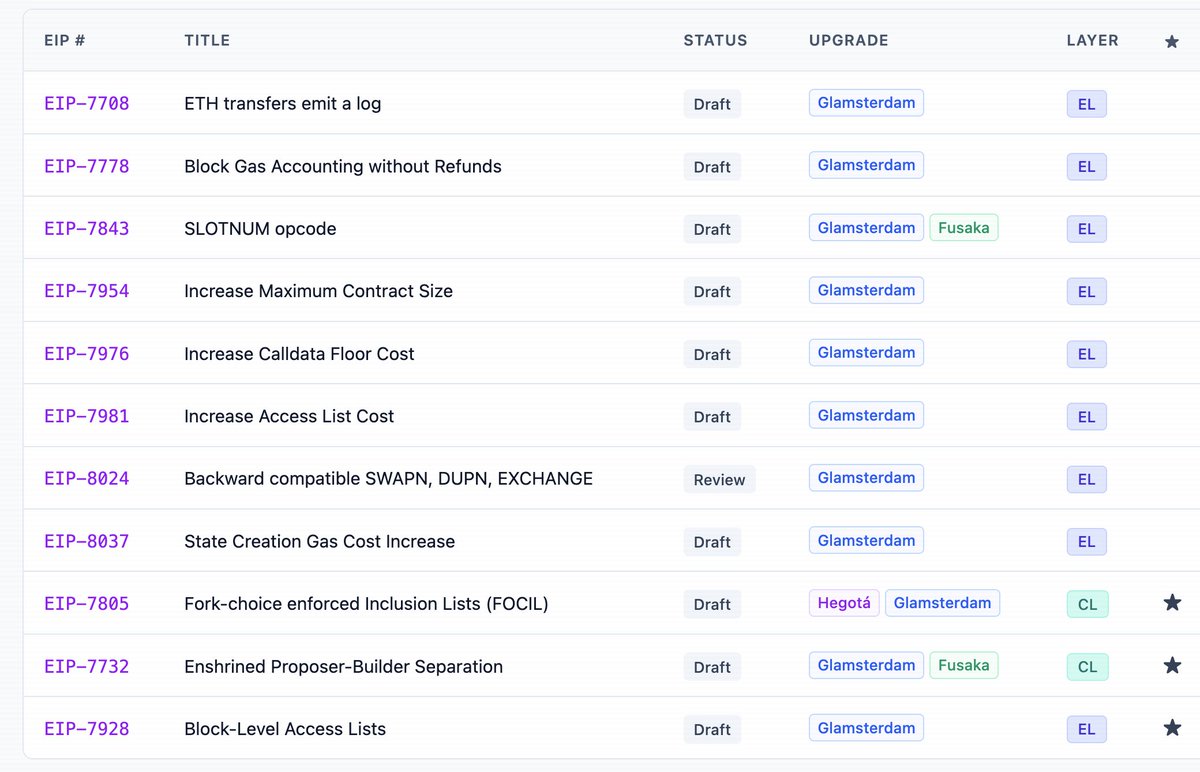
Glamsterdam has ten EIPs included(confirmed) that are shipping together, each fixing a different issue and touches every layer of @ethereum
> EIP-7732 ePBS: Block builders enter the protocol, validators stop depending on off-chain relays.
> EIP-7928 BALs: Transactions execute in parallel, blocks process significantly faster.
> EIP-7708: Every ETH transfer now emits a log, giving ETH the same trackability ERC-20 tokens have always had.
> EIP-7778: Gas refunds are removed, making block gas accounting predictable and consistent.
> EIP-7843: Smart contracts can read the current slot number natively.
> EIP-7954: Contracts can store more logic without hitting size limits.
> EIP-7976: Calldata floor cost increases to reduce worst-case block size.
> EIP-7981: Access list costs increase to reflect actual resource usage.
> EIP-8024: New stack opcodes resolve the stack too deep compiler issue in Solidity.
> EIP-8037 & EIP-8038: State creation and state access get repriced to slow chain growth.
Ten fixes. One fork.
12
27
228
14,189
liam retweeted

May 25
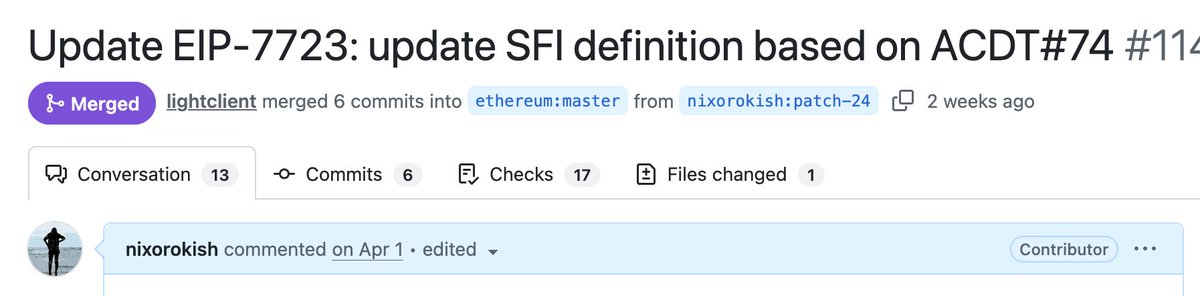
Easy-to-have-missed update to the @ethereum governance process: the "Scheduled" status has a new definition that makes it easier for you to plan for upcoming features
A thread 🧵 for
1. what changed
2. why it matters for the ecosystem
↴↴↴↴↴
5
14
85
7,088
liam retweeted
May 24
Some of my perspective on where the @ethereumfndn is going.
First of all, this is only my own view. The board is not just me, and I have no extra special powers on the board that the other board members do not. @aerugoettinea is the one executing much of this transition. My input has been largely on technical questions. The board is in the process of expanding, and my own power within the org will continue to decrease, which is honestly what I want.
The 2025 era brought many important improvements to EF and its ability to execute. Many issues were resolved, and EF continues to benefit from its improved efficiency and greater focus on concrete goals to this day. And so with those problems resolved, early this year, the largest remaining hole that I perceived was something different nagging at me: I would regularly spot people saying things like "vitalik says these beautiful things about ethereum needing to be decentralized, and have privacy, and be a sanctuary technology, but why do the EF's actions not reflect that?"
Now, you may have been hearing something different. You may not have been sensing a feeling of crisis at all, and maybe were hearing people saying that finally we were taking execution and BD seriously and the main task for us is to keep going that way and be even better and faster. Then probably there is genuine difference between you and me, in what kinds of criticism I take most seriously, and what kinds of critics through their criticism are most able to make me feel pain.
As an analogy, let's briefly switch over to a different domain.
One belief you can have about Google is that it is a success story, and has brought a lot of good to humanity in organizing the world's information. Another belief you can have about Google is that they had a beautiful idealistic beginning, but at some point the corruption of mainstream corporate attitudes seeped in, and they slowly bit by bit completely abandoned the "don't be evil" slogan.
My belief on Google specifically is probably somewhere between the two. BUT, if you had taken me back in time to ~2008, and offered me a button to press to make Google one or two standard deviations more "dogmatic", eg. give Richard Stallman permanent veto power over some key policies, I would immediately press it.
Why? Because a choice for one company is not a choice for the world, or even one country. Google existed and exists in the context of a technology industry generally drifting away from early idealistic don't-be-evil roots and toward greed for financial gain, totalizing visions of accelerated superintelligence, infiltration by sociopaths, and craven capitulation to (or worse, active participation in) government pressure for ideological control, surveillance and war. And so *one company* doing something different, positioning itself to be what George Bernard Shaw calls the Unreasonable Man, resisting the trend of the times, would have been better for freedom, balance of power and stability of society as a whole, than *all* large companies bending to dominant trends. This is a part of my version of pluralism.
This line of thinking is not just mine, but I also is not too far off from what Aya and others had in mind with the Mandate.
Now how does this all get to the role of the EF?
EF is not a "center of Ethereum", rather EF is "one node, with a defined purpose, alongside other nodes". We've always said that the EF should be the latter, but many in the Ethereum ecosystem (and even within the EF) wanted us to be the former. Now, we are taking action to ensure that we will be the latter.
This is particularly important because EF is a limited organization, with limited resources and limited organizational capacity. The EF has only ~0.16% of all ETH (less than many other individual ETH holders), whereas among other blockchains it's common for "the central foundation" to have 10-50%. Fiscally, the EF was originally designed to fulfill a limited work scope defined in the token sale docs and other pre-launch materials (building the chain software; getting through Frontier, Homestead, Metropolis, Serenity), which was fully completed in 2022; it was not designed to be an eternal steward.
And so today, the EF is choosing to use its remaining resources to pursue longevity over breadth (yes, this means we sell less ETH). The EF focuses *specifically* on those activities critical to the success of ethereum as a censorship/capture-resistant, open, private and secure system, that would not happen otherwise. This means making hard choices, and in some cases even activities that we highly approve of and people that we highly respect becoming outside of the EF. People of great technical talent, public respect and even alignment with the mission and CROPS being outside of the EF is in fact necessary if we want important tasks to be able to attract outside capital. This also means the EF taking opinionated stands culturally.
This is all intended in cooperation with all other parts of ethereum. We recognize that many other parts of the ethereum world highly respect CROPS and related values. But highly respecting is not the same as choosing to specialize and totally dedicate to a domain (Compare in a different domain: I think reducing animal cruelty is important, and I like vegan food, but am not full unconditional vegan myself)
EF is still in a transition period, and we expect its new long-term form to stabilize over the next few months. What are the guiding principles of this new form? Again, I am only one person, but I can give my answer from a technical perspective (there are also critical non-technical aspects).
At the core, *Ethereum must be impressive*. We are living in an age of highly intelligent AI and all kinds of other technological acceleration. "Status quo EVM, with a hard fork or two a year to optimize for short-term needs of users" is not interesting.
To some, "impressive" means: 250ms latency and 1M TPS. I think Ethereum trying to go that route is a mistake. Being as fast and as scalable as possible, and only a small epsilon more decentralized than the others, is a route to mediocrity, and if we try it we will lose.
I think Ethereum should scale. But I think Ethereum should strive the hardest to be deeply impressive in a different dimension: the CROPS dimension. This means things like:
* Provably bug-free Ethereum. This is a goal that all cybersecurity researchers would have thought is absurd and impossible, up until roughly 6 months ago. Now, it's on the cusp of being possible, thanks to AI-assisted formal verification. So we should be frontrunners in doing this.
* Available chain consensus. Ethereum is, and with lean consensus will cotninue to be, the ONLY chain that has both (i) traditional-BFT style properties that it's safe under asynchrony up to a high level of fault tolerance, and (ii) the bitcoin PoW-style property that under synchrony it's safe up to 49% attackers. As far as I can tell, literally no other chain has this or is planning for it; bitcoin goes for (ii) only and most other chains go for (i) only. Some will remember I fought hard for this, Unreasonably insisting that it is not OK for ethereum to rely on social consensus and hard forks to rescue ethereum from 34% of nodes going offline. It's OK for chains like hyperledger, bnb, solana, tempo, etc. It's not OK for bitcoin or ethereum or eg. zcash.
* Intermediary minimization. The fact that smart contract wallets, protocols like railgun, etc have to send transactions through intermediaries to get included onchain is honestly embarrassing, and it's a constant point of fragility. Hence the work on FOCIL and EIP-8141 (and 7701 and years of work before) to make transaction sending intermediary-minimized with public mempool and strong inclusion properties, in a truly general-purpose way, that covers not just eg. secp256r1, but also privacy protocols and much more. Kohaku is pushing intermediary minimization at the user layer, pulling Ethereum away from the dystopian status quo world where our wallets don't even verify the chain, send our private data out to a dozen third-party servers, and toward a brighter CROPS future.
Some of these goals are Unreasonable - maybe Ethereum would be "fine" getting only 50% of the way - what if we depend on intermediaries, but make it easy to switch? But going 50% of the way would not make Ethereum Deeply Impressive in the CROPS way. So we push for 100%.
Fortunately all these goals are compatible with high TPS, this is a major focus of research (esp. on scaling the state). Well-designed L2s can also help, especially L2s optimized for specific applications (eg. high-volume trading, privacy...). These goals are even compatible with significantly lower slot times, thanks to Raul's work on erasure-coded P2P, and many other optimizations.
The most high-value "product" of the ethereum blockchain, financially speaking, is ETH the asset. Ethereum secures $250 billion of ETH. The types of properties of Ethereum that I mentioned above are very good for ETH the asset. Nearly 90% of my net worth is in ETH, and most of the remainder is ~$40m of onchain fiat of which every dollar has already been allocated for some open-source biotech or software or hardware initiative. That said, there are aspects of supporting ETH the asset - *necessary* aspects even - that are outside the scope of the EF. This is where we need other heroes (some of whom hold more ETH than the EF does) to step in and help. EF has been recently thinking more about how it will relate to other such organizations, and give them needed initial support.
EF will be a smaller ship than in previous years, a more opinionated one - in some cases more opinionated in ways that might be difficult to comprehend - but a longer-lasting one, and one suited to making sure that ethereum brings something meaningful to the world. We are grateful to all those inside and outside the EF who are helping to make this happen.
1,614
1,599
7,884
4,095,855
liam retweeted

May 14
🏰 BuidlGuidl creates tooling and education to help developers build secure apps on Ethereum!
😬 But our funding is running out 🥶
⏱️ 18 hrs left to contribute quadratically:
🫡 Please support @buidlguidl in the dao security round from @Giveth at qf.giveth.io/project/buidlgu…
16
31
168
9,064
liam retweeted

May 14
The Ethereum Security QF round by @thedaofund is closing soon.
Direct funding toward the projects making Ethereum safer.
Explore the round with @jchaskin22 and @griffgreen.
x.com/i/broadcasts/1qKVmQABZ…
13
20
96
6,501

liam retweeted

May 14
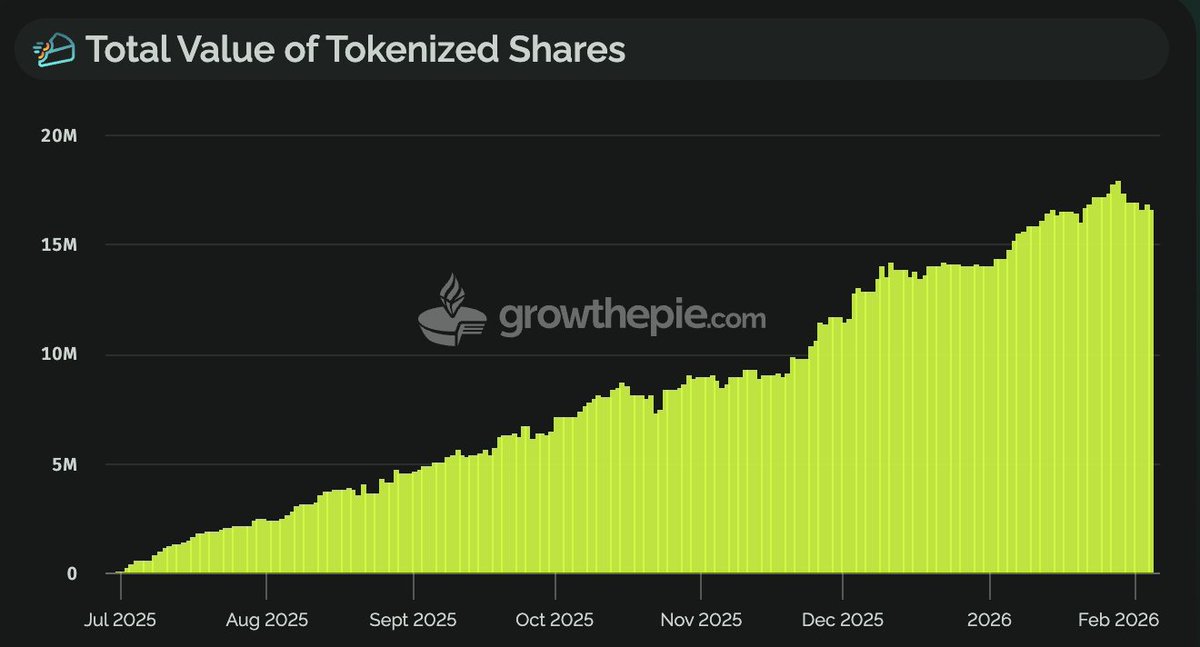
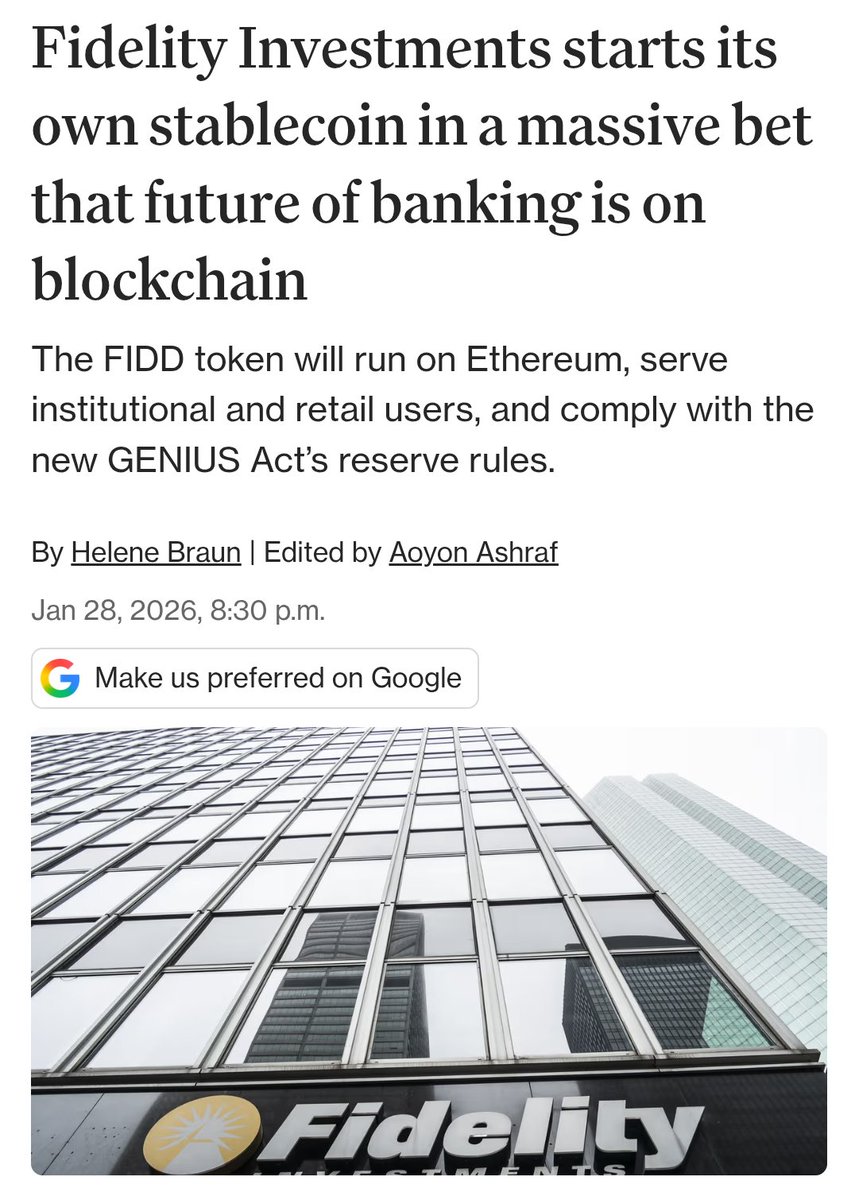
Fidelity International just launched FILQ — a tokenized money market fund issued as an ERC-20 on Ethereum.
It's an onchain version of their ~$7B institutional liquidity fund: same strategy, a Moody's AAA-mf rating, but with 24/7 subscription and redemption.
The biggest asset managers in the world are tokenizing cash, and settling it on Ethereum.
As BlackRock CEO Larry Fink put it, "We're not spending enough time talking about how quickly we're going to tokenize every financial asset."
May 13

BlackRock CEO Larry Fink: “We’re not spending enough time talking about how quickly we’re going to tokenize every financial asset”
“The biggest questions from central banks are: What is the role of tokenization and digitization? How quickly should they think about digitizing their own currency? What does that mean for the role of the dollar if every currency digitizes? What does that mean for bank payments? What does that mean for the payment companies like MasterCard and Visa? All of these are being questioned right now.”
“We spend so much talking about AI. We’re not spending enough time talking about how quickly we’re going to tokenize every financial asset… Moving ETFs and other things through a digital wallet — I think that’s going to happen worldwide very rapidly. I think most most countries are ill-prepared for that and under-appreciate how technology is changing… the plumbing of finance.”
BlackRock and JP Morgan both announced more tokenized funds on Ethereum this past week.
19
61
351
51,749
liam retweeted
May 12
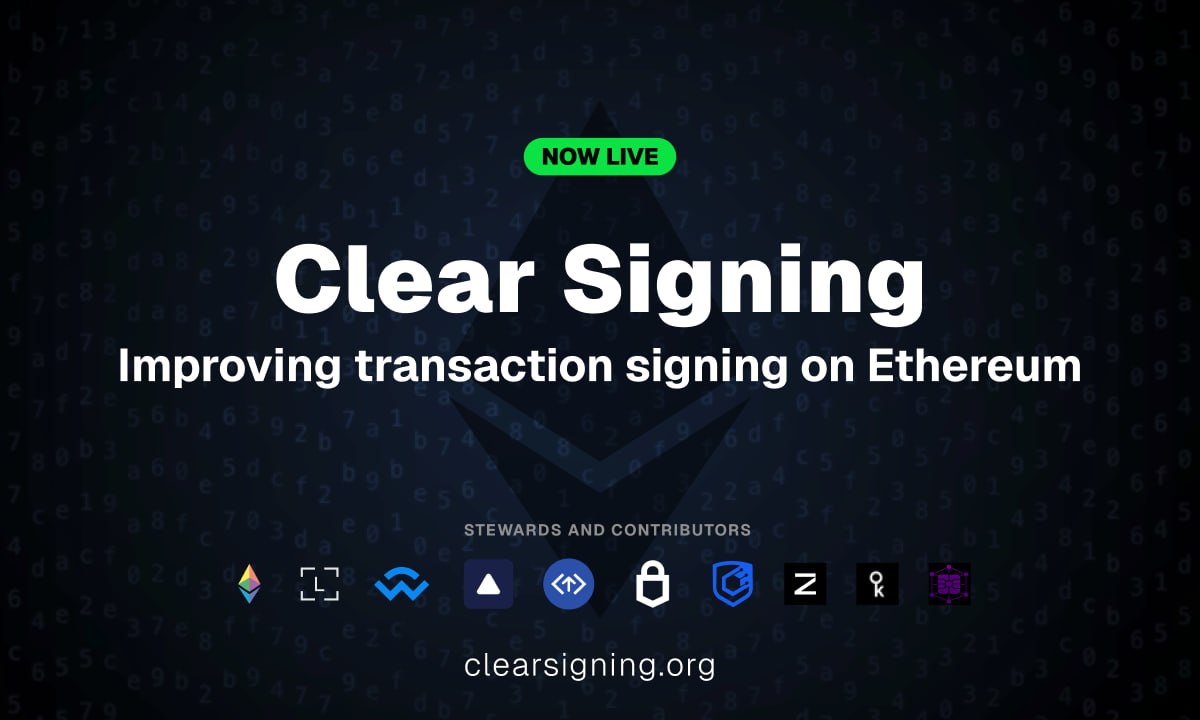
0/ Clear signing is now live.
An open standard to end blind signing, making human-readable transactions default.
This effort brings a major UX and Security upgrade to transaction signing on Ethereum.
160
443
2,179
323,739

May 13
RT @benjaminion_xyz: Upgrading Finality - Edition 1
Check out the plan for bringing fast finality to Ethereum.
Hosted on the the brand ne…
86
liam retweeted

This is a spiritual update to my 2018 Ethereum thesis.
Less philosophy, more pragmatics. Covers what GENIUS and CLARITY actually change, the supply-side reality, network reliability metrics, and the valuation reframing nobody is pricing yet.
Worth reading whether you've been here since 2017 or you're just now taking crypto seriously. 👇
medium.com/@adriano.feria/wh…
12
21
126
30,091
May 13
important not to forget that scaling ethereum L1 unlocks an unimaginable amount of scale at the L2 layer.
providing people/orgs with the best of both worlds (maximally decentralized L1 & customizable L2s) is how ethereum wins the long game.
May 7

Not from the EF, but Glamsterdam allows for an immediate increase by 400% of blob space without increasing bandwidth requirements. If anyone tells you this is not supporting L2s, they're just crazy
1
7
266
May 13
all roads lead to ethereum.
May 13

Ronin. Is. Home.
Migration to Ethereum complete ⚔
Five years ago, Ronin was a new Ethereum sidechain with a single game aboard: Axie Infinity.
Over the years, Ronin emerged as THE gaming chain, onboarding millions of players through more games like Pixels, Cambria, Angry Dynomites, and many others.
Today, we plugged our engine into the mothership: Ethereum.
Here’s what that means 🧵👇
1
129
liam retweeted
May 12
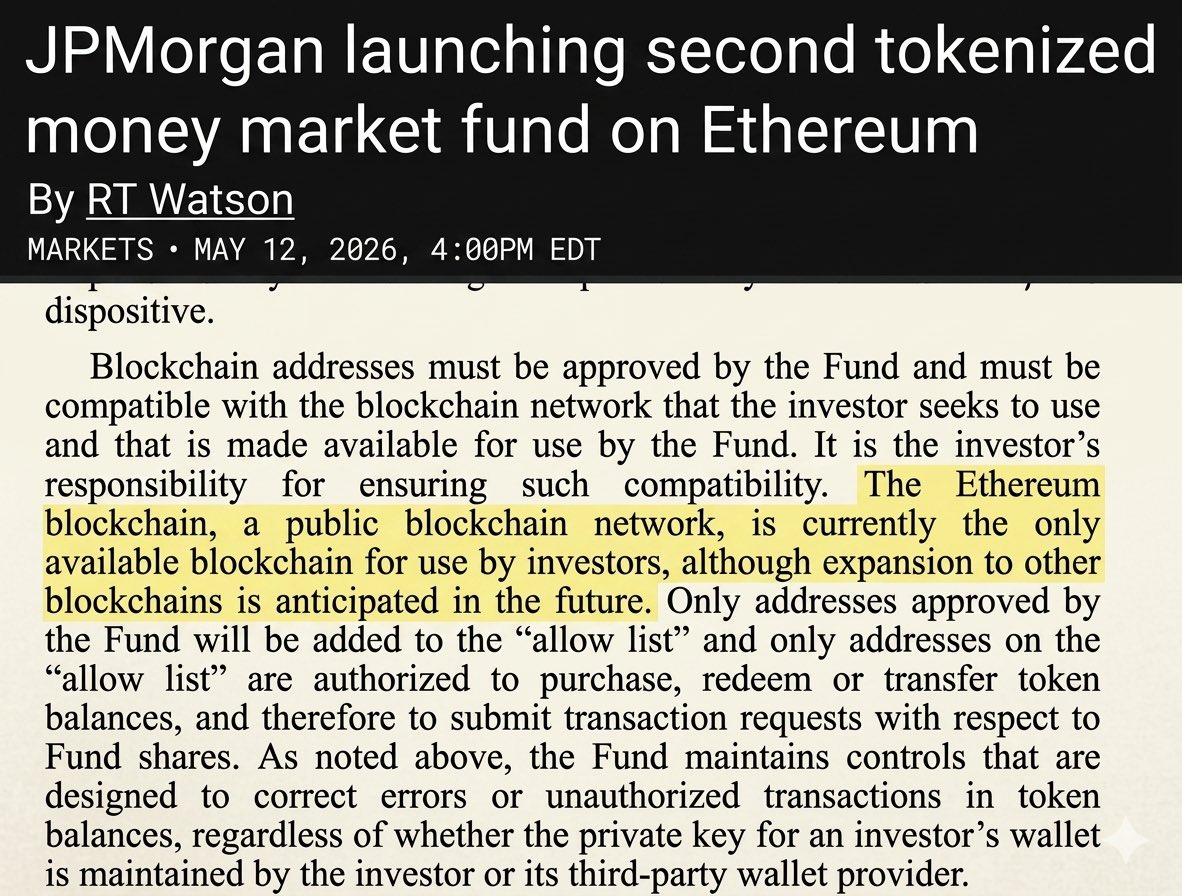
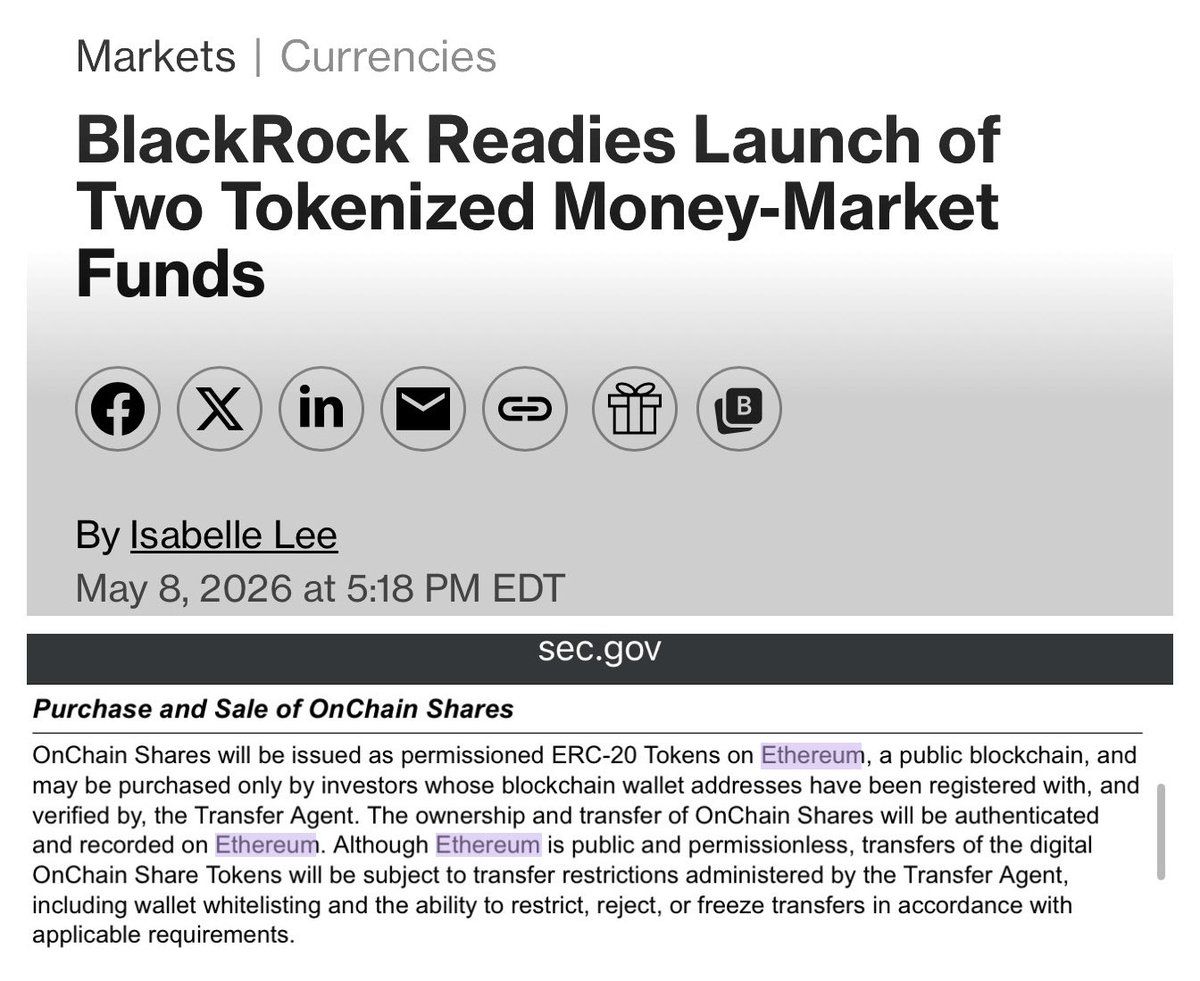
1/ Five months after MONY, JP Morgan is launching a second tokenized money market fund — on the biggest, most institutional public blockchain:
Ethereum.
May 9

1/ Two years after BUIDL, Blackrock launches two more tokenized funds — on the most biggest, most institutional public blockchain:
Ethereum.
25
93
596
169,707
liam retweeted

May 12
1/ We're thrilled to welcome @AztecFND as the latest project to take the 1% Pledge 🎉
1% of the AZTEC token supply has been deposited into Protocol Guild's 4-year vesting contract to support 187 Ethereum core contributors across client teams, research, and coordination
13
43
172
28,967
liam retweeted

May 11
Excited to announce this evolution of Protocol, the @ethereumfndn teams stewarding, researching and developing the Ethereum protocol.
After our re-launch of Protocol in June last year, @TimBeiko, @ralexstokes and I are now passing the torch to our talented colleagues @corcoranwill @kevaundray and @fredrik0x. They are taking on the task of delivering on Scaling, UX and Hardness objectives, with the protocol strawmap in their pocket (strawmap.org/).
---
It is also time to announce that I made the decision to leave the Ethereum Foundation, my home for the past 6.5 years ❤️
I am so grateful for this opportunity I had, to work with amazing individuals, on the most impactful project there is.
Looking back from when I started (here it is -> x.com/barnabemonnot/status/1…), it has been a wild ride from early EIP-1559 work, to the Merge, to MEV markets, to staking, finality, interoperability and UX; and from my beginnings in the Robust Incentives Group to co-leading Protocol for the past year.
Over this past year, our Protocol priorities, particularly our "Improve UX" work, shifted my attention to nearer-term questions. Throughout, I've been excited to take on a more product-centric view. Making Ethereum's unique features more available to users today is on my mind; so is participating in the plurality of ways that Ethereum gets built.
I'd love to hear from friends old and new about what excites them at the moment, and share where I'm at. Please reach out!
May 11

There's a new chapter starting for the Protocol cluster. We're welcoming new leads and coordinators, and continuing our work toward Glamsterdam, Hegotà, and the Strawmap.
More in the blog below 👇
89
32
543
118,943