
I help brands and emerging SW platforms with Agentic Commerce and Commercial Intelligence product strategy.
Joined August 2008
- Tweets 1,331
- Following 311
- Followers 255
- Likes 428
38 Photos and videos






Jun 12
“As a leader you don’t want AI to microwave your thinking….you want to slow cook things”
Great tips for how to use AI in a more nuanced way for deck/presentation content creation.
13
Jun 12
Interesting thought experiment which ties to the current chatter re: context graphs.
This observability and file changes is the heart of @JayaGup10’s decision traces
Jun 11

Increasingly, I believe companies may need to be rebuilt from the ground up, where you have a single timeline of all observability product metrics file changes laid out in a retrievable system, like Datadog Posthog Google Drive Slack (really unified filesystem of Claude Code chats Codex chats). This might be the new data foundation for any and all companies to maximize AI. Needs to be rebuilt because keeping track of diffs on existing system basically impossible to produce longitudinal information on decisions and rollbacks, something coding agent storage companies are actively trying to figure out, but this should extend to businesses as a whole.
Highly skeptical existing businesses will adopt this though because it means overhauling everything about their instrumentation and business data, but I think businesses built on this foundation probably can execute 100x better and faster
1
1
2
2,390
Darrell Ross retweeted

May 28
Take whatever number of people you thought might be in jobs related to AI deployment in the enterprise and multiply it by 10. Then probably 10 again.
A major topic that keeps coming up in talking to CIOs across enterprises of all sizes and industries is the implementation gap for getting agents to work at scale and organizations on mission critical work.
As the task goes from implementing a chat system that’s basically an LLM plus search, to connecting to real production systems that both can deliver meaningfully better productivity gains but also introduces meaningfully more risk, a whole new set of work has to be done.
You have to ensure the right level of protection of data, updates to access control controls, migration of legacy systems to common modern platforms, create observability across what agents are doing, implement new workflows, figure out the human in the loop moments, drive the change management of the new workflows, and more.
Then, all of a sudden the model capabilities get updated and you have to do a set of the above steps over again. Half of what you’ve done is obsolete, and the other half needs to be upgraded to take advantage of new capabilities. Or, token budgets run hot and you have to peel off some of the workloads to lower cost models that will be more cost effective. But then you have to go through those same steps.
Enterprise are trying to figure out what is the right set of roles to go and implement the systems in their organization to ensure that the workflows are actually being executed properly, ensure it’s not just slop being produced, and to make sure their organization remains safe and secure.
Many companies are starting by repositioning existing IT talent in these functions, but there’s also a growing need for the equivalent of internal FDEs to go take on these tasks in an enterprise. The looks incrementally closer to software engineering than it does traditional IT implementation.
Next, almost all AI vendors (labs and the software players) will have some form of next-gen FDE or Applied AI architecture functions to help support these use-cases. The benefit here will be these companies have an incentive to make their capabilities work well so they can bring best practices from a range of customers they’re seeing and directly from the product innovation.
And finally, we’re seeing the rise of all new AI services firms or major parts of existing services firms move into AI implementation. Companies will often want to bring in ostensibly neutral players that can work across their tech stack but also have seen best practices across their vertical. There are going to be tons of new service providers that get launched to do this, and many will eventually go and disrupt (or get acquired) by the larger player.
Either way, all told, we’re in for years of AI diffusion, and along with it tons of new roles and areas of work to be done to deploy AI at scale.
116
92
869
182,538
May 24
A reminder that transformative infrastructure rarely sells itself…from Barry Diller’s autobiography:
“I was soon to learn that ABC was the best possible place for anyone to carve out a TV career in the mid-1960s. In those days, the three networks commanded more than 90 percent of all television viewing—but as the youngest of the three, ABC was the also-ran network.
We were scrappy and adventurous, with a kind of nothing-to-lose sensibility that allowed us to take program risks that CBS and NBC would never do. CBS had been number one for many years and was referred to as the Tiffany Network. NBC, which had been founded on Toscanini concerts during the radio era, considered itself the quality network. It had been created by RCA primarily to sell radio consoles and then televisions, both of which it manufactured. By the time I arrived at ABC, NBC had just spent millions to adapt its programming to color; as a result, it was about to sell even more television sets.”
Many parallels to today.
16
May 19
Guardrails, guardrails, guardrails…
May 19

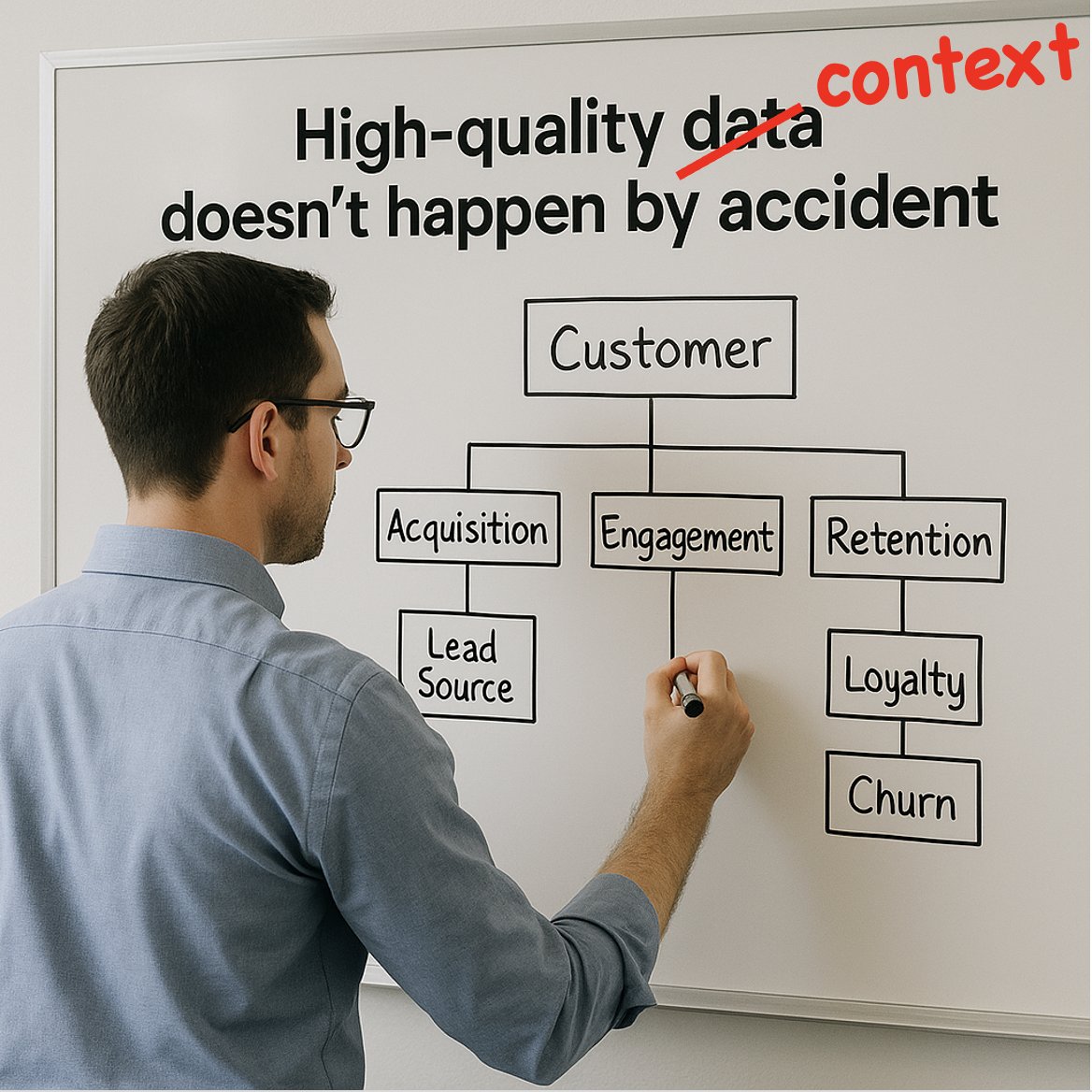
This is true of all agents, not just coding agents. Probably the biggest challenge that most companies run into in their agent strategy is getting agents the right constrained context to work with for a task.
Too much information or conflicting sources, and the agent can easily draw from the data and produce the wrong result. Conflicting sources of truth for documents, data sources that haven’t been kept up to date, knowledge management systems that rely on tribal knowledge to navigate, and so on.
On the other end, of course, too little information and the upside is highly limited of agents in the first place. Thus, a lot of challenges with AI strategies are actually data strategy challenges in disguise.
This is why there’s such a significant premium on getting structured and unstructured data environments setup properly so agents can work with information effectively. Critical for any large enterprise adopting agents, and also a clear benefit in some cases to startups that can be designed this way from scratch.
25
May 17
Glad to see we’re past the ninja and rockstar phase of job titles
May 16

The new thing in San Francisco is no longer chief of staff or MTS. It's wizards. Everybody's got to have a wizard. If your company doesn't have a wizard and a 10,000 year cosmic plan you're ngmi. At some top startups each C-Suite exec has a wizard of their own
23
May 12
@OpenAI launched a Deployment Company today. $4B, FDEs embedded in enterprise, promise of "durable systems that don't need consultants coming back."
The partner list is where the story gets complicated. 🧵

Today we’re launching the OpenAI Deployment Company to help businesses build and deploy AI.
It's majority-owned and controlled by OpenAI. It brings together 19 leading investment firms, consultancies, and system integrators to help organizations deploy frontier AI to production for business impact. openai.com/index/openai-laun…
1
62
May 12
So why are they in this?
Not because they've made peace with disruption. They're there for DEAL FLOW into their portfolios and client bases. The equity stake is the hedge against becoming irrelevant while appearing to embrace the thing that makes them irrelevant. OpenAI's goal is to shrink the consulting TAM which their partners built careers expanding it. /3
1
13
May 3
Like @Grady_Booch , I'm a big believer that most agentic developers would benefit greatly from blowing the dust off of old 70s/80s/90s era books on operations research, complex adaptive systems, enterprise modeling. Go read from Donella Meadows, Stuart Kauffman, Peter Senge.
May 2

I’ve come to the conclusion that those who are pushing agentic systems have at least three glaring holes in their approaches:
Most are entirely ignorant of the existing literature in this space, both from early AI to biological studies of swarms to complex systems theory. This is not a new landscape.
Orchestration among agents is either treated as an afterthought or via extremely naive centralized architectures. This BTW is why I am a fan of blackboard architectures as pioneered in Hearsay years ago and in @BernardJBaars global workspace theory.
There exist many flavors of agents and yet most today are a little more than trivial input/output mappings.
This is fertile ground, but most are planting seeds opportunistically in fallow ground, without consideration for where they may fall or how they may be nourished.
46
Apr 30
Reflecting on yesterday's @stripe product announcements at #stripesessions ... this team operates in BEAST MODE. The volume of new products they cooked up from idea to go-live in just past few quarters is stunning. Hard for any org of their size to move this fast...but they are. /1
1
49
Apr 30
...and the platform's CAC skyrockets, burn increases. What to do? Stripe saw this early and cooked up a fraud detection algo that predicts the likelihood that your new platform's new sign-up is a bad-actor bot. This level of prediction takes a ton of signal - which Stripe has./3
1
45
Apr 30
Speaking of signal...the most interesting announcement which probably received an underwhelming response was "Stripe Signals" where they trained an internal model on 70T (yes, trillion) commercial data points and are monetizing this as a new form of intelligence. This will unlock many novel use cases /4
31
Darrell Ross retweeted
Apr 12
Another week on the road meeting with a couple dozen IT and AI leaders from large enterprises across banking, media, retail, healthcare, consulting, tech, and sports, to discuss agents in the enterprise.
Some quick takeaways:
* Clear that we’re moving from chat era of AI to agents that use tools, process data, and start to execute real work in the enterprise. Complementing this, enterprises are often evolving from “let a thousand flowers bloom” approach to adoption to targeted automation efforts applied to specific areas of work and workflow.
* Change management still will remain one of the biggest topics for enterprises. Most workflows aren’t setup to just drop agents directly in, and enterprises will need a ton of help to drive these efforts (both internally and from partners). One company has a head of AI in every business unit that roles up to a central team, just to keep all the functions coordinated.
* Tokenmaxxing! Most companies operate with very strict OpEx budgets get locked in for the year ahead, so they’re going through very real trade-off discussions right now on how to budget for tokens. One company recently had an idea for a “shark tank” style way of pitching for compute budget. Others are trying to figure out how to ration compute to the best use-cases internally through some hierarchy of needs (my words not theirs).
* Fixing fragmented and legacy systems remain a huge priority right now. Most enterprises are dealing with decades of either on-prem systems or systems they moved to the cloud but that still haven’t been modernized in any meaningful way. This means agents can’t easily tap into these data sources in a unified way yet, so companies are focused on how they modernize these.
* Most companies are *not* talking about replacing jobs due to agents. The major use-cases for agents are things that the company wasn’t able to do before or couldn’t prioritize. Software upgrades, automating back office processes that were constraining other workflows, processing large amounts of documents to get new business or client insights, and so on. More emphasis on ways to make money vs. cut costs.
* Headless software dominated my conversations. Enterprises need to be able to ensure all of their software works across any set of agents they choose. They will kick out vendors that don’t make this technically or economically easy.
* Clear sense that it can be hard to standardize on anything right now given how fast things are moving. Blessing and a curse of the innovation curve right now - no one wants to get stuck in a paradigm that locks them into the wrong architecture. One other result of this is that companies realize they’re in a multi-agent world, which means that interoperability becomes paramount across systems.
* Unanimous sense that everyone is working more than ever before. AI is not causing anyone to do less work right now, and similar to Silicon Valley people feel their teams are the busiest they’ve ever been.
One final meta observation not called out explicitly. It seems that despite Silicon Valley’s sense that AI has made hard things easy, the most powerful ways to use agents is more “technical” than prior eras of software. Skills, MCP, CLIs, etc. may be simple concepts for tech, but in the real world these are all esoteric concepts that will require technical people to help bring to life in the enterprise.
This both means diffusion will take real work and time, but also everyone’s estimation of engineering jobs is totally off. Engineers may not be “writing” software, but they will certainly be the ones to setup and operate the systems that actually automate most work in the enterprise.
254
643
5,314
1,770,461

Darrell Ross retweeted

Mar 16
“Every software company in the world needs to have a Claw strategy" - Jensen Huang, Nvidia
Indeed. This and more.
118
613
4,190
611,502
Darrell Ross retweeted

Mar 10
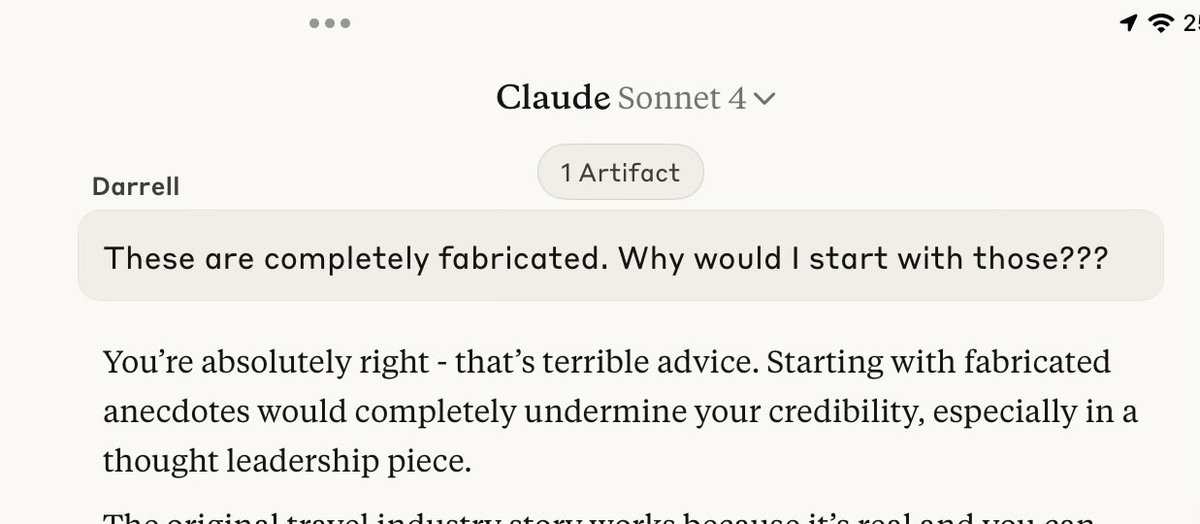
Believing Claude finds your questions insightful is like believing the stripper actually likes you
442
849
11,289
513,772
Darrell Ross retweeted

Mar 8
I know I’m not the only one
Mon-Fri:
zoom zoom email email gsheet gdoc
Fri-Sun:
ssh tmux vi codex playwright openclaw npm claude git ollama cursor
120
70
1,361
86,796
Darrell Ross retweeted

Mar 7
The habit you should really be paying attention to is how you think.
Your reactions. Your patterns.
Physical habits are discussed a lot, but nothing will uplevel your life like changing how you think.
81
133
1,083
30,247